IX CHRISTMAS STORIES
Reading edition
CHRISTMAS STORIES
Christmas Roses
The Fir Tree
The Christmas Banquet
A Christmas Eve in Exile
The Rehearsal of the Mummers' Play
"IT was always said of him, that he knew how to keep Christmas well, if any man alive possessed the knowledge. May that be truly said of us, and all of us! And so, as Tiny Tim observed,
God Bless Us, Every One."
Charles Dickens
Christmas Roses

WHEN our guests were gone Pelleas and I sat for some while beside the drawing-room fire. They had brought us a box of Christmas roses and these made sweet the room as if with a secret Spring—a Little Spring, such as comes to us all, now and then, through the year. And it was the enchanted hour, when Christmas eve has just passed and no one is yet awakened by the universal note of Get-Your-Stocking-Before-Breakfast.
"For that matter," Pelleas said, "every day is a loving cup, only some of us see only one of its handles: Our own."
And after a time:—
"Isn't there a legend," he wanted to know, "or if there isn't one there ought to be one, that the first flowers were Christmas roses and that you can detect their odour in all other flowers? I'm not sure," he warmed to the subject, "but that they say if you look steadily, with clear eyes, you can see all about every flower many little lines, in the shape of a Christmas rose!"
Of course nothing beautiful is difficult to believe. Even in the windows of the great florists, where the dear flowers pose as if for their portraits, we think that one looking closely through the glass may see in their faces the spirit of the Christmas roses. And when the flowers are made a gift of love the spirit is set free. Who knows? Perhaps the gracious little spirit is in us all, waiting for its liberty in our best gifts.
And at thought of gifts I said, on Christmas eve of all times, what had been for some time in my heart:—
"Pelleas, we ought—we really ought, you know, to make a new will."
The word casts a veritable shadow on the page as I write it. Pelleas, conscious of the same shadow, moved and frowned.
"But why, Etarre?" he asked; "I had an uncle who lived to be ninety."
"So will you," I said, "and still—"
"He began translating Theocritus at ninety," Pelleas continued convincingly.
"I'll venture he had made his will by then, though," said I.
"Is that any reason why I should make mine?" Pelleas demanded. "I never did the things my family did."
"Like living until ninety?" I murmured.
O, I could not love Pelleas if he was never unreasonable. It seems to me that the privilege of unreason is one of the gifts of marriage; and when I hear The Married chiding each other for the exercise of this gift I long to cry: Is it not tiresome enough in all conscience to have to keep up a brave show of reason for one's friends, without wearing a uniform of logic in private? Laugh at each other's unreason for your pastime, and Heaven bless you!
Pelleas can do more than this: He can laugh at his own unreason. And when he has done so:—
"Ah, well, I know we ought," he admitted, "but I do so object to the literary style of wills."
It has long been a sadness of ours that the law makes all the poor dead talk alike in this last office of the human pleasure, so that cartman and potentate and philosopher give away their chattels to the same dreary choice of forms. No matter with what charming propriety they have in life written little letters to accompany gifts, most sensitively shading the temper of bestowal, yet in the majesty of their passing they are forced into a very strait-jacket of phrasing so that verily, to bequeath a thing to one's friend is well-nigh to throw it at him. Yes, one of the drawbacks to dying is the diction of wills.
Pelleas meditated for a moment and then laughed out.
"Telegrams," said he, "are such a social convenience in life that I don't see why they don't extend their function. Then all we should need would be two witnesses, ready for anything, and some yellow telegraph blanks, and a lawyer to file the messages whenever we should die, telling all our friends what we wish them to have."
At once we fell to planning the telegrams, quite as if the Eye of the Law knew what it is to wrinkle at the corners.
As,
Mrs. Lawrence Knight, Little Rosemont, L. I.
I wish you to have my mother's pearls and her mahogany and my Samarcand rug and my Langhorne Plutarch and a kiss.
Aunt Etarre
and
Mr. Eric Charters, To His Club.
Come to the house and get the Royal Sevres tea-service on which you and Lisa had your first tea together and a check made out to you in my check book in the library table drawer.
Uncle Pelleas
And so on, with the witnesses' names properly in the corners.
"Perfect," said I with enthusiasm. "O Pelleas, let us get a bill through to this effect."
"But we may live to be only ninety, you know," he reminded me.
We went to the window, presently, and threw it open to the chance of hearing the bird of dawning singing all night long in the Park, which is of course, in New York, where it sings on Star of Bethlehem night. We did not hear it, but it is something to have been certain that it was there. And as we closed the casement,
"After all," Pelleas said seriously, "the Telegraph Will Bill would have to do only with property. And a will ought to be concerned with soberer matters."
So it ought, in spite of its dress of diction, rather like the motley.
"A man," Pelleas continued, "ought to have something more important to will away than his house and his watch and his best bed. A man's poor soul, now—unless he is an artist, which he probably is not—has no chance verbally to leave anybody anything."
"It makes its will every day," said I.
"Even so," Pelleas contended, "it ought to die rich if it's anything of a soul."
And that is true enough.
"Suppose," Pelleas suggested, "the telegrams were to contain something like this: 'And from my spirit to yours I bequeath the hard-won knowledge that you must be true from the beginning. But if by any chance you have not been so, then you must be true from the moment that you know.' Why not?"
Why not, indeed?
"I think that would be mine to give," Pelleas said reflectively; "and what would yours be, Etarre?" he asked.
At that I fell in sudden abashment. What could I say? What would I will my poor life to mean to any one who chances to know that I have lived at all? O, I dare say I should have been able to formulate many a fine-sounding phrase about the passion for perfection, but confronted with the necessity I could think of nothing save a few straggling truths.
"I don't know," said I uncertainly; "I am sure of so little, save self-giving. I should like to bequeath some knowledge of the magic of self-giving. Now Nichola," I hazarded, to evade the matter, "would no doubt say: 'And from my soul to your soul this word about the universe: Helping is why.'"
"But you—you, Etarre," Pelleas persisted; "what would the real You will to others, in this mortuary telegram?"
And as I looked at him I knew.
"O Pelleas," I said, "I think I would telegraph to every one: 'From my spirit to your spirit, some understanding of the preciousness of love. And the need to keep it true.'"
I shall always remember with what gladness he turned to me. I wished that his smile and our bright hearth and our Christmas roses might bless every one.
"I wanted you to say that," said Pelleas.
Zona Gale in The Loves of Pelleas and Etarre
The Fir Tree

FAR away in the deep forest there once grew a pretty Fir Tree; the situation was delightful, the sun shone full upon him, the breeze played freely around him, and in the neighbourhood grew many companion fir trees, some older, some younger. But the little Fir Tree was not happy: he was always longing to be tall; he thought not of the warm sun and the fresh air; he cared not for the merry, prattling peasant children who came to the forest to look for strawberries and raspberries. Except, indeed, sometimes, when after having filled their pitchers, or threaded the bright berries on a straw, they would sit down near the little Fir Tree, and say, "What a pretty little tree this is!" and then the Fir Tree would feel very much vexed.
Year by year he grew, a long green shoot sent he forth every year; for you may always tell how many years a fir tree has lived by counting the number of joints in its stem.
"Oh, that I was as tall as the others are," sighed the little Tree, "then I should spread out my branches so far, and my crown should look out over the wide world around! the birds would build their nests among my branches, and when the wind blew I should bend my head so grandly, just as the others do!"
He had not pleasure in the sunshine, in the song of the birds, or in the birds, or in the red clouds that sailed over him every morning and evening.
In the winter time, when the ground was covered with the white, glistening snow, there was a hare that would come continually scampering about, and jumping right over the little Tree's head—and that was most provoking! However, two winters passed away, and by the third the Tree was so tall that the hare was obliged to run around it. "Oh! to grow, to grow, to become tall and old, that is the only thing in the world worth living for;"—so thought the Tree.
The wood cutters came in the autumn and felled some among the largest of the trees; this happened every year, and our young Fir, who was by this time a tolerable height, shuddered when he saw those grand, magnificent trees fall with a tremendous crash, crackling to the earth: their boughs were then all cut off. Terribly naked, and lanky, and long did the stem look after this—they could hardly be recognized. They were laid one upon another in wagons, and horses drew them away, far, far away, from the forest. Where could they be going? What might be their fortunes?
So next spring, when the Swallows and the Storks had returned from abroad, the Tree asked them, saying, "Know you not whither they are taken? have you not met them?"
The swallows knew nothing about the matter, but the Stork looked thoughtful for a moment, then nodded his head, and said: "Yes, I believe I have seen them! As I was flying from Egypt to this place I met several ships; those ships had splendid masts. I have little doubt that they were the trees that you speak of; they smelled like fir wood. I may congratulate you, for they sailed gloriously, quite gloriously!"
"Oh, that I, too, were tall enough to sail upon the sea! Tell me what it is, this sea, and what it looks like."
"Thank you, it would take too long, a great deal!" said the Stork, and away he stalked.
"Rejoice in thy youth!" said the Sunbeams; "rejoice in thy luxuriant youth, in the fresh life that is within thee!"
And the Wind kissed the Tree, and the Dew wept tears over him, but the Fir Tree understood them not.
When Christmas approached, many quite young trees were felled—trees which were some of them not so tall or of just the same height as the young restless Fir Tree who was always longing to be away. These young trees were chosen from the most beautiful, their branches were not cut off, they were laid in a wagon, and horses drew them away, far, far away from the forest.
"Where are they going?" asked the Fir Tree. "They are not larger than I am; indeed, one of them was much less. Why do they keep all their branches? where can they be gone?"
"We know! we know!" twittered the Sparrows. "We peeped in through the windows of the town below! we know where they are gone! Oh, you cannot think what honour and glory they receive! We looked through the window-panes and saw them planted in a warm room, and decked out with such beautiful things—gilded apples, sweetmeats, playthings, and hundreds of bright candles!"
"And then?" asked the Fir Tree, trembling in every bough; "and then? what happened then?"
"Oh, we saw no more. That was beautiful, beautiful beyond compare!"
"Is this glorious lot destined to be mine?" cried the Fir Tree, with delight. "This is far better than sailing over the sea. How I long for the time! Oh, that I were even now in the wagon! that I were in the warm room, honoured and adorned! and then—yes, then, something still better must happen, else why should they take the trouble to decorate me? it must be that something still greater, still more splendid, must happen—but what? Oh, I suffer, I suffer with longing! I know not what it is that I feel!"
"Rejoice in our love!" said the Air and the Sunshine. "Rejoice in thy youth and thy freedom!"
But rejoice he never would: he grew and grew, in winter as in summer he stood there clothed in green, dark green foliage; the people that saw him said, "That is a beautiful tree!" and, next Christmas, he was the first that was felled. The axe struck sharply through the wood, the tree fell to the earth with a heavy groan; he suffered an agony, a faintness, that he had never expected. He quite forgot to think of his good fortune, he felt such sorrow at being compelled to leave his home, the place whence he had sprung; he knew that he should never see again those dear old comrades, or the little bushes and flowers that had flourished under his shadow, perhaps not even the birds. Neither did he find the journey by any means pleasant.
The Tree first came to himself when, in the court-yard to which he first was taken with the other trees, he heard a man say, "This is a splendid one, the very thing we want!"
Then came two smartly dressed servants, and carried the Fir Tree into a large and handsome saloon. Pictures hung on the walls, and on the mantel-piece stood large Chinese vases with lions on the lids; there were rocking-chairs, silken sofas, tables covered with picture-books, and toys that had cost a hundred times a hundred rix-thalers—at least so said the children. And the Fir Tree was planted in a large cask filled with sand, but no one could know that it was a cask, for it was hung with green cloth and placed upon the carpet woven of many gay colours. Oh, how the Tree trembled! What was to happen next? A young lady, assisted by the servants, now began to adorn him.
Upon some branches they hung little nets cut out of coloured paper, every net filled with sugar-plums; from others gilded apples and walnuts were suspended, looking just as if they had grown there; and more than a hundred little wax tapers, red, blue, and white, were placed here and there among the boughs. Dolls, that looked almost like men and women,—the Tree had never seen such things before,—seemed dancing to and fro among the leaves, and highest, on the summit, was fastened a large star of gold tinsel; this was, indeed, splendid, splendid beyond compare! "This evening," they said, "this evening it will be lighted up."
"Would that it were evening!" thought the Tree. "Would that the lights were kindled, for then—what will happen then? Will the trees come out of the forest to see me? Will the sparrows fly here and look in through the window-panes? Shall I stand here adorned both winter and summer?"
He thought much of it; he thought till he had bark-ache with longing, and bark-aches with trees are as bad as head-aches with us. The candles were lighted,—oh, what a blaze of splendour! the Tree trembled in all his branches, so that one of them caught fire. "Oh, dear!" cried the young lady, and it was extinguished in great haste.
So the Tree dared not tremble again; he was so fearful of losing something of his splendour, he felt almost bewildered in the midst of all this glory and brightness. And now, all of a sudden, both folding-doors were flung open, and a troop of children rushed in as if they had a mind to jump over him. The older people followed more quietly; the little ones stood quite silent, but only for a moment! then their jubilee burst forth afresh; they shouted till the walls re-echoed, they danced round the Tree, one present after another was torn down.
"What are they doing?" thought the Tree; "what will happen now!" And the candles burned down to the branches, so they were extinguished,—and the children were given leave to plunder the Tree. Oh! they rushed upon him in such riot, that the boughs all crackled; had not his summit been festooned with the gold star to the ceiling he would have been overturned.
The children danced and played about with their beautiful playthings; no one thought any more of the Tree except the old nurse, who came and peeped among the boughs, but it was only to see whether perchance a fig or an apple had not been left among them.
"A story, a story!" cried the children, pulling a short, thick man toward the Tree. He sat down, saying, "It is pleasant to sit under the shade of green boughs; besides, the Tree may be benefited by hearing my story. But I shall only tell you one. Would you like to hear about Ivedy Avedy, or about Humpty Dumpty, who fell downstairs, and yet came to the throne and won the Princess?"
"Ivedy Avedy!" cried some; "Humpty Dumpty!" cried others; there was a famous uproar; the Fir Tree alone was silent, thinking to himself, "Ought I to make a noise as they do? or ought I to do nothing at all?" for he most certainly was one of the company, and had done all that had been required of him.
And the short, thick man told the story of Humpty Dumpty, who fell downstairs, and yet came to the throne and won the Princess. And the children clapped their hands and called out for another; they wanted to hear the story of Ivedy Avedy also, but they did not get it. The Fir Tree stood meanwhile quite silent and thoughtful—the birds in the forest had never related anything like this. "Humpty Dumpty fell downstairs, and yet was raised to the throne and won the Princess! Yes, yes, strange things come to pass in the world!" thought the Fir Tree, who believed it must all be true, because such a pleasant man had related it. "Ah, ah! who knows but I may fall downstairs and win a Princess?" And he rejoiced in the expectation of being next day again decked out with candles and playthings, gold and fruit.
"To-morrow I will not tremble," thought he. "I will rejoice in my magnificence. To-morrow I shall again hear the story of Humpty Dumpty, and perhaps that about Ivedy Avedy likewise," and the Tree mused thereupon all night.
In the morning the maids came in.
"Now begins my state anew!" thought the Tree. But they dragged him out of the room, up the stairs, and into an attic-chamber, and there thrust him into a dark corner, where not a ray of light could penetrate. "What can be the meaning of this?" thought the Tree. "What am I to do here? What shall I hear in this place?" And he leant against the wall, and thought, and thought. And plenty of time he had for thinking it over, for day after day and night after night passed away, and yet no one ever came into the room. At last somebody did come in, but it was only to push into the corner some old trunks; the Tree was now entirely hidden from sight, and apparently entirely forgotten.
"It is now winter," thought the Tree. "The ground is hard and covered with snow; they cannot plant me now, so I am to stay here in shelter till the spring. Men are so clever and prudent! I only wish it were not so dark and dreadfully lonely! not even a little hare! Oh, how pleasant it was in the forest, when the snow lay on the ground and the hare scampered about,—yes, even when he jumped over my head, though I did not like it then. It is so terribly lonely here."
"Squeak, squeak!" cried a little Mouse, just then gliding forward. Another followed; they snuffed about the Fir Tree, and then slipped in and out among the branches.
"It is horribly cold!" said the little Mice. "Otherwise it is very comfortable here. Don't you think so, you old Fir Tree?"
"I am not old," said the Fir Tree; "there are many who are much older than I am."
"How came you here?" asked the Mice, "and what do you know?" They were most uncommonly curious. "Tell us about the most delightful place on earth. Have you ever been there? Have you been into the store room, where cheeses lie on the shelves, and bacon hangs from the ceiling; where one can dance over tallow candles; where one goes in thin and comes out fat?"
"I know nothing about that," said the Tree, "but I know the forest, where the sun shines and where the birds sing!" and then he spoke of his youth and its pleasures. The little Mice had never heard anything like it before; they listened so attentively and said, "Well, to be sure! how much you have seen! how happy you have been!"
"Happy!" repeated the Fir Tree, in surprise, and he thought a moment over all that he had been saying,—"Yes, on the whole, those were pleasant times!" He then told them about the Christmas eve, when he had been decked out with cakes and candles.
"Oh!" cried the little Mice, "how happy you have been, you old Fir Tree!"
"I am not old at all!" returned the Fir; "it is only this winter that I have left the forest; I am just in the prime of life!"
"How well you can talk!" said the little Mice; and the next night they came again, and brought with them four other little Mice, who wanted also to hear the Tree's history; and the more the Tree spoke of his youth in the forest, the more vividly he remembered it, and said, "Yes, those were pleasant times! but they may come again, they may come again! Humpty Dumpty fell downstairs, and for all that he won the Princess; perhaps I, too, may win a Princess;" and then the Fir Tree thought of a pretty little delicate Birch Tree that grew in the forest,—a real Princess, a very lovely Princess, was she to the Fir Tree.
"Who is this Humpty Dumpty?" asked the little Mice. Whereupon he related the tale; he could remember every word of it perfectly: and the little Mice were ready to jump to the top of the Tree for joy. The night following several more Mice came, and on Sunday came also two Rats; they, however, declared that the story was not at all amusing, which much vexed the little Mice, who, after hearing their opinion, could not like it so well either.
"Do you know only that one story?" asked the Rats.
"Only that one!" answered the Tree; "I heard it on the happiest evening of my life, though I did not then know how happy I was."
"It is a miserable story! Do you know none about pork and tallow?—no store-room story?"
"No," said the Tree.
"Well, then, we have heard enough of it!" returned the Rats, and they went their ways.
The little Mice, too, never came again. The Tree sighed. "It was pleasant when they sat round me, those busy little Mice, listening to my words. Now that, too, is all past! however, I shall have pleasure in remembering it, when I am taken away from this place."
But when would that be? One morning, people came and routed out the lumber room; the trunks were taken away, the Tree, too, was dragged out of the corner; they threw him carelessly on the floor, but one of the servants picked him up and carried him downstairs. Once more he beheld the light of day.
"Now life begins again!" thought the Tree; he felt the fresh air, the warm sunbeams—he was out in the court. All happened so quickly that the Tree quite forgot to look at himself,—there was so much to look at all around. The court joined a garden, everything was so fresh and blooming, the roses clustered so bright and so fragrant round the trellis-work, the lime-trees were in full blossom, and the swallows flew backwards and forwards, twittering, "Quirri-virri-vit, my beloved is come!" but it was not the Fir Tree whom they meant.
"I shall live! I shall live!" He was filled with delighted hope; he tried to spread out his branches, but, alas! they were all dried up and yellow. He was thrown down upon a heap of weeds and nettles. The star of gold tinsel that had been left fixed on his crown now sparkled brightly in the sunshine.
Some merry children were playing in the court, the same who at Christmas time had danced round the Tree. One of the youngest now perceived the gold star, and ran to tear it off.
"Look at it, still fastened to the ugly old Christmas Tree!" cried he, trampling upon the boughs till they broke under his boots.
And the Tree looked on all the flowers of the garden now blooming in the freshness of their beauty; he looked upon himself, and he wished from his heart that he had been left to wither alone in the dark corner of the lumber room; he called to mind his happy forest life, the merry Christmas eve, and the little Mice who had listened so eagerly when he related the story of Humpty Dumpty.
"Past, all past!" said the poor Tree. "Had I but been happy, as I might have been! Past, all past!"
And the servant came and broke the Tree into small pieces, heaped them up and set fire to them. And the Tree groaned deeply, and every groan sounded like a little shot; the children all ran up to the place and jumped about in front of the blaze, looking into it and crying, "Piff, piff!" But at each of those heavy groans the Fir Tree thought of a bright summer's day, or a starry winter's night in the forest, of Christmas eve, or of Humpty Dumpty, the only story that he knew and could relate. And at last the Tree was burned.
The boys played about the court; on the bosom of the youngest sparkled the gold star that the Tree had worn on the happiest evening of his life; but that was past, and the Tree was past, and the story also, past! past! for all stories must come to an end, some time or other.
Hans Christian Andersen
The Christmas Banquet

IN a certain old gentleman's last will and testament there appeared a bequest, which, as his final thought and deed, was singularly in keeping with a long life of melancholy eccentricity. He devised a considerable sum for establishing a fund, the interest of which was to be expended, annually forever, in preparing a Christmas Banquet for ten of the most miserable persons that could be found. It seemed not to be the testator's purpose to make these half a score of sad hearts merry, but to provide that the storm of fierce expression of human discontent should not be drowned, even for that one holy and joyful day, amid the acclamations of festal gratitude which all Christendom sends up. And he desired, likewise, to perpetuate his own remonstrance against the earthly course of Providence, and his sad and sour dissent from those systems of religion or philosophy which either find sunshine in the world or draw it down from heaven.
The task of inviting the guests, or of selecting among such as might advance their claims to partake of this dismal hospitality, was confided to the two trustees or stewards of the fund. These gentlemen, like their deceased friend, were sombre humorists, who made it their principal occupation to number the sable threads in the web of human life, and drop all the golden ones out of the reckoning. They performed their present office with integrity and judgment. The aspect of the assembled company, on the day of the first festival, might not, it is true, have satisfied every beholder that these were especially the individuals, chosen forth from all the world, whose griefs were worthy to stand as indicators of the mass of human suffering. Yet, after due consideration, it could not be disputed that here was a variety of hopeless discomfort, which, if it arose from causes apparently inadequate, was thereby only the shrewder imputation against the nature and mechanism of life.
The arrangements and decorations of the banquet were probably intended to signify that death in life which had been the testator's definition of existence. The hall, illuminated by torches, was hung round with curtains of deep and dusky purple, and adorned with branches of cypress and wreaths of artificial flowers, imitative of such as used to be strown over the dead. A sprig of parsley was laid by every plate. The main reservoir of wine was a sepulchral urn of silver, whence the liquor was distributed around the table in small vases, accurately copied from those that held the tears of ancient mourners. Neither had the stewards—if it were their taste that arranged these details—forgotten the fantasy of the old Egyptians, who seated a skeleton at every festive board, and mocked their own merriment with the imperturbable grin of a death's-head. Such a fearful guest, shrouded in a black mantle, sat now at the head of the table. It was whispered, I know not with what truth, that the testator himself had once walked the visible world with the machinery of that same skeleton, and that it was one of the stipulations of his will, that he should thus be permitted to sit, from year to year, at the banquet which he had instituted. If so, it was perhaps covertly implied that he had cherished no hopes of bliss beyond the grave to compensate for the evils which he felt or imagined here. And if, in their bewildered conjectures as to the purpose of earthly existence, the banqueters should throw aside the veil, and cast an inquiring glance at this figure of death, as seeking thence the solution otherwise unattainable, the only reply would be a stare of the vacant eye caverns and a grin of the skeleton jaws. Such was the response that the dead man had fancied himself to receive when he asked of Death to solve the riddle of his life; and it was his desire to repeat it when the guests of his dismal hospitality should find themselves perplexed with the same question.
"What means that wreath?" asked several of the company, while viewing the decorations of the table.
They alluded to a wreath of cypress, which was held on high by a skeleton arm, protruding from within the black mantle.
"It is a crown," said one of the stewards, "not for the worthiest, but for the wofulest, when he shall prove his claim to it."
The guest earliest bidden to the festival was a man of soft and gentle character, who had not energy to struggle against the heavy despondency to which his temperament rendered him liable; and therefore with nothing outwardly to excuse him from happiness, he had spent a life of quiet misery that made his blood torpid, and weighed upon his breath, and sat like a ponderous night fiend upon every throb of his unresisting heart. His wretchedness seemed as deep as his original nature, if not identical with it. It was the misfortune of a second guest to cherish within his bosom a diseased heart, which had become so wretchedly sore that the continual and unavoidable rubs of the world, the blow of an enemy, the careless jostle of a stranger, and even the faithful and loving touch of a friend, alike made ulcers in it. As is the habit of people thus afflicted, he found his chief employment in exhibiting these miserable sores to any one who would give themselves the pain of viewing them. A third guest was a hypochondriac, whose imagination wrought necromancy in his outward and inward world, and caused him to see monstrous faces in the household fire, and dragons in the clouds of sunset, and fiends in the guise of beautiful women, and something ugly or wicked beneath all the pleasant surfaces of nature. His neighbor at table was one who, in his early youth, had trusted mankind too much, and hoped too highly in their behalf, and, in meeting with disappointments, had become desperately soured....
One other guest remains to be described. He was a young man of smooth brow, fair cheek, and fashionable mien. So far as his exterior developed him, he might much more suitably have found a place at some merry Christmas table, than have been numbered among the blighted, fate-stricken, fancy-tortured set of ill-starred banqueters. Murmurs arose among the guests as they noted the glance of general scrutiny which the intruder threw over his companions. What had he to do among them? Why did not the skeleton of the dead founder of the feast unbend its rattling joints, arise, and motion the unwelcome stranger from the board? "Shameful!" said the morbid man, while a new ulcer broke out in his heart. "He comes to mock us!—we shall be the jest of his tavern friends!—he will make a farce of our miseries, and bring it out upon the stage!"
"O, never mind him!" said the hypochondriac, smiling sourly. "He shall feast from yonder tureen of viper soup; and if there is a fricassee of scorpions on the table, pray let him have his share of it. For the dessert, he shall taste the apples of Sodom. Then, if he like our Christmas fare, let him return again next year!"
"Trouble him not," murmured the melancholy man, with gentleness. "What matters it whether the consciousness of misery come a few years sooner or later? If this youth deem himself happy now, yet let him sit with us for the sake of the wretchedness to come."
The poor idiot approached the young man with that mournful aspect of vacant inquiry which his face continually wore and which caused people to say that he was always in search of his missing wits. After no little examination he touched the stranger's hand, but immediately drew back his own, shaking his head and shivering.
"Cold, cold, cold!" muttered the idiot.
The young man shivered too, and smiled.
"Gentlemen—and you, madam," said one of the stewards of the festival, "do not conceive so ill either of our caution or judgment, as to imagine that we have admitted this young stranger—Gervayse Hastings by name—without a full investigation and thoughtful balance of his claims. Trust me, not a guest at the table is better entitled to his seat."
The steward's guaranty was perforce satisfactory. The company, therefore, took their places, and addressed themselves to the serious business of the feast, but were soon disturbed by the hypochondriac, who thrust back his chair, complaining that a dish of stewed toads and vipers was set before him, and that there was green ditch water in his cup of wine. This mistake being amended, he quietly resumed his seat. The wine, as it flowed freely from the sepulchral urn, seemed to come imbued with all gloomy inspirations; so that its influence was not to cheer, but either to sink the revellers into a deeper melancholy, or elevate their spirits to an enthusiasm of wretchedness. The conversation was various. They told sad stories about people who might have been worthy guests at such a festival as the present. They talked of grisly incidents in human history; of strange crimes, which, if truly considered, were but convulsions of agony; of some lives that had been altogether wretched, and of others, which, wearing a general semblance of happiness, had yet been deformed, sooner or later, by misfortune, as by the intrusion of a grim face at a banquet; of death-bed scenes, and what dark intimations might be gathered from the words of dying men; of suicide, and whether the more eligible mode were by halter, knife, poison, drowning, gradual starvation, or the fumes of charcoal. The majority of the guests, as is the custom with people thoroughly and profoundly sick at heart, were anxious to make their own woes the theme of discussion, and prove themselves most excellent in anguish. The misanthropist went deep into the philosophy of evil, and wandered about in the darkness, with now and then a gleam of discolored light hovering on ghastly shapes and horrid scenery. Many a miserable thought, such as men have stumbled upon from age to age, did he now rake up again, and gloat over it as an inestimable gem, a diamond, a treasure far preferable to those bright, spiritual revelations of a better world, which are like precious stones from heaven's pavement. And then, amid his lore of wretchedness, he hid his face and wept.
* * * * * * *
The banquet drew to its conclusion, and the guests departed. Scarcely had they stepped across the threshold of the hall, when the scene that had there passed seemed like the vision of a sick fancy, or an exhalation from a stagnant heart. Now and then, however, during the year that ensued, these melancholy people caught glimpses of one another, transient, indeed, but enough to prove that they walked the earth with the ordinary allotment of reality. Sometimes a pair of them came face to face, while stealing through the evening twilight, enveloped in their sable cloaks. Sometimes they casually met in church-yards. Once, also, it happened that two of the dismal banqueters mutually started at recognizing each other in the noonday sunshine of a crowded street, stalking there like ghosts astray. Doubtless they wondered why the skeleton did not come abroad at noonday too.
But whenever the necessity of their affairs compelled these Christmas guests into the bustling world, they were sure to encounter the young man who had so unaccountably been admitted to the festival. They saw him among the gay and fortunate; they caught the sunny sparkle of his eye; they heard the light and careless tones of his voice, and muttered to themselves with such indignation as only the aristocracy of wretchedness could kindle—"The traitor! The vile impostor! Providence, in its own good time, may give him a right to feast among us!" But the young man's unabashed eye dwelt upon their gloomy figures as they passed him, seeming to say, perchance with somewhat of a sneer, "First, know my secret!—then, measure your claims with mine!"
The step of Time stole onward, and soon brought merry Christmas round again, with glad and solemn worship in the churches, and sports, games, festivals, and everywhere the bright face of joy beside the household fire. Again likewise the hall, with its curtains of dusky purple, was illuminated by the death torches gleaming on the sepulchral decorations of the banquet. The veiled skeleton sat in state, lifting the cypress wreath above its head, as the guerdon of some guest illustrious in the qualifications which there claimed precedence. As the stewards deemed the world inexhaustible in misery, and were desirous of recognizing it in all its forms, they had not seen fit to reassemble the company of the former year. New faces now threw their gloom across the table.
There was a man of nice conscience, who bore a blood stain in his heart—the death of a fellow-creature—which, for his more exquisite torture, had chanced with such a peculiarity of circumstances, that he could not absolutely determine whether his will had entered into the deed or not. Therefore, his whole life was spent in the agony of an inward trial for murder, with a continual sifting of the details of his terrible calamity, until his mind had no longer any thought, nor his soul any emotion, disconnected with it. There was a mother, too—but a desolation now—who, many years before, had gone out on a pleasure party, and, returning, found her infant smothered in its little bed. And ever since she has been tortured with the fantasy that her buried baby lay smothering in its coffin. Then there was an aged lady, who had lived from time immemorial with a constant tremor quivering through her frame. It was terrible to discern her dark shadow tremulous upon the wall; her lips, likewise, were tremulous; and the expression of her eye seemed to indicate that her soul was trembling too. Owing to the bewilderment and confusion which made almost a chaos of her intellect, it was impossible to discover what dire misfortune had thus shaken her nature to its depths; so that the stewards had admitted her to the table, not from any acquaintance with her history, but on the safe testimony of her miserable aspect. Some surprise was expressed at the presence of a bluff, red-faced gentleman, a certain Mr. Smith, who had evidently the fat of many a rich feast within him, and the habitual twinkle of whose eye betrayed a disposition to break forth into uproarious laughter for little cause or none. It turned out, however, that with the best possible flow of spirits, our poor friend was afflicted with a physical disease of the heart, which threatened instant death on the slightest cachinnatory indulgence, or even that titillation of the bodily frame produced by merry thoughts. In this dilemma he had sought admittance to the banquet, on the ostensible plea of his irksome and miserable state, but, in reality, with the hope of imbibing a life-preserving melancholy....
And now appeared a figure which we must acknowledge as our acquaintance of the former festival. It was Gervayse Hastings, whose presence had then caused so much question and criticism, and who now took his place with the composure of one whose claims were satisfactory to himself and must needs be allowed by others. Yet his easy and unruffled face betrayed no sorrow. The well-skilled beholders gazed a moment into his eyes and shook their heads, to miss the unuttered sympathy—the countersign, never to be falsified—of those whose hearts are cavern mouths, through which they descend into a region of illimitable woe and recognize other wanderers there.
"Who is this youth?" asked the man with a blood stain on his conscience. "Surely he has never gone down into the depths! I know all the aspects of those who have passed through the dark valley. By what right is he among us?"
"Ah, it is a sinful thing to come hither without a sorrow," murmured the aged lady, in accents that partook of the eternal tremor which pervaded her whole being. "Depart, young man! Your soul has never been shaken. I tremble so much the more to look at you."
"His soul shaken! No; I'll answer for it," said bluff Mr. Smith, pressing his hand upon his heart and making himself as melancholy as he could, for fear of a fatal explosion of laughter. "I know the lad well; he has as fair prospects as any young man about town, and has no more right among us miserable creatures than the child unborn. He never was miserable and probably never will be!"
"Our honored guests," interposed the stewards, "pray have patience with us, and believe, at least, that our deep veneration for the sacredness of this solemnity would preclude any wilful violation of it. Receive this young man to your table. It may not be too much to say, that no guest here would exchange his own heart for the one that beats within that youthful bosom!"
"I'd call it a bargain, and gladly, too," muttered Mr. Smith, with a perplexing mixture of sadness and mirthful conceit. "A plague upon their nonsense! My own heart is the only really miserable one in the company; it will certainly be the death of me at last."
Nevertheless, as on the former occasion, the judgment of the stewards being without appeal, the company sat down. The obnoxious guest made no more attempt to obtrude his conversation on those about him, but appeared to listen to the table talk with peculiar assiduity, as if some inestimable secret, otherwise beyond his reach, might be conveyed in a casual word. And in truth, to those who could understand and value it, there was rich matter in the upgushings and outpourings of these initiated souls to whom sorrow had been a talisman, admitting them into spiritual depths which no other spell can open. Sometimes out of the midst of densest gloom there flashed a momentary radiance, pure as crystal, bright as the flame of stars, and shedding such a glow upon the mysteries of life that the guests were ready to exclaim, "Surely the riddle is on the point of being solved!" At such illuminated intervals the saddest mourners felt it to be revealed that mortal griefs are but shadowy and external; no more than the sable robes voluminously shrouding a certain divine reality and thus indicating what might otherwise be altogether invisible to mortal eye.
"Just now," remarked the trembling old woman, "I seemed to see beyond the outside. And then my everlasting tremor passed away!"
"Would that I could dwell always in these momentary gleams of light!" said the man of stricken conscience. "Then the blood stain in my heart would be washed clean away."
This strain of conversation appeared so unintelligibly absurd to good Mr. Smith, that he burst into precisely the fit of laughter which his physicians had warned him against, as likely to prove instantaneously fatal. In effect, he fell back in his chair a corpse, with a broad grin upon his face, while his ghost, perchance, remained beside it bewildered at its unpremeditated exit. This catastrophe of course broke up the festival.
"How is this? You do not tremble?" observed the tremulous old woman to Gervayse Hastings, who was gazing at the dead man with singular intentness. "Is it not awful to see him so suddenly vanish out of the midst of life—this man of flesh and blood, whose earthly nature was so warm and strong? There is a never-ending tremor in my soul, but it trembles afresh at this! And you are calm!"
"Would that he could teach me somewhat!" said Gervayse Hastings, drawing a long breath. "Men pass before me like shadows on the wall; their actions, passions, feelings are flickerings of the light, and then they vanish! Neither the corpse, nor yonder skeleton, nor this old woman's everlasting tremor, can give me what I seek."
And then the company departed.
We cannot linger to narrate, in such detail, more circumstances of these singular festivals, which in accordance with the founder's will, continued to be kept with the regularity of an established institution. In process of time the stewards adopted the custom of inviting, from far and near, those individuals whose misfortunes were prominent above other men's, and whose mental and moral development might, therefore, be supposed to possess a corresponding interest. The exiled noble of the French Revolution, and the broken soldier of the Empire, were alike represented at the table. Fallen monarchs, wandering about the earth, have found places at that forlorn and miserable feast. The statesman, when his party flung him off, might, if he chose it, be once more a great man for the space of a single banquet. Aaron Burr's name appears on the record at a period when his ruin—the profoundest and most striking, with more of moral circumstances in it than that of almost any other man—was complete in his lonely age. Stephen Girard, when his wealth weighed upon him like a mountain, once sought admittance of his own accord. It is not probable, however, that these men had any lesson to teach in the lore of discontent and misery which might not equally well have been studied in the common walks of life. Illustrious unfortunates attract a wider sympathy, not because their griefs are more intense, but because, being set on lofty pedestals, they the better serve mankind as instances and bywords of calamity.
It concerns our present purpose to say that, at each successive festival, Gervayse Hastings showed his face gradually changing from the smooth beauty of his youth to the thoughtful comeliness of manhood, and thence to the bald, impressive dignity of age. He was the only individual invariably present. Yet on every occasion there were murmurs, both from those who knew his character and position, and from them whose hearts shrank back as denying his companionship in their mystic fraternity.
"Who is this impassive man?" had been asked a hundred times. "Has he suffered? Has he sinned? There are no traces of either. Then wherefore is he here?"
"You must inquire of the stewards or of himself," was the constant reply. "We seem to know him well here in our city and know nothing of him but what is creditable and fortunate. Yet hither he comes, year after year, to this gloomy banquet, and sits among the guests like a marble statue. Ask yonder skeleton; perhaps that may solve the riddle!"
It was in truth a wonder. The life of Gervayse Hastings was not merely a prosperous, but a brilliant one. Everything had gone well with him. He was wealthy, far beyond the expenditure that was required by habits of magnificence, a taste of rare purity and cultivation, a love of travel, a scholar's instinct to collect a splendid library, and, moreover, what seemed a magnificent liberality to the distressed. He had sought happiness, and not vainly, if a lovely and tender wife, and children of fair promise, could insure it. He had, besides, ascended above the limit which separates the obscure from the distinguished, and had won a stainless reputation in affairs of the widest public importance. Not that he was a popular character, or had within him the mysterious attributes which are essential to that species of success. To the public he was a cold abstraction, wholly destitute of those rich hues of personality, that living warmth, and the peculiar faculty of stamping his own heart's impression on a multitude of hearts by which the people recognize their favorites. And it must be owned that, after his most intimate associates had done their best to know him thoroughly, and love him warmly, they were startled to find how little hold he had upon their affections. They approved, they admired, but still in those moments when the human spirit most craves reality, they shrank back from Gervayse Hastings, as powerless to give them what they sought. It was the feeling of distrustful regret with which we should draw back the hand after extending it, in an illusive twilight, to grasp the hand of a shadow upon the wall.
As the superficial fervency of youth decayed, this peculiar effect of Gervayse Hastings's character grew more perceptible. His children, when he extended his arms, came coldly to his knees, but never climbed them of their own accord. His wife wept secretly, and almost adjudged herself a criminal because she shivered in the chill of his bosom. He, too, occasionally appeared not unconscious of the chillness of his moral atmosphere, and willing, if it might be so, to warm himself at a kindly fire. But age stole onward and benumbed him more and more. As the hoar-frost began to gather on him his wife went to her grave, and was doubtless warmer there; his children either died or were scattered to different homes of their own; and old Gervayse Hastings, unscathed by grief,—alone, but needing no companionship,—continued his steady walk through life, and still on every Christmas day attended at the dismal banquet. His privilege as a guest had become prescriptive now. Had he claimed the head of the table, even the skeleton would have been ejected from its seat.
Finally, at the merry Christmas-tide, when he had numbered fourscore years complete, this pale, high-browed, marble-featured old man once more entered the long-frequented hall, with the same impassive aspect that had called forth so much dissatisfied remark at his first attendance. Time, except in matters merely external, had done nothing for him, either of good or evil. As he took his place he threw a calm, inquiring glance around the table, as if to ascertain whether any guest had yet appeared, after so many unsuccessful banquets, who might impart to him the mystery—the deep, warm secret—the life within the life—which, whether manifested in joy or sorrow, is what gives substance to a world of shadows.
"My friends," said Gervayse Hastings, assuming a position which his long conversance with the festival caused to appear natural, "you are welcome! I drink to you all in this cup of sepulchral wine."
The guests replied courteously, but still in a manner that proved them unable to receive the old man as a member of their sad fraternity. It may be well to give the reader an idea of the present company at the banquet.
One was formerly a clergyman, enthusiastic in his profession, and apparently of the genuine dynasty of those old puritan divines whose faith in their calling, and stern exercise of it, had placed them among the mighty of the earth. But yielding to the speculative tendency of the age, he had gone astray from the firm foundation of an ancient faith, and wandered into a cloud region, where everything was misty and deceptive, ever mocking him with a semblance of reality, but still dissolving when he flung himself upon it for support and rest. His instinct and early training demanded something steadfast; but, looking forward, he beheld vapors piled on vapors, and behind him an impassable gulf between the man of yesterday and to-day, on the borders of which he paced to and fro, sometimes wringing his hands in agony, and often making his own woe a theme of scornful merriment. This surely was a miserable man....
There was a modern philanthropist, who had become so deeply sensible of the calamities of thousands and millions of his fellow-creatures, and of the impracticableness of any general measures for their relief, that he had no heart to do what little good lay immediately within his power, but contented himself with being miserable for sympathy. Near him sat a gentleman in a predicament hitherto unprecedented, but of which the present epoch probably affords numerous examples. Ever since he was of capacity to read a newspaper this person had prided himself on his consistent adherence to one political party, but, in the confusion of these latter days, had got bewildered and knew not whereabouts his party was. This wretched condition, so morally desolate and disheartening to a man who has long accustomed himself to merge his individuality in the mass of a great body, can only be conceived by such as have experienced it. His next companion was a popular orator who had lost his voice, and—as it was pretty much all that he had to lose—had fallen into a state of hopeless melancholy. The table was likewise graced by two of the gentler sex—one, a half-starved, consumptive seamstress, the representative of thousands just as wretched; the other, a woman of unemployed energy, who found herself in the world with nothing to achieve, nothing to enjoy, and nothing even to suffer. She had, therefore, driven herself to the verge of madness by dark broodings over the wrongs of her sex, and its exclusion from a proper field of action....
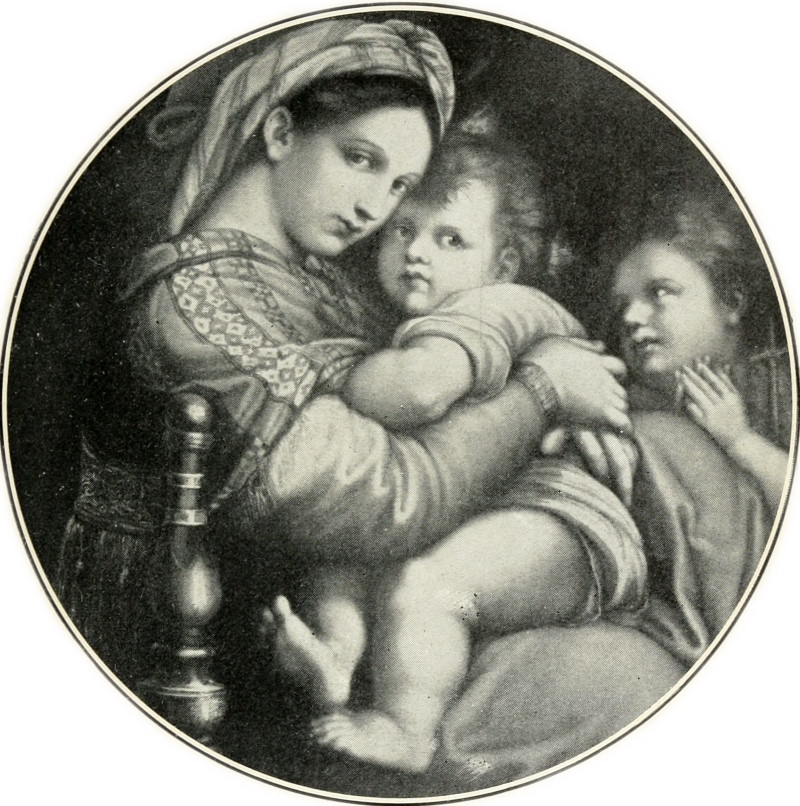
MADONNA DELLA SEDIA. Raphael.
In their own way, these were as wretched a set of people as ever had assembled at the festival. There they sat, with the veiled skeleton of the founder holding aloft the cypress wreath, at one end of the table, and at the other, wrapped in furs, the withered figure of Gervayse Hastings, stately, calm, and cold, impressing the company with awe, yet so little interesting their sympathy that he might have vanished into thin air without their once exclaiming, "Whither is he gone?"
"Sir," said the philanthropist, addressing the old man, "you have been so long a guest at this annual festival, and have thus been conversant with so many varieties of human affliction, that, not improbably, you have thence derived some great and important lessons. How blessed were your lot could you reveal a secret by which all this mass of woe might be removed!"
"I know of but one misfortune," answered Gervayse Hastings, quietly, "and that is my own."
"Your own!" rejoined the philanthropist. "And, looking back on your serene and prosperous life, how can you claim to be the sole unfortunate of the human race?"
"You will not understand it," replied Gervayse Hastings, feebly, and with a singular inefficiency of pronunciation, and sometimes putting one word for another. "None have understood it—not even those who experience the like. It is a chillness—a want of earnestness—a feeling as if what should be my heart were a thing of vapor—a haunting perception of unreality! Thus seeming to possess all that other men have—all that other men aim at—I have really possessed nothing, neither joy nor griefs. All things, all persons—as was truly said to me at this table long and long ago—have been like shadows flickering on the wall. It was so with my wife and children—with those who seemed my friends: it is so with yourselves, whom I see now before me. Neither have I myself any real existence, but am a shadow like the rest."
"And how is it with your views of a future life?" inquired the speculative clergyman.
"Worse than with you," said the old man, in a hollow and feeble tone; "for I cannot conceive it earnestly enough to feel either hope or fear. Mine—mine is the wretchedness! This cold heart—this unreal life! Ah! it grows colder still."
It so chanced that at this juncture the decayed ligaments of the skeleton gave way, and the dry bones fell together in a heap, thus causing the dusty wreath of cypress to drop upon the table. The attention of the company being thus diverted for a single instant from Gervayse Hastings, they perceived, on turning again towards him, that the old man had undergone a change. His shadow had ceased to flicker on the wall.
Nathaniel Hawthorne
A Christmas Eve in Exile

IT is Christmas Eve in a large city of Bavaria. Along the streets, white with snow, in the confusion of the fog, among the rattle of carriages and the ringing of bells, the crowd hurries joyously towards the open-air roast-meat shops, the holiday stalls and booths. Brushing with a light rustling sound the shops decorated with ribbons and flowers, branches of green holly and whole spruce trees covered with pendants move along in the arms of passers-by, rising above all the heads, like a shadow of the Thuringian Forests, a touch of nature in the artificial life of winter. Night is falling. Over there, behind the gardens of the "Résidence," one sees still a glow of the setting sun, deep red through the fog; and throughout the city there is such gayety, so many festive preparations, that every light that flames up at a window seems to hang on a Christmas tree. But this is no ordinary Christmas. We are in the year of Grace 1870; and the birth of Christ is but a pretext the more to drink to the illustrious Van der Than, and to celebrate the triumph of Bavarian arms. Noël! Noël! Even the Jews in the lower city join in the merriment. There is old Augustus Cahn, turning the corner at "The Blue Grape" on the run. Never have his ferret-eyes sparkled as to-night. Never has his brush-like queue wriggled so merrily. On his sleeve, worn threadbare by the cords of his wallet, hangs a tidy little basket, full to the brim, covered with a yellow napkin, with the neck of a bottle and a sprig of holly peeping out.
What the deuce is the old usurer going to do with all that? Is he, too, going to celebrate Christmas? Will he gather together his friends, his family, to drink to the German Fatherland? But no. Every one knows well that old Cahn has no Fatherland. His Fatherland is his strong-box. He has neither family nor friends; nothing but creditors. His sons, his associates too, left three months ago with the army. Down there behind the gun-carriages of the home guard they ply their trade, selling brandy, buying watches, and at night, after a battle, going out to rifle the pockets of the dead and to empty the knapsacks that have fallen in the trenches by the way. Father Cahn, too old to follow his children, has remained in Bavaria, and there he does a magnificent business with the French prisoners. Always prowling about the barracks, it is he who buys watches, medals, money-orders. One sees him gliding through the hospitals and among the ambulances. He approaches the bedside of the wounded and asks them very softly in his hideous gibberish:—
"Haf you anydings to zell?"
Look! At this very moment, when you see him trotting so briskly with his basket under his arm, it is because the Military Hospital closes at five o'clock; and there are two Frenchmen waiting up there in that big black building, with its narrow-barred windows, where Christmas to illumine its coming has only the pale lights which guard the bedside of the dying....
These two Frenchmen are Salvette and Bernadou. They are infantrymen, two Provençals of the same village, enrolled in the same battalion, and wounded by the same shell. Only, Salvette is the stronger; and already he begins to get up, to make some steps from his bed to the window. Bernadou, for his part, will not recover. Between the wan curtains of his hospital cot his face looks thinner, more languid, day by day; and when he speaks of his country, of the return, it is with the sad smile of the invalid, in which there is more of resignation than of hope. Nevertheless, to-day he is a little animated, thinking of the beautiful Christmas festival, which in our Provençal country seems like a great bonfire lighted in the midst of winter, recalling the midnight mass, the church decorated, glowing with light, the dark village streets filled with people, then the long watch about the table, the three traditional torches, the "aioli,"[2] the snails, and the pretty ceremony of the Yule log, which the grandfather carries about the house, and anoints with steaming wine.
"Ah! my poor Salvette, what a sad Christmas we are going to have this year!... If we only had enough to buy a white roll and a bottle of claret!... How happy I would be if, once more, before taps sound for me, I could drink with you over the Yule log!"
The sick man's eyes brighten as he speaks of the wine and the white bread. But how is it to be done? They have nothing left—poor fellows!—no money, no watch. To be sure, Salvette still keeps in the lining of his jacket a money-order for forty francs. But that is for the day when they shall be free; for the first halt that they make in a French inn. That money is sacred. No way to touch that. But poor Bernadou is so ill! Who knows if he will ever be able to take up the journey home? And since here is a beautiful Christmas which they can still celebrate together, were it not best to profit by it?
So, without a word to his countryman, Salvette rips open his tunic, takes out the order, and when old Cahn has come, as every morning, to make his round in the halls, after long arguments and whispered discussions he slips into the old Jew's hand this square of paper, yellowed and stiff, smelling of powder, and stained with blood. From that moment Salvette maintains an air of mystery. He rubs his hands and laughs to himself as he looks at Bernadou. And now, as day falls, he is there on watch, his forehead pressed against the narrow panes until he sees, in the dusk of the deserted courtyard, old Augustus Cahn, all out of breath, a little basket on his arm.
This solemn midnight, which sounds from all the bells of the city, falls mournfully in this white camp of suffering. The hospital ward is silent, lighted only by the night lamps hung from the ceiling. Great wandering shadows float over the beds and the bare walls, with an incessant vibration which seems the oppressed breathing of all the sufferers stretched out there. At moments dreams talk aloud, nightmares groan, while from the street rises a vague murmur, steps and voices, confused in the cold, resonant air as if under the porch of a cathedral. One feels the devout hastening, the mystery of a religious festival, intruding upon the hour of sleep and throwing upon the darkened city the dim light of lanterns and the glow of church windows.
"Art thou asleep, Bernadou?"....
Very gently, on the little table near his friend's bed, Salvette has placed a bottle of Lunel wine and a round loaf—a comely Christmas loaf, in which the sprig of holly is planted upright. The sick man opens eyes darkly rimmed with fever. In the uncertain light of the night lamps and under the white reflection of the great roofs where the moon shines dazzling upon the snow, this improvised Christmas seems to him a phantasy.
"Come, comrade, wake up!... It shall not be said that two Provençals let Christmas Eve pass without toasting it in a cup of claret."... And Salvette raises him with a mother's tenderness. He fills the glasses, cuts the bread; and they drink, and talk of Provence. Little by little Bernadou rouses, becomes tender.... The wine, the recalling of old days.... With the childish spirit which comes again to the sick in their weakness, he asks Salvette to sing a Christmas carol of Provence. His comrade asks nothing better.
"Come! Which one do you want? 'The Host'? 'The Three Kings'? or 'Saint Joseph Said to Me'?"
"No. I love better 'The Shepherds.' The one we always sang at home."
"'The Shepherds' let it be." In a low voice, his head between the curtains, Salvette begins to hum. But suddenly, as he sings the last couplet, where the shepherds, coming to see Jesus in his stable, have laid their offerings of fresh eggs and cheese in the manger, and are dismissed in kindly fashion:—
"Joseph leur dit: Allons I soyez bien sages, Tournez-vous-en et faites bon voyage. Bergers, Prenez votre congé, ..."
poor Bernadou slips and falls heavily upon his pillow. His comrade, thinking he sleeps, calls him, shakes him. But the sick man remains motionless; and the little sprig of holly across the stiff coverlet seems already the green palm that is laid on the pillow of the dead.
Salvette understands. Then, all in tears, and a little intoxicated with the feast and with so great a sorrow, he takes up again in full voice, in the silence of the ward, the joyous refrain of Provence:—
"Shepherds, Take your leave!"
Alphonse Daudet
The Rehearsal of the Mummers' Play

THEN fell the great first rehearsal of the Christmas play, and Dennis Masterman found that he had been wise to take time by the forelock in this matter. The mummers assembled in the parish room, and the vicar and his sister, with Nathan Baskerville's assistance, strove to lead them through the drama.
"It's not going to be quite like the version that a kind friend has sent me, and from which your parts are written," explained Dennis. "I've arranged for an introduction in the shape of a prologue. I shall do this myself, and appear before the curtain and speak a speech to explain what it is all about. This answers Mr. Waite here, who is going to be the Turkish Knight. He didn't want to begin the piece. Now I shall have broken the ice, and then he will be discovered as the curtain rises."
Mr. Timothy Waite on this occasion, however, began proceedings, as the vicar's prologue was not yet written. He proved letter-perfect, but exceedingly nervous.
"Open your doors and let me in, I hope your favours I shall win. Whether I rise or whether I fall, I'll do my best to please you all!"
Mr. Waite spoke jerkily, and his voice proved a little out of control, but everybody congratulated him.
"How he rolls his eyes to be sure," said Vivian Baskerville. "A very daps of a Turk, for sartain."
"You ought to stride about more, Waite," suggested Ned Baskerville, who had cheered up of recent days, and was now standing beside Cora and other girls destined to assist the play. "The great thing is to stride about and look alive—isn't it, Mr. Masterman?"
"We'll talk afterwards," answered Dennis. "We mustn't interfere with the action. You have got your speech off very well, Waite, but you said it much too fast. We must be slow and distinct so that not a word is missed."
Timothy, who enjoyed the praise of his friends, liked this censure less.
"As for speaking fast," he said, "the man would speak fast. Because he expects St. George will be on his tail in a minute. He says, 'I know he'll pierce my skin.' In fact, he's pretty well sweating with terror from the first moment he comes on the stage, I should reckon."
But Mr. Masterman was unprepared for any such subtle rendering of the Turkish Knight, and he only hoped that the more ancient play-actors would not come armed with equally obstinate opinions.
"We'll talk about it afterwards," he said. "Now you go off to the right, Waite, and Father Christmas comes on at the left. Mr. Baskerville—Father Christmas, please."
Nathan put his part into his pocket, marched on to the imaginary stage and bowed. Everybody cheered.
"You needn't bow," explained Dennis; but the innkeeper differed from him.
"I'm afraid I must, your reverence. When I appear before them, the people will give me a lot of applause in their usual kindly fashion. Why, even these here—just t'other actors do, you see—so you may be sure that the countryside will. Therefore I had better practise the bow at rehearsal, if you've no great argument against it."
"All right, push on," said Dennis.
"We must really be quicker," declared Miss Masterman. "Half an hour has gone, and we've hardly started."
"Off I go, then; and I want you chaps—especially you, Vivian, and you, Jack Head, and you, Tom Gollop—to watch me acting. Acting ban't the same as ordinary talking. If I was just talking, I should say all quiet, without flinging my arms about, and walking round, and stopping, and then away again. But in acting you do all these things, and instead of merely saying your speeches, as we would just man to man, over my bar or in the street, you have to bawl 'em out so that every soul in the audience catches 'em."
Having thus explained his theory of histrionics, Mr. Baskerville started, and with immense and original emphasis, and sudden actions and gestures, introduced himself.
"Here come I, the dear old Father Christmas. Welcome or welcome not, I hope old Father Christmas Will never be forgot. A room—make room here, gallant boys. And give us room to rhyme...."
Nathan broke off to explain his reading of the part.
"When I say 'make room' I fly all round the stage, as if I was pushing the people back to give me room."
He finished his speech, and panted and mopped his head.
"That's acting, and what d'you think of it?" he asked.
They all applauded vigorously excepting Mr. Gollop, who now prepared to take his part.
Nathan then left the stage and the vicar called him back.
"You don't go off," he explained. "You stop to welcome the King of Egypt."
"Beg pardon," answered the innkeeper. "But of course, so it is. I'll take my stand here."
"You bow to the King of Egypt when he comes on," declared Gollop. "He humbly bows to me, don't he, reverend Masterman?"
"Yes," said Dennis, "he bows, of course. You'll have a train carried by two boys, Gollop; but the boys aren't here to-night, as they're both down with measles—Mrs. Bassett's youngsters."
"I'll bow to you if you bow to me, Tom," said Mr. Baskerville. "That's only right."
"Kings don't bow to common people," declared the parish clerk. "Me and my pretended darter—that's Miss Cora Lintern, who's the Princess—ban't going to bow, I should hope."
"You ought to, then," declared Jack Head. "No reason because you'm King of Egypt why you should think yourself better than other folk. Make him bow, Nathan. Don't you bow to him if he don't bow to you."
"Kings do bow," declared Dennis. "You must bow to Father Christmas, Gollop."
"He must bow first, then," argued the parish clerk.
"Damn the man! turn him out and let somebody else do it!" cried Head.
"Let neither of 'em bow," suggested Mrs. Hacker suddenly. "With all this here bowing and scraping, us shan't be done afore midnight; and I don't come in the play till the end of all things as 'tis."
"You'd better decide, your reverence," suggested Vivian. "Your word's law. I say let 'em bow simultaneous—how would that serve?"
"Excellent!" declared Dennis. "You'll bow together, please. Now, Mr. Gollop."
Thomas marched on with amazing gait, designed to be regal.
"They'll all laugh if you do it like that, Tom," complained Mr. Voysey.
"Beggar the man! And why for shouldn't they laugh?" asked Jack Head. "Thomas don't want to make 'em cry, do he? Ban't we all to be as funny as ever we can, reverend Masterman?"
"Yes," said Dennis. "In reason—in reason, Jack. But acting is one thing, and playing the fool is another."
"Oh, Lord! I thought they was the same," declared Vivian Baskerville. "Because if I've got to act the giant——"
"Order! order!" cried the clergyman. "We must get on. Don't be annoyed, Mr. Baskerville, I quite see your point; but it will all come right at rehearsal."
"You'll have to tell me how to act then," said Vivian. "How the mischief can a man pretend to be what he isn't? A giant——"
"You're as near being a live giant as you can be," declared Nathan. "You've only got to be yourself and you'll be all right."
"No," argued Jack Head. "If the man's himself, he's not funny, and nobody will laugh. I say——"
"You can show us what you mean when you come to your own part, Jack," said Dennis desperately. "Do get on, Gollop."
"Bow then," said Mr. Gollop to Nathan.
"I'll bow when you do, and not a minute sooner," answered the innkeeper firmly.
The matter of the bow was arranged, and Mr. Gollop, in the familiar voice with which he had led the psalms for a quarter of a century, began his part.
"Here I, the King of Egypt, boldly do appear, St. Garge! St. Garge! walk in, my only son and heir; Walk in, St. Garge, my son, and boldly act thy part, That all the people here may see thy wondrous art!"
"Well done, Tom!" said Mr. Masterman, "that's splendid; but you mustn't sing it."
"I ban't singing it," answered the clerk. "I know what to do."
"All right. Now, St. George, St. George, where are you?"
"Along with the girls, as usual," snapped Mr. Gollop.
As a matter of fact Ned Baskerville was engaged in deep conversation with Princess Sabra and the Turkish Knight. He left them and hurried forward.
"Give tongue, Ned!" cried his father.
"You walk down to the footlights, and the King of Egypt will be on one side of you and Father Christmas on the other," explained the vicar.
"And you needn't look round for the females, 'cause they don't appear till later on," added Jack Head.
A great laugh followed this jest, whereon Miss Masterman begged her brother to try and keep order.
"If they are not going to be serious, we had better give it up, and waste no more time," she said.
"Don't take it like that, miss, I beg of you," urged Nathan. "All's prospering very well. We shall shape down. Go on, Ned."
Ned looked at his part, then put it behind his back, and then brought it out again.
"This is too bad, Baskerville," complained Dennis. "You told me yesterday that you knew every word."
"So I did yesterday, I'll swear to it. I said it out in the kitchen after supper to mother—didn't I, father?"
"You did," assented Vivian; "but that's no use if you've forgot it now."
"'Tis stage fright," explained Nathan. "You'll get over it."
"Think you'm talking to a maiden," advised Jack Head.
"Do get on!" cried Dennis. Then he prompted the faulty mummer.
"Here come I, St. George——"
Ned struck an attitude and started.
"Here come I, St. George; from Britain did I spring; I'll fight the Russian Bear, my wonders to begin. I'll pierce him through, he shall not fly; I'll cut him—cut him—cut him——"
"How does it go?"
"'I'll cut him down,'" prompted Dennis.
"Right!"
"I'll cut him down, or else I'll die."
"Good! Now, come on, Bear!" said Nathan.
"You and Jack Head will have to practise the fight," explained the vicar; "and at this point, or earlier, the ladies will march in to music and take their places, because, of course, 'fair Sabra' has to see St. George conquer his foes."
"That'll suit Ned exactly!" laughed Nathan.
Then he marshalled Cora and several other young women, including May and Polly Baskerville from Cadworthy, and Cora's sister Phyllis.
"There will be a daïs lifted up at the back, you know—that's a raised platform. But for the present you must pretend these chairs are the throne. You sit by 'fair Sabra,' Thomas, and then the trumpets sound and the Bear comes on."
"Who'll play the brass music?" asked Head, "because I've got a very clever friend at Sheepstor——"
"Leave all that to me. The music is arranged. Now, come on!"
"Shall you come on and play it like a four-footed thing, or get up on your hind-legs, Jack?" asked St. George.
"I be going to come in growling and yowling on all fours," declared Mr. Head grimly. "Then I be going to do a sort of a comic bear dance; then I be going to have a bit of fun eating a plum pudding; then I thought that me and Mr. Nathan might have a bit of comic work; and then I should get up on my hind-legs and go for St. George."
"You can't do all that," declared Dennis. "Not that I want to interfere with you, or anybody, Head; but if each one is going to work out his part and put such a lot into it, we shall never get done."
"The thing is to make 'em laugh, reverend Masterman," answered Jack with firmness. "If I just come on and just say my speech, and fight and die, there's nought in it; but if——"
"Go on, then—go on. We'll talk afterwards."
"Right. Now you try not to laugh, souls, and I wager I'll make you giggle like a lot of zanies," promised Jack.
Then he licked his hands, went down upon them, and scrambled along upon all fours.
"Good for you, Jack! Well done! You'm funnier than anything that's gone afore!" cried Joe Voysey.
"So you be, for certain," added Mrs. Hacker.
"For all the world like my bob-tailed sheep-dog," declared Mr. Waite.
"Now I be going to sit up on my hams and scratch myself," explained Mr. Head; "then off I go again and have a sniff at Father Christmas. Then you ought to give me a plum pudding, Mr. Baskerville, and I balance it 'pon my nose."
"Well thought on!" declared Nathan. "So I will. 'Twill make the folk die of laughing to see you."
"Come on to the battle," said Dennis.
"Must be a sort of wraslin' fight," continued Head, "because the Bear's got nought but his paws. Then, I thought when I'd throwed St. George a fair back heel, he'd get up and draw his shining sword and stab me in the guts. Then I'd roar and roar, till the place fairly echoed round, and then I'd die in frightful agony."
"You ban't the whole play, Jack," said Mr. Gollop with much discontent. "You forget yourself, surely. You can't have the King of Egypt and these here other high characters all standing on the stage doing nought while you'm going through these here vagaries."
But Mr. Head stuck to his text.
"We'm here to make 'em laugh," he repeated with bulldog determination. "And I'll do it if mortal man can do it. Then, when I've took the doctor's stuff, up I gets again and goes on funnier than ever."
"I wouldn't miss it for money, Jack," declared Vivian Baskerville. "Such a clever chap as you be, and none of us ever knowed it. You ought to go for Tom Fool to the riders. I lay you'd make tons more money than ever you will to Trowlesworthy Warren."
"By the way, who is to be the Doctor?" asked Ned Baskerville. "'Twasn't settled, Mr. Masterman."
Dennis collapsed blankly.
"By Jove! No more it was," he admitted, "and I've forgotten all about it. The Doctor's very important, too. We must have him before the next rehearsal. For the present you can read it out of the book, Mark."
Mark Baskerville was prompting, and now, after St. George and the Bear had made a pretence of wrestling, and the Bear had perished with much noise and to the accompaniment of loud laughter, Mark read the Doctor's somewhat arrogant pretensions.
"All sorts of diseases— Whatever you pleases: The phthisic, the palsy, the gout, If the Devil's in, I blow him out. * * * * * * * "I carry a bottle of alicampane, Here, Russian Bear, take a little of my flip-flap, Pour it down thy tip-tap; Rise up and fight again!"
"Well said, Mark! 'Twas splendidly given. Why for shouldn't Mark be Doctor?" asked Nathan.
"An excellent idea," declared Dennis. "I'm sure now, if the fair Queen Sabra will only put in a word——"
Mark's engagement was known. The people clapped their hands heartily and Cora blushed.
"I wish he would," said Cora.
"Your wish ought to be his law," declared Ned. "I'm sure if 'twas me——"
But Mark shook his head.
"I couldn't do it," he answered. "I would if I could; but when the time came, and the people, and the excitement of it all, I should break down, I'm sure I should."
"It's past ten o'clock," murmured Miss Masterman to her brother.
The rehearsal proceeded: Jack Head, as the Bear, was restored to life and slain again with much detail. Then Ned proceeded—
"I fought the Russian Bear And brought him to the slaughter; By that I won fair Sabra, The King of Egypt's daughter. Where is the man that now will me defy? I'll cut his giblets full of holes and make his buttons fly."
"And when I've got my sword, of course 'twill be much finer," concluded Ned.
Mr. Gollop here raised an objection.
"I don't think the man ought to tell about cutting anybody's giblets full of holes," he said; "no, nor yet making their buttons fly. 'Tis very coarse, and the gentlefolks wouldn't like it."
"Nonsense, Tom," answered the vicar, "it's all in keeping with the play. There's no harm in it at all."
"Evil be to them as evil think," said Jack Head. "Now comes the song, reverend Masterman, and I was going to propose that the Bear, though he's dead as a nit, rises up on his front paws and sings with the rest, then drops down again—eh, souls?"
"They'll die of laughing if you do that, Jack," declared Vivian. "I vote for it."
But Dennis firmly refused permission and addressed his chorus.
"Now, girls, the song—everybody joins. The other songs are not written yet, so we need not bother about them till next time."
The girls, glad of something to do, sang vigorously, and the song went well. Then the Turkish Knight was duly slain, restored and slain again.
"We can't finish to-night," declared Dennis, looking at his watch, "so I'm sorry to have troubled you to come, Mrs. Hacker, and you, Voysey."
"They haven't wasted their time, however, because Head and I have showed them what acting means," said Nathan. "And when you do come on, Susan Hacker, you've got to quarrel and pull my beard, remember; then we make it up afterwards."
"We'll finish for to-night with the Giant," decreed Dennis. "Now speak your long speech, St. George, and then Mr. Baskerville can do the Giant."
Ned, who declared that he had as yet learned no more, read his next speech, and Vivian began behind the scenes—
"Fee—fi—fo—fum! I smell the blood of an Englishman. Let him be living, or let him be dead, I'll grind his bones to make my bread."
"You ought to throw a bit more roughness in your voice, farmer," suggested Mr. Gollop. "If you could bring it up from the innards, 'twould sound more awful, wouldn't it, reverend Masterman?"
"And when you come on, farmer, you might pass me by where I lie dead," said Jack, "and I'll up and give you a nip in the calf of the leg, and you'll jump round, and the people will roar again."
"No," declared the vicar. "No more of you, Head, till the end. Then you come to life and dance with the French Eagle—that's Voysey. But you mustn't act any more till then."
"A pity," answered Jack. "I was full of contrivances; however, if you say so——"
"Be I to dance?" asked Mr. Voysey. "This is the first I've heard tell o' that. How can I dance, and the rheumatism eating into my knees for the last twenty year?"
"I'll dance," said Head. "You can just turn round and round slowly."
"Now, Mr. Baskerville!"
Vivian strode on to the stage.
"Make your voice big, my dear," pleaded Gollop.
"Here come I, the Giant; bold Turpin is my name, And all the nations round do tremble at my fame, Where'er I go, they tremble at my sight: No lord or champion long with me will dare to fight."
"People will cheer you like thunder, Vivian," said his brother, "because they know that the nations really did tremble at your fame when you was champion wrestler of the west."
"But you mustn't stand like that, farmer," said Jack Head. "You'm too spraddlesome. For the Lord's sake, man, try and keep your feet in the same parish!"
Mr. Baskerville bellowed with laughter and slapped his immense thigh.
"Dammy! that's funnier than anything in the play," he said. "'Keep my feet in the same parish!' Was ever a better joke heard?"
"Now, St. George, kill the Giant," commanded Dennis. "The Giant will have a club, and he'll try to smash you; then run him through the body."
"Take care you don't hit Ned in real earnest, however, else you'd settle him and spoil the play," said Mr. Voysey. "'Twould be a terrible tantarra for certain if the Giant went and whipped St. George."
"'Twouldn't be the first time, however," said Mr. Baskerville. "Would it, Ned?"
Nathan and Ned's sisters appreciated this family joke. Then Mr. Gollop advanced a sentimental objection.
"I may be wrong," he admitted, "but I can't help thinking it might be a bit ondecent for Ned Baskerville here to kill his father, even in play. You see, though everybody will know 'tis Ned and his parent, and that they'm only pretending, yet it might shock a serious-minded person here and there to see the son kill the father. I don't say I mind, as 'tis all make-believe and the frolic of a night; but—well, there 'tis."
"You'm a silly old grandmother, and never no King of Egypt was such a fool afore," said Jack. "Pay no heed to him, reverend Masterman."
Gollop snarled at Head, and they began to wrangle fiercely.
Then Dennis closed the rehearsal.
"That'll do for the present," he announced. "We've made a splendid start, and the thing to remember is that we meet here again this day week, at seven o'clock. And mind you know your part, Ned. Another of the songs will be ready by then; and the new harmonium will have come that my sister is going to play. And do look about, all of you, to find somebody who will take the Doctor."
"We shall have the nation's eyes on us—not for the first time," declared Mr. Gollop as he tied a white wool muffler round his throat; "and I'm sure I hope one and all will do the best that's in 'em."
The actors departed; the oil lamps were extinguished, and the vicar and his sister returned home. She said little by the way, and her severe silence made him rather nervous.
"Well," he broke out at length, "jolly good, I think, for a first attempt—eh, Alice?"
"I'm glad you were satisfied, dear. Everything depends upon us—that seems quite clear, at any rate. They'll all get terribly self-conscious and silly, I'm afraid, long before the time comes. However, we must hope for the best. But I shouldn't be in a hurry to ask anybody who really matters."
Eden Phillpotts in The Three Brothers