Part 2 — ILLUSTRATIONS OF THE PUFF POETICAL
Reading edition
[The following eleven pieces of verse appeared originally with many others in an article called “Puffs and Poetry,” from which the following passage is taken:—
“Some people are fond of excursions into the realms of old romance, with their Lancelots and Gueneveres, their enchanted castles, their bearded wizards, ‘and such odd branches of learning.’ There needs a winged griffin, at the very least, to carry them out of the everyday six-and-eightpenny world, or the whizz of an Excalibur to startle their drowsy imaginations into life. The beauties and the wonders of the universe died for them some centuries ago; they went out with Friar Bacon and the invention of gunpowder. Praised be Apollo! this is not our case. There is a snatch of poetry, to our apprehension, in almost everything. We have detected it pushing its petals forth from the curls of a barrister’s wig, and scented its fragrance even in the columns of the ‘London Gazette.’
“‘The deep poetic voice that hourly speaks within us’ is never silent. Like Signor Benedick, it ‘will still be talking.’ We can scarcely let our eyes dwell upon an object—nay, not even upon a gridiron or a toothpick—but it seems to be transmuted as by the touch of Midas into gold. Our facts accordingly adopt upon occasions a very singular shape. We are not nice to a shade. A trifle here or there never stands in our way. We regard a free play of fancy as the privilege of every genuine Briton, and exclaim with Pistol, ‘A fico for all yea and nay rogues.’
“We have often thought of entering the lists against Robins [famous for his imaginative advertisements of properties for sale]. It may be vanity, but we think we could trump him. Robins amplifies well, but we think we could trump him. There is an obvious effort in his best works. The result is a want of unity of effect. Hesiod and Tennyson, the Caverns of Ellora, and the magic caves of the Regent’s Park Colosseum, are jumbled confusedly one upon another. He never achieves the triumph of art—repose. Besides, he wants variety. A country box, consisting of twenty feet square of tottering brickwork, a plateau of dirt, with a few diseased shrubs and an open drain, is as elaborately be-metaphored as an island of the Hebrides, with a wilderness of red-deer, Celts, ptarmigan, and other wild animals upon it. Now, this is out of all rule. An elephant’s trunk can raise a pin as well as uproot an oak, but it would be ridiculous to employ the same effort for one as for the other. Robins—with reverence to so great a name, be it spoken—does not attend to this. He has yet to acquire the light and graceful touch of the finished artist.” Thereupon Bon Gaultier proceeds to illustrate his views by the following, and many other rhyming advertisements.]
The Death of Ishmael.
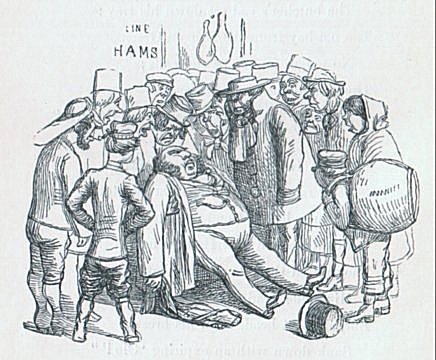
Died the Jew? “The Hebrew died. On the pavement cold he lay, Around him closed the living tide; The butcher’s cad set down his tray; The pot-boy from the Dragon Green No longer for his pewter calls; The Nereid rushes in between, Nor more her ‘Fine live mackerel!’ bawls.”
Died the Jew? “The Hebrew died. They raised him gently from the stone, They flung his coat and neckcloth wide— But linen had that Hebrew none. They raised the pile of hats that pressed His noble head, his locks of snow; But, ah, that head, upon his breast, Sank down with an expiring ‘Clo!’”
Died the Jew? “The Hebrew died, Struck with overwhelming qualms From the flavour spreading wide Of some fine Virginia hams. Would you know the fatal spot, Fatal to that child of sin? These fine-flavoured hams are bought At 50 Bishopsgate Within!”
Parr’s Life Pills.
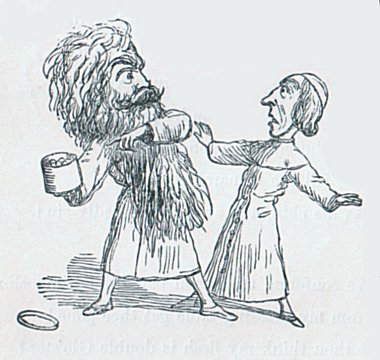
’Twas in the town of Lubeck, A hundred years ago, An old man walked into the church, With beard as white as snow; Yet were his cheeks not wrinkled, Nor dim his eagle eye: There’s many a knight that steps the street, Might wonder, should he chance to meet That man erect and high!
When silenced was the organ, And hushed the vespers loud, The Sacristan approached the sire, And drew him from the crowd— “There’s something in thy visage, On which I dare not look; And when I rang the passing bell, A tremor that I may not tell, My very vitals shook.
“Who art thou, awful stranger? Our ancient annals say, That twice two hundred years ago Another passed this way, Like thee in face and feature; And, if the tale be true, ’Tis writ, that in this very year Again the stranger shall appear. Art thou the Wandering Jew?”
“The Wandering Jew, thou dotard!” The wondrous phantom cried— “’Tis several centuries ago Since that poor stripling died. He would not use my nostrums— See, shaveling, here they are! These put to flight all human ills, These conquer death—unfailing pills, And I’m the inventor, Parr!”
Tarquin and the Augur.
Gingerly is good King Tarquin shaving. Gently glides the razor o’er his chin, Near him stands a grim Haruspex raving, And with nasal whine he pitches in Church extension hints, Till the monarch squints, Snicks his chin, and swears—a deadly sin!
“Jove confound thee, thou bare-legged impostor! From my dressing-table get thee gone! Dost thou think my flesh is double Glo’ster? There again! That cut was to the bone! Get ye from my sight; I’ll believe you’re right, When my razor cuts the sharpening hone!”
Thus spoke Tarquin with a deal of dryness; But the Augur, eager for his fees, Answered—“Try it, your Imperial Highness; Press a little harder, if you please. There! the deed is done!” Through the solid stone Went the steel as glibly as through cheese.
So the Augur touched the tin of Tarquin, Who suspected some celestial aid; But he wronged the blameless gods; for hearken! Ere the monarch’s bet was rashly laid, With his searching eye Did the priest espy Rogers’ name engraved upon the blade.
La Mort d’Arthur,
not by alfred tennyson.
Slowly, as one who bears a mortal hurt, Through which the fountain of his life runs dry, Crept good King Arthur down unto the lake. A roughening wind was bringing in the waves With cold dull plash and plunging to the shore, And a great bank of clouds came sailing up Athwart the aspect of the gibbous moon, Leaving no glimpse save starlight, as he sank, With a short stagger, senseless on the stones.
No man yet knows how long he lay in swound; But long enough it was to let the rust Lick half the surface of his polished shield; For it was made by far inferior hands, Than forged his helm, his breastplate, and his greaves, Whereon no canker lighted, for they bore The magic stamp of Mechi’s Silver Steel.
Jupiter and the Indian Ale.
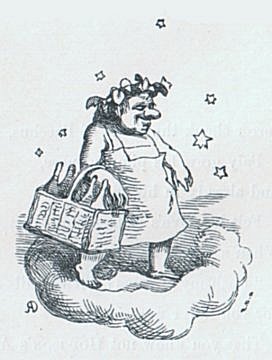
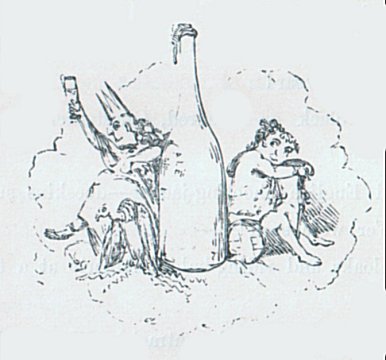
“Take away this clammy nectar!” Said the king of gods and men; “Never at Olympus’ table Let that trash be served again. Ho, Lyæus, thou the beery! Quick—invent some other drink; Or, in a brace of shakes, thou standest On Cocytus’ sulphury brink!”
Terror shook the limbs of Bacchus, Paly grew his pimpled nose, And already in his rearward Felt he Jove’s tremendous toes; When a bright idea struck him— “Dash my thyrsus! I’ll be bail— For you never were in India— That you know not Hodgson’s Ale!”
“Bring it!” quoth the Cloud-compeller; And the wine-god brought the beer— “Port and claret are like water To the noble stuff that’s here!” And Saturnius drank and nodded, Winking with his lightning eyes, And amidst the constellations Did the star of Hodgson rise!
The Lay of the Doudney Brothers.
Coats at five-and-forty shillings! trousers ten-and-six a pair! Summer waistcoats, three a sov’reign, light and comfortable wear! Taglionis, black or coloured, Chesterfield and velveteen! The old English shooting-jacket—doeskins such as ne’er were seen! Army cloaks and riding-habits, Alberts at a trifling cost! Do you want an annual contract? Write to Doudneys’ by the post. Doudney Brothers! Doudney Brothers! Not the men that drive the van, Plastered o’er with advertisements, heralding some paltry plan, How, by base mechanic stinting, and by pinching of their backs, Lean attorneys’ clerks may manage to retrieve their Income-tax: But the old established business—where the best of clothes are given At the very lowest prices—Fleet Street, Number Ninety-seven. Wouldst thou know the works of Doudney? Hie thee to the thronged Arcade, To the Park upon a Sunday, to the terrible Parade. There, amid the bayonets bristling, and the flashing of the steel, When the household troops in squadrons round the bold field-marshals wheel, Shouldst thou see an aged warrior in a plain blue morning frock, Peering at the proud battalions o’er the margin of his stock,— Should thy throbbing heart then tell thee, that the veteran worn and grey Curbed the course of Bonaparte, rolled the thunders of Assaye— Let it tell thee, stranger, likewise, that the goodly garb he wears Started into shape and being from the Doudney Brothers’ shears! Seek thou next the rooms of Willis—mark, where D’Orsay’s Count is bending, See the trouser’s undulation from his graceful hip descending; Hath the earth another trouser so compact and love-compelling? Thou canst find it, stranger, only, if thou seek’st the Doudneys’ dwelling! Hark, from Windsor’s royal palace, what sweet voice enchants the ear? “Goodness, what a lovely waistcoat! Oh, who made it, Albert dear? ’Tis the very prettiest pattern! You must get a dozen others!” And the Prince, in rapture, answers—“’Tis the work of Doudney Brothers!”
Paris and Helen.
As the youthful Paris presses Helen to his ivory breast. Sporting with her golden tresses, Close and ever closer pressed,
“Let me,” said he, “quaff the nectar, Which thy lips of ruby yield; Glory I can leave to Hector, Gathered in the tented field.
“Let me ever gaze upon thee, Look into thine eyes so deep; With a daring hand I won thee, With a faithful heart I’ll keep.
“Oh, my Helen, thou bright wonder, Who was ever like to thee? Jove would lay aside his thunder, So he might be blest like me.
“How mine eyes so fondly linger On thy smooth and pearly skin; Scan each round and rosy finger, Drinking draughts of beauty in!
“Tell me, whence thy beauty, fairest? Whence thy cheek’s enchanting bloom? Whence the rosy hue thou wearest; Breathing round thee rich perfume?”
Thus he spoke, with heart that panted, Clasped her fondly to his side, Gazed on her with look enchanted, While his Helen thus replied:
“Be no discord, love, between us, If I not the secret tell! ’Twas a gift I had of Venus,— Venus, who hath loved me well;
“And she told me as she gave it, ‘Let not e’er the charm be known; O’er thy person freely lave it, Only when thou art alone.’
“’Tis enclosed in yonder casket— Here behold its golden key; But its name—love, do not ask it, Tell’t I may not, even to thee!”
Long with vow and kiss he plied her; Still the secret did she keep, Till at length he sank beside her, Seemed as he had dropped to sleep.
Soon was Helen laid in slumber, When her Paris, rising slow, Did his fair neck disencumber From her rounded arms of snow.
Then, her heedless fingers oping, Takes the key and steals away, To the ebon table groping, Where the wondrous casket lay;
Eagerly the lid uncloses, Sees within it, laid aslope, Pears’ Liquid Bloom of Roses, Cakes of his Transparent Soap!
A Warning.
Lose thou no time! A grave and solemn warning, Yet seldom ta’en, to man’s eternal cost. Night wanes, day lessens, evening, noon, and morning Flit by unseen, and yet much time is lost.
And why? Are moments useless as the vapour That rises from the lamp’s extinguish’d flame! Why do we, like the moth around the taper, Sport with the fire that must consume our frame?
Be wise in time! Arouse thee, oh thou sleeper, Account thy moments dearer than thy gold; While time thou hast, appoint a good time-keeper To treasure up thine hours till thou art old.
Lose but this chance, and thou art lost for ever,— Seek him who keeps a watch for sinking souls— Ask for Cox Savory’s Horizontal Lever, With double case, and jewell’d in four holes!
To Persons About to Marry.
Gentle pair, ere Hymen binds you In his fetters, soft but sure, Pray, bethink you, have you ever Had substantial furniture?
Love’s a fickle god, they tell us, Giddy-pated, lightly led, Therefore it were well you found him In a comfortable bed.
Olive branches soon will blossom Round your table, two or three; And that table should be made of Good and strong mahogany.
If the cares of life should gather, And we all must look for cares,— Sorrow falls extremely lightly In the midst of rosewood chairs.
Few that walk can ’scape a stumble, Thus hath said The Prophet-King; But your fall will be a light one On Axminster carpeting.
We can keep your little children From collision with the grate— We have wardrobes, we have presses At a reasonable rate;
Mirrors for the queen of beauty Basins of the purest stone, Ottomans which Cleopatra Might have envied on her throne.
Seek us ere you taste with rapture Love’s sweet draught of filter’d honey, And you’ll find the safest plan is, No Discount, and Ready Money!
Want Places.
Wants a place a lad, who’s seen Pious life at brother Teazle’s, Used to cleaning boots, and been Touch’d with grace, and had the measles.
* * * * *
Wants a place as housemaid, or Companion to a bachelor, Up in years, and who’d prefer A person with no character, A female, who in this respect, Would leave him nothing to object.