Subfamily IV. CERVICAPRINÆ. (continued 2)
Reading edition
“The latter name is that by which the Wawemba call C. vardoni—not ‘Inswala’ as Mr. Sharpe has stated in the account he wrote of his journey to Mweru; he was no doubt misled by his Watonga porters from Lake Nyasa, who gave him what is the Manganga name for the ‘Impala,’ which they confused with C. vardoni, never having seen that animal before.
“It is curious how very accurate Livingstone’s information proves to be, even on such small points as these; he, though not a sportsman or one who cared much for natural history, records in his last journals the Wawemba name for C. vardoni as ‘Sebula’—which of course might be a mistake in the printing for ‘Seyula,’ the name by which the Wawemba call this animal to the present day.
“It will bear me out in my statement that this Cobus is considerably smaller than C. vardoni, when I say that two of the Wasenga carried the animal, turn and turn about, for some three miles, when they were relieved by other men sent out from camp.
“I should estimate its weight at, roughly, 90 lbs., possibly more. It is an adult specimen; for we found in her a fœtus (♂), to which she would have given birth in another week or 10 days.
“Her height at the withers, as she lay dead, measured 30½ inches.”
Mr. Crawshay’s typical specimen (now by his kindness deposited in the British Museum) being the only example yet obtained of this species, we have nothing more to say about it, except to express our regret that it arrived too late to be figured, or to be included in the synopsis of the species of Cobus given above (p. 95).
December, 1896.
THE BOOK OF ANTELOPES, PL. XLII.
Wolf del., J. Smit lith.
Hanhart imp.
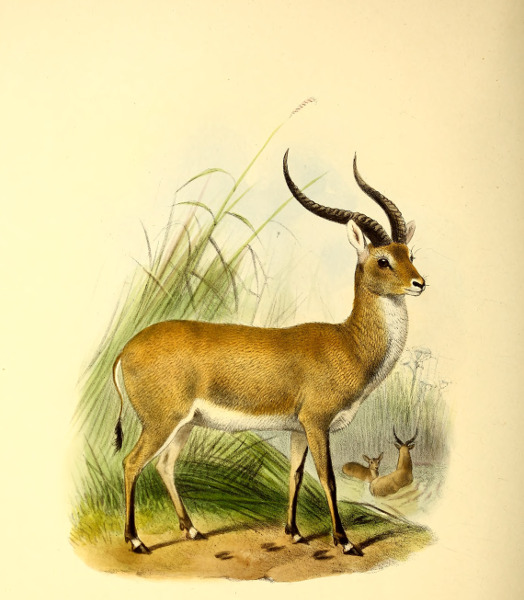
The Lechee.
COBUS LECHEE.
Published by R. H. Porter.
69. THE LECHEE. COBUS LECHEE (Gray). [PLATE XLII.]
Leechee, Oswell, J. R. G. S. xx. p. 150 (1851); Livingstone, J. R. G. S. xxi. p. 23 (1851); id. Miss. Trav. p. 71 & plate (1857); Andersson, Lake Ngami, p. 448, pl. xiii. (1856).
Kobus leché, Gray, Knowsl. Men. p. 23 (1850); Turner, P. Z. S. 1850, p. 174.
Adenota leché, Gray, P. Z. S. 1850, p. 130, Mamm. pl. xx.; id. Ann. Mag. N. H. (2) viii. p. 212 (1851); Huet, Bull. Soc. Acclim. 1887, p. 77.
Adenota lechee, Gray, Cat. Ung. B. M. p. 97 (1852); Gerrard, Cat. Bones B. M. p. 239 (1862).
Heleotragus leché, Kirk, P. Z. S. 1864, p. 658 (Upper Zambesi).
Onotragus lechee, Gray, Cat. Rum. B. M. p. 17 (1872); id. Hand-l. Rum. B. M. p. 88 (1873).
Cobus leechi, Buckley, P. Z. S. 1876, p. 291.
Cobus lechee, Selous, P. Z. S. 1881, p. 760; id. Hunter’s Wand. S. Afr. p. 220 (1881); Ward, Horn Meas. (1) p. 90 (1892), (2) p. 125 (1896); Sclater, P. Z. S. 1893, p. 728 (L. Mweru, Sharpe).
Kobus lechee, Nicolls et Egl. Sportsm. in S. Afr. p. 42, pl. vii. fig. 22 (1892).
Vernacular Names:—Leche or Leegwee of the Makalolos. Inya of the Masubias; Oonya of the Makubias (Selous).
Size nearly equal to that of the large Waterbucks of the first section of the genus (height at withers 40–41 inches), although the general form is more graceful. Colour fulvous, slightly paler than in C. thomasi, which this species resembles in having well-defined black markings running down the legs, but which are succeeded below by white rings above the hoofs. Backs of both fore and hind pasterns quite naked, a character which distinguishes this species from all its allies. Pale areas round eyes and ears not sharply defined; back of ears not black-tipped. Muzzle, lips, chin, and belly white as usual. Tail slender, with a black tuft, just reaching to the level of the hocks.
Horns long, slender, and gracefully curved, attaining a length of 26 or 27 inches.
Female similar to the male, but without horns.
Hab. Zambesia, extending northwards to Lake Mweru, and south-westwards to Lake Ngami.
Like the Poku the Lechee was first discovered by Livingstone and his companions Oswell and Murray, who travelled with him in 1849 on his first journey to Lake Ngami. After leaving the lake, on descending the valley of the River Zouga, he tells us (‘Missionary Travels,’ p. 71):—“We discovered an entirely new species of Antelope, called ‘lechè’ or ‘lechwi.’ It is a beautiful water-antelope of a light brownish-yellow colour. Its horns—exactly like those of the Aigoceros ellipsiprymnus, the water-buck, or ‘tumōga’ of the Bechuanas—rise from the head with a slight bend backwards, then curve forwards at the points. The chest, belly, and orbits are nearly white, the front of the legs and ankles deep brown. From the horns, along the nape to the withers, the male has a small mane of the same yellowish colour with the rest of the skin, and the tail has a tuft of black hair. It is never found a mile from water; islets in marshes and rivers are its favourite haunts, and it is quite unknown except in the central humid basin of Africa. Having a good deal of curiosity, it presents a noble appearance as it stands gazing with head erect at the approaching stranger. When it resolves to decamp, it lowers its head, and lays its horns down to the level with the withers; it then begins with a waddling trot, which ends in its galloping and springing over bushes like the pallahs. It invariably runs to the water and crosses it by a succession of bounds, each of which appears to be from the bottom. We thought the flesh good at first, but soon got tired of it.”
To accompany this description a steel plate, drawn by Wolf and engraved by Whymper (already alluded to in our account of the Poku), was given at the same page of the work. It represents a scene on the Zouga with males of the Lechee and Poku occupying a conspicuous position in the foreground, and a mixed herd of these two Antelopes, which are said to be frequently found together, on the reedy banks.
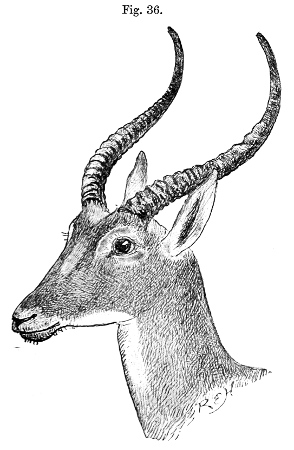
Fig. 36.
Head of Cobus lechee.
(From Mr. Selous’s mounted specimen in Brit. Mus.)
Oswell sent home to his friend Capt. Vardon a specimen of the new-found Antelope, and Capt. Vardon, as we find on reference to the minute-books of the meetings of the Zoological Society of London, exhibited it at the scientific meeting of that Society on June 11th, 1850. The species thus became included in Gray’s “Synopsis of Antelopes and Strepsiceres,” which was read on the same evening. A coloured plate by Joseph Wolf, attached to the Synopsis, was taken from Capt. Vardon’s specimen, which was subsequently presented to the British Museum.
The Lechee is also well figured by Wolf in a plate in Andersson’s ‘Lake Ngami,’ which contains an account of that traveller’s expedition to the Lake from the west coast in 1854. After a description of the animal Andersson says:—“The Leché is a Waterbuck, for though not actually living in the water, it is never found any distance from it. Great numbers are annually destroyed by the Bayeye, who convert their hides into a kind of rug for sleeping on, carosses, and other wearing apparel.”
The National Collection likewise contains a good mounted specimen of the male of this Antelope obtained by Mr. F. C. Selous at Umparira, on the Chobe, in 1881. In his paper on the Antelopes of Central South Africa, published in the Zoological Society’s ‘Proceedings’ for 1881, Mr. Selous gives us the following account of his experiences with the Lechee:—“This Antelope is first met with in the marshes of the Botletlie River, and is very numerous in the open grassy plains which are always more or less inundated by the Tamalakan, Mababe, Machabe, Sunta, and Chobe rivers. It is also common along the Upper Zambesi. In the swamps of the Lukanga River, about 150 miles to the south-west of Lake Bengweolo, which I visited in 1878, I found the Leegwee Antelope in large herds.
“After Speke’s Antelope, the Lechee is the most water-loving Antelope with which I am acquainted, and is usually to be seen standing knee-deep, or even up to its belly, in water, cropping the tops of the grass that appear above the surface, or else lying just at the water’s edge. As is the case with Tragelaphus spekii, the backs of the feet are devoid of hair between the hoof and the dew-claws, whilst in the Pookoo, as with all other Antelopes, this part is covered with hair. In some parts of the country Leegwee Antelopes are very tame; in others, where they are much persecuted by the natives, excessively wild. When they first make up their minds to run they stretch out their noses, the males laying their horns flat along their sides, and trot; but on being pressed they break into a springing gallop, now and then bounding high into the air. Even when in water up to their necks, they do not swim, but get along by a succession of bounds, making a tremendous splashing. Of course, when the water becomes too deep for them to bottom, they are forced to swim, which they do well and strongly, though not as fast as the natives can paddle; and when the country is flooded, great numbers are driven into deep water and speared. In the adult Leegwee the ears are of a uniform fawn-colour; but in the young animal they are tipped with black as in the adult Pookoo. In the flooded grassy plains in the neighbourhood of Linyanti on the Chobe, this beautiful Antelope may be seen in almost countless numbers, and I have counted as many as fifty-two rams consorting together. Some of these were quite young, with horns only a few inches in length; but there was not a single ewe amongst them. The longest pair of Leegwee horns that I have ever seen measured 2 feet 3 inches in length; but it is rare to get them over 2 feet long measured along the curve. In common with the Pookoo, they appear to me to be more tenacious of life than other Antelopes.”
As will be observed by what is said above, Mr. Selous has traced the Lechee beyond the Zambesi nearly as far north as Lake Bangweolo. Hence it extends into the basin of Lake Mweru, where Consul Sharpe met with it in “enormous herds” in company with Cobus vardoni. Specimens obtained by Mr. Sharpe in this district were forwarded by Sir Harry Johnston to Sclater, and are now in the British Museum.
We have, however, no evidence at present of the occurrence of the Lechee anywhere further north than the Mweru district. The specimens obtained by Petherick on the White Nile and assigned to Cobus lechee by Gray are, as already mentioned, properly referable to C. leucotis.
Our figure of this Antelope has been drawn by Smit from a sketch made by Wolf, and taken, we believe, from the original typical specimen now in the British Museum.
December, 1896.
Genus II. CERVICAPRA.
(See page 93.)
Type.
Cervicapra, Blainv. Bull. Soc. Philom. 1816, p. 75 C. redunca.
Redunca, H. Sm. in Griff. An. K. v. p. 337 (1827) C. redunca.
Nagor, Laurill. Dict. Univ. d’H. N. i. p. 621 (1839) C. redunca.
Eleotragus, Gray, List Mamm. B. M. p. 165 (1843) C. arundinum.
Similar in essential characters to Cobus, but size smaller, build lighter, tail more bushy, and a glandular spot, naked or short-haired, present on the side of the head beneath the ears. Skull light, with large anteorbital vacuities; no anteorbital fossæ; premaxillæ not reaching the nasals. Horns of median length, evenly curved upwards and, in some species, forwards; not present in the females.
Distribution. Africa, south of the Sahara (not found in the forest-districts of Western Africa).
The species of Cervicapra are remarkably closely allied, and differ in fact by scarcely any striking characters but size. The strong curvature of the horns in some of the species would seem to be an important character, were it not that in C. bohor there is much variation, even in specimens from the same locality. Darker markings on the face and crown seem also to be too variable to afford good distinctive features. We are therefore reduced to dividing the species mainly according to size, as follows:—
A. Height about 36 inches. Basal length of skull about 10 inches. 70. C. arundinum.
B. Height about 31 inches. Basal length of skull about 9 inches. 71. C. bohor.
C. Height about 28 inches. Basal length of skull about 8 inches.
a. Horns strongly hooked at the tips 72. C. redunca.
b. Horns not hooked terminally.
a´.. S. Africa 73. C. fulvorufula.
b´.. E. Africa 74. C. chanleri.
THE BOOK OF ANTELOPES, PL. XLIII.
Wolf del. J. Smit lith.
Hanhart imp.
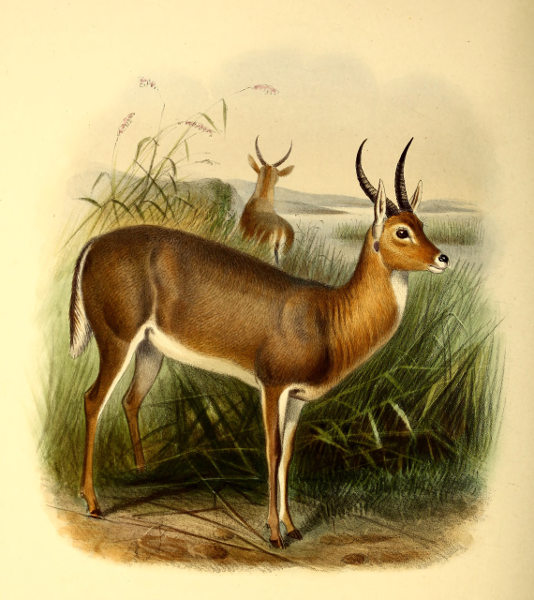
The Reed Buck.
CERVICAPRA ARUNDINUM.
Published by R. H. Porter.
70. THE REEDBUCK. CERVICAPRA ARUNDINUM (Bodd.). [PLATE XLIII.]
Ritbok, Allamand, in Buff. Suppl. vi. p. 187, pls. xxiii. & xxiv. (1782).
Antilope arundinum, Bodd. Elench. Anim. p. 141 (1785).
Cervicapra arundinum, Flow. & Lyd. Mamm. p. 340 (1891); Ward, Horn Meas. (1) p. 93 (1892), (2) p. 134 (1896); Nicolls & Egl. Sportsm. S. Afr. p. 36, pl. vii. fig. 23 (1892); Lyd. Horns & Hoofs, p. 227 (1893); Lugard, E. Afr. i. p. 538 (1893) (in part.) (Nyasa); Sclater, P. Z. S. 1893, p. 278 (L. Mweru); Thos. P. Z. S. 1894, p. 146 (Nyasa); Rendall, P. Z. S. 1895, p. 358 (Transvaal); Matschie, Thierwelt Ost-Afr., Säug. p. 127 (1895).
Antilope eleotragus, Schreb. Säug. pl. cclxvi. (1787); Shaw, Gen. Zool. ii. pt. 2, p. 349 (1801); G. Cuv. Dict. Sci. Nat. ii. p. 244 (1804); Thunb. Mém. Ac. Pétersb. iii. p. 314 (1811); Licht. Mag. nat. Fr. vi. p. 173 (1814); Afz. N. Act. Ups. vii. p. 220 (1815); Desm. N. Dict. d’H. N. (2) ii. p. 190 (1816); Goldf. Schr. Säug. v. p. 1225 (1818); Schinz, Cuv. Thierr. i. p. 395 (1821); Desm. Mamm. ii. p. 459 (1822); Burch. List Quadr. pres. to B. M. p. 6 (1825) (Rietfontein); H. Sm. Griff. An. K. iv. p. 237, v. p. 337 (1827); Less. Man. Mamm. p. 376 (1827); J. B. Fisch. Syn. Mamm. p. 465 (1829); Less. Compl. Buff. x. p. 290 (1836); Oken, Allg. Naturg. vii. p. 1364 (1838); Laurill. Dict. Univ. d’H. N. i. p. 621 (1839); Wagn. Schr. Säug. Suppl. iv. p. 426 (1844), v. p. 431 (1855); Schinz, Syn. Mamm. ii. p. 410 (1845); Gieb. Säug. p. 315 (1853–5).
Cerophorus (Cervicapra) eleotragus, Blainv. Bull. Soc. Philom. 1816, p. 75.
Redunca eleotragus, A. Sm. S. Afr. Quart. Journ. ii. p. 210 (1834); Rüpp. Verz. Senck. Mus. p. 38, Osteol. p. 51 (1842).
Eleotragus eleotragus, Jent. Notes Leyd. Mus. ix. p. 172 (1887) (Mossamedes).
Antilope cærulescens, Link, Beytr. Nat. ii. p. 99 (1795).
Antilope oreotragus, Bechst. Syst. Uebers. vierf. Th. i. p. 80 (1799) (nec Schreb.).
Antilope arundinaceus, Bechst. op. cit. i. p. 81 (1799), ii. p. 644 (1800); Shaw, Gen. Zool. ii. p. 347 (1801); Huet, Bull. Soc. Acclim. 1887, p. 485.
Cemas arundinacea, Oken, Lehrb. Nat. iii. pt. 2, p. 740 (1816).
Eleotragus arundinaceus, Gray, Ann. Mag. N. H. (1) xviii. p. 232 (1846); id. List Ost. B. M. p. 57 (1847); id. Knowsl. Men. p. 12 (1850); id. P. Z. S. 1850, p. 126; id. Ann. & Mag. N. H. (2) viii. p. 144 (1851); id. Cat. Ung. B. M p. 91 (1852); Gerr. Cat. Bones Mamm. B. M. p. 138 (1862); Kirk, P. Z. S. 1864, p. 657 (Zambesia); Drumm. Large Game S. Afr. p. 397 (1875); Gray, Cat. Rum. B. M. p. 18 (1872); id. Hand-l. Rum. B. M. p. 88 (1873); Bryden, Kloof and Karroo, p. 297 (1889); Bocage, J. Sci. Lisb. (2) v. p. 28 (1890) (Angola).
Cervicapra arundinacea, Selous, P. Z. S. 1881, p. 758 (distribution); id. Hunter’s Wanderings S. Afr. p. 216 (1881); Crawshay, P. Z. S. 1890, p. 653 (Nyasa); W. Scl. Cat. Mamm. Calc. Mus. ii. p. 164 (1891); Lorenz, Ann. Mus. Wien, ix. Notizen, p. 61 (1894).
Antilope cinerea, Bechst. Syst. Uebers. vierf. Th. ii. p. 643 (1800); Afzel. N. Act. Ups. vii. p. 250 (1815).
Antilope isabellina, Afzel. N. Act. Ups. vii. p. 250 (1815); Goldf. Schr. Säug. v. p. 1226 (1818); Desm. Mamm. ii. p. 460 (1822); H. Sm. Griff. An. K. iv. p. 240, v. p. 338 (1827); Licht. Darst. Säug. pl. x. (♂) (1827); Smuts, En. Mamm. Cap. p. 76 (1832); Schinz, Syn. Mamm. i. p. 411 (1845); id. Mon. Antil. p. 15, pl. xv. (1848); Peters, Säug. Mossamb. p. 189 (1852).
Redunca isabellina, A. Sm. S. Afr. Quart. J. ii. p. 210 (1834).
Redunca isabellina, varr. multiannulata, caffra, and algoensis, Fitz. SB. Wien, lix. 1, p. 169 (1869).
Eleotragus isabellinus, Gray, List Mamm. B. M. p. 165 (1843); Temm. Esq. Zool. Guin. p. 191 (1853); Jent. Cat. Mamm. Leyd. Mus. (Mus. P.-B. ix.) p. 159 (1892).
Cervicapra isabellina, Sund. Pecora, K. Vet.-Ak. Handb. 1844, p. 194 (1846); id. Hornschuch’s Transl., Arch. Skand. Beitr. ii. p. 146; Reprint, p. 70 (1848); Scl. List An. Zool. Soc. (8) p. 144 (1883).
Eleotragus reduncus, Gray, List of Mamm. p. 165 (1843) (nec Pall.).
Antilope oleotragus, Desmoul. Dict. Class. d’H. N. i. p. 446 (1822); Gerv. Dict. Sci. Nat. i. p. 261 (1840); Less. N. Tabl. R. A., Mamm. p. 177 (1842).
Vernacular Names:—Reedbuck of English and Reitbok of Dutch Cape Colonists. Inhlango of Kaffirs (Drummond); Cipohata of Bechuanas (Nicolls & Eglington); Imsigi or Umsagoka of Zulus; Ihlangu of Swazis (Rendall); Imzeegee of Matabili; Ee-bee-pa of Makalakas; Imvwee of Masubias; Umvwee of Makubas; Bemba of Masaras (Selous); Nsengo at Sena and Tette (Kirk); also Poyo at Tette (Peters). In Nyasaland, Mpoyo of Anyanja; Ndopi of Ajawa; Mzigi of Angoni; Swye of Ahenga and Amyika; Iswera of Ankonde (Crawshay). Nuxe in Angola (Bocage).
Size comparatively large; height at withers about 36 inches. General colour greyish fawn, very finely grizzled with brown. Head and neck clearer fawn. Face-markings generally absent, but a brown patch on the muzzle in some specimens, and on the crown between the ears in others; chin white. Backs of ears pale fawn, not black-tipped; a whitish patch at the base of the ears surrounding the auricular gland, which in young specimens is covered with short velvety-white hairs, and in old animals is entirely naked. Belly white. Fore legs generally black in front, from the knee downwards, fawn externally and white internally; hind legs also commonly marked with black on the lower part of the cannon-bone, otherwise fawn, but on both fore and hind limbs the dark markings are sometimes absent. Tail thick, bushy, reaching halfway to the hocks; fawn above and all round the base, white below and at the tip.
Horns evenly divergent, curved backwards and upwards; never strongly hooked at their tips. At their bases the growing pad, which in other species is absorbed at maturity, remains persistent throughout life as a soft rounded swelling. In length the horns of the adults attain from 14 to 16 inches.
Skull-measurements of an adult male:—basal length 10·3 inches, greatest breadth 4·7, muzzle to orbit 6·3.
Female like the male, but without horns.
Hab. South Africa, as far north as Angola on the west, and Mozambique on the east. (Whether C. bohor is only a smaller northern form of C. arundinum is as yet uncertain.)
The Reedbucks, although closely allied to the Waterbucks and hardly to be distinguished from them in osteological characters, as has been shown by Turner[11], are easily recognized externally by the forward turn of their horns and by the naked glandular spot which is always present to a greater or less extent on the sides of the head beneath the ears. Of the five species of Reedbuck which we treat of in the present work, three were known to the writers of the last century; but they have been much confused together, even by some of the more recent authorities, and it is a difficult task to unravel their complicated synonymy.
We will begin with the finest and largest species of this group, the well-known Reedbuck of the English colonists of the Cape, large specimens of which attain a height at the shoulders of thirty-six inches or more. Like the White-tailed Gnu, the Reedbuck was first described at Amsterdam by Allamand, whose account of it is quoted by Buffon in the sixth volume of his supplement to the ‘Histoire Naturelle,’ published in 1782. Buffon gives rough uncoloured figures of both sexes of this animal, under the name of “Le Ritbok,” which he adopts from Allamand. Upon Buffon’s “Ritbok” Boddaert, in his ‘Elenchus Animalium’ three years later, established his “Antilope arundinum” and thus furnished the first specific name of the present species. In 1787 Schreber issued a copy of Buffon’s figure of the male “Ritbok” with the name Antilope eleotragus upon it—a term which has been frequently adopted by the older authors, but which, as will be seen, is clearly subsequent in date to that of Boddaert. Bechstein, Shaw, and other authors following them have used arundinaceus, the adjectival form, as the specific term of the Reedbuck; but we see no reason for departing from Boddaert’s term of arundinum, which is perfectly good grammar.
In 1815 Afzelius, in the course of his learned commentary ‘De Antilopis speciatim Guineensibus,’ published at Upsala, introduced further complications into the subject by dividing the Reedbuck into two species. One of these he called “Antilope cinerea” based upon the “Ritbok” of Allamand; and the second Antilope isabellina, founded upon a South-African specimen in Thunberg’s collection. So far as we can make out, however, Afzelius shows no valid reason for distinguishing the latter species from the former, and we believe that both these names may be safely referred to Cervicapra arundinum. It should be noted also that in his ‘List of Mammals in the British Museum,’ published in 1843, Gray called the Reedbuck of the Cape Eleotragus reduncus, whereas the specific term reduncus properly appertains to the “Nagor”—the West-African species, of which we shall treat further on. In his subsequent writings, Gray usually reverted to the more correct specific term “arundinaceus” for the present species, but sometimes called it “isabellinus.”
Harris, in his great work on the ‘Game and Wild Animals of Southern Africa,’ published in 1840, figures the “Reitbok,” as he calls it, in his twenty-seventh portrait, along with the Wart-hog, and with an appropriate landscape of reeds and water. In those days the Reedbuck appears to have been common throughout the Colony, and is described by Harris as follows:—“This species resides either in pairs or in very small families along the margins of springs and swampy ground abounding in flags and rushes, or among the sedges that choke the channel of desiccated torrents, which flow only during the winter season. Specimens occurred throughout our route, chiefly to the eastward of the Colony, and in the tropical streams ‘’mongst reeds and willows that o’erhang the flood’; but owing to the shy and secluded habits of the animal, it was not often seen, nor is it in fact anywhere so common as on the western coast, where the attraction of water—a rare element in those barren regions—sometimes causes it to congregate in the open plain.”
Twenty years later, in 1861, Mr. Layard states that the Reedbuck was hardly then to be met with within the Colony! It is, however, as we are informed by Mr. W. L. Sclater, still to be found even up to the present day, though rarely, on some places on the east coast (Bathurst and Komgha), and in considerable numbers in the adjoining countries. Writing in 1881, Mr. Selous tells us that a few were then still to be found in the Transvaal, and that in Matabeleland and Mashonaland, on both slopes of the watershed, it was very common along the banks of the rivers. On the Manica plateau north of the Zambesi, Mr. Selous found Reedbucks particularly abundant, and had seen as many as eight at one time feeding in close proximity one to another. He remarks, however, that they are animals that go in pairs, and in this particular differ altogether from the various Waterbucks, which consort together in herds of not more than one male to ten females.
Messrs. Nicolls and Eglington, in their ‘Sportsman in South Africa,’ the most recent authority on this subject, give us the following account of the present distribution of the Reedbuck and of its habits:—“It is now extremely rare to meet with this species in the Transvaal, except along some of the rivers in the north-eastern districts, and in Bechuanaland it is virtually extinct, although five years ago it was fairly common in the reeds of the Molopo, close to the site of the present town of Mafeking. In portions of the British Protectorate bordering the Crocodile River, and along its north-western tributaries, the Reedbuck may still occasionally be met with, but nowhere there in plenty. In the low country on the east coast about the Pungwe and Sabi Rivers it is extremely numerous. On those rivers of Mashonaland and Matabeleland which are margined with reeds, and where it has not been driven out by the natives and the prospectors, it may be in places plentifully found. But along the Chobe, Mababe, Tamulakani, and Botletle Rivers (where the banks are not precipitous) it is still quite common. In the dry reed-patches bordering Lake Ngami, the Taouhe, and Okavango, as far up as Indalis, from which the water recedes during several months of the year, the Reedbuck is particularly numerous; so much so as to lead to the erroneous impression that this antelope is gregarious, so many often being observed together at one time. It is usual to find the rams and ewes consorting in pairs, accompanied by a couple of their immature progeny, usually frequenting dry patches of reeds; but when these become flooded they often resort to the bush in the immediate vicinity of water. Although always found in proximity to the latter element, the Reedbuck when pursued will never take refuge in it; but in endeavouring to escape will direct its course right away from the river-beds towards the shelter of the thick bush, and, where such is not at hand, even into the open country. When suddenly alarmed, the males sometimes give vent to a whistle resembling that of the Red Rhébok (Cervicapra fulvorufula). This species is rather easily approached, and the gallop being slow and regular, it is perhaps the easiest of the South-African antelopes to shoot; but, at the same time, it must be remarked that this, like all the other water-resorting varieties, possesses an extraordinary amount of vitality. The flesh is scarcely palatable, but the liver is considered a tit-bit.”
There is still much left to be ascertained about the range of the Reedbuck towards the north. On the west coast it certainly extends into Angola, where specimens have been recorded by Prof. Bocage, while Dr. Jentink includes it amongst the Mammals of Mossamedes, and registers examples in the Leyden Museum from Damaraland and Benguela. Far up the east coast it seems to be abundant in Nyasaland. Mr. Crawshay, in his “Field-Notes” on the Antelopes of this Protectorate (P. Z. S. 1890), considers it quite as widely distributed there as the Waterbuck, though in fewer numbers. He found it, perhaps, in greatest abundance on the vast swampy plains at the foot of the Wa-Kinga mountains, north-west of the lake. In their habits, he says, they are decidedly local, and day after day the same animals can be found in the same spot: they are specially partial to bare sandy patches and open plains, well away from cover:—“When alarmed they give vent to shrill screams, and bound off, kicking up their hind legs and tossing up their tails like rabbits. Their tails are thick and bushy, and, being white on the underside, present a striking appearance when their owners are making off.” Although they have a strong scent, Mr. Crawshay considers their flesh “better than that of any other antelope except that of the Impala and Eland.”
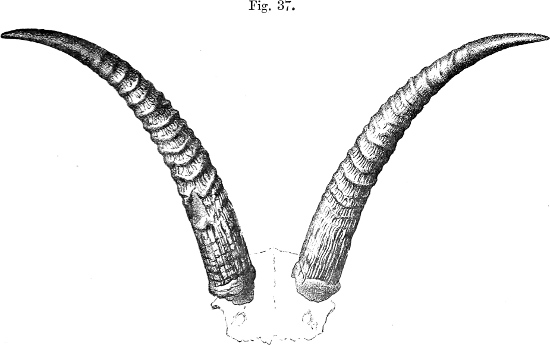
Fig. 37.
Horns of Cervicapra arundinum from Nyasaland (Major Trollope).
Amongst other hunters’ trophies from Nyasaland which Major F. C. Trollope has kindly allowed us to examine is a fine pair of horns of this Antelope, of which we give a figure. They measure 17 inches from the base to the tip along the curve and the distance between the points is 19½ inches.
In German East Africa, Dr. Matschie records the Reedbuck as having been obtained by Böhm, and observed by Neumann in several localities, although the latter traveller did not bring home specimens. Dr. Matschie seems a little doubtful as to its exact identity with the Reedbuck of the Cape, and it is probably somewhere here that C. bohor from the north inosculates with C. arundinum.
Reedbucks, even in the same district, appear to vary much in size, in colour, and in other external characters, and some authorities have attempted to divide them into several species. Sundevall, in his ‘Expositio Pecorum,’ has described four varieties of the present animal, remarking that all the specimens he has examined varied a little amongst themselves. Besides the differences in the direction of the hairs on the head, to which he alludes, there is much variation in the amount and in the depth of the dark markings on the feet, which are quite black in some examples and brown in others. Our figure (Plate XLIII.), which has been put upon the stone by Mr. Smit from an original drawing by Wolf (kindly lent to us by Sir Douglas Brooke), shows this particular feature in its less decided form. It was probably taken from a mounted specimen in the British Museum, but we regret to say there is no absolute certainty upon this point.
Living specimens of the Reedbuck are occasionally brought to Europe, but are rarely seen in our menageries, and do not bear captivity easily. The Zoological Society of London received examples of this species in 1864, 1865, and 1879, but none of them lived long in the Gardens.
February, 1897.
71. THE BOHOR. CERVICAPRA BOHOR (Rüpp.).
Antilope redunca, Rüpp. N. Wirb. Abyss, p. 20, pl. vii. fig. 1 (1835) (Woggers, Abyssinia) (nec Pall.).
Eleotragus reduncus, Heugl. Ant. u. Büff. N.O.-Afr. (N. Act. Leop. xxx. pt. 2), p. 11 (1863); Sclat. P. Z. S. 1864, p. 101 (Usagara, Speke); Jent. Cat. Mamm. Leyd. Mus. (Mus. P.-B. xi.) p. 150 (1892).
Redunca bohor, Rüpp. Verz. Senck. Mus. p. 38, Osteol. p. 50 (1842); Fitz. SB. Wien, lix. pt. 1, p. 169 (1869).
Antilope (Redunca) bohor, Wagn. Schr. Säug. Suppl. iv. p. 425 (1844), v. p. 432 (1855).
Cervicapra bohor, Sund. Pecora, K. Vet.-Ak. Handl. 1844, p. 195 (1846); id. Hornschuch’s Transl., Arch. Skand. Beitr. ii. p. 146; Reprint, p. 70 (1848); Scl. List An. Zool. Soc. (8) p. 144 (1883), (9) p. 153 (1896); Günth. P. Z. S. 1890, p. 604; Flow. & Lyd. Mamm. p. 340 (1891); Ward, Horn Meas. (1) p. 93 (1892), (2) p. 136 (1896); Lyd. Horns and Hoofs, p. 229 (1893); Jackson, Badm. Big Game Shooting, i. pp. 285 & 297 (1894); Matschie, Thierw. Ost-Afr., Säug. p. 128 (1895).
Eleotragus bohor, Temm. Esq. Zool. Guin. p. 191 (1853).
Eleotragus arundinaceus, Heugl. Ant. u. Büff. N.O.-Afr. (N. Act. Leop. xxx. pt. ii. p. 11 (1863) (Sobat); Pagenst. JB. Hamb. ii. p. 36 (1884) (Maurui, Masailand); True, Pr. U. S. Nat. Mus. xv. p. 472 (1892) (Kilimanjaro).
Antilope arundinacea, Schweinf. Herz von Afrika, ii. pp. 465 & 534 (1874).
Cervicapra arundineum, Lugard, E. Afr. i. p. 538 (1893) (Ruwenzori).
Kobus, sp. inc., Scl. P. Z. S. 1864, p. 103 (Uganda).
Reedbuck, Hunter, in Willoughby’s E. Africa, p. 289 (1889).
Vernacular Names:—Xondieh in Arabic; Behor or Bohor in Amharic (Rüppell & Heuglin); Oboor of the Madi (Baku, fide Günther); Käo in Dinka; Pohr in Djur; Jalo in Bongo; Joro in Niam-Niam; Ngallah in Golo; Djiang in Ssebre (Schweinfurth); Njasa in Uganda (Lugard); Porhi in Swahili (Hunter), also Toi or Tohi (Jackson).
Nearly similar to C. arundinum, but decidedly smaller, and with the horn more hooked at their tip. As the hooked tip, however, gradually wears off, and the horns grow up straight from their bases, even this difference tends to disappear in quite adult specimens. The horns attain a length of from 10 to 13 inches. The tail is rather shorter and less bushy than in C. arundinum, and the black markings of the limbs are less defined than in well-marked examples of that species. In the general colour there is also less difference between the head and the body than in C. arundinum, both being fawn-coloured.
Skull dimensions of an old male:—Basal length 9 inches, greatest breadth 4·3, muzzle to orbit 5·35.
Female. Like the male, but hornless.
Hab. Abyssinia and East Africa, southward to Kilimanjaro.
The great explorer of Abyssinia, Rüppell, was the first to obtain specimens of the Reedbuck in that country, although its existence there had, perhaps, been vaguely alluded to by Bruce in his ‘Travels.’ Rüppell was at first inclined to refer the Abyssinian animal, which he met with in the plains of Woggara, to C. redunca, but at a later period, when he had had an opportunity of comparing its skull with that of the West-African species, came to the conclusion that it was distinct, and changed its specific name to “bohor.” “Cervicapra bohor” has therefore been generally adopted as the appellation of the East-African Reedbuck, although, as yet, we are far from being well acquainted with this animal and the points of its distinctions from its congeners.
Heuglin, in his memoir on the Antelopes of North-east Africa, enumerates this species still under the name redunca of Pallas, but quotes the plate of Antilope bohor in Rüppell’s ‘Atlas,’ and gives its native Amharic name as “Behor.” Heuglin met with it in small troops in the bushy plains and hills of the provinces of Woggara, Dembea, Begemeger, and Foggara in Abyssinia, at a height of from six to eight hundred feet above the sea-level. Heuglin was not certain as to having encountered this Antelope in the districts west of the Nile, but believed that a female specimen which he obtained in November 1853, in Southern Kordofan, must have belonged to it. According to Dr. Günther (P. Z. S. 1890, p. 607), Sir Samuel Baker met with the Bohor among the Madi tribes on the White Nile between 4° and 2° 30´ N. lat., and supplied him with a sketch of the skull which enabled him to identify the species.
We have as yet no records of any Reedbuck having been obtained in Somaliland, but when we go further south to British East Africa we have good evidence from several trustworthy observers of its existence in that country. It is a difficult question, however, and one which is by no means yet decided, whether the East-African Reedbuck is the same as the Abyssinian “Bohor.”
Dr. Günther was the first to interest himself in this subject, and contributed a paper on it to the Zoological Society’s ‘Proceedings’ in 1890. Taking the skull of an adult male Reedbuck, obtained by Mr. H. C. V. Hunter in British East Africa, he pointed out the differences between it and the South-African Reedbuck called C. redunca by Gray, which is in fact C. fulvorufula of the present work. By the kind permission of the Zoological Society of London we are enabled to reproduce the woodcuts of the portions of the skull of these two Antelopes upon which Dr. Günther based his conclusions, and we add thereto Dr. Günther’s descriptions of these differences.
“Cervicapra fulvorufula[12] (fig. 38, p. 168) is distinguished by its very large orbit; in a skull 230 millim. long the vertical dimension of the orbit is 45 millim.; the eyeball is supported below by a largely expanded concavity of the jugal bone, the lower edge of the orbit being particularly sharp and thin, merging into the suture between the jugal and lacrymal bones. The cheek part of the skull is flat, rather concave, so that the facial portion of the cranium between the orbit and the antorbital foramen appears rather compressed when viewed from above. The ascending ramus of the intermaxillary reaches to, or nearly to, the nasal bone. The horns are but slightly divergent and very little bent forwards.
“In Cervicapra bohor (fig. 39, p. 169) the orbit is comparatively smaller; in a skull 245 millim. long the vertical diameter of the orbit is only 40 millim.; the jugal bone is much less expanded to form the bottom of the orbital cavity; the lower rim of the orbit has two edges, the lower of which does not merge into the jugo-lacrymal suture, but runs parallel to it at a distance of about 8 millim. The cheek part of the skull is swollen and convex, so that the facial portion of the cranium above the molar teeth cannot be termed compressed. The ascending ramus of the intermaxillary is short, terminating at a considerable distance from the nasal bone.”
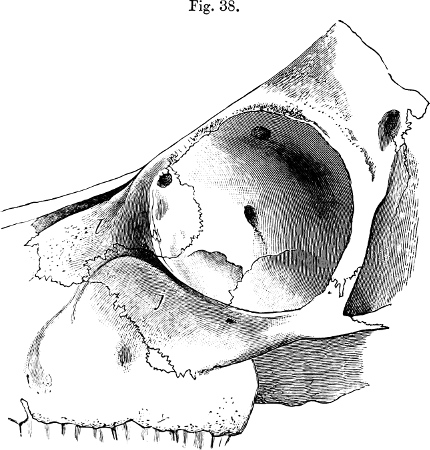
Fig. 38.
Skull of Cervicapra fulvorufula.—j, jugal; l, lacrymal.
(P. Z. S. 1890, p. 604.)
Dr. Günther adds that the horns of C. bohor are much stronger and larger than in Cervicapra fulvorufula; their basal portion is somewhat flattened from the front backwards, but similarly corrugated; they diverge very slightly and have their points strongly curved forwards. He also says that the skull of a female Antelope brought home by Capt. Speke and given to the Museum in 1863 evidently belongs to C. bohor[13]; it has the basal portion of the nasal bones raised into a slight convexity, whilst this part is flat in the male. A similar sexual difference exists in the skulls of Cervicapra arundinum.
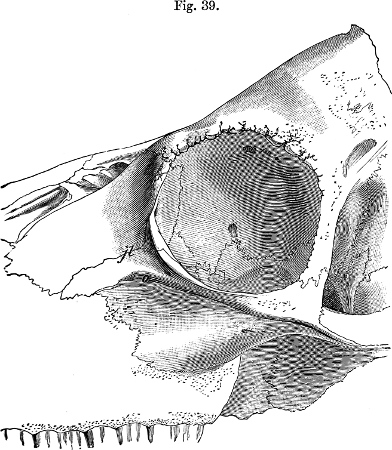
Fig. 39.
Skull of Cervicapra bohor.—jl, jugo-lacrymal suture; o, lower edge of infra-orbital rim.
(P. Z. S. 1890, p. 605.)
Assuming Dr. Günther’s view to be correct, and that the Reedbuck of British East Africa is truly referable to Cervicapra bohor, we will proceed to recount what has been said about it by the leading authorities on the antelopes of this country. Mr. Hunter, from whom, it will be recollected, Dr. Günther obtained the specimen upon which he made his observations, tells us that the Reedbuck met with in the district of Kilimanjaro is usually found in the early morning and evening feeding near the edges of the reedy swamps, and when disturbed immediately runs into the rushes. Mr. Hunter and his companions found it very common in a large swamp near Mikundune, to the south-west of the mountain. Mr. Jackson, who calls the same antelope the “Lesser Reedbuck,” and gives its Swahili name as “Toi” or “Tohi,” tells us that this species is very local in British East Africa, and, as a rule, frequents only the vicinity of rivers and swamps that are never dry. He found it on the shores of Lake Jipi, and on the river Ziwa, to the east of Kilimanjaro, and in a few other places. He also saw on the hills to the north-west of Machako’s several small herds of it, which had evidently been driven up there by the grass-fires in the plains. Mr. Jackson remarks that these Reedbucks give a shrill whistle when disturbed, and are very shy and difficult to stalk, but that in long grass they lie close and sometimes allow the sportsman to approach to within twenty or thirty yards of them.
In the large series of mammals obtained by Dr. Abbott in the district of Kilimanjaro, which has been described by Mr. True, there were two young male specimens of a Reedbuck which were referred by Mr. True to C. arundinum, but which belonged no doubt to the present species (if distinct).
This species is so like C. arundinum in its general external characters that we have not thought it worth while to give a special figure of it. Besides the skull in the National Collection presented by Mr. H. C. V. Hunter, and used for description by Dr. Günther, as mentioned above, and the female head from Uganda obtained by Speke, also already spoken of, there are in the British Museum two good specimens, adult and young, presented by Major Kenrick. The more adult of these, as Major Kenrick kindly informs us, was shot in July 1892, about six miles east of Kiumengelia, at the north-east corner of the Kilimanjaro range, and the younger one in August of the same year on the banks of the Pangani River, both these places being now within the limits of German East Africa.
Reedbucks, as we have already stated, do not, as a rule, do well in captivity. The Zoological Society of London have on two occasions (in 1877 and 1883) received female Reedbucks from East Africa which have been referred with some doubt to the present species. In neither instance, however, did they live long in the Society’s Gardens.
February, 1897.
THE BOOK OF ANTELOPES, PL. XLIV.
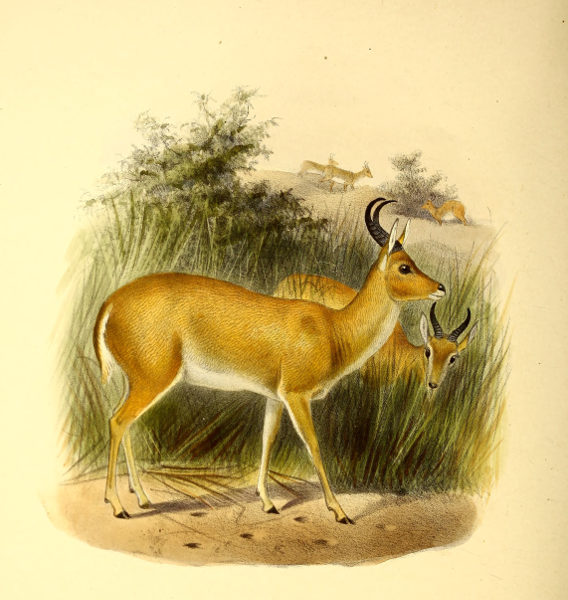
Wolf del., J. Smit lith.
Hanhart imp.
The Nagor.
CERVICAPRA REDUNCA.
Published by R. H. Porter.
72. THE NAGOR. CERVICAPRA REDUNCA (Pall.). [PLATE XLIV.]
Le Nagor, Buff. Hist. Nat. xii. p. 326, pl. xlvi. (1764) (Goree Isl., Senegambia).
Antilope reversa, Pall. Misc. Zool. p. 5 (1766) (nec Capra reversa, L.).
Antilope redunca, Pall. Spic. Zool. i. p. 8 (1767), xii. p. 13 (1777); Müll. Natursyst. Suppl. p. 53 (1776); Erxl. Syst. R. A. p. 281 (1777); Zimm. Spec. Zool. Geog. p. 541 (1777); id. Geogr. Gesch. ii. p. 114 (1780); iii. expl. to chart, p. 9 (1783); Gatt. Brev. Zool. i. p. 81 (1780); Herm. Tab. Affin. Anim. p. 108 (1783); Schreb. Säug. pl. cclxv. (1785); Bodd. Elench. Anim. p. 141 (1785); Gmel. Linn. S. N. i. p. 184 (1788); Kerr, Linn. An. K. p. 308 (1792); Donnd. Zool. Beytr. i. p. 624 (1792); Link, Beytr. Nat. ii. p. 98 (1795); Bechst. Syst. Uebers. vierf. Th. ii. p. 643 (1800); Shaw, Gen. Zool. ii. pt. 2, p. 360 (1801); Turt. Linn. S. N. i. p. 112 (1802); Desm. N. Dict. d’H. N. (1) xv. p. 330 (1803), xxiv. Tabl. p. 32 (1804); G. Cuv. Dict. Sci. Nat. ii. p. 243 (1804); Tiedem. Zool. i. p. 409 (1808); Licht. Mag. nat. Fr. vi. p. 170 (1814); G. Fisch. Zoogn. iii. p. 410 (1814); Afzel. N. Act. Ups. vii. p. 220 (1815); Desm. N. Dict. d’H. N. (2) ii. p. 188 (1816); Goldf. Schr. Säug. v. p. 1200 (1818); Schinz, Cuv. Thierr. i. p. 395 (1821); Desm. Mamm. ii. p. 458 (1822); H. Sm. Griff. An. K. iv. p. 238, v. p. 338 (1827); Less. Man. Mamm. p. 375 (1827); J. B. Fisch. Syn. Mamm. p. 464 (1829); Less. Compl. Buff. x. p. 290 (1836); Oken, Allg. Nat. vii. p. 1385 (1838); Laurill. Dict. Univ. d’H. N. i. p. 621 (1839); Gerv. Dict. Sci. Nat. i. p. 261 (1840); Less. N. Tabl. R. A., Mamm. p. 177 (1842); Wagn. Schr. Säug. Suppl. iv. p. 426 (1844), v. p. 431 (1855); Schinz, Syn. Mamm. ii. p. 425 (1845); Rüpp. Mus. Senckenb. iii. p. 182 (1845); Gieb. Säug. p. 314 (1853–5); Huet, Bull. Soc. Acclim. 1887, p. 267.
Cerophorus (Cervicapra) redunca, Blainv. Bull. Soc. Philom. 1816, p. 75.
Eleotragus reduncus, Gray, Ann. Mag. N. H. (1) xviii. p. 232 (1846); id. Knowsl. Men. p. 13, pl. xiii. (1850); id. P. Z. S. 1850, p. 127; id. Ann. & Mag. N. H. (2) viii. p. 145 (1851); id. Cat. Ung. B. M. p. 94 (1852); Temm. Esq. Zool. Guin. p. 191 (1853); Gray, Cat. Rum. B. M. p. 18 (1872); id. Hand-l. Rum. B. M. p. 88 (1873); Jent. Cat. Ost. Leyd. Mus. (Mus. Pays-Bas, ix.), p. 130 (1887); Huet, Bull. Soc. Acclim. 1887, p. 84.
Cervicapra redunca, Sund. Pecora, K. Vet.-Ak. Handl. 1844, p. 195 (1846); id. Hornschuch’s Transl., Arch. Skand. Beitr. ii. p. 146; Reprint, p. 70 (1848); Flow. & Lyd. Mamm. p. 340 (1891); Lyd. Horns and Hoofs, p. 228 (1893); Scl. P. Z. S. 1890, p. 698; id. List of An. Zool. Soc. (9) p. 153 (1896).
Redunca redunca, Fitz. SB. Wien, lix. 1, p. 169 (1869).
Antilope rufa, Afzel. N. Act. Ups. vii. p. 250 (1815).
Ourebi du Sénégal[14], F. Cuv. Hist. Nat. (fol.) iii. livr. lx., imm. ♀ (1829), whence
Antilope fulva, Schinz, Mon. Antil. p. 17 (1848).
Redunca nagor, Rüpp. Verz. Senck. Mus. p. 38, Ost. p. 51 (1842).
Vernacular Name:—Wonto of natives on the Gambia (Gray, fide Whitfield).
Size decidedly smaller than in the previous species, the height at the withers only about 27 or 28 inches. Colour uniform bright fawn generally, without darker markings on the limbs; head and body quite alike. Tail comparatively short and little bushy, fawn above, white below.
Horns very thick in proportion to the size of the animal, 5 inches in circumference at the base but only about 8 to 10 inches long. Their terminal portion is strongly turned forwards, a character most marked in rather young specimens before the long straight basal part has grown.
Dimensions of a male skull:—Basal length 8·1 inches, greatest breadth 3·8, muzzle to orbit 5.
Female similar, but hornless.
Hab. West Africa north of the forest region (Senegal and Gambia).
The Reedbuck of West Africa was somewhat vaguely described by Buffon, in his ‘Histoire Naturelle,’ from a stuffed specimen in the cabinet of Adanson, which had been obtained from the island of Goree on the coast of Senegal. Fortunately Buffon added a tolerably recognizable figure of the “Nagor,” as he proposed to call it (from its fancied resemblance to the “Nanguer,” i. e. Gazella dama!), and taking this figure into consideration along with the locality, we can have little doubt as to its identity. In the first essay on the Antelopes, published in his ‘Miscellanea Zoologica,’ in 1766, Pallas suggested the name “Antilope reversa” for Buffon’s “Nagor”; but in his second essay on the same subject, issued in the ‘Spicilegia Zoologica’ in 1767, Pallas changed this name, which had been already used by Linnæus for another animal, to Antilope redunca. There can be no doubt, therefore, that redunca is the proper specific name of the present species of Cervicapra, although this term has been applied by various authors, as will be seen by reference to our lists of synonyms, to three other species of the genus.
Beyond quoting Buffon’s account of the “Nagor” and references to the authors who had adopted his description, little, if anything more, appears to have been added by subsequent writers to our knowledge of Cervicapra redunca until 1850, when the ‘Gleanings’ from the Knowsley Menagerie were published. In the letterpress to this work Gray appears to have confounded the present animal with C. bohor, and perhaps with C. fulvorufula, but the plate of Eleotragus reduncus (tab. xiii.) seems to represent a male and young one of the present species. In the letterpress we are told that a “young male” was then living at Knowsley, and, so far as we can understand the remarks, had been obtained from the Gambia, where Whitfield had given its native name as “Wonto.” Again, from 1850 to the present period there has been an almost complete blank in the history of the West-African Reedbuck. No examples of it appear to have been received either by the British Museum or at Leyden, and the species seems to have remained (even up to the present time) unrepresented in most of the great National Collections, except in Paris, where there are two mounted males from Senegal, besides other specimens formerly living in the Menagerie, and in the Senckenbergian Museum at Frankfort-on-the-Main, where, according to Rüppell’s list (Mus. Senck. iii. p. 182), there is also a specimen of it, which enabled him to realize the differences between this species and C. bohor.
It was not until 1890 that the Zoological Society of London received their first living specimen of this scarce Antelope. This was a young male brought home from the Gambia and presented to the Society, along with a young male Harnessed Antelope, by Dr. Percy Rendall, F.Z.S., on the 23rd of June of that year. A photograph presented by Dr. Rendall to Sclater, which was taken at Bathurst in August 1889, represents the Harnessed Antelope, at that time one year old, and the little Nagor, then only four months old, being fed together by Dr. Rendall himself. The Nagor, we need hardly say, has long ago attained its full stature, and at the time we write (January 1897) is, we are glad to say, still living and thriving in the Zoological Society’s Antelope-House.
It stands about 28 inches high at the shoulders, and is above of a nearly uniform reddish brown in colour, rather darker on the central line; the insides of the ears and the ocular region are white, the face being rather more rufous. The belly and inner sides of the limbs are whitish. The large naked space beneath the ear is white and very noticeable. The tail is short, broad, and bushy, like the back above, and white beneath. The horns are black; the distance from their base to their tips is about 5½ inches in a straight line; the muzzle is moist, naked, and black; and the hoofs are black.
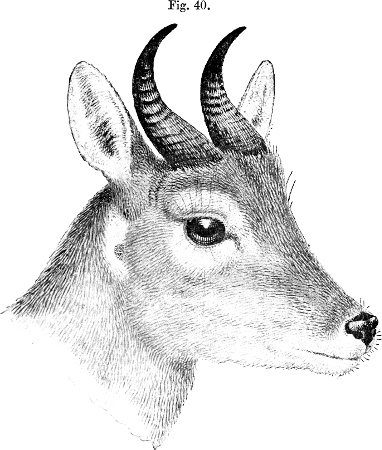
Fig. 40.
Head of Cervicapra redunca. (In viv. Soc. Zool. Lond.)
So far as we know this is the only example of the Nagor that has reached Europe alive, except the specimens formerly in the Knowsley Menagerie and in the Jardin des Plantes of which we have already spoken.
Our figure of the present species has been put on the stone by Smit from a coloured sketch prepared for the late Sir Victor Brooke by Wolf. Through the kindness of Sir Douglas Brooke we have been able to examine the original drawing, which is marked on the back “C. redunca” in Sir Victor Brooke’s handwriting, but we have no clue as to the original specimen from which it was taken.
February, 1897.
THE BOOK OF ANTELOPES, PL. XLV.
J. Smit lith.
Hanhart imp.
The Roi Rhebok.
CERVICAPRA FULVORUFULA.
Published by R. H. Porter.
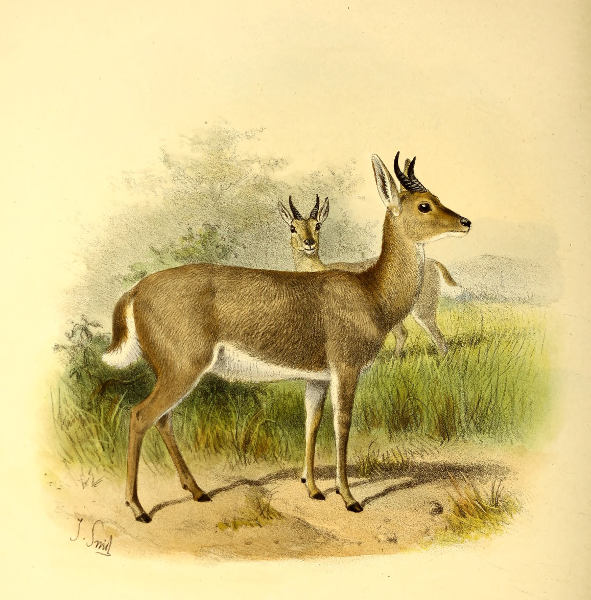
73. THE ROI RHÉBOK. CERVICAPRA FULVORUFULA (Afzel.). [PLATE XLV.]
Antilope fulvorufula, Afzel. N. Act. Ups. vii. p. 250 (1815) (ex Allamand, in Buff. Suppl. vi. p. 188 (1782); Goldf. Schr. Säug. v. p. 1226 (1818); H. Sm. Griff. An. K. iv. p. 239 (1827).
Antilope lalandia, Desmoul. Dict. Class. d’H. N. i. p. 445 (1822); Less. Man. Mamm. p. 378 (1827).
Antilope landiana, Desm. Mamm. ii. p. 462 (1822).
Antilope lalandii, J. B. Fisch. Syn. Mamm. p. 467 (1829); Laurill. Dict. Univ. d’H. N. i. p. 621 (1839); Schinz, Syn. Mamm. ii. p. 415 (1845).
Redunca lalandii, A. Sm. S. Afr. Quart. J. ii. p. 210 (1834).
Cervicapra lalandii, Nicolls & Egl. Sportsm. S. Afr. p. 34, pl. i. fig. 4 (1892); Lyd. Horns and Hoofs, p. 228 (1893); Ward, Horn Meas. (2) p. 132 (1896); Rendall, P. Z. S. 1895, p. 359 (Transvaal).
Antilope eleotragus, Licht. Darst. Säug. pl. ix. (♂ ♀) (1827) (nec Schreb.); Smuts, En. Mamm. Cap. p. 75 (1832); Schinz, Mon. Antil. p. 15, pl. xiv. (1848).
Cervicapra eleotragus, Sund. Pecora, K. Vet.-Ak. Handl. 1844, p. 194 (1846); id. Hornschuch’s Transl., Arch. Skand. Beitr. ii. p. 145; Reprint, p. 69 (1848).
Redunca eleotragus, Fitz. SB. Wien, lix. 1, p. 169 (1869); Brehm, Thierl. iii. p. 222 (1880).
Eleotragus eleotragus, Jent. Cat. Ost. Leyd. Mus. (Mus. Pays-Bas. ix.) p. 130 (1887); id. Cat. Mamm. Leyd. Mus. (op. cit. xi.) p. 159 (1892).
Eleotragus reduncus, Bryden, Kloof and Karroo, p. 298 (1889).
Cervicapra redunca, Günth. P. Z. S. 1890, p. 604.
Eleotragus arundinaceus, Temm. Esq. Zool. Guin. p. 191 (1853) (nec Bechst.).
Vernacular Names:—Roi Rhébok of Dutch and English Cape Colonists; Njala or Ihlangu matse (i. e., Reedbuck of the Rocks) of the Swazi (Rendall).
Size about that of C. redunca; height at withers 28 inches. General colour greyish fawn, brighter, sometimes almost rufous, on the head and neck, greyer on the body. Chin, upper part of throat, belly, and inner sides of limbs white. Darker leg-markings absent or inconspicuous. Tail only reaching about to the level of the groin, very bushy, fawn above, white below.
Horns slender, not exceeding 4 inches in circumference, evenly curved upwards and forwards, but showing in a very marked degree the change of general form with age already referred to in the other species.
Skull measurements of an adult male:—Basal length 8·1 inches, greatest breadth 4·1, muzzle to orbit 5·1.
Female similar to the male, but hornless.
Hab. Eastern portion of South Africa south of the Zambesi, especially Natal, Zululand, and Bechuanaland.
Besides the ordinary Reedbuck of the Cape (which is that called in this work Cervicapra arundinum) the Dutch settlers have from an early date recognized the existence of a second species of the same group in eastern parts of the Colony, which, instead of frequenting banks of rivers, resorts to the terraces of the mountains, and is commonly called the “Roi Rhébok,” or “Red Roebuck.” Great confusion has prevailed for many years as to the proper scientific name of this species. By Lichtenstein and Sundevall it has been called “eleotragus,” and by Gray “reduncus”; but, according to our views, both these names are properly applicable to other species. Until lately we have used for it the specific term “lalandii” it being in all probability the “Antilope lalandia” of Desmoulins, founded by that author in 1822 upon a specimen of a female Antelope in the Musée d’Histoire Naturelle obtained at the Cape by the well-known French collector Delalande. But we have lately found another older name for it, which, under the circumstances, we think we shall be justified in employing, although we must confess that in all these old names there is a considerable element of uncertainty. After describing the Reedbuck (C. arundinum) Allamand, in his edition of Buffon (as quoted by Afzelius), speaks of another similar animal of a darker colour, which is found in the mountains of the Cape Colony. Upon this variety of Allamand, Afzelius, in his memoir on Antelopes, published at Upsala in 1815, proceeds to establish a species Antilope fulvorufula. Between two uncertain names, therefore, in order to avoid the necessity of proposing a new one, we will select the oldest and call the Roi Rhébok Cervicapra fulvorufula.
The earliest good description and figure of this species were published by Lichtenstein in the second Heft of his ‘Darstellung der Säugethiere,’ issued at Berlin about the year 1829. Here Antilope eleotragus, as he unfortunately calls it, is well distinguished by many characters from the larger Reedbuck (which Lichtenstein termed A. isabellina), and figures are given of it of both sexes.
Harris, during his extensive travels in South Africa in 1836 and 1837, curiously enough does not seem to have recognized this Antelope as a distinct species, but alludes to it in the letterpress to his ‘Portraits’ as a variety of the Reedbuck, “usually met with on high rocky mountains along the dry channels of upland streams.” Of this supposed variety he had killed a single specimen in the Cashan range, but doubted whether it was more than a young individual of the well-known Reedbuck. But we have good accounts of the habits and distribution of this Antelope from more recent authorities, who take a very different view of its position.
The “Roi-raebuck,” Mr. W. H. Drummond tells us, in his volume on the ‘Large Game of South Africa,’ published in 1875, though inhabiting thorny districts, prefers such as are on stony or broken ground. It is a fine large Antelope, but a little smaller than the Reedbuck, though its colour, he says, as its name implies, is of a reddish tinge.
Messrs. Nicolls and Eglington, writing in 1892 in their ‘Sportsman in South Africa,’ give a small but very recognizable representation of the head of the Red Rhébuck (see figure 4 of their first plate), and, after speaking of what has been called the “Lesser Reedbuck” (which is probably nothing more than this species under another English name), point out that the Red Rhébuck is quite a different animal from the true Reedbuck, and has totally different habits. The Red Rhébuck “runs in herds, often exceeding twenty in number, and invariably frequents the summits of hilly and mountainous districts, where there are no reeds and where water may be miles and miles distant”; whereas the Reedbuck is found “either in pairs or in parties, never exceeding four in number,” only in low lying country along rivers which have reeds on their banks. “The one peculiarity common to both species is the fact that the males, when alarmed, give vent to a shrill whistle.”
As regards the distribution of this species, the same writers inform us:—“The Red Rhébuck is generally found in favourable localities all over that part of Africa south of the Zambesi, but more plentiful in the mountainous ranges of the Transvaal and the broken country in the Bechuanaland Protectorate, especially the vicinity of Sichele’s stronghold. Resorting to inaccessible places, it is nowhere by any means abundant, and consequently specimens are but seldom obtained. Like the Vaal Rhébuck (Pelea capreolus) one old ram of a herd constantly acts as sentinel while the remainder feed, and on the least approach of danger at once gives the alarm by shrilly whistling. The flesh is somewhat poor.”
In his recently published ‘Haunts of Wild Game,’ Mr. F. V. Kirby, F.Z.S., has given us an excellent account of his sporting wanderings in the north-eastern provinces of the Transvaal. Here this Reedbuck, as he tells us, is now only found on the mountain-range of the Drakensberg. In former days, however, he had seen them amongst the foot-hills and well down in the flats in the district lying between the Sabi and Crocodile Rivers, where they run in small troops of from six to eight.
A letter received by Sclater from Mr. Kirby in the summer of 1896 gives the following further particulars of this Antelope:—
“The so-called Rooi Rhébuck are usually found in pairs, or in small ‘clumpies’ (excuse the Dutch) of four or five. Never on the bleak open mountain-summits like Pelea capreolus, but always on the ‘hang’ of the mountains—the narrow terraces thickly covered with sugar-bush. They lie close like Reedbuck, and when alarmed move off with a shrill whistle, like that of their confrères. Their action when in motion is also similar to that of C. arundinum—a sort of easy, free, rocking-horse motion, like a horse in a hand canter.
“The tail is always fan-spread, as in C. arundinum. The fur of the young animal is very woolly in texture, as in that of the young Reedbuck. The flesh I consider decidedly coarse, quite as much as that of Pelea capreolus.
“When running off on being alarmed, a sharp whistle will usually bring them to a stand, under 200 yards. Amongst the rocks they are quite as active as Vaal Rhébuck, but unlike them, when alarmed, they never run up hill towards the summits, but invariably make down for the deep wooded kloofs. The young are born in October to December. I have seen Rooi Rhébuck running with Vaal Rhébuck (Pelea capreolus) in a troop, but only when all have been alarmed on the edge of the kloof together.”
Mr. F. C. Selous, who did not include the Roi Rhébok amongst the species met with in his ‘Hunter’s Wanderings,’ published in 1881, subsequently obtained full particulars concerning this species, and has kindly favoured us with the following valuable notes:—
“The ‘Rooi Rhébok’ of the Boers is an inhabitant of arid stony hills, and wherever such hills are met with one may expect to find this handsome little Antelope throughout the Cape Colony, Natal, Zululand, the Orange Free State, the Transvaal, Bechuanaland, and the southern portion of the Bechuanaland Protectorate. In the west it does not range further north than Sichele’s country, and though plentiful in the parched-up stony hills scattered over the territory of that chief, it is unknown in very similar ground in Khama’s country, only a short distance further north; nor have I ever heard of its existence in any country to the north of the Limpopo River, and it is certainly unknown in Makalakaland, Matabeleland, and Mashunaland. In appearance the Red Rhébuck looks very much like a miniature Reedbuck, but on a close inspection, although the resemblance between the two species is very close, certain points of difference will be noted. Both species have a large fluffy tail, which they throw up when alarmed, exposing the white under surface; the shape of the ears is the same in both, and both have bare spots about the size of a sixpence an inch below the base of the ears. There is not much difference in the colour of the two species, and the distribution of white on the underparts of each is the same. The character of the horns in the two species is, however, different, for although the male Red Rhébuck has horns crooking forwards like those of a Reedbuck, a pair of Red Rhébuck horns do not look like a pair of Reedbuck horns in miniature. The minor points of divergence would be difficult to explain, though apparent enough on comparison of actual specimens; but the most important difference is the absence in the Red Rhébuck of the soft cushion at the base of the horn, which is always present in the Reedbuck. This soft gristly cushion covered with black skin, at the base of the horn above the eye, is found in no other Antelope but the Reedbuck, and is never absent in this species, nor does it ever disappear or turn into horn with age, being invariably found at the base of the horns of the oldest males. In the Red Rhébuck the hair grows close up round the base of the horn, as in all other Antelopes, with the exception of the Reedbuck. In both species the females are hornless, and in both the alarm-call is a shrill whistle. Although the Red Rhébuck is so similar in shape, coloration, and general appearance that it looks like a miniature Reedbuck, in its habits and mode of life it differs entirely from that species. The Reedbuck, as its name implies, loves the neighbourhood of rivers and lakes and swamps, and is never found far away from water. It does not occur in herds, but in small families, a male and female usually living together, the latter often accompanied by its last year’s kid. It is worthy of remark, however, that the Reedbuck though, as a rule, it is a dweller on level ground on the borders of rivers and lakes, in some parts of the country may often be found on stony ridges where these latter are in the immediate vicinity of rivers, as is often the case in Mashunaland. As the Red Rhébuck is not found in any of the countries between the Limpopo and the Zambesi, through which my various hunting expeditions have led me, my knowledge of these little Antelopes is not very extensive. However, whilst journeying slowly from Port Elizabeth to the Diamond Fields by bullock-waggon first in 1871, and for the second time in 1876, I saw a considerable number of them both in the hills of the Cape Colony and in those of the Orange Free State, and shot in all about a dozen specimens. More recently, in the early part of 1888, I searched for and found a good many Red Rhébuck in the arid hills near Sechele’s town[15], and secured the heads of three fine males for my collection. According to my experience the Red Rhébuck is usually to be met with in small herds of from three or four to fifteen animals, only one full-grown buck being with the herd, though a young male or two with horns not fully developed may also be present. Old males at certain seasons leave the herds and live alone, as is the case with all other gregarious Antelopes. The hills on which I found Red Rhébuck were of no great altitude, rising as a rule from 500 to 1000 feet above the surrounding country. Often they were flat or table-topped, with a precipitous cliff of 50 or 60 feet in height just below the table-like summit. In such cases I often found the Red Rhébuck lying in the bushes just at the base of these cliffs. Where arid stony hills, which they are known to frequent, are intersected by ravines, in which grow a certain amount of scrubby bush, Red Rhébuck will most likely be found in the neighbourhood of such ravines. In my experience these Antelopes are usually to be met with well up the sides and near the tops of the hills which they frequent, and are best hunted from the summit of the hill, as they always run upwards when alarmed. In the hills where I last hunted Red Rhébuck in Sechele’s country, there was absolutely no water whatever, and in the Cape Colony and the Free State the hills are also for the most part arid and waterless; so that these little Antelopes seem to be able to do without drinking water for several months in the year, as is the case with many other Antelopes in South-western Africa. I now forget the general colour of the Red Rhébucks I shot many years ago in the Cape Colony and the Orange Free State; but the three males I last shot in the Bechuanaland Protectorate were fawn-coloured on the head and neck, and dark grey on the upper parts of the body.”
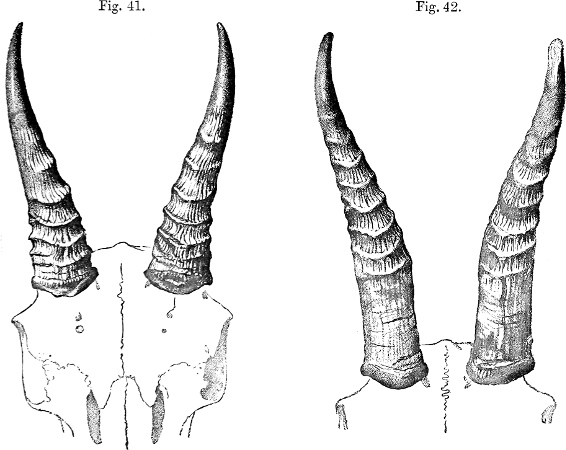
Fig. 41.—Horns of Cervicapra fulvorufula, not adult.
Fig. 42.—Horns of Cervicapra fulvorufula, aged.
The corresponding rings in the two pairs of horns are placed opposite each other.
The change of shape of the horns in the Antelopes as the animals grow older, so frequently referred to in this work, is well marked in the present species, and we have therefore thought it worth while to illustrate these differences by figures (figs. 41 and 42). Figure 41 represents the horns of a young, or rather just adult, male, in which they have attained a length of about 6¼ inches, and are evenly curved upwards to their slender points. Figure 42 shows those of an aged specimen, in which it will be seen that the sharp slender point has got more worn down, while at the same time a long straight basal portion has been added below. This change causes such a difference in the general appearance of the horns that authors have in many cases been led to suppose that the extremes represent different species. We therefore take the opportunity of pointing out how deceptive such appearances are, and how careful writers should be when they found species mainly on the characters presented by the horns. At the same time, the perfect identity of the curves in the part that is common to both specimens is very noteworthy, and shows how valuable horn-characters may be when skill and care are exercised in using them.
Our figure of this Antelope (Plate XLV.) has been taken by the kind permission of Mr. W. L. Sclater from a specimen of this species belonging to the South-African Museum at Cape Town, which had been sent home to Mr. Edward Gerrard of Camden Town to be mounted. It is an adult male and was obtained by Dr. D. R. Kannemeyer near Burghersdorp in the Cape Colony on the 28th May, 1894. The specimen stands about 27½ inches high at the shoulders, and the body from the nape to the rump measures about 29 inches. The tail is very bushy, and measures at least 9 inches to the end of the hairs. The bare spot beneath the ear is very observable. The general colour of the specimen is well shown in Mr. Smit’s figure.
February, 1897.
74. CHANLER’S REEDBUCK. CERVICAPRA CHANLERI, Rothsch.
Cervicapra chanleri, Rothschild, Nov. Zool. ii. p. 53 (1895); Chanler, Through Jungle and Desert, p. 431 (cum tab.) (1896); Ward, Horn Meas. (2) p. 137 (1896).
Apparently similar to C. fulvorufula in all important respects. A dark stripe present on the top of the nose, similar to that often found in C. arundinum and C. fulvorufula.
Skull and horns exactly like those of C. fulvorufula. Dimensions of the typical skull, taken from a cast:—Basal length 7·65 inches, greatest breadth 3·9, orbit to tip of muzzle 4·8.
Hab. British East Africa, mountains east of Mount Kenia.
This recently described species has been founded upon a single specimen obtained by Mr. Astor Chanler, during his recent expedition into the interior of British East Africa, on the slopes of the Jambene mountains, about 45 miles N.N.E. of Mount Kenia. In his volume entitled ‘Through Jungle and Desert,’ in which an account of his expedition is given, Mr. Chanler speaks of this animal as follows:—“During the rains (of 1893) three small Antelopes visited the hill just above my camp (at Daicho[16]) and I was able to secure one of them. I felt convinced that it was a new species, so I carefully preserved its skeleton and skin. It proved to be a species of Reedbuck heretofore unknown, and has since been designated ‘Cervicapra chanleri.’”
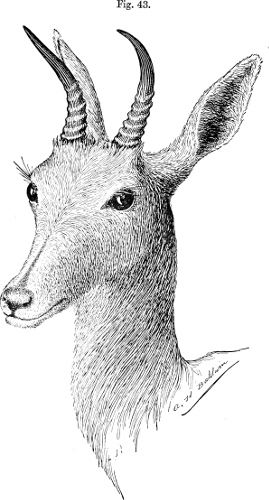
Fig. 43.
Head of Cervicapra chanleri.
(From the typical specimen.)
Mr. Chanler’s specimen of this Reedbuck was placed in the hands of Messrs. Rowland Ward & Co., of Piccadilly, for the purpose of being mounted, and there attracted Mr. Ward’s special attention, as he had previously seen a flat skin somewhat similar, and had called Mr. Chanler’s attention to it before his departure on his expedition. Before sending the specimen to its destination in the United States National Museum at Washington, Mr. Ward showed it to Mr. Walter Rothschild as probably belonging to an undescribed species, and shortly afterwards Mr. Rothschild dedicated it to its discoverer in a paper published in the second volume of ‘Novitates Zoologicæ,’ with the following characters:—“This new species belongs to the group of the smaller species of Cervicapra, and is nearest to C. bohor, but much the smallest of the genus. Perhaps the most striking difference to the ordinary observer is the central black stripe running from the nose to between the eyes. Head and neck generally orange-buff, as in C. bohor; back, sides of body, upperside of tail, and outer sides of limbs warm buffy grey, instead of being of the same colour as the neck, as in C. bohor and C. redunca. Belly, underside of tail, and inside of limbs down to the knees white. Just below the knee in front is a dark brown patch. The ears seem to be longer and narrower in proportion than those of C. bohor; they are sparingly covered on the outside with short hair of the colour of the neck, and inside thickly lined with long white hair. The horns are much smaller and thinner than those of C. bohor, and much more so, of course, than those of C. redunca, both of which are much more curved forward. The rings on the horns project much more and are much sharper than in my specimens of C. bohor and C. redunca, and are also much more regular. They are five in number, besides the basal ring.”
“The skull is in all its proportions much smaller than that of C. bohor, but the palatine is, if anything, longer than in C. bohor.
“Height about 30 inches, hoofs on the bottom line 1½, fore legs 20, tail about 6, ear 6¼, horns along the curve nearly 6.”
After the description was made the specimen was unfortunately sent off to America before we had time to make a special examination of it. In reply to our enquiries, however, Mr. F. W. True, of the U.S. National Museum at Washington, has most kindly forwarded to us a large-sized black-and-white drawing of the head of this species, from which the accompanying reduction (fig. 43, p. 184) has been made by photography. In the absence of a coloured figure, this we trust will serve to make Chanler’s Reedbuck, if rediscovered, more easily recognizable by future travellers.
This is, we fear, nearly all that we can say respecting the present Antelope, of the claims of which to specific separation we are by no means certain. In fact, it appears to be doubtfully separable from C. fulvorufula, with which Mr. Rothschild did not compare it, and we should not have given it a separate heading had it not been for its very wide difference in locality. Up to the present time C. fulvorufula has not been found north of the Zambesi, while the district of British East Africa in which Mr. Chanler shot the type of this species lies nearly under the Equator.
Our knowledge of the proper position of this Antelope is mainly due to an accurate cast of the typical skull prepared by Messrs. Rowland Ward & Co., and generously presented by them to the National Museum.
P.S.—Since this was written Thomas has examined some examples of Chanler’s Reedbuck obtained by Mr. F. J. Jackson in British East Africa, probably near the Ravine Station, where he is now resident. So far as can be made out in their present condition, these specimens are very similar to the South-African C. fulvorufula, without special face-markings, and therefore confirm our view that C. chanleri cannot be well distinguished from its South-African relative.
February, 1897.
Genus III. PELEA.
(See p. 93.)
Type.
Pelea, Gray, P. Z. S. 1850, p. 126 P. capreolus.
Size small. Fur rather woolly. Naked muzzle large. No subauricular glandular patch. Skull much as in Cervicapra. No anteorbital fossa. Lacrymal fissure long and narrow. Premaxillæ not reaching the nasals. Bullæ small. Horns medium in length, slender, ringed, nearly vertical, straight or slightly curved forwards; absent in the female.
Distribution. South Africa. (One species only.)
THE BOOK OF ANTELOPES, PL XLVI.
Wolf del. J. Smit lith.
Hanhart imp.
The Vaal Rhebok.
PELEA CAPREOLUS.
Published by R. H. Porter.
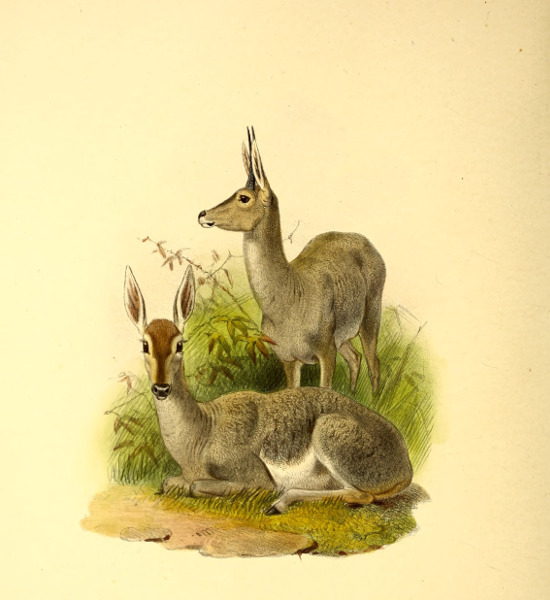
75. THE VAAL RHÉBOK. PELEA CAPREOLUS (Bechst.). [PLATE XLVI.]
Antilope capreolus, Bechst. Syst. Uebers. vierf. Thiere, i. p. 98 (1799), ii. p. 646 (1800); Thunb. Mém. Ac. Pétersb. iii. p. 312 (1811) (Cape Flats); Afzel. N. Act. Ups. vii. pp. 251 & 262 (1815); Goldf. Schr. Säug. v. p. 1232 (1818); Schinz, Cuv. Thierr. i. p. 393 (1821); Desm. Mamm. ii. p. 461 (1822); Licht. Darst. Säug. pl. viii. (♂ ♀) (1827); Less. Man. Mamm. p. 377 (1827); J. B. Fisch. Syn. Mamm. p. 467 (1829); Smuts, En. Mamm. Cap. p. 77 (1832); Less. Compl. Buff. x. p. 291 (1836); Oken, Allg. Naturg. vii. p. 1364 (1838); Forst. Descr. Anim. p. 392 (1844); Wagn. Schr. Säug. Suppl. iv. p. 428 (1844), v. p. 430 (1855); Schinz, Syn. Mamm. ii. p. 410 (1845); id. Mon. Antil. p. 14, pl. xiii. (1848); Gieb. Säug. p. 315 (1853).
Antilope (Gazella) capreolus, Licht. Mag. nat. Fr. vi. p. 174 (1814).
Cemas capreolus, Oken, Lehrb. Nat. iii. pt. 2, p. 740 (1816).
Redunca capreolus, A. Sm. S. Afr. Quart. J. ii. p. 107 (1834); Harris, Wild Anim. S. Afr. p. 138, pl. xxv. fig. 1 (1840); Fitz. SB. Wien, lix. pt. 1, p. 169 (1869).
Cervicapra capreolus, Sund. Pecora, K. Vet.-Ak. Handl. 1844, p. 193 (1846); id. Hornschuch’s Transl., Arch. Skand. Beitr. ii. p. 145; Reprint, p. 69 (1848).
Eleotragus capreolus, Gray, Ann. Mag. N. H. (1) xviii. p. 232 (1846); id. List Ost. B. M. p. 57 (1847); id. Knowsl. Men. p. 12 (1850); Blyth, Cat. Mamm. Mus. As. Soc. p. 168 (1863).
Eleotragus (Pelea) capreolus, Gray, P. Z. S. 1850, p. 126; id. Ann. Mag. N. H. (1) viii. p. 144 (1851).
Pelea capreolus, Gray, Cat. Ung. B. M. p. 90, pl. xxxvi. fig. 2 (skull) (1852); Gerrard, Cat. Bones Mamm. B. M. p. 238 (1862); Gray, Cat. Rum. B. M. p. 29, pl. iii. fig. 5 (1872); id. Hand-1. Rum. B. M. p. 99 (1873); Bryden, Kloof and Karroo, pp. 125 & 297 (1889); Ward, Horn Meas. (1) p. 85 (1892), (2) p. 130 (1896); Nicolls & Egl. Sportsm. S. Afr. p. 33, pl. vii. fig. 24 (1892); Lyd. Horns and Hoofs, p. 220 (1893); Lorenz, Ann. Mus. Wien, ix., Notizen, p. 60 (1894); Rendall, P. Z. S. 1895, p. 360 (Transvaal).
Calotragus capreolus, Temm. Esq. Zool. Guin. p. 191 (1853).
Antilope lanata, Desmoul. Dict. Class. d’H. N. i. p. 445 (1822); Laurill. Dict. Univ. d’H. N. i. p. 623 (1839).
Antilope villosa, Burch. Trav. ii. p. 302 (1824); id. List of Mamm. pres. to B. M. p. 5 (1825) (Swellendam, Nov. 19, 1814); H. Sm. Griff. An. K. iv. p. 241, v. p. 339 (1827); Less. Compl. Buff. x. p. 290 (1836); Gerv. Dict. Sci. Nat. i. p. 262 (1840); Less. N. Tabl. R. A., Mamm. p. 177 (1842).
Eleotragus villosus, Gray, List Mamm. B. M. p. 165 (1843).
Vernacular Names:—Rhébok or Vaal Rhébok of Dutch and English Colonists; Peeli of Bechuanas (Burchell and others); Iza of Zulus (Rendall).
Height at withers about 29 or 30 inches. General form comparatively slender and delicate. Fur soft and woolly, though not very thick. Colour dull pale grey all over, the head and limbs tending rather towards fawn-colour. Ears very long and narrow, their backs grey. Throat and belly similar to and scarcely paler than the back; chin, however, with a distinct blackish patch. Lower part of limbs slightly and inconspicuously darker in front. Tail reaching to about the level of the groin, rather bushy; fawn-grey above near the body, white below and at the end.
Horns slender, barely 2½ inches in circumference at the base, strongly ringed on their lower half, smooth at the tips; rising nearly vertically, and slightly curving forwards. In length they ordinarily attain to about 8 or 9 inches, though some of 11½ inches have been recorded.
Dimensions of an old male skull:—Basal length 7·35 inches, greatest breadth 3·95, muzzle to orbit 5.
Female. Like the male, but hornless.
Hab. S. Africa, south of the Zambesi.
Closely allied to the Reedbucks, and, in fact, hardly differing from them in general structure, except in its nearly straight horns and the want of the naked patch beneath the ears, is the Vaal Rhébok of the South-African colonists, so named by the Dutch settlers from its fancied resemblance to the Roebuck of Europe (Capreolus caprea), and so called by Le Vaillant, Sparrman, and the older authors. Bechstein in 1799 appears to be the first author who gave it a scientific name, and he wisely chose for it that of “capreolus” following the precedent of the vernacular. In this he was followed by Thunberg, Afzelius, and other subsequent writers on the Antelopes, and the name has been mostly accepted and appended to the generic term Pelea bestowed upon it by Gray in 1850, taken from “Peeli,” the Bechuana name of this Antelope.
In 1822, however, Desmoulins, in his article on Antelopes in the ‘Dictionnaire Classique d’Histoire Naturelle,’ redescribed the species as Antilope lanata, from specimens transmitted to Paris from the Cape by Delalande; and two years subsequently Burchell, who had met with this Antelope during his travels in Bechuanaland, gave it the new name Antilope villosa; but neither of these appellations has attained much circulation.
The earliest recognizable figures of the Vaal Rhébok were published about 1829, when Lichtenstein gave representations of both sexes in his ‘Darstellung der Thiere’ from specimens in the Berlin Museum.
This species appears to have qualities that enable it to resist the advancing tide of civilization better than some of its kindred, and is consequently still found scattered over wide districts of the Cape. Mr. W. L. Sclater, who has kindly sent us an account of the present distribution of the Antelopes still existing within the limits of the Colony, gives us the following list of actual localities of the present species:—In the west, Namaqualand, Clanwilliam, Malmesbury, Caledon, Bredarsdorp, Zwellendam, Riversdale, Ceres, Sutherland, Prince Albert, Beaufort West, Carnarvon, Kenhardt, and Pruska (scarce); in the middle districts, Mossel Bay, Middelburg, Colesburg, and Albert; in the east of the Colony, Bathurst, Albany, Tembuland, Barkly East, Griqualand East, and Queenstown; and in the north, Great Namaqualand, Kimberley, Barkly West, and Herbert.
Besides these districts of the Cape Colony we shall presently see that the Vaal Rhébok is also found in the Orange Free State, the Transvaal, Natal, Mashonaland, and Matabeleland, and in the adjoining districts up to the Zambesi.
In the days of Harris (1836–37) we learn from his ‘Portraits’ that the “Rhébok,” as he calls it, was extremely common throughout the Cape Colony, even in the more thickly inhabited cantons. “Never entering the forest,” he tells us, “but residing chiefly among rocky glens and mountain-passes, the Rhébok inhabits the vicinage of little stagnant pools that have been left by the winter torrents, where small families, comprising one old male and five or six females with their fawns, may frequently be seen grazing quietly on the bare hillsides or gambolling amongst the dwarf trees and underwood. To guard against surprise a vidette is invariably on the alert; and should a human figure or other suspicious object be descried nearer than is judged to be safe, the wary sentinel forthwith extends her slender neck, and gives warning to her companions by a sharp sneeze. Away they all bound, lightly as the wind, tossing their graceful heads, whilst their dainty feet scarcely seem to touch the earth; and never slackening their pace until they have gained the summit of some distant eminence, they halt as if by word of command, and suddenly facing half round, reconnoitre the enemy. Exceedingly shy and possessed of a keen scent and a hawk-vision, it is difficult enough to approach within rifle-range; but the little herd, when thus in motion, usually winding round the base of a hill instead of taking directly up the acclivity, an opportunity is often presented to the pursuer to gallop across the path they have selected, and thus obtain an easy snap-shot.”
Mr. H. A. Bryden, in his ‘Kloof and Karroo,’ devotes a whole chapter to the pleasures of “Vaal Rhébok-shooting,” which, for some reason or other, he says, has been unaccountably neglected by hunters and naturalists, in “their rush to follow the larger and nobler game of this game-abounding country.” The most peculiar feature of this Antelope, he tells us, “lies in its coat, which differs essentially from that of every other South-African species, consisting of a thick woolly fur, approaching very closely to the texture of that of the rabbit, but softer, finer, and longer.” The venison, he adds, “although inferior to that of the Spring-bok and some of the larger Antelopes, is by no means inestimable, but has the fault, common to much South-African game, of being somewhat dry.”
Our most recent authorities on the game-animals of South Africa, Messrs. Nicolls and Eglington, speak of this species as fairly well distributed, even in these days, throughout the Cape Colony, the Orange Free State, the Transvaal, the Bechuanaland Protectorate, and portions of Natal, Zululand, and Matabeleland, but nowhere, at the present time, to be met with in large numbers.
“Like the Red Rhébuck and the Klipspringer, it is only met with in very broken country, frequenting the highest points on the mountains and kopjies, never descending to the valleys or plains except at night when in search of water. It is generally found in flocks of six or seven up to a dozen, and is most wary and difficult of approach, one old ram usually standing on guard while the remainder feed. On the least sign of danger, the sentry immediately decamps among the rocky boulders, being instantly followed by the whole herd, springing from rock to rock with great activity. Driving is the best plan to adopt when hunting this species, the guns taking up a position in some narrow valley through which the Rhébuck are bound to pass on being driven by natives and dogs from one range of hills to another. It is worthy of remark that at certain portions of the year the entire body of this animal is often found to be burrowed with a large sort of warble, and consequently the flesh, at such times, is unfit for food, in addition to which it decomposes with great rapidity.”
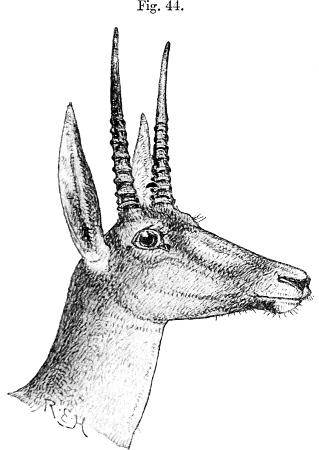
Fig. 44.
Head of Vaal Rhébok, ♂.
In the Transvaal it appears, from what Dr. Percy Rendall tells us (see P. Z. S. 1895, p. 360), under present circumstances, to be growing rather scarce in the mining districts that he visited. It is still found, however, on the highest ridges of the Makongwe Range near Barberton. In the less frequented north-eastern portion of the Transvaal, north of the Crocodile River, Mr. Kirby found the Vaal Rhébok “throughout the mountain-ranges and near the stony krantzes bordering the terrace-lands.” They were also occasionally seen amongst the lower hills, and were observed to run in small troops of from ten to twelve in number.
The Rhébok seems to be impatient of captivity and is very seldom brought to Europe alive. The register of the Zoological Society of London contains the record of only four examples as received, two of which were transmitted by Sir George Grey from the Cape in 1861. These were both females; but a male was presented by Mr. E. R. Wodehouse in 1863, and a female was obtained by purchase in 1864. During his many visits to the continental menageries, Sclater does not recollect to have observed a single individual of this Antelope. Besides a stuffed pair of adults of this species in the Gallery of the British Museum, from the male of which our drawing of the head (fig. 44, p. 193) has been taken, there are a skin and several skulls from the Burchell and other collections. But fresh specimens of this Antelope would be desirable acquisitions.
Our coloured Plate (no. XLVI.) represents both sexes of this beautiful Antelope, giving special prominence to the long ears, one of its most remarkable features. It has been put upon the stone by Mr. Smit from an original sketch by Mr. Wolf, which Sir Douglas Brooke has kindly allowed us to examine. But we regret to say that we have no information as to the exact individuals from which these figures were taken.
February, 1897.