Introductory material
Reading edition
THE BLUE SCARAB
I. THE BLUE SCARAB
Medico-legal practice is largely concerned with crimes against the person, the details of which are often sordid, gruesome and unpleasant. Hence the curious and romantic case of the Blue Scarab (though really outside our specialty) came as somewhat of a relief. But to me it is of interest principally as illustrating two of those remarkable gifts which made my friend, Thorndyke, unique as an investigator: his uncanny power of picking out the one essential fact at a glance, and his capacity to produce, when required, inexhaustible stores of unexpected knowledge of the most out-of-the-way subjects.
It was late in the afternoon when Mr. James Blowgrave arrived, by appointment, at our chambers, accompanied by his daughter, a rather strikingly pretty girl of about twenty-two; and when we had mutually introduced ourselves, the consultation began without preamble.
“I didn’t give any details in my letter to you,” said Mr. Blowgrave. “I thought it better not to, for fear you might decline the case. It is really a matter of a robbery, but not quite an ordinary robbery. There are some unusual and rather mysterious features in the case. And as the police hold out very little hope, I have come to ask if you will give me your opinion on the case and perhaps look into it for me. But first I had better tell you how the affair happened.
“The robbery occurred just a fortnight ago, about half-past nine o’clock in the evening. I was sitting in my study with my daughter, looking over some things that I had taken from a small deed-box, when a servant rushed in to tell us that one of the outbuildings was on fire. Now my study opens by a French window on the garden at the back, and, as the outbuilding was in a meadow at the side of the garden, I went out that way, leaving the French window open; but before going I hastily put the things back in the deed-box and locked it.
“The building—which I used partly as a lumber store and partly as a workshop—was well alight and the whole household was already on the spot, the boy working the pump and the two maids carrying the buckets and throwing water on the fire. My daughter and I joined the party and helped to carry the buckets and take out what goods we could reach from the burning building. But it was nearly half an hour before we got the fire completely extinguished, and then my daughter and I went to our rooms to wash and tidy ourselves up. We returned to the study together, and when I had shut the French window my daughter proposed that we should resume our interrupted occupation. Thereupon I took out of my pocket the key of the deed-box and turned to the cabinet on which the box always stood.
“But there was no deed-box there!
“For a moment I thought I must have moved it, and cast my eyes round the room in search of it. But it was nowhere to be seen, and a moment’s reflection reminded me that I had left it in its usual place. The only possible conclusion was that during our absence at the fire, somebody must have come in by the window and taken it. And it looked as if that somebody had deliberately set fire to the outbuilding for the express purpose of luring us all out of the house.”
“That is what the appearances suggest,” Thorndyke agreed. “Is the study window furnished with a blind or curtains?”
“Curtains,” replied Mr. Blowgrave. “But they were not drawn. Any one in the garden could have seen into the room; and the garden is easily accessible to an active person who could climb over a low wall.”
“So far, then,” said Thorndyke, “the robbery might be the work of a casual prowler who had got into the garden and watched you through the window, and assuming that the things you had taken from the box were of value, seized an easy opportunity to make off with them. Were the things of any considerable value?”
“To a thief they were of no value at all. There were a number of share certificates, a lease, one or two agreements, some family photographs and a small box containing an old letter and a scarab. Nothing worth stealing, you see, for the certificates were made out in my name and were therefore unnegotiable.”
“And the scarab?”
“That may have been lapis lazuli, but more probably it was a blue glass imitation. In any case it was of no considerable value. It was about an inch and a half long. But before you come to any conclusion, I had better finish the story. The robbery was on Tuesday, the 7th of June. I gave information to the police, with a description of the missing property, but nothing happened until Wednesday, the 15th, when I received a registered parcel bearing the Southampton postmark. On opening it I found, to my astonishment, the entire contents of the deed-box, with the exception of the scarab, and this rather mysterious communication.”
He took from his pocket-book and handed to Thorndyke an ordinary envelope addressed in typewritten characters, and sealed with a large, elliptical seal, the face of which was covered with minute hieroglyphics.
“This,” said Thorndyke, “I take to be an impression of the scarab; and an excellent impression it is.”
“Yes,” replied Mr. Blowgrave, “I have no doubt that it is the scarab. It is about the same size.”
Thorndyke looked quickly at our client with an expression of surprise. “But,” he asked, “don’t you recognize the hieroglyphics on it?”
Mr. Blowgrave smiled deprecatingly. “The fact is,” said he, “I don’t know anything about hieroglyphics, but I should say, as far as I can judge, these look the same. What do you think, Nellie?”
Miss Blowgrave looked at the seal—rather vaguely—and replied, “I am in the same position. Hieroglyphics are to me just funny-looking things that don’t mean anything. But these look the same to me as those on our scarab, though I expect any other hieroglyphics would, for that matter.”
Thorndyke made no comment on this statement, but examined the seal attentively through his lens. Then he drew out the contents of the envelope, consisting of two letters, one typewritten and the other in a faded brown handwriting. The former he read through and then inspected the paper closely, holding it up to the light to observe the watermark.
“The paper appears to be of Belgian manufacture,” he remarked, passing it to me. I confirmed this observation and then read the letter, which was headed “Southampton” and ran thus:—
Dear old pal,
I am sending you back some trifles removed in error. The ancient document is enclosed with this, but the curio is at present in the custody of my respected uncle. Hope its temporary loss will not inconvenience you, and that I may be able to return it to you later. Meanwhile, believe me,
Your ever affectionate, Rudolpho.
“Who is Rudolpho?” I asked.
“The Lord knows,” replied Mr. Blowgrave. “A pseudonym of our absent friend, I presume. He seems to be a facetious sort of person.”
“He does,” agreed Thorndyke. “This letter and the seal appear to be what the schoolboys would call a leg-pull. But still, this is all quite normal. He has returned you the worthless things and has kept the one thing that has any sort of negotiable value. Are you quite clear that the scarab is not more valuable than you have assumed?”
“Well,” said Mr. Blowgrave, “I have had an expert opinion on it. I showed it to M. Fouquet, the Egyptologist, when he was over here from Brussels a few months ago, and his opinion was that it was a worthless imitation. Not only was it not a genuine scarab, but the inscription was a sham, too; just a collection of hieroglyphic characters jumbled together without sense or meaning.”
“Then,” said Thorndyke, taking another look at the seal through his lens, “it would seem that Rudolpho, or Rudolpho’s uncle, has got a bad bargain. Which doesn’t throw much light on the affair.”
At this point Miss Blowgrave intervened. “I think, father,” said she, “you have not given Dr. Thorndyke quite all the facts about the scarab. He ought to be told about its connection with Uncle Reuben.”
As the girl spoke Thorndyke looked at her with a curious expression of suddenly awakened interest. Later I understood the meaning of that look, but at the time there seemed to me nothing particularly arresting in her words.
“It is just a family tradition,” Mr. Blowgrave said deprecatingly. “Probably it is all nonsense.”
“Well, let us have it, at any rate,” said Thorndyke. “We may get some light from it.”
Thus urged, Mr. Blowgrave hemmed a little shyly and began:
“The story concerns my great-grandfather, Silas Blowgrave, and his doings during the war with France. It seems that he commanded a privateer, of which he and his brother Reuben were the joint owners, and that in the course of their last cruise, they acquired a very remarkable and valuable collection of jewels. Goodness knows how they got them; not very honestly, I suspect, for they appear to have been a pair of precious rascals. Something has been said about the loot from a South American church or cathedral, but there is really nothing known about the affair. There are no documents. It is mere oral tradition and very vague and sketchy. The story goes that when they had sold off the ship, they came down to live at Shawstead in Hertfordshire, Silas occupying the manor house—in which I live at present—and Reuben a farm-house adjoining. The bulk of the loot they shared out at the end of the cruise, but the jewels were kept apart to be dealt with later—perhaps when the circumstances under which they had been acquired had been forgotten. However, both men were inveterate gamblers, and it seems—according to the testimony of a servant of Reuben’s who overheard them—that on a certain night when they had been playing heavily, they decided to finish up by playing for the whole collection of jewels as a single stake. Silas, who had the jewels in his custody, was seen to go to the manor house and return to Reuben’s house carrying a small, iron-bound chest.
“Apparently they played late into the night, after every one else but the servant had gone to bed, and the luck was with Reuben, though it seems probable that he gave luck some assistance. At any rate, when the play was finished and the chest handed over, Silas roundly accused him of cheating, and we may assume that a pretty serious quarrel took place. Exactly what happened is not clear, for when the quarrel began Reuben dismissed the servant, who retired to her bedroom in a distant part of the house. But in the morning it was discovered that Reuben and the chest of jewels had both disappeared, and there were distinct traces of blood in the room in which the two men had been playing. Silas professed to know nothing about the disappearance; but a strong—and probably just—suspicion arose that he had murdered his brother and made away with the jewels. The result was that Silas also disappeared, and for a long time his whereabouts was not known even by his wife. Later it transpired that he had taken up his abode, under an assumed name, in Egypt, and that he had developed an enthusiastic interest in the then new science of Egyptology—the Rosetta Stone had been deciphered only a few years previously. After a time he resumed communication with his wife, but never made any statement as to the mystery of his brother’s disappearance. A few months before his death he visited his home in disguise and he then handed to his wife a little sealed packet which was to be delivered to his only son, William, on his attaining the age of twenty-one. That packet contained the scarab and the letter which you have taken from the envelope.”
“Am I to read it?” asked Thorndyke.
“Certainly, if you think it worth while,” was the reply.
Thorndyke opened the yellow sheet of paper and, glancing through the brown and faded writing, read aloud:
Cairo, 4th March, 1833.
My dear Son,
I am sending you, as my last gift, a valuable scarab, and a few words of counsel on which I would bid you meditate. Believe me, there is much wisdom in the lore of Old Egypt. Make it your own. Treasure the scarab as a precious inheritance. Handle it often but show it to none. Give your Uncle Reuben Christian burial. It is your duty, and you will have your reward. He robbed your father, but he shall make restitution.
Farewell!
Your affectionate father, Silas Blowgrave.
As Thorndyke laid down the letter he looked inquiringly at our client.
“Well,” he said, “here are some plain instructions. How have they been carried out?”
“They haven’t been carried out at all,” replied Mr. Blowgrave. “As to his son William, my grandfather, he was not disposed to meddle in the matter. This seemed to be a frank admission that Silas killed his brother and concealed the body, and William didn’t choose to reopen the scandal. Besides, the instructions are not so very plain. It is all very well to say, ‘Give your Uncle Reuben Christian burial,’ but where the deuce is Uncle Reuben?”
“It is plainly hinted,” said Thorndyke, “that whoever gives the body Christian burial will stand to benefit, and the word ‘restitution’ seems to suggest a clue to the whereabouts of the jewels. Has no one thought it worth while to find out where the body is deposited?”
“But how could they?” demanded Blowgrave. “He doesn’t give the faintest clue. He talks as if his son knew where the body was. And then, you know, even supposing Silas did not take the jewels with him, there was the question, whose property were they? To begin with, they were pretty certainly stolen property, though no one knows where they came from. Then Reuben apparently got them from Silas by fraud, and Silas got them back by robbery and murder. If William had discovered them he would have had to give them up to Reuben’s sons, and yet they weren’t strictly Reuben’s property. No one had an undeniable claim to them, even if they could have found them.”
“But that is not the case now,” said Miss Blowgrave.
“No,” said Mr. Blowgrave, in answer to Thorndyke’s look of inquiry. “The position is quite clear now. Reuben’s grandson, my cousin Arthur, has died recently, and as he had no children, he has dispersed his property. The old farm-house and the bulk of his estate he has left to a nephew, but he made a small bequest to my daughter and named her as the residuary legatee. So that whatever rights Reuben had to the jewels are now vested in her, and on my death she will be Silas’s heir, too. As a matter of fact,” Mr. Blowgrave continued, “we were discussing this very question on the night of the robbery. I may as well tell you that my girl will be left pretty poorly off when I go, for there is a heavy mortgage on our property and mighty little capital. Uncle Reuben’s jewels would have made the old home secure for her if we could have laid our hands on them. However, I mustn’t take up your time with our domestic affairs.”
“Your domestic affairs are not entirely irrelevant,” said Thorndyke. “But what is it that you want me to do in the matter?”
“Well,” said Blowgrave, “my house has been robbed and my premises set fire to. The police can apparently do nothing. They say there is no clue at all unless the robbery was committed by somebody in the house, which is absurd, seeing that the servants were all engaged in putting out the fire. But I want the robber traced and punished, and I want to get the scarab back. It may be intrinsically valueless, as M. Fouquet said, but Silas’s testamentary letter seems to indicate that it had some value. At any rate, it is an heirloom, and I am loath to lose it. It seems a presumptuous thing to ask you to investigate a trumpery robbery, but I should take it as a great kindness if you would look into the matter.”
“Cases of robbery pure and simple,” replied Thorndyke, “are rather alien to my ordinary practice, but in this one there are certain curious features that seem to make an investigation worth while. Yes, Mr. Blowgrave, I will look into the case, and I have some hope that we may be able to lay our hands on the robber, in spite of the apparent absence of clues. I will ask you to leave both these letters for me to examine more minutely, and I shall probably want to make an inspection of the premises—perhaps to-morrow.”
“Whenever you like,” said Blowgrave. “I am delighted that you are willing to undertake the inquiry. I have heard so much about you from my friend Stalker, of the Griffin Life Assurance Company, for whom you have acted on several occasions.”
“Before you go,” said Thorndyke, “there is one point that we must clear up. Who is there besides yourselves that knows of the existence of the scarab and this letter and the history attaching to them?”
“I really can’t say,” replied Blowgrave. “No one has seen them but my cousin Arthur. I once showed them to him, and he may have talked about them in the family. I didn’t treat the matter as a secret.”
* * * * * * *
When our visitors had gone we discussed the bearings of the case.
“It is quite a romantic story,” said I, “and the robbery has its points of interest, but I am rather inclined to agree with the police—there is mighty little to go on.”
“There would have been less,” said Thorndyke, “if our sporting friend hadn’t been so pleased with himself. That typewritten letter was a piece of gratuitous impudence. Our gentleman overrated his security and crowed too loud.”
“I don’t see that there is much to be gleaned from the letter, all the same,” said I.
“I am sorry to hear you say that, Jervis,” he exclaimed, “because I was proposing to hand the letter over to you to examine and report on.”
“I was only referring to the superficial appearances,” I said hastily. “No doubt a detailed examination will bring something more distinctive into view.”
“I have no doubt it will,” he said, “and as there are reasons for pushing on the investigation as quickly as possible, I suggest that you get to work at once. I shall occupy myself with the old letter and the envelope.”
On this I began my examination without delay, and as a preliminary I proceeded to take a facsimile photograph of the letter by putting it in a large printing-frame with a sensitive plate and a plate of clear glass. The resulting negative showed not only the typewritten lettering, but also the watermark and wire lines of the paper, and a faint grease spot. Next I turned my attention to the lettering itself, and here I soon began to accumulate quite a number of identifiable peculiarities. The machine was apparently a Corona, fitted with the small “Elite” type, and the alignment was markedly defective. The “lower case”—or small—“a” was well below the line, although the capital “A” appeared to be correctly placed; the “u” was slightly above the line, and the small “m” was partly clogged with dirt.
Up to this point I had been careful to manipulate the letter with forceps (although it had been handled by at least three persons, to my knowledge), and I now proceeded to examine it for finger-prints. As I could detect none by mere inspection, I dusted the back of the paper with finely-powdered fuchsin, and distributed the powder by tapping the paper lightly. This brought into view quite a number of finger-prints, especially round the edges of the letter, and though most of them were very faint and shadowy, it was possible to make out the ridge pattern well enough for our purpose. Having blown off the excess of powder, I took the letter to the room where the large copying camera was set up, to photograph it before developing the finger-prints on the front. But here I found our laboratory assistant, Polton, in possession, with the sealed envelope fixed to the copying easel.
“I shan’t be a minute, sir,” said he. “The doctor wants an enlarged photograph of this seal. I’ve got the plate in.”
I waited while he made his exposure and then proceeded to take the photograph of the letter, or rather of the finger-prints on the back of it. When I had developed the negative I powdered the front of the letter and brought out several more finger-prints—mostly thumbs this time. They were a little difficult to see where they were imposed on the lettering, but, as the latter was bright blue and the fuchsin powder was red, this confusion disappeared in the photograph, in which the lettering was almost invisible while the finger-prints were more distinct than they had appeared to the eye. This completed my examination, and when I had verified the make of typewriter by reference to our album of specimens of typewriting, I left the negatives for Polton to dry and print and went down to the sitting-room to draw up my little report. I had just finished this and was speculating on what had become of Thorndyke, when I heard his quick step on the stair and a few moments later he entered with a roll of paper in his hand. This he unrolled on the table, fixing it open with one or two lead paper-weights, and I came round to inspect it, when I found it to be a sheet of the Ordnance map on the scale of twenty-five inches to the mile.
“Here is the Blowgraves’ place,” said Thorndyke, “nearly in the middle of the sheet. This is his house—Shawstead Manor—and that will probably be the outbuilding that was on fire. I take it that the house marked Dingle Farm is the one that Uncle Reuben occupied.”
“Probably,” I agreed. “But I don’t see why you wanted this map if you are going down to the place itself to-morrow.”
“The advantage of a map,” said Thorndyke, “is that you can see all over it at once and get the lie of the land well into your mind; and you can measure all distances accurately and quickly with a scale and a pair of dividers. When we go down to-morrow, we shall know our way about as well as Blowgrave himself.”
“And what use will that be?” I asked. “Where does the topography come into the case?”
“Well, Jervis,” he replied, “there is the robber, for instance; he came from somewhere and he went somewhere. A study of the map may give us a hint as to his movements. But here comes Polton ‘with the documents,’ as poor Miss Flite would say. What have you got for us, Polton?”
“They aren’t quite dry, sir,” said Polton, laying four large bromide prints on the table. “There’s the
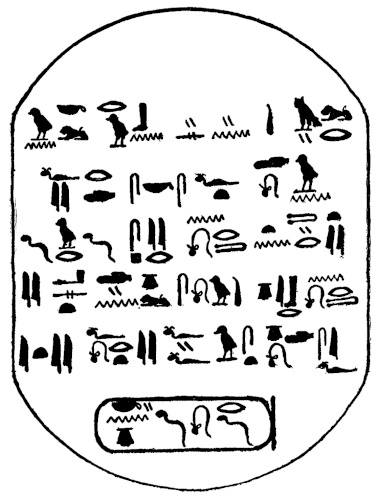
Thorndyke’s tracing of the impression of the Scarab
enlargement of the seal—ten by eight, mounted—and three unmounted prints of Dr. Jervis’s.”
Thorndyke looked at my photographs critically. “They’re excellent, Jervis,” said he. “The finger-prints are perfectly legible, though faint. I only hope some of them are the right ones. That is my left thumb. I don’t see yours. The small one is presumably Miss Blowgrave’s. We must take her finger-prints to-morrow, and her father’s, too. Then we shall know if we have got any of the robber’s.” He ran his eye over my report and nodded approvingly. “There is plenty there to enable us to identify the typewriter if we can get hold of it, and the paper is very distinctive. What do you think of the seal?” he added, laying the enlarged photograph before me.
“It is magnificent,” I replied, with a grin. “Perfectly monumental.”
“What are you grinning at?” he demanded.
“I was thinking that you seem to be counting your chickens in pretty good time,” said I. “You are making elaborate preparations to identify the scarab, but you are rather disregarding the classical advice of the prudent Mrs. Glasse.”
“I have a presentiment that we shall get that scarab,” said he. “At any rate we ought to be in a position to identify it instantly and certainly if we are able to get a sight of it.”
“We are not likely to,” said I. “Still, there is no harm in providing for the improbable.”
This was evidently Thorndyke’s view, and he certainly made ample provision for this most improbable contingency; for, having furnished himself with a drawing-board and a sheet of tracing-paper, he pinned the latter over the photograph on the board and proceeded, with a fine pen and hectograph ink, to make a careful and minute tracing of the intricate and bewildering hieroglyphic inscription on the seal. When he had finished it he transferred it to a clay duplicator and took off half a dozen copies, one of which he handed to me. I looked at it dubiously and remarked: “You have said that the medical jurist must make all knowledge his province. Has he got to be an Egyptologist, too?”
“He will be the better medical jurist if he is,” was the reply, of which I made a mental note for my future guidance. But meanwhile Thorndyke’s proceedings were, to me, perfectly incomprehensible. What was his object in making this minute tracing? The seal itself was sufficient for identification. I lingered awhile hoping that some fresh development might throw a light on the mystery. But his next proceeding was like to have reduced me to stupefaction. I saw him go to the bookshelves and take down a book. As he laid it on the table I glanced at the title, and when I saw that it was Raper’s “Navigation Tables” I stole softly out into the lobby, put on my hat and went for a walk.
When I returned the investigation was apparently concluded, for Thorndyke was seated in his easy chair, placidly reading “The Compleat Angler.” On the table lay a large circular protractor, a straight-edge, an architect’s scale and a sheet of tracing-paper on which was a tracing in hectograph ink of Shawstead Manor.
“Why did you make this tracing?” I asked. “Why not take the map itself?”
“We don’t want the whole of it,” he replied, “and I dislike cutting up maps.”
By taking an informal lunch in the train, we arrived at Shawstead Manor by half-past two. Our approach up the drive had evidently been observed, for Blowgrave and his daughter were waiting at the porch to receive us. The former came forward with outstretched hand, but a distinctly woebegone expression, and exclaimed: “It is most kind of you to come down; but alas! you are too late.”
“Too late for what?” demanded Thorndyke.
“I will show you,” replied Blowgrave, and seizing my colleague by the arm, he strode off excitedly to a little wicket at the side of the house, and, passing through it, hurried along a narrow alley that skirted the garden wall and ended in a large meadow, at one end of which stood a dilapidated windmill. Across this meadow he bustled, dragging my colleague with him, until he reached a heap of freshly-turned earth, where he halted and pointed tragically to a spot where the turf had evidently been raised and untidily replaced.
“There!” he exclaimed, stooping to pull up the loose turfs and thereby exposing what was evidently a large hole, recently and hastily filled in. “That was done last night or early this morning, for I walked over this meadow only yesterday evening and there was no sign of disturbed ground then.”
Thorndyke stood looking down at the hole with a faint smile. “And what do you infer from that?” he asked.
“Infer!” shrieked Blowgrave. “Why, I infer that whoever dug this hole was searching for Uncle Reuben and the lost jewels!”
“I am inclined to agree with you,” Thorndyke said calmly. “He happened to search in the wrong place, but that is his affair.”
“The wrong place!” Blowgrave and his daughter exclaimed in unison. “How do you know it is the wrong place?”
“Because,” replied Thorndyke, “I believe I know the right place, and this is not it. But we can put the matter to the test, and we had better do so. Can you get a couple of men with picks and shovels? Or shall we handle the tools ourselves?”
“I think that would be better,” said Blowgrave, who was quivering with excitement. “We don’t want to take any one into our confidence if we can help it.”
“No,” Thorndyke agreed. “Then I suggest that you fetch the tools while I locate the spot.”
Blowgrave assented eagerly and went off at a brisk trot, while the young lady remained with us and watched Thorndyke with intense curiosity.
“I mustn’t interrupt you with questions,” said she, “but I can’t imagine how you found out where Uncle Reuben was buried.”
“We will go into that later,” he replied; “but first we have got to find Uncle Reuben.” He laid his research-case down on the ground, and opening it, took out three sheets of paper, each bearing a duplicate of his tracing of the map; and on each was marked a spot on this meadow from which a number of lines radiated like the spokes of a wheel.
“You see, Jervis,” he said, exhibiting them to me, “the advantage of a map. I have been able to rule off these sets of bearings regardless of obstructions, such as those young trees, which have arisen since Silas’s day, and mark the spot in its correct place. If the recent obstructions prevent us from taking the bearings, we can still find the spot by measurements with the land-chain or tape.”
“Why have you got three plans?” I asked.
“Because there are three imaginable places. No. 1 is the most likely; No. 2 less likely, but possible; No. 3 is impossible. That is the one that our friend tried last night. No. 1 is among those young trees, and we will now see if we can pick up the bearings in spite of them.”
We moved on to the clump of young trees, where Thorndyke took from the research-case a tall, folding camera-tripod and a large prismatic compass with an aluminium dial. With the latter he took one or two trial bearings and then, setting up the tripod, fixed the compass on it. For some minutes Miss Blowgrave and I watched him as he shifted the tripod from spot to spot, peering through the sight-vane of the compass and glancing occasionally at the map. At length he turned to us and said:
“We are in luck. None of these trees interferes with our bearings.” He took from the research-case a surveyor’s arrow, and sticking it in the ground under the tripod, added: “That is the spot. But we may have to dig a good way round it, for a compass is only a rough instrument.”
At this moment Mr. Blowgrave staggered up, breathing hard, and flung down on the ground three picks, two shovels and a spade. “I won’t hinder you, Doctor, by asking for explanations,” said he, “but I am utterly mystified. You must tell us what it all means when we have finished our work.”
This Thorndyke promised to do, but meanwhile he took off his coat, and rolling up his shirt sleeves, seized the spade and began cutting out a large square of turf. As the soil was uncovered, Blowgrave and I attacked it with picks and Miss Blowgrave shovelled away the loose earth.
“Do you know how far down we have to go?” I asked.
“The body lies six feet below the surface,” Thorndyke replied; and as he spoke he laid down his spade, and taking a telescope from the research-case, swept it round the margin of the meadow and finally pointed it at a farm-house some six hundred yards distant, of which he made a somewhat prolonged inspection, after which he took the remaining pick and fell to work on the opposite corner of the exposed square of earth.
For nearly half an hour we worked on steadily, gradually eating our way downwards, plying pick and shovel alternately, while Miss Blowgrave cleared the loose earth away from the edges of the deepening pit. Then a halt was called and we came to the surface, wiping our faces.
“I think, Nellie,” said Blowgrave, divesting himself of his waistcoat, “a jug of lemonade and four tumblers would be useful, unless our visitors would prefer beer.”
We both gave our votes for lemonade, and Miss Nellie tripped away towards the house, while Thorndyke, taking up his telescope, once more inspected the farm-house.
“You seem greatly interested in that house,” I remarked.
“I am,” he replied, handing me the telescope. “Just take a look at the window in the right hand gable, but keep under the tree.”
I pointed the telescope at the gable and there observed an open window at which a man was seated. He held a binocular glass to his eyes and the instrument appeared to be directed at us.
“We are being spied on, I fancy,” said I, passing the telescope to Blowgrave, “but I suppose it doesn’t matter. This is your land, isn’t it?”
“Yes,” replied Blowgrave, “but still, we didn’t want any spectators. That is Harold Bowker,” he added, steadying the telescope against a tree, “my cousin Arthur’s nephew, whom I told you about as having inherited the farm-house. He seems mighty interested in us; but small things interest one in the country.”
Here the appearance of Miss Nellie, advancing across the meadow with an inviting looking basket, diverted our attention from our inquisitive watcher. Six thirsty eyes were riveted on that basket until it drew near and presently disgorged a great glass jug and four tumblers, when we each took off a long and delicious draught and then jumped down into the pit to resume our labours.
Another half-hour passed. We had excavated in some places to nearly the full depth and were just discussing the advisability of another short rest when Blowgrave, who was working in one corner, uttered a loud cry and stood up suddenly, holding something in his fingers. A glance at the object showed it to be a bone, brown and earth-stained, but evidently a bone. Evidently, too, a human bone, as Thorndyke decided when Blowgrave handed it to him triumphantly.
“We have been very fortunate,” said he, “to get so near at the first trial. This is from the right great toe, so we may assume that the skeleton lies just outside this pit, but we had better excavate carefully in your corner and see exactly how the bones lie.” This he proceeded to do himself, probing cautiously with the spade and clearing the earth away from the corner. Very soon the remaining bones of the right foot came into view and then the ends of the two leg-bones and a portion of the left foot.
“We can see now,” said he, “how the skeleton lies, and all we have to do is to extend the excavation in that direction. But there is only room for one to work down here. I think you and Mr. Blowgrave had better dig down from the surface.”
On this, I climbed out of the pit, followed reluctantly by Blowgrave, who still held the little brown bone in his hand and was in a state of wild excitement and exultation that somewhat scandalized his daughter.
“It seems rather ghoulish,” she remarked, “to be gloating over poor Uncle Reuben’s body in this way.”
“I know,” said Blowgrave, “it isn’t reverent. But I didn’t kill Uncle Reuben, you know, whereas—well it was a long time ago.” With this rather inconsequent conclusion he took a draught of lemonade, seized his pick and fell to work with a will. I, too, indulged in a draught and passed a full tumbler down to Thorndyke. But before resuming my labours I picked up the telescope and once more inspected the farm-house. The window was still open, but the watcher had apparently become bored with the not very thrilling spectacle. At any rate he had disappeared.
From this time onward every few minutes brought some discovery. First, a pair of deeply rusted steel shoe buckles; then one or two buttons, and presently a fine gold watch with a fob-chain and a bunch of seals, looking uncannily new and fresh and seeming more fraught with tragedy than even the bones themselves. In his cautious digging, Thorndyke was careful not to disturb the skeleton; and looking down into the narrow trench that was growing from the corner of the pit, I could see both legs, with only the right foot missing, projecting from the miniature cliff. Meanwhile our part of the trench was deepening rapidly, so that Thorndyke presently warned us to stop digging and bade us come down and shovel away the earth as he disengaged it.
At length the whole skeleton, excepting the head, was uncovered, though it lay undisturbed as it might have lain in its coffin. And now, as Thorndyke picked away the earth around the head, we could see that the skull was propped forward as if it rested on a high pillow. A little more careful probing with the pick-point served to explain this appearance. For as the earth fell away and disclosed the grinning skull, there came into view the edge and iron-bound corners of a small chest.
It was an impressive spectacle; weird, solemn and rather dreadful. There for over a century the ill-fated gambler had lain, his mouldering head pillowed on the booty of unrecorded villainy, booty that had been won by fraud, retrieved by violence, and hidden at last by the final winner with the witness of his crime.
“Here is a fine text for a moralist who would preach on the vanity of riches,” said Thorndyke.
We all stood silent for a while, gazing, not without awe, at the stark figure that lay guarding the ill-gotten treasure. Miss Blowgrave—who had been helped down when we descended—crept closer to her father and murmured that it was “rather awful”; while Blowgrave himself displayed a queer mixture of exultation and shuddering distaste.
Suddenly the silence was broken by a voice from above, and we all looked up with a start. A youngish man was standing on the brink of the pit, looking down on us with very evident disapproval.
“It seems that I have come just in the nick of time,” observed the new-comer. “I shall have to take possession of that chest, you know, and of the remains, too, I suppose. That is my ancestor, Reuben Blowgrave.”
“Well, Harold,” said Blowgrave, “you can have Uncle Reuben if you want him. But the chest belongs to Nellie.”
Here Mr. Harold Bowker—I recognized him now as the watcher from the window—dropped down into the pit and advanced with something of a swagger.
“I am Reuben’s heir,” said he, “through my Uncle Arthur, and I take possession of this property and the remains.”
“Pardon me, Harold,” said Blowgrave, “but Nellie is Arthur’s residuary legatee, and this is the residue of the estate.”
“Rubbish!” exclaimed Bowker. “By the way, how did you find out where he was buried?”
“Oh, that was quite simple,” replied Thorndyke with unexpected geniality. “I’ll show you the plan.” He climbed up to the surface and returned in a few moments with the three tracings and his letter-case. “This is how we located the spot.” He handed the plan marked No. 3 to Bowker, who took it from him and stood looking at it with a puzzled frown.
“But this isn’t the place,” he said at length.
“Isn’t it?” queried Thorndyke. “No, of course; I’ve given you the wrong one. This is the plan.” He handed Bowker the plan marked No. 1, and took the other from him, laying it down on a heap of earth. Then, as Bowker pored gloomily over No. 1, he took a knife and a pencil from his pocket, and with his back to our visitor, scraped the lead of the pencil, letting the black powder fall on the plan that he had just laid down. I watched him with some curiosity; and when I observed that the black scrapings fell on two spots near the edges of the paper, a sudden suspicion flashed into my mind, which was confirmed when I saw him tap the paper lightly with his pencil, gently blow away the powder, and quickly producing my photograph of the typewritten letter from his case, hold it for a moment beside the plan.
“This is all very well,” said Bowker, looking up from the plan, “but how did you find out about these bearings?”
Thorndyke swiftly replaced the letter in his case, and turning round, replied, “I am afraid I can’t give you any further information.”
“Can’t you, indeed!” Bowker exclaimed insolently. “Perhaps I shall compel you to. But, at any rate, I forbid any of you to lay hands on my property.”
Thorndyke looked at him steadily and said in an ominously quiet tone:
“Now, listen to me, Mr. Bowker. Let us have an end of this nonsense. You have played a risky game and you have lost. How much you have lost I can’t say until I know whether Mr. Blowgrave intends to prosecute.”
“To prosecute!” shouted Bowker. “What the deuce do you mean by prosecute?”
“I mean,” said Thorndyke, “that on the 7th of June, after nine o’clock at night, you entered the dwelling-house of Mr. Blowgrave and stole and carried away certain of his goods and chattels. A part of them you have restored, but you are still in possession of some of the stolen property, to wit, a scarab and a deed-box.”
As Thorndyke made this statement in his calm, level tones, Bowker’s face blanched to a tallowy white, and he stood staring at my colleague, the very picture of astonishment and dismay. But he fired a last shot.
“This is sheer midsummer madness,” he exclaimed huskily; “and you know it.”
Thorndyke turned to our host. “It is for you to settle, Mr. Blowgrave,” said he. “I hold conclusive evidence that Mr. Bowker stole your deed-box. If you decide to prosecute I shall produce that evidence in court and he will certainly be convicted.”
Blowgrave and his daughter looked at the accused man with an embarrassment almost equal to his own.
“I am astounded,” the former said at length; “but I don’t want to be vindictive. Look here, Harold, hand over the scarab and we’ll say no more about it.”
“You can’t do that,” said Thorndyke. “The law doesn’t allow you to compound a robbery. He can return the property if he pleases and you can do as you think best about prosecuting. But you can’t make conditions.”
There was silence for some seconds; then, without another word, the crestfallen adventurer turned, and scrambling up out of the pit, took a hasty departure.
It was nearly a couple of hours later that, after a leisurely wash and a hasty, nondescript meal, we carried the little chest from the dining-room to the study. Here, when he had closed the French window and drawn the curtains, Mr. Blowgrave produced a set of tools and we fell to work on the iron fastenings of the chest. It was no light task, though a century’s rust had thinned the stout bands, but at length the lid yielded to the thrust of a long case-opener and rose with a protesting creak. The chest was lined with a double thickness of canvas, apparently part of a sail, and contained a number of small leathern bags, which, as we lifted them out, one by one, felt as if they were filled with pebbles. But when we untied the thongs of one and emptied its contents into a wooden bowl, Blowgrave heaved a sigh of ecstasy and Miss Nellie uttered a little scream of delight. They were all cut stones, and most of them of exceptional size; rubies, emeralds, sapphires, and a few diamonds. As to their value, we could form but the vaguest guess; but Thorndyke, who was a fair judge of gem-stones, gave it as his opinion that they were fine specimens of their kind, though roughly cut, and that they had probably formed the enrichment of some shrine.
“The question is,” said Blowgrave, gazing gloatingly on the bowl of sparkling gems, “what are we to do with them?”
“I suggest,” said Thorndyke, “that Dr. Jervis stays here to-night to help you to guard them and that in the morning you take them up to London and deposit them at your bank.”
Blowgrave fell in eagerly with this suggestion, which I seconded. “But,” said he, “that chest is a queer-looking package to be carrying abroad. Now, if we only had that confounded deed-box——”
“There’s a deed-box on the cabinet behind you,” said Thorndyke.
Blowgrave turned round sharply. “God bless us!” he exclaimed. “It has come back the way it went. Harold must have slipped in at the window while we were at tea. Well, I’m glad he has made restitution. When I look at that bowl and think what he must have narrowly missed, I don’t feel inclined to be hard on him. I suppose the scarab is inside—not that it matters much now.”
The scarab was inside in an envelope; and as Thorndyke turned it over in his hand and examined the hieroglyphics on it through his lens, Miss Blowgrave asked: “Is it of any value, Dr. Thorndyke? It can’t have any connection with the secret of the hiding-place, because you found the jewels without it.
“By the way, Doctor, I don’t know whether it is permissible for me to ask, but how on earth did you find out where the jewels were hidden? To me it looks like black magic.”
Thorndyke laughed in a quiet, inward fashion. “There is nothing magical about it,” said he. “It was a perfectly simple, straightforward problem. But Miss Nellie is wrong. We had the scarab; that is to say we had the wax impression of it, which is the same thing. And the scarab was the key to the riddle. You see,” he continued, “Silas’s letter and the scarab formed together a sort of intelligence test.”
“Did they?” said Blowgrave. “Then he drew a blank every time.”
Thorndyke chuckled. “His descendants were certainly a little lacking in enterprise,” he admitted. “Silas’s instructions were perfectly plain and explicit. Whoever would find the treasure must first acquire some knowledge of Egyptian lore and must study the scarab attentively. It was the broadest of hints, but no one—excepting Harold Bowker, who must have heard about the scarab from his Uncle Arthur—seems to have paid any attention to it.
“Now it happens that I have just enough elementary knowledge of the hieroglyphic characters to enable me to spell them out when they are used alphabetically; and as soon as I saw the seal, I could see that these hieroglyphics formed English words. My attention was first attracted by the second group of signs, which spelled the word ‘Reuben,’ and then I saw that the first group spelled ‘Uncle.’ Of course, the instant I heard Miss Nellie speak of the connection between the scarab and Uncle Reuben, the murder was out. I saw at a glance that the scarab contained all the required information. Last night I made a careful tracing of the hieroglyphics and then rendered them into our own alphabet. This is the result.”
He took from his letter-case and spread out on the table a duplicate of the tracing which I had seen him make, and of which he had given me a copy. But since I had last seen it, it had received an addition; under each group of signs the equivalents in modern Roman lettering had been written, and these made the following words:
“UNKL RUBN IS IN TH MILL FIELD SKS FT DOWN CHURCH SPIR NORTH TEN THIRTY EAST DINGL SOUTH GABL NORTH ATY FORTY FIF WST GOD SAF KING JORJ.”
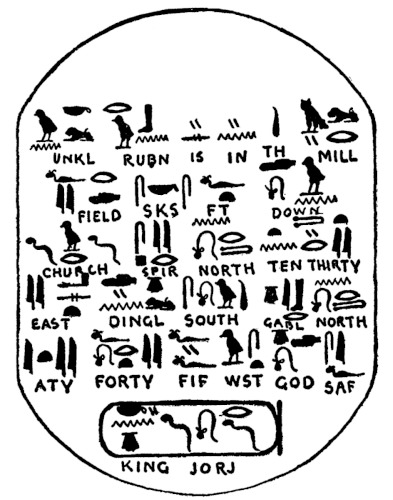
The transliteration of the hieroglyphics.
Our two friends gazed at Thorndyke’s transliteration in blank astonishment. At length Blowgrave remarked: “But this translation must have demanded a very profound knowledge of the Egyptian writing.”
“Not at all,” replied Thorndyke. “Any intelligent person could master the Egyptian alphabet in an hour. The language, of course, is quite another matter. The spelling of this is a little crude, but it is quite intelligible and does Silas great credit, considering how little was known in his time.”
“How do you suppose M. Fouquet came to overlook this?” Blowgrave asked.
“Naturally enough,” was the reply. “He was looking for an Egyptian inscription. But this is not an Egyptian inscription. Does he speak English?”
“Very little. Practically not at all.”
“Then, as the words are English words and imperfectly spelt, the hieroglyphics must have appeared to him mere nonsense. And he was right as to the scarab being an imitation.”
“There is another point,” said Blowgrave. “How was it that Harold made that extraordinary mistake about the place? The directions are clear enough. All you had to do was to go out there with a compass and take the bearings just as they were given.”
“But,” said Thorndyke, “that is exactly what he did, and hence the mistake. He was apparently unaware of the phenomenon known as the Secular Variation of the Compass. As you know, the compass does not—usually—point to true north, but to the Magnetic North; and the Magnetic North is continually changing its position. When Reuben was buried—about 1810—it was twenty-four degrees, twenty-six minutes west of true north; at the present time it is fourteen degrees, forty-eight minutes west of true north. So Harold’s bearings would be no less than ten degrees out, which, of course, gave him a totally wrong position. But Silas was a ship-master, a navigator, and of course, knew all about the vagaries of the compass; and, as his directions were intended for use at some date unknown to him, I assumed that the bearings that he gave were true bearings—that when he said ‘north’ he meant true north, which is always the same; and this turned out to be the case. But I also prepared a plan with magnetic bearings corrected up to date. Here are the three plans: No. 1—the one we used—showing true bearings; No. 2, showing corrected magnetic bearings which might have given us the correct spot; and No. 3, with uncorrected magnetic bearings, giving us the spot where Harold dug, and which could not possibly have been the right spot.”
On the following morning I escorted the deed-box, filled with the booty and tied up and sealed with the scarab, to Mr. Blowgrave’s bank. And that ended our connection with the case; excepting that, a month or two later, we attended by request the unveiling in Shawstead churchyard of a fine monument to Reuben Blowgrave. This took the slightly inappropriate form of an obelisk, on which were cut the name and approximate dates, with the added inscription: “Cast thy bread upon the waters and it shall return after many days”; concerning which Thorndyke remarked dryly that he supposed the exhortation applied equally even if the bread happened to belong to some one else.
II. THE CASE OF THE WHITE FOOT-PRINTS
“Well,” said my friend Foxton, pursuing a familiar and apparently inexhaustible topic, “I’d sooner have your job than my own.”
“I’ve no doubt you would,” was my unsympathetic reply. “I never met a man who wouldn’t. We all tend to consider other men’s jobs in terms of their advantages and our own in terms of their drawbacks. It is human nature.”
“Oh, it’s all very well for you to be so beastly philosophical,” retorted Foxton. “You wouldn’t be if you were in my place. Here, in Margate, it’s measles, chicken-pox and scarlatina all the summer, and bronchitis, colds and rheumatism all the winter. A deadly monotony. Whereas you and Thorndyke sit there in your chambers and let your clients feed you up with the raw material of romance. Why, your life is a sort of everlasting Adelphi drama.”
“You exaggerate, Foxton,” said I. “We, like you, have our routine work, only it is never heard of outside the Law Courts; and you, like every other doctor, must run up against mystery and romance from time to time.”
Foxton shook his head as he held out his hand for my cup. “I don’t,” said he. “My practice yields nothing but an endless round of dull routine.”
And then, as if in commentary on this last statement, the housemaid burst into the room and, with hardly dissembled agitation, exclaimed:
“If you please, sir, the page from Beddingfield’s Boarding House says that a lady has been found dead in her bed and would you go round there immediately.”
“Very well, Jane,” said Foxton, and as the maid retired, he deliberately helped himself to another fried egg and, looking across the table at me, exclaimed: “Isn’t that always the way? Come immediately—now—this very instant, although the patient may have been considering for a day or two whether he’ll send for you or not. But directly he decides, you must spring out of bed, or jump up from your breakfast, and run.”
“That’s quite true,” I agreed; “but this really does seem to be an urgent case.”
“What’s the urgency?” demanded Foxton. “The woman is already dead. Any one would think she was in imminent danger of coming to life again and that my instant arrival was the only thing that could prevent such a catastrophe.”
“You’ve only a third-hand statement that she is dead,” said I. “It is just possible that she isn’t; and even if she is, as you will have to give evidence at the inquest, you don’t want the police to get there first and turn out the room before you’ve made your inspection.”
“Gad!” exclaimed Foxton. “I hadn’t thought of that. Yes. You’re right. I’ll hop round at once.”
He swallowed the remainder of the egg at a single gulp and rose from the table. Then he paused and stood for a few moments looking down at me irresolutely.
“I wonder, Jervis,” he said, “if you would mind coming round with me. You know all the medico-legal ropes, and I don’t. What do you say?”
I agreed instantly, having, in fact, been restrained only by delicacy from making the suggestion myself; and when I had fetched from my room my pocket camera and telescopic tripod, we set forth together without further delay.
Beddingfield’s Boarding House was but a few minutes’ walk from Foxton’s residence, being situated near the middle of Ethelred Road, Cliftonville, a quiet, suburban street which abounded in similar establishments, many of which, I noticed, were undergoing a spring-cleaning and renovation to prepare them for the approaching season.
“That’s the house,” said Foxton, “where that woman is standing at the front door. Look at the boarders, collected at the dining-room window. There’s a rare commotion in that house, I’ll warrant.”
Here, arriving at the house, he ran up the steps and accosted in sympathetic tones the elderly woman who stood by the open street door.
“What a dreadful thing this is, Mrs. Beddingfield! Terrible! Most distressing for you!”
“Ah, you’re right, Dr. Foxton,” she replied. “It’s an awful affair. Shocking. So bad for business, too. I do hope and trust there won’t be any scandal.”
“I’m sure I hope not,” said Foxton. “There shan’t be if I can help it. And as my friend, Dr. Jervis, who is staying with me for a few days, is a lawyer as well as a doctor, we shall have the best advice. When was the affair discovered?”
“Just before I sent for you, Dr. Foxton. The maid noticed that Mrs. Toussaint—that is the poor creature’s name—had not taken in her hot water, so she knocked at the door. As she couldn’t get any answer, she tried the door and found it bolted on the inside, and then she came and told me. I went up and knocked loudly, and then, as I couldn’t get any reply, I told our boy, James, to force the door open with a case-opener, which he did quite easily as the bolt was only a small one. Then I went in, all of a tremble, for I had a presentiment that there was something wrong; and there she was, lying stone dead, with a most ’orrible stare on her face and an empty bottle in her hand.”
“A bottle, eh!” said Foxton.
“Yes. She’d made away with herself, poor thing; and all on account of some silly love affair—and it was hardly even that.”
“Ah,” said Foxton. “The usual thing. You must tell us about that later. Now we’d better go up and see the patient—at least the—er—perhaps you’ll show us the room, Mrs. Beddingfield.”
The landlady turned and preceded us up the stairs to the first-floor back, where she paused, and softly opening a door, peered nervously into the room. As we stepped past her and entered, she seemed inclined to follow, but, at a significant glance from me, Foxton persuasively ejected her and closed the door. Then we stood silent for a while and looked about us.
In the aspect of the room there was something strangely incongruous with the tragedy that had been enacted within its walls; a mingling of the commonplace and the terrible that almost amounted to anticlimax. Through the wide-open window the bright spring sunshine streamed in on the garish wall-paper and cheap furniture; from the street below, the periodic shouts of a man selling “sole and mack-ro!” broke into the brisk staccato of a barrel-organ and both sounds mingled with a raucous voice close at hand, cheerfully trolling a popular song, and accounted for by a linen-clad elbow that bobbed in front of the window and evidently appertained to a house painter on an adjacent ladder.
It was all very commonplace and familiar and discordantly out of character with the stark figure that lay on the bed like a waxen effigy symbolic of tragedy. Here was none of that gracious somnolence in which death often presents itself with a suggestion of eternal repose. This woman was dead; horribly, aggressively dead. The thin, sallow face was rigid as stone, the dark eyes stared into infinite space with a horrid fixity that was quite disturbing to look on. And yet the posture of the corpse was not uneasy, being, in fact, rather curiously symmetrical, with both arms outside the bed-clothes and both hands closed, the right grasping, as Mrs. Beddingfield had said, an empty bottle.
“Well,” said Foxton, as he stood looking down on the dead woman, “it seems a pretty clear case. She appears to have laid herself out and kept hold of the bottle so that there should be no mistake. How long do you suppose this woman has been dead, Jervis?”
I felt the rigid limbs and tested the temperature of the body surface.
“Not less than six hours,” I replied. “Probably more. I should say that she died about two o’clock this morning.”
“And that is about all we can say,” said Foxton, “until the post-mortem has been made. Everything looks quite straightforward. No signs of a struggle or marks of violence. That blood on the mouth is probably due to her biting her lip when she drank from the bottle. Yes; here’s a little cut on the inside of the lip, corresponding to the upper incisors. By the way, I wonder if there is anything left in the bottle.”
As he spoke, he drew the small, unlabelled, green glass phial from the closed hand—out of which it slipped quite easily—and held it up to the light.
“Yes,” he exclaimed, “there’s more than a drachm left; quite enough for an analysis. But I don’t recognize the smell. Do you?”
I sniffed at the bottle and was aware of a faint unfamiliar vegetable odour.
“No,” I answered. “It appears to be a watery solution of some kind, but I can’t give it a name. Where is the cork?”
“I haven’t seen it,” he replied. “Probably it is on the floor somewhere.”
We both stooped to look for the missing cork and presently found it in the shadow, under the little bedside table. But, in the course of that brief search, I found something else, which had indeed been lying in full view all the time—a wax match. Now a wax match is a perfectly innocent and very commonplace object, but yet the presence of this one gave me pause. In the first place, women do not, as a rule, use wax matches, though there was not much in that. What was more to the point was that the candlestick by the bedside contained a box of safety matches, and that, as the burned remains of one lay in the tray, it appeared to have been used to light the candle. Then why the wax match?
While I was turning over this problem Foxton had corked the bottle, wrapped it carefully in a piece of paper which he took from the dressing table and bestowed it in his pocket.
“Well, Jervis,” said he, “I think we’ve seen everything. The analysis and the post-mortem will complete the case. Shall we go down and hear what Mrs. Beddingfield has to say?”
But that wax match, slight as was its significance, taken alone, had presented itself to me as the last of a succession of phenomena each of which was susceptible of a sinister interpretation, and the cumulative effect of these slight suggestions began to impress me somewhat strongly.
“One moment, Foxton,” said I. “Don’t let us take anything for granted. We are here to collect evidence, and we must go warily. There is such a thing as homicidal poisoning, you know.”
“Yes, of course,” he replied, “but there is nothing to suggest it in this case; at least, I see nothing. Do you?”
“Nothing very positive,” said I; “but there are some facts that seem to call for consideration. Let us go over what we have seen. In the first place, there is a distinct discrepancy in the appearance of the body. The general easy, symmetrical posture, like that of a figure on a tomb, suggests the effect of a slow, painless poison. But look at the face. There is nothing reposeful about that. It is very strongly suggestive of pain or terror or both.”
“Yes,” said Foxton, “that is so. But you can’t draw any satisfactory conclusions from the facial expression of dead bodies. Why, men who have been hanged, or even stabbed, often look as peaceful as babes.”
“Still,” I urged, “it is a fact to be noted. Then there is that cut on the lip. It may have been produced in the way you suggest; but it may equally well be the result of pressure on the mouth.”
Foxton made no comment on this beyond a slight shrug of the shoulders, and I continued:
“Then there is the state of the hand. It was closed, but it did not really grasp the object it contained. You drew the bottle out without any resistance. It simply lay in the closed hand. But that is not a normal state of affairs. As you know, when a person dies grasping any object, either the hand relaxes and lets it drop, or the muscular action passes into cadaveric spasm and grasps the object firmly. And lastly, there is this wax match. Where did it come from? The dead woman apparently lit her candle with a safety match from the box. It is a small matter, but it wants explaining.”
Foxton raised his eyebrows protestingly. “You’re like all specialists, Jervis,” said he. “You see your specialty in everything. And while you are straining these flimsy suggestions to turn a simple suicide into murder, you ignore the really conclusive fact that the door was bolted and had to be broken open before any one could get in.”
“You are not forgetting, I suppose,” said I, “that the window was wide open and that there were house painters about and possibly a ladder left standing against the house.”
“As to the ladder,” said Foxton, “that is a pure assumption; but we can easily settle the question by asking that fellow out there if it was or was not left standing last night.”
Simultaneously we moved towards the window; but half-way we both stopped short. For the question of the ladder had in a moment become negligible. Staring up at us from the dull red linoleum which covered the floor were the impressions of a pair of bare feet, imprinted in white paint with the distinctness of a woodcut. There was no need to ask if they had been made by the dead woman: they were unmistakably the feet of a man, and large feet at that. Nor could there be any doubt as to whence those feet had come. Beginning with startling distinctness under the window, the tracks diminished rapidly in intensity until they reached the carpeted portion of the room, where they vanished abruptly; and only by the closest scrutiny was it possible to detect the faint traces of the retiring tracks.
Foxton and I stood for some moments gazing in silence at the sinister white shapes; then we looked at one another.
“You’ve saved me from a most horrible blunder, Jervis,” said Foxton. “Ladder or no ladder, that fellow came in at the window; and he came in last night, for I saw them painting these window-sills yesterday afternoon. Which side did he come from, I wonder?”
We moved to the window and looked out on the sill. A set of distinct, though smeared impressions on the new paint gave unneeded confirmation and showed that the intruder had approached from the left side, close to which was a cast-iron stack-pipe, now covered with fresh green paint.
“So,” said Foxton, “the presence or absence of the ladder is of no significance. The man got into the window somehow, and that’s all that matters.”
“On the contrary,” said I, “the point may be of considerable importance in identification. It isn’t every one who could climb up a stack-pipe, whereas most people could make shift to climb a ladder, even if it were guarded by a plank. But the fact that the man took off his boots and socks suggests that he came up by the pipe. If he had merely aimed at silencing his foot-falls, he would probably have removed his boots only.”
From the window we turned to examine more closely the footprints on the floor, and, while I took a series of measurements with my spring tape, Foxton entered them in my notebook.
“Doesn’t it strike you as rather odd, Jervis,” said he, “that neither of the little toes has made any mark?”
“It does indeed,” I replied. “The appearances suggest that the little toes were absent, but I have never met with such a condition. Have you?”
“Never. Of course one is acquainted with the supernumerary toe deformity, but I have never heard of congenitally deficient little toes.”
Once more we scrutinized the footprints, and even examined those on the window-sill, obscurely marked on the fresh paint; but, exquisitely distinct as were those on the linoleum, showing every wrinkle and minute skin-marking, not the faintest hint of a little toe was to be seen on either foot.
“It’s very extraordinary,” said Foxton. “He has certainly lost his little toes, if he ever had any. They couldn’t have failed to make some mark. But it’s a queer affair. Quite a windfall for the police, by the way; I mean for purposes of identification.”
“Yes,” I agreed, “and having regard to the importance of the footprints, I think it would be wise to get a photograph of them.”
“Oh, the police will see to that,” said Foxton. “Besides, we haven’t got a camera, unless you thought of using that little toy snapshotter of yours.”
As Foxton was no photographer I did not trouble to explain that my camera, though small, had been specially made for scientific purposes.
“Any photograph is better than none,” I said, and with this I opened the tripod and set it over one of the most distinct of the footprints, screwed the camera to the goose-neck, carefully framed the footprint in the finder and adjusted the focus, finally making the exposure by means of an Antinous release. This process I repeated four times, twice on a right footprint and twice on a left.
“Well,” Foxton remarked, “with all those photographs the police ought to be able to pick up the scent.”
“Yes, they’ve got something to go on; but they’ll have to catch their hare before they can cook him. He won’t be walking about barefooted, you know.”
“No. It’s a poor clue in that respect. And now we may as well be off as we’ve seen all there is to see. I think we won’t have much to say to Mrs. Beddingfield. This is a police case, and the less I’m mixed up in it the better it will be for my practice.”
I was faintly amused at Foxton’s caution when considered by the light of his utterances at the breakfast table. Apparently his appetite for mystery and romance was easily satisfied. But that was no affair of mine. I waited on the doorstep while he said a few—probably evasive—words to the landlady and then, as we started off together in the direction of the police station, I began to turn over in my mind the salient features of the case. For some time we walked on in silence, and must have been pursuing a parallel train of thought for, when he at length spoke, he almost put my reflections into words.
“You know, Jervis,” said he, “there ought to be a clue in those footprints. I realize that you can’t tell how many toes a man has by looking at his booted feet. But those unusual footprints ought to give an expert a hint as to what sort of man to look for. Don’t they convey any hint to you?”
I felt that Foxton was right; that if my brilliant colleague, Thorndyke, had been in my place, he would have extracted from those footprints some leading fact that would have given the police a start along some definite line of inquiry; and that belief, coupled with Foxton’s challenge, put me on my mettle.
“They offer no particular suggestions to me at this moment,” said I, “but I think that, if we consider them systematically, we may be able to draw some useful deductions.”
“Very well,” said Foxton, “then let us consider them systematically. Fire away. I should like to hear how you work these things out.”
Foxton’s frankly spectatorial attitude was a little disconcerting, especially as it seemed to commit me to a result that I was by no means confident of attaining. I therefore began a little diffidently.
“We are assuming that both the feet that made those prints were from some cause devoid of little toes. That assumption—which is almost certainly correct—we treat as a fact, and, taking it as our starting point, the first step in the inquiry is to find some explanation of it. Now there are three possibilities, and only three: deformity, injury and disease. The toes may have been absent from birth, they may have been lost as a result of mechanical injury, or they may have been lost by disease. Let us take those possibilities in order.
“Deformity we exclude since such a malformation is unknown to us.
“Mechanical injury seems to be excluded by the fact that the two little toes are on opposite sides of the body and could not conceivably be affected by any violence which left the intervening feet uninjured. This seems to narrow the possibilities down to disease; and the question that arises is, What diseases are there which might result in the loss of both little toes?”
I looked inquiringly at Foxton, but he merely nodded encouragingly. His rôle was that of listener.
“Well,” I pursued, “the loss of both toes seems to exclude local disease, just as it excluded local injury; and as to general diseases, I can think only of three which might produce this condition—Raynaud’s disease, ergotism, and frost-bite.”
“You don’t call frost-bite a general disease, do you?” objected Foxton.
“For our present purpose, I do. The effects are local, but the cause—low external temperature—affects the whole body and is a general cause. Well, now, taking the diseases in order, I think we can exclude Raynaud’s disease. It does, it is true, occasionally cause the fingers or toes to die and drop off, and the little toes would be especially liable to be affected as being most remote from the heart. But in such a severe case the other toes would be affected. They would be shrivelled and tapered, whereas, if you remember, the toes of these feet were quite plump and full, to judge by the large impressions they made. So I think we may safely reject Raynaud’s disease. There remain ergotism and frost-bite; and the choice between them is just a question of relative frequency. Frost-bite is more common; therefore frost-bite is more probable.”
“Do they tend equally to affect the little toes?” asked Foxton.
“As a matter of probability, yes. The poison of ergot acting from within, and intense cold acting from without, contract the small blood-vessels and arrest the circulation. The feet, being the most distant parts of the body from the heart, are the first to feel the effects; and the little toes, which are the most distant parts of the feet, are the most susceptible of all.”
Foxton reflected awhile, and then remarked:
“This is all very well, Jervis, but I don’t see that you are much forrarder. This man has lost both his little toes, and on your showing, the probabilities are that the loss was due either to chronic ergot poisoning or to frost-bite, with a balance of probability in favour of frost-bite. That’s all. No proof, no verification. Just the law of probability applied to a particular case, which is always unsatisfactory. He may have lost his toes in some totally different way. But even if the probabilities work out correctly, I don’t see what use your conclusions would be to the police. They wouldn’t tell them what sort of man to look for.”
There was a good deal of truth in Foxton’s objection. A man who has suffered from ergotism or frost-bite is not externally different from any other man. Still, we had not exhausted the case, as I ventured to point out.
“Don’t be premature, Foxton,” said I. “Let us pursue our argument a little farther. We have established a probability that this unknown man has suffered either from ergotism or frost-bite. That, as you say, is of no use by itself; but supposing we can show that these conditions tend to affect a particular class of persons, we shall have established a fact that will indicate a line of investigation. And I think we can. Let us take the case of ergotism first.
“Now how is chronic ergot poisoning caused? Not by the medicinal use of the drug, but by the consumption of the diseased rye in which ergot occurs. It is therefore peculiar to countries in which rye is used extensively as food. Those countries, broadly speaking, are the countries of North Eastern Europe, and especially Russia and Poland.
“Then take the case of frost-bite. Obviously the most likely person to get frost-bitten is the inhabitant of a country with a cold climate. The most rigorous climates inhabited by white people are North America and North Eastern Europe, especially Russia and Poland. So you see, the areas associated with ergotism and frost-bite overlap to some extent. In fact they do more than overlap; for a person even slightly affected by ergot would be specially liable to frost-bite, owing to the impaired circulation. The conclusion is that, racially, in both ergotism and frost-bite, the balance of probability is in favour of a Russian, a Pole, or a Scandinavian.
“Then in the case of frost-bite there is the occupation factor. What class of men tend most to become frost-bitten? Well, beyond all doubt, the greatest sufferers from frost-bite are sailors, especially those on sailing ships, and, naturally, on ships trading to arctic and sub-arctic countries. But the bulk of such sailing ships are those engaged in the Baltic and Archangel trade; and the crews of those ships are almost exclusively Scandinavians, Finns, Russians and Poles. So that, again, the probabilities point to a native of North Eastern Europe, and, taken as a whole, by the overlapping of factors, to a Russian, a Pole, or a Scandinavian.”
Foxton smiled sardonically. “Very ingenious, Jervis,” said he. “Most ingenious. As an academic statement of probabilities, quite excellent. But for practical purposes absolutely useless. However, here we are at the police station. I’ll just run in and give them the facts and then go on to the coroner’s office.”
“I suppose I’d better not come in with you?” I said.
“Well, no,” he replied. “You see, you have no official connection with the case, and they mightn’t like it. You’d better go and amuse yourself while I get the morning’s visits done. We can talk things over at lunch.”
With this he disappeared into the police station, and I turned away with a smile of grim amusement. Experience is apt to make us a trifle uncharitable, and experience had taught me that those who are the most scornful of academic reasoning are often not above retailing it with some reticence as to its original authorship. I had a shrewd suspicion that Foxton was at this very moment disgorging my despised “academic statement of probabilities” to an admiring police-inspector.
My way towards the sea lay through Ethelred Road, and I had traversed about half its length and was approaching the house of the tragedy when I observed Mrs. Beddingfield at the bay window. Evidently she recognized me, for a few moments later she appeared in outdoor clothes on the doorstep and advanced to meet me.
“Have you seen the police?” she asked as we met. I replied that Dr. Foxton was even now at the police station.
“Ah!” she said, “it’s a dreadful affair; most unfortunate, too, just at the beginning of the season. A scandal is absolute ruin to a boarding-house. What do you think of the case? Will it be possible to hush it up? Dr. Foxton said you were a lawyer, I think, Dr. Jervis?”
“Yes, I am a lawyer, but really I know nothing of the circumstances of this case. Did I understand that there had been something in the nature of a love affair?”
“Yes—at least—well, perhaps I oughtn’t to have said that. But hadn’t I better tell you the whole story?—that is, if I am not taking up too much of your time.”
“I should be interested to hear what led to the disaster,” said I.
“Then,” she said, “I will tell you all about it. Will you come indoors, or shall I walk a little way with you?”
As I suspected that the police were at that moment on their way to the house, I chose the latter alternative and led her away seawards at a pretty brisk pace.
“Was this poor lady a widow?” I asked as we started up the street.
“No, she wasn’t,” replied Mrs. Beddingfield, “and that was the trouble. Her husband was abroad—at least, he had been, and he was just coming home. A pretty home-coming it will be for him, poor man. He is an officer in the civil police at Sierra Leone, but he hasn’t been there long. He went there for his health.”
“What! To Sierra Leone!” I exclaimed, for the “White Man’s Grave” seemed a queer health resort.
“Yes. You see, Mr. Toussaint is a French Canadian, and it seems that he has always been somewhat of a rolling stone. For some time he was in the Klondike, but he suffered so much from the cold that he had to come away. It injured his health very severely; I don’t quite know in what way, but I do know that he was quite a cripple for a time. When he got better he looked out for a post in a warm climate and eventually obtained the appointment of Inspector of Civil Police at Sierra Leone. That was about ten months ago, and when he sailed for Africa his wife came to stay with me, and has been here ever since.”
“And this love affair that you spoke of?”
“Yes, but I oughtn’t to have called it that. Let me explain what happened. About three months ago a Swedish gentleman—a Mr. Bergson—came to stay here, and he seemed to be very much smitten with Mrs. Toussaint.”
“And she?”
“Oh, she liked him well enough. He is a tall, good-looking man—though for that matter he is no taller than her husband, nor any better looking. Both men are over six feet. But there was no harm so far as she was concerned, excepting that she didn’t see the position quite soon enough. She wasn’t very discreet, in fact I thought it necessary to give her a little advice. However, Mr. Bergson left here and went to live at Ramsgate to superintend the unloading of the ice ships (he came from Sweden in one), and I thought the trouble was at an end. But it wasn’t, for he took to coming over to see Mrs. Toussaint, and of course I couldn’t have that. So at last I had to tell him that he mustn’t come to the house again. It was very unfortunate, for on that occasion I think he had been ‘tasting,’ as they say in Scotland. He wasn’t drunk, but he was excitable and noisy, and when I told him he mustn’t come again he made such a disturbance that two of the gentlemen boarders—Mr. Wardale and Mr. Macauley—had to interfere. And then he was most insulting to them, especially to Mr. Macauley, who is a coloured gentleman; called him a ‘buck nigger’ and all sorts of offensive names.”
“And how did the coloured gentleman take it?”
“Not very well, I am sorry to say, considering that he is a gentleman—a law student with chambers in the Temple. In fact, his language was so objectionable that Mr. Wardale insisted on my giving him notice on the spot. But I managed to get him taken in next door but one; you see, Mr. Wardale had been a Commissioner at Sierra Leone—it was through him that Mr. Toussaint got his appointment—so I suppose he was rather on his dignity with coloured people.”
“And was that the last you heard of Mr. Bergson?”
“He never came here again, but he wrote several times to Mrs. Toussaint, asking her to meet him. At last, only a few days ago, she wrote to him and told him that the acquaintance must cease.”
“And has it ceased?”
“As far as I know, it has.”
“Then, Mrs. Beddingfield,” said I, “what makes you connect the affair with—with what has happened?”
“Well, you see,” she explained, “there is the husband. He was coming home, and is probably in England already.”
“Indeed!” said I.
“Yes,” she continued. “He went up into the bush to arrest some natives belonging to one of these gangs of murderers—Leopard Societies, I think they are called—and he got seriously wounded. He wrote to his wife from hospital, saying that he would be sent home as soon as he was fit to travel, and about ten days ago she got a letter from him saying that he was coming by the next ship.
“I noticed that she seemed very nervous and upset when she got the letters from hospital, and still more so when the last letter came. Of course, I don’t know what he said to her in those letters. It may be that he had heard something about Mr. Bergson, and threatened to take some action. Of course, I can’t say. I only know that she was very nervous and restless, and when we saw in the paper four days ago that the ship he would be coming by had arrived in Liverpool, she seemed dreadfully upset. And she got worse and worse until—well, until last night.”
“Has anything been heard of the husband since the ship arrived?” I asked.
“Nothing whatever,” replied Mrs. Beddingfield, with a meaning look at me which I had no difficulty in interpreting. “No letter, no telegram, not a word. And you see, if he hadn’t come by that ship he would almost certainly have sent a letter by her. He must have arrived in England, but why hasn’t he turned up, or at least sent a wire? What is he doing? Why is he staying away? Can he have heard something? And what does he mean to do? That’s what kept the poor thing on wires, and that, I feel certain, is what drove her to make away with herself.”
It was not my business to contest Mrs. Beddingfield’s erroneous deductions. I was seeking information—it seemed that I had nearly exhausted the present source. But one point required amplifying.
“To return to Mr. Bergson, Mrs. Beddingfield,” said I. “Do I understand that he is a seafaring man?”
“He was,” she replied. “At present he is settled at Ramsgate as manager of a company in the ice trade, but formerly he was a sailor. I have heard him say that he was one of the crew of an exploring ship that went in search of the North Pole and that he was locked up in the ice for months and months. I should have thought he would have had enough of ice after that.”
With this view I expressed warm agreement, and having now obtained all the information that appeared to be available, I proceeded to bring the interview to an end.
“Well, Mrs. Beddingfield,” I said, “it is a rather mysterious affair. Perhaps more light may be thrown on it at the inquest. Meanwhile, I should think that it will be wise of you to keep your own counsel as far as outsiders are concerned.”
The remainder of the morning I spent pacing the smooth stretch of sand that lies to the east of the jetty, and reflecting on the evidence that I had acquired in respect of this singular crime. Evidently there was no lack of clues in this case. On the contrary, there were two quite obvious lines of inquiry, for both the Swede and the missing husband presented the characters of the hypothetical murderer. Both had been exposed to the conditions which tend to produce frost-bite; one of them had probably been a consumer of rye meal, and both might be said to have a motive—though, to be sure, it was a very insufficient one—for committing the crime. Still, in both cases the evidence was merely speculative; it suggested a line of investigation, but it did nothing more.
When I met Foxton at lunch I was sensible of a curious change in his manner. His previous expansiveness had given place to marked reticence and a certain official secretiveness.
“I don’t think, you know, Jervis,” he said, when I opened the subject, “that we had better discuss this affair. You see, I am the principal witness, and while the case is sub judice—well, in fact the police don’t want the case talked about.”
“But surely I am a witness, too, and an expert witness, moreover——”
“That isn’t the view of the police. They look on you as more or less of an amateur, and as you have no official connection with the case, I don’t think they propose to subpœna you. Superintendent Platt, who is in charge of the case, wasn’t very pleased at my having taken you to the house. Said it was quite irregular. Oh, and by the way, he says you must hand over those photographs.”
“But isn’t Platt going to have the footprints photographed on his own account?” I objected.
“Of course he is. He is going to have a set of proper photographs taken by an expert photographer;—he was mightily amused when he heard about your little snapshot affair. Oh, you can trust Platt. He is a great man. He has had a course of instruction at the Finger Print Department in London.”
“I don’t see how that is going to help him, as there aren’t any finger prints in this case.” This was a mere fly-cast on my part, but Foxton rose at once at the rather clumsy bait.
“Oh, aren’t there?” he exclaimed. “You didn’t happen to spot them, but they were there. Platt has got the prints of a complete right hand. This is in strict confidence, you know,” he added, with somewhat belated caution.
Foxton’s sudden reticence restrained me from uttering the obvious comment on the superintendent’s achievement. I returned to the subject of the photographs.
“Supposing I decline to hand over my film?” said I.
“But I hope you won’t—and in fact you mustn’t. I am officially connected with the case, and I’ve got to live with these people. As the police-surgeon, I am responsible for the medical evidence, and Platt expects me to get those photographs from you. Obviously you can’t keep them. It would be most irregular.”
It was useless to argue. Evidently the police did not want me to be introduced into the case, and after all, the superintendent was within his rights, if he chose to regard me as a private individual and to demand the surrender of the film.
Nevertheless I was loath to give up the photographs, at least, until I had carefully studied them. The case was within my own specialty of practice, and was a strange and interesting one. Moreover, it appeared to be in unskilful hands, judging from the finger-print episode, and then experience had taught me to treasure up small scraps of chance evidence, since one never knew when one might be drawn into a case in a professional capacity. In effect, I decided not to give up the photographs, though that decision committed me to a ruse that I was not very willing to adopt. I would rather have acted quite straightforwardly.
“Well, if you insist, Foxton,” I said, “I will hand over the film or, if you like, I will destroy it in your presence.”
“I think Platt would rather have the film uninjured,” said Foxton. “Then he’ll know, you know,” he added, with a sly grin.
In my heart, I thanked Foxton for that grin. It made my own guileful proceedings so much easier; for a suspicious man invites you to get the better of him if you can.
After lunch I went up to my room, locked the door and took the little camera from my pocket. Having fully wound up the film, I extracted it, wrapped it up carefully and bestowed it in my inside breast-pocket. Then I inserted a fresh film, and going to the open window, took four successive snapshots of the sky. This done, I closed the camera, slipped it into my pocket, and went downstairs. Foxton was in the hall, brushing his hat, as I descended, and at once renewed his demand.
“About those photographs, Jervis,” said he, “I shall be looking in at the police station presently, so if you wouldn’t mind——”
“To be sure,” said I. “I will give you the film now, if you like.”
Taking the camera from my pocket, I solemnly wound up the remainder of the film, extracted it, stuck down the loose end with ostentatious care, and handed it to him.
“Better not expose it to the light,” I said, going the whole hog of deception, “or you may fog the exposures.”
Foxton took the spool from me as if it were hot—he was not a photographer—and thrust it into his hand-bag. He was still thanking me quite profusely when the front-door bell rang.
The visitor who stood revealed when Foxton opened the door was a small, spare gentleman with a complexion of the peculiar brown-papery quality that suggests long residence in the Tropics. He stepped in briskly and introduced himself and his business without preamble.
“My name is Wardale—boarder at Beddingfield’s. I’ve called with reference to the tragic event which——”
Here Foxton interposed in his frostiest official tone. “I am afraid, Mr. Wardale, I can’t give you any information about the case at present.”
“I saw you two gentlemen at the house this morning,” Mr. Wardale continued, but Foxton again cut him short.
“You did. We were there—or at least, I was—as the representative of the Law, and while the case is sub judice——”
“It isn’t yet,” interrupted Wardale.
“Well, I can’t enter into any discussion of it——”
“I am not asking you to,” said Wardale, a little impatiently. “But I understand that one of you is Dr. Jervis.”
“I am,” said I.
“I must really warn you,” Foxton began again; but Mr. Wardale interrupted testily:
“My dear sir, I am a lawyer and a magistrate and understand perfectly well what is and what is not permissible. I have come simply to make a professional engagement with Dr. Jervis.”
“In what way can I be of service to you?” I asked.
“I will tell you,” said Mr. Wardale. “This poor lady, whose death has occurred in so mysterious a manner, was the wife of a man who was, like myself, a servant of the Government of Sierra Leone. I was the friend of both of them; and in the absence of the husband, I should like to have the inquiry into the circumstances of this lady’s death watched by a competent lawyer with the necessary special knowledge of medical evidence. Will you or your colleague, Dr. Thorndyke, undertake to watch the case for me?”
Of course I was willing to undertake the case and said so.
“Then,” said Mr. Wardale, “I will instruct my solicitor to write to you and formally retain you in the case. Here is my card. You will find my name in the Colonial Office List, and you know my address here.”
He handed me his card, wished us both good afternoon, and then, with a stiff little bow, turned and took his departure.
“I think I had better run up to town and confer with Thorndyke,” said I. “How do the trains run?”
“There is a good train in about three-quarters of an hour,” replied Foxton.
“Then I will go by it, but I shall come down again to-morrow or the next day, and probably Thorndyke will come down with me.”
“Very well,” said Foxton. “Bring him in to lunch or dinner, but I can’t put him up, I am afraid.”
“It would be better not,” said I. “Your friend, Platt, wouldn’t like it. He won’t want Thorndyke—or me either for that matter. And what about those photographs? Thorndyke will want them, you know.”