THE BLACK TORTOISE (continued 2)
Gertrude Hughes Brækstad translation
Last of all, we now come to the lady's-maid, Evelina; and should you have a suspicion that she is likely to play an important part in the lamentable events which now followed, one upon the other, you will not be far wrong.
From the first, or, more correctly, from the second day I entered old Frick's house, this young girl had struck me as being strange. There was something mysterious about her, perhaps on account of her reserved and even sulky manners.
Sigrid also considered her unusually silent, more so by nature than most young girls are. She thought that she was a girl of strong character, and liked her, in spite of her reticent ways.
During the latter days she had been still more reserved than before, and had not given one the impression of being in good health, although there was little change noticeable in her appearance on account of her naturally pale complexion.
The afternoon of the disappearance of the diamond, Evelina had spent in the following manner (her explanation tallied exactly with that of others): She had, soon after dinner, when the family had retired to the museum, served the coffee there. When that was finished, she had left Villa Ballarat to visit her sick mother, just before the time Jurgens had left the house. At six o'clock she had returned to the villa again to fetch something she had forgotten, and had, at the same time, put on another dress on account of a change in the weather; but she had been scarcely half an hour in the house.
It struck me as strange that Evelina had suddenly become more lively than I had ever seen her, and Sigrid also thought that she looked better and more cheerful since the day when the diamond disappeared.
As regards Evelina's mother, Madame Reierson, I found out that she made her living by washing and ironing, and by letting a couple of her rooms; but it was said that she was fond of drink, and that her principal income evidently consisted in what her daughter allowed her. Miss Frick's generosity no doubt enabled Evelina to give her mother considerable help.
Madame Reierson's specialty lay in talking of times gone by, when Reierson was alive and was a well-to-do turner in Grönland; "she too had had her own house and a horse and trap."
As you see, I had not gained much by my investigations, but my opinion regarding the loss of the diamond had, however, begun to take shape, which made it desirable that I should make Madame Reierson's acquaintance.
* * * * *
At half-past nine the next morning, when the May sun was shining warmly, a gentleman entered the courtyard of 44 Russelök Street.
The gentleman was not very elegantly dressed; his coat was somewhat shabby, and his trouser-bottoms a little the worse for wear, but still he might pass as quite a respectable person; for instance, as a poor theological student of middle age.
I hoped, at least, that my appearance was something like this, for this was the rôle I intended to play.
In the courtyard a woman was standing rinsing clothes under a pump. I asked for Madame Reierson, and learned that she was living in the fourth story on the right-hand side of the staircase.
"I mean the woman who takes in washing."
"Well, I don't think there's much washing done, but there's only one Madame Reierson in this house, at any rate," was the surly answer.
"I think you're right about the washing. In any case, the clothes I last got home were only half washed," I remarked.
My depreciatory remark about her neighbour's work evidently appealed to the woman; she deigned to let go the wet clothes she had in her hand, and turned round to me.
"Ah, indeed! Really! So she has been washing for you, has she, and you don't like her washing? Well, you're not the first as says that. It's a shame that such a drunken wretch should take the bread out of other people's mouths, and live in grand style, and enjoy herself."
"Well, I, for my part, have been thinking of giving her up as my washerwoman."
"Ha! ha! you give her up?" said the worthy woman, with a scornful laugh. "A lot she'll care about that! As long as she's got that fine daughter of hers in service at old Frick's, in the Drammen Road, she can live in grand style, and enjoy herself without washing a rag. But I should say it'll all come to a terrible end some day; when people begin to run after them actors I wouldn't give you a thank you for 'em!"
And with that our short but pleasant conversation ended.
I tried to find out a little more about the actor who had suddenly been introduced upon the scene, but I was sharply sent about my business by the woman, who "did not go about telling tales, let alone to strangers."
There was nothing more to be done, so I mounted up to the fourth story.
On a door with glass panes were fastened two visiting-cards. I read: Ludwig Frederiksen, actor; Tho. Herstad, medical student.
To the left I found an ordinary kitchen door. As I knocked at this a stout woman appeared. Madame Reierson was clad in what I would call a simple morning toilet. I can hardly describe the various articles of her dress; all of them, however, appeared to be too tight-fitting for her buxom figure, and to have seen better days.
I lifted my large, broad-brimmed, low-crowned, clerical hat to her, and then explained that the object of my visit was to ask madame to do some washing for me.
She seemed greatly surprised that any one, unsolicited, should intrust his clothes to her to wash, and asked rather suspiciously who had recommended her.
"Perhaps we might go inside," said I. "I would like to sit down a little. I'm not quite well, and the stairs trouble me."
She mumbled something about "she didn't mind," and showed me through the kitchen into a disorderly room, filled with foul air. This served as her parlour and her bedroom.
I sat down heavily and laid my hand on my heart.
She didn't seem, however, to be troubled with any sympathetic feelings, for I heard her mumble something about, "Why do folks climb stairs when they can't manage 'em?"
"But who has shown you up to me, then," she continued.
I could see it would be difficult for me, if not impossible, to get into conversation with this unpleasant woman, as she apparently had not yet had her "morning drop," and was therefore not amenable to any friendly approach.
I decided to come to the point at once.
"Miss Frick has recommended me to come to you, as I wanted a good washerwoman,—Miss Frick, who lives in Drammen Road."
The woman sat herself down in a chair right opposite me, and looked rather astonished.
"Do you go to the Fricks'?—You?" was the unflattering answer, as she critically surveyed me.
I regretted the plain attire, which I had thought would be suitable for my supposed errand; but there was no help for that now; I had to get along as best I could.
"I am studying for the church," I said with dignity, "and I am secretary to the women's mission, and we generally have the committee meetings at Miss Frick's."
"Oh, indeed! Really!" Suddenly there was a gleam in the woman's eyes. She had evidently got an idea into her head, because from that moment her manner was affable and insinuating.
"Oh, indeed! Now really! So you are going to be a parson? That was what our eldest son was also to be. Reierson wanted him to become a doctor, but I swore that he should become a parson. Well, I expect you meet a lot of grand ladies there, then! Have you seen my daughter at Miss Frick's?"
"What, your daughter?"
"Oh, well; that's no matter;" she evidently did not find it very opportune to say anything about her daughter, since I myself didn't appear to know her position in Frick's house. "But as you go to old Frick's, you have, of course, heard summat of his big diamond which he has lost."
I knew, of course, that the town had already begun to talk of the diamond affair, but it came quite unexpectedly upon me to hear this woman talking of it. Did she want to know what suspicions they had at Frick's house? Did she know anything about it? Had she her own suspicions, or was it only curiosity?
"Yes, fortunately, they have got hold of the thief."
"No! now you don't say so!"
Just at this interesting point of the conversation we heard the kitchen door open.
Madame Reierson left me, and quickly disappeared.
Then began a lively conversation in almost a whisper, but the door was rickety and my hearing sharp; it was Madame Reierson's voice and another woman's voice. I recognized it; it was her daughter's.
"—Not home?—not come home yet, do you say?—been out the whole night—"
I heard the mother mumble something, that "he" must soon come home.
"And he has not even left any message? He promised that I should meet him at ten o'clock to-day.—A strange gentleman, do you say, whom Miss Frick has recommended to come to you—?"
The mother must have spoken of my presence, but the daughter seemed to have a legitimate suspicion about the recommendation from Miss Frick. Perhaps she was inquisitive, and wanted to see the phenomenon who came to Madame Reierson with his washing; for the door immediately opened, and I stood face to face with Evelina, the lady's-maid.
She stood there, tall and erect, pretty and tastefully dressed as usual. When she recognized me, her pale face became still paler, and it seemed to me she tottered a little. She only pressed her thin lips together and looked calmly at me.
"Are you here? I did not know the police were here." She looked at my garb and smiled a little scornfully.
At these words, Madame Reierson forced herself past her daughter and surveyed me angrily.
"Police, do you say? Does he belong to the police? Well, I might have guessed it, since he sneaked in here and began to talk of the stolen diamond and suchlike."
I looked at the daughter, but her features were immovable. Either she had nothing to do with the diamond robbery, or she had a stronger will power than most people.
"You forget, Madame Reierson," said I, "that it was you who began to talk to me of the robbery at Mr. Frick's."
Was I mistaken, or was it really so? It seemed to me that the young girl's look was directed for a second or two at her mother with great displeasure.
"Well, if it was I who began the talk, it must have been because you fooled me on to do it," said Madame Reierson, jumping up from her chair; "else why did you come here? Perhaps you fancy we have stolen Frick's diamond! Be so kind as to look for yourself, and see if it is to be found in my house."
The worthy dame began to pull out her chest of drawers, and to open her cupboards, while her tongue went on with startling rapidity.
"I hadn't thought of making any investigations in your house, my dear madame," said I, trying to pacify her; "I came really to find out a little about your lodger, the actor, Frederiksen."
This time the daughter's self-control did not serve her; for some seconds her face was overspread with a deep flush, and she went away and looked out of the window.
"Frederiksen is old enough to answer for himself," said Mrs. Reierson, curtly. "He is not at home now, and I don't know when he is likely to be."
As I had nothing further to do there, I took my hat, nodded to the woman, and left without ceremony. The young girl still stood at the window, and did not turn round when I went out. Either she did not notice it, or she did not wish to show her face.
When I had descended to the next floor, I heard the sound of heavy steps coming up. First of all a ruffled silk hat appeared on the stairs, afterward a pale, dissipated-looking face, with clean-shaven cheeks, luxuriant curly hair under the brim of the hat, a black frock coat of faultless cut but with spotted silk revers, light trousers somewhat frayed at the bottoms, and cracked patent-leather shoes with large bows. The apparition stared at me stupidly and disappeared through the door leading to his apartments. It was Ludwig Frederiksen, who had little or no reputation as an actor, but was well known as a Don Juan, now somewhat on the decline, but worshipped, nevertheless, by the fair sex, not only of the better classes, but also of the demi-monde.
He possessed the happy gift of being able to easily forget unpleasantness, for at this moment he evidently did not recognize me, while less than a month before we had had a not very pleasant conversation at my office.
The cause of this conversation was a respectful application from the artist for a loan of some thousand of kroners, directed to one of the merchants of the town. This document the merchant in question found best to deliver into the hands of the police, although the bewitching artist had offered to deposit, as security, several pink and perfumed notes, billets-doux, from the merchant's own daughter to the owner of the curly locks.
"We shall probably have another interesting conversation," I thought, as my eyes followed the form of the artist as he mounted upward and disappeared; "but not now."
The fact was that in the course of the last half hour, certain ideas, which earlier had begun to dawn in my mind, now assumed a more solid form, and fitted together, so that they formed a chain.
I thought I had hold of one end of the chain, and I was determined to fumble my way to the other end; or perhaps it would be better with a resolute pull to try and grasp it without fumbling at all.
The chain had, however, begun to link itself in this way, and when I left Mrs. Reierson's parlour, I felt convinced that Evelina knew something about the diamond, and very likely her mother also.
As I had passed through the little kitchen my elbow knocked against a dirty coffee-service which stood there,—a pot and two cups with dried-up grounds at the bottom. This accident was sufficient to set going a train of thoughts which, no doubt, had already been unconsciously developing in my mind; but which would never have been started into active life if Mrs. Reierson's objectionable coffee-cups had not been standing there.
They brought to my mind an expression in Evelina's explanation the other day:—
"I went home to my mother as soon us I had served the coffee in the museum."
She had served the coffee in the museum; she had seen that the diamond had been shown about; had seen Jurgens's imbecile greediness to become possessed of it; she had heard him bid ten thousand kroners for it! Later on she had passed the museum, when all were gone, and seeing the door standing open, knew she had only to stretch out her hand to become possessed of a large sum of money.
Perhaps she had some use or another for the latter, of which I, as yet, had no certain knowledge,—but of which I had a suspicion.
If this train of thought was correct, then Mr. Jurgens had now the diamond in his possession.
The improbability that this worthy old man should have become the receiver of stolen goods did not concern me. I knew that the mania for collecting sweeps away all moral considerations like chaff before the wind, especially when second childhood has already begun to obscure the mind.
CHAPTER VII
LAWYER JURGENS
My decision was taken. I would pay a visit to the lawyer without loss of time. The difficulty lay in getting the old man to speak out the truth, if he really was in possession of the black tortoise.
I dared not use strong means; it was a weakly old man I had to do with, but to get the better of him was not so easy. He was possessed of not a little cunning, and his firmness, when it was a question of preserving any of his treasures, was quite incredible; of this I was already aware.
Mr. Jurgens knew me well. I had had to do with him twice before on official business, when some one had tried to rob him. Besides, we had met each other several times at Frick's, and finally, I had now and then gone, like so many other interested people in the town, to see if he had any remarkable increase in his line collection.
Of course you know the Jurgens collection in the national museum? It has a whole department to itself. Some time before his death he presented all of it to the public.
While I called at my lodgings to change clothes I laid my plan of campaign.
It was neither particularly subtle nor cunningly conceived—only a common trick, as you will see; but, as you will also see, it was good enough for the occasion.
I rang at Mr. Jurgens's house in Munkedam Road. He lived on the first floor.
At the back lay a kitchen and servants' room, where his cook and housekeeper lived; on the other side of the hall was a room which belonged to the servant-man. Jurgens himself lived in a room looking out on the street, and the remaining three rooms, which likewise looked to the street, gave him ample space for his collection of antiquities and other curiosities.
By my advice, he had taken a lot of precautions to protect himself against thieves. There were strong doors provided with patent locks, iron bars before the windows, and some fire-proof iron safes as a place of deposit for the most costly articles.
The man-servant opened the door to me. The reason why the lawyer had a man-servant was, as I have already mentioned, because his feet were almost lame. He could just manage to get along from one room to another, with much difficulty; but in the street he was obliged to be wheeled in a chair. Otherwise the lawyer was a man of small pretensions, and notwithstanding his large fortune, was very economical. That is to say, in everything possible, except what concerned his collection. In this respect he was, as already mentioned, irresponsibly extravagant.
The old lawyer got up with difficulty from his armchair and tottered toward me.
He shook me by the hand, fumbling a long gold chain, which he wore round his neck, with the other hand, and himself began the conversation.
His voice was a little shaky, and he seemed to be uneasy when he saw me; but it was difficult to say if these symptoms were a natural consequence of the man's age, or if he really had something to hide, and felt uneasy at my appearance.
"Well, really, Mr. Monk," he said, "it is a long time since I had the honour of seeing you at my house. May I perhaps have the pleasure of showing you some rare curiosities which I have lately acquired? You have generally so little time that I believe you have really never seen my collection properly."
These words proved to me that if the old man had the diamond in his possession, he had it in a safe hiding place, and of these there were plenty. The old furniture was full of the most extraordinary corners, secret places, drawers, and such-like.
"Many thanks, Mr. Jurgens," I answered promptly, "but this time I am here on official business, and have still less time than usual."
"What a pity," grumbled the old fellow, letting himself fall back into his chair, and taking a pinch of snuff with his shaky hands. "Any snuff? No, young fellows nowadays don't take snuff; but take a seat, Mr. Monk, take a seat!"
"Thanks!" I brought a chair forward in front of the old man and leaned toward him. "The fact is, that an audacious robbery has been committed; an unusually costly article has been stolen, and the superintendent has sent me to inquire about it."
"You don't suppose I buy stolen goods, sir?"
The lawyer's eyes blinked, and his hands and shrivelled fingers moved up and down the watch chain.
"No, of course not; but you know that it has happened once or twice before, that stolen goods have been offered to you for sale, and that you have been of inestimable value to us in giving the thief's description; therefore—"
"No, this time I cannot help you; no, not at all!"
"But you haven't yet heard what it is."
"No—but—but—I have not bought anything for a long time; nothing of consequence, or anything that could be of interest to you."
"That is tiresome—most tiresome! Our last hope is gone; if only the bracelet is not sent abroad! It would then be very difficult to get."
"Bracelet, you say; was it a bracelet, you said?"
"Yes, it was a bracelet, an uncommonly costly bracelet, set with precious stones, which disappeared from Adelina Patti's dressing-room in the theatre yesterday. You know she is appearing here for a few days. She had had it given her by the Emperor of Brazil."
"Indeed! What a pity! But as I said, no one has tried to sell anything of the kind to me lately."
There was no doubt that the old fellow felt very much relieved. He took hold of the bell rope and ordered his man-servant to bring in wine and cigars.
"Take a glass of wine with me, sir; both old and young need a good glass of wine, and you'll not get better than this: I brought it myself from Oporto in '47."
We each drank a glass, and I must admit that the wine was good.
The lawyer had hastily left the subject of the stolen gem, and had begun upon several interesting reminiscences from the year 1820 or so.
But it was not my plan to let him have his own way; I had opened my trenches, and I wished to advance to the attack.
"It is a nuisance," said I, "all these robberies of curiosities and costly jewels, which have taken place in the town of late. No one knows what bother they cause the police."
"I can understand," said the lawyer, unwilling again to approach the same theme; and he filled the glasses again with a shaking hand.
"Yes," I continued, "every one who possesses such things should be just as careful as old Frick of Drammen Road."
On hearing old Frick's name, the old fellow almost jumped out of his chair, but I continued mercilessly.
"This last robbery at old Frick's is a laughable affair." I then burst into long and hearty laughter, which evidently affected Jurgens's nerves in the most unpleasant manner.
"Haven't you heard about it? Well, as you know, old Frick possesses a whole lot of curiosities, and many of them are of gold, silver, and precious stones, and all are very valuable. People are always coming there, some as guests of the house, and some to visit his collection. Old Frick got tired of always having to watch them so carefully, and so he had imitations made of all his most valuable objects,—gilt-brass mounts instead of gold, and glass instead of precious stones. This is, however, a great secret, so much so, that even his best friends think they are the real things they see, while these are lying securely in the cellar of the bank."
"Eh, what do you say?" The old fellow stretched out his neck like a vulture.
"Yes, indeed—but listen: a few days ago the most costly of all his curiosities disappeared; I fancy it was a black diamond in gold setting. It was called the 'black tortoise.' We expect the thief has gone abroad with his treasure. Ha! ha! just sixpenny worth of brass, and half a crown's worth of cut glass!"
I again burst into a peal of hearty laughter. The old man sank back, but tried to raise himself, gasping for breath. I thought he was going to have a fit, and in a minute I got his necktie undone, and rang for the servant.
We soon brought him round again; he was a tough old bit of humanity, that I must admit.
I knew now what I wanted to know; the lawyer had the diamond in one of his hiding places. The difficulty was to get him to give it up without being obliged to resort to unpleasant means.
For this reason I took leave, as soon as I saw he had got over his little attack, and without suggesting anything as to what the cause might be.
The servant followed me into the hall to open the door for me.
Having reached the hall, I asked hastily, "Do you know who I am?"
"Yes, sir, you are Inspector Monk," answered the man in surprise, and somewhat tardily.
"All right, let me then remain here in the hall, but open the door and then shut it, so that your master can hear it and think I am gone."
The man hesitated a little and looked doubtfully at me.
"Quick! What I do, I do in the name of the law, but I have no time for further explanations. Now then!"
He did as I told him and went in again to his master.
Everything happened as I had foreseen. The servant came out soon afterward, sent away by his master, and disappeared at a sign from me into his own room.
I took off my shoes and opened the door stealthily to the lawyer's room. As I had expected, he had gone into one of the other rooms, where he kept his collection.
Without making any noise I followed him.
In the innermost room the old man stood before the open door of one of his iron safes. His shaky hands were busy trying to adjust a pair of spectacles with round glasses to his nose.
I took my time, until he had taken out from a secret drawer an object which he held close up to his eyes. The next minute my hand lay on his shoulder, and immediately after the black tortoise was safe in my pocket!
I led the old fellow carefully across the room to a chair. He had never uttered a word.
He remained seated, gasping for breath with half-shut eyes, and his withered hands dancing up and down in his lap.
I made him drink a glass of wine, and after a little while he found his speech again.
"What right have you to sneak in upon me and take my property? The diamond is mine—I have honestly bought it—" and he stretched out his hands, as if to get it back.
"The diamond is stolen property," I said, "and will be delivered by me into the hands of the authorities. I am sorry I have been obliged to play a trick upon you to get it from you; but I understood at once that you wouldn't give it up of your own free will."
"I have bought it and paid for it, and it is not stolen property; your conduct will cost you dear, Mr. Monk."
"No more talk about that, if you please, Mr. Jurgens," I said firmly. "From whom did you buy the diamond?"
"I bought the diamond from Miss Frick, and she got it from her uncle."
The old man could not say another word, for my hands were round his throat. Only for a moment, however. I remembered myself, and let go my hold, but remained standing in front of him quivering with rage.
"What is it you dare say about the young lady, about Sigrid, about my—I mean about Mr. Frick's niece? Mr. Frick himself has given information of the robbery, and now you say that Miss Frick has sold the diamond to you; that is the same as saying that she has stolen it. You can thank your stars that you are an old man, otherwise—"
The old man stretched out his hand, as if to ring; but no bell was near. His eyes wandered wildly.
Then it stood clearly before me that I had nearly frightened the life out of him, and I at once became calmer.
"Be sensible, sir, and take the matter quietly. It was imprudent of you to buy the diamond, but we all know, of course, that you did it in good faith. But it will be necessary that you give a truthful account of how you got it, and from whom. If not, it may become a disagreeable business for you. That you can well understand."
"I only understand that I have bought the diamond from a young lady and given five thousand kroners for it. She did not ask for more," said the old man, trembling, while his eyes began to look brighter. "When you say it was not Miss Frick, perhaps, after all, it was not she; but then it must have been the other young girl in the house. I believe they call her Evelina. Yes, it was she, if you absolutely must know it."
"Well, that is far more probable, sir," I said encouragingly, for I felt a little ashamed of my violent conduct to the old man, "and you must excuse me if I was a little rough with you."
I rang myself for the servant, and with him as a witness, I gave the lawyer a receipt for the tortoise, which I took with me, and left.
* * * * *
The superintendent was not a little surprised when I put the diamond before him on the table; and when I had given my report, he congratulated me at the result, and complimented me on the manner in which I had conducted the affair.
I found it unnecessary to mention Jurgens's wretched attempt to prove that it was Miss Frick who had sold him the diamond.
The superintendent did not lay much stress on the part Jurgens had played in the matter.
"The man must soon be pronounced incapable of managing his own affairs, and be placed under proper control. He will, of course, be declared irresponsible by the court, if the public prosecutor should proceed against him."
In this I fully concurred. Then I gave the superintendent a detailed account of my visit to Mrs. Reierson, and of how the actor's name was mentioned, and of my hurried meeting with the latter.
"Do I understand you aright," said the superintendent, "that you have a suspicion that the pretty maid and the fascinating actor are intimate?"
"Yes, I have."
"And you go still farther; in this, you seek the reason why the unhappy girl has committed the robbery, isn't that so?"
"Yes, indeed, I cannot deny that something of the sort was in my mind; only it seemed strange to me that a girl like Evelina, who not only has the best of characters from Miss Frick, as a good and honest girl, but who, after all I have been able to ascertain, also possesses a certain amount of character and love of truth, can have fallen in love with such a man, or given herself into his power!"
"Why, my dear Monk!" broke in the superintendent, with a smile, which could have made those who did not know him take him for a heartless cynic, "do you, after so many years in the police service, still nourish illusions with regard to the fair sex?"
"I have, of course, in my day seen a good deal of—"
"Yes, you have seen a good deal; which shows you that the greatest Don Juan is also the greatest liar, and that a man with a smooth face, who can flatter and deceive, has greater power over the fair sex than any honest man whatsoever. Isn't that so?"
I was accustomed to my superior's humorous exaggerations, and could not deny that my experiences as a detective in the police force to a considerable degree went in the same direction.
"Well," continued the superintendent, "when you have been in the police force for a generation, you will certainly not have much respect for women's ideals. But let us return to this affair about the diamond. You shall at once have a warrant, and then you had better arrest the young girl as soon as possible. The sooner it's done the greater the prospect of getting back the money which she got from the lawyer."
"Pardon me, sir," I answered, "Evelina is most probably at this moment at Mr. Frick's house, and will remain there over night. It would be very unpleasant for the Fricks if the arrest took place in the house. Have you any objection to my waiting until to-morrow? Then she will probably visit her mother, and we can avail ourselves of the opportunity and make a domiciliary visit at the same time. If Mrs. Reierson is an accomplice, we might succeed in taking her by surprise, and in getting her to give up the money. I have an idea that it will be easier to take her than the daughter by surprise."
"But are you not afraid that one of them can make use of the time to get the money out of the way, if it has not already been taken to some place or other?"
"On the contrary, I believe it will be of advantage to leave them in peace to-night. I shall have them watched by some of my best men meanwhile."
"And the actor?"
"He is already in good hands. Detective Kolstad has orders to follow him like a shadow, and arrest him if he should attempt to leave the town."
"Well, that will do! Do as you think right, Monk. I begin to think you are the better detective of us two. If you should meet old Frick to-night, give him my compliments, and tell him I shall keep his diamond until the case has been settled in court; but in the meantime it will be in good hands."
It was not with a light heart, however, that I walked along the Drammen Road, after having given the constable the necessary orders. I knew that the news I had to bring would greatly distress both old Frick and Sigrid.
After having proceeded some distance, it struck me that after all I had nothing to do at Villa Ballarat that night. It ought not to be known in the house that the diamond had been found—not so long as Evelina was there. Old Frick and Sigrid would naturally ask me if I had any news, and I should be obliged to tell a lie and keep back from them what had happened.
Although I was very anxious to see Sigrid, yet I was sensible enough to turn back, and, after having had some supper at a café, I went home to my lodgings.
I telephoned to the police office, and asked if there was any news from the constables who had to watch the three persons before mentioned.
No, there was no news. Evelina was quite safe inside Villa Ballarat, and the house was being watched.
I lighted a cigar, and gave myself up to thinking over the day's events. I had been successful in everything, and yet I felt far from satisfied; it must have been due to a certain feeling of pity for poor Evelina, and the concern it would occasion her master and mistress. Or—?
If you believe in presentiment, or that great misfortunes—without our being able to divine the cause—throw their shadows before, you will have to attribute it to such a cause. But enough,—I felt unwell and depressed, and when I had lain down it was a long time before I went to sleep.
CHAPTER VIII
THE ARREST
"The actor has vanished, sir!"
These were the words with which I was awakened at seven o'clock next morning.
Before the bed stood my trusty constable, Kolstad, with a face considerably longer than usual.
"What do you say? Have you let him slip through your fingers? That was a—"
"Yes; but who could possibly imagine that—"
"All right, go into the next room a bit and get yourself a cup of coffee; I shall make haste and get dressed, and then we can talk it over."
It was not long before I had finished dressing and was ready to continue the discussion.
My landlady had in the meanwhile tried to serve the worthy officer with a good breakfast, but disappointment had evidently taken away his appetite; it was impossible to get him to continue his meal after my appearance.
"It is just as well that I give my report at once, sir, and tell you how shamefully I have been made a fool of. Yes; that such a pomatummed lady-killer should befool me—I who have been in the service of the police these twenty-seven years!"
"Don't trouble yourself about that, Kolstad," I said reassuringly, for the man was so excited that he apparently had some difficulty in explaining himself; "we shall soon get hold of him, if we want him. I am sure it is not your fault that he has disappeared temporarily: have another cup of coffee, and let us hear about it."
"No, thanks, no more coffee; but here is the report, sir. You remember that it was yesterday, at dinner time, that I got orders to watch the actor and arrest him if he should try and leave the town? Well, it was not difficult to keep my eye on him for the first few hours, for he was sitting in a room on the first floor of the Tivoli Restaurant, together with eight or ten other actors and actresses. They had the best dinner one could get and drank so much champagne that it was simply disgusting to see all the empty bottles being taken out—I know the head waiter there, you see, and went and spoke to him while the carousing was going on. Frederiksen paid for it all."
"You are sure it was he who paid?"
"Yes, that I am; the head waiter showed me the bill: it was 142 kroners. By that I knew, sir, that you, as usual, were on the right track. If only I had not been so stupid, well—you must excuse me, sir, if I am a little excited—it is the first time it has ever happened to me that—but—"
"Now, now, let us come to the point, my good Kolstad," I answered, with assumed severity, as the best means of "bringing him to."
It helped, for he pulled himself together, and from then on he did not attempt to diverge from the dry style of an ordinary report.
"Well, sir, I telephoned to the station for assistance, and got one of our new men. We took it in turn to keep watch while the actors were eating and drinking. After dinner they had coffee and all kinds of liquors, and went on like that until six o'clock in the evening. Then Frederiksen went home to No. 44 Russelök Street, and there he remained till nine o'clock. He must have slept during that time, for he looked quite sober when he came out again, and he had been not a little muddled when he got home after the carousal at the Tivoli. He had a large hand-bag in his hand, but no other luggage. He wore the same clothes he had had on in the afternoon."
"Was the hand-bag new?"
"Yes, it was brand new; and now you shall hear how sly the fellow was.
"He went up to the cab-stand at the corner of Drammen Road, and there he took a carriage. I and the young officer took another carriage and drove after him. Whether he knew that any one was following him or not, I can't say. We were obliged to keep a little behind, so that he should not be suspicious.
"He drove to the Victoria Hotel, and there we saw him go in at the door, and the carriage drive away empty. Soon after I went in and asked the porter what was the name of the gentleman who had just entered the hotel, and what room he had obtained. The porter, who was a new man and not one of my acquaintances, answered that the servant was just then upstairs with the visitor's book, but that the new arrival had taken room No. 47. He had not said anything about how long he intended to remain, or anything of significance.
"Now, for the time being, I felt entirely sure of my bird. After telling him who I was, I got the porter to promise to telephone to me if the stranger should be getting ready to leave; then I set my young officer to watch outside, and went home to take a nap.
"It was just about half-past ten when the porter rang up and said that the gentleman in No. 47 had just ordered a carriage, as he was going by the midnight train to Sweden. As you know, sir, the train goes eleven five, so I had only just time to dress and go to the station; but I was, of course, sure that the young officer would follow the actor so that we could arrest him together. I got to the station seven minutes before eleven; but there was no sign of the actor or the officer.
"A minute before the train started, I went for the last time through all the carriages and had a railway official with me. There was not a sign of the actor! In the first class there sat only one personage. It was Mr. D——, the ambassador from Paris, said the official. I went in and looked at him—yes, quite right, it was he."
"Do you know the ambassador, then?"
"Yes, of course, I know him by sight; it is he who is so like Peer Gynt on the stage,—not, perhaps, in the beginning of the piece, but in the third and fourth acts."
I couldn't help laughing. "There, you see, Kolstad! it's not an easy thing to have to do with an actor. It was just by playing his old rôle of Peer Gynt in the fourth act that the actor made a fool of you!"
"Yes, of course it was; but who the devil could imagine—"
"No, you are right there; but how was it that your assistant didn't follow him from the hotel?"
"Well, it happened like this. The constable saw a servant beckoning for a carriage from the stand. He went up to the servant and asked who was going away. It was Mr. D——, the ambassador, he answered, and when the constable saw a fine old gentleman with grey whiskers step into the carriage he suspected nothing, but continued to keep his watch outside, as before."
"That is all right, so far; but I can't understand that the man's hand-bag did not betray him. Both you and your assistant knew it well. Besides, it seems to me that the porter must have been astonished to see a young, smooth-shaven man come into the hotel, and then leave it as a 'fine old gentleman,' as you say, 'with grey whiskers.'"
"Yes; but I have not yet told you all, sir. You shall hear how clever the rascal was. Inside the large hand-bag which he carried, he had another suit, a false beard, and all his apparatus, besides a smaller travelling bag to carry in the hand. It was in the carriage that he transformed himself into an ambassador; the hood was well pulled down, as it rained a little. The hotel porter had, therefore, only seen him as the elderly gentleman the whole time; and we, who only saw him step out of the carriage with his back toward us, several hundreds of yards off, could have no idea that he had thus changed his appearance. It did not enter into our minds to ask the porter about the appearance of the man whom we had followed the whole time."
"But the large hand-bag?"
"Well, he let that remain in the carriage, and gave the coachman orders to take it back to his lodgings early to-day. I got hold of the driver at last, and heard how all had happened. He himself thought it was a little strange that the man should disguise himself during the drive; but as far as I could understand, he was a little tipsy on this occasion, and as he got two kroners as a tip he presumed it was no business of his. Now you know all, sir, and can see how cleverly I was taken in by that vagabond of an actor; only—"
I did not let him dilate further upon this subject, but sent him away. I had heard enough.
It will also be sufficient for this narrative, if I explain that the actor, on the same day, after telegraphic instructions from us, was arrested at Gothenburg, where he arrived next morning, and that he, when arrested, was only in possession of a very small sum of money. He was taken back to Christiania, and it was soon ascertained that he had been or was engaged to Evelina. Also, that the day before his journey he had been very flush with his money; but it was impossible to prove any complicity in the theft, and he was set free in a few days, with the warning not to leave town, as he would have to appear as witness at the trial of Evelina Reierson.
* * * * *
In the meantime I must return to my account of what happened later on that day, which began with the melancholy apparition of the disappointed constable beside my bed.
As I have already stated, it was my intention to have Evelina arrested that day. There was no longer anything to wait for after the actor had disappeared; and when I, in addition, received information from one of my men that she had left Villa Ballarat to visit her mother, I decided to avail myself of the opportunity. As before mentioned, I wished to prevent the arrest taking place at old Frick's.
I have no liking for this sort of work, but this time I decided to take it in hand myself, for several reasons.
It appeared to me, beyond all doubt, that Evelina's motive for the robbery must be sought for in her relations to the actor. In any case, I felt she deserved some pity, and I wished therefore to make the arrest myself in order that it might be effected as gently and considerately as possible.
It occurred to me to be quite likely that the mother might be an accomplice, or in any case be cognizant of the crime and the place where Jurgens's money was to be found. To get hold of this was now my chief aim, and I hoped to take the woman by surprise and get her to reveal it.
It was not later than nine o'clock in the morning when I drove to Russelök Street with a policeman in plain clothes.
We told the driver to wait outside the gate; the constable remained behind in the yard, and I went up alone.
I stopped outside Mrs. Reierson's door and listened. I heard voices within, but very indistinctly. As I opened the door, I saw the first room was empty; then I heard the voices still more plainly in the inner room, although the door was shut.
"You should have done as your mother told you, you unlucky child; then we should have been able to take things as easy as any one—but—"
It was Mrs. Reierson's shrill angry voice. It was interrupted by a sound of suppressed sobbing, and then by a youthful voice rendered hoarse by passion and sorrow. I stepped nearer to the door and listened, although the task before me was most repulsive to my feelings.
"Don't talk to me any more, mother! you know that what you wanted me to do I could never have done, never in this world! and what I already have done cannot now be undone—I have nothing more to do now but to put an end to myself—if only I had the strength to—"
Here the unhappy girl's words were interrupted by loud sobbing, and some angry exclamations from her mother.
Soon after the door was opened, and the ugly old woman appeared in the doorway, while her daughter could be seen lying across the bed with her head buried in the pillows.
I have seldom felt so uncomfortable.
The mother's shrill imprecations against the police in general, and me in particular, passed me by unheeded. I only saw the young girl's deadly pale face, as she lifted it to me, and the hopeless expression of her eyes.
She was gifted, however, with a strength of mind which few persons possess. She got up hurriedly, stroked back her hair from her face, and was the first to speak.
Her voice was low, but wonderfully calm; every drop of blood seemed to have fled from her lips.
"You have come to arrest me, Mr. Monk, because I have stolen Mr. Frick's diamond. Well, I have been expecting it both yesterday and to-day. Yesterday I should probably have denied it, but to-day I don't! I have stolen the diamond—let me be taken to prison and be sentenced as soon as possible, only let it be done quickly."
Her mother had become purple in the face on hearing what her daughter said, and tried several times to interrupt her; but there was a dignity in her daughter's words and bearing which stayed her.
"Don't lose courage, Evelina," I said, and I hope my voice was sympathetic. "There are probably extenuating circumstances which may make your guilt less than it seems. If you are only frank, and confess all, your punishment will be less,—perhaps even—"
The young girl interrupted me. "Thank you very much for your kindness, Mr. Monk. You are a good man; but I don't wish my punishment to be lessened. I have told you I have stolen the diamond. More than that I shall not say, even if you put me on the rack."
"For God's sake don't talk like that, Evelina."
Her mother could now control herself no longer, and began:—
"What are you saying, Evelina, you stupid fool! Just fancy!—That one should hear one's own flesh and blood tell lies about herself and get herself convicted! You can see very well, sir, that she is out of her senses, and doesn't know what she is saying."
"You had better look after yourself, Mrs. Reierson, and help us to get a full confession and the money back. The diamond has been sold for five thousand kroners, and perhaps you have got the money yourself."
I shan't weary you by recalling the scene which followed; suffice it to say that the mother raged like a fury, and denied knowing anything whatever about the diamond or the money. The young girl did not utter a single word from this moment until she was taken to the police station. I let her mother accompany us in the carriage, to which she seemed to have no objection.
Before the examining magistrate the same scene was gone through. The young girl confessed she was guilty of the robbery, but refused to give any further explanation. She only asked that there might be no delay in passing sentence upon her. The mother declared her daughter was mad, and denied all knowledge of the matter.
At the domiciliary visit to Mrs. Reierson's, no trace could be found of the money.
I informed Mr. Frick, by letter, that the diamond was found, and of Evelina's arrest and confession; at the same time, I asked him for the present not to mention the matter to Mr. Howell, who was expected back about this time.
Mr. Jurgens was declared by his relations incapable of looking after his affairs, and the authorities decided to drop the proceedings against him for having bought stolen goods.
It was discovered that the money for the diamond had been paid in thousand kroner notes. Next day a person had changed five of these in one of the banks in the town. But the cashier had not taken any particular notice of the appearance of the person. He declared it might possibly be Frederiksen the actor, but he could not say anything definitely about it.
No trace of the remaining notes could be discovered.
CHAPTER IX
THE PHOTOGRAPH
The next morning, as I was sitting in my office, writing a note to Mr. Howell—it was on the day he was expected back—to request the favour of an interview with him, the constable came in with a visiting card. A gentleman desired to speak to me. I read:—
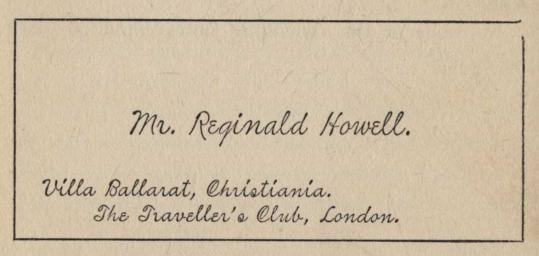
Visiting card of Mr. Reginald Howell
"Ask him to step in."
Mr. Howell entered and shook my hand in his free-and-easy English manner.
"Glad to see you."
"Welcome back again."
He had quickly mastered Norwegian, and we always talked together in that language.
"I was just writing a note to you, Mr. Howell, to request the favour of an interview with you; you have forestalled me, perhaps for the same purpose."
"I—suppose so," answered the Englishman, hesitating. "I should like to say a few words to you in confidence, with regard to the robbery at Mr. Frick's."
He looked round as if to assure himself that we were alone.
"You can speak freely: we are alone; I was wishing to ask you a few questions about this same matter. You were, of course, in the house on the day, right up to seven o'clock."
"Quite right; but tell me, Mr. Monk, shall I be called as a witness in this case?"
"When the case comes before the court, there is every probability that you will be called to give testimony."
"But am I bound to appear and answer?"
"Yes, you are! I hope you have no objection."
There was something in the young man's manner which caused me to pay the greatest attention to his words and behaviour.
"But can the matter come before the court before you have found the thief?"
"As soon as we have got sufficient evidence against some person, that person will be charged and brought before the court."
"But before this happens it is not necessary for me to reply to any questions about the affair?"
"When the police, who are conducting the inquiries into the matter, ask you, you should certainly answer. To refuse to answer would be considered somewhat strange, and might even lead to unpleasantnesses for you."
"Many thanks for your information," answered Mr. Howell; he had got up and was walking restlessly up and down the room. "It is not pleasant for a man to contribute to the ruin of some wretched creature, but perhaps it is impossible to avoid it."
From the words which bad been exchanged between us, I felt sure the young Englishman did not know of Evelina's arrest. As you remember, I had requested old Frick and Sigrid not to speak to him about the affair. I could also see that my answers to the questions he put to me had not told him anything which he did not know before; he was not altogether so ignorant about the matter. He must have put these questions to me as a feint, for some purpose or another. I was almost certain that he knew something of importance to the discovery of the robbery.
I decided at once to inform him of Evelina's arrest but not of her confession. It would, indeed, be strange if he did not betray how far the knowledge he had of the matter did not point in the same direction.
"Besides," I continued, "you need not be afraid that your evidence will be of such fatal significance. We have already got the diamond back, and the guilty party arrested. It is Evelina, Miss Frick's maid. Circumstantial evidence is so strong that a confession is unnecessary."
"Well," said Mr. Howell, quietly, "I can just as well tell you now what I know, as later on. It was on the afternoon when the diamond disappeared, after the old crank, Jurgens, had dined at Villa Ballarat. Soon after we had had some coffee in the museum I went up to my room and loaded some cartridges, for I was going to Osterdal for some shooting, you know."
"Yes; I know what took place in the house that afternoon. Please go on."
"Well, when I was ready with the cartridges, I went down into the garden to smoke a cigar. The other people had gone to their rooms, I suppose, for I did not see any of them. As I went by the museum it seemed to me that the door wasn't shut, and when I touched it it slid right up. You know it is a large iron door, but so well balanced and oiled that it moves quite noiselessly. Well, I glanced into the museum, and there I saw a lady standing before the cupboard on the opposite side of the room, with her back toward me. With one hand she held up the iron lid, and in the other she had an article which she seemed to have just taken from the case, and which she was examining. It did not occur to me to think it was anybody but Miss Frick; I thought I recognized the light spring jacket with dark braid."
I looked up suddenly and met Mr. Howell's gaze; his eyes did not impress me pleasantly, and it appeared to me that their expression was dark and cunning.
"Continue," I said hurriedly, and, I believe, rather roughly.
"Well, you know, Mr. Monk, that I am very fond of photography, and that I always go about with a little snap-shot camera. You know it, of course,—we have often had fun at Villa Ballarat photographing people when they least expected it!"
I nodded.
"I had the apparatus with me, and so it struck me that I would photograph Miss Frick as she stood there, without her knowing it. I went hurriedly and softly inside the door, took the photograph, and went out again without her seeing me. She stood quite still, as if she was wondering what she should do with what she had in her hand."
The Englishman paused, as if to give me an opportunity to speak. But as I did not even look up, but went on drawing figures on the paper before me, with as careless an expression as possible, he continued:—
"Later in the afternoon I took a carriage outside and drove to the station. On the way I took some negatives to the photographer, amongst them the picture of which I have just spoken, as there were some of them that I wanted to get developed by the time I got back. On my return from Osterdal I heard that the diamond had disappeared, and then I remembered the photograph. I naturally said nothing about it to Mr. Frick or his niece, but I called for the prints. Would you like to see the one from the museum?"
This was the second time that Sigrid's name had been mentioned in connection with the disappearance of the diamond. It awoke the most unpleasant feelings in me; but as I felt Mr. Howell's searching look resting upon me, I assumed perfect calmness, and took what he handed me.
It was quite a small photograph on thin prepared paper, and placed between two glass plates held together by an india-rubber band.
I took it with me to the window to examine it closely.
It was, as before said, a small picture, only two or three inches high and very narrow, but exceedingly clear.
A young girl stood before the well-known cupboard in old Frick's museum. Her position was exactly as Mr. Howell had described it.
The one hand held the lid open, the other held an article which was hidden by the shoulder; the head and neck were bent somewhat forward, examining the object.
It was a tall, fine figure in a light walking costume, trimmed with dark braid.
There was not much to be seen of the room. One saw part of the cupboard on both sides, a chair, the arm of another chair, but nothing else. Over the cupboard, at about the same height as the young girl, was a shelf. Part of this shelf, on which could be seen several small curios, was included in the picture.
One glance was enough for me to be certain who the young girl was.
I turned round to Mr. Howell. "It is Evelina, as I suspected."
"Yes, of course; I am only astonished that I could have taken her for Miss Frick when first I saw her. It must have been the costume which deceived me. Miss Frick has worn it all the spring."
"Yes, I know," I answered curtly. It was irritating always to have to return to Sigrid in this manner.
"Very well; on this occasion I also played the detective, Mr. Monk. I have privately found out from the other servants that Miss Frick had, that same afternoon, given the costume to Evelina. You see everything is quite clear in that respect."
"Will you allow the police to keep the photograph, Mr. Howell, and is there anything else you can tell us about the matter?" My manner was, perhaps, somewhat abrupt.
"Wait a little," he answered; "I hope you understand now the reason for the question which I put to you at the beginning of our conversation?"
"Yes; you would rather not appear as a witness, as far as I could understand."
"Exactly; and, as you yourself say, the person in question is already arrested, and the circumstantial evidence is so strong that my evidence cannot be of much importance one way or other. This being the case, would it not be possible for me to avoid appearing in court? and could you not consider what I have said as confidential, so that I might take the photograph and destroy it? Otherwise I shall appear very much in the light of a spy or a thief-catcher, Mr. Monk. Also, it would be most objectionable to me to have to testify against the unfortunate woman."
"Your sentiments do you all honour, Mr. Howell; but I cannot, all the same, prevent your being called as a witness. Neither can I, of course, keep your photograph against your will; but I must mention it in my report, and most earnestly request you to preserve it. What you have said to me in my office, with respect to a matter concerning which inquiries are now being conducted, I cannot, in my capacity as a police official, consider confidential."
"Well, Mr. Monk, I see it cannot be helped, and I ought, perhaps, to have denied all knowledge of the matter. But you can, at any rate, bear evidence that I appear most reluctantly; I would like both the unhappy girl and the Frick family to understand this."
"I can only confirm what you yourself say, Mr. Howell," I answered stiffly, for I began to be more and more convinced that the man was playing a part. "You will leave the photograph then in the hands of the police?" I continued..
"Yes, I may just as well leave it; I cannot see that I can do any one any good by not doing so. You police deal with people in your own way,—we speak and do just as you want us to do."
"Allow me one question, Mr. Howell,"—I had again taken the photograph in my hand,—"this photograph is very small; it looks as though it had been clipped at the sides. Was the photograph originally broader, and did it include nothing more of the room?"
"Yes, it was originally broader, but only the middle part was clear and distinct. Either side of it was, for some reason or another, very foggy, so I cut it off to get the picture to fit between the two glass plates. I had, besides, no interest for anything but what you see there. The young girl is, of course, the principal object of interest,"—he sighed gently.
"What time could it have been when you took the photograph?"
"Well, that question I cannot answer very exactly. I thought, of course, at the time, that I should never be asked about it, but—let me see—it can't have been far off six o'clock, for it was not long after that I left for the railway station, and that was somewhere about seven."
* * * * *
The next minute Mr. Howell was gone, and I sat beside my desk in deep thought.
The Englishman's visit had made an unpleasant impression upon me, and I could not make out what his purpose in making it really was.
The man wished to come forward as a witness—that I felt sure about. All the rest was mere dissimulation; but for what purpose? What could be his motives?
It puzzled me at the time, and it puzzles me still!
* * * * *
During the whole of this long story, Monk had remained calm. He had been speaking evenly and dispassionately, as if he had been reading a police report. But now he changed in expression and manner. He began to pace up and down the floor with contracted eyebrows, and I saw that the perspiration stood on his brow.
* * * * *
You look astonished at me (he continued). After what you have heard, does the whole affair seem clear to you? It will, perhaps, seem still clearer when you have heard me for a few minutes longer: and you will not be able to understand how it could become an enigma! Yes, an enigma which I would give half or the whole of my life to solve!—But wait a bit! When you have heard the rest of my story, you will join with me in asking, "Who stole old Frick's diamond?" And you will likewise understand that upon that question my fate has depended from that day to this. But I shan't proceed any longer in that strain; I will continue as impartially as I can. On that will, perhaps, depend how far you or anybody else can help me—alone I can do nothing. I, who was so proud of my own acuteness and ability to penetrate where others failed to see a way!—No, don't interrupt me. We shall discuss it afterward, when I have finished my story.
I had got as far as Evelina's arrest and that Mr. Howell had called on me with the photograph. So far, everything was in order. The accused had confessed, and the stolen article had been brought to light. But it had been impossible to discover where the five thousand kroners had disappeared.
Evelina refused positively to say a word beyond the confession, and as we were not able to prove any complicity against the actor and Mrs. Reierson, they were discharged.
The state of affairs in Mr. Frick's house was anything but satisfactory. Sigrid had been suffering from nervous headaches ever since a few days before the robbery. Old Frick was in a rage, and spent the whole day in swearing at the duplicity and untrustworthiness of mankind. I believe, however, that sympathy for the wretched Evelina was the true cause of his anger. The young girl's arrest had, in fact, brought gloom and sadness into the house. Einar Frick was still absent on business. Mr. Howell decided to go to Spitzbergen as soon as the case against Evelina was settled.
It vexed me that I could not trace the money, or obtain any proof of the actor's complicity; and I took it for granted that the sly fellow had succeeded in getting it safely put away in Gothenburg, before he was arrested.
But although we had a clever officer there, and got all possible assistance from the Swedish police, we did not succeed in obtaining any proofs, and as long as Evelina would not speak we could proceed no further in the affair.
Thus matters stood, and I think that all the actors in this drama were only wishing that it would come to an end as soon as possible.
Suddenly one day I received the most astonishing news—Evelina had demanded to be brought before the examining magistrate, and had retracted before him her confession in full. She had declared that when she confessed she had not been herself, and that she was really innocent and knew nothing of the robbery. She would not say anything further, and refused to answer any questions.
Of course, those who knew the ins and the outs of the case only shook their heads at this unexpected development, and began to doubt her reason. The doctors, however, who examined her, could not discover any signs of a deranged mind.
The proofs were otherwise very strong against her; and as there was no prospect of any new evidence in the matter, the hearing of the case was fixed for the first sitting of the court.
I visited the young girl in prison and found her taciturn, depressed, and pale; but she gave me the impression of being entirely normal. I tried earnestly, and in a friendly way, to prevail upon her to adhere to her confession and to give a full explanation; but she only smiled sadly, and begged to be left alone. What could have caused her to retract her confession? The more I pondered over this, the more sure I became that this step must be due to some outside influence; that she must have received some message or communication from without. She did not wish to receive any visitors in her cell. Only the mother had obtained permission to visit her once, and then the conversation had been quite short, and had taken place in the presence of a constable.
The mother had, on that occasion, until interrupted by the constable, tried to continue her reproaches against her daughter, because she had confessed something which she had not done.
But her daughter had contemptuously turned away from her, and soon after the mother was taken away without the robbery having been further discussed between them.
I felt sure that these reproaches from the mother, which the daughter seemed to treat with disgust and contempt, had had no effect, and that the explanation must be sought for elsewhere.
By closely examining the jailer, he at last told me that he one day surprised the young girl while she had a small piece of paper in her hand, but that she immediately turned away and had probably put the paper in her mouth and swallowed it. The man declared, however, that it all happened so quickly that he could hardly be quite certain about the matter, and Evelina, as usual when I spoke to her about it, took refuge in an obstinate silence.
My suspicion that Evelina acted on other people's advice was now strengthened. How far this circumstance can have any influence upon your opinion, when you have heard me out, I don't know. To me, all is dark; but I shall try to tell my story in such a way, that nothing of what I know shall be hidden from you.
Fortunately, I have got on so far with it that I can now let others speak for me—at least for a while. The next great event in my story is the trial of Evelina, which took place about three weeks after her arrest.
The proceedings are to be found fully reported in all the papers at that time, and you will get a more complete idea of the case by reading one of these reports, than if I give you a verbal account.
* * * * *
Monk opened a drawer in his writing-table, and took out a locked portfolio, from which he produced a large grey envelope. The envelope proved to contain several cuttings from the Morning News, which Monk laid before me.
"But," I objected hurriedly, "I would much rather hear the account from your own lips. Otherwise I should miss your impressions, which, to me, have much more value than a newspaper reporter's idiotic and irrelevant remarks. And even if he does report the bare facts, such a report cannot possibly be as satisfactory as your own account."
"There is a difference in newspaper reporters," was Monk's dry reply. "As you will see, the Morning News man has not only reported carefully and judiciously, but his remarks are impartial, and show good sense and power of observation."
"That's all very well; but I depend, however, more upon your power of observation."
"In this case, you cannot do so. If a detective ever has made a great fiasco, I did so on that occasion, as you yourself will learn. Don't you understand that I am afraid that you are beginning to look at the events with my eyes? I am afraid to lead you into the labyrinth in which I, myself, am lost, and which I probably have myself built up!"
It struck me that Monk's reasoning was correct, and I made no further comment.
"Only one question," I said; "have you any objection to Clara hearing your story?"
"No; on the contrary, it was my intention to ask you to tell her everything, when we are finished. I hope for help from her; she is an unusually intelligent woman, and besides, women have, in many respects, much finer feelings,—instinct, or what you call it,—than we men."
"Then I have a proposal to make to you. We shall not continue to-night, but I shall tell Clara all that you have now told me. Clara and I will read the newspaper account together, and then we will see you again."
"I gladly accept your proposal," said Monk, a little hesitatingly; "but if I could be allowed, I would ask you both to read the account in the paper in my presence. Of course I have read it, not once, but ten times, to myself, without any result; but now it has struck me that the whole affair might appear to me in a new light, if I heard some one else read an exact account of what happened on that fateful day."
"Yes, with pleasure," I exclaimed. "I promise to do this, both on my own and on Clara's behalf."
Monk shook me by the hand, and asked if Clara and I would come up to him one day, when I had told her all I had heard from him.
"You shall see us here to-morrow," I answered quickly, and so we parted that evening or, more correctly, that night. It was half-past one when I reached my home.
I had had a busy day, and the intense interest with which I had listened to Monk's account had tired me. I only longed to get to sleep as quickly as possible. But then happened what a more experienced man than I might perhaps have foreseen.
When I got home Clara was sitting up waiting for me. So I explained to her, as casually as possible, that next day she should hear Monk's remarkable story,—a story, the continuation of which we were to read together; well—what further happened I cannot remember, but I am sure it was past four that night before I got to sleep, and then Clara had heard everything that the reader knows of Monk's history.
"Pshaw! it isn't difficult to understand how the story will end! The horrid Englishman naturally managed things so that Miss Frick should be suspected of having stolen her uncle's diamond; and—"
These were the last words I heard Clara utter as sleep overcame me. "Yes, if there must be a villain in the drama, Clara must be right in thinking that the Englishman must have played that rôle," I thought with my last efforts, before my senses were entirely bedimmed.
* * * * *
The next day we all three were sitting in Monk's study.
"We mustn't lose any time," said Clara, as she smartly cleared aside the tea and cakes to which Monk's kindly landlady had treated us. "Remember, Mr. Monk, that we now change rôles. It is you who seek advice and help, while Frederick and I represent the detective firm. Well! we had got so far that the case was on for trial,—my husband has told me everything,—and here are the newspaper accounts of the case, which you want Frederick to read aloud, isn't that so? So set to work, Frederick!"
PART II
CHAPTER I
THE TRIAL
In the Morning News of June 2, 189-, appeared the following, under the heading:—
THE BLACK TORTOISE IN COURT
The court to-day was filled to overflowing, and a large number were unable to gain admittance.
The disappearance of old Frick's diamond—we hope our respected fellow-citizen will excuse our using the familiar name by which he is so well known—has been eagerly discussed and commented upon by the newspapers for the last few weeks.
The case did not promise to become a particularly difficult or complicated one, although it was known that the accused had retracted her confession; but the stolen article was of such an unusual kind, and of such great value, and the persons who were to appear in the case were so well-known, that it was only to be expected that the proceedings would attract as many people as the court would hold. One could hardly imagine anything more sadly interesting than the pale and pretty girl who stood charged before the court with the theft of the now famous diamond. By her side sat her counsel, a young advocate who is already known in legal circles as a most able and successful counsel for the defence.
Among the witnesses was the well-known figure of old Frick, and by his side his niece, Miss Frick. Not far off stood Mr. Monk, acting chief of the detective department, already a well-known and popular figure in our town, as much appreciated for his acuteness and boldness as for his tactful conduct when in the execution of his duty as a police official.
The dark distinguished-looking man beside Miss Frick was the Englishman, Mr. Howell, who, as everybody knows, has been compelled by a strange coincidence to appear as a witness in the case, and who, it is said, will give the most remarkable evidence ever heard in our courts of justice. The Englishman did not appear particularly edified with his task. From what I hear, it seems he has tried to escape giving evidence. It is anything but a pleasant duty to give evidence against a young woman when one feels that it will mean conviction for her.
* * * * *
The presiding judge of the court took his seat, the case for the prosecution was stated, and the usual questions asked of the accused as to her name, age, etc.
She did not look up, but answered in a fairly audible voice. Then she was asked whether she was guilty or not guilty.
All waited anxiously for the answer.
Her voice was this time so low that the judge had to lean toward her and request her to speak more loudly.
The silence was so intense that the answer, although scarcely more than a whisper, was heard all over the court: "Not guilty."
Had the public expected anything else? Perhaps—perhaps not....
The public prosecutor then began his charge:—
The crime with which the accused was charged was not of a particularly complicated nature with regard to the question as to how, or by whom, the theft had been committed. But it was a different matter with regard to the motives and the circumstances under which it had taken place, and he was willing to admit that in this respect little or no light had been thrown upon the matter. An uncommon article, an object of great value, in other words, the black diamond, which now lay on the judge's table, was stolen on May 10 from Mr. Frick, who was now present in court as a witness. The police were at once informed of the theft, and they succeeded not only in recovering the stolen object, but also in providing such information that the public prosecutor was able to prove fully before the court, both how the theft had been perpetrated, by whom, and how the thief had disposed of the stolen object.
He would call witnesses to prove at what time the theft had been committed, that the accused at that time had been at least half an hour in the house, that she during that time had the opportunity of going into the room where the diamond was kept, and at a time when the cupboard was not locked. He could prove by a means which seldom fell to the lot of the authorities, that the accused, in the time during which the theft had taken place, had been into the room and even opened the case where the diamond was kept. He could next prove that the accused at an earlier hour of the same day had had an opportunity of hearing an assurance from a rich man that he would pay a large sum of money to become possessed of the diamond. She thus knew beforehand that she could sell the stolen article without any difficulty.
Finally, he could prove that the diamond was actually sold by the accused on the same day to the man just mentioned.
Thus far the chain of evidence was as complete as any could be, and in order to substantiate the guilt of the accused it was of no consequence that she had retracted her confession, and had hitherto refused to give any explanation whatsoever; every experienced judge would know exactly what value to put on circumstantial evidence of such a character. It was just as good, if not surer, than a confession.
What still had to be explained was, what had become of the money which the accused had received for the diamond and what could be the particular motives for this criminal act.
Some information might possibly be obtained during the examination of the witnesses; but if this was not the case, the prosecutor would be obliged to maintain that the punishment be in accordance with the utmost rigour of the Law. The public prosecutor would, therefore, conclude with the request to the judge that he ask the accused most earnestly to give a full explanation. If she still persisted in her refusal to give this explanation, he must warn her that it would be with detriment to her cause, and possibly to that of justice.
It was so quiet in the court, when the public prosecutor sat down, that one could hear a pin drop.
The judge then turned and addressed the young girl. In calm, considerate words he called her attention to the fact that she had the right, in any case, to do as she pleased—either to speak or to keep silent; and that no pressure would be brought to bear upon her, least of all to make her confess. This much, however, he felt it his duty to tell her, that she was certainly not acting in her own interests by maintaining silence. If she were innocent, which he still hoped, then her own explanations would only serve to show it: and if she were guilty, they would enable the court to consider her case in the most lenient manner possible.
Every eye in the room was turned on the unhappy girl, but her face remained as impassive as that of a statue; her lips were pressed together, and her eyes cast down.
Her counsel leaned toward her and whispered something in her ear. She did not raise her eyes; her only answer was a slight inclination of the head.
"I must request," said the young advocate, "that my client's wish to make no further statements shall be respected. She has decided to say nothing; and I know that her resolution in this respect is not to be shaken. Whether this decision is wise or no, and whether or no it is taken by my advice, is not for the moment a subject for discussion. It is enough to say that whatever appeals were directed toward her to state what she knows of the case would, however well meant, only prolong the proceedings."
No sooner had the counsel sat down than a murmur went around the court, giving expression to nearly all the different feelings which move the human heart. Some feared that the accused would damage her own cause, others admired her firmness, while many expressed astonishment at her audacity. As all the papers have already published detailed accounts of what happened at Villa Ballarat upon the day that the robbery was committed, it will be sufficient to mention that the evidence of all the witnesses only served to corroborate what the public already knew, thanks to the unremitting zeal of the newspaper reporters.
It also seemed as if the counsel for the defence understood that it would be hopeless to upset that part of the evidence.
He certainly tried to make it appear possible that some strange person might have crept into the garden of the villa between five and half-past seven in the afternoon; but this attempt was stranded, upon the gardener's definite assurance that the gate had been locked the whole time, and on the evidence of the chief of the detective police with regard to the examination he had made of the railing and the ground round the garden.
The counsel for the defence was more fortunate in his attempt to obtain evidence of good character and behaviour for the accused. Mr. Frick and his niece were especially unremitting in their praise of the young girl.
Miss Frick caused much excitement when, in answer to a question by the counsel for the defence, she answered:—
"Evelina has for several years had all my trinkets and jewels in her custody. Thanks to my uncle's generosity, I have more of those kinds of things than I need, and it would have been very easy for her to take any one of many of these, without fear of discovery. Her mere assertion that something had been lost would have been enough.... No! she is honesty itself! She could never steal my uncle's diamond, of that I am convinced, however much appearances are against her!..."
There was great sensation in court when Mr. Howell was called as witness. Every one, of course, knew of the strange circumstances under which he had been involved in the matter.
He began by asking the judge if he might be excused from appearing as witness. The judge asked him to give his reasons for this request. Mr. Howell explained that he was a private gentleman and not a police spy. It was quite by an accident he had come to play a rôle in this affair—a rôle which did not please him. He had already given his explanation to the police, and had hoped that would have been sufficient.
The judge answered that none of these explanations could exempt him from appearing as witness. One could not help respecting his feelings; but since no lawful reasons could be given, they must request him to give what evidence he could.
Mr. Howell, who spoke the Norwegian language fluently, submitted to the inevitable, and gave a short and clear account of how he came to photograph the accused, so to speak, "in flagrante."
The papers have already published an account of this scene, so that I shall not repeat his evidence "in extenso." I shall only reproduce the following of the examination.
Public prosecutor: "What did you do with the film after you had taken the photograph?"
Witness: "I went to my room with it, took the films out of the apparatus, and took them to the photographer's to be developed. I called at the photographer's on my way to the railway station."
Public prosecutor: "You maintain, then, that it is the accused whom you have photographed, but without your being aware of it? Are you sure it is the accused?"
Witness: "Any one who has seen the accused a few times will see that she is the person in the photograph."
Public prosecutor (taking an object from the judge's table): "Is this the photograph in question, which you, yourself, delivered up to the police?"
Witness (taking the photograph in his hand and carefully examining it): "Yes, it is."
The public prosecutor declared himself satisfied, and the counsel for the defence began: "Now, are you quite sure that when you photographed the accused you did not believe her to be some one else—for instance, Miss Frick?"
Witness: "Yes, I believe I have already explained myself sufficiently clearly on that point."
Counsel for the defence: "I cannot understand how you can now be so sure that the picture represents my client, while you believed quite otherwise when you had the living person before you. What is the reason for this?"
Witness: "I have before explained I was in a great hurry at the time. I wanted to get away before the person should turn round—it was all done in fun on my part. Besides, I thought I recognized Miss Frick's jacket,—she had been in the habit of wearing a jacket trimmed with braid. Later, I got to hear that Miss Frick that same day had given it to her maid as a present, and on looking at the photo I became convinced it was the maid."
Counsel for the defence: "Good! Are you also quite sure that the picture you now see here is the same as that you took on that occasion? The film has been several days out of your keeping, and in other hands."
The young Englishman seemed rather impatient at this examination. "If the film has not been tampered with at the photographer's," he exclaimed quickly, "it is the picture of what I saw in the museum. Whether it has been tampered with or not, I see here before me the same person, in the same position, and in the same room—others must now decide which is most probable."
He took up the picture again, examined it carefully, and handed it back to the public prosecutor.
"I have only wanted to show," said the counsel for the defence, quietly, "that you yourself at one time have doubted the identity of the person who stands in front of Miss Frick's cupboard in the photograph. I have now only two other questions to ask you.
"What was the time when you took the photograph?"
Witness: "About six."
Counsel for the defence: "Are you not able to give the time more exactly? Might it not just as well have been half-past six?"
Witness: "I cannot give the exact time. I didn't attach much importance to the incident. When I had taken the photograph I went up to my room, and was busy there for some time before I left. It was then about seven, so from that I conclude that the photograph was taken about six."
Counsel: "Might it not have been a little over half-past six?"
Witness: "No! I can be quite certain it was not over half-past six."
Counsel: "Could you see that the person held the diamond in her hand? In the photograph the object which she holds is hidden by her shoulder."
Witness: "When first I caught sight of her, she held the diamond somewhat higher, so that I was able to see it; afterward she lowered her arm, and while in that position she was photographed."
The counsel for the defence seemed to be satisfied.
Then Mr. Rodin, the photographer, was called as witness.
The well-known artist, whose pleasant manners have obtained for him so many customers and friends, bowed to the judge and court, and, the usual formalities having been observed, he answered quickly and decisively the questions which the public prosecutor put to him.
Public prosecutor: "Do you recognize this photograph? Has it been in your hands before?"
Witness: "Yes; this film, together with some others, was given me to develop, by Mr. Howell, on the evening of the 10th of May, about seven or half-past."
Public prosecutor: "And are you sure that this photograph is an exact reproduction of the negative?"
Witness (smiling): "The photograph cannot lie, sir! Even if I had wished it, I could not have produced anything else than what was to be seen in front of the apparatus at the moment it was opened to take the photograph."
The public prosecutor finished his examination, and the counsel for the defence began his.
Counsel: "Can you be certain that this photograph is the same one which you developed several weeks ago for Mr. Howell? It has not been in your possession since?"
Witness: "Yes, sir, I am quite sure; you can see for yourself that my initials are written on the back;—look, O.R. 10/5, H. 10. The first are my initials, then follows the date it was received, then the initial of Mr. Howell's name, from whom I received it, and lastly, the number in the series. The roll which he brought me that day consisted of ten films; this was number ten, the last photograph he had taken."
Counsel: "You cannot, however, be quite certain that this is the same picture which Mr. Howell brought you. During the work, some of your people might have mixed Mr. Howell's pictures together with other people's. Such a thing might happen, might it not?"
Witness: "No, sir; I develop all Mr. Howell's films with my own hands. He is very particular about them. As you will see, this picture is very clear and distinct, and I flatter myself that all the pictures which have passed through my hands are the same,—that is to say, when such an expert snap-shot taker as Mr. Howell has taken them."
Counsel: "Is there any reason, Mr. Rodin, why one could not photograph first the room, then a person, and then transfer that person to the first picture, so that a person appears in the room on the picture?"
The public had remained unusually silent and attentive during the whole of the proceedings; at this question the silence became still more intense. Every one understood the counsel's object in putting this question—that each one of his questions was an attempt to clutch at a last straw in the interest of his client; but all understood also that each straw slipped out of his hand, one by one. The same happened to this question. The witness answered, without any hesitation, "It is possible, sir; but every experienced photographer would tell you that this has not been attempted in the present case."
The young advocate looked disappointed. He made a motion like one who washes his hands, and allowed the witness to step down.