PART I—THE DEATH
Reading edition
I
IN the big hall of the Grand Hotel at Rome I introduced Peter Deeming to Vernon Kersteven.
The two men were friends of mine, and I wanted them to like each other; and, perhaps because they were both fond of me, I thought that they would get on well together, and that we should form a happy and a lively trio at dinner. Was this the fancy of an egoist? I have sometimes wondered since.
At the time I speak of I had known Deeming for over two years, having met him first in London at a friend’s house. Vernon was a comparatively recent acquaintance whom I had encountered when I was travelling in Algeria; but already in my heart I gave him the dearer title, for I had come to like him greatly, and I knew that my sympathy was returned.
The two men were very different—in their appearance, their natures, their ways of life—but differences sometimes seem to make for pleasant intercourse, and even for intimacy. We often love ourselves; but do we generally love those who markedly resemble us?
Vernon usually spent his winters in Rome, where he had a delightful house on the Trinità dei Monti. Deeming had come from England to take a long holiday, as his health had partially broken down from overwork. He was a very successful London doctor, devoted to his profession. Vernon was a rich man, passionately interested in the arts and in travel. How well I remember that first evening we spent together, that—I had almost written fatal evening! We were dining in the restaurant, and directly I had made my friends known to each other we went in and sat down at our table, which was in the middle of the room.
Deeming was a very thin man, nearly forty, clean shaven, with iron-grey thick hair, narrow clear-cut features, and a tremendously decisive mouth and chin, betokening power and resolution. His face was pale, and bore traces of his recent illness. In his long, rather colourless grey eyes, penetrating and usually calm, one could see the slightly anxious and irritable expression of a man whose nerves had been, and still were, overwrought. His hands were delicate, with thin fingers curving backward perceptibly at the tips. He leaned forward as he sat in his chair, glancing over the crowd of English, Americans, and foreigners who were busily eating and talking round us.
Vernon was tall and fair, younger than Deeming by some five or six years, with meditative, almost gentle, and very kind brown eyes, a sensitive, though not handsome, face, with a clear boyish colour in it, a voice that was generally low unless he got much interested in the subject he was discussing, and an extremely fascinating manner, whose fascination sprang from his great courtesy, combined with a perfectly natural self-possession, as of a man who seldom thought about himself, and who was desirous of making things go easily and pleasantly for those with whom he was brought into contact.
I saw Deeming look at him steadily, rather as a doctor looks at a new patient, more than once as we drank our soup, and I knew that with his invariable acuteness he was taking stock of his new acquaintance. Vernon, on the other hand, showed at first no special interest in Deeming, did not regard him earnestly, but was gracefully agreeable to him as he was to everyone. He was far more what is generally called a man of the world than Deeming, whose devotion to, and great success in, his profession had kept him bound to the wheel of work in London, and had prevented him from having the opportunity of knowing the nations and mixing perpetually with society which Vernon had enjoyed.
At first we talked quietly, almost languidly, of Rome, of its changes and its tourists, of the influence of America upon its society, of its climate, of the differences between life in England and life abroad, and so forth. It was not till the middle of dinner that anything occurred to wake us up into great animation. Then a stout, dark, and very vivacious little lady, with a commanding air, came into the restaurant followed by two men, and sat down at a table near us. She and her companions were obviously Italians, and almost directly she screwed up her eyes at Vernon and nodded to him. He returned her salute with empressement.
“Would you mind telling me who that lady is?” said Deeming.
“Margherita Terrascalchi,” replied Vernon.
“What—the famous authoress?” I said. “The writer of ‘Pietà’?”
“Yes.”
Deeming stared hard at the little lady, who was beginning to eat with extraordinary, almost comical, gusto.
“I have read that book,” he said. “In a translation.”
“What do you think of it?” asked Vernon.
“No doubt it is well done and calculated to move the ordinary reader.”
“Only the ordinary reader?” said Vernon, with a slight upward movement of his eyebrows.
“I think it wrongheaded and sentimental,” said Deeming, with more energy than he had yet shown. “She appears to wish to elevate the animals above humanity, to take them out of their proper place.”
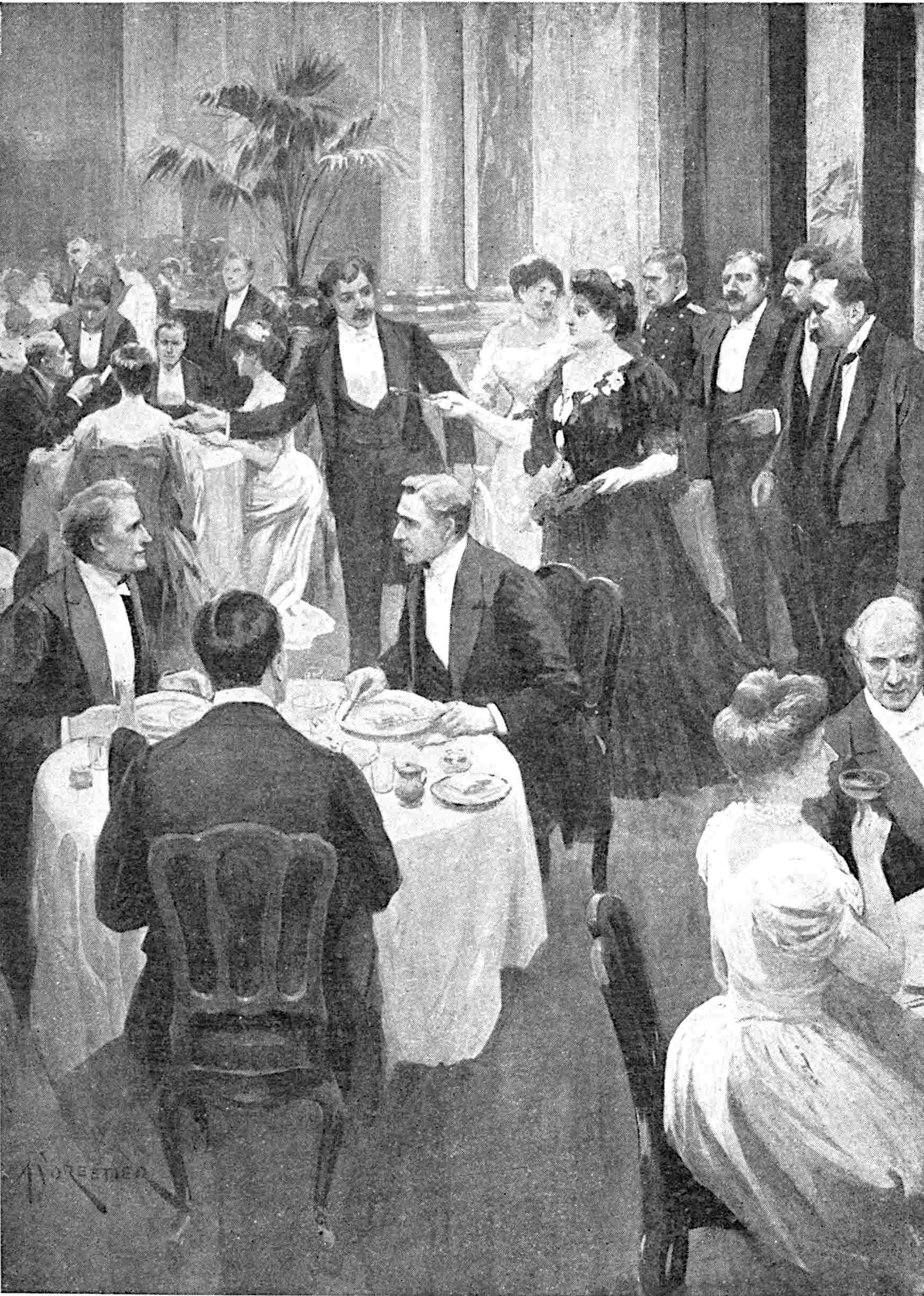
“SHE AND HER COMPANIONS WERE OBVIOUSLY ITALIANS.”
“What would you say is their proper place?”
“They are in the world, in my opinion, to be the servants of humanity, to minister to our comfort, our pleasure, our necessities, to help to increase our knowledge and satisfy our appetites, to give us ease and to gain us money. Don’t you think so?”
“No doubt many scientists, many sportsmen, and most, if not all, butchers do.”
I laughed.
“But you, Vernon,” I said, “are neither scientist, sportsman, nor butcher, and Deeming asks you what you think.”
Vernon was looking less tranquil, less gentle than usual at this moment. His face was lit up by a fire I had never seen burning in his eyes before.
“My sympathies march with Madame Terrascalchi’s,” he answered, “though perhaps she expresses them with a feminine enthusiasm that may seem to some almost hysterical, and is carried away by her passion of pity into an excess of animosity against men and women, who often err against the animal world more from lack of imagination than from any definite bias towards cruelty.”
“The question is, are we to be the servants of the animals or they to be our servants?” Deeming said rather drily. “I notice that Madame Terrascalchi is eating something that looks remarkably like a veal cutlet at this very moment.”
“Oh,” said Vernon, with his pleasant smile. “I hold no brief for her. I believe her, in fact, to be very—shall I say human? But as to what you were saying. Is it wholly a matter of whether we are to be masters or slaves? Cannot we and the animals—we are not, of course, discussing dangerous wild beasts—be friends, or, let us say, could we not be friends, good and close friends, they serving us in their way, we serving them in ours?”
“How are we to serve the animals?” asked Deeming, still drily.
“By considering them far more than we generally do, by studying them, their natures, habits, desires, likes and dislikes far more closely, by encouraging their affection for us, and giving them more of ours.”
“I think that would be a great waste of time.”
“Deeming is a terribly busy man, Vernon,” I said.
“I know my London well enough to know it,” Vernon remarked politely. “Still, I think we might find time for that; even that we ought to find time for it. I am rather what you might call a ‘crank’ on the subject of the animal world.”
“I didn’t know it,” I said.
“Oh, yes, I am.”
The almost fierce light again shone in his eyes.
“I love all animals. Ouida speaks of their ‘mysterious lives,’ spent side by side with ours, and comparatively little noticed, little sympathised with by us. I know that many animal-lovers would raise a cry of protest against this. ‘Look,’ they would say, ‘how dogs are worshipped and petted, how horses are loved by their owners, how cats are stroked and fondled!’ and so forth. Yes, it is true. Out of the great world of the animals, we—those of us who are fond of animals—select a few who, we think, can minister to our pleasure, and we give them, or think we give them, a good time. But these pet animals who enjoy life are few in number compared with the many who are made to suffer by man; the dogs that are kept everlastingly tied up, or are half-starved, or are perpetually cuffed and kicked and beaten; the cats that are abandoned to die when their thoughtless owners change home; the horses that are overdriven, tortured by tight bearing-reins, lashed with the whip, made to draw loads that are too heavy for them; the birds—let me include them—that are forced to spend their lives in tiny cages in dark places. To any real, observant lover of animals, even of the so-called pet animals—excluding the beasts of burden, donkeys, mules, oxen, and the beasts that form part of our food supply, and the dumb creatures that are given over to the tender mercies of the sportsman: the hares that are coursed, the foxes and stags and deer that are hunted, the pigeons that are let out of traps (their eyes pierced to make them fly in a given direction) to be shot and are often left maimed to die, the sea-birds that the Cockney ‘wings’ and abandons to starve and rot, floating helpless on the waves of the sea, the pheasants that, wounded in a battue, are crushed one on the top of the other into bags to perish of suffocation; excluding all these—to any real and observant lover of animals the lack of sympathy, or the actual cruelty of man, is a perpetual source of disturbance, of anxiety, even of lively distress and misery.”
I was quite amazed at the energy with which Vernon had spoken, at the vigour and force of his manner. He paused for a moment, then he added—
“My love of animals has given me very many horrible moments in my life, moments in which I confess that my heart has been turned to bitterness and I have longed to make men suffer as they were making animals suffer. Yes, I have longed to see the cursed Cockney sportsman drifting face to face with a lingering death upon the sea, the callous game-preserver wounded in one of his traps and alone in the darkness of night in the forest, the careless hunter at bay with hounds rushing in upon him. But especially have I known the longing to turn one whom I have seen being cruel to a pet animal into that animal, and to be his master for a little while. You know some hold that theory.”
“What theory?” said Deeming.
“That what we do is eventually done to us in another life; for instance, that if a man has been brutal to an animal, at death his soul passes into a similar animal, which endures the fate he once meted out when he was a man.”
“Good heavens!” exclaimed Deeming. “You surely can’t believe such unscientific nonsense!”
“I did not say I believed it, but I should not be sorry to.”
He sipped his champagne. Then, more lightly, he said—
“I told you I was a bit of a crank. I am even hand-in-glove with Arthur Gernham.”
At the mention of this name, Deeming moved, and I saw his eyes flash.
“The prominent anti-vivisectionist?” he said.
“Yes.”
“And you share his views?”
“To a considerable extent, though I don’t always approve of what he writes or of what he says.”
“I’m glad of that. We doctors, you know, ab—well, we don’t love that eager gentleman. If he had his way humanity would undoubtedly suffer far more in the future than it will. For I don’t think his sentimentalities and wild exaggerations will ever gain over our legislators to his views.”
“Perhaps not. But I sometimes wonder whether anyone has the right, whether anyone was intended by the Creator to have the right, to avoid suffering at the cost of inflicting it, even to save life by causing death. However, the vivisection question is hardly a pleasant one for the dinner-table, eh!”
There was a moment’s silence. Then Deeming said—
“Of course you never shoot or hunt?”
“Never.”
“I do,” I said. “But I am not such a contemptible hypocrite as to deny that cruelty, and often very gross cruelty, enters into sport.”
Deeming slightly smiled.
“Do you keep any pets?” said Vernon to him, rather sharply.
“Yes. I have a dog at home, a black spaniel; and you?”
“No. For years I have kept no animals. I shall never keep one again.”
“That surprises me. You would give them a remarkably good time, I feel sure.”
“I have a reason.”
“May I ask what it is?”
“Certainly. I once had a dog that I—that I cared about. She was out with me one day in London and disappeared. I made every possible inquiry, offered a reward, went to the Dogs’ Home, but I couldn’t find her. Eventually, through an odd chain of circumstances that I needn’t trouble you with, I learnt her fate.”
“What was it?” I asked.
“She had been picked up by a dog-stealer and sold to the proprietor of an establishment called ‘Lilac Hall,’ near London.”
“An establishment?” I said, struck by the tone in which he had uttered the words.
“Where a large number—stock, I’ll say—of animals of all kinds, horses, cats, rabbits, guinea-pigs, dogs, was kept on hand for scientific purposes. My companion and friend died under the knife of the vivisector. What do you think of the food here? They’ve got a new chef.”
“I—I—oh, it’s very good, I think; it’s excellent.”
Deeming seemed startled by the sudden change of topic, and when we went into the hall to smoke he tried to return to the discussion. But Vernon did not rise to the bait he threw out, and at last frankly said—
“You’d much better not get me on to the subject of animals. I am really a bore when I let myself loose, as I did at dinner. And I am quite sure you”—and he met Deeming’s eyes—“don’t agree with my views. Are you staying long in Rome?”
“Till I feel quite set up again and ready for work.”
“Then I’ll hope you’ll come and see me.”
He gave his card to Deeming, and soon after went away.
I felt sure he had asked Deeming to call in order to please me. My two friends, I feared, had not taken a fancy to each other. One curious thing struck me as I watched Vernon’s tall figure going out through the doorway to the street. It was this—that I knew a side of Vernon’s, and a side of Deeming’s character that had been hitherto completely concealed from me. Each had elicited a frankness from the other that I, of whom they were fond, had not been able to bring forth.
Their two enmities—so I thought of it—had clashed together and struck out sparks of truth.
By the way, Vernon’s last remark to me in the outer hall of the hotel, whither I had accompanied him, leaving Deeming in the winter-garden, was this—
“I shouldn’t care to be Deeming’s black spaniel.”
II
A day or two afterwards Deeming said to me, “I’m going to call on your friend Vernon this afternoon. When is he likely to be in?”
“He’s generally at home between six and seven,” I said. After a moment I added, “You want to find him then?”
“Why—yes. He’s a very agreeable fellow. Did you think I disliked him?”
“Disliked him—no, hardly that. But, somehow, I scarcely fancied you two were quite in sympathy the other night.”
“Oh, you mean that animal-versus-human-being discussion. Now it is just because of that I want to meet him again.”
“To win him over to your views?”
“Well, I confess that I should like to get him to see how harmful such a man as his friend Gernham is or may become to the world—of men understood. He’s probably got all kinds of absurd notions as to how vivisection is carried on. I should like to have a quiet, reasonable talk with him.”
“Go to-day, then, at six. You’re almost sure to find him.”
“I will.”
And Deeming set his lips together with determination.
I was, I confess, a little curious as to the result of the interview. I heard something about it the same evening from Vernon, who sent round a note asking me to dine with him alone.
“Your friend Deeming has been here,” he said, almost directly I was in the house.
“I know. Did you have a pleasant time?”
“He’s extremely intelligent—got a great deal of character, real force. That ruthless mouth and chin of his tell the truth.”
At this moment the servant said that dinner was ready. We continued our conversation in the dining-room, which was hung with sacred pictures, gentle-eyed Madonnas—one by Luini—Saints, an Agony in the Garden by an unnamed painter, the little children coming to Christ, the Magi offering their gifts, watched by calm-eyed beasts in a dim stable.
“Yes,” I said. “Deeming is very decisive.”
“To me there’s something very strange in the thought that he is a healer.”
“Why?”
“Well—do you mind my speaking frankly about a friend of yours?”
“Not a bit.”
“I shall startle you, perhaps. You know one reads sometimes in the papers of people who are afflicted with what is called the mania to persecute. There was a trial of a woman not long ago—a Mrs. Denby.”
“I know. But⸺”
“And there have been various instances in distant Colonial possessions of France and Belgium—and, perhaps, of other countries—various instances of men placed practically in the position of tyrants who have indulged in orgies of persecution of natives.”
“But, my dear Vernon, you surely don’t mean that you think Deeming has the bloodlust because he believes good can come of vivisection. Upon my word, if you don’t take care, I shall begin to think you really are a crank.”
“It isn’t that. It isn’t what the man says. I can quite understand that as a doctor he wishes by every means to advance the spread of medical knowledge. No, no; it’s the man himself. Do you know him well?”
“I have seen a good deal of him in London. Not a great deal, because he’s such a busy man. But I have often been with him.”
“Often in his house?”
“More often at his club, and in my own house and at restaurants. Being a bachelor, when he entertains he nearly always does so at Claridge’s, or the Savoy, or one of those places. But, of course, I have been in his house.”
“Have you ever seen his dog, that black spaniel he spoke of?”
“No, I can’t remember that I have.”
For a moment Vernon spoke of a certain dish that had just been brought in, a special plat for which his cook was famous. Then he said—
“That dog I spoke of the other night—the dog I lost—you remember?”
“Yes.”
“She was a black spaniel.”
His tone in saying this was so peculiar that I was misled and exclaimed: “But you told us the poor beast was killed in that house—in Lilac Hall!”
“So she was.”
“I thought—really, by the way you spoke, you led me to imagine that perhaps you fancied Deeming had got possession of your dog.”
“Oh, dear no! Whisper is dead, years ago. I seldom speak of her.”
“I never heard you mention her till the other night.”
“The other night I showed you a side of me that you had never suspected the existence of, didn’t I?”
“You did indeed.”
“Well, having broken through my reserve, I feel that I don’t mind being frank with you.”
His eyes began to shine as they had shone in the restaurant when he spoke of man’s cruelty to animals.
“My dog was the greatest solace in my life,” he said. “I am not a sentimental fool. There is nothing either sentimental or foolish in loving that which, with a whole heart and perfectly, loves you. And a dog’s devotion really is one of the most perfect, one of the most touching, and one of the most complete sentiments that can be manifested by one living creature to another. Not to respond to it would be absolutely devilish. But one can’t help oneself if one isn’t made of stone. I won’t bore you with a long account of Whisper’s devotion and fidelity. Why should I? It’s enough to say that she loved me as much as a dog can love, and in a dog’s way, with absolute unselfishness, with entire singleheartedness. I never felt lonely when she was with me, scarcely ever even dull. When I had been out without her, and, on my return, she met me at the door, almost hysterically eager to show her rapture, I—well, I was glad to be alive, and felt that life was worth while so long as I could evoke such a tempest of delight in any living creature. A faithful dog, believe me, is the best bulwark against the coming of cynicism. You can’t be a cynic when a dog’s cold nose is pushed into your hand, or a dog’s paw is placed gently and solemnly upon your knee. When I lost Whisper, when I found out what had been her fate, I felt something that was more than grief”—he leaned over the table and laid his hand on my arm—“I felt hatred, burning hatred, against those who had snared and murdered her, against all who use animals cruelly for the purposes of men.”
His face was transformed. I seemed to see before me a man whom I had never seen before. This man, I felt, could be not only gentle, but vindictive, and would be quite capable of expressing himself not only in words, but also through actions.
“I can understand your bitterness,” I said. “But does not this recalling of a painful event only stir up recollections that⸺?”
He interrupted me almost roughly.
“That doesn’t matter at all. I want to tell you now. I prefer to.”
“Go on, then,” I said.
He took his hand from my arm, and continued—
“The fate of my companion altered me. It either stirred from sleep, or actually woke into life, a fierceness that till then I had not known existed, or could exist, in me. It made me understand that, in certain circumstances and to certain people, I could be implacable, almost ferocious; that I could deny the sole right of Providence—you know the text: why quote it?—to administer that gorgeous justice we name vengeance; that I could stand up and exclaim, ‘I will repay,’ and repay without fear, without flinching, and even to the uttermost farthing. But that was not all it did to me. With this awakening, or this creation of fierceness in me, there came a deepening of pity, of tenderness for the slaves of man. Yet I was selfish, and I have remained selfish.”
“How?” I asked, wondering.
“It was, and is, in my power to make at least some animals happy, as I had made my dead dog happy. I could not, and cannot, bring myself to do that. I feared and I fear too much to suffer again as I suffered when I lost Whisper, and when I learnt the truth about her end. That end has been a nightmare to me ever since. I cannot think of it even now without torture.”
“My dear fellow,” I said. “Don’t dwell upon it. To do so is really morbid.”
“I don’t dwell upon it, as a rule. Have I ever even mentioned this subject to you before?”
“No, no. But⸺”
“That man, your friend Deeming, has roused me up. I—I tell you that I hate—that it is almost unbearable to me to think of his having a dog—a black spaniel, like Whisper—in his power.”
He said the last words with extraordinary vehemence.
“That was what you meant then!” I exclaimed.
“When you mistook me just now? Yes, that!”
He relapsed into silence, but kept his still glowing eyes fixed upon me. I seemed to read in them that he had more to tell me, to see that there was some project, some intention of action, blazing in his mind.
“Look here, Vernon,” I said, determined to be quite frank with him at whatever cost, “Deeming is a friend of mine.”
“I know.”
“That being so, I don’t think you can expect me to be ready to harbour foul suspicions of him without any reason for them being adduced. If he were to be suspicious of you, and told me so, I should speak to him as I speak to you now. What on earth has the man done or said to make you so violent—yes, my dear friend, that is the word—against him?”
He did not look angry at my energy, but, on the other hand, he did not look doubtful or disposed towards modification. He only said, “How well do you know Deeming?”
“Not very intimately, but well enough to feel sure that he is a humane man. Patients of his have spoken to me of him, of his skill, his care, and devotion in the highest terms.”
“I don’t doubt it. I don’t doubt that he is humane as a doctor. Anyone can see that he is devoted to his profession, and his profession is to heal human suffering. Ambition alone would cause him to be humane—as a doctor.”
“You said yourself you were a bit of a crank. Aren’t you ever afraid that your crankiness may lead you—now do forgive me!—into something approaching malice?”
I thought he might be angry, but he wasn’t.
“My intuition—apart from anything else,” he said—“my intuition tells me that Deeming is a cruel man.”
“I don’t believe it. Vivisection⸺”
“I’m not thinking of that now. What I am thinking is that I should like to see Deeming’s dog.”
“That wouldn’t be difficult, I imagine.”
“You don’t mean that she is with him here, in Rome?”
“Oh no. A dog in a hotel is apt to be a nuisance.”
“I don’t agree with you.”
“Well, well; but you always come to London in the late summer. I suppose you’ll do so this year?”
“Probably.”
“Call on Deeming. He’s a hospitable man, and if you entertain him here in Rome, he is sure to ask you out in London. There you can see for yourself whether his dog isn’t properly treated, as I’ll swear she is, and as happy as dog can be.”
I spoke lightly, even with a deliberately jocose and chaffing air. He listened to me gravely.
“I will invite Deeming here,” he said. “Indeed, I intended to in any case, as he is a friend of yours.”
“Thank you.”
“But you say he usually entertains in restaurants when he is in London. I have no reason to think I shall ever set my foot inside his house.”
The extreme gravity of his manner, the earnestness of the eyes that were fixed upon me, made me realise how strong was his strange desire, and therefore, how strong was his—as I thought then—absurd and unreasonable suspicion. I might have continued to laugh at it, and chaff him about it, but I did not. Something in his face and manner made me unable to do so, made me suddenly conscious that, however much I laughed, I could never laugh him out of his curious, and surely morbid, anxiety to verify, or lull to rest, his fears. And I must confess—so easily are we influenced by certain convinced people whom we care for—that I, too, was becoming, at that moment, oddly interested in this matter of Deeming and his black spaniel. Why had I never seen the dog, never heard Deeming mention it till the other night?
“If Deeming doesn’t invite you to his house,” I said, changing my tone, “there’s a very easy method of getting into it.”
“What method?” said Vernon eagerly.
“Go to him as a patient.”
I had scarcely said the words before I felt uncomfortable, almost traitorous. Here was I entering into something that was like a plot with one friend to get at a knowledge of another which that other had never voluntarily tendered to me. I was angry with myself.
“Upon my word, Vernon,” I exclaimed, “I’m ashamed of myself! Don’t let us discuss this matter any longer. Deeming and you are both my friends, and I wish to act always fairly and squarely by you both.”
“What unfairness is there in enabling me to prove the folly and falseness of my suspicions?” he rejoined quickly.
“I know—I know; but—oh, the whole thing is really absurd. It is madness to think such things of a man with no evidence to go upon.”
“How do you know that I have no evidence?”
“How can you have any?”
“Are a man’s words no evidence? Is his face while he says them no evidence?”
“Did you talk about his dog when he was here this afternoon?” I asked abruptly, moved by a sudden impression that he was keeping something from me.
“He wouldn’t talk about her. I am quite certain of one thing.”
“What is that?”
“That Deeming wishes now that he had never mentioned to us that he had a dog.”
I suppose I looked incredulous, for he added, without giving me time to speak—
“When you see him again, try to turn the conversation upon the black spaniel, and see how he takes it. And now let us talk of something else.”
During the rest of the evening Deeming and his dog were not mentioned. Vernon resumed, almost like a garment, his old self, the self I had always known, cultured, gentle in manner, full of interest in every topic that lent itself to quiet discussion and amiable debate. The evil spirit—I thought of it as almost that—had departed out of him, and when I got up to go I could hardly believe that I had ever been the recipient of his vehemence, or seen his eyes blazing with the light of scarcely controlled passion. He came with me to the hall-door and let me out into the quiet night.
“Good-bye,” he said, pressing my hand.
“Good-bye,” I answered.
I hesitated. Then I said—
“Doesn’t this calm of the night embracing Rome make you—make you feel that in your suspicions of Deeming you have been unreasonable; that, after all, it is unlikely he should be what you have fancied him to be?”
In an instant all the calmness, all the gentleness went out of his face. But he only answered—
“When you get back to the hotel talk to him about his black spaniel, and see how he takes it. Good-night.”
Before I could say anything more he had drawn back into his house and shut the door quickly behind him.
III
As I walked back to the Grand Hotel I thought over Vernon’s last words and the way in which he had said them. Should I obey his injunctions? I confessed to myself with reluctance that my conversation with him that evening had made me suspicious of a friend. Yet I had Vernon’s own word for it that he was a crank on the subject of animals, and my recent experience of him almost forced me to the conclusion that in his nature, usually so gentle, there must be an odd strain of fanaticism. My mind was troubled, and I reached the hotel without coming to a decision as to whether I would speak to Deeming about his dog or not. As I came into the outer hall I saw him through the glass door sitting alone in the winter garden, smoking, with a paper, which he was not reading, lying on his knee. He did not see me, and, for a moment, I watched him with a furtive curiosity of which I was secretly half-ashamed. Perhaps stirred by my gaze, he suddenly looked up, caught sight of me, smiled, and made a slight gesture, as if beckoning me to come in and have a talk. I took off my overcoat and joined him.
“I’ve just come from Vernon,” I said, sitting down and lighting a cigar.
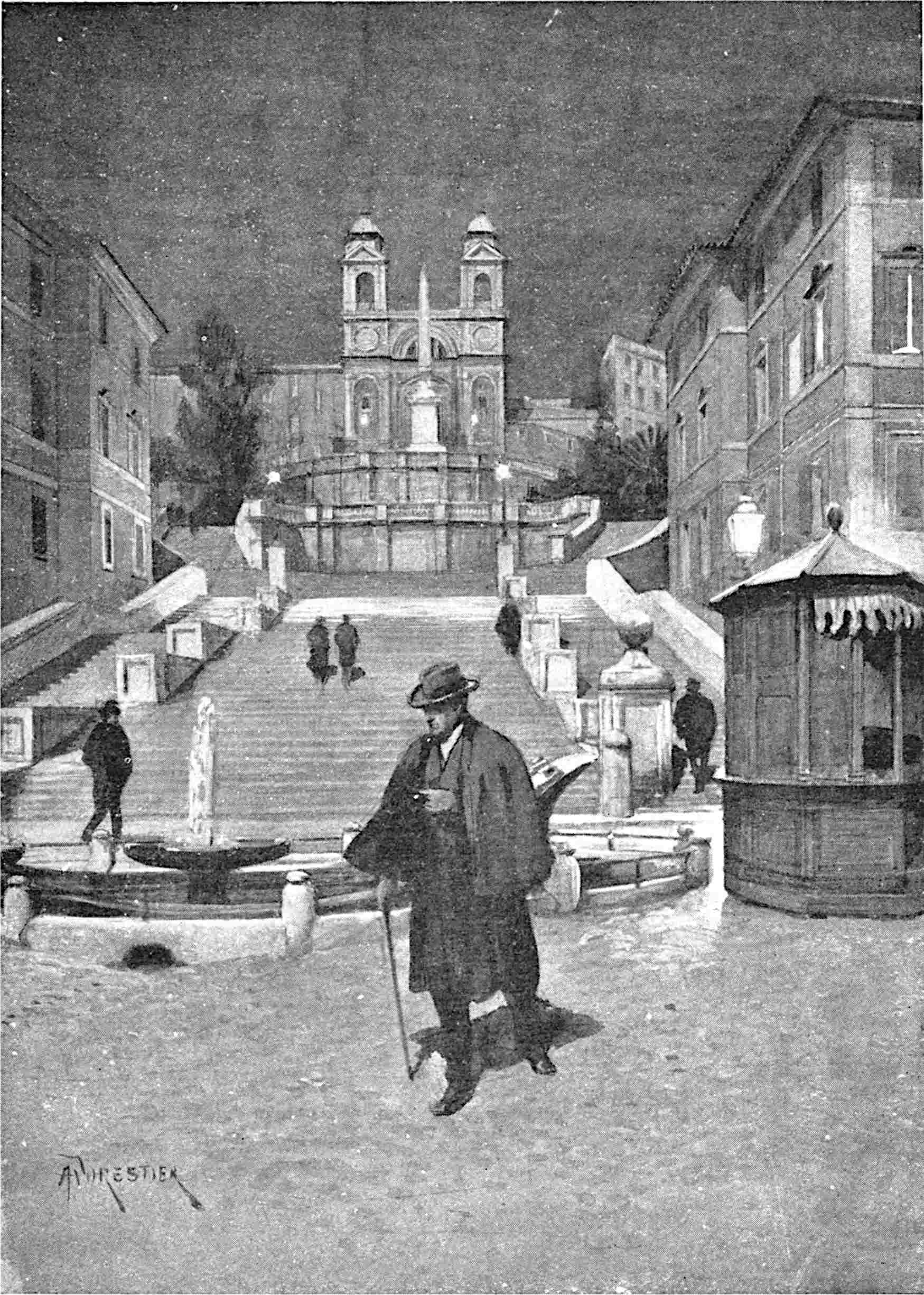
“AS I WALKED BACK, I THOUGHT OVER VERNON’S LAST WORDS.”
“Ah!” said Deeming.
He uncrossed his legs, crossed them again, and added:
“He’s got a beautiful house.”
“Yes, one of the most beautiful in Rome. He wants you to dine with him one night, I believe. Probably he’ll ask you in a day or two.”
“Very good of him.”
His voice was scarcely cordial.
“He’s a curious fellow,” he continued. “Easy in his manner, but difficult really to know, I fancy.”
“If you dine with him you may find him less reserved,” I said, rather perfunctorily.
“I don’t suppose he’ll ask me alone.”
“Oh, I shouldn’t wonder.”
“I don’t think he cares much about me,” Deeming continued abruptly. “Do you?”
“My dear fellow, he hardly knows you,” I exclaimed. “You haven’t been quarrelling over the animal world this afternoon, have you?”
And I laughed, but without much cordiality, I fear.
“Did he say we had?”
“Good heavens, no! But you differ on the dog question, and so⸺”
Deeming frowned.
“The dog question!” he said. “Why on earth should you call it that?”
“Well, I mean that he’s very sensitive since he lost his dog, and that perhaps makes him a little unreasonable at times, though I must say that till the other night when he dined here I never heard him mention the subject of animals and their relation with man. And, by the way, you’ve been equally silent. Till the other night I never knew you possessed a dog.”
“Is it such an important matter that I should go about proclaiming it?”
His tone was suddenly hard and impatient.
“No, of course not.”
“I hate people who bother their friends about their pets. It’s almost as bad as the women who are always talking about the marvellous beauty and genius of their squalling babies.”
He set his lips together as if he never meant to open them again, and I saw a look as of acute nervous irritation in his eyes. It warned me not to persevere in the conversation, and made me vexed with myself for having given way to Vernon’s desire.
“Let’s have a nightcap,” I said. “What do you think of doing to-morrow? What do you say to getting a carriage and driving over to lunch at Tivoli?”
He looked more easy.
“If it is fine I should enjoy it immensely,” he said in a calmer voice.
And we talked of old gardens and the beauty of rushing water.
We spent the following day together at Tivoli. When we came back towards evening, the hall-porter handed to Deeming a note. It was from Vernon, inviting him to dine two days later.
“You see how he hates you!” I said chaffingly when he told me. “Do you mean to go?”
“Oh, yes. Why not?”
He spoke lightly, holding the note open in his hand.
He did not go, however, and for this reason. On the morning of the day he was to dine with Vernon, he left Rome for England. An urgent summons from a patient, he told me, made it necessary for him to go to London without a moment’s delay.
I remonstrated with him, but in vain.
“I’ve had quite enough rest,” he said. “I’m all right. And this is an important matter. It means a very large sum of money.”
“Health’s more than money.”
“Certainly, but I feel quite my own man again.”
He did not look it, but I said no more.
I knew that argument would be useless. He sent a note to Vernon, and, when I bade him good-bye, begged me to express his regret at being obliged to cancel the dinner.
“But I hope some day he’ll come to dine with me in London. Do tell him so,” he said, as he stepped into the omnibus to go to the station. “I should like to meet him again.”
Those were his last words. I repeated them to Vernon.
“I shall not forget that invitation, I assure you,” he said quietly. “And I may be able to enjoy Deeming’s hospitality sooner than he, perhaps, expects.”
“Why? You’re surely not going to London yet awhile? I thought you loved your June in Rome better than any other month of the year.”
“But I’ve had so many Junes in Rome that I think I shall make a change. By the way, when will you be in London?”
“Oh, certainly by the last week in April.”
“If I asked to travel back with you, would you object to my company?”
“My dear fellow! Of course I should be delighted.”
“Let us consider it a bargain, then.”
He spoke decisively, and shook me by the hand as if to clinch the bargain. Nor did he forget it.
The third week in April found us in Paris, and on the twenty-second of that month we stepped into the rapide at the Gare du Nord, bound for England.
We sat opposite to one another in the compartment, with, at first, ramparts of London papers between us; but, as we drew near to Boulogne, first Vernon’s rampart fell, and then mine. The thought of the nearness of England had got hold of us both. London ideas were taking possession of us, and, as the train rushed on towards the sea, we became restless, as if the roar of the great city were already in our ears.
“Do you know,” I said, breaking our mutual silence, “that, familiar as I am with London, I can never return to it after an absence without a feeling of apprehension. It always seems to me that in its black and smoky arms it must hold some disaster which it is waiting to give to me.”
“I’ve had that sensation, too,” said Vernon. “Among the cities of the world London is the monster, not merely by right of size but by other, and more mysterious rights. It affects my imagination more than any of the European capitals, but rather frightfully than agreeably. I feel that it is the city of adventure, but that every adventure there must have a fearsome ending.”
“No doubt we are affected by its climate and its atmosphere.”
“I dare say. Still, if anything very strange, very uncommon, should ever happen to me, I am quite sure that it will be in London.”
I smiled.
“My experience,” I said, “has been that in London I am perpetually expectant of gloomy and mysterious events, but that my life there is remarkably unromantic and commonplace.”
“You speak almost regretfully. Do you wish for gloomy and mysterious events in your life?”
“I suppose not. Yet there is a spirit hidden in one which does sigh plaintively for the strange.”
“Perhaps this time it will be gratified.”
Something in the tone of his voice moved me to say—
“Do you expect it to be gratified?”
“I! Why should I?”
“I don’t know. Something in your voice made me fancy that you did.”
He laughed.
“The London atmosphere is, perhaps, affecting me already,” he said. “The London influence is taking hold of me. I told you it always stirred my imagination.”
“At Boulogne-sur-mer!” I said, as the train ran into the station. “The monster’s arms are longer than Goliath’s!”
The stoppage of the train interrupted our conversation. We got out to stretch our legs for a moment, and as we did so I found myself wondering why Vernon, generally a very frank man, at any rate with me, should have met my plain question with an attempt at laughing subterfuge. It was a very slight matter, of course. In another man I should, perhaps, scarcely have noticed it. But it was not Vernon’s way, and therefore it struck me. I felt that he wished to prevent me from getting at the truth of his mind at this moment. Usually, his desire certainly was that the truth of his mind should be known to me.
We travelled to Calais in silence. Then came the bustle of going aboard the steamer and fortifying ourselves against the painful attentions of a sharp north-easterly wind. When we were established in our deck-chairs, and closely wrapped in rugs, we glanced round to see whether we had any acquaintances among our fellow-passengers. The steamer was just casting off, and some, like ourselves, were already settled down for the voyage, while others were tramping up and down briskly, with an air of determination, as if bent upon making their blood circulate, and getting the maximum of benefit out of the crossing. Among the latter was an elderly man, with pepper-and-salt hair and a thin, aristocratic face.
“Hullo,” I said, “there’s Lord Elyn. I wonder where he’s come from.”
Turning in his walk, he was in front of us almost as I said the words, and, seeing me, stopped, and, bending down, shook my hand.
“Where do you hail from?” he asked.
“Paris,” I answered. “I’ve been in Rome. And you?”
“Calais.”
“You’ve been staying at Calais?”
“No. I’m here for my medicine. I live on the Channel at present, or nearly. My doctor, Peter Deeming—he’ll be Sir Peter before long, I suppose—has prescribed the double voyage, from Dover and back, every day of the week for a month. I sleep at the Burlington and eat bœuf-à-la-mode at the Calais buffet every midday of my life just now.”
“Deeming’s a friend of mine—of ours,” I said. “May I introduce Mr. Kersteven—Lord Elyn.”
The two men bowed.
“It’s a pity he doesn’t take his own medicine,” said Lord Elyn. “I’ve tried to persuade him, but in vain so far. However, I’ve got his promise to come down to-night—Saturday, you know—and stay till Monday, and make the voyage with me to-morrow. I expect to find him at the Burlington when I get back.”
I saw a sharp look of eagerness come into Vernon’s face.
“Is Deeming looking ill, Lord Elyn?” he asked. “You say it is a pity he doesn’t take the medicine he prescribes for you.”
“I think him looking very ill—pale and worried and played out. He is too great a success and pays the penalty—works too hard, like most successful men. He ought to have prolonged his holiday in Rome. I can’t imagine why he hurried back to town so unexpectedly.”
“Oh,” I said, “I can explain that. He was summoned to town by an important patient.”
“Really!” said Lord Elyn. “I never heard of it.”
He sounded slightly incredulous.
“I saw him almost directly he arrived,” he added; “and when I inquired why he had shortened his trip to Italy, he merely told me that he was all right and had got sick of doing nothing.”
“Well,” I answered, “he left Rome at a moment’s notice, and gave me the reason I told you.”
“Oh! Well, then, of course, it was so. A pity for him—though not for us, eh? He’s a wonderful doctor. No one like him. And now, if you’ll excuse me, I must take exercise. I keep walking the whole time, by command.”
He nodded, and went off up the deck at a brisk pace.
“I’m sorry to hear that about Deeming,” I said to Vernon.
“Yes. It’s a pity he was called away from Rome.”
His voice, too, sounded incredulous.
“Why d’you say it like that?” I asked. “You don’t think he told us a lie?”
“Why put it so cruelly? He may have made an excuse. When one receives a boring dinner-invitation, one has sometimes a previous engagement.”
“A dinner-invitation! Surely you don’t⸺?”
“Well, he was to have dined with me the night of the day he left. But, of course, it may have been a pure coincidence.”
Lord Elyn passed us again, and repassed.
“I say, Luttrell,” Vernon added, “what do you say to one more night out of London? What do you say to a night at the Burlington?”
“At Dover?”
“Yes.”
“But the luggage! It’s all registered through.”
“We’ve got our dressing-cases, and my man has a bag with my pyjamas. Evening dress doesn’t matter for a night. I’m sure the Burlington will forgive us, especially if we engage a sitting-room.”
“Oh, yes, that doesn’t matter.”
“What do you say, then?”
“I don’t know that I mind, but—what’s made you think of it all of a sudden? Have you taken a violent fancy to Lord Elyn?”
My voice was challenging. He only smiled quietly.
“A very violent fancy. I like obedient men.”
Lord Elyn passed once more with a serious, determined air. He did not look at us. He was intent on his medicine.
“You’re joking.”
“So were you.”
I laughed.
“Of course. You don’t choose to tell me your reason for wishing to stop at Dover?”
“I think you’ve guessed it.”
He unrolled the rug from his legs and got up.
“I’m going to take some medicine, too. Think over the Burlington and tell me presently.”
In a moment I saw him join Lord Elyn, and they walked up and down together, talking busily.
Of course, I had “guessed it.” He wanted to meet Deeming again, to meet him directly we landed in England. My previous suspicion—it had been almost more than a suspicion—was confirmed. I felt positive now that Vernon had cut short his stay in Rome, given up his June there, in order to follow Deeming to London and try to see more of him. The obsession of the black spaniel—I called it that now in my mind for the first time—was still upon him, had been upon him ever since the night when I had made my two friends acquainted with each other in the winter garden of the Grand Hotel. And Deeming? Had he really invented an imaginary patient in order to have a good excuse for leaving Rome and so avoiding Vernon’s dinner? If that were so, then I was assisting at a sort of man-hunt, in which two of my friends were pursued and pursuer. I began to feel as if I were going to be involved in something extraordinary. And yet how vague, how fantastic it all was! And my own position? I tried to review it. If I assisted Vernon in any way, could I be called—or rather, should I be, that was the only thing that mattered—disloyal to Deeming? I felt rather uncomfortable, and yet—and this was strange—rather excited. I thought of my conversation with Vernon about London. I had been absent from it for some time, yet already, and on the sea, I felt affected by its powerful and dreadful influence, felt that curious sense of apprehension which I had mentioned to Vernon in the train. Suddenly I resolved to fall in with my friend’s wish to stay the night at Dover. After all, what did it matter? He and Deeming would certainly meet in London. Why strive to postpone the meeting? It seemed to me—I was thinking somewhat absurdly, I acknowledge it—that it would be better, safer, that the encounter should take place at Dover, under the white cliffs, with the sea-wind coming in, perhaps, through open windows. London was mephitic, and turned one to gloomy and morbid imaginations. The sea-wind might blow away Vernon’s extraordinary suspicions of Deeming, and lay to rest the obsession of the black spaniel.
Moved by this idea, when Vernon presently stopped before me with Lord Elyn, I said—
“I give my vote for a night at the Burlington.”
“Capital!” said Vernon. “I’ve been telling Lord Elyn we thought of staying, and he is sure our tweeds and coloured ties will be forgiven us.”
IV
At the Burlington in the hall we found Deeming. I saw him before he was aware of us, and was startled by the change in his face. There was the stamp of nervous exhaustion upon it. The complexion was grey, the mouth was drawn, the eyes were anxious, almost feverish. When he turned and faced us fully he made an abrupt movement which was certainly not caused by pleasure, and I saw the fingers of his two hands clench themselves violently in the palms. Then he recovered himself, came forward, and greeted us with self-possession.
“I never expected to see you in England so soon,” he said to Vernon. “I thought you usually spent part of the summer in Rome.”
“I often do. But this year something has called me to London.”
“Oh. Well, all the better. We shall see something of you. I hope we shall bring off our dinner together in town. Only you must let me be the host.”
“Thank you. I shall be delighted.”
The note of cordiality was, I thought, forced by both men. Few more words were spoken, for it was getting late, and the hour of dinner was approaching. As we went upstairs I said to Vernon—
“Deeming does certainly want medicine of one sort or another. Don’t you think he looks horribly ill?”
“He has a strung-up expression. I should say he’s overworking. Did you notice how he started when he saw us?”
“Did he?” I answered, disingenuously I confess. “Naturally he was surprised. He had no idea we were in England.”
“Exactly. Here are our rooms. Au revoir at dinner.”
The dinner I need not chronicle at length. It took place downstairs, although we had engaged the sitting-room to appease a management shocked at our lack of evening clothes. The talk ran easily enough, helped by Lord Elyn’s unconsciousness of the obsession of the black spaniel, which sometimes seemed to me to be hovering about our table, creeping beneath our chairs, a shadow importunate, servile, yet menacing. I felt that the thoughts of Deeming and Vernon, interlacing and inimical, were on this whining, whimpering, uneasy shadow, that had called the latter from his home in Italy, that had stopped him here by the grey sea. I knew it as if those thoughts were spread before me by my plate. And all the time we chatted, glancing from subject to subject without great earnestness, laughing lightly at the last London absurdity, or discussing with apparent animation the chances of politics and the trend of art, I felt that our conversation was but a thin veil spread over a depth in which were other voices than ours, murmuring, in which the pale forms of future events glided, like spectres, to and fro.
Directly after dinner Lord Elyn excused himself.
“The eyes of the nurse are upon me,” he said, jocosely. “I see them saying: ‘Master Elyn, it’s time for you to go to bed!’ Eh, Deeming?”
“Quite right, Lord Elyn,” answered Deeming, smiling.
“Well, good-night. You’d much better come too, Deeming.”
“Oh, I couldn’t sleep yet. I haven’t been on the sea. I think I shall go out and take a breath of air on the front.”
“Perhaps it may do you good. I feel full of sleep.”
And he went off, leaving us in the hall.
“Will you come out?” asked Deeming.
The invitation seemed addressed to both of us. I expected Vernon to accept it with alacrity, but, to my surprise, he took up the Westminster Gazette.
“I’m a bit tired,” he answered. “I think I’ll stay here.”
“I’ll come with you,” I said.
“Right. I want a turn or two to summon slumber.”
There was something almost pathetic in his voice. It moved me to ask, as we went down the steps, and along the row of houses to the sea-front—
“Have you been sleeping badly, then?”
“Pretty badly. I say, what’s brought Vernon over so soon?”
The question was sharply suspicious.
“He didn’t tell me,” I answered.
“Then you don’t know?”
We turned to the left and walked along the parade towards the cliff. No one was about in the cold and gusty night. Now and then a light flashed out across the sea, swept it in a half circle, and vanished in the darkness.
“Oh, I’m not in all Vernon’s secrets,” I said.
Directly I had spoken I regretted my choice of words.
“Secrets!” he said.
“I only mean that Vernon’s not specially given to making confidences. If he has any particular reason for coming to England at this time of year, he hasn’t told it to me. But why should he have any special reason?”
Deeming shrugged his shoulders.
“Where is he going to stay in town?” he asked.
“At Claridge’s, I believe; at any rate, for a time.”
“Then he means to make a long stay?”
His voice still sounded intensely suspicious. Suddenly I felt as if I could not stand all this subterfuge, as if I must brush away from me the spider’s web of mutual distrust in which my two friends were entangling me with each other.
“My dear fellow!” I exclaimed. “You really make me feel as if I were under cross-examination. I begin to wish I had never introduced you and Vernon to each other.”
Deeming stopped dead, and looked at me.
“Perhaps it would have been better,” he said. “Much better.”
“You think so, too? Why?”
“Can’t you see that Vernon hates me?” he said, with violence.
“What earthly reason can he have for hating you?”
“Some men don’t ask for reasons. There is something about me which is antipathetic to Vernon, and he’s a strange fellow. You think him gentle, I know. But I—well, I believe that underneath his apparent gentleness hides the soul of a fanatic, a black fanatic.”
We were still standing face to face. Now I looked into his eyes and said:
“I’m going to be very rude to you.”
“Go on. I’ll bear it.”
“I am perfectly certain you are suffering from nervous exhaustion. You have all the symptoms. You are horribly pale and shaky, and full of irritability and suspicion, ready to entertain any dark idea that may present itself to you, unable to see things in a clear light of reason.”
“And you, Luttrell; do you know what you are?”
“I!”
“Yes. I’m going to be rude to you. You are either a self-deceiver or a—well, something one doesn’t care to call a man. You know quite well, in your heart, that Vernon has come over so soon because—because⸺”
Suddenly he hesitated, faltered, broke off.
I seemed to hear the whimper of a dog near us in the night.
“I’ve had enough of the wind,” he said. “I’m going in.”
And we went back to the hotel without another word.
Next morning, Vernon and I went up to town by an early train, leaving Lord Elyn and Deeming to take their Channel trip. At Charing Cross, as we were parting, Vernon to go to Claridge’s and I to my flat in Albemarle Street, Vernon said, “By the way, what is Deeming’s address?”
“Three hundred, Wimpole Street,” I said.
He took out a card and a pencil.
“Three hundred, Wimpole Street,” he repeated slowly, as he wrote it down. “Good-bye. Let’s meet to-morrow. Come and lunch with me.”
He got into a hansom and drove away. I followed in a moment. As my cab came out of the station yard and crossed Trafalgar Square I was enveloped in what I called to myself “the London feeling.” The day was warm, but dull and grey. The tall buildings, the statue of Gordon, the Nelson column, the lions, looked sad and phantom-like to my eyes, for many months accustomed to the pellucid clearness of African landscapes, to the brilliant blue of Italian skies. And the well-known depression which always settles down upon me like a fog when I first return to London came to me once more, bathing me in a gloom which I strove in vain to shake off. In this gloom I seemed to see, like shadows passing in a fog, the forms of Vernon, of Deeming, and another form, small, black, and cringing, the form of a dog.
“P’f!” I said to myself. “Am I going to be the slave of a too sensitive imagination?”
And I resolutely began to think of pleasant things, of the friends, of the amusements, of the occupations that would solace me. Yet, when I reached Albemarle Street, I was heavy-hearted, and all that day and the next my depression persisted. Even a cheerful lunch with Vernon at Claridge’s and the renewal of many old acquaintanceships failed to restore me to my normal temper.
A week passed by, and I had not seen Deeming. I was beginning to wonder what had become of him, when I received from him a note asking me to dine with him at the Carlton on the following evening to meet Vernon. I was, unfortunately, already engaged to dine with some American friends and go to the play; so I wrote to excuse myself, and added this postscript—
“May your dinner banish your mutual misunderstanding. Remember that it will always be a grief to me if my two friends are at cross-purposes.”
The day after the dinner, when I had just come in from the club at seven o’clock in the evening, my servant announced “Doctor Deeming,” and Deeming walked into the room. I saw at once that he was in a condition of unusual excitement. We shook hands, and directly my man had gone out and the door was shut, Deeming, who was still standing and who did not seem to see the chair I offered to him, exclaimed—
“Of course, you have heard about Number 301?”
“Number 301? What the deuce do you mean?” I asked.
“Number 301, Wimpole Street, the house next door to mine.”
“What about it? Has it been burgled, or burnt down, or what?”
“Burnt down! Nonsense! It’s been to let for the last three months. Yesterday morning I found the board was down, and last night Vernon told me that he has taken it. He’s taken it as it is, furnished, and is going in at once.”
I was surprised, and, I suppose, showed that I was in my face, for he continued—
“Oh, then you didn’t know! He hadn’t told you!”
“He has told me nothing.”
“It’s a strange business. I—I⸺”
He began to walk to and fro.
“Why should he come to live next door to me? Why should he⸺?”
He stopped in front of me.
“Did you tell him where I lived?” he said, almost menacingly.
I resented his tone.
“Look here, Deeming,” I said, quietly. “If we are to continue friends, there must really be an end of all this mystery and suspicion about nothing. Why shouldn’t I tell Vernon where you live?”
“Did you tell him?”
“Certainly. He asked me, and of course I answered. Are you a criminal hiding from justice, and is Vernon a detective? Upon my word⸺”
I felt I was getting hot, and was silent. He stood quite still, staring at me for a moment with eyes that were almost fierce. Then he sat down on a sofa a little way from me, and said in a calmer voice—
“Yes, of course there was no reason. Still, it’s very odd. You must see that.”
“What is there odd in it? If it’s a good house, why shouldn’t Vernon take it as well as anyone else?”
“It’s a fairly good house.”
He moved, and leaned towards me.
“Originally,” he said, speaking slowly, “originally it was one with mine. The two houses were thrown into one. That was when Renold, the author, lived there. Afterwards, it was as it is now. But it’s still almost like one house.”
“How can that be?”
“Well, the alteration was very flimsily carried out, I suppose; for in the one house one can—I hope to goodness Vernon isn’t much of a musician.”
“You’re afraid of being disturbed?”
“If he plays the piano—by Jove!”
He burst into a laugh.
“Look out in the papers very soon,” he said. “I shall probably be bringing a case against him for annoyance. I can’t stand a hullabaloo next door after I’ve finished my day’s work. I want rest and peace. It’s no joke being a successful physician, I can tell you.”
I laughed too, almost as unnaturally as he had.
“Oh,” I said, “you needn’t be afraid. Vernon does play, but I’m sure, if you ask him, he’ll put his piano against the wall of the other house, and keep the windows shut when he is practising. Why didn’t you speak about it last night?”
“I’ll ask no favours of Vernon,” he said sternly.
Then he got up.
“I thought I’d just tell you,” he said. “Now I can’t stop. I’ve got a patient to see.”
He gave me a feverish hand, and went quickly out of the room.
While he was with me, I had endeavoured to make light of his news, to deceive him into the belief that I thought Vernon’s action a chance one, but directly I was alone I felt, though less agitated, nearly as angry at this affair as he did. It was a strange business—this pursuit. Deeming had said to me at Dover that Vernon was a “black fanatic”; what if it were so? What if my friend, so kind, so calm, even so unusually gentle in ordinary life, well balanced and eminently sane in his outlook upon men and affairs, really had a “screw loose”—to use the current phrase? What if the fate of his dog had actually affected his mind? I knew that there are men in the world who are sound on all subjects except one. Touch upon that subject, and they show an eccentricity that is akin to madness. It might be so with Vernon. I began to feel as if it must be so, and a great restlessness, a great uneasiness, beset me. Driven by it, I caught up my hat, hurried downstairs, hailed a hansom, and went to Claridge’s.
The hall-porter informed me that Mr. Kersteven was out.
“Do you happen to know where he has gone?” I asked.
“No, sir; he didn’t leave any word.”
My cab was waiting. I jumped into it again and called to the man—
“Go to 301, Wimpole Street.”
My instinct told me that I should find Vernon there.
Night was now falling. It was the hour when, to me, London presents its dreariest aspect. The streets are not yet thronged with those who, having worked during the day, are beginning to seek their nocturnal pleasures. The just-lit lamps are waging a feeble combat with the last fading rays of the flickering twilight. There is a sense of something closing in, like a furtive enemy, upon the great city. As I neared Wimpole Street I noticed that a fine rain was beginning to fall. The air was damp, without freshness, oppressive. In the gloom the cabman mistook the number and stopped at Deeming’s door. I got out quickly, paid and dismissed him, and was about to move on to Number 301, when it seemed to me that I heard the shrill, short whine of a dog. It startled me, and I remained where I was, listening in the rain. The sound was not repeated. I looked down the dismal street, but I saw no animal. I had not been able to locate the noise. I glanced at Deeming’s house. It was dark. Only from a window in the area shone a pale gleam of light. After two or three minutes’ hesitation I moved away, ascended the step of Number 301, and pressed the electric-bell. There was no response. I pressed it again and kept my finger upon it for at least a minute. This time my summons was answered, though in a rather unorthodox fashion. A window on the first-floor was pushed up, and I saw a vague face looking out at me from above.
“Vernon,” I said, “is it you?”
No voice replied, but the window was shut down, and almost directly, through some glass above the hall-door, I saw a bright light start up, and I heard a faint movement within. Then the door was opened and Vernon stood before me. He looked greatly surprised.
“You?” he said. “How on earth did you know I was here?”
“I didn’t know it. Can I come in?”
“Yes. Why not?”
But he still stood in the doorway, blocking up the entrance.
“You’re alone?” he asked, rather suspiciously.
“Quite alone.”
“Come in.”
I stepped into a hideous passage, and he at once shut the door.
“Well?” he said.
Not only his voice, but his attitude questioned me.
“I went to Claridge’s. They told me you were out, so I came on here on the chance that you might be looking over your new abode.”
“So Deeming’s been with you!”
“Yes, he came in for a minute, and mentioned casually that you had taken this house.”
“Oh! he mentioned it casually, did he? Well, come and have a look at it, won’t you?”
“If you don’t mind.”
He spoke with constraint, and so did I. Indeed, I had never before felt so uncomfortable with Vernon as I did at this moment. I did not know exactly what I had expected of him if I found him at the house; but it certainly was not this cold reserve, as of one who scarcely knew me, and to whom my appearance was unwelcome.
“It’s not a bad house,” he said, as we went towards the stairs. “It will do very well for me for the season.”
“You’re in luck, then.”
The words faltered on my lips even while I strove to speak carelessly, for, in truth, knowing Vernon as I did, knowing his house in Rome, it was almost impossible not to express my amazement at his choice—or, no, perhaps not that, for I could no longer be in any doubt as to why he had rented Number 301—but it was almost impossible to keep up the ridiculous pretence, forced upon me by his words and manner, that I thought he had rented Number 301 because it had seemed to him a suitable London home.
A more dreadful house I have seldom seen. The stamp of bad taste, of pretentious middleclass vulgarity, was upon it, showing in every detail, in the colouring of walls, in the patterns of carpets, in the shapes of the furniture, in the tiles of the hearths, in the very balusters and fire-irons. The mirrors were painted with bulrushes, poppies, tulips. Cushions of brown and sulphur-coloured plush lay upon settees that imitated shells. Chocolate-hued portières hung across double doors, upon which were views of Swiss lakes and Alpine heights. There were ceilings that represented the starry firmament, and there were floors that suggested the vegetable-monger’s shop. In “cosy corners,” thick with dusty draperies, nestled imitation beetles and frogs, among Japanese fans and squads of photographs of possibly well-known actresses, roofed in by open umbrellas of paper, from whose spokes hung gilded balls.
And there were yellow spotted palms in pots, wrapped, like a face distraught with toothache, in smothering cloths of bilious yellow and of shrieking green.
“Not a bad house, is it?” said Vernon once more, when we had partially explored it. By the words, by his manner, I was made at once to realise that from this moment he intended to keep me out of his confidence. Why this was so I could only try to surmise. As to action, all I could do was to accept the situation and follow him in travesty with as good a grace as possible. It was evident that Vernon’s suspicions of my good faith had been aroused by my unexpected visit, following so immediately upon Deeming’s announcement of the taking of the house, and that he had resolved to show me that he would not permit any criticism, even any discussion of his doings, however strange, however hostile to Deeming they must seem to me in the light of recent events.
“Not at all bad,” I answered.
We were standing at the moment in the terrible double drawing-room. I carefully abstained from looking round. There was an instant of, to me, rather embarrassing silence. Then Vernon said—
“Well, shall we go out together? It’s getting rather late. You hadn’t anything special to say to me, I suppose?”
“No, nothing. I just called at the hotel, and thought, as you were out, I might find you examining your new abode.”
Even as I spoke I involuntarily shuddered; I thought at the idea of Vernon living in this house, this inmost sanctuary of Philistinism.
“Why did you do that?” he said sharply.
“What?”
“Shiver like that. Did you—did you hear anything?”
His eyes searched mine; and once more I saw the fierce light in them.
“Hear? No. What should I hear?”
He did not answer; but continued to stare at me as if he doubted my words. Then he said abruptly:
“Let us be off, then.”
We descended the stairs and let ourselves out into the darkness and the rain. As we passed Deeming’s house I seemed once more to hear the shrill whimper of a dog. I wondered if Vernon had heard it too, for he hesitated by the step of the door, almost as if he thought of mounting it, and glanced swiftly down to the area, from which still shone the ray of light. But he said nothing, and we walked on, and were soon in the bustle of Oxford Street.
V
After seeing Vernon that evening in No. 301, Wimpole Street, I knew two things for certain. One was that he had taken the house in order to be next door to Deeming; the other, that whatever project he might have formed, whatever intention or desire was driving him on into a strange path, he did not mean me to know of it through him. I was to be shut out from his confidence.
This fact, while it irritated me, also relieved me. It rendered my position as the friend of both men more tenable than it could have been had Vernon confided in me. Now, if at any time Deeming were suspicious of me, I should be able to confront him with the complacency of a complete innocence, whereas hitherto I had more than once experienced the discomfort of—I hope I may say it without offence—an honourable man who is forced by circumstance to practise a mild deceit. This was a relief.
Nevertheless, I did feel both irritation and surprise at Vernon’s attitude towards me. It seemed to throw a chill over our friendship. If he had never spoken to me of Deeming and his black spaniel, the matter would not have troubled me, but a confidence begun and then abruptly discontinued surely implies that one’s friendship is doubted. I could no longer feel quite at ease when I was with Vernon. A dark and cringing shadow separated us.
Vernon moved into his dreadful house two days after I had first seen it. I naturally expected that, being a rich man, he would immediately begin to tear down draperies, to get in new furniture, to lay down carpets that did not recall the vegetable-monger’s, to turn out the frogs and the beetles, and to do away with the paper umbrellas. I was mistaken. He left things much as they were.
“I don’t suppose I shall be here long,” he said.
“I thought you had the house on a year’s lease?” I rejoined.
“The owner wouldn’t let it for a shorter time. But I don’t expect to be here for twelve months, or anything like it. I may be out of it in a month. Who knows?”
He glanced at me as if he expected me to find some hidden meaning in his words, some meaning which he did not choose to put before me.
“I’m not even going to be bothered with a staff of servants,” he continued. “I shall only have my man, Cragg, and one woman who can do all that is necessary for me.”
“Really! What does Cragg think of it?” I ventured.
“Oh, Cragg has been with me for years and thoroughly understands me.”
I knew that; I knew, too, that Cragg was a rare being, a confidential servant who was absolutely faithful. But, still, Cragg was unaccustomed to such a peculiar kind of “roughing it” as was now in prospect.
“I hope you’ll be comfortable,” I said, rather lamely.
“Oh, yes. Of course, I don’t intend to entertain here. I shall imitate Deeming. I shall exercise all my hospitality in restaurants. The Englishman’s house is more than ever his castle since the restaurant came into fashion.”
And he laughed.
“But perhaps, now I’m next door, Deeming may ask me in sometimes in the evening,” he said. “We ought to be neighbourly.”
Something in his voice, as he said the last words, turned me cold. I felt quite sure, for the first time, that hatred was blazing in his heart, hatred against Deeming. Of course, I could not speak of my new certainty now that I was confronted by his reserve, but a sudden idea sprang up within my brain. There was one way, and one way only, of brushing aside this spider’s-web of suspicion and intrigue, which was being woven day by day, and it was this. If I could only ascertain for myself, and prove to Vernon, that the mysterious black spaniel was happy as had been his “Whisper,” well-cared-for, well-loved, these two men who were at secret enmity would doubtless at once be reconciled, and I should no longer have to endure the vexation of being on uneasy terms with both. Vernon knew me well enough to know that if I made a solemn statement he could absolutely rely upon it. Deeming disliked him, as men generally and naturally dislike those who, without good reason, are suspicious of them. But though he was now cold and distant with me, I could not think that he disliked me. Where Vernon would probably fail, I might surely succeed. It was such a simple matter after all. I merely wanted to see a dog with his master, Deeming with his black spaniel. That could surely be managed without much difficulty and before many days had elapsed. I said nothing to Vernon of my project. Indeed, I resolved not to seek a meeting with him until I had accomplished it. Our present intercourse was too restrained to be particularly agreeable. The London season was setting in and there was much to be got through. I could easily avoid Vernon for a few days and, when I had the news I wanted, go to him and put an end to a condition of things at once painful and—so I called it resolutely to myself—ridiculous.
Having made up my mind, I had only to act. I must see Deeming’s black spaniel, and see him with his master.
I began my campaign by calling one evening at Deeming’s house at an hour when I thought it probable that the last sufferer would have gone. But I had miscalculated his popularity as a doctor. His extremely thin and sympathetic butler informed me in a whispering voice that the waiting-room was still thronged with anxious patients.
“When is he free?” I inquired.
“He is engaged all day, Sir, at this season of the year.”
“Does he never get out for a breath of air?”
“Oh, yes, Sir, when he drives out to the hospital.”
“And on a Sunday, I suppose. No doubt”—I tried to make my voice very natural and careless at this point—“he goes out on a Sunday if it’s fine, to give the dog a run, eh?”
It seemed to me that the butler’s pale face slightly twisted as I said the last words, as if he made a sudden effort not to show in it some expression which would have betrayed a feeling; as if he suppressed, perhaps, a smile, or concealed a knowing leer.
“The Doctor’s generally shut up on a Sunday, writing, Sir,” he murmured, “or pursuing his researches.”
“Oh!”
There seemed nothing more to be done just then, and as I saw a patient coming out and looking for his hat in the hall, I went away.
That evening I wrote to Deeming, telling him I had called to see if I could persuade him to take a stroll, as I was sure his health needed some rest, air, and relaxation.
“Will you come for a walk in Regent’s Park some Sunday morning?” I ended, regardless of the butler’s information.
He answered, by return, that he would come, if I liked, on the following Sunday. I replied, fixing the hour, and saying I would call for him. This done, I went out and—bought a dog.
It was a gay fox-terrier, young, full of abounding life, and quite ready to attach itself to anyone who was kind to it. When Sunday arrived, it was already devoted to me, and gleefully accompanied me to Wimpole Street to fetch Deeming for the promised walk. While I rang the bell it squatted on the step, wagging its short tail, and looking eagerly expectant. The butler opened the door.
“The Doctor is quite ready, Sir,” he said, when he saw me. “Will you step in?”
Suddenly he caught sight of the dog, who had jumped up when the door was opened, and was evidently preparing for exploration.
“Is that your dog, Sir?”
“Yes,” I said.
“I don’t think the Doctor⸺ Get back, you little beast!”
The last exclamation came in a voice so different from the whispering one I was accustomed to that I could hardly believe it was the butler who had spoken. At the same moment my dog dodged his outstretched foot and vanished, pattering, into the house.
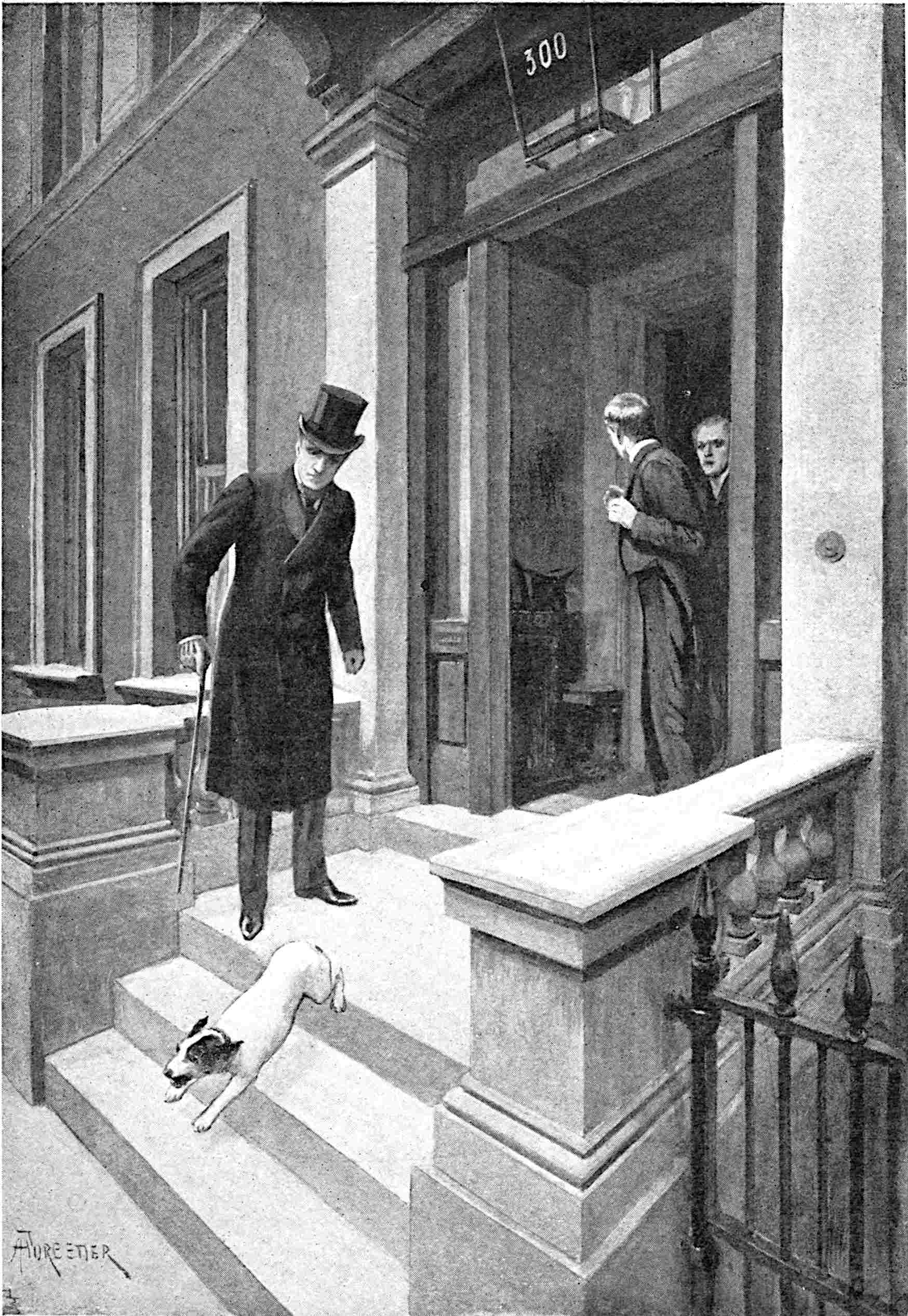
“AS HE VANISHED, DEEMING APPEARED AT THE HALL DOOR.”
“Call him back, Sir; call him back, for the Lord’s sake, or there’ll be trouble!” exclaimed the butler, turning sharply with the evident intention of trying to catch the little culprit. But he had no time to act nor I to call. Almost as he spoke there came from within the house the piercing cry of a dog in pain, and the fox-terrier darted out of the hall, down the street, and disappeared, yelping shrilly as he went, with his ears set flat against his head, and his tail tucked down in his back. As he vanished, Deeming appeared at the hall-door.
“How dare you let stray dogs into my house?” he said to the butler in a savage voice.
“I beg pardon, Sir,” stammered the butler; “but it was this gentleman’s dog, and⸺”
“It was your dog, was it?” said Deeming, turning to me. “I did not know you had a dog.”
I was feeling so angry that I could hardly trust myself to speak.
“Certainly it’s mine,” I said curtly. “I must go and find it.”
And without another word I walked away down the street. I could not discover the dog. Its terror had evidently been so great that it had fled blindly and far. From that day to this I have never seen it or heard anything of it. When it rushed out of Deeming’s house it rushed out of my life. Having failed to find it, after walking some distance, I gave up the search and stood still. The natural thing, I suppose, would have been to retrace my steps to Wimpole Street, where Deeming was waiting for me. But this I did not do. I felt that I could not do it. An invincible repulsion against Deeming’s society had come into my heart. When I thought of him I saw the fox-terrier fleeing, with his ears set back against his head; I heard the yelping of a dog.
I stood, therefore, for a moment, and then walked home to Albemarle Street.
I had bought the dog in order to find out, if possible, how Deeming was with animals, how they comported themselves towards him. Secondarily I had thought of using the dog as a pretext for introducing the subject of the black spaniel. I had meant, when Deeming came out, to point to my dog and suggest that, as I had mine with me for the walk, he should bring out his.
Well, my curiosity had surely been satisfied. I had not, it is true, seen the mysterious black spaniel; but I could hardly remain in doubt as to Deeming’s attitude towards pet animals. The expression upon his face as he came out from the hall had been ferocious. Vernon was right. Deeming was a cruel man.
As I realised that, I began to wonder more about the black spaniel. Why should such a man keep a pet—a man, too, who was so incessantly occupied that he had no time for amusement, for almost any relaxations? And why had the butler—for I now felt sure that I had seen his face contorted for an instant on the evening when I had spoken to him of the black spaniel—why had the butler felt such amazement, or bitter contempt, or sardonic amusement, when I had alluded to the possibility of Deeming giving the black spaniel a run?
It almost began to seem to me just then as if the black spaniel were a baleful chimera, like the creation of a madman’s brain, a nothingness that yet can govern, can terrify, can cause tragic events and lead to bitterness and crime. Who had ever seen this creature? Where was it, in what place of concealment? Did it ever come forth into the light of day? I longed to know something of it, of its existence in that house, of its relations with its master.
Perhaps Vernon knew or would know. He lived next door. He had gone there to discover; of that I was sure. He watched at his window to see the spaniel let out. He listened at his wall at night, perhaps, to hear its whining.
Perhaps Vernon knew or would know.
And when he knew, would he tell me?
In the afternoon of that day I received a note from Deeming—
I waited for you to come back for an age. What was the matter? I am very sorry about your dog. The fact is I am not very well and in a nervous condition, and it startled me to come suddenly upon it in the dimly lighted hall. Let me know when we can meet.
P. D.
That was the note. I read it several times before I threw it into the waste-paper basket. But I did not answer it. I felt that I did not want to meet Deeming again for some time.
I felt that. Fate willed it that I should never look upon him again as mortal man. Within two days from that time I was called to the North of England by the serious illness of my dear mother, who lived in Cumberland. And there I remained until she died. Her death took place on the twenty-seventh of June. Her funeral was three days later. After it was over I returned to the house where I had been born, where I was now quite alone with the servants. I had to wind up many affairs, to put many things in order, to sort and examine papers and pay off some of the household. Despite my grief I was obliged to be busy, to be practical. For several days I was so much occupied that I did not look at a newspaper. I even set aside the letters that came by the post—letters of condolence, I felt sure they were, most of them—wishing to read them and answer them all together when I had leisure, and felt less miserable and deserted, and more able to take an interest in such affairs as were not actually forced upon me.
At last one evening I had got through everything. I had dined, and was sitting alone in the drawing-room, where my mother had always sat, feeling really almost as if I dwelt in a world unpeopled, or peopled only by the spectres of those who once had lived, when a servant came in with the last post. There were no letters, only two or three papers from London. Without interest, merely to do something, I tore the paper covering from one and unfolded it. My eyes fell at once upon the following paragraph—
As so many rumours have been put into circulation with regard to the lamented decease of Dr. Peter Deeming, which took place on the 30th of June, we are glad to be able to state authoritatively that the actual cause of death was blood-poisoning, which was, it seems, set up by the bite of a dog. Doctor Deeming, like many other eminent medical men, while solicitous for the health of others, was singularly careless about his own. The bite was severe, but he took little heed of it, although he had the dog, which was a pet, destroyed. He has now paid the penalty of his regrettable carelessness, and society is the poorer. For no West End physician was more trusted and esteemed by his patients than Dr. Deeming.
The paper dropped from my hand.
So Deeming and the black spaniel were dead! And each had destroyed the other!