INTRODUCTION.
Reading edition
Expect not, gentle readers, here to find
Some wild romance,—effusion of a mind
Imbued with pictures, which dark fancies give;—
My Heroine, like yourselves doth act and live.
No scenes of terror here you’ll see portrayed,
To shock the feelings of a timid maid.
No scowling wretches here with purpose dire,
With dark-laid plots and fiendlike men conspire.
No women, who, forgetful of their sex,
Yielding to passion’s sway, their hearts perplex.
No tyrant father, and no mother cross;
No gamester desperate with heavy loss.
No rivals using every wicked art,
To rob a damsel of her lover’s heart.
No murderous dagger, and no poisoned cup,
To make pale readers full on horrors sup.
No sinful love here marks its guilty course,
Followed by shame, remorse, and a divorce.
No ruined château, and no gliding ghost,
No duel or elopement, can we boast
In these poor pages, only meant to shew
The scenes of real life, whose truth you know.
My Heroine, like yourselves, devoid of art,
Rich in each gift of person, mind, and heart;—
Just such a daughter as all parents prize,
And just as you appear to the fond eyes
Of yours;—just such a nymph as men adore:
Look in your glass—her image stands before.
The tresses may present a different hue,
The eyes may gray or black be, ’stead of blue;
More or less embonpoint perhaps you’ll see,
But, ne’ertheless, mankind will all agree
That beauties are as sisters like: ’tis true,
When Mary I described—I thought of you.
The same your winning charms, your dimples, smiles,
The same mild virtue that each heart beguiles,
The same your occupations, hopes, and fears,
Your artless gaiety, your ready tears;—
You’ll recognise the portrait I am sure,
Though you deny it with a look demure:
And thus alike in loveliness and lives,
May you, like Mary, soon be blessed as—wives.
THE BELLE OF A SEASON.
’Tis noon, and Spring, with genial power,
Hath lent her sunshine to the hour;
Hath breathed her sweetness through the air
That murmurs o’er the bright parterre;
On many a forest-monarch tall
Hath hung a fresh green coronal—
The emerald turf hath dressed anew,
With primrose pale, and violet blue;
And showers of snow-like wind-flowers strown
In many a copse and upland lone;
Hath heaped on the laburnum gay
Its gold—its fragrance on the May;
And balls of silver rich to see
Hung o’er the wild wayfaring-tree:
No wonder that yon ancient hall
Looks decked as for a festival.
Yon ancient hall!—a noble race,
Whose deeds hath History loved to trace,
Spread yonder court, and raised that tower
Whose oriel speaks it Beauty’s bower;
And loved in manhood’s youthful pride
Through that oak-planted chase to ride,
Where antlered roamers brouse and play
Throughout the golden summer day;
And hares, with eyes like gems that burn,
Crouch timid ’mid the rustling fern.
Beyond,—a river, clear and blue
As Heaven’s own bright cerulean hue,
Winds with a song of pleasant tone
Through many a meadow-valley lone,
Where teeming cows and snowy sheep
Along its flowery border creep—
And soon as peeps the early Spring,
Her merry choir their gladness sing—
Whose joy but cheers the soft repose,
So fair an English landscape knows.
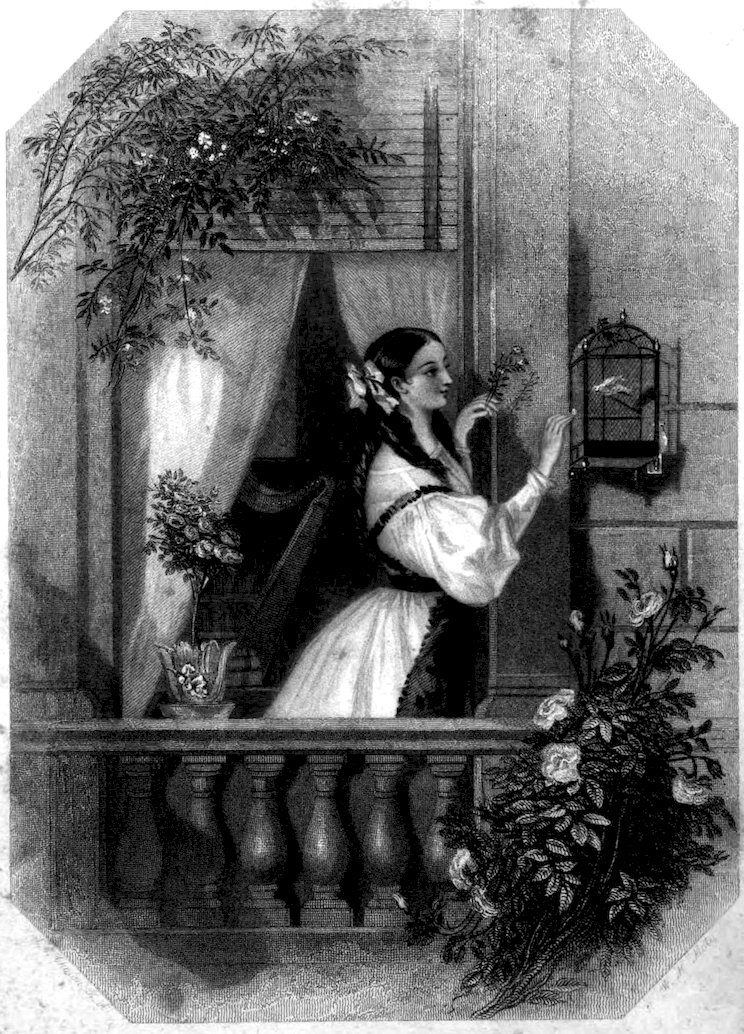
The Hall OR FEED THE BIRD THAT AT HER VOICE WOULD IN ITS PRISON-CAGE REJOICE
A daughter of that noble race,
With all its beauty in her face,
Looks from yon hall across that scene
Of river bright and meadow green—
I said her face was proudly fair,
But—lovelier far—a heart is there,
Filled with o’erflowing love of all
On which her gentle glance doth fall.
Oft have her childhood’s feet at dawn
Brushed its bright dew from yonder lawn,
And well she knows each sheltered dell,
And each peculiar tree can tell;
And every flower before her feet
Is linked with memories passing sweet:
She little dreams who gazes there,
That she is far more fresh and fair
Than all the pride of her parterre:
So those the most who charm and bless
Least know their wealth of loveliness!
’Twould tame the most malicious sprite
To watch those eyes so azure bright,
Upon the faëry pleasaunce bent
With wishes gay as innocent;
Or mark her, with more serious air,
Tend her flower-darlings rich and rare;
Or feed the bird that at her voice
Would in its prison-cage rejoice;
Or when in other mood she came
To stoop above her easel’s frame,
As true her taper fingers sped
To trace the scene before her spread;
Or view her, in green garden nook,
Bend thoughtful o’er some gentle book;
Or hear when, blithe as bird of spring,
She half unconsciously would sing
A lay like this—O ne’er again
Those woods will hear so sweet a strain!
SONG.
O Nature! let me dwell with thee,
The happy playmate of the bee;
Thou bringest back the golden Spring,—
I cannot choose but gaily sing!
Old Winter’s gone with clouds and rain,
And flowers are on the earth again,
And birds fly forth with gladsome wing;—
I cannot choose but gaily sing!
The insects chirp as blithe they pass
Among the dew-gemmed waving grass,
Fresh verdure clothes each fairy-ring;—
I cannot choose but gaily sing!
O Nature! let me dwell with thee;
Thou ne’er art stern and harsh to see,
But mark’st each day by some bright thing,
That makes thy children gaily sing.
What wonder that a maid like this,
With heart so pure, so full of bliss,
The sternest only named to bless!—
Nay—even her cold staid governess
Forgot her formal rules, and smiled,
As she—half woman, half a child—
Would break her studies grave and long,
With carolled snatch of such a song;
Or fragment of the blithest dance,
That ever Sylph had stolen from France;
Or through the opened window hie,
To chase the gorgeous butterfly!
Delicious time! when life is new,
And Pleasure opens wide to view
Her paths of sunshine and of bloom,
That in far distance hide the tomb;
Ere one illusion false is known,
Or one affection chilled, or flown.
O Youth! how passing fair art thou,
Ere care hath worn that open brow,
Ere the fresh roses on thy cheek
Sad tears have dewed—when but to speak
Of joy, with rapture uncontrolled,
Thy lips their coral gates unfold!
Ere yet one bright and cherub trace
Of Heaven hath parted from thy face,
O Youth! so passing blithe and fair!
Why should not Time thy gladness spare?
Now sixteen summers just had sped
In rapid course o’er Mary’s head,—
Each gave her cheek a brighter hue,
Each to her mind some treasure new.
Her sire—what wonder?—long had eyed
His child, his idol, with the pride
Which deems its darling hath no peer
Among her sister-beauties here;
And longs the envying world should view
Her matchless charms, and think so, too.
At length, this boastful rapture, nursed
In secret, forth to utterance burst;
’Twas on that smiling April day
He to his lady spouse did say—
“I think, as now advances Spring,
Our girl to town ’t were well to bring;
’T is time she went to court, my dear!”
Quick cries the Lady—“What!—this year?
Court at sixteen! too soon, no doubt!
All the young ladies round about—
The Greys—the Mordaunts—ne’er were seen,
Never presented ’till eighteen.”—
“Nay, as you will—perchance you’ve reason;
Well then, we keep at home this season.
That last election thinned my purse,
Which, truth to say, requires a nurse;
Though on dear Mary’s pleasure bent,
I should not count how much I spent.”
The Lady hears—and from her spouse
Hides sudden fears, she knits her brows,
And o’er her features still most fair,
Calls up a bland, persuaded air;
“Réflexion faite—you may be right,
I would not stand in Mary’s light;
And to her pleasure, I my own
Would sacrifice;—let’s go to town!”
She uttered not her thought of wo,
“How rapidly one’s daughters grow!”
Yes, pain can seize a mother’s heart,
When, ere her mellowed charms depart,
She must, a full-blown rose, retire
While eager crowds the bud admire;
And while a daughter at her feet }
Hath words that burn, and hearts that beat, }
Must fill the chaperon’s lonely seat! }
Ye, whom a fate like this doth scare,
Be wise, though Cupid sets the snare,
Bid the sly urchin from your door,
To come again at twenty-four;
Then wedded, to such follies cold,
At placid forty you’ll behold,
Without an envious thought or care,
Your second-self—or one more fair;—
Hear with fond pride your daughter’s name,
Look calmly on the lively game,
Nor wince, if careless tongue should say,
“Her mother, too, she had her day!”
Hail Fashion! thou mysterious Queen!
Whose reign omnipotent hath been:
Ay, since the times remote and dark,
When Mistress Noah left her ark!
Sovereign, whose subjects ne’er rebel,
Though of tyrannic sway they tell!
Thy sceptre, Queen, whom all adore,
Hath strange and elephantine power,—
Can rout an army with its strength,
Or raise a pin an atom’s length;
The young, the noble, and the gay,
Hear thy loved voice, and straight obey.
What though the Spring with open arms
Spreads to their gaze her wealth of charms,
With primrose and with king-cup gilds
The hedge-row banks, the sunny fields,
Thou callest—and from these scenes they part,
To mingle in thy busy mart,
And thought, and health, and pleasure drown,
In the dull mazes of a town!
Then, when the Dog-star rages high,
Thou bidd’st the obedient throng to fly
To coasts where not a leaf of green
Their beauty from the blaze may screen,
Let scorched-up eyes, and sun-browned faces,
Declare thy might at watering places!
Then, when rough Winter’s frost and snow
His dismal coming makes them know,
And all is gloom, and storm, and rain,
And bowers are stripped, and hill, and plain,
And garden path, and sheltered wood,
Are carpeted alike with mud,
Thou drivest the herd, most stern of Queens,
To the repose of country scenes;
O prithee! for one little season,
Rule this poor weary world by reason!
At thy decree must Mary go
The town’s tumultuous joys to know.
In simple garb, the lovely maid
Is for the journey soon arrayed;
But ere she leaves that haunted ground,
With tearful gaze she looks around,
And every flower and every tree
Awakens her fond sympathy,
As sparkling with fresh morning dew,
They seem to wave a kind adieu!
She knows not yet of courtlier joys,
No anxious thought her mind employs;
She never dreamed of tricks or arts
Used by coquettes to win light hearts;
The snow-white lily of the lea
Is not more free from guile than she!
The journey o’er—in Grosvenor Square
Behold arrived our timid fair,
Perplexed and deafened by the din
Of crowds and carriages that spin
In dizzy whirl through every street
Where busy trade and luxury meet.
At first the strangeness and surprise
Brings her no joy—she softly sighs,
“O my own home! that I were there
’Mid its green fields and purer air!”
Short time hath she to muse and dream
Of grove-crowned hill, and placid stream,
For Mary is a child no more,
And a gay host assails her door,
With smiles, and becks, and modish airs,
Marchandes des modes—and Couturières;
At first she shrinks back half-ashamed,
As loud their splendid wares are named.
One tells how rulers of the monde
Wear just such satin, just such blonde;
Another, as a peacock vain,
Spreads out a corsage and a train:
“Pour une miladi, aussi belle,
Ça irait vraiment à merveille.”
A third brings wreaths so fair to see,
The King of Judah’s[1] cunning bee
From flower to flower had boldly flown,
And deemed them surely Nature’s own.
All praised her tournure, and her grace,
Till modest blushes dyed her face;
Then each, demanding “pardon,” thought
“That if sa seigneurie had bought
A few more nouveautés ’twere wise,
Ere they were shewn to other eyes—
As now les grandes dames wished to buy
More than their artistes could supply;
For then, just then,—’twas sad, but true,—
Even if they wrought the whole night through,
Full many a lady needs must wait,
Who’d ordered robes for the next fête.”
The prologue’s done—the father sighs,
As all those glittering gauds he eyes;
And, while his spouse makes haste to tell
Their cheapness is a miracle,
He thinks of his estates at nurse,
And in his pocket grasps his purse.
And now to Mary’s wondering eyes,
Behold the magic curtain rise;
O day of joy, and agitation,
Comes on her courtly presentation!
Gems deck her brow, and waving plumes,
Her train came forth from Genoa’s looms,
And rich transparent folds of lace
Fall from her head with airy grace;
To Nature, Art has lent its aid,
And proud she looks, though half afraid.
No longer now the sportive child,
With buoyant step, and spirits wild,
Who chased the winged flowers of air,
Or wandered through her bright parterre;
Schooled to a stately dignity
She moves, while crowds press on to see
A form from Beauty’s finest mould,
Which all of purple, and of gold,
Of nodding plume, and diamond bright,
Are but too poor to deck aright!
They little dream who see her glide
On her new path with mien of pride,
How in her secret, throbbing breast,
A trembling, timid heart doth rest!
Her mother leads her through the throng,
Who whisper as she moves along,
Some, with a haggard envious air,
Whose ancient faces round her stare,
“Wonder the men so weak can be,
So undiscerning as to see
One single charm or winning grace
In such a blushing baby face.”
In vain they cavil—gallants gay
From older beauties shrink away;
Eye the fair girl with flattering gaze,
And whisper, to be heard, her praise;
Their words, “How charming!” meet her ear,
A spell to dissipate her fear.
More calm she nears the throne at last—
A step—the dreaded ordeal’s past!
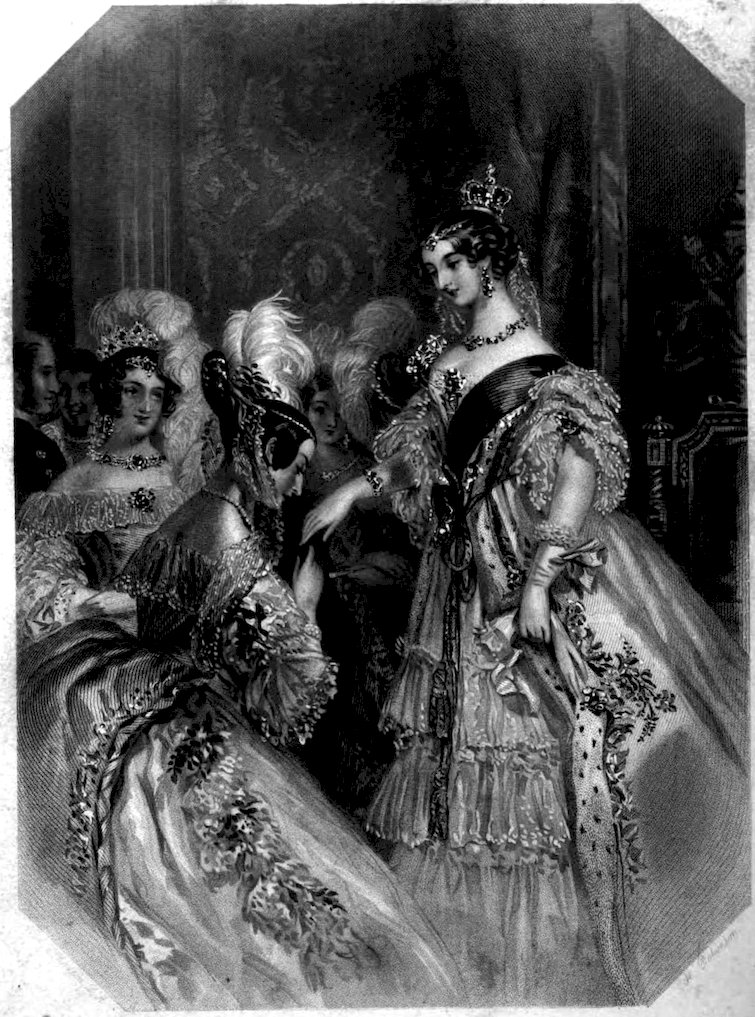
The Presentation SHE BENDS BEFORE OUR GENTLE QUEEN THE YOUNGEST, FAIREST, EVER SEEN
She bends before our gentle Queen,
The youngest, fairest, ever seen,
The Rose of England’s rich parterre
(Where every flower is passing fair);
All youth, all hope, all loveliness,
Whom millions only name to bless.
How dazzling is that open brow!
Not even the diadem, whose glow
Encircles it with lustre bright,
Casts into shade its gentle light;
So dignified, so lofty, mild,
There meet the angel, woman, child.
O! who could gaze upon thy face,
Young scion of a royal race,
Without that warm and earnest feeling,
To hand, and heart, and word, appealing,
Which stirred so well in days gone by
Old England’s glorious chivalry,
And now surrounds thy stately throne
With millions proud thy sway to own,
Ready the wide world to defy,
And quick to arm—and blest to die,
Ere from thy royal coronal
Its smallest gem shall fade or fall!
Thy gracious glance, with gentle spell }
Can many a fluttering tremor quell, }
As our young timid maid can tell; }
Who never even in dreams hath been
In such a bright and gorgeous scene.
Before her, sparkling in the light,
Dance waving plumes, flash diamonds bright;
A thousand trains come sweeping by,
A thousand beauties meet her eye:
But o’er them all, like star serene,
She sees her lovely, gentle Queen!
And now,—the presentation o’er
Which opens Fashion’s fairy door—
A thousand perfumed billets come
Scrawled with these peaceful words, “At Home!”
She, in her young simplicity,
Admires the domesticity
Of those whom opera, dinner, rout,
Tempt to the sparkling world without!
But soon (the enigma’s point to reach)
A few entrancing midnights teach
By nodding plumes, and whirling feet,
And wheels that thunder down the street,
And glittering lamps, and music loud,
“At home,” in London means “a crowd!”
No longer decked in waving plumes,
Mary a simpler dress assumes,—
A robe that well her form displays,
And many a silken ringlet strays
Round pearly brow, and cheek that glows
With Youth and Health’s most brilliant rose,
At her first ball—where smile and stare
Our heroine’s rising power declare—
Her mother proud, with practised eye,
Dissects the crowds that hover nigh;
No younger brother dare draw near,
To whisper in her treasure’s ear.
Ah! in the world where hearts are stakes,
Too oft the blessing Esau takes!
Now, shall we gently cast aside
The veil that Mary’s heart doth hide?
And whisper to all friendly ears,
That child-like as the maid appears,—
There is one youth, whose glance hath met
Her own—she longs to know, and yet,
For worlds she could not ask his name:
The thought’s enough to tint with shame
Her fair young cheek—though, truth to own,
The maiden now hath curious grown,
For those deep lustrous eyes have cast
Spells o’er her thoughts to hold them fast;
She looked but once, and half was won—
She looked again, her heart was gone!
O Love! that find’st thy path through eyes,
Revealed by glances and soft sighs,
The harbingers of hopes, and fears,
And rosy blushes, smiles, and tears,—
Why, wily archer, try thine art
On such a young unguarded heart?
Why, ere yet childhood’s dreams have flown,
Ere Life its fairest views hath shewn,
Chase halcyon Peace from that sweet nest
She builds in such a gentle breast?
The experienced mother marks the gaze
With which the youth her child surveys,—
The blush that dyes her modest cheek,—
And though ’tis best no word to speak,
Swift through her heart a hope will glance,
That he will with her Mary dance:
For well she knows, by form and air,
He ranks among the noblest there.
Is it all vainly she aspires?
For lo! the admired one swift retires:—
He’s gone—there seems a cloud to creep
O’er Mary’s bosom still and deep—
He’s gone—but, no—he’s here again,
Leading the Duchess Deloraine.
With outstretched hand and smiling face
Thus speaks at once her sapient Grace:—
“Dear Lady Percy, how d’ ye do?
I thought it could be only you
My son described—let me present
Lord Deloraine; indeed I meant
To seek you—this is Lady Mary,
Whom I remember, like a fairy,
When tripping lightly round your room,
Her lip all smiles, her cheek all bloom.
I should have known her by her brow
And chin. Dear girl, will you allow
Me to present Lord Deloraine?
You’ll make his mother very vain
If you to him your smiles extend,
And to her also, as the friend
Of Lady Percy. How’s your Lord?
Your daughter’s charming, on my word!
While you—I vow I heard Lord Lyster
Say you looked like her elder sister.
My son has just come from the East,
But has not suffered in the least,
Though hundreds are in Smyrna dead,
None saved, except the wise, who fled
That dreadful plague!—It never ends,
It killed a dozen of his friends—
But Heaven be thanked—once more at home,
I trust he ne’er again will roam.
Well, Lady Mary’s quite a Belle,
And dressed, I must say, à merveille—
Any attachment, entre nous? }
Too young?—ha! ha! that’s so like you! }
Au revoir, chère amie! adieu!” }
While thus his mother’s nimble tongue
Talked on—the son enchanted hung
On every smile, and winning grace,
That played o’er Mary’s lovely face;
The while she listened as he told
Of many a storied land of old—
Few words were said, ere youth and maid
A kindred feeling did pervade:
Did ever traveller talk so sprightly?
Smiled ever Beauty’s eyes so brightly?
The mother, with abundant tact
The chaperon’s part did well enact,
No over-marked desire to please,
No feigned reserve—she talked at ease
Of climes, and courts, where he had been,
With wit and taste, which made it seem
That study and reflection taught her,
This gives bright promise for her daughter;
So deems the youth, whom, half-past five
Sees homeward from that revel drive.
We tell not Mary’s dreams that night,
Or how next morning with delight
She thought past doubt, that they should meet,
Or in the park or in the street,
Then gently sighed while counting o’er
The hours which must elapse before.
At length—at length the clock strikes five,
And Mary’s summoned for a drive.
She throws by a half-finished sonnet,
And blushes as she ties her bonnet,
Then smiles as in the glass she sees
A face that every eye must please;
Each Beau she passes in the street,
Causes her timid heart to beat;
Afar—she thinks it Deloraine,
But near—O hope! why art thou vain?
He comes not—an incipient pout
Longs to enwreathe her lips about;
But her sweet nature conquers spleen,
And home returned, there’s something seen,
On which her smiles unchecked may fall:
His card—she finds it in the hall!
Now at her mirror stands our Mary,
Like Cinderella dressed by fairy:
A robe, than gossamer more light,
And whiter even than snow is white,
She wears; and with a bright wreath dresses
The rich net of her glossy tresses.
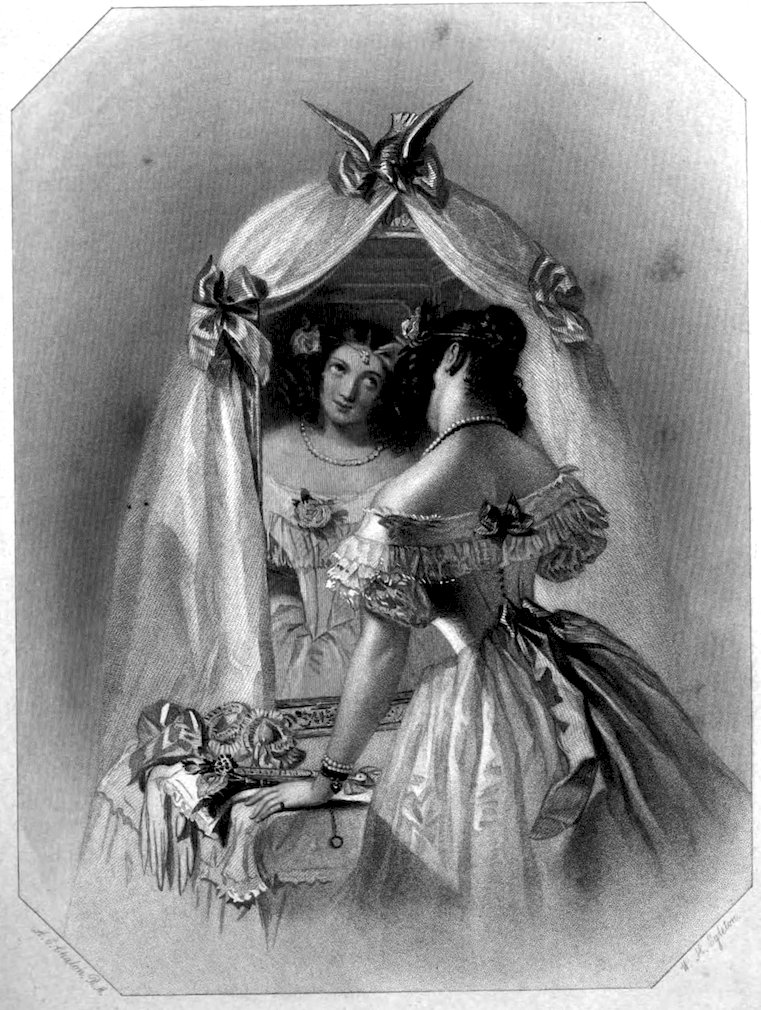
The Toilet NOW AT HER MIRROR STANDS OUR MARY LIKE CINDERELLA DRESSED BY FAIRY!
Ah! who that saw her thus arrayed
Did e’er behold a fairer maid?
While crowded carriages encumber
The streets, she wonders at the number;
So patient waiting in the Square, }
Ere they arrive the ball to share, }
When but one Deloraine can be there! }
Now strains of music float around,
Mingling with many a harsher sound
Of crushing panels, curses, cries,
As coachman, meeting coachman, tries
To win the portal, whence a blaze
Of light streams, brilliant as the rays
Of noonday sun; while passers by
Pause, and move on with envious sigh.
At length released, and in the hall,
Their names the liveried Stentors call:
Unshawled, uncloaked, they slow ascend,
’Midst flowers that thousand odours blend;
And once again a fairy scene
Holds her, in beauty’s right its Queen!
They reach at last the bright saloon,
One with a beating heart—how soon
To beat more wildly:—yes! ’tis he
Who nought but Mary seems to see.
In her mild eyes one care will dwell—
She hath not greeted him too well?
He bolder, blessing friendly chance,
Must claim her for the coming dance;
While some, with jealous envy vexed,
Sneer as they pass, and ask “What next?”
O! who that viewed so bright a scene
Could guess that sorrow here had been;
That any through the dance who glide,
In splendour decked, elate with pride,
Had seen hopes changed for gloomy fears,
Had known the sad relief of tears—
As bending o’er the cherished dead
They deemed that joy for aye had fled;
While now, forgetful, at the call
Of Mirth, they fill her echoing hall?
Yet, in these proud and gilded rooms,
Where music, blent with rich perfumes
From fair exotic garlands wreathed,
Upon the entranced sense hath breathed;
Where mirrors loveliest shapes display,
As through the mazy dance they stray;
Even here cold Death has held his state—
Here drooping mourners wept the fate
Of some, whom not even Love could save
From the stern beckoner to the grave;
Here, where the flowery trophies rise,
Came breaking hearts, and streaming eyes;
Here, where the airiest feet resound,
A sable pall hath swept the ground;
Down yonder staircase, broad and deep,
A funeral train was seen to sweep:
O! strange, how revelry and death—
The smile above, the worm beneath,—
Divide this earth, till scarce we know
Which is the master, Mirth or Wo.
O! where’s the dwelling, rich and vast,
Wherein no scenes like these have passed;
Where yet no tear was ever shed—
Came in no fear—went out no dead?
A few bright days—a few brief years,
And each house is baptised in tears;
A few sad hours of sorrow o’er,
And Folly shakes her bells once more!
Now skilled in every art to please,
Deloraine his partner set at ease;
He talked of scenery, and flowers,
And books that bring us pleasant hours,
Till by his converse, wise and mild,
Was won the dear confiding child.
But deem not her simplicity
Had aught of crude rusticity,
For dignity and native sense
Were mingled with her innocence:
And soon his mind, with projects rife,
Of his young partner makes a wife;
So young, so artless, and so fair,
Blessed by his stars, he’ll win and wear;
And she ... but who can paint that heart
Where vanity had ne’er a part;
Where ne’er malicious thought had birth,—
A shrine that makes a heaven of earth?
He to her mother leads the fair,
Then hovers anxious near her chair,
Marking with new-born jealousy
A herd of beaux, who flock to see
One of whose beauty tongues are loud;
While she, unconscious why the crowd
Press round, beholds but Deloraine,
And hopes that near her he’ll remain.
Some twenty youths, with bows, demand
To be presented—ask her hand
For coming dances;—ask in vain—
She dances not the night again.
Her mother’s tactics only grant
One partner to the débutante;
She fears fatigue—she talks of heat,
So Mary gladly keeps her seat.
Again Lord Deloraine draws nigh,
With softest words, and earnest eye,
Her cheek with brightest roses blooms,
Her eye a sparkling light illumes,
As he (’tis music’s sweetest strain!)
Murmurs the words—“We meet again!”
Ne’er had he paid to any other
Such court as to our Mary’s mother;
By flatteries, which adroitly hit,
He makes her feel herself a wit,
And all the sprightly words she measures,
Thankful receives as precious treasures;
Some spell—he asks not how or why—
Opens new vistas to his eye;
For when mamma, with wisdom trite,
Says, “Girls should not sit up all night,”
And firmly will demand her carriage,
The word recalls another “marriage!”
Marriage!—to him!—few weeks had sped
Since he had vowed he’d never wed
Until that age when, blasé, cool,
A man’s too old to play the fool!—
O strong, strong man! one glance at Mary
Had made his life’s whole purpose vary!
What were the dreams, that sweet spring night,
That floated o’er her slumbers light?
So pure, so blithe, so blest were they,
That Sleep had brighter hours than Day.
Again within that festive scene,
Where erst with Deloraine she had been,
She stooped to hear his whispered praise,
She shrunk back from his glowing gaze,
Like touch of an enchanter’s wand
She felt the farewell of his hand;
And yet how timidly ’twas taken—
He touched, where common friend had shaken!
And then a sudden change comes o’er
Her dream—the maiden roves once more
With him amid the favourite shade
Of well-known grove, and woodland glade,
Shews him the flowers she loved to rear,
Which he, by praising, makes more dear;
Points out each cherished haunt—the view
Of limpid stream and mountain blue;
And feels, the while he fondly speaks,
Her native breezes fan her cheeks.
They plan—they talk of future schemes, }
And now to kiss her hand he seems— }
She wakens.... ’Twas the dream of dreams! }
Of all our fêtes, the wise ones say,
There’s nothing like a déjeûner,
In gardens rife with vernal bloom,
That to the air exhales perfume;
Where down through many a rich bosquet
Blithe Music’s voice is heard to stray,
And women with the bright flowers vie
Which shall the most enchant the eye.
The same soft tints of lily, rose,
Do many a cheek and leaf disclose,
And both so radiant in their bloom;
Alike their beauty and their doom,
For the fair pride of home and lea,
Soon fades and dies—Ah! wo is me!
That flowers must droop, and fair cheeks wither,
When Death and Winter cry “Come hither!”
Why should not Beauty wear more slowly?—
A truce to thoughts so melancholy.
A déjeûner’s a charming thing }
In summer, for though poets sing }
Of thy enchantments, vernal Spring, }
Alas! we of them little know,
Save what Arcadian writers shew.
They never told of north-east winds
Whirling the dust until it blinds—
Of a bright sun, whose beams can freeze—
Of airs, whose keenness makes us sneeze—
Of dews, vouchsafed in storms of rain,
Until we want the Ark again—
Of agues, fevers, and sore throats,
Of fur-lined mantles and great-coats;
Yet thus—thy old enchantments undone—
O Spring! thou meet’st mankind in London!
Yet strange to tell, though year by year
The same chill spectre doth appear,
Instead of that young nymph, who still is
By rhymesters crowned with daffodillies,
Whom we remember from our cradles,
Described in every poet’s fables—
How wild their words—how warm their praise—
And ours what folly still to raise
Our expectations towards that Spring,
Which not even May itself doth bring.
Peace, saucy minstrel!—nor forget
How Summer sometimes pays the debt
With days, like angel-visits seen
Most bright—but “few and far between.”
And sure it is, such visits rare
Make us esteem them doubly fair,
And Nature’s brightest to their eyes
Who see her, sun-lit, with surprise;
’Tis pleasant through umbrageous trees
To watch the groups with careless ease,
That far and near, and fair and free,
Wind like the nymphs of Arcady;
White flowing robes become them well,
And each at distance seems a belle,
And tripping from some green retreat }
Of clustered leaves, and garlands sweet, }
Is credited with fairy feet. }
And the unusual exercise
Tints up the cheeks, and lights the eyes;
What wonder, then, that lover’s tale
Makes eloquent each bower and dale?
That flattery’s soft and silver tongue
Then smoothest speaks from old and young—
And all are bent on charming hours,
’Mid such a paradise of flowers?
As Mary, at her mother’s side,
Walked gracefully, her suitors vied
Which could extol her charms the most,
Or of her slight acquaintance boast;
Nay some, to whom she scarce had bowed,
Of her sweet temper spoke aloud,
And charming sayings had to tell
Of her they called their favourite belle.
Her mother was, the men all said,
A damask rose of royal red,
And Mary was the bud half blown,
That each one wished to call his own,
And wear on his vain-glorious breast,
To raise the envy of the rest.
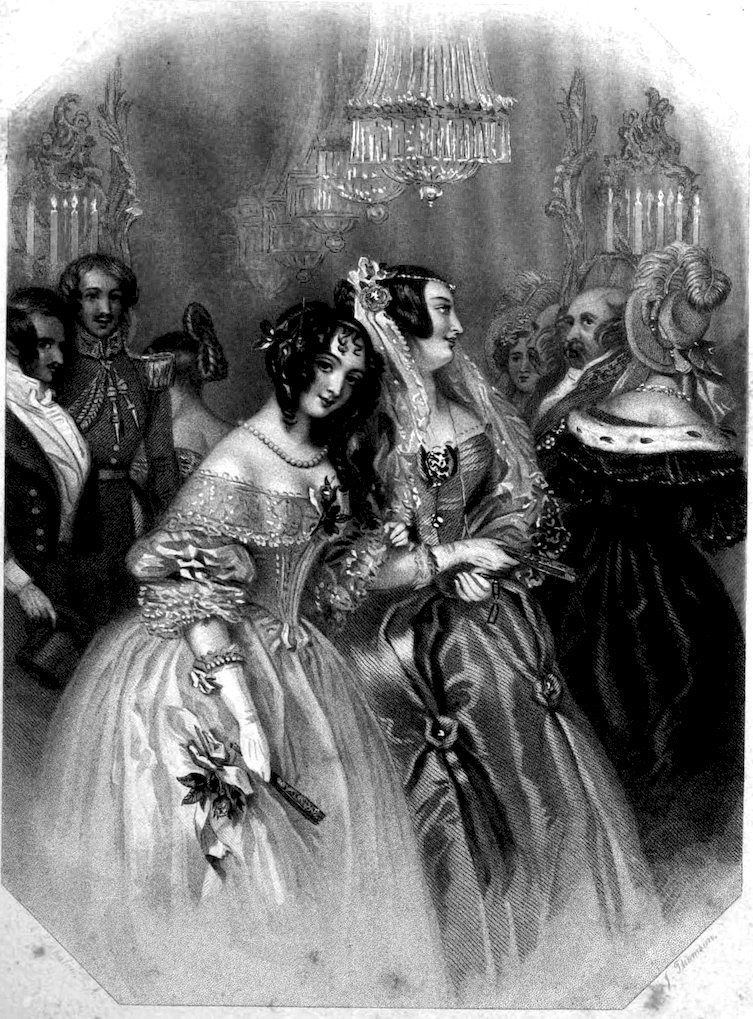
The Ball AS MARY, AT HER MOTHER’S SIDE, WALKED GRACEFULLY, HER SUITORS VIED.
She heard not words that quick flew by,
The ready compliment—the sigh—
Nor saw grave men, at Love who joke,
Now prone to kneel before she spoke—
Her heart, her eye, her ear were gone,
She had but words, but thoughts for one.
At length, at distance in the crowd,
Deloraine she saw, and said aloud
“Tis he!” “Pray who?” with placid tone
Her mother asks—a blush hath flown
To her clear cheek—she feels it burn,
And redder roses mount in turn.
But ere she could an answer frame
A troop of ladies round her came;
She stops—there hangs on Deloraine’s arm
A graceful form; how many a charm
Bewitching doth that maid array,
And points the pang that will have way,
As forced, alas! to pause and see,
Her heart grew sick—she wished to be
Apart from all that brilliant throng,
Apart from smile, and jest, and song:
The fête so late all mirth and light,
Hath lost its gladness to her sight;
The women teaze, the men annoy,
The giddy crowd can yield no joy;
A tear (that would despite her rise)
Sought to escape from her bright eyes,
As past she saw Lord Deloraine glide
With that fair lady at his side.
O Jealousy! thy serpent fang
Strikes through the heart its keenest pang;
Thou changest Summer’s sunny air
To Winter’s hue of dull despair;
The young rose with its radiant bloom,
For the wan flower that decks the tomb;
And with thy cold insidious art
Bidd’st Hope from warmest breast depart.
How mused our maid, on every charm
Of her who hung on Deloraine’s arm;
One minute’s length had been that gaze,
But oh! so fraught with wild amaze,
A long life it had seemed to be
To her excited phantasy.
With care she scarcely knew to hide,
That beauty how she magnified,
Which every eye that both had known
Must find inferior to her own!
That smile, how brightly did it shine,
“Ah!” Mary thought, “what chance had mine?”
Yet had some fairy made her pass
That woman’s shrine—a looking-glass,
Even she, all jealous, must have seen
Which was of Beauty’s empire Queen:
But on she wandered mute and slow—
How tedious seemed the revel now!
The smiling dandies how she hated,
The tiresome chaperons how they prated!
“Would it were done!” she sighs once more,
“Was ever fête so dull before?”
An hour—a long, long hour, has flown,
A year she thought had fleeter gone,
When as her eyes, that wander wide,
From the green alley turn aside,
Lo! from the lawn Lord Deloraine,
With that fair lady, comes again;
Some one he seems in haste to seek,
And blushes rise to Mary’s cheek,
Their glances meet—ah! vain to hide
Her gentle joy, as at her side,
Eager he takes his wonted place,
With rapture beaming in his face;
Tells her how vainly, and how long,
He sought her ’mid the motley throng;
Some witchcraft (what she knows not well),
Hath o’er the revel cast a spell;
She guesses not what magic wand
Restores her back to fairy land,
And for those thoughts of saddening strain,
Gives back her young bright hopes again.
That dreaded rival, it appears,
Had Mary’s mother known for years;
The two, enchanted at the meeting,
Exchange at once the kindest greeting:
“So glad!—a sweet surprise! my dear,
(Lord Deloraine’s cousin) Lady Vere!”
Together now through shady walk
And rich parterre they stroll and talk;
Mary hath but one grief, alas!
That hours will now like moments pass.
’Tis true no words of love were spoken,
But glance and smile, by many a token,
Told that the link, which but death parts,
Was flung around a pair of hearts:
In truth, ’twas passing fair to see
Mary, with sweet simplicity,
Droop her long lashes ’neath his gaze,
That looked his worship and her praise,
The while she thought that praise was sweet
As childhood’s music, when we meet
Its echoes in a stranger land,
And wrapt in pensive reverie stand,
Dwelling on happy days gone by,
Until a tear-drop dews the eye;
And well we love that sadness brief,
The softness—not the sting of grief,
E’en while we sighing ask again
To hear that loved and ancient strain.
But Beauty (so a bard of ours
Declares), alas! can’t live on flowers;
And honeyed words, however dear,
And charming to the thirsty ear,
Too fine are, too ambrosial quite,
To satisfy the appetite.
And hence, our senses to content,
Luxurious déjeûners were meant;
A rich repast,—O call not food
The choice inventions of a Ude!
Now even lovers rush to eat,
And happy they who find a seat—
So thickly streams the crowd aside,
To taste the good the gods provide!
’Tis strange that when the eye reposes
On summer skies and beds of roses—
And fountains with their spray-showers glancing,
And green leaves in the south-wind dancing—
That tyrant Hunger, grossest sense!
Will not a few short hours dispense
His congé to poor earthly sinners,
But sets them craving for their dinners:
’Tis strange that all, howe’er refined,
Of lofty thought, poetic mind,
Nor leaves nor roses will espy,
If but a tempting pâté’s by;
Transparent fountains flow in vain,
If froth for them the brisk champagne,
As chuckling while they pile a plate,
They cry, “I love a rural fête!”
’Tis strange—explain it, learned sages—
That chaperons all, whate’er their ages,
Whether dame Fortune smiles or spites,
Rejoice in boundless appetites;
And some I’ve seen such homage do
To fish, flesh, fowl, and pastry too,
Fearless of ache or indigestion,
Having profoundly solved the question,
How many different foods with zest
A Christian stomach can digest;
That hecatombs must offer up
The amazed Amphitryons where they sup.
Maidens, au contraire, little eat;
How should they, when, from neighbouring seat,
A lover, with devouring eyes,
Each tempting morsel jealous spies?
Ye charmers, who would lovers gain
To hover round, a sighing train!
From all but sparrow-meals refrain;
Men bear a small plump hand to see
A golden fork wield gracefully,
Not guided by a heart intent,
Like nun’s, half starved with keeping Lent,
But in a light capricious way
As less in hunger than in play.
Would you enchain the creatures fast,
Choose delicately for repast
Of whitest chicken, one small slice—
Some orange jelly, cool as ice—
Three cherries, and an almond cake— }
And water tinged with wine,—they’ll make }
A charm not Samson’s self could break. }
But should your suitors chance to spy
The open mouth, the hungry eye,
You’ll look around—and where are they?
Scared—gone—and sure, past doubt, to say,
“Nay, saw you that?—no joke indeed!
I hate to see a woman feed!”
And now ’tis dark and balmy night:
Ten thousand lamps hang forth their light
From high verandas, arches, bowers,
Festooned with pendant wreaths of flowers.
And glorious shines the summer green
Of tree, and shrub, by that light seen;
And delicate the rainbow dyes,
Of every flower that odour sighs;
And spirit-like the white-robed maids,
That loiter ’mid the garden shades:
There’s not a rhymester there that night
But calls the scene Elysian quite,
And, waxing sentimental on it,
Thinks of Boccaccio and a sonnet;
Or some bright isle of genii sprites,
We read of in the “Arabian Nights;”
Or some bright banquet which Watteau,
With courtier pencil, loved to shew;
Or, if excursive grow his fancies,
He conjures up those old romances
Where sorceress, for her favourite’s bliss,
Would raise, by spells, a scene like this,
Which chaster knight could, with one prayer
And holy sign, dispense in air;
Music from dusky ambush stole
To witch with melody the soul,
As wandering minstrels sung soft lays,
Such as Moore writes, and Thalberg plays:
And, oh! the voice hath wondrous power
To melt, to move, at such an hour.
As Mary walked with Deloraine,
They paused, arrested by a strain,
The notes were rich, and low, and sweet,
Voice of a mind—nor all unmeet
The words, of Love in ambuscade,
Which Deloraine’s secret thoughts betrayed.
“O! fair, surpassing fair thou art,
Unconscious all—the Graces’ boast;
What wonder myriads seek thy heart?
But, Lady, I adore thee most!
When others on thy beauty dwell,
Hang on thy words, explore thine eyes,
O, never earthly bard could tell
What thoughts within my bosom rise.
Let speechless Love, in sighs reveal
That passion which the bolder vow;
And let one thought of pity steal
For him who never felt till now.
Tell her, ye stars! thou winged air
Breathe to her, Flora’s painted host,
That I am true as she is fair—
Though all must love, I love her most!”
The strain is o’er—ere Deloraine speaks,
Bright blushes mount to Mary’s cheeks,
For well she guesses, by his sigh,
He would the minstrel’s lay apply;
And, aided by another’s art,
Reveal the secret of his heart.
But Modesty, her guardian, throws
Its ægis round her—grave she grows,
As quick her head is turned aside,
Her cheek’s deep rosy blush to hide.
Still looked he earnest—still he sought
In her mild eyes to read her thought,
If her heart’s inmost folds among
There lurked kind answer to that song.
And still she feared to meet his eye,
Lest her confusion he should spy;
For yet, though softened, charmed, and moved,
She only hopes she is beloved!
And, self-accusing, thinks it wrong
To give such meaning to a song:
Thus, he all fear, and she all shame,
He breathes no word to tell his flame.
At length her mother she descried,
Then flew, half-fluttered, to her side!
For Crœsus’ wealth he should not know
The fancies which disturbed her so,
While all the firmer chained was he,
By her young timid modesty.
O Modesty!—which angels yield
To helpless woman for a shield,
What diamond from Golconda’s mine,
Adorns her brow, like blush of thine?
Worthless the form, and coarse the face,
(However fair) thou dost not grace;
The sweetest voice is like a lute
Strung with harsh chords, when thou art mute;
The heart, a stained and ruined shrine,
Thou dost not enter to refine;
The eye but shoots a meteor gleam
Noxious and keen, without thy beam;
How vainly beauty, lacking thee,
Would chain men’s love—Sweet Modesty!
Cestus that Venus surely wore,
To wile a world in days of yore,
The charm that she to Juno lent,
When that bold, dark-eyed Queen was bent
To win the recreant from her love,
The haughty and inconstant Jove:
Bright spirit! thou in Mary’s eye
Smilest when she bids Deloraine good-by!
And—fairy follower—at her call,
Attend’st her from that festival!
Mary’s at home—and pondering o’er
Each word of his, as ne’er before
She dwelt on them. His looks of love,
Even now recalled, have power to move,
Of his sweet voice each cherished tone, }
Fond Memory has made its own, }
So dear, and so familiar grown }
Some little thought of earthly cares
Are mingled with her fervent prayers,
Hopes that they soon again shall meet,
Before she yields to slumber sweet
As falls on infant’s brow, ere guile
Hath chased its Heaven-remembering smile!
Then white-robed Innocence doth bend,
And o’er her couch its wings extend.
Visions of love and happiness,
Soothing and calm, her pillow bless;
Nor purer dreams the blessed know,
Released from earth and all its wo.
It is a lovely sight to see
A maiden in the privacy
Of her own chamber—where the day
In gentle studies glides away:
Her spirit breathes through all things round—
The dainty volumes that abound;
The silken broidery in its frame,
That might e’en Flora’s labour shame;
The easel, where no critic’s eye
A meretricious taste could spy;
The harp, on which she loves to play,
Singing the while some sweet old lay;
Here gay and placid speed the hours,
Among her music, books, and flowers—
No thought of care, or anger rude,
No breath of evil dare intrude,
No babbler, fraught with idle speech,
This maiden solitude can reach:
Save her fond Sire’s, no footstep male
Has e’er presumed to cross its pale.
Here he brings gifts of gem and flower,
And Indian birds to deck her bower;
And, dearer gifts! her mother oft
With looks of love, and accents soft,
Steals in to bless her duteous child,
And leave behind her counsels mild:
There’s not a book that here may lie,
Unseen by that unsleeping eye,
Which knows how subtly books might lure
That maiden, still so angel-pure.
Here, where a crucifix you’d see,
Did Southern maiden bend the knee;
The ‘Book of Life’ is laid, and read—
I know it by the page outspread;
Approached with love, and reverent awe,
Our maiden from its page will draw
Those hopes that light declining years,
Those promises that dry our tears!
The very air that lingers round
This sanctuary is sweet—no sound,
Except of music rich and low,
Or gentle voices, doth it know:
Listen! her hand is on the strings,
And, artless, to herself she sings.
SONG.
Oh! never doubt I love thee!
When every sigh of thine
Awakens Echo’s music
Within this heart of mine!
Oh! never doubt I love thee!
Thy smile, oh! oft it gleams,
Like fabled lamps of fairies,
To cheer my midnight dreams!
Oh! never doubt I love thee!
As few have loved before;
There’s nought can change my worship
Till life itself be o’er!
The song is o’er—why doth she seem
Abstracted—lost in pleasant dream?
Her harp is left—she turns aside,
And now her taper fingers guide
The pencil.—No, ’tis all in vain!
What art could picture Deloraine?
A step is heard—with glowing cheeks
She hides the sketch—and vainly seeks
To sing as blithely as before,
While her good mother’s at the door.
O Love! thou subtle, dexterous cheat,
To such a maid to prompt deceit!
Thy wily lessons to impart
To one, till now, who knew not art;—
To teach our Mary’s heart to glow
With secret thoughts, she dare not shew
To her, who erst each feeling shared,
As if its inmost cells were bared!
Ah! why thus rend the tender bond
’Twixt duteous child and mother fond?
’Tis strange thy sudden work to see,
Begun—complete:—Telle est la vie!
Among the beaux who fluttered round
The gentle Mary, some were found
Of that unworthy class, too common,
Who speak despitefully of woman,
And who, with empty purse and head,
For fortune only, woo, and wed;
With mind as vacant as the heart,
Willing with liberty to part,
If in exchange they but obtain
The gold to forge dull Hymen’s chain:
“For gold,” they swear—(how dainty slip
The oaths from each moustachio’d lip!)
“With welcome weight can never gall,
Nor its bright charms (like Beauty’s) pall!”
Among these gems Lord Squander shone, }
A flashy—but not precious stone, }
His health, his wealth, his feelings gone: }
Misguided youth!—a prey to ills
Which spring from long-neglected bills;
Heir of an old estate, ’twas true—
Now doubly mortgaged to the Jew—
Compelled the evils to endure
Which only can an heiress cure—
“It must be so!” he sighs, “and, ’gad!
’Twill make some pretty person glad”—
For ruin tries in vain to shake
The self-assurance of a rake.
O Vanity! ’tis passing strange,
That thou, content with little change,
The weakest heads wilt always rule,
Nor from thy empire spare one fool!
Our bold Adonis, passing well
Could every widow’s jointure tell,—
Knew, certain as by rule of three,
What every spinster’s wealth must be.
One month, when hard pressed—what a pity!—
He turned his thoughts to the vile city;
But flattering Fate, with kindly rigour,
Denied him the appointed figure—
A blessed release! indeed, ’twere shame
To wed a miss with vulgar name;
Whate’er her gold, if name she lacks,
A dweller of St. Mary Axe!
Oh, dreadful!—“No, it ne’er could be;
Old family and wealth for me!
A lovely girl—good manners, too.”
So once again he did review
The season’s list—and Mary saw,
A prize he straight would seek to draw.
He dreamed not she could e’er withstand
His thousand merits; well he scanned
Her thousand acres—the rent-roll
Of her papa quite charmed his soul:
’Twas very monstrous that her sire
Of life, at fifty, would not tire;
Pity, for reasons sound and weighty,
They could not push him on to eighty!
But still—though not a first-rate catch— }
The match would be a decent match, }
And just his worn-out fortune patch. }
So, filled with his sublime intent,
To see and conquer, forth he went!
Kind were the Fates: it oft befell
Lord Squander met our youthful belle,
And often to her side he drew,
And tender adoration threw
Into his eyes—that she might guess,
The love it bored him to confess.
She heeded not those loving eyes,
Nor once remarked his frequent sighs;
Or if she thought of him again,
’Twas but to vote him stupid, vain!
A month went by—no progress made!
And duns most clamorous to be paid!
Urged by his pressing want of cash
Our Celadon became more rash,
And to explain his purpose better,
Bestirred himself, and wrote a letter.
A letter such as, well I ween,
Few ladies’ eyes have ever seen
Self-flatteries laid on so thick;
But then the patient was so sick
With debt—and with his love intense
Was mingled such a confidence;
Something like this the letter said,
“You, lovely maid, I mean to wed—
You’re far too charming, all agree
To mate with any one, save me.
To spare your blushes, I would rather
Arrange the needful with your father:
This done—though half the world may wonder,
I’ll prove myself your faithful Squander!”
Signed—sealed—the letter was despatched:
The writer yawned, “At last I’m matched!”
No fears had he—in half an hour
His homage entered Mary’s bower,
A place unmeet for words of folly;
They found her thoughtful—melancholy.
’Twas yet unopened—and a hue
Of crimson to her soft cheek flew,
By Love’s own instinct half-deceived,
She paused, she trembled, and believed
The thing she hoped—she broke the seal,
Sure that the letter must reveal
Lord Deloraine’s love, which though full well
She knew, she longed to have him tell.
But angry as Idalia’s Queen,
If, bent on journey, she had seen
Her doves towards haunts forbidden wander,
When she beheld the name of Squander
She stood one instant lost in rage,
Then cast away th’ audacious page;
She scarcely could the insult bear,
That such a brainless fop should dare
Address her thus—then once again
Thought wistfully of Deloraine.
Struggling with shame she scarce could smother,
She gave the letter to her mother;
The Lady Percy spared her ire:
“What! that known roué?—He aspire
To win my child, whom best of men
Might scarce deserve? Be quick! a pen!
I’ll write a proper answer now!”
And, ere the flush passed from her brow,
A proud rejection sent to Squander,
Set that brave youth agape with wonder;
And, while he gapes, the ghosts of bets,
Dishonoured bills, rapacious debts,
In a long line before him come,
That stretches out “till crack of doom:”
“Well, there’s no choice! and I must pity
Some golden Venus of the City!”
Were I a gossip, I could tell
Of other suitors to our Belle:
One—Sir George Vapid, hearing praised
Her wondrous beauty—half-amazed
Out of his slumbers—felt the praise,
Somewhat like love, a penchant raise;
Not in his heart, but in his brain,
For he was artless, cold, and vain,
And ne’er till doomsday had desired
To win a beauty few admired.
Had Hebe’s self come down to snare
The experienced youth of proud May Fair,
He’d but have owned her goddess when
A goddess owned her other men.
And thus it is—the word t’ admire,
Through Fashion’s circles runs like fire;
Nine out of ten, my Muse believes,
Thus pin their taste on others’ sleeves!
And so, with no more sapient reason,
He sought the Beauty of the Season.
Needs it to tell how soon his wooing,
Like my Lord Squander’s, went to ruin?
The self-same pen—as proud, as rapid—
His answer gave to Sir George Vapid.
Great was his wonder, his dejection
Gave birth for once to cool reflection:
“There’s some one else, I clearly see,
Will carry off this prodigy—
I should have liked the gem to wear,
And make my friends at Crockford’s stare!”
Hail, Envy! thou their choicest bliss,
Givest, by rebound, to fools like this!
Now change the scene, for one more gay!
At least, so Lords and Ladies say;
The maiden’s chamber fades in air,
And with its sparkle and its glare,
And music’s ever-witching spell,
The Opera wooes our youthful Belle.
For many a wise and cogent reason,
The Lady Percy had each season
An opera box; yet, though no prude,
Suspicious doubt would now intrude,
Whether ’twas right her virgin treasure
Should share that fascinating pleasure?
She scarcely knows what she intends,
And hints her scruples to her friends;
But all, inured to play and ballet,
With many a pleasantry did rally
The fears which in the mother woke:
“How very odd!—’twas quite a joke!
Why, all young ladies, when presented,
That harmless paradise frequented.
What is it you can see alarming?
Not the Cachoucha?—that’s so charming!”
“My daughters, though they sometimes flush,”
Quoth one high dame, “did never blush—
Not even in their earliest teens:
I’ve got a box beneath the Queen’s.”
Such sapient rhetoric laughed down all
The reasons Madame Mère could call
For, or against; and, thus persuaded,
Mary, she said, should do as they did—
The glories of the opera see,
And learn to speak with ecstasy,
As Grisi, like a summer bird,
Poured forth the tones, while none who heard
Had pity wherewithal to note
How much the siren strained her throat.
The night is come—and now to eyes
Behold the scarlet curtain rise,
Which never novel’s page had read,
But history, voyages, instead,
With lives of great and virtuous men,
Such as a Plutarch loved to pen;
For poetry the maid had pleaded,
And but enjoyed it—wisely weeded:
Little she dreamed, how much less knew,
What things Italian play-wrights do!
Judge then—to make her entrance easy,
The piece was “Norma,” played by Grisi!
A Priestess breaking vestal vows,
A mother twice—not once a spouse:
All frenetic with jealous rage,
Which nought but vengeance can assuage,
Grasping a keen and murderous dagger,
To yon low couch behold her stagger,
Where sleep her babes:—but love prevails,
The mother stays—the murderess fails!
When this dark picture Mary saw
She trembled—scarcely dared to draw
Her breath—the while Bellini stole
With magic witchery through her soul,
And tears relieved her; then there came
O’er her young brow the blush of shame.
Around she timid glanced her eye,
But none looked shocked, and none looked shy;
Faces, as youthful as her own,
Were placid all—nor there were shewn
The feelings wakened in her breast,
By Norma’s love and shame confessed!
The curtain falls—the horror’s o’er,
And Mary calmer breathes once more!
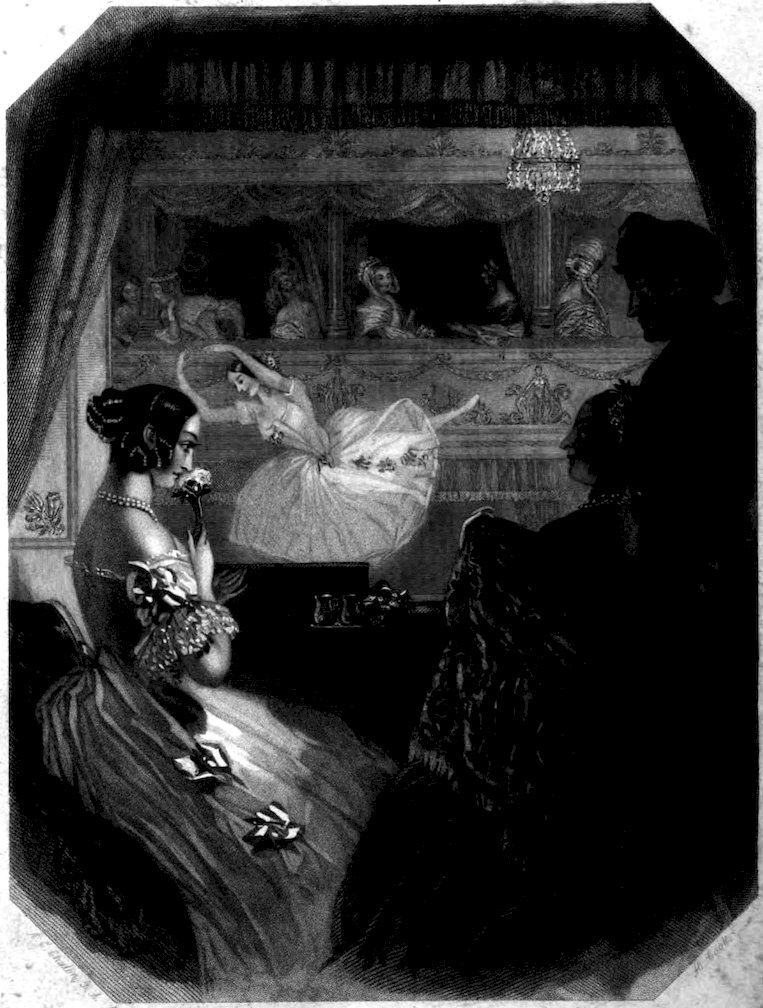
The Opera BRISK MUSIC GAYER SCENES ANNOUNCES AND IN A HALF-DRESSED DANSEUSE BOUNCES
Brisk music gayer scenes announces,
And in a half-dressed danseuse bounces,
With arms that wreathe, and eyes that swim,
And drapery that scarce shades each limb,
And lip that wears a studied smile,
Applauding coxcombs to beguile,
As entre-chat or pirouette
Doth “Brava!” thundered loud, beget.
When Mary saw her vault in air,
Her snow-white tunic leaving bare
Her limbs—and heard that deafening shout
Grow louder as she twirled about,
With one leg pointing towards the sky
As if the gallery to defy;
Surprised, and shocked, she turned away,
Wondering how women e’er could stay,
And thinking men must sure be frantic
Who patronised such postures antic;
She felt abashed to meet the eye
Of every fop that loitered by:
And, oh! how rudely did it vex
Her fresh, pure heart, to mark her sex
Thus outraged, while the noblest came
To gaze and revel in their shame.
Her troubled look the mother saw,
And rose all-pitying, to withdraw,
Convinced such shows must pain dispense
To one bred up in innocence.
But there was one who joyed to see
The pure and shrinking modesty
Of this fair girl—’twas Deloraine!
Ah! stands he at her side again?
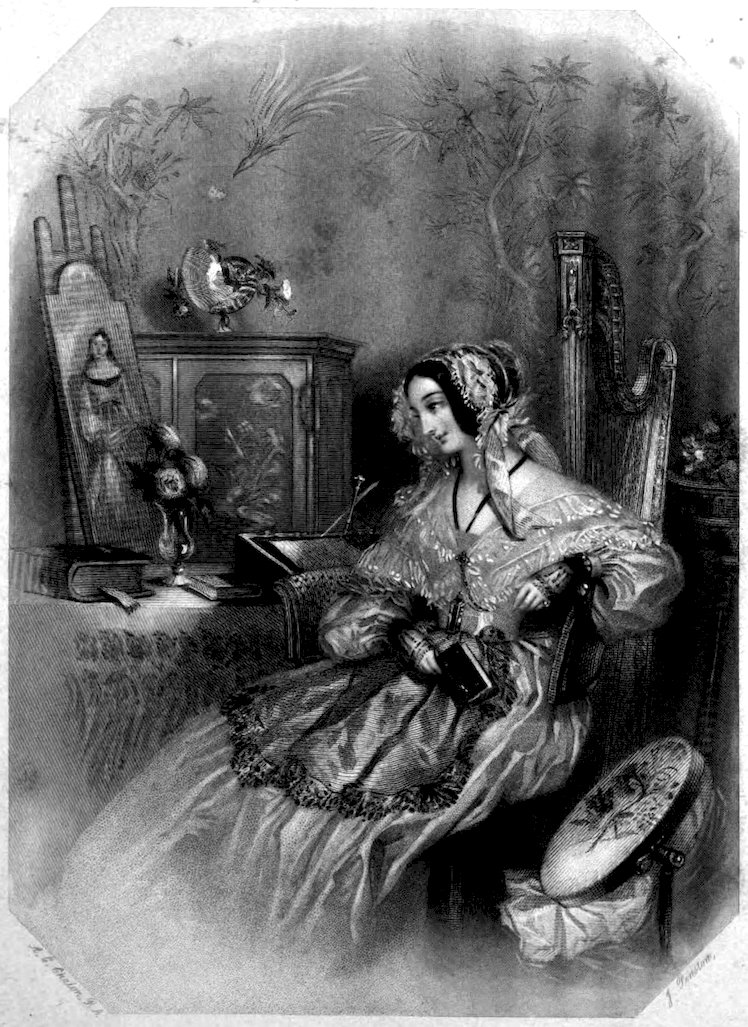
The Maiden’s Chamber HERE GAY AND PLACID SPEED THE HOURS AMONG HER MUSIC, BOOKS, AND FLOWERS
Yes, he now knows that there can be
No maid more innocent than she;
And doth with pitying look survey
The bolder damsels—pleased to stay,
And watch what makes the indignant blush
Warm to his idol’s forehead rush.
The Races next,—O! Sport refined
For women who pretend to mind—
Come in their turn; but humdrum folks
Can miss “the Derby,” or “the Oaks.”
What, though the road to Epsom’s lined
With crowds, and “cabined, cribbed, confined,”
Each carriage scarce can move along
Amid the dense and motley throng;
And clouds of suffocating dust
Are borne by every fitful gust;
And slang, and curses—gentle notes!—
Are heard from silken-kerchiefed throats;
And rude remarks enough to raise
The blush of shame—if ever praise
Could mortify, it sure were here—
When men, the vilest, passing near,
Proclaim each high-born maid “a gal,”
With half the points of Jane or Sal.
And then tobacco’s fume exhales,
To poison e’en the vernal gales.
The coronetted coach, with steeds
Such as our England only breeds,
Ploughs down the crowded road its way,
’Mid taxcart, fly-van, buggy, dray;
The four-in-hand, from whose high seat }
Each Noble drives, with look elate, }
As if he held the reins of State; }
And flocks of men, and women too,
With nought but staring work to do,
And idle urchins, line the road
And by loud shouts the horses goad:
Such is the scene the route displays
To Epsom, on the appointed days,
When Fashion sends her votaries out
To mingle with the rabble rout.
The weather, too, propitious shines,
And all our climate’s change combines;
And showers, and wind, and dust, and sun,
Annoy us ’till the day be done;
Oh! who the Races ever knew
To pass, and was not well soaked through?
Arrived, the Stand each Lady seeks,
With crimson nose and purple cheeks,
Ringlets that all their curl have lost,
And robes and canezous sadly tossed,
And bonnets that from Paris came,
So spoilt, who’d know them for the same?
As droop poor Nattier’s faded flowers,
Pale victims to this clime of ours;
Or hangs the twisted, broken feather,
Attesting our uncertain weather.
The men behold the altered faces
Of belles who stood in their good graces;
And some, intending to propose,
Draw off, alarmed by ruby nose.
But Woman, ever prone to please,
Affects, although she feels not ease;
For, half-suspecting she’s a fright,
She tries to set her toilette right;
And lisps, “I hope your horse will win,”
To every beau that enters in:
While man, the gentler sex forgetting,
Remembers nothing but his betting,
Consults his book, takes three to two,
Then nods and hollas “Done with you!”
’Tis true he comes between the heats,
And wanders round the women’s seats,
’Till he has found the favoured dame
For whom he feels, or feigns a flame;
And, by attentions somewhat free,
Leads cool spectators to agree
That “he’s a devilish lucky fellow,”
Who’ll tell them all when next he’s mellow.
To mingle with this herd of men,
Who thought of nought but horses then,
Our Mary felt was not her place,
And took no pleasure in the race.
But when she marked the women bet,
And more and more excited get,
With flushing cheek, and sparkling eye,
Whene’er a favourite’s horse they spy,
And talked of odds to give or take,
Of Handicap, Match, or Sweepstake,
And saw their dainty fingers hold
Purses in which shone coins of gold,
Ready to pay in case of loss,
Though e’en the notion made them cross;
Or heard them eager claim the cash
Won from the losers, young and rash;
She marked the scene with sad surprise,
And wished her sex more proud—more wise.
Now rise the shouts of races bawled,
And discord, falsely music called—
Vile organs, viler clarionets,
With cries of blacklegs offering bets;
Shrill flutes, and shriller pipes of Pan,
And songs deserving censor’s ban;
“The horses, and their owners’ names,”
At every side some knave proclaims;
And cries of “Dorling’s genuine card,”
From lungs stentorian ceaseless heard;
While thimbleriggers boors entice,
And sharpers others tempt with dice;
And execrations, loud and deep,
Are heard, as disappears the heap
Of coins of silver and of brass,
Won from the coffers of each ass;
And countless beggars ply their trade,
Whom practice long hath perfect made;
And gipsy, chattering like a witch,
Foretells weak maidens husbands rich,
Prates of dark women and fair men,
Begs you’ll but cross her hands, and then
She’ll straight reveal your future fate,
Whether a coffin or a mate:
These mingled sounds produce such din,
That Mary feels, a realm to win,
Again she’d not a race-course see,
And longed—how longed—at home to be!
And now the racers are led out,
And quick disperse the rabble rout;
The generous steeds impatient stand,
While held in by their trainers’ hand:
Their coats how sleek, their limbs how fine!
England, what coursers equal thine?
The Jockeys, too, how trim, how neat!
How light each hand, how firm each seat!
The signal’s given, they start a pace
That promises a well-fought race:
They quicker move—now quicker still,
Round Tottenham Corner; see what skill
Each Jockey shews to save his horse!
Now rapidly along the course
They dart, like arrows from the bow,
And keep so near, that none can know
Which is the fleetest. Side by side,
The pink and yellow rapid glide;
They’re neck to neck: how far behind
The rest are left!—swift as the wind
They fly. Now yellow dashes past
The pink—the leader’s now the last!
The yellow keeps a-head: he’ll win—
He nears the goal—“He’s in! he’s in!”
A deaf’ning shout now rends the air; }
The winners laugh, the losers swear, }
Whose feeling wives their salts prepare. }
How pallid look their cheeks and brows!
How sullen seems each beaten spouse,
Reflecting he must soon “book up,”
And leave the victor, gold, and cup!
A luncheon next the Stand supplies,
Where chickens, pâtés, lamb, cold pies,
Tongues, lobster-salads, hams, are all
Devoured, till appetite doth pall;
And soda-water, and champagne,
Restore the losers’ nerves again.
Those who, less favoured, find no place
In the Grand Stand to see the race,
Feast on their dickeys, or in carriage;
And hungry gazers can’t disparage
Their appetites, when e’en the fair
Lay in a meal to make one stare;
And sparkling eye, and deep-flushed cheek,
Thy influence, brisk champagne! bespeak.
How glad was Mary, when, all over,
Seated beside her ardent lover,
She heard her mother, with remorse,
Regret the hours lost at the Course;
And soon forgetting all around
Her mind its native quiet found.
Time flew on gay and airy wing,
And Summer had replaced the Spring;
No more in the street and square were seen,
The trees beclad in mantle green,
For now exhausted, dusty, brown,
They wore the livery of the town.
The grass, wherever grass was seen,
Resembled nought save washed nankeen;
The shrubs, in spite of gardener’s care,
Hung their limp boughs with dying air;
No more the sickly window-roses
Had strength to charm the inmates’ noses;
And balconies in every street
With mignonette so lately sweet,
(A melancholy sight indeed!)
Shewed their whole treasure run to seed.
Now to the plague of mortal eyes
Began the carnival of flies;
All London, still of Fashion full,
Sent up one groan—“How hot and dull!”
Now maidens bright begin to fear
They needs must wait another year
For that dear thing—establishment,
On which their eager hearts were bent;
“So fleet to chase—so hard to find,
What ails the men? they grow so blind!”
And pretty lips, with smiles that shone,
Pout as their owners sit alone,
Viewing with dread the time approach,
When, packed in the ancestral coach,
To London’s joys they bid adieu,
With long and dreary months in view!
Autumn and Winter spent at home,
Where but old stupid neighbours come—
The Rector and his prosy madam,
Whose pedigree dates back to Adam;
The Doctor, with his gossip small,
So fond of luncheon at the Hall;
The noisy, dull, and sporting Squire,
Splashed to his waist in horrid mire;
And then his loud, red-elbowed girls,
What feet! what scarlet ears! what curls!
Poor things! devoured with earnest passion
To know and ape the newest fashion—
What wonder maids would rather bear }
With dusty streets, and blazing air, }
Than bid adieu to dear May Fair? }
Now mothers, too, with soirées sated,
Who hoped to see their daughters mated,
And deemed their prey each sauntering beau,
Who, passing, notice, chanced to shew;
Whose talk, however slow and fade, }
Betwixt quadrille and gallopade }
No cold repulse from them forbade; }
Are left—(the beaux all fled away),
With milliners’ long bills to pay,
Which now come pouring in a number
To rob the matrons of their slumber,
While they can scarcely courage gather
To shew them to a surly father
Too sure to swear—to sure to scoff—
“Five hundred pounds?—not one gone off?
Now truly, Madam, on my word,
This cursed expense is quite absurd!”
And while on sleepless beds they toss,
Scared by the thoughts of husbands cross,
The anxious chaperons fret and wonder
Why men bend brows of darkest thunder
Upon the adornments which, no doubt,
No well-born girl could do without;
And think some most malicious star
Takes pains their prospects bright to mar.
“Heavens! how my Lord will stamp and scold,
And hint that Dora looks so old!
And here’s another season closed,
Sir Harry—gone, and not proposed!
I did my best—gave Sunday dinners,
Though strict Sir Andrew called us sinners!
I’m sure I caught three bad sore throats,
With water pic-nics made in boats:
Another year—and all but ruin!
What ever can the men be doing?”
Now fathers on their banker’s book
With long and rueful visage look,
Sum the small balance, curse the town,
And, filled with sullen spleen, go down
To country-seats—to sleep, till Spring
Bids them again reluctant bring
Their wares, so long on hand, for sale,
And some—alas! grown rather stale!
While thus the weeks went quickly o’er,
His cabriolet, each morning bore
Deloraine, to meet the maid, who grew
Dearer the more he saw, and knew
The varied treasures of her mind,
By culture formed, by taste refined:
He only waited just to know
If but the substance equalled show—
For beauty he but little rated,
Unless by spirit animated;
And Deloraine, wiser than his age,
Must pause before he dared engage
His faith to one but slightly known.
But all was right!—his wooed, his own,
Surpassed what fondest fancy dreamed
Of pure, and good—and now he deemed
The experiment had well been tried,
And longed to claim her for his bride!
But ere he spoke, and her fair hand
From her fond parents dared demand,
He longed to seek if in her heart
His humble image had a part;
At times depressed, at times elate,
He now would dare, and meet his fate.
There came a splendid carnival,
The season’s last—a costume ball;
And called, as if by wizard’s wand,
In garbs of many a distant land:
To grace that gorgeous revel came,
A host of charms—ah! who could name
One half the beauty, rich and bright,
That shone on that last revel night?
There many a youthful matron bore
Her store of gems—and sighed for more,
Yon fair Sultana to eclipse
With henna on her fingers’ tips;
There in a snowy veil entangled
Drooped pensive Nun; and next, half-strangled
By garland, Perdita the fair,—
And an Ophelia, with a stare
Of wonder, as she queried whether
’Twas right to wear the heron feather,
That nodded, with each Scottish breath,
On her who stood for Queen Macbeth?
In truth it was a pleasant sight
To meet, in noon-tide blaze of light,
The denizens of furthest lands,
From Asia’s shores to Egypt’s sands:
There prudes, with shrinking horror, saw
The beads and blanket of a Squaw;
But ere their whispered blame began }
To circle round, a murmur ran, }
“How very droll!—a nice young man!” }
There fair young Greeks in freedom strayed,
With braided locks, and robes that played
In many a light and graceful fold,
And white brows bound with coins of gold;
The Turkish fair unveiled were then
To the promiscuous gaze of men,
With such a wealth of raven hair,
And cheeks so radiant, brows so fair—
No wonder Sultans, passing nigh,
Eyed the fair groups, and wished to buy!
One dame—a daring feat I ween,
Wore the rich robes of Scotland’s Queen,
And loud, and long, was heard to sigh }
Whenever stately glided by, }
In harsh and formal Majesty, }
Her rival, with a well-starched ruff,
And robe of grand brocaded stuff.
There Anna Boleyn smiled elate
Defying her approaching fate;
So blithe she looked, the wise ones said
Before her time she’d lost her head:
While bluff King Harry, following after,
Thought her much younger than her daughter.
And she, the serious, sweet Jane Gray,
Who better loved to read than play—
As Ascham tells us—danced as though
She took much pleasure in the show;
There with mantilla, flower, and fan,
And saucy page behind who ran,
And sour duenna in a hoop,
Came Spanish maids, a haughty group;
Behind them close, with charming song,
Did three Tyrolean sisters throng;
And in the chaine, a Croat did turn
A pretty black-capped maid of Berne;
Three Nuns demure—pressed hard by railers,
(Fresh-water though) a pair of Sailors;
A Hollandaise, contrasted well
With a Savoyard—his vielle
Slung at his back—and when he played,
Ye Gods! what doleful noise he made!
And Naples sent her peasants there,
With sparkling eyes, and jetty hair,
And dresses dight with colours gay
Such as at festas they display:
Thus, once resistless, moved along
Bright MALIBRAN, that queen of song!
They little thought, who passed her by,
And marvelled at her mirthful eye,
So full of life and joy was she,
That soon the tomb her home must be!
And Roman Ladies, chaste and proud,
Were mingled in that motley crowd;
And witching gipsies fortunes told,
The same one theme, to young and old;
And Pilgrims with their cockle-shells;
And Folly with his cap and bells;
And Comus with his cup divine;
And Circe, but without her swine;
And she who on the willowy shore[2] }
Of Carthage, did her love deplore;— }
The Muse lacks breath: she can no more. }
Through the vast hall the brilliant crowd
Roamed gaily, or to music loud
Whirled nimble feet, while some apart,
Revealed soft secrets of the heart:
Full many a fair and dimpled lisper
Lent her white ear to Flattery’s whisper,
And though in Love’s experience read,
Believed the whole the coxcomb said:
’Twas almost true—if true not quite—
And who could doubt on such a night?
Who on this brilliant scene had dwelt,
And paused to think, but must have felt
As Xerxes, when he wept to see }
That mighty, moving throng, whom he }
Had marshalled on to destiny, }
This crowd of young, and blithe, and fair,
Smiled on by Death—but not to spare?
To his wan eye, the gilded room
Is but a thickly peopled tomb;
To him the years are but a day,
That pass, and all have gone their way,
Or, touched by Time with finger cold,
Are frail, and spectral to behold:
He laughs at every polished brow,
And floating tress, and neck of snow,
And cheek that shames the rarest rose,
And lips that rows of pearl disclose;
And forms from Beauty’s faultless mould,
So softly fair or proudly bold,
That seraphs, from their amaranth bowers,
Might envy shapes this earth of ours
Yields from its dust;—and while he quaffs
His wine of tears, the Spoiler laughs,
Too soon that shadowy wand to wave,
Which sweeps the revellers to the grave!
But O! how few e’er pause to think,
While Pleasure’s cup, filled to the brink,
Lures them to taste—and idly gay,
Their brief existence sport away;
Until, perchance, some dear one dies,
Then falls the bandage from their eyes
That hid the dread truth from their gaze,
And, terror-struck, in wild amaze
They learn that nought of man’s endeavour
Can change the doom—“Ye part for ever!”
For ever?—No—in realms on high,
If the heart’s instinct prove no lie ...
But pause—nor trench on themes divine,
Unmeet for such light lay as mine.
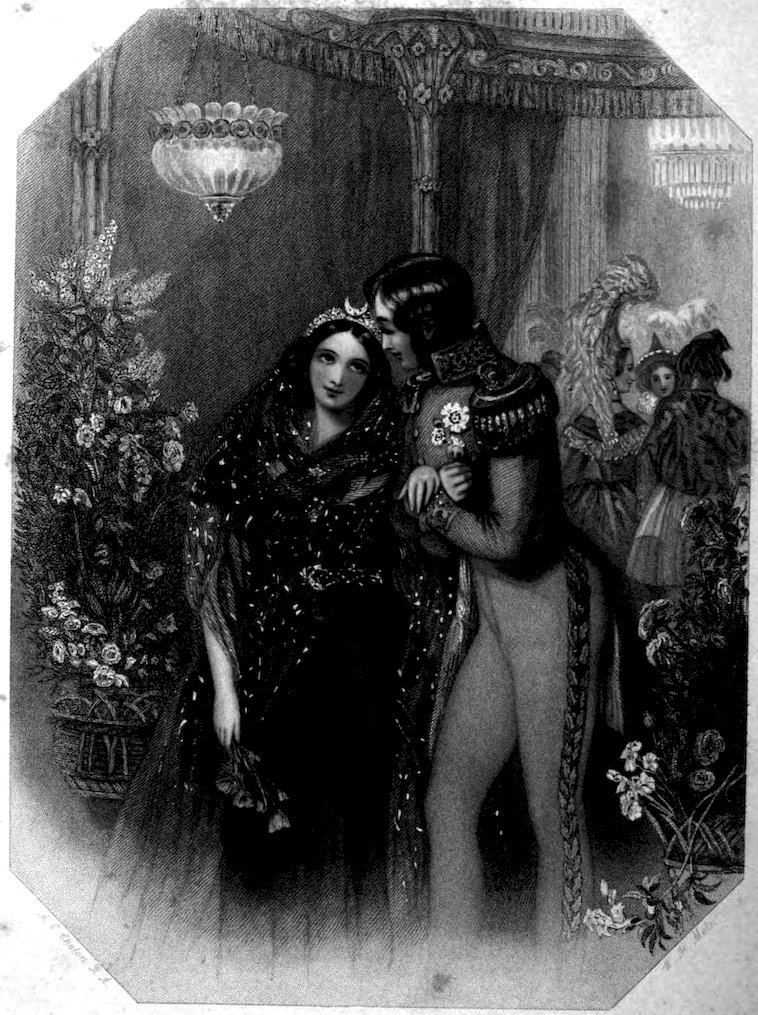
The Declaration MARK YONDER YOUTH ON WHOSE FOND ARM LEANS ONE ENRICHED WITH EVERY CHARM
Mark yonder youth, on whose fond arm
Leans one enriched with every charm
That ever-bounteous Nature spent,
When on some loving labour bent!
How fresh, how young, how fair the face!
That form, how round, how full of grace!
That foot, how fairy-like and small!
It might on bed of roses fall,
And scarce a delicate leaflet crush,
Nor by its pressure stain the blush:
A sable robe, in graceful folds,
Sweeps to her feet—a cestus holds
Her slender waist, with many a gem
Brilliant; so shines the diadem
That crowns her brow, as marble pale,
Whence low descends a dusky veil
Round her sweet face in shadowy flow,
Like clouds that float o’er Dian’s brow;
Now her rare splendour half concealing,
Now, touched by air, the whole revealing—
“She walks in beauty,” Queen of Night,
Did e’er the Goddess look more bright?
Large diamonds, of the purest lustre,
Within her raven tresses cluster,
Which darker seem between the rays
Emitted by their dazzling blaze:
So show the heavens when stars abound,
And shed their sparkling gleams around.
Her veiled arms (might Fancy say)
Remind us of the milky way,
When in the winter’s midnight sky
Its lone, long path, streams pale on high.
All eyes are on her, but her own
Are veiled, as though the lids had grown
Jealous of those bright orbs they shade,
And to reveal them half afraid.
Why wears her cheek a brighter hue,
Than Cashmere’s gardens ever knew?
Why throbs that fair and gentle breast
So wildly ’gainst her starry vest?
Would she abashed those gazers shun?
She hears—she sees—she feels but one!
At last, the chosen at her side
Hath asked her to become his Bride;
Hath told not half the manly love
Which all his future life shall prove;
And every tender, timid word,
Her ears hath drank—her heart has heard:
Yet maiden shame would half repress }
The words her blushing cheeks confess, }
Fond thoughts she dares not all express. }
“Look up, mine own! a word—a sign—
To tell me you are ever mine;
Nay, are you pained, that thus you sigh,
And listen with averted eye?—
Say—may I hope?”—O! who can tell
The rapture on his soul which fell,
When those twin faltering lips betrayed
The “Yes,” of that dear conscious maid?
Scarcely his joy he can dissemble,
The while he felt her round arm tremble
Within his own, as to his breast,
Gently, but lovingly, ’twas pressed.
And she—O! who could e’er disclose
The deep, tumultuous bliss she knows?
She longs to be alone, to weep
The tears she scarce concealed can keep.
Now, bolder grown, the ardent youth
Repeats his vows of faith and truth,
’Till, all disclosed, the maid may own
The secret by her blushes shewn.
At last—for Time, who jealous hovers
O’er mortal raptures, spares not lovers—
He leads her to her mother’s chair,
And whispers (not to empty air)
How high his bliss, how great his pride,
To call her angel-daughter bride:
Smiling, the lady hears the news,
She could not parley or refuse;
Yet dignified the gracious mien
In which she let assent be seen.
’Twas fixed next morning he should call
And tell the good Lord Percy all:
No fear of him—he could not say,
To Mary and Lord Deloraine, “Nay!”
Pass we the interim in our song—
O! but the lovers thought it long!
’Twere vain to tell how quickly flew
The hours which now the lovers knew,
As, ne’er apart, they rode or walked,
Or of the golden future talked,
For even old age looks passing bright
When viewed by Love’s own magic light:
Or how the self-same poet’s page
Would oft their downcast eyes engage.—
The bard who sung the “hell[3] of sueing,”
Forgot, methinks, the heaven of wooing!
No Deloraine blamed the law’s delay,
And drove to Lincoln’s Inn each day
To urge its ministers to speed,
Who of impatience took small heed.
They wasted weeks, without remorse,
Their tedious covenants to endorse;
Talked of fee-simple and entail,
And due provisions for heirs-male
And younger children, and made good
Jointure in case of widowhood—
Nay, so o’er-provident were they,
As with shred counsel long to weigh
What sum, in case of separation,
Should form the lady’s reparation.
The youth to fancy did begin
That Time stood still in Lincoln’s Inn;
He’d wait no more, but spoke aloud,
And, angry with impatience, vowed
He’d rather give his whole estate
Than for tedious lawyers wait.
Cold to his prayers, those parchment men
The pin-money must settle then.
But all, at last, was finished well.
Now of the thousand gifts to tell
When father, mother, loved vied,
Which should most enrich the bride!
Diamonds, the costliest and the rarest;
Pearls of the East, the largest, fairest—
How proud had Egypt’s royal Queen,
In her triumphant glory, been
To drink such ocean-spoils, as now
Waited to hang on Mary’s brow!—
Rubies, that flashed like the red sun,
When earth he latest looks upon;
Emeralds, whose deep and lucid green,
Would shame the fairies’ turf, I ween;
And sapphires, of such hues intense
As Midnight’s heaven had dropped them thence;
And turquoises of paler hue,
Fond Memory’s flower hath such a blue;
And opals of such changeful dyes
As rainbows shew in Summer skies,
Were showered on her, whose beauty rare,
Surpassed all gems beyond compare.
And now arrived the time to shew
Her gorgeous and complete trousseau—
Crowds flocked to Regent Street each day,
Enchanted with rich display
Which Howell’s taste and skill provide,
To deck this young and peerless bride.
And many a maiden’s tempted eye
Made her young heart for wedlock sigh.
What Cashmere shawls!—why, for one glance,
Had crossed the sea the flower of France!
Even English dames (the truth to speak)
Dreamed of them many an after-week,
And raved in ecstasy’s disorder
About “that matchless Turkish border!”
Robes of each fashion, stuff, and shade,
In dazzling number were displayed;
With peignoirs, white as snows which arch
The weeping branches of the larch;
Chapeaux and caps outpassing number—
Some for the morning, some for slumber;
Furs from Siberia—mart Zipline,
Nor Czar nor Kaisar e’er had seen
Finer; and ermine, soft and white
As flakes of snow, ere they alight
On earth; and shoes, which Cinderella
In her glass shoe had found no fellow;
Muslins from Dacca’s cunning looms;
Velvets and satins with such blooms,
As, shewn in garden-walks, would quite
With envy turn the peaches white!
And then such hues!—less changeful deck
The monarch of the bee-birds’[4] neck;
Not Juno, when she dressed a cloud
To cheat the vacant youth who bowed
To its false charms, chose tints more gay
Than, flower-like, in that trousseau lay.
But who the treasures e’er could tell,
Disposed within the rich corbeille?
Embroidered kerchiefs white and fine,
Their lace had made Arachne pine,
Or, desperate grown in weaver’s pride,
Resolve on doleful suicide!
And veils were there, in which the bride
Might her too-glowing blushes hide;
With scarfs and lappets, ruffles, frills,
A mine ’twould take to pay their bills!
And Point d’Alençon, too, was there;
And Mechlin, that made ladies stare;
With Valenciennes so very fine—
They said, for trimming ’twas divine.
French gloves in sachets, whose perfume
Lends fragrance to the dressing-room;
With artificial flowers by Nardin,
Vieing with those that grow in garden;
Fans, smelling-bottles, casolets,
The gazers called them, “perfect pets!”
Enriched with gems of every dye
Golconda’s glittering mines supply;
Purses, and reticules most rare,
Her gold and handkerchief to bear:—
No wonder that the spinsters sighed,
When such a store as this they eyed!
All done—all ready—nought remains
For Mary now, save Hymen’s chains,
Or garlands rather; if by Love
They’re forged, they ne’er can galling prove:
No hapless captive sure is she,
Who dreads even dreams which set her free.
And yet, when nothing now remains
Save to put on those rosy chains,
To leave a father—O! how dear!
To feel a mother’s falling tear,
When, strained to her o’erflowing heart,
She finds ’tis very hard to part!
For one brief instant, tearful, fond,
She does not view the home beyond,
But trembles as her feet press on
Towards that strange solemn Rubicon!
Then rise most tender thoughts of youth
Th’ unsleeping love, th’ unshaken truth,
In those so honoured and so loved, }
So often tried, so largely proved, }
Till all the daughter’s heart is moved! }
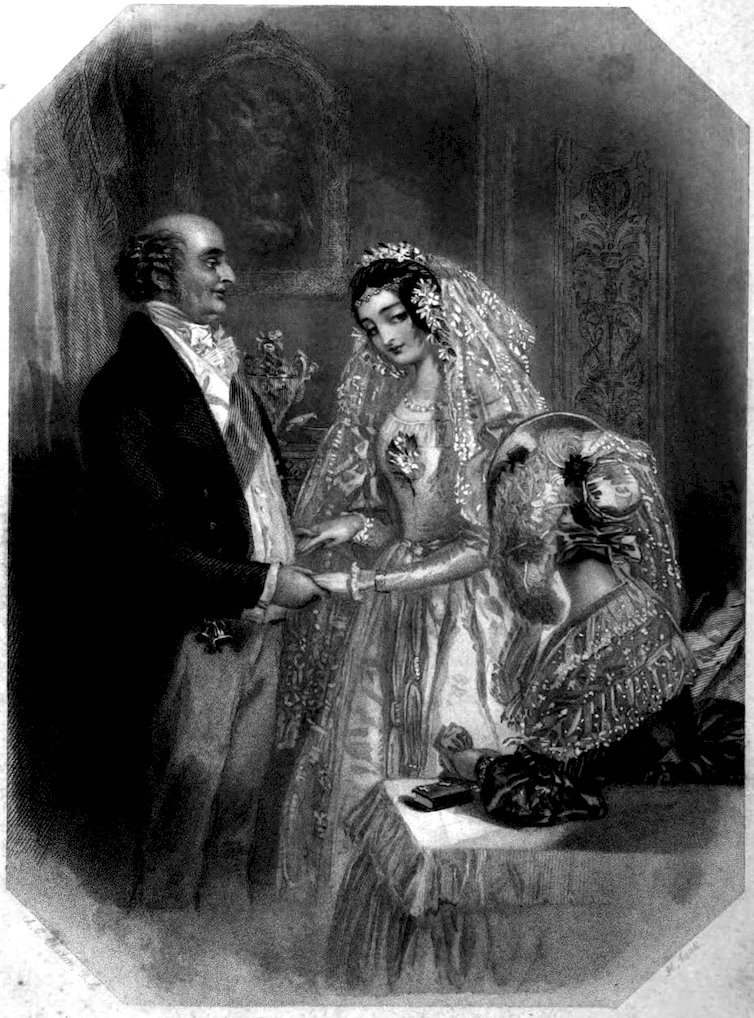
The Bride AND NOW IN SPOTLESS GARB ARRAYED, WAS NEVER SEEN A FAIRER MAID.
Yes, even for a husband’s arms,
And his ancestral home, whose charms,
Painted by him—she longed to see,
O! bitter must such partings be!
But soon ’tis promised they shall meet,
And Deloraine whispers, ’twill be sweet
To welcome to her stately home
Those much-loved parents when they come.
Gently he dries her gushing tears,
And feels how much such grief endears;
And soon her sadness can beguile,
Until there dawns a happier smile
Round her fresh lips: to add the grace
Of gladness to her pensive face,
He tells her, ere the autumn fades,
He’ll lead her to her native shades,
Make friends with every field and tree,
By her beloved since infancy!
Soothed by his words, and calmer grown,
At last the bridal hour comes on.
And now, in spotless garb arrayed,
Was never seen a fairer maid;
Her parents gaze with tearful pride,
Her lover longs to call her bride;
And while the altar she draws nigh,
She checks the tear and trembling sigh,
And with religious awe doth feel
The solemn bond she comes to seal!
She utters not, like words of course,
The vows that wedlock’s laws enforce;
With holy fervour does she speak
Each word, and with a spirit meek
Resolves their purpose to fulfil,
Obedient to the Almighty Will!
The Bishop now the bride has blessed,
Her husband now her lips hath pressed;
Her friends flock round, and wish the pair
May all life’s joys and blessings share:
Her mother tries to hide a tear,
And still her father hovers near
Once more to bless, once more to speak;
He can but look—for words are weak,—
But a life’s love’s in the embrace,
And tears that fall upon her face.
And now, before my story ends, }
A sumptuous déjeûner attends }
The happy couple and their friends. }
’Tis done: behold approach the door
A well-appointed chaise-and-four:
More tasteful never left Long Acre.
What wonder?—Barker was the maker.
The bride, attired in travelling dress,
Meets once, once more, the sad caress
Of parents, who with breaking heart,
Behold their mansion’s flower depart.
They’d keep her still.—In vain! for marriage
Were nought without its travelling-carriage.
And now my Muse disdains to tune
Her tired harp for the honey-moon:
The wooing past—the wedding o’er—
Paid every fee—what would ye more?
True wishes, lovely maids, and kind,
That such a lot you each may find;
And every Belle have equal reason
To bless the closing of the Season!
THE END.
LONDON: PRINTED BY MOYES AND BARCLAY, CASTLE STREET, LEICESTER SQUARE.
PUBLISHED FOR THE PROPRIETOR, BY LONGMAN, & Cº, PATERNOSTER N. Y.
AND APPLETON, & Cº NEW YORK
TRANSCRIBER’S NOTES
Typos fixed; non-standard spelling and dialect retained.
Used numbers for footnotes, placing them all at the end of the last chapter.