Front matter (continued 2)
Reading edition
We shall, under the head of Autumnal management, give general directions for the removal or deprivation of full super boxes; but it may be well here to describe the method to be pursued where it is necessary to operate on a stock-hive. In such a case, a piece of board is useful, of the same width and thickness as the top, or crown-board. In the middle of the day, unscrew the latter, sliding it sideways; the extra board covering over the vacancy as you proceed. In this way, only as much space as is wanted to get at any given bar need be exposed. “A few puffs of smoke,” says Mr. Golding, "may now be blown down the sides of the comb to be taken out, which will intimidate the bees, and drive them away. A double-edged knife-blade, an inch and a half long, and three eighths of an inch wide, turned at right angles from the end of an iron rod of about a foot in length, is now passed down the edges of the comb, to detach them from the hive. After this is done, the comb may be easily lifted; such bees as still adhere to it being swept down into the hive as the bar is lifted upwards. Such operations as these are much less formidable than many persons believe. The fact is, the bees, when once intimidated by the smoke, may be done almost anything with. Quietness and a little tact are all that is required. When combs are taken out, they may be either detached from the bars at once, and the bars returned, or spare bars may be kept on hand wherewith to replace such as have been extracted."
BAR GLASS-HIVE.
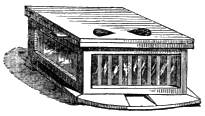
Before we leave the subject of box-hives, it may be interesting to give a description of one recently constructed by me for experimental purposes, as referred to in the note at page 53, and here illustrated. It may not improperly be termed a Light, or Observatory Hive, in distinction from the usual mode of rendering the dwelling as dark as possible. The hive itself resembles the bar-boxes just described, as to its interior dimensions, bars, crown-board, &c.; but differs inasmuch as it is made simply as a frame, filled in on the four sides with thick glass, flush with the inside surface of the wood. For the purpose of preventing the bees from attaching the combs to the glass, thin upright strips of wood, rather more than half an inch wide, are tacked under the centre of each bar, at both ends, extending from top to bottom inside of the hive. Or some might prefer to use frame-bars, like the one described and illustrated at page 58; but guides or waxed bars must be used, to ensure the regularity of the combs, and prevent an obstruction to the sight. The hive ought to be placed in a house, and in winter should be carefully covered; an outer case or box going over all.
STRAW BAR-HIVE.
We have already alluded to hives of straw, fitted with bars. The one now about to be described differs from those commonly used, in several respects, as will be seen on reference to the annexed illustration.
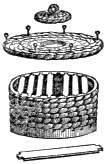
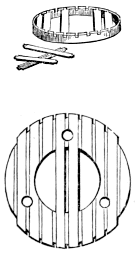
In form, my hive is an open cylinder, 14 inches in inside diameter, and 7 inches in height, to the upper side of the bars, which are eight in number; similar in size, and interspaced like those in the square bar-hive, described at page 56. For the purpose of supporting the bars, a well-seasoned hoop is introduced within, and on a level with, the upper edge of the hive—nearly two inches in depth, and a quarter inch thick; its interior diameter being the same as that of the hive. The two upper straw bands of the latter are reduced in size, sufficiently to form a recess equal to the thickness of the hoop,—the outside of the hive remaining flush. The hoop is there retained by a few small brad-nails, driven through it and into the straw; and thus no impediment is offered on extracting the combs. A difficulty presented itself in attaching the bars to the edge of the hoop, to overcome which I constructed a pattern-gauge, differing in form from that seen at page 57. Our illustration will show that the outer edges of the gauge are divided, so as, when laid flat upon the hoop, to give the precise position of the indentations for the reception of the ends of the bars: moreover, these may severally be correctly fashioned by following the form shown upon the gauge. The adjustment of the bars should be done previously to attaching the hoop to the hive, not allowing them to fit too tight. The cover is a flat piece of worked straw, which ought to lie close upon the bars. I have found no better method of securing the cover in its place than by the use of a few pointed iron pins, going down through it and into the upper edge of the hive. For convenience of working supers, a three-inch hole is left in the centre of the cover; stopped, when not in use, by a small piece of worked straw, pinned down. Some persons might prefer a wooden top, which may be perforated either with one hole or three. It should rest upon the bars, and can be held in its place by pins, in the way we have just mentioned, and which at any time are removable; or a hoop may be attached to the edge of the crown-board, as described and shown at page 35.
CIRCULAR WOODEN HIVES.
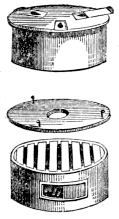
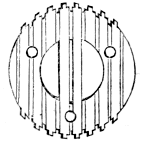
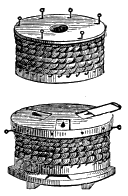
I have sometimes turned my attention to cylinders of wood, as offering great advantages in constructing a hive; not only in attaching bars, but also the desirable convenience of windows. The facilities for procuring them made with the requisite correctness of form, however, depends on circumstances not always at command; the process of construction being the same of steaming, rolling, and shaping, employed by the manufacturers of our common wooden corn measures, &c. The cost of the wood cylinders alone are not much more than the straw ones, and being made of oak or ash, they are very durable. Softer and more porous wood would doubtless be preferable, but a difficulty attends the use of such. In size, the dimensions before recommended are adhered to; viz., 14 inches clear, by seven inches in height, for hives with or without bars; the thickness being about half an inch. A reference to our illustration, and to the accompanying pattern gauge, will show the mode of cutting and adjusting the bars; these resting rather loosely in rabbets, cut the width of the bar, half through the thickness of the hive. The crown-board may be made and cut in the way already described, and can be fixed by means of a few small screws; or, if preferred, in the method detailed and illustrated at page 59. When the hive is not fitted with bars, it is an advantage partially to sink the crown-board within the diameter of the cylinder, which ensures a more perfect joint. At the back is a window of bent glass, protected by a sliding zinc shutter, moving in a frame of rabbeted moulding; all following the curved form of the wood. A suitable staining and varnishing gives to the whole a neat appearance. Two of the hives may be placed one upon the other, for supering; an adapter or centre board going between them: or smaller wooden round hives, of any size, with thin tops, can be used for the same purpose; and these might be made by a common cooper.
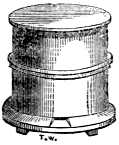
These hives are of too recent introduction to warrant saying more than that, to adapt them to the object in view, it is essential that they be placed in a house or cover, as from the density of the wood they are not calculated to bear exposure to the sun and weather. In winter attention should be given to close covering them. I may add that, in using a thinner cylinder, I have tried the experiment of coating the outside with an envelope of gutta percha, giving the advantage of improved appearance, and doubtless of utility, but at a considerable increase of cost.
COLLATERAL SYSTEM.
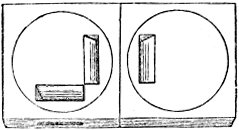
Various modes of working hives collaterally, or side by side, have been devised, but a very simple one has been practised with success by a correspondent, which as adapted by me may with propriety be termed a doubling-board. It is formed of a plain board not less than an inch thick. It must be of sufficient width to take a broad shallow hive, and long enough to contain two of these, with six or eight inches to spare. A stock-hive is in the first instance placed over the centre circular mark, within which is the double outlet for the bees. When more space is required, it must be moved over one of the side circles, and a second hive placed over the other. The double outlet forms a communication within the floor-board from hive to hive. The part hollowed out for this purpose is five inches wide, six inches long, and half an inch high inside, a sloping way being cut on the two further sides down into it. Two covered passages lead from this, terminating at one point on the alighting-board. The bees, having been accustomed to both these passages, will commonly take to the second hive, and commence working therein, particularly if smeared with honey. In order to show the position of the parts hollowed out, these are slightly shaded in the engraving. They are cut from the bottom side of the board, in the way described at page 45. A second piece of wood, nine or ten inches wide, must be screwed to the under side, to enclose the openings. This ought to reach back nearly the width of the upper board; at the same time projecting far enough in front to form the alighting-place. Another cross piece may be screwed to the under side, at each end.
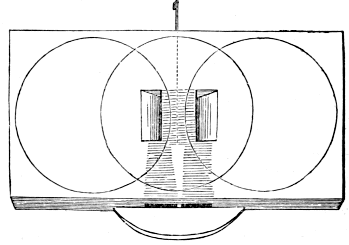
When it is required to take away one of the hives, the communication below must be cut off between them. This is done by means of a divider of strong tin, copper, or iron, pushed in from behind, in a groove cut edgewise in the bottom side of the main board, and resting on the under one. The dotted line in the engraving shows the position of the divider, which must in depth be the same as the passage between the two hives, so as, when in its place, to stop it entirely across the centre.
Another plan of working hives side by side is shown below, two boards being required.
They are made on the double plan, as described at page 45; alike in size and thickness, with the entrance passages cut out from beneath. There must, however, be two entrances to the board intended for the second hive—one in front, and the other at the side, with doorways not less than six inches wide. A wedge or two of wood will contract them as needed. When room is required, the first board with its hive must be moved so far sideways that the second one can precisely occupy its place. At the same time it must be turned half round, so that its mouth and that on the side of the new hive meet and fit close together. The bees will pass into the other hive on going out: on returning it will be the same, for the alighting-board (which ought to be a fixture) will remain as usual. On removing a full hive, the other must be restored to its original position.
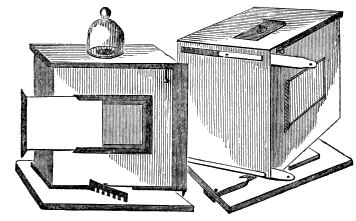
WHITE’S COLLATERAL HIVE.
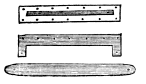
As regards collateral bee-boxes, we owe our original acquaintance with them principally to White, nearly a century ago.[L] His plan requires two boxes, placed side by side, with means of communication, open or stopped at pleasure. These hives do not appear to have been very extensively used; perhaps a good deal owing to the imperfect way in which they were made. For my own use, I endeavoured to improve upon the original design, of which the engraving following will give an idea. The boxes and their boards are shown a little separated; the passages from one to the other being made along the top and bottom of each box. These openings can be closed by the introduction horizontally of slides of thick tin or copper, of an inch and a quarter wide, inserted from behind; let into the boxes their own thickness, and there loosely kept by cases or strips of tin, cut to correspond with the openings. The tins may be about two and a half inches wide. Their form, and that of the slides, is here shown.
NUTT’S COLLATERAL HIVE.
The modes we have hitherto noticed as applicable to hives worked side by side suppose two to be employed; but Nutt, a few years ago, introduced three boxes, as forming a set; and these hives had their day, where cost and space were not objects.[M]
The three boxes are placed together collaterally, with an entrance from the centre box to the side ones, each way, through what may be termed a grating; which communication can either be open, or cut off by means of a divider, made of sheet tin, pushed between. The centre box Nutt named the Pavilion, into which the bees must be hived, and not afterwards disturbed. As more space is required by the bees, it is given by withdrawing the divider. They then take possession of one or both of the side boxes, which when filled can be removed. There are holes on the top of the side boxes for the reception of ventilators. In the construction of these hives the theory of Nutt supposes that a warmer temperature is required in the seat of breeding from that in which comb-building and the storing of honey ought to take place, than which no greater fallacy is possible, as during the formation of a comb the bees cluster round it in masses, to generate the highest degree of warmth. By the agency of ventilation in his side boxes, these are injuriously rendered cooler than the centre one; a thermometer inserted within the ventilator determining the relative degrees of heat.[N]
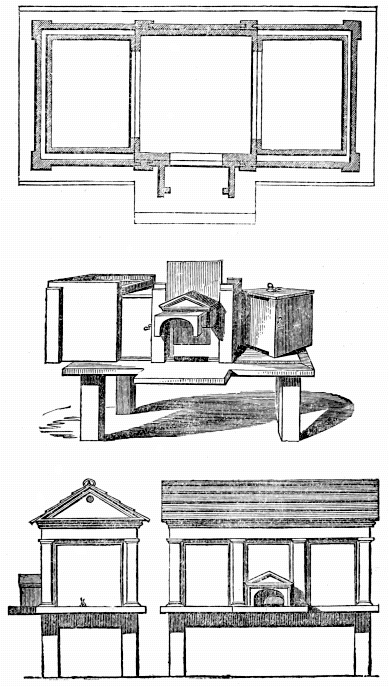
Although at one time I inclined to the principle propounded by Nutt, yet in the working of his hives, I found several disadvantages in their details. I therefore, for my own convenience, altered in part the form, and mode of communication between the boxes, as shown in White’s hive; in the absence of a bee-house, completing the fabric by the addition of an outer cover and weather-boarded roof. The details of this hive have so frequently been repeated in former editions, that a reference to the preceding engravings will now suffice to give a general idea of the ground and separated plan, and elevation.
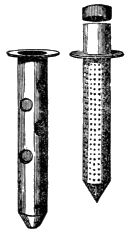
The ventilators I constructed for my Nutt’s hive, after trying various forms, consist of double tin or zinc tubes, both resting on a flanch or rim, in the holes prepared for them on the top of the box, usually near the back. The outer tube is of one inch diameter, and six inches long, with six half-inch holes dispersed over it. It is soon fixed down in its place by the bees, and so must remain. The inner tube is of perforated zinc, with a projecting top as a handle, and a cap to put on or off this, as required. The bees will stop up the inner tube where they can get at it, when it may be turned round a little to present a new surface. When wholly stopped, it can be withdrawn from its place, and a clean tube substituted. A small thermometer fits within the inner tube. The scientific apiarian, with experimental objects in view, will often find this kind of apparatus, which is applicable to any plain box-hive, of use.
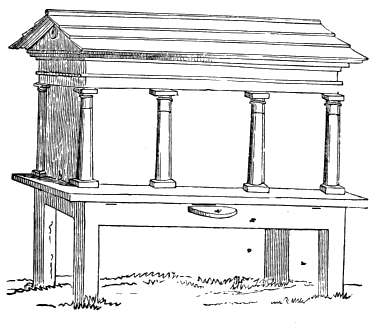
There is nothing to prevent the adoption, in this hive, of an entrance from beneath the floor-board, in the way described at page 45. In this case, the portico and its adjuncts are superseded; as seen below, in an improved elevation.
NADIR HIVE.
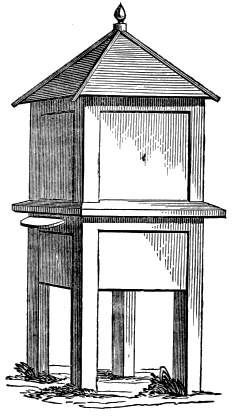
Elevation
Bees not unfrequently take advantage of a hole or crack in the floor of their domicile to commence building combs underneath it, a position possessing some advantages. Deriving a hint from themselves, I contrived what, from this peculiarity, I used to term by way of distinction a Nadir Hive, the store box being placed underneath the stock, coming out at the back, as a drawer. The details of construction of the Nadir Hive have appeared several times in our former editions, but by way of illustrating the principle and methods of its application, the engravings annexed will not be without their utility. In practice I found no indisposition on the part of the bees to enter and work in the store drawer, into which they have access through the floor-board above, and which is in part made like that shown at page 78. It will be seen that the entire design supposes an out-door hive, with a hipped cover. The stock-box is enclosed by four panels, moving up and down in grooves or rabbets, cut in the corner pilasters, the latter being attached to the box.
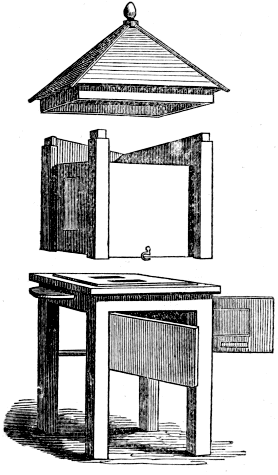
Separated Plan.
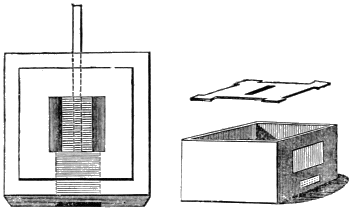
Floor-board. Nadir drawer and loose cover.
This mode of applying the Nadir, or rather Nether principle, must not be confounded with the usual plan of disturbing the stock-hive for the purpose of placing an empty one beneath it, with a new entrance in the latter for the bees. Under such circumstances the Queen will commonly descend and breed in the nadir, which is converted into the stock, occasioning much subsequent inconvenience. I have not found such to be the case where the stock, and the entrance into it, is not interfered with; and am inclined to believe that this adaptation of bottom-hiving is worthy of much more attention than it has received; to say nothing of its simplicity, safety in management, and obvious convenience to the bees. I will therefore proceed to show in what way it may be made applicable, generally, to the purposes of an apiary.
We have just pointed out that the mode we are now discussing differs from the Nadir principle, and by way of distinction, the term Nether will be used, not only to mark the difference, but as presenting a contrast to the opposite word Super.
We are to suppose that the shelf on which the hives are ranged in a bee-house is perforated under the centre of each, from back to front, with an opening through, three inches long, and about three quarter inch wide. The hive-board must be a separate loose one; and it ought to lie flat on the shelf, with a perforation similar to the other, the holes in each coming together: to ensure this the shelf can be marked. By moving the hive-board (which is best square) a little sideways of this mark, the position of the two holes is altered, and the communication downwards becomes stopped; always doing this cautiously, to avoid injuring the bees. Or, the same object is perhaps better attained by means of a narrow zinc or tin slide, inserted from behind, between the two boards, moving in a groove ploughed its own thickness out of the shelf. A reference to our last engraving sufficiently exhibits a box, or rather drawer (of suitable size), which, when in its place, moves close on the underneath side of the bee-house shelf, by means of blocks and runners; drawing out at the back by a handle. It may have a window and shutter, but no entrance for the bees, except downwards through the cover, in which is an aperture, corresponding in size and position with those in the boards above it. It will be seen that the cover of the drawer is a moveable one, of half inch board, fitting down flush into it, and resting at the four corners upon wire supports, or small blocks, placed the thickness of the cover, across the angles. The edges of the cover (except at the corners) are cut away just enough to admit of passing a knife-blade down, to separate the combs from the sides, when the whole may be lifted up, with the combs attached. The honey thus obtained is of the purest kind, and I have known a large quantity made available with the least possible disturbance to the bees, on removal. The drawer may be sometimes further made useful for the purpose of feeding, a trough being placed in it, close up to the opening in the cover. A small opening or perforation, at or near the bottom of the drawer, will give ventilation should it be needed.
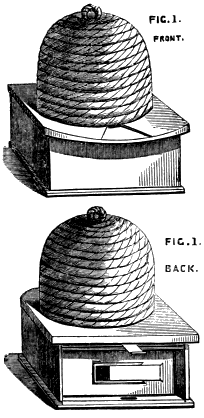
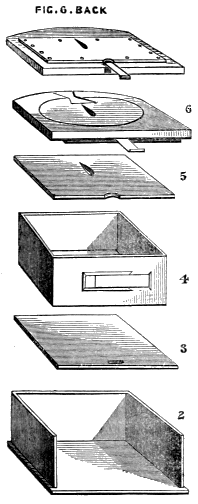
With a further view of facilitating the practice of under-hiving, when favorable circumstances allow of it, we will proceed to describe what I have termed a Nether, which may be used as an adjunct to a straw or any other hive, as shown in the illustrations Fig. 1, back and front. It may be of half inch wood, 11 or 11½ inches square withinside, and 6 to 7 inches deep, as circumstances require (see Fig. 4). It has a window and shutter at the back, but neither a fixed top nor bottom, these being moveable boards, of half inch wood, made to project half an inch beyond the Nether box; except that, as respects the bottom board, the projection is increased at the back, with a view to give facilities on the removal of the Nether. (See Figs. 3 and 5.) To receive and enclose the Nether, there is an outer case or cover, also of half inch wood, 13 to 13½ inches square withinside, made half an inch higher than the Nether, its top and bottom boards inclusive. The outer case is closed on all sides except the top and back. (See Fig. 2.) Upon it rests the floor-board of the stock-hive, which may be of inch wood, showing a projection all round of an inch, except at the front, where an additional three inches is given, to form the alighting board, this part bevelling forwards. A square of half inch wood must be screwed to the under side of the floor-board, of a size to drop easily within the square of the outer case, and thus retaining it in its place. Between the two pieces of which the floor-board is composed, a groove is ploughed out, from front to back, two inches wide, to receive a zinc dividing slide, pushing in from behind. An opening, about three inches long, is cut through the floor-board, towards the front, and also through the cover of the Nether, to correspond, so that a passage for the bees can be opened on withdrawing the divider. (See Figs. 6, front and back.)
A reversal of this proceeding enables possession or inspection to be had of the Nether box, by withdrawing it (upon its bottom board) from behind, the stock-hive being entirely undisturbed by the operation.
It is well here to remark that experience has shown that it is seldom expedient to apply the Nether principle to any but strong and populous stocks, and especially in only moderately warm weather, as otherwise the bees will prefer to follow the warmth upwards, into a super. On their first admission into the Nether, a few bees will often be lost in consequence of their inability to find the way out, so that, as a precaution, a frequent inspection of the window is at such time desirable. A small aperture behind, at the bottom or side of the Nether, may be made, as a mode of exit for the prisoners, to be closed at pleasure.
BEE SHEDS AND HOUSES.
Under the head of Hive-covers we have shown in what way exposed hives can be protected from the effects of weather; and where only one or two of them are kept, any of these might suffice. The case, however, is altered when a well-stocked apiary is aimed at, requiring a more complete provision for permanent safety. For this purpose, some proprietors like a covered shed or verandah, in a well-screened spot, partially open in the front only. There should be ample space inside for a passage behind the hives, which may be ranged far enough from the front to be beyond the reach of wet and too much sun. At page 49, is given a description of a Hive-range well adapted for a position like this.
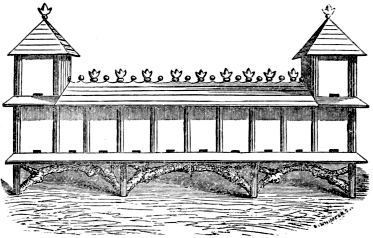
The common wooden bee-houses, as usually constructed, open in front, and closed altogether behind, retaining the sun’s heat as an oven, are objectionable. These are frequently the receptacles of dirt and vermin, and most inconvenient to operate in. It would be an improvement to make them deeper backwards; or with a falling front, moving on hinges, so that the hives can be recessed behind it, away from the influence of weather. At the back should be folding doors, opening from top to bottom, allowing a good access to the hives. For greater convenience, it is best only to have them in a single row, with good head room. But a still more desirable plan is to board up the front of the house entirely, making oblong openings through for a passage to the bees, with an exterior alighting board, a good deal slanted downwards (the bees preferring this to a flat surface). The hives are arranged immediately behind, upon a shelf, the further apart the better, as the bees occasionally mistake their own homes, and fall a sacrifice in consequence. This kind of house is capable of receiving some architectural form; and, with locked doors at the back, gives better security than most others against depredation; for hive-stealing is by no means rare, in many localities.
A spare room in a dwelling or an outhouse may often be fitted up to serve the purpose of an apiary, with great convenience; but a lower room is to be preferred, as bees placed at a high elevation often fly a long distance before they alight when swarming, or, perhaps, may settle on the top of a tree. A shelf can be fixed along the wall, with perforated passages facing the hives, leading outside. Any space there may be between the mouth of the hive and the wall should be filled up by means of a suitably formed wooden block or covered passage, well hollowed out on the underneath side; admitting the bees freely through it into their dwelling, but excluding them from the room itself, and thus ensuring safety in operating. Even at a common window, I have sometimes placed a stock-hive on a doubling-board; the latter fitting within the frame of the window, which is raised, to admit of its being projected under the lower edge, so that the bees have no admission except to their domicile.
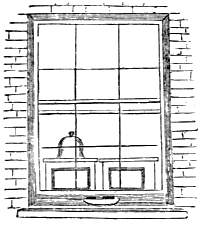
POSITION AND ASPECT.
As regards position, it is of great importance that an apiary should be as free from damp, or the drippings of trees, and as little exposed to the direct influence of the wind as possible, for which end a sheltered nook on a low level is preferable to an elevated one. A dry gravel, or well-mown grass plot, is often to be preferred; closed in with evergreens, especially the laurel and laurustinus, which are much resorted to by the bees; but always leaving an approach at the back of the hives. Let these not be placed too near water, into which the bees are apt to fall or be blown; and it is desirable that they should be within sight of some dwelling-house, to prevent losses in swarming time. The absence from noise and of bad smells ought to be studied; for no sense in bees is so acute as that of scent. Disturbers of any kind, as fowls, dogs, pigs, &c., should be kept at a distance. Experience has shown that where bees are very extensively kept, the apiary is best divided on the same premises, so as not to have the whole crowded together; often inconvenient, particularly in the season of swarming. Nothing high enough to obstruct the direct flight of the bees should be allowed immediately in front of the hives; but a few low plants are rather useful as resting-places; for bees, from fatigue, often fall to the ground just on reaching home, especially in an evening, and numbers in consequence fall a prey to cold, and various enemies. Many lives may be saved by spreading out a cloth or mat in front of a hive, when this is observed. Shrubs or bushes, at no great distance, are convenient in the swarming season for the bees to alight upon; and often prevent a longer flight, or collecting on high trees, &c.
As regards aspect for bees, many and conflicting have been the recommendations relative to it, influenced by locality and climate. So many circumstances have to be taken into account, that it is difficult to lay down any rule of universal application, and they have been known to prosper in all positions, from due south to north. We know that it has been sometimes advised to turn the hives from the sun in winter, and to screen them from its direct rays in summer: this has led to an opinion that a permanent north aspect is the best; and often it is so. Still local considerations must have their weight, and we are to look to these as regards shelter from cutting winds; the more necessary where no sun reaches the front of the hives. A north aspect need not necessarily be an exposed one in winter; nor at other times one wholly uninfluenced by the effects of the sun. We have recommended doors at the back of a bee-house, by opening which at proper times, in the case of a north frontage, the sun’s rays have access from behind, with sufficiently good effect in producing a genial general warmth. In forming a decision as to aspect, we ought to take into account the position of buildings, trees, &c., for we have already observed that the flight of the bees from the hives should be uninterrupted. Moreover, the kind of house must have its weight in the scale; for where this is one closed at the front from the immediate influence of the sun, aspect is of less importance. Dr. Bevan placed his hives around the interior of an octagon erection, without perceiving any sensible difference in their well-doing. It may, however, be remarked that, occasionally, in a hive exposed to the earliest rays of the sun, the bees have been prematurely tempted out in the spring months, and fallen victims to the effects of a damp and chilly atmosphere.
When once fixed, do not move your bees, the mischief of which is self-evident. I cannot enforce this recommendation better than Gelieu has done. “I have seen people,” says he, "shift about their hives very inconsiderately; but change of place invariably weakens them, as the bees will return to their old residence, the environs of which are so familiar to them. A hive should remain as fixed to the spot as the ancient oaks, in the hollows of which they delight to establish themselves; where they have their young, their companions, their beloved queen, and all their treasures. When the young bees take wing for the first time, they do it with great precaution, turning round and round, and fluttering about the entrance, to examine the hive well before taking flight. They do the same in returning, so that they may be easily distinguished, conducting themselves nearly after the same manner as the workers of a newly-hived swarm. When they have made a few excursions, they set off without examining the locality; and returning in full flight will know their own hive in the midst of a hundred others. But if you change its place you perplex them, much the same as you would be if, during a short absence, some one lifted your house and placed it a mile off. The poor bees return loaded, and, seeking in vain for their habitation, either fall down and perish with fatigue, or throw themselves into the neighbouring hives, where they are speedily put to death. When hives are transported to a considerable distance, there is no fear that the bees will return. But this inconvenience would be sure to take place if they were removed only a few hundred paces from the spot they have been accustomed to. The hive may not perish, but it will be greatly weakened. In my opinion, if the situation is to be changed at all, they should be taken at least a mile and a half." This removal should only be attempted in winter or early spring, under usual circumstances. It might, however, happen that it was required to move a hive only a very short distance, in the summer time; when no harm would arise were the change of location made by daily shifting it a few inches.
BEE PASTURAGE, AND NUMBER OF HIVES.
It is almost needless to say that on the nature and extent of the vegetable productions, following in succession, in the immediate neighbourhood of an apiary, must mainly depend its prosperity. After every care has been bestowed on all points of housing and management, it is in vain to expect a large harvest of honey where nature has limited the sources of supply, or restricted them to a particular season of the year. The most highly-cultivated corn districts are rarely so favorable to bees as those in which wild commons, woods, and heathy moors prevail; or where some such farm products as Dutch clover, trefoil, saintfoin, buck-wheat, tares, mustard, colewort, turnip and cabbage blossoms, &c., do not enter largely into the staple of the country. The neighbourhood of certain kinds of willows, and of hazels, in the opening spring, is of great advantage to our little collectors in furnishing farina; as also the blossoms of the furze, broom, bramble, wild thyme, &c. To these we may add the large early stores of honey and farina available from many of the products of our horticultural gardens and orchards, as gooseberries, currants, raspberries, apples, pears, plums, and other fruits. Payne says, "I have always found the advantage of planting in the vicinity of my hives a large quantity of the common kinds of crocus, single blue hepatica, helleborus niger, and tussilago petasites, all of which flower early, and are rich in honey and farina. Salvia memorosa (of Sir James Smith), which flowers very early in June, and lasts all the summer, is in an extraordinary manner sought after by the bees; and, when room is not an object, twenty or thirty square yards of it may be grown with advantage. Origanum humile, and origanum rubescens (of Haworth), and mignonette may also be grown. Cuscuta sinensis is a great favorite with them; and the pretty little plant anacampseros populifolium, when in flower, is literally covered by them. Garden cultivation, beyond this, exclusively for bees, I believe answers very little purpose."
It will follow as a matter of course from what we have said, that the size of an apiary in any district must be mainly determined by circumstances. In some seasons, so prolific a harvest of blossoms and honey comes all at once, that a large number of hives may abundantly be filled together. The locality must be the chief guide; and I have known instances where fewer stocks would have yielded a much better return; for one rich colony is worth more than two or three half-starved ones.
The distance to which bees will resort during the honey harvest has been the subject of controversy; some limiting their flight to one mile, and others extending it to three or four. When pressed for stores, they will doubtless fly a long distance, directed probably by their very acute sense of smell; but I am inclined to believe, with Dr. Dunbar, that the ordinary range of their excursions is comprised within the radius of a comparatively small circle.
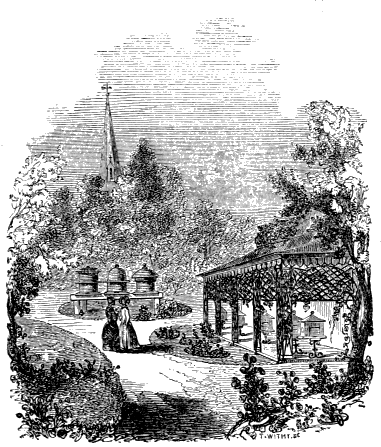
SUMMER MANAGEMENT.
The question has often been put to me, “How and at what time can an apiary be best commenced?” Some remarks in reference to this subject will be found under the heads both of Autumnal and Spring Management. At present the reader is supposed to have been put in possession of a prime swarm, in the season, which is the best method of stocking a new hive of whatever kind, and the earlier the better.[O] On this head we may with advantage quote the words of Mr. Golding. “Notwithstanding,” says he, "all that has been said about tenanting hives by the removal of the bees of other hives into them, there is no plan so safe or certain as peopling them by good early swarms. When these are brought from a distance, it should be on the day in which they are hived, and in a cloth of coarse texture, which should be tied round near the bottom of the hive, so as to prevent the escape of the bees. Tie up the cloth by its corners over the top of the hive; and, if carried by the hand, or properly suspended, a swarm may be removed in this manner for miles."
All experienced apiculturists know that no colony of bees thrives, or works so well, as one that is populous at the outset. Should any doubt exist on this point, it is often expedient to unite a second smaller swarm to the first, but this can only be attempted within a few days, before many combs are made, or mischief would result. Our recommendation applies with greater force in a late season, or to the case of second swarms, which are rarely strong enough, separately, to collect sufficient winter stores. Of the mode of proceeding in effecting these junctions we shall hereafter speak, when treating of Uniting Swarms, under the section Spring Management.
The plan originally proposed in the Bee-keeper’s Manual supposes, as has before been intimated, an arrangement embracing directions for the management of an apiary, “according to the order of the seasons.” Our legitimate commencement, therefore, must practically date from the separate existence of the recently established colony; noticing, as we proceed, the various substances stored or used in a hive, and collected more or less abundantly, according to circumstances and season.
Should the weather now be fine, operations are commenced with astonishing activity, the bees being at first solely intent on preparing their new dwelling for its intended objects—the rearing of young, and storing supplies for the future requirements of the family. If, however, circumstances are such as to prevent them from quitting the hive for several successive days following swarming, and before provision is accumulated, recourse to feeding becomes expedient, or starvation might ensue. Under any circumstances, some apiculturists have advised giving honey, or a syrup of sugar, to a newly-hived colony. It is well known that, on leaving the parent stock, the bees carry with them a good deal of honey. There is little doubt that the main object in this provident proceeding is to enable them at once to commence the work of building: this they do almost as soon as they are hived, a piece of comb being frequently made on the same day, which is as quickly appropriated, either as a receptacle of honey or of eggs, if the Queen is already fertile. Where a young Queen has accompanied the swarm, such is not always the case, and this occasions a delay in laying of several days.
The entrance of the hive should now (and at all times when the bees are at full work) be opened to its whole extent.[P]
Wax and Combs.—The material of which the combs are so curiously formed is wax, secreted by the bees themselves, and not any substance directly conveyed into the hive, as is generally, but erroneously, supposed. Its component parts are carbon, oxygen, and hydrogen. To enable them to form this secretion, the workers must have access to honey or some other saccharine matter; and this is the first thing sought by a new colony. The quantity required is very great, it being estimated that thirteen to twenty pounds are necessary to make one pound of wax. The common opinion is, that the substance often seen adhering so abundantly to the legs of bees is wax, and as such is the basis of the combs. Has it never appeared strange to the observer of a new swarm, that at the time when comb-building is proceeding more rapidly than at any other period, the bees are loaded with but little of this substance? On the other hand, is it not equally clear, that in the early spring, when few or no combs are constructed, they carry it into the hive with the utmost avidity? “To see the wax-pockets in the hive-bee,” observes Kirby and Spence, “you must press the abdomen, so as to cause its distension; you will then find on each of the four intermediate ventral segments, separated by the carina or elevated central part, two trapeziform whitish pockets, of a soft membranaceous texture; on these the laminæ of wax are formed, in different states, more or less perceptible.” "Whenever combs are wanted," says Dr. Bevan, "bees fill their crops with honey, and, retaining it in them, hang together in a cluster from the top of the hive, and remain apparently in a state of profound inactivity about twenty-four hours. During this time, the wax is secreted, and may be seen in laminæ, under the abdominal scales, whence it is removed by the hind legs of the bee, and transferred to the fore legs; from them it is taken by the jaws, and after being masticated, the fabrication of comb commences." An extraordinary degree of heat always accompanies comb-building, supplied no doubt by the large quantity of oxygen at that time generated.
“In the height of the honey season,” Dr. Dunbar observes, “in one day the bees will construct no fewer than 4000 cells. The whole structure is so delicately thin, that three or four of their sides, placed upon one another, have no more thickness than a leaf of common paper.” The best authorities have estimated that about half a pound of wax is yielded to fifteen pounds of honey.
The form and number of the combs in a hive vary considerably, the bees adapting them according to the shape of their domicile, so as to fit and fill in every part, and often very irregularly. At first they are beautifully white, but soon, from the heat of the hive, become tinged, and finally turn nearly black. The worker-breeding cells are made the first: they are invariably hexagonal in form, and of one uniform size and depth; but those intended only for the storing of honey are often somewhat larger and elongated; sometimes more so on one side than the other. A small dip or inclination upwards is given to the cells, the better to prevent the honey from running out, assisted, moreover, by a small bar or thickened border of wax, at the entrances. The cells in which the drones are bred are larger in diameter than the common ones, and they are generally placed nearer the outside of the hive, though occasionally joined on to the others. When this takes place, our little architects have the sagacity to interpose two or three rows of cells of an intermediate size, gradually enlarged to the proper dimensions. In this, as in everything else, the bees adapt their operations according to circumstances; constructing their combs, either by suspending them from the top of their dwelling, or occasionally by working them from the bottom, upwards.
Propolis.—To attach the combs firmly in their place, the bees employ a pliable substance of balsamic odour, called propolis, a glutinous exudation from certain trees, or their buds, of a grayish colour, which they collect immediately on swarming, blending with it a portion of wax. With this material they varnish the lids of the closed honey-cells, glue up all crevices in the hive, and cement it down to the floor.
Honey.—We have seen that the first want of the swarm is honey, for the purpose of comb-building. This valuable article the bees collect, by means of their proboscis, from the nectaries of certain flowers, from whence it derives a higher or less degree of flavour, together with its colouring matter; sometimes nearly transparent, to various shades of brown. They receive it into their first stomach or honey-bag, the greater portion being subsequently regurgitated into the cells, employing for the purpose those of both workers and drones. As these become severally filled, they are coated over or sealed with a thin covering of wax. The honey-cells, when thus closed, are distinguishable from those containing brood, by being whiter in appearance, and often slightly concave. The brood-cells are more coloured, besides being a little convex. In some seasons honey is abundantly collected when in the state of what is termed honey-dew, a viscous substance found adhering to the leaves of particular trees, especially the oak. This only occurs in certain years, for in others it is found very sparingly, or not at all.
Pollen, or Farina.—The hive will be rapidly filled with combs, and progressively with an increased population, for the eggs, as we have seen in page 13, are matured in three weeks. In the mean time, the bees will have commenced a new labour—that of collecting pollen or farina. This is the anther-dust of the stamina of flowers, varying in colour according to the source from whence it is derived; and it may be remarked that the bees in their collection never mix together the pollen of different plants, but in each excursion visit only one species of flower. By a peculiar adaptation, they are enabled to brush this off, and pack it into the spoon-like cavities (or baskets as they have been termed), furnished for this object, on the centre joint of their hind legs; being often, as has been already pointed out, mistaken for wax. The powder or meal thus conveyed into the hive is by other bees afterwards kneaded up into paste, and stored for use in the worker cells, adjoining those containing brood. To preserve it from the air, a small portion of honey is put on the top of each cell, coated over with wax. Thus prepared, it is a very heavy substance; and this often leads to a false estimate of the value of a hive; for the annual collection of pollen has been variously estimated at thirty to one hundred pounds in a single family.
Naturalists are, I believe, pretty well agreed that the store of pollen or farina is used (with a mixture of honey and water) chiefly for feeding the larvæ; though a portion of such compound may form, occasionally, the sustenance of the bees themselves. Indeed, it has been asserted that pollen is often found in the stomach of bees engaged in the fabrication of wax.
Water.—At certain dry periods, but always in the breeding time, bees require a supply of water, which is necessary in preparing the farina and honey for the brood, as well as to enable them to secrete wax. If no pond or brook is within a reasonable distance, a shallow vessel will do, filled frequently to the brim, having a piece of thin perforated wood floating on it and covering the whole surface; or it may be filled with moss or pebbles, pouring in water to the top, and placing it near the apiary. Precaution is necessary, for the bees easily slip into the water and are drowned. So essential is water, that it has been recommended to place a supply, early in the year, within the hive.
Shade.—It has already been observed that out-door hives ought not to be left exposed to the mid-day and afternoon sun in sultry weather; the heat not only rendering the bees extremely irascible, but subjecting the combs to melting, and especially in wooden boxes, with most disastrous consequences. In all such cases it is well, therefore, to give the comfort of a mat, or something of the kind, thrown over them. In the words of Gelieu, “they delight best in thick forests, because they there find a uniform temperature and a propitious shade. It is a mistake to suppose that bees exposed to the sun produce the earliest and strongest swarms: I have often experienced the reverse. Bees like the shade when working, and the sun only when in the fields.”
Moths, Wasps, Hornets, and other Enemies.—In the warm summer evenings, bees are often much annoyed by the attempted inroads of moths, particularly the small Wax Moth (Tinea Mellonella), of a whitish gray colour. These are sometimes formidable foes, and their appearance at dusk on the alighting-board is the signal for a commotion. It is difficult to eject them if they obtain a footing in a hive, where they will deposit their eggs, spinning their silken webs, and they now and then increase so as to cause its entire destruction. When these vermin have established themselves, there is no remedy but driving the bees into another hive. To prevent the ingress of these troublesome invaders, it is sometimes desirable for an hour or two in an evening to close the entrance, by placing before it a screen of gauze, wire-grating, or perforated zinc, to be removed at dark.[Q]
Poultry, and some kinds of birds, are destroyers of bees; and many, that from weakness or other causes fall to the ground, become a sacrifice to them. In particular, that little marauder, the Blue Tomtit or Titmouse (Parus major of Linnæus), must not be tolerated. In summer he will devour bees, and feed his young with them; and in winter he will even try to force an entrance into the hive.[R] Rats and mice must also be guarded against, as well as slugs and snails.
The nests of wasps ought to be destroyed: from their superiority in strength and activity, they are very annoying, and often destructive, to bees towards the end of summer; and the nuisance must forthwith be met by contracting the entrance to the hive, when the passage is more readily defended.[S] In this place it may be well to draw attention to a very simple mode of dealing with wasps attacking a hive. We shall have occasion hereafter to notice the fondness of bees for barley-sugar: let a piece of this be laid across, or just within, the entrance of the hive, so as greatly to narrow it. This is so attractive to the bees, that they muster at the door in greater force than the wasps durst venture to assail. As fast as the fortification is devoured, it ought to be renewed, and the out-generalled enemy will retire from a hopeless contest.
Insects of all kinds, as earwigs, spiders, wood-lice, &c., should be cleared away from the hives and stands, and ants' nests destroyed. Cobwebs must not be permitted to remain, or numerous deaths would ensue to the bees from entanglement in them. In short, we may sum up by a general recommendation of cleanliness, in every way, and the removal of whatever serves as a harbour to dirt and vermin.
Super-hiving.—Should the weather continue favorable for honey-gathering, the colony must be inspected in about three weeks from the time of hiving. Indeed in sultry weather, and where the swarm is a large one, it is often politic to place a glass or small super upon it very soon, as a ventilator, to moderate the temperature, and prevent the clustering of the bees at the mouth of the hive. If the combs are worked pretty nearly down to the floor, and the cells in a good measure filled, no time should be lost in supplying additional working-room; more especially if symptoms of crowding are apparent, for by this time young bees are coming forth. We may here observe that many experienced bee-keepers object to supering in the case of a new colony, preferring to give the requisite room at the bottom, by means of a Nadir; which, as the bees carry their stores upwards, often ensures abundance in the stock-hive, the nadir being removed in the autumn. Under the head Depriving System, are some remarks as to the mode of using nadirs; as also under that of Nadir Hive, and Nadiring Stocks.

Bell-glasses.—As these are commonly formed, nothing can be more objectionable: inconveniently high and narrow, a few misshapen combs are all that can be packed into the space; and these are afterwards only to be extracted by a general mash. The same remark applies to all supers, of any material, where breadth of surface enough is not afforded for a large number of bees to cluster and labour at one time. Can it be a matter of wonder, that a chimney-formed vessel should be twice as long in being filled (supposing that the bees do not forsake it) as a broad one, in which a genial warmth is concentrated, and where several combs can be in progress simultaneously? A reversal of the usual proportions, both in straw and glass supers, is therefore to be recommended. The latter may advantageously be from nine to eleven inches across; the depth being about half the diameter: straight at the sides, and flat on the top. A piece or two of guide-comb, slightly melted, and fixed by its edge to the top of the glass, previously made warm, will serve as an attraction; or in a large glass, four or eight pieces, radiating from the centre uniformly, will direct the bees in working with a regular design, producing a pleasing effect. A useful adjunct to a glass is a small circular tube of perforated zinc, having a rim round its upper end, by which it is held suspended within a small hole on the top. It should be long enough to reach nearly down to the level of the floor. To the tube, when a little warmed, a narrow piece of guide-comb will adhere, and act as an attraction to the bees: it will be further useful as a central support to the loaded combs.
Whatever may be said as to the pleasing appearance of glass supers, it is doubtful whether in point of utility and economy they can compete with those of straw, made as directed under the head of “Straw Depriving Hives,” and which can readily be packed and sent to a distance, if needed: or shallow supers, as wide as the stock-hive admits, may be cheaply made by means of a wood hoop, three or four inches deep, on which is fixed a thin top, by two or three small screws. These are readily withdrawn, when the top can be lifted up with the combs suspended. Under the head Circular Wooden Hives are some remarks on the subject of wood supers.
In the use of Glasses it is always well at first to prevent the escape of warmth, especially at night, till the bees are well established in their new work-room; and the admission of light is best avoided. A little ventilation afterwards, in sultry weather, is desirable; which may be given by slightly wedging up the lower edge of the super. If a double adapter is in use, it is easy to insert a slip or two of tin or zinc between the two boards, so as to keep them a little separated, for the passage of air, when it seems necessary. Sometimes it is even advisable to introduce between the stock and the super a very shallow box, as a moderator of the temperature. I have found, by experiment with the thermometer, that at a temperature between 95 and 100, the combs will soften so much as to be in danger of collapsing.
Triplets and Nadirs.—In good seasons and localities, the first super is sometimes filled in time to admit of the introduction of another (or triplet), on an adapter, observing the rules laid down at page 32. But even where the first super is completely filled, it is often politic not to remove it for a few days, as its attraction induces the bees to occupy the triplet. On the other hand, if from any cause a super has been left only partially filled upon one hive, it may be removed (the bees being first ejected), and placed upon some other for completion. Instead of a separate triplet, an addition may often be made to the first super, especially if of straw, by placing beneath it an eke, consisting merely of two or three bands of the same material; in fact a hoop. This will save the bees the labour of laying the foundations of fresh combs, as they have but to continue the old ones downwards. We may here call attention to what has been said at page 62, respecting the use of box, No. 3, of the bar-hive, and of Nadiring.
After the main honey season is over, which is usually as soon as the dry July weather sets in, it is useless, in most localities, to give any further extension of working room; and, indeed, from the end of this month there is, under common circumstances, often rather a diminution than an increase of store.
In proportion to the wealth of the colony is the determination of the bees to defend it; and their irascibility and vigilance are now greater than heretofore, the strongest stocks showing it the most. The work of the year being pretty well over, all their attention is turned towards home. They become more and more suspicious, and the less they are approached or annoyed the better; for they are slow to forget or forgive an injury.
AUTUMNAL MANAGEMENT.
Much of what has been said in the preceding section is equally applicable in practice to the later periods of the summer. The month of August is usually associated with the collection of harvest. Though this may often hold good as regards honey, yet the storified or doubled stocks of the spring are commonly ready for deprivation at an earlier period, occasionally in May, and so on throughout July; the spring-gathered honey being usually to be preferred in point of quality. I know of no better rule as to the fitness of a super, or side hive, for removal, than an observation of the state of the combs and cells, which ought to be completely filled and sealed over, to prevent a loss of honey by running out. In this stage the sooner it is appropriated the better, as a longer continuance only leads to discoloration. As respects a colony of the same year, Dr. Bevan remarks, “as a general rule, no honey should be taken from a colony the first season of its being planted, though there may be an extraordinary season now and then, which may justify a departure from this rule:” the produce in such a case is usually denominated virgin honey, though that term is often applied indiscriminately to any in combs free from brood. But in any event the stock-hive should be previously examined, for there is a disposition in bees to carry their stores into a super, though afterwards they sometimes remove it into the stock-hive. In cases where doubt exists as to a sufficiency of winter store, it is often well to allow them to do this; recollecting the further advice of Dr. Bevan, that, “it should be an invariable rule never to remove an upper box or hive till an under one be quite full; nor to diminish the weight of a stock-box below seventeen or eighteen pounds, exclusive of the box itself.”
To remove a full Box or Super.—The middle of a sunny day may be recommended as the best time to take away for deprivation a box or glass of honey. The mode usually adopted is at once to remove it from its position to a distance from the stock-hive, and there get rid of the bees. I have often found it well to reverse this proceeding. Whether the box to be taken is a collateral or storified one, let the communication from the parent hive be previously cut off, and without any jarring. Entire quietness is the main requisite. Gently lift up the super on one side, inserting under it a small wedge or two, so as just to allow an exit for the bees. The position of the queen bee will soon become apparent. If she is not in the super (and she seldom is there after it is filled), the silence that at first prevailed will be exchanged for a murmuring hum, attended by a commotion among the bees; and they shortly after begin to quit the super, without attempting any attack. Should the queen be present, however, a very different scene would ensue, and a hubbub would then commence in the stock-hive; though the loss of their queen is sometimes not discovered by the bees for a considerable time. In such a case, the box must be reinstated in its former position, and the communication reopened till some other day. The process might happen to be complicated by the presence of brood, for this the bees leave very reluctantly, and often not at all. In an emergency of this kind, it is best to restore matters to their previous state, and let the super remain till the brood is perfected. A little patience is sometimes necessary: but all attempts at ejection of the bees by tapping, smoking, or driving usually do more harm than good. So long as they continue to leave the super, it may remain where it is, for on these occasions young bees are sometimes numerous; and if the super is removed, though only to a short distance, these are in part lost, not having become sufficiently acquainted with the position of their home; or, if they enter a wrong hive, they pay the penalty with their lives. This freedom from disturbance has the further good effect of preventing in a great degree the intrusion of robber bees, readily distinguishable from the others by their hovering about the box, instead of flying from it. These are strangers from various quarters, immediately attracted by the scent attending the removal of a full box or glass. Should a few of these plunderers once obtain a taste or sample of the honey, they speedily convey the good news to their associates, when large reinforcements from every hive in the neighbourhood will be at once on the alert, and quickly leave nothing behind but empty combs. Let the separated super, therefore, not be left or lost sight of, but if scented out by robbers, be conveyed into some room or out-building to prevent a general battle; and which might extend itself to all the neighbouring hives. The remaining bees may here be brushed out, escaping by the window or door. Mr. Golding has sometimes found the advantage of using for the purpose a darkened room, with the exception of a very small aperture, to which the bees will fly and make their exit. Others like to remove a super at once to a short distance from the stock-hive, leaving it shut up in perfect darkness, for an hour or two. Its edge is then raised up, when the bees will evacuate it. In the case of a bar-hive super, after most of the bees have left it, it can be placed across a couple of rails or sticks, when the top cover may be unscrewed and detached. It is then readily cleared of bees by brushing them downwards between the bars, with a feather or a twig.
The same general directions apply when a full glass is to be removed. If it stands on a double adapter, a piece of tin or zinc can be inserted between them, and the upper part then lifted with the glass. Payne, however, says, “I have found the process much simplified by placing an empty box between the glass and the parent hive, and leaving it a few hours. The bees by that time have quitted the glass, and by this plan robbing is entirely prevented, whilst the bees are less irritated.” It might occasionally happen that a piece of comb had been worked upwards, so as to be connected with the underneath hive, and thus causing a difficulty on attempting a separation. There is no better way of meeting such an emergency than by passing a bit of fine wire beneath the lower edge of the super, from side to side, and thus cutting through the obstruction. It may be well to observe that on removal, the box or glass ought to be kept in its original position, to prevent the honey, which at first is thin and fluid, from running out of the cells, and especially in hot weather.
Honey Harvest.—As regards the quantity of honey to be taken from a hive in any one year, there can, in our uncertain climate, be no general rule, though now and then I have known a very large amount obtained by deprivation.
Payne says, as the result of his own experience with depriving hives, “It is usual to obtain from every good stock twenty or perhaps thirty pounds of honey annually.” This would be thought too high an estimate, in many districts; as in my own, near London. It must be remembered that honey thus harvested sells at a higher rate than that procured by suffocating the bees, as in the common single hives; for then the brimstone not only imparts a disagreeable flavour, but there is no means of preventing the intermixture with the honey more or less of pollen and brood. After deprivation, the sooner the honey is drained from the comb the better, as it soon thickens, particularly if not kept warm. For the purpose of straining it off, a hair sieve is commonly used, within which the combs are inverted; the waxen seals on both sides being first sliced off. The honey will of course run off the sooner if placed before a fire, but exposure to heat is injurious to fine flavour. We may here resort to the advice of Payne, who says, "the honey should be put into jars, quite filled, and tied down with a bladder; for exposure to the air, even for a few hours, very much deteriorates its flavour. I may observe that honey in the combs keeps remarkably well, if folded in writing paper, sealed up to exclude the air, and kept dry."
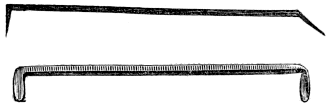
Comb-knives.—A difficulty sometimes arises in extracting the combs from common hives or boxes. A large spatula will separate them from the sides, but to detach them from the top, an instrument of a different kind is requisite. The one often preferred is simply a bar of steel about fourteen inches in total length, half an inch wide, and an eighth of an inch thick. At one end it is bent at a right angle with the handle, and at the other at an angle of 80° or 90°. The part thus turned up is in both cases an inch and a half long, rather less than half an inch wide, and made spear-pointed, or lancet-shaped; sharp on both sides, to cut either way. The one end is used when the top of the hive is flat; and the other is adapted to the common dome-formed roof. Another useful instrument is the one employed in detaching the combs from the bar-hives, made as recommended by Mr. Golding, with a double-edge blade, an inch and a half long, and three eighths of an inch wide; turned at right angles from the end of a rod, which may be of quarter-inch square iron. For occasional convenience, the other end may be turned the flat way, sharpened at both edges.
Robbers.—Should an attack upon a hive from strange bees take place, which sometimes occurs at this season (the strong robbing the weak), no time ought to be lost in narrowing the entrance, for if allowed to continue a day or two the ruin of the family might be the consequence. Indeed, it is always well gradually to do this as the working season draws to a close. An assault from robber bees is often a much more formidable evil than one from wasps, although it is said that one of these is a match for three bees. Unless the colony is very weak, they are usually soon expelled, if the methods pointed out at page 117 are resorted to. Not so with bees, for if but one or two strangers gain admittance into a hive they will return again and again, always with an accession of force; and for a day or two it is often necessary entirely to close the entrance against them, opening it only at night. In such case the robber bees will sometimes collect in vast numbers at the mouth of the hive, when a shower from a watering-pot will send them away to dry themselves. The thieves are generally distinguishable; and they are often cunning enough to commence their marauding practices early in the morning and late at night. A supply of honey given on the top, or even sprinkled among the combs of contending hives, will often divert the attention of the combatants; or smoke is sometimes effectual, puffed into both hives. If fighting recommences on the succeeding day, the smoking should be repeated, followed by a feed of honey. Others have found it advantageous to remove for some days a plundered hive to a distance; or even to make the belligerent hives change places in the apiary; which, as a friend remarked to me, “gives a new turn to their ideas of meum and tuum.” A German proprietor, after removing an attacked stock, put in its place a hive filled with wormwood leaves, so distasteful to the robbers that they forsook the spot, when the stock was brought back again.
Autumnal Feeding.—All labour is now usually suspended for the year, and it remains to see that ample provision is laid up for the coming winter and spring. There ought not to be less than seventeen to twenty pounds of honey in a hive of the same year; but in the case of an old one, eight or ten pounds more must be allowed in estimating the weight; for old combs are much heavier than new ones; besides that they are a good deal filled with stale pollen, and sometimes contain candied honey, of no use to the bees.[T] In a healthy stock there should be no scarcity of food, if the season has been tolerable. The worst, however, must be provided for; and if, from any cause, it should be necessary, recourse must be had to supplying the deficiencies of nature. “A stock of bees,” observes Dr. Bevan, “generally consumes from a pound to a pound and a half of honey per month, betwixt the first of October and the first of March. From this time to the end of May, they will consume double that quantity.”
The requisite feeding to make up the winter store ought not to be delayed later than the beginning of October, and the weather should be fine. Food must never be placed in the open air, but under a cover; otherwise the smell would attract wasps or, what is worse, strange bees; in the latter case a battle generally following.
Feeding-troughs.—The feeding of bees, though apparently a simple matter, is often a troublesome process, and without due precaution sometimes leads to a good deal of commotion. The common swarming hives present much difficulty, from their construction. Having no opening at the crown, the clumsy and dangerous mode must be resorted to of bottom-feeding, in any way possible; either by tearing up the hive for every supply of food, or by means of an eke, pushed for the purpose beneath it. An improved hive gives facilities for presenting food on the top, obviating these inconveniences; and where it may be supplied in any quantity, without disturbance; at the same time that it is inaccessible to all enemies.
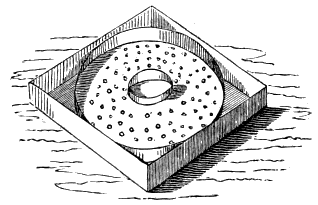
When there is a hole in the centre of the top of the hive, a trough may be used, made of tin or zinc, seven or eight inches square, and one inch and a quarter deep; having a circular two-inch hole in the middle of the bottom, with a rim round it, standing up half an inch, through which the bees enter the pan from below. Another circular rim or partition, as large in diameter as the square of the pan will admit, is soldered down within it at the four points where it touches the sides. It must not go down to the bottom, but a space should there be left of nearly an eighth of an inch, as a passage for the food, which is poured in at the four angles. A perforated thin wooden bottom or float is fitted loosely into the pan, between the circles, removing an objection sometimes made against the chilling effects of metal upon bees. The float should be a little raised by means of two thin strips of wood, appended below, to allow the liquid to flow beneath. A cover is made by a piece of glass, resting on the larger circle, but cut nearly octagonal in form, so as to leave the corners open. The circle on which the glass rests should be an eighth of an inch lower than the outer rim. In making a trough of this kind, it is sometimes customary to append beneath it a central descending rim or tube, fitting down into the hole on the top of the hive. This is worse than useless, and it is in the way on the removal of the pan; on which occasion it is expedient to push beneath it a piece of sheet tin or zinc, to stop the communication from below.
Such a pan is perhaps made more readily without the inner circle; in which case, all that is needed for pouring in the food is a partition going nearly down to the bottom, so as to cut off a portion at one corner. The glass pane can rest on angle-pieces, sunk an eighth of an inch, at three of the corners, and upon the partition at the fourth one, this part being left open.
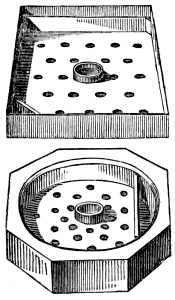
A charge is sometimes brought against zinc feeding-pans, as tending to create acidity in the food. There is perhaps some truth in this, where it is suffered to remain too long; together with another cause of mischief,—a very general neglect of cleanliness. Those, however, who prefer wood altogether may have troughs made of that material, either square or round in form, as that given in our illustration, which is turned from hard wood in a lathe; a piece being divided off on one side by a partition, under which the food passes, beneath a wood float. A pane of glass rests upon a circular rabbet turned out to receive it, leaving uncovered the part beyond the partition.
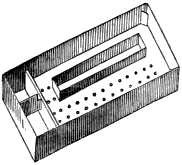
For the purpose of feeding the bees in my bar-hive, a zinc or tin trough is provided, of a form adapted to the position of the openings cut through the crown-board to the stock-box. The extreme length is ten inches and a half, four inches wide, and an inch and a half deep. At one end is a partition an inch and a quarter wide, going down nearly to the bottom. Into this the honey or other food is poured, running under a wooden perforated float, and fitted loosely within the bottom. A pane of glass rests on two angle pieces, at one end, and on the cross division at the other, all sunk a quarter of an inch, and covering the pan as far as the partition. The latter is strengthened in the centre by a cross-stay, against which the glass rests. At the bottom is an opening seven inches long and half an inch wide, with a rim around it, about half an inch high. This opening is placed so as to correspond with that communicating through the bars beneath. Draw out the slides, and the bees will have access to the pan. This proceeding is of course reversed on its removal.
Bee Food.—Nothing that can be presented to bees is so acceptable as their natural food—pure honey. At this season, as it is chiefly stored for future consumption, it is best unmixed with water. Fill the pan every evening till the requisite quantity is given, for it will speedily be emptied. Refuse honey may be given to the bees in the combs, piled in a pan, a little separated, and covered by a box or hive. The sooner the feeding is ended the better, the bees, if in health, being on these occasions much excited and often irascible. Let enough be given when you are about it. Gelieu says, “Let there be no higgling with bees; better that they have too much than too little.” Recollect that little of your bounty is now eaten, but is conveyed and stored for the day of need; the bees sometimes extending the combs purposely to receive it, and often of pollen as well; for it is observable that feeding at any time stimulates them to foraging abroad. Nothing is wasted, and whatever there is to spare will be repaid with interest in the spring. It must also be borne in mind, that what food is likely to be wanted must be supplied now, for very rarely should any further attempts at feeding be made till the returning spring restores animation to the family. A reference to Spring Feeding will supply information as to various substitutes for honey.
Winter Store.—Under the head of Autumnal Feeding we have mentioned the usual estimate as to the requisite supply of honey for the winter. Anomalous as it may seem, it has been remarked, that the quantity apparently required is not dependent on the population of the hive. The number of mouths make little sensible difference, even when two or three stocks have been united. This fact was first noticed by Gelieu, and has been corroborated by other observers.
“In doubling the population,” says Gelieu, “I naturally conceived that we must also double the quantity of food; for I had always seen that two or three families, living together, used more meat than each would have done singly, however rigid their economy. The more mouths the more meat, thought I; and, in consequence, I augmented greatly the amount of provision the first time that I doubled a hive; but to my astonishment, when I weighed it again in the spring, I found that the united swarm had not consumed more than each would have done singly. I could not believe my eyes, but thought there must be some mistake; nor could I be convinced until I had repeated the experiment a hundred times over, and had always the same result.”
This seeming anomaly, Gelieu and others have attempted to account for on the principle that the increased heat of an augmented population is in some measure a substitute for food; but this is opposed to all experience, which proves that warmth is a stimulus to consumption. A more satisfactory way of disposing of the question seems to be, in the first place, that the bees in a well-peopled hive feel in a lower degree the evils consequent on frequent changes of temperature occurring in winter, than is observable in a less populous one; for alternations of cold and warmth have an injurious effect, generally leading to an increased consumption of stores. The next consideration is that the junction of stocks, alluded to by Gelieu, ensures a larger supply of labourers in the early spring. It is not in the cold weather that much consumption of food takes place, but after the month of February, when the great hatching comes on; and then not so much by the bees, as by the brood. In a thinly-populated hive, almost the whole family is required within-doors at this time, to warm the eggs and feed the young; and consequently little is added to the continually diminishing stock of honey and farina. Nothing is more common than to see a hive, apparently well stored in February, on the point of perishing in the month of April. This is not the case where a large number of bees can be spared to go abroad and bring in fresh supplies, to keep pace with, or even to exceed, the demands of the craving brood.
Autumnal Unions, Fuming, and Transferring Bees.[U]—The subject of autumnal unions of bee stocks is strongly advocated by Gelieu; and in this country has not always received the attention it demands. Perhaps this is in part owing to ignorance as to a ready mode of accomplishing the object; and in some degree from the supposed doubt about maintaining the bees, when collected in a large body, through the winter. The latter difficulty is removed by a reference to what has been said on the subject of winter store, in the last section. I hope I shall be able to show that, by a safe and simple expedient, the bees of two or three weak or worn-out families may be joined together, to form one vigorous stock; at the same time saving thousands of valuable lives. The late Apiarian Society of Oxford is entitled to credit for the care it bestowed on this branch of bee economy; and the method of procedure now to be explained was there successfully practised. It should be done about September, and in warm weather.

The custom of stupefying bees by some narcotic substance has long been in practice; and, observes Dr. Dunbar, “there is no more useful auxiliary in every operation in an apiary than smoke.” By subjecting them to the fumes, the bees are rendered insensible and harmless for a time; but soon recover, with no ill-effects subsequently. Apparatus more or less complicated has been invented for fuming; but perhaps the most simple was that used at Oxford, which is a tin tube, eighteen inches long, and three quarters of an inch in diameter; readily made by any tin-worker. One end is extended and flattened to adapt it to the entrance of the hive, whilst the other is applied to the mouth of the operator. In the centre of the tube is a box, two inches and a half long, and two inches in diameter, to contain the fumigating material; and to receive which, one end is made to draw out like a telescope. The two ends of the box, where the tubes join it, are stopped withinside by divisions of perforated tin. This part must be put together, by rivetting, and without solder, which the heat would melt. An instrument of this form is adapted for most purposes where smoke is needed, it being applicable to fuming a hive at the mouth, or, in some cases, from the top; for it is, occasionally, more in accordance with the object in view that the bees should be driven down, rather than upwards. When, therefore, this is proposed, a bend in the tube becomes expedient, which is readily managed by having the farther end made in two pieces to be disconnected at pleasure, after the plan of a watering-pot. Another end-piece can then be slipped on like a nozzle, turned downwards, to enter the hole through the top of the hive. The instrument just described is of course used in the hand; but another kind is sometimes applicable, made not unlike a pepper-box, upon a foot, which stands on, or in a hole in, the ground, whilst the hive about to be fumed is placed over it. The top lifts off to receive the fungus; and this, as well as the lower end, is pierced with holes.
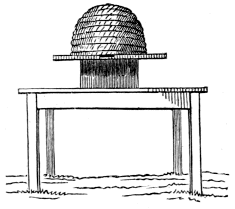
The substance hitherto chiefly recommended for the fumigation or stupefying of bees is a kind of fungus, found growing often very large and round, mostly in rich pastures or plantations, in the autumn. It is the Lycoperdon Giganteum, but variously called, as Devil’s snuff-box, fuzz-ball, or puff-ball. It should be gathered when nearly ripe. Dry it in the sun, or a cool oven, and preserve it from damp. It is then a spongy substance, containing brown dust; and burns with an offensive smell. The difficulty often of procuring this material led me to make trial of another kind of fungus, called Racodium Cellare, or mouse-skin Byssus. It may be found growing in large wine or beer vaults, in immense dark-coloured bunches or festoons, suspended from the roof, often wearing a handsome appearance. In a single such vault, in London, I have seen as much as would suffice for a large portion of the bee-keepers in Great Britain; and I can recommend it (not too freely used) as even more efficacious than the other fungus. It requires no preparation, igniting and smouldering readily, and may be preserved for years. Whatever be the material employed, let the box of the tube be about two-thirds full; and a few puffs will cause it to send forth smoke abundantly. The hive which it is intended to deprive of its tenants may be lifted gently from its place soon after dusk, and placed over some kind of receptacle. An empty hive, turned bottom upwards, might answer with a little management, but there must be no place of escape for the bees. The best thing is a box or bowl, about ten inches square withinside, and four or five inches deep; with a wide flat rim all round. The first introduction of the smoke will cause an uproar among the bees, which will speedily be followed by silence, as they fall down from its effect. A minute or two generally suffices for this, assisted by striking the sides and top of the hive. When all is quiet, turn up the hive, and you will have received the greater part of its inhabitants in the bowl, in a stupefied state and perfectly subdued. A portion will remain sticking in the combs, which must be cut out one by one, and the bees swept with a feather into the bowl, where a little more smoke will, if needed, keep them quiet in the interim. As respects the Queen, if perceived, she can be taken away, but the bees will commonly dispose of her in their own way, by the next morning. The whole being thus collected, they soon begin to show signs of returning animation; and when this is about to take place, sprinkle them pretty freely with a mixture of sugared ale. Next, lift quietly from its stand the hive to which the smoked bees are to be united, placing it over the bowl, but leaving no opening except the mouth, for air. The bees from above, attracted by the scent, will go down, and begin licking the sprinkled ones. The whole become intermixed, and ascend together into the hive over them, in perfect goodwill. Leave them till the following morning early, when the bowl will generally be found empty. Replace the doubled hive on its original stand, and the work is complete. If it is thought desirable still further to augment its strength, the bees of a second hive may be added in the bowl; or a second union may be made in a night or two afterwards. All that remains is to see that the hive contains honey to last the winter; and whatever is wanted to make up about eighteen pounds must be supplied for that purpose, in the way pointed out in a previous section.
We will now detail another mode of proceeding, at once speedy and efficacious, and attended with no risk to the operator. With the tube of which we have before spoken, in the evening puff some smoke into the mouth of the hive you wish to take, without removing it. Compel as many of the bees to fall down as you can; then lift the hive, and brush out those remaining; taking away the Queen if you can find her without much trouble. Collect the whole in a heap on the floor-board, and sprinkle them pretty well with sugared ale. You may now, if the numbers are still thought insufficient, add to the first, the smoked bees of a second hive. Next puff some smoke within the stock-hive into which the bees thus collected are to be transferred, quietly where it stands; just sufficient to stupify its inhabitants, and produce a uniformity of scent. Turn it bottom upwards, floor-board and all, so as to drop no bees; and place it, if of straw, in a pail, or some similar kind of support. In this position lift off the floor-board, and sprinkle these bees also with a smaller portion of the ale, in the hive where they are. After this is done, before they have recovered, sweep the smoked bees uniformly among the combs of the hive destined to receive them. Clean and scrape its floor-board, and as soon as symptoms of returning animation begin to appear, replace it, turning the whole again into the right position. All that remains is to restore it at once to its original place or stand. Before the hive is left, clear away from the entrance any bees that may have fallen down, so that the passage for air is not obstructed. In the absence of a tube like the one described, it is very practicable to make use of a common pipe and tobacco; but the latter should be of a mild kind, and not too freely used, or many deaths might ensue.
In selecting the future domicile of the family thus augmented, it will be well to observe that the hive is not one of long standing, in which the combs have become thickened with age. Indeed, a colony of the same year is to be preferred, and more particularly where the Queen is a young one. If, however, it is desired to cut out the old combs from the intended future stock-hive, it can now be done with safety; first turning on to the board as many of the bees as you can. A supply of honey will invigorate the new community, and the vacancies will be filled up with fresh combs, provided the operation has not been delayed too late in the season.
It is of great importance here to observe, that after making autumnal unions, in cases where the bees have been expelled from hives possessing fresh combs, the latter ought to be left undisturbed, as so much gain to a spring swarm, which will gladly accept a house ready furnished: moreover, a vast saving of honey results, for the fabrication of comb, as we have shown at page 110, consumes a great deal of this. The same remark applies to supers partly filled with combs; but they should be kept clean and dry. It is worthy of remark, that some authorities maintain the opinion that bees will now and then re-work portions of old combs or wax, but it must be free from impurity.
As far as it can be managed, it is desirable that attention should be paid to the previous position of the hives intended to form unions, for there is always a disposition in bees to return to the spot to which they have been accustomed. Where it is practicable, therefore, it is best to unite adjoining families; or when the union is to consist of three, unite to a hive in the centre, one on each side. A little foresight at the time of swarming, in the arrangement of the hives, will often facilitate after proceedings. Some have resorted to the plan of confinement of the bees, but this does not always meet the difficulty; for, on the first opportunity, many of them will return to their old haunts, and seek in vain their former dwelling.
Fumigation may often be resorted to in cases where a superabundance of honey exists in a hive at this season; for after the introduction of a little smoke the bees will fall down. It may then be reversed, and a portion of comb cut away in due moderation. Restore the bees to the hive, and replace its board, when the whole may be turned back to its proper position without injury.
Under the head of Common Straw Hives, we have remarked that suffocation with brimstone is the usual mode of obtaining possession of their stores; the stocks of the second or third year’s standing being commonly selected for destruction. If, however, such stocks can be made strong and healthy in the way we have been detailing, good policy would point to the colonies of the present year as those affording the richest harvest of honey, and of the best quality, as being in new combs. These will never be of more value for the market than in the first autumn, provided the proprietor is satisfied as to the state of his older stocks for the next year’s swarming. Such of the latter, moreover, as have sent out swarms in the same season will of course possess young Queens. In some districts this principle is carried out in practice, and doubtless with advantage, when a proper discretion is used. Under any circumstances, it is clear that in gaining possession of the honey, destruction of the bees may be avoided by adopting the fuming and uniting plan, instead of that of suffocation; for whether the hive be new or old, rich or poor, the same principle applies, with no amount of time, trouble, or expense, greater than under the brimstone system. The plea of necessity no longer exists for a wanton waste of valuable life; and to this point the attention of the cottager, in particular, might surely be directed, as one often involving his future profits. Let him know that it is his interest not to kill his bees; but, when expelled from one hive, to unite them to another, where augmented numbers will require no more than the usual stock of winter food. Inform him that he is acting on a mistaken principle when he imagines that his bees are worn out with age—the common plea for destroying them: that these are short-lived, and periodically renewed, so that the hive alone becomes old: moreover, that a large proportion of the bees at the close of the season are those produced in the later months; the older ones gradually disappearing in the autumn, to be succeeded by others destined to become the early labourers of the opening new year.[V]
Before we leave this part of our subject, a word may be said to those who are disposed to fancy there may be an evil in a super-abundant winter population in a hive. I never observed any permanent inconvenience arising from this; and no doubt can exist as to the advantage of maintaining a comfortable temperature, the Queen continuing to lay later in the autumn under such stimulant. Moreover, it must not be imagined that all the bees collected together to form a stock, at this time, are destined to survive till the spring. The day of life may, with many of them, be already far spent; but we have shown in what way their presence, though but temporary in the hive, indirectly contributes to augment the numbers of future spring labourers. Were it not so, there would be nothing to mark the well-known distinction between a populous and a half-tenanted hive. It is certain that, however numerous may be the eggs laid in the spring, a portion only are of avail in any but a hive so well peopled as to create a favorable temperature for hatching them, and to supply the means necessary to their full development. Thus strength in one year begets it in succeeding ones; and it must be remembered how influential is warmth to the early productive powers of the Queen, without which all goes wrong; and how important it is in the opening spring to be able to spare from the home duties of the hive a large number of collectors to add to the stores, which would otherwise not keep pace with the cravings of the rising generation.