Volume 2 — EARLY HISTORY OF THE BERMUDA ISLANDS.
Reading edition
By JAMES H. STARK.
The singular collection of islands known as the Bermudas are situated about seven hundred miles from Boston, in a southeast direction, and about the same distance from Halifax, or Florida. The nearest land to Bermuda is Cape Hatteras, distant 625 miles.
Within sixty-five hours' sail from New York it is hardly possible to find so complete a change in government, climate, scenery and vegetation, as Bermuda offers; and yet these islands are strangely unfamiliar to most well-informed Americans.
Speaking our own language, having the same origin, with manners, which in many ways illustrate those prevalent in New England a century ago, the people are bound to us by many natural ties; and it is only now that these islands, having come to the front as a winter resort, have led us to inquire into their history and resources. Settled in 1612, Virginia only of the English colonies outdating it, life in Bermuda has been as placid as its lovely waters on a summer day; no agitation of sufficient occurrence having occurred to attract the attention of the outside world, from which it is so absolutely isolated.
The only communication with the mainland is by the Quebec Steamship Company, who dispatch a steamer every alternate Thursday between New York and Hamilton, Bermuda, the fare for the round trip, including meals and stateroom, is fifty dollars. During the crop season, in the months of April, May and June, steamers are run weekly.
The Cunard Company also have a monthly service between Halifax, Bermuda, Turks Island and Jamaica, under contract with the Admiralty.
The Bermudas were first discovered in 1515 by a Spanish vessel, called La Garza, on a voyage from Spain to Cuba, with a cargo of hogs, and commanded by Juan Bermudez, and having on board Gonzalez Oviedo, the historian of the Indies, to whom we are indebted for the first account of these islands. They approached near to the islands, and from the appearance of the place concluded that it was uninhabited. They resolved to send a boat ashore to make observations, and leave a few hogs, which might breed and be afterwards useful. When, however, they were preparing to debark a strong contrary gale arose, which obliged them to sheer off and be content with the view already obtained. The islands were named by the Spaniards indifferently, La Garza from the ship and Bermuda from the captain, but the former term is long since disused.
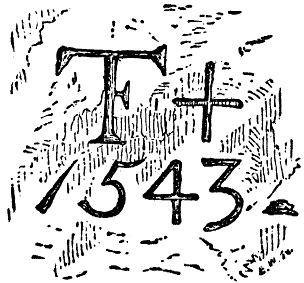
INSCRIPTION ON SPANISH ROCK
It does not appear that the Spaniards made any attempt to settle there, although Philip II. granted the islands to one Ferdinand Camelo, a Portuguese, who never improved his gift, beyond taking possession by the form of landing in 1543, and carving on a prominent cliff on the southern shore of the island2 the initials of his name and the year, to which, in conformity with the practical zeal of the times, he super-added a cross, to protect his acquisition from the encroachments of roving heretics and the devil, for the stormy seas and dangerous reefs gave rise to so many disasters as to render the group exceedingly formidable in the eyes of the most experienced navigators. It was even invested in their imagination with superstitious terrors, being considered as unapproachable by man, and given up in full dominion to the spirits of darkness. The Spaniards therefore called them "Los Diabolos," the Devil's Islands.
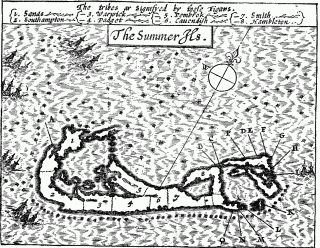
Fac-simile reproduction of a Map of Bermuda made in 1614 by Captain John Smith.
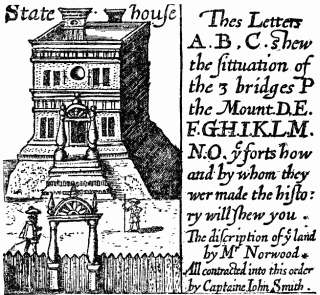
View of the State House and reference as to location of the fort, bridges, etc., shown herewith on Smith's map of 1614. (Fac-simile reproduction.)
These islands were first introduced to the notice of the English by a dreadful shipwreck. In 1591 Henry May sailed to the East Indies, along with Captain Lancaster, on a buccaneering expedition. Having reached the coast of Sumatra and Malacca, they scoured the adjacent seas, and made some valuable captures. In 1593 they again doubled the Cape of Good Hope and returned to the West Indies for supplies, which they much needed. They first came in sight of Trinidad, but did not dare to approach a coast which was in possession of the Spaniards, and their distress became so great that it was with the utmost difficulty that the men could be prevented from leaving the ship. They shortly afterwards fell in with a French buccaneer, commanded by La Barbotiere, who kindly relieved their wants by a gift of bread and provisions. Their stores were soon again exhausted, and, coming across the French ship the second time, application was made to the French Captain for more supplies, but he declared that his own stock was so much reduced that he could spare but little, but the sailors persuaded themselves that the Frenchman's scarcity was feigned, and also that May, who conducted the negotiations, was regailing himself with good cheer on board without any trouble about their distress. Among these men, inured to bold and desperate deeds, a company was formed to seize the French pinnace, and then to capture the large vessel with its aid. They succeeded in their first object, but the French Captain, who observed their actions, sailed away at full speed, and May, who was dining with him on board at the time, requested that he might stay and return home on the vessel so that he could inform his employers of the events of the voyage and the unruly behavior of the crew. As they approached Bermuda strict watch was kept while they supposed themselves to be near that dreaded spot, but when the pilot declared that they were twelve leagues south of it they threw aside all care and gave themselves up to carousing. Amid their jollity, about midnight, the ship struck with such violence that she immediately filled and sank. They had only a small boat, to which they attached a hastily-constructed raft to be towed along with it; room, however, was made for only twenty-six, while the crew exceeded fifty. In the wild and desperate struggle for existence that ensued May fortunately got into the boat. They had to beat about nearly all the next day, dragging the raft after them, and it was almost dark before they reached the shore; they were tormented with thirst, and had nearly despaired of finding a drop of water when some was discovered in a rock where the rain waters had collected.
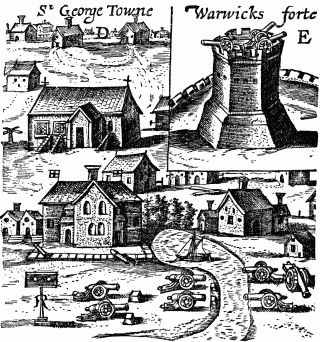
St. George's and Warwick Fort in 1614. (Fac-simile of Smith's engraving.)
The land was covered with one unbroken forest of cedar. Here they would have to remain for life unless a vessel could be constructed. They made a voyage to the wreck and secured the shrouds, tackles and carpenters' tools, and then began to cut down the cedars, with which they constructed a vessel of eighteen tons. For pitch they took lime, rendered adhesive by a mixture of turtle oil, and forced it into the seams, where it became hard as stone.
During a residence of five months here May had observed that Bermuda, hitherto supposed to be a single island, was broken up into a number of islands of different sizes, enclosing many fine bays, and forming good harbors. The vessel being finished they set sail for Newfoundland, expecting to meet fishing vessels there, on which they could obtain passage to Europe. On the eleventh of May they found themselves with joy clear of the islands. They had a very favorable voyage, and on the twentieth arrived at Cape Breton. May arrived in England in August, 1594, where he gave a description of the islands; he stated that they found hogs running wild all over the islands, which proves that this was not the first landing made there.
It was owing to a shipwreck that Bermuda again came under the view of the English, and that led England to appropriate these islands.
In 1609, during the most active period of the colonization of Virginia, an expedition of nine ships, commanded by Sir Thomas Gates, Sir George Somers and Captain Newport, bound for Virginia, was dispersed by a great storm. One of the vessels, the Sea Adventure, in which were Gates, Somers and Newport, seems to have been involved in the thickest of the tempest. The vessel sprung aleak, which it was found impossible to stop. All hands labored at the pumps for life, even the Governor and Admiral took their turns, and gentlemen who had never had an hour's hard work in their life toiled with the rest. The water continued to gain on them, and when about to give up in despair, Sir George Somers, who had been watching at the poop deck day and night, cried out land, and there in the early dawn of morning could be seen the welcome sight of land. Fortunately they lighted on the only secure entrance through the reefs. The vessel was run ashore and wedged between two rocks, and thereby was preserved from sinking, till by means of a boat and skiff the whole crew of one hundred and fifty, with provisions, tackle and stores, reached the land. At that time the hogs still abounded, and these, with the turtle, birds and fish which they caught, afforded excellent food for the castaways. The Isle of Devils Sir George Somers and party found "the richest, healthfulest and pleasantest" they ever saw.
Robert Walsingham and Henry Shelly discovered two bays abounding in excellent fish; these bays are still called by their names. Gates and Somers caused the long boat to be decked over, and sent Raven, the mate, with eight men, to Virginia to bring assistance to them, but nothing was ever heard of them afterwards, and after waiting six months all hopes were then given up. The chiefs of the expedition then determined to build two vessels of cedar, one of eighty tons and one of thirty. Their utmost exertions, however, did not prevent disturbances, which nearly baffled the enterprise. These were fomented by persons noted for their religious zeal, of Puritan principles and the accompanying spirit of independence. They represented that the recent disaster had dissolved the authority of the Governor, and their business was now to provide, as they best could, for themselves and their families. They had come out in search of an easy and plentiful subsistence, which could nowhere be found in greater perfection and security than here, while in Virginia its attainment was not only doubtful, but attended with many hardships. These arguments were so convincing with the larger number of the men that, had it rested with them, they would have lived and died on the islands.
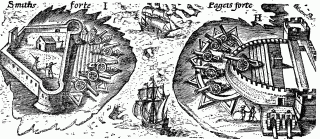
Entrance to St. George Harbor, between Smith's and Paget's Islands. (Fac-simile re-production of Smith's engraving. 1614.)
Two successive conspiracies were formed by large parties to separate from the rest and form a colony. Both were defeated by the vigilance of Gates, who allowed the ringleaders to escape with a slight punishment. This lenity only emboldened the malcontents, and a third plot was formed to seize the stores and take entire possession of the islands. It was determined to make an example of one of the leaders named Payne; He was condemned to be hanged, but, on the plea of being a gentleman, his sentence was commuted into that of being shot, which was immediately done. This had a salutary effect, and prevented any further trouble.
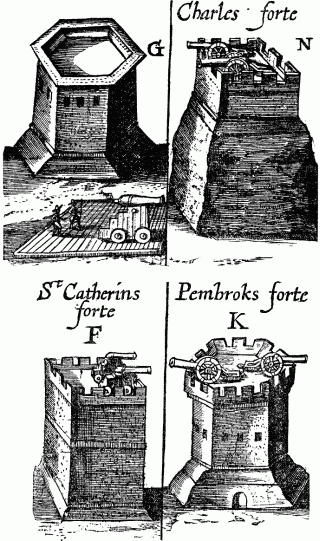
View of ancient forts. (Re-produced from Smith's engraving, 1614)
Two children, a boy and girl, were born during this period; the former was christened Bermudas and the latter Bermuda; they were probably the first human beings born on these islands.
Before leaving the islands Gates caused a cross to be made of the wood saved from the wreck of his ship, which he secured to a large cedar; a silver coin with the king's head was placed in the middle of it, together with an inscription on a copper plate describing what had happened—That the cross was the remains of a ship of three hundred tons, called the Sea Venture, bound with eight more to Virginia; that she contained two knights, Sir Thomas Gates, governor of the colony, and Sir George Summers, admiral of the seas, who, together with her captain, Christopher Newport, and one hundred and fifty mariners and passengers besides, had got safe ashore, when she was lost, July 28, 1609.
On the tenth of May, 1610, they sailed with a fair wind, and, before reaching the open sea, they struck on a rock and were nearly wrecked the second time. On the twenty-third they arrived safely at Jamestown. This settlement they found in a most destitute condition on their arrival, and it was determined to abandon the place, but Sir George Summers, "whose noble mind ever regarded the general good more than his own ends," offered to undertake a voyage to the Bermudas for the purpose of forming a settlement, from which supplies might be obtained for the Jamestown colony. He accordingly sailed June 19, in his cedar vessel, and his name was then given to the islands, though Bermuda has since prevailed.
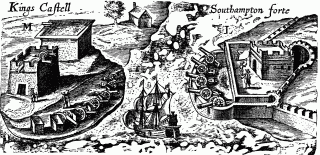
Entrance to Castle Harbor, between Castle and Southhampton Islands. (Fac-simile re-production of Smith's engraving, 1614.)
Contrary winds and storms carried him to the northward, to the vicinity of Cape Cod. Somers persevered and reached the islands, but age, anxiety and exertion contributed to produce his end. Perceiving the approach of death he exhorted his companions to continue their exertions for the benefit of the plantations, and to return to Virginia. Alarmed at the untimely fate of their leader, the colonists embalmed his body, and disregarding his dying injunction, sailed for England. Three only of the men volunteered to remain, and for some time after their companions left they continued to cultivate the soil, but unfortunately they found some ambergris, and they fell into innumerable quarrels respecting its possession. They at length resolved to build a boat and sail for Newfoundland with their prize, but, happily for them, they were prevented by the arrival of a ship from Europe. An extraordinary interest was excited in England by the relation of Captain Mathew Somers, the nephew and heir of Sir George. The usual exaggerations were published, and public impressions were heightened by contrast with the dark ideas formerly prevalent concerning these islands. A charter was obtained of King James I., and one hundred and twenty gentlemen detached themselves from the Virginia company and formed a company under the name and style of the Governor and Company of the City of London, for the plantation of the Somer Islands.
On the twenty-eighth of April, 1612, the first ship was sent out with sixty emigrants, under the charge of Richard Moore, who was appointed the Governor of the colony. They met the boat containing the three men left on the island, who were overjoyed at seeing the ship, and conducted her into the harbor. It was not long before intelligence of the discovery of the ambergris reached the Governor; he promptly deprived the three men of it. One of them named Chard, who denied all knowledge of it, and caused considerable disturbance, which at one time seemed likely to result in a sanguinary encounter, was condemned to be hanged, and was only reprieved when on the ladder.
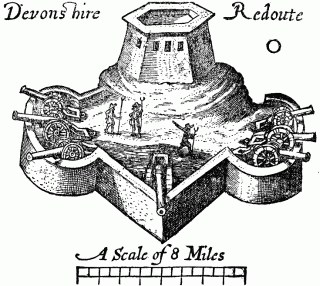
The Governor now applied himself actively to his duties. He had originally landed on Smith's Island, but he soon removed to the spot where St. George's now stands, and built the town which was named after Sir George Somers, and which became, and remained for two centuries, the capital of Bermuda. He laid the foundation of eight or nine forts for the defence of the harbor, and also trained the men to arms in order that they might defend the infant colony from attack. This proved necessary, for, in 1614, two Spanish ships attempted to enter the harbor; the forts were promptly manned and two shots fired at the enemy, who, finding them better prepared than they imagined, bore away.
Before the close of 1615 six vessels had arrived with three hundred and forty passengers, among whom were a Marshall and one Bartlett, who were sent out expressly to divide the colony into tribes or shares; but the Governor finding no mention of any shares for himself, and the persons with him, as had been agreed on, forbade his proceeding with his survey. The survey was afterward made by Richard Norwood, which divided the land into tribes, now parishes; these shares form, the foundation of the land tenure of the islands, even to this day, the divisional lines in many cases yet remaining intact. Moore, whose time had expired, went back to England in 1615, leaving the administration of the government to six persons, who were to rule, each in turn, one month. They proceeded to elect by lot their first ruler, the choice falling upon Charles Caldicot, who then went, with a crew of thirty-two men, in a vessel to the West Indies for the purpose of procuring plants, goats and young cattle for the islands. The vessel was wrecked there, and the crew were indebted to an English pirate for being rescued from a desert island on which they had been cast.
For a time the colony was torn by contention and discord, as well as by scarcity of food. The news of these dissensions having reached England the company sent out Daniel Tucker as Governor. Tucker was a stern, hard master, and he enforced vigorous measures to compel the people to work for the company. The provisions and stores he issued in certain quantities, and paid each laborer a stated sum in brass coin, struck by the proprietor for the purpose, having a hog on one side, in commemoration of the abundance of those animals found by the first settlers, and on the reverse a ship. Pieces of this curious hog money, as it is called, is frequently found, and it brings a high price.
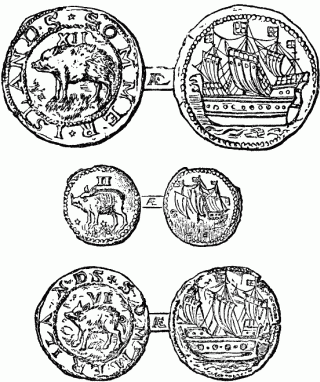
HOG MONEY.
Shortly after Governor Tucker arrived he sent to the West Indies for plants and fruit trees. The vessel returned with figs, pine-apples, sugar-cane, plantain and paw-paw, which were all planted and rapidly multiplied. This vessel also brought the first slaves into the colony, an Indaian and a negro.
The company dispatched a small bark, called the Hopewell, with supplies for the colony, under the command of Captain Powell. On his way he met a Portuguese vessel homeward bound from Brazil, with a cargo of sugar, and, as Smith adds, "liked the sugar and passengers so well" he made a prize of her. Fearing to face Governor Tucker after this piratical act he directed his course to the West Indies. On his arrival there he met a French pirate, who pretended to have a warm regard for him, and invited him, with his officers, to an entertainment. Suspecting nothing he accepted the invitation, but no sooner had they been well seated at the table than they were all seized and threated with instant death, unless they surrendered their prize. This Powell was, of course, compelled to do, and finding his provisions failing him he put the Portuguese crew on shore and sailed for Bermuda, where he managed to excuse himself to the Governor. Powell again went to the West Indies pirating, and in May he arrived with three prizes, laden with meal, hides, and ammunition. Tucker received him kindly and treated him with consideration, until he had the goods in his own possession, when he reproached the Captain with his piratical conduct and called him to account for his proceedings. The unlucky buccaneer was, in the end, glad to escape to England, leaving his prizes in the hands of the Governor.
The discipline and hard labor required of the people reduced them to a condition but little better than that of slaves, and caused many to make desperate efforts to escape from the islands. Five persons, neither of whom were sailors, built a fishing boat for the Governor, and when completed they borrowed a compass from their preacher, for whom they left a farewell epistle. In this they reminded him how often he had exhorted them to patience under ill-treatment, and had told them how Providence would pay them, if man did not. They trusted, therefore, that he would now practice what he had so often preached.
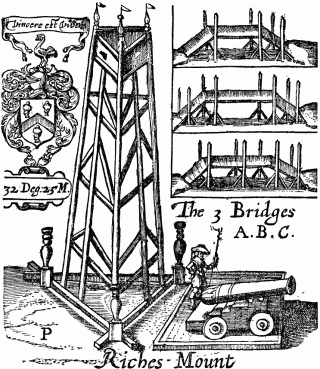
Reproduction of Smith's engraving, 1614, showing his coat of arms with the three Turk heads.
These brave men endured great hardships in their boat of three tons during their rash voyage; but at the end of about forty-two days they arrived at Ireland, where their exploit was considered so wonderful that the Earl of Thomond caused them to be received and entertained, and hung up their boat as a monument of this extraordinary voyage. The Governor was greatly exasperated at their escape, and threatened to hang the whole of them if they returned.
Another party of three, one of whom was a lady, attempted in a like manner to reach Virginia, but were never afterwards heard of. Six others were discovered before they effected their departure, and one was executed. John Wood, who was found guilty of speaking "many distasteful and mutinous speeches against the Governor," was also condemned and executed.
As there were at that time only about five hundred inhabitants on these islands, it would appear from Captain Smith's History that Tucker hanged a good percentage of them. Many were the complaints that were forwarded to England concerning the tyrannical government of Tucker, and he, fearing to be recalled, at last returned to England of his own accord, having appointed a person named Kendall as his deputy.
Kendall was disposed to be attentive to his office, but wanted energy, and the company took an early opportunity to relieve him; this was not very agreeable to the people, but they did not offer any resistance.
Governor Butler arrived with four ships and five hundred men on the twentieth of October, 1619, which raised the number of the colonists to 1000, and at his departure three years later, it had increased to 1500.
On the first of August, 1620, in conformity with instructions sent out by the company, the Governor summoned the first general assembly at St. George's for the dispatch of public business. It consisted of the Governor, Council, Bailiffs, Burgesses, Secretary, and Clerk. It appears that they all sat in one house, which was probably the "State House" shown on Smith's engraving. Most of the Acts passed on this occasion were creditable to the new legislators.
Governor Butler, as Moore had done before him, turned his chief attention to the building of forts and magazines; he also finished the cedar Church at St. George's, and caused the assembly to pass an Act for the building of three bridges, and then initiated the useful project of connecting together the principal islands. When Governor Butler returned to England he left the islands in a greatly improved condition. But in his time, also, there were such frequent mutinies and discontent, that at last "he longed for deliverance from his thankless and troublesome employment." It was probably during Governor Butler's administration that Captain3 John Smith had a map and illustrations of the "Summer Ils" made, for in it we find the three bridges, numerous well-constructed forts, and the State House at St. George's. The map and illustrations were published in "Smith's General Historic of Virginia, New England and the Summer Ils" 1624; they are of the greatest value and importance, as they show accurately the class of buildings and forts erected on these islands at that early period; such details even are entered into as the showing of the stocks in the market place of St. George's, and the architecture and the substantial manner in which the buildings were constructed is remarkable, especially so when it is considered that previous to 1620 the Puritans had not settled at Plymouth, and it was ten years from that date before the settlement of Boston: in fact, with the exception of Jamestown in Virginia, the English had not secured a foot-hold in North America at the time these buildings and forts were constructed. There are very few copies of this rare print in existence, even in Smith's history it is usually found wanting, and it was only after considerable trouble and expense that the writer succeeded in obtaining a reproduction of it.
The early history of Bermuda is in many important points similar to that of New England. Like motives had in most instances induced emigration, and the distinguished characteristics of those people were repeated here.
Like the Salem and Boston colonists they had their witchcraft delusions, anticipating that, however, some twenty years, Christian North was tried for it in 1668, but was acquited. Somewhat later a negro woman, Sarah Basset, was burned at Paget for the same offence. The Quakers were persecuted by fines, imprisonment, and banishment, by the stem and dark-souled Puritans, who had emigrated to this place to escape oppression, and to enjoy religious toleration, but were not willing to grant to others who differed from them in their religious belief the same privileges as they themselves enjoyed.
The company discovered by degrees that the Bermudas were not the Eldorado which they had fondly imagined them to be. The colonists were now numerous, and every day showed a strong disposition to break away from the control of the company. The company had issued an order forbidding the inhabitants to receive any ships but such as were commissioned by them. The company complained against the quality of tobacco shipped to London, as well as the quantity.
The people were forbidden to cut cedar without a special license, and as they were in the habit of exporting oranges in chests made of this wood, the regulation operated very materially to the injury of the place. Previous to this order many homeward-bound West Indiamen arrived at Castle Harbor to load with this fruit for the English market. Whaling was claimed as an exclusive privilege, and was conducted for the sole benefit of the proprietors. Numerous attempts were made to boil sugar, but the company directed the Governor to prevent it, as it would require too much wood for fuel.
In consequence of instructions from England Governor Turner called upon all the inhabitants of the islands to take the oath of supremacy and allegiance to his majesty, but as the Puritans had left their native country on account of their republican sentiments, they refused to comply, and the prisons were soon filled to overflowing.
The rapid change of affairs in England during the civil war, in which the Puritans were victorious, and Cromwell was elevated to the Protectorship, opened the doors of the prisons, and stopped all further persecutions, both political and religious.
It must be said in favor of the company that they had, at an early period, established schools throughout the colony, and appropriated lands in most of the tribes or parishes, for the maintainance of the teachers.
From 1630 to 1680 many negro and Indian slaves were brought to the colony; the negroes from Africa and the West Indies, and a large number of Indians from Massachusetts, prisoners taken in the Pequot and King Philip's wars. The traces of their Indian ancestry can readily be seen in many of the colored people of these islands at the present time.
In October, 1661, the Protestant inhabitants were alarmed by rumors of a proposed combination between the negroes and the Irish. The plan was to arm themselves and massacre the whites who were not Catholics. Fortunately the plot was discovered in time, and measures adopted to disarm the slaves and the disaffected.
The proprietary form of government continued until 1685, with a long succession of good, bad, and indifferent Governors.
Many acts of piracy were perpetrated at different times by the inhabitants of these islands. In 1665 Captain John Wentworth made a descent upon the island of Tortola and brought off about ninety slaves, the property of the Governor of the place. Governor Seymour received a letter from him in which he stated that "upon the ninth day of July there came hither against me a pirate or sea robber, named John Wentworth, the which over-run my lands, and that against the will of mine owne inhabits, and shewed himself a tyrant, in robbing and firing, and took my negroes from my Isle, belonging to no man but myself. And likewise I doe understand that this said John Wentworth, a sea robber, is an indweller with you, soe I desire that you would punish this rogue, according to your good law. I desire you, soe soon as you have this truth of mine, if you don't of yourself, restore all my negroes againe, whereof I shall stay here three months, and in default of this, soe be assured, that wee shall speake together very shortly, and then I shall be my owne judge."
This threatening letter caused great consternation, and immediately steps were taken to place the colony in the best posture for defence, reliance being had on the impregnability of the islands, instead of delivering up the plunder, especially as Captain Wentworth held a commission from the Governor and Council, and acted under their instructions.
Isaac Richier, who became Governor of the colony in 1691, was another celebrated freebooter. The account of his reign reads like a romance. The love of gold, and the determination to possess it, was the one idea of his statesmanship. He was a pirate at sea and a brigand on land. Nevertheless, it does not appear that any of his misdeeds, such as hanging innocent people, and robbing British ships, as well as others, led to his recall, or caused any degree of indignation which such conduct usually arouses. The fact appears to be that, although Governor Richier was a bold, bad man, yet few of his subjects were entitled to throw the first stone at his excellency.
Benjamin Bennett became Governor of the colony in 1701. At this time the Bahama Islands had become a rendezvous for pirates, and a few years later, King George the First issued a proclamation for their dislodgment. Governor Bennett accordingly dispatched a sloop, ordering the marauders to surrender. Those who were on shore on his arrival gladly accepted the opportunity to escape, and declared that they did not doubt but that their companions who were at sea would follow their example. Captain Henry Jennings and fifteen others sailed for Bermuda, and were soon followed by four other Captains—Leslie, Nichols, Hornigold, and Burges, with one hundred men, who all surrendered.
In 1710 the Spaniards made a descent on Turk's Island, which had been settled by the Bermudians for the purpose of gathering salt, and took possession of the island, making prisoners of the people. The Bermudians, at their own expense and own accord, dispatched a force under Captain Lewis Middleton to regain possession of the Bahama Cays. The expedition was successful, and a victory gained over the Spaniards, and they were driven from the islands; they still, however, continued to make predatory attacks on the salt-rakers at the ponds, and on the vessels going for and carrying away salt. To repel these aggressions and afford security to their trade, the Bermudians went to the expense of arming their vessels.
In 1775 the discontent in the American provinces had broken out into open opposition to the crown, and the people were forbidden to trade with their late fellow subjects. Bermuda suffered great want in consequence, for at this period, instead of exporting provisions the island had become dependent on the continent for the means of subsistence. This, together with the fact that many of the people possessed near relatives engaged in the struggle with the crown, tended to destroy good feelings towards the British government. These circumstances must be considered in order to judge fairly of the following transaction, which has always been regarded to have cast a stain upon the patriotism and loyalty of the Bermudians.
At the outbreak of the American Revolution, two battles were fought in the vicinity of Boston—Lexington and Bunker Hill, after which all intercourse with the surrounding country ceased, and Boston was reduced to a state of siege. Civil war commenced in all its horrors; the sundering of social ties; the burning of peaceful homes; the butchery of kindred and friends.
Washington was appointed by the Continental Congress, Commander-in-Chief of the American forces, and on July 3, 1775, two weeks after the battle of Bunker Hill, he took formal command of the army at Cambridge. In a letter to the President of Congress notifying him of his safe arrival there, he made the following statement. "Upon the article of ammunition, I must re-echo the former complaints on this subject. We are so exceedingly destitute that our artillery will be of little use without a supply both large and seasonable. What we have must be reserved for the small arms, and that well managed with the utmost frugality." A few weeks later General Washington wrote the following letter on the same subject.4
TO GOVERNOR COOKE, OF RHODE ISLAND.
Camp at Cambridge, 4 August, 1775.
Sir,
I am now, Sir, in strict confidence, to acquaint you, that our necessities in the articles of powder and lead are so great, as to require an immediate supply. I must earnestly entreat that you will fall upon some measure to forward every pound of each in your colony that can possibly be spared. It is not within the propriety or safety of such a correspondence to say what I might on this subject. It is sufficient that the case calls loudly for the most strenuous exertions of every friend of his country, and does not admit of the least delay. No quantity, however small, is beneath notice, and, should any arrive, I beg it may be forwarded as soon as possible.
But a supply of this kind is so precarious, not only from the danger of the enemy, but the opportunity of purchasing, that I have revolved in my mind every other possible chance, and listened to every proposition on the subject which could give the smallest hope. Among others I have had one mentioned which has some weight with me, as well as the other officers to whom I have proposed it. A Mr. Harris has lately come from Bermuda, where there is a very considerable magazine of powder in a remote part of the island; and the inhabitants are well disposed, not only to our cause in general, but to assist in this enterprise in particular. We understand there are two armed vessels in your province, commanded by men of known activity and spirit; one of which, it is proposed to despatch on this errand with such assistance as may be requisite. Harris is to go along, as the conductor of the enterprise, that we may avail ourselves of his knowledge of the island; but without any command. I am very sensible, that at first view the project may appear hazardous; and its success must depend on the concurrence of many circumstances; but we are in a situation, which requires us to run all risks. No danger is to be considered, when put in competition with the magnitude of the cause, and the absolute necessity we are under of increasing our stock. Enterprises, which appear chimerical, often prove successful from that very circumstance. Common sense and prudence will suggest vigilance and care, where the danger is plain and obvious; but where little danger is apprehended, the more the enemy will be unprepared; and consequently there is the fairest prospect of success.
Mr. Brown has been mentioned to me as a very proper person to be consulted upon this occasion. You will judge of the propriety of communicating it to him in part or the whole, and as soon as possible favor me with your sentiments, and the steps you may have taken to forward it. If no immediate and safe opportunity offers, you will please to do it by express. Should it be inconvenient to part with one of the armed vessels, perhaps some other might be fitted out, or you could devise some other mode of executing this plan; so that, in case of a disappointment, the vessel might proceed to some other island to purchase.
I am, Sir,
Your most obedient, humble servant,
G. Washington.
This plan was approved by the Governor and Committee of Rhode Island, and Captain Abraham Whipple agreed to engage in the affair, provided General Washington would give him a certificate under his own hand, that in case the Bermudians would assist the undertaking, he would recommend to the Continental Congress to permit the exportation of provisions to those islands from the colonies.
General Washington accordingly sent the following address to the Bermudians.5
TO THE INHABITANTS OF THE ISLAND OF BERMUDA.
Camp at Cambridge, 6 September, 1775.
Gentlemen:
In the great conflict, which agitates this continent, I cannot doubt but the assertors of freedom and the rights of the constitution are possessed of your most favorable regards and wishes for success. As descendants of freemen, and heirs with us of the same glorious inheritance, we flatter ourselves, that, though divided by our situation, we are firmly united in sentiment. The cause of virtue and liberty is confined to no continent or climate. It comprehends, within its capacious limits, the wise and good, however dispersed and separated in space or distance.
You need not be informed that the violence and rapacity of a tyrannic ministry have forced the citizens of America, your brother colonist, into arms. We equally detest and lament the prevalence of those counsels, which have led to the effusion of so much human blood, and left us no alternative but a civil war, or a base submission. The wise Disposer of all events has hitherto smiled upon our virtuous efforts. Those mercenary troops, a few of whom lately boasted of subjugating this vast continent, have been checked in their earliest ravages, and now actually encircled within a small space; their arms disgraced, and themselves suffering all the calamities of a siege. The virtue, spirit, and union of the provinces leave them nothing to fear, but the want of ammunition. The application of our enemies to foreign states, and their vigilance upon our coasts, are the only efforts they have made against us with success.
Under these circumstances, and with these sentiments, we have turned our eyes to you, Gentlemen, for relief. We are informed, that there is a very large magazine in your island under a very feeble guard. We would not wish to involve you in an opposition, in which, from your situation, we should be unable to support you; we knew not, therefore, to what extent to solicit your assistance, in availing ourselves of this supply; but, if your favor and friendship to North America and its liberties have not been misrepresented, I persuade myself you may, consistently with your own safety, promote and further this scheme, so as to give it the fairest prospect of success. Be assured, that, in this case, the whole power and exertion of my influence will be made with the honorable Continental Congress, that your island may not only be supplied with provisions, but experience every other mark of affection and friendship, which the grateful citizens of a free country can bestow on its brethren and benefactors. I am, Gentlemen,
With much esteem,
Your humble servant,
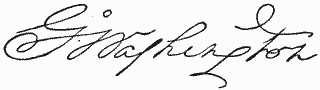
Signature G Washington
Captain Whipple had scarcely sailed from Providence before an account appeared in the newspapers of one hundred barrels of powder having been taken from Bermuda by a vessel supposed to be from Philadelphia, and another from South Carolina. This was the same powder that Captain Whipple had gone to procure. General Washington and Governor Cooke were both of the opinion it was best to countermand his instructions. The other armed vessel of Rhode Island was immediately dispatched in search of the Captain with orders to return.
But it was too late; he reached Bermuda and put in at the west end of the island. The inhabitants were at first alarmed, supposing him to command a king's armed vessel, and the women and children fled from that vicinity; but when he showed them his commission and instructions they treated him with much cordiality and friendship, and informed him that they had assisted in removing the powder, which was made known to General Gage, and he had sent a sloop of war to the island. They professed themselves hearty friends to the American cause. Captain Whipple being defeated in the object of his voyage returned to Providence.
Soon after the inhabitants of Bermuda petitioned Congress for relief, representing their great distress in consequence of being deprived of the supplies that usually came from the colonies. In consideration of their being friendly to the cause of America, it was resolved by Congress that provisions in certain quantities might be exported to them.6
The powder procured from the Bermudians led to the first great victory gained by Washington in the Revolutionary war, the evacuation of Boston by the British army. After the arrival of the powder Washington caused numerous batteries to be erected in the immediate vicinity of the town. On the night of March 4, 1776, Dorchester Heights were taken possession of and works erected there, which commanded Boston, and the British Fleet lying at anchor in the harbor. This caused the town to be evacuated, and General Howe with his army and about one thousand loyalists went aboard of the fleet and sailed for Halifax, March 17, 1776.
Nothing could exceed the indignation of Governor Bruere when he received intelligence of the plundering of the magazine; he promptly called upon the legislature to take active measures for bringing the delinquents to justice. No evidence could ever be obtained, and the whole transaction is still enveloped in mystery. The Governor let no opportunity escape him to accuse the Bermudians of disloyality, and no doubt severe punishment would have been inflicted on the delinquents could they have been discovered.
Two American brigs under Republican colors arrived shortly after this and remained some weeks at the west end of the islands unmolested, and Governor Bruere complained bitterly of this to the assembly.7
Governor George James Bruere died in 1780, and the administration devolved on the Honorable Thomas Jones, who was relieved by George Bruere as Lieutenant Governor, in October, 1780.
Governor Bruere was soon openly at variance with the assembly, and did not hesitate to accuse the people of treason in supplying the revolted provinces with salt, exchanging it for provisions. Mr. Bruere extremely exasperated at their trading, which he considered to be treasonable conduct, commented on it in his message to the assembly in no measured terms. Some intercepted correspondence with the rebels added fuel to the flame, and on the fifteenth of August, 1781, he addressed them in a speech which could not fail to be offensive, although it contained much sound argument. This was followed by a message more bitter and acrimonious, all of which they treated with silent contempt, until the twenty-eight of September, when they discharged their wrath in an address, in which the Governor was handled most roughly for his attacks on the inhabitants of these islands. In return he addressed a message, equally uncourteous in its tone, and dissolved the house.
The arrival of William Browne, whose administration commenced the fourth of January, 1782, put an end to Mr. Bruere's rule.
The high character of the new Governor had preceded him in the colony, and he was joyfully received on his arrival. He was a native of Salem, Massachusetts, and was high in office previous to the Revolution, was Colonel of the Essex regiment, judge of the Supreme Court, and Mandamus Counselor. After the passage of the Boston Port bill, he was waited on by a committee of the Essex delegates, to inform him, that "it was with grief that the country had viewed his exertions for carrying into execution certain acts of parliament calculated to enslave and ruin his native land; that while the country would continue the respect for several years paid him, it resolved to detach, from every future connection, all such as shall persist in supporting or in any way countenancing the late arbitrary acts of Parliament; that the delegates in the name of the country requested him to excuse them from the painful necessity of considering and treating him as an enemy to his country, unless he resigned his office as Counsellor and Judge." Colonel Browne replied as follows:
"As a judge and in every other capacity, I intend to act with honor and integrity and to exert my best abilities; and be assured that neither persuasion can allure me, nor menaces compel me, to do anything derogatory to the character of a Counselor of his Majesty's province of Massachusetts."—William Browne.
Colonel Browne was esteemed among the most opulent and benevolent individuals of that province prior to the Revolution; and so great was his popularity that the gubernatorial chair of Massachusetts was offered him by the "committee of safety," as an inducement for him to remain and join the "sons of liberty." But he felt it a duty to adhere to government; even at the expense of his great landed estate, both in Massachusetts and Connecticut, the latter comprising fourteen valuable farms, all of which were afterwards confiscated.
By preferring to remain on the side representing law and authority, and unwilling to adopt the course of the revolutionists, this courtly representative of an ancient and honorable family, this sincere lover of his country, this skilled man of affairs, this upright and merciful judge, once so beloved by his fellow townsmen, drew upon himself their wrath, and he fled from his native country never to return again. First he sought refuge in Boston in 1774, then in Halifax, and from there he went to England in 1776, where he remained till 1781, when he was appointed Governor of Bermuda, as a slight return for his great sacrifices and important services in behalf of the Crown. Colonel Browne married his cousin, the daughter of Governor Wanton, of Rhode Island, and was doubly connected with the Winthrop family; the wives of the elder Browne and Governor Wanton being daughters of John Winthrop, great grandson of the first Governor of Massachusetts. Colonel Browne's son William was an officer in the British service at the siege of Gibralter in 1784.
Under the judicious management of Governor Browne the colony continued to steadily flourish; he conducted the business of the colony in the greatest harmony with the different branches of the legislature. He found the financial affairs of the islands in a confused and ruinous state, and left them flourishing. In 1778 he left for England, deeply and sincerely regretted by the people, and was succeeded by Henry Hamilton as Lieutenant Governor, during whose administration the town of Hamilton was built and named in compliment of him.
Near the close of the American Revolution a plan was on foot to take Bermuda, in order to make it "a nest of hornets" for the annoyance of British trade, but the war closed, and it was abandoned. It, however, proved a nest of hornets to the United States during the late civil war. At that time St. George's was a busy town, and was one of the hot-beds of secession. Being a great resort for blockade runners, which were hospitably welcomed here, immense quantities of goods were purchased in England, and brought here on large ocean steamers, and then transferred to swift-sailing blockade runners, waiting to receive it. These ran the blockade into Charleston, Wilmington and Savannah.
It was a risky business, but one that was well followed, and many made large fortunes there during the first year of the war, but many were bankrupt, or nearly so at its close.
Here, too, was concocted the fiendish plot of Dr. Blackburn, a Kentuckian, for introducing yellow fever into northern cities, by sending thither boxes of infected clothing.
[The foregoing article on the history of Bermuda was compiled by the author of "Stark's Illustrated Bermuda Guide," published by the Photo-Electrotype Company, of 63 Oliver Street, Boston. The work contains about two hundred pages and is embellished with sixteen photo-prints, numerous engravings, and a new map of Bermuda made from the latest surveys.—ED.]