HISTORIC TREES.
Reading edition
By L.L. Dame.
THE WASHINGTON ELM.
At the north end of the Common in Old Cambridge stands the famous Washington Elm, which has been oftener visited, measured, sketched, and written up for the press, than any other tree in America. It is of goodly proportions, but, as far as girth of trunk and spread of branches constitute the claim upon our respect, there are many nobler specimens of the American elm in historic Middlesex.
THE WASHINGTON ELM. [From D. Lothrop & Company's Young Folks' Life of Washington.]
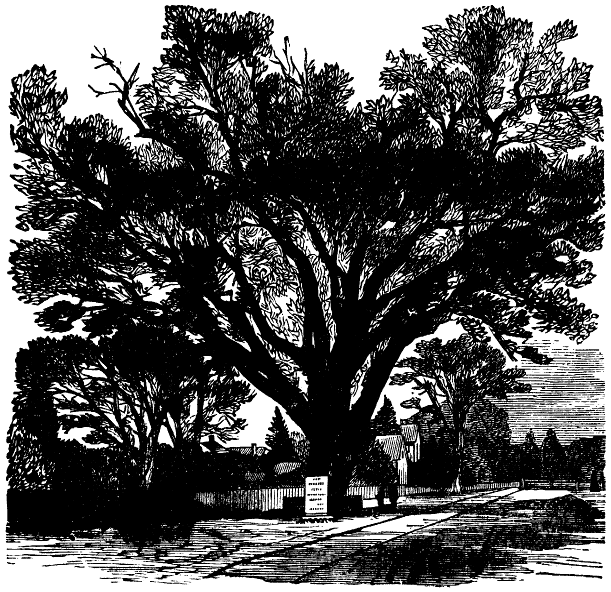
Extravagant claims have been made with regard to its age, but it is extremely improbable that any tree of this species has ever rounded out its third century. Under favorable conditions, the growth of the elm is very rapid, a single century sometimes sufficing to develop a tree larger than the Washington Elm.
When Governor Winthrop and Lieutenant-Governor Dudley, in 1630, rode along the banks of the Charles in quest of a suitable site for the capital of their colony, it is barely possible the great elm was in being. It would be a pleasant conceit to link the thrifty growth of the young sapling with the steady advancement of the new settlement, enshrining it as a sort of guardian genius of the place, the living witness of progress in Cambridge from the first feeble beginnings.
The life of the tree, however, probably does not date farther back than the last quarter of the seventeenth century. In its early history there was nothing to distinguish it from its peers of the greenwood. When the surrounding forest fell beneath the axe of the woodman, the trees conspicuous for size and beauty escaped the general destruction; among these was the Washington Elm; but there is no evidence that it surpassed its companions.
Tradition states that another large elm once stood on the northwest corner of the Common, under which the Reverend George Whitefield, the Wesleyan evangelist, preached in 1745. Others claim that it was the Washington Elm under which the sermon was delivered. The two trees stood near each other, and the hearers were doubtless scattered under each. But the great elm was destined to look down upon scenes that stirred the blood even more than the vivid eloquence of a Whitefield. Troublous times had come, and the mutterings of discontent were voicing themselves in more and more articulate phrase. The old tree must have been privy to a great deal of treasonable talk—at first, whispered with many misgivings, under the cover of darkness; later, in broad daylight, fearlessly spoken aloud. The smoke of bonfires, in which blazed the futile proclamations of the King, was wafted through its branches. It saw the hasty burial, by night, of the Cambridge men who were slain upon the nineteenth of April, 1775; it saw the straggling arrival of the beaten, but not disheartened, survivors of Bunker Hill; it saw the Common—granted to the town as a training-field—suddenly transformed to a camp, under General Artemas Ward, commander-in-chief of the Massachusetts troops.
The crowning glory in the life of the great elm was at hand. On the twenty-first of June, Washington, without allowing himself time to take leave of his family, set out on horseback from Philadelphia, arriving at Cambridge on the second of July. Sprightly Dorothy Dudley in her Journal describes the exercises of the third, with the florid eloquence of youth.
"To-day, he (Washington) formally took command, under one of the grand old elms on the Common. It was a magnificent sight. The majestic figure of the General, mounted upon his horse beneath the wide-spreading branches of the patriarch tree; the multitude thronging the plain around, and the houses filled with interested spectators of the scene, while the air rung with shouts of enthusiastic welcome, as he drew his sword, and thus declared himself Commander-in-chief of the Continental army."
Dorothy does not specify under which elm Washington stood. It is safely inferable from her language that our tree was one of several noble elms which at this time were standing upon the Common.
Although no contemporaneous pen seems to have pointed out the exact tree beyond all question, happily the day is not so far distant from us that oral testimony is inadmissible. Of this there is enough to satisfy the most captious critic.
Where the stone church is now situated, there was formerly an old gambrel-roofed house, in which the Moore family lived during the Revolution. The situation was very favorable for observation, commanding the highroad from Watertown to Cambridge Common, and directly opposite the great elm. From the windows of this house the spectators saw the ceremony to good advantage, and one of them, styled, in 1848, the "venerable Mrs. Moore," lived to point out the tree, and describe the glories of the occasion, seventy-five years afterward. Fathers, who were eyewitnesses standing beneath this tree, have told the story to their sons, and those sons have not yet passed away. There is no possibility that we are paying our vows at a counterfeit shrine.
Great events which mark epochs in history, bestow an imperishable dignity even upon the meanest objects with which they are associated. When Washington drew his sword beneath the branches, the great elm, thus distinguished above its fellows, passed at once into history, henceforward to be known as the Washington Elm.
"Under the brave old tree Our fathers gathered in arms, and swore They would follow the sign their banners bore, And fight till the land was free."—Holmes.
The elm was often honored by the presence of Washington, who, it is said, had a platform built among the branches, where, we may suppose, he used to ponder over the plans of the campaign. The Continental army, born within the shade of the old tree, overflowing the Common, converted Cambridge into a fortified camp. Here, too, the flag of thirteen stripes for the first time swung to the breeze.
These were the palmy days of the elm. When the tide of war set away from New England, the Washington Elm fell into unmerited neglect. The struggling patriots had no time for sentiment; and when the war came to an end they were too busy in shaping the conduct of the government, and in repairing their shattered fortunes, to pay much attention to trees. It was not until the great actors in those days were rapidly passing away, that their descendants turned with an affectionate regard to the enduring monuments inseparably associated with the fathers. Among these, the Washington Elm deservedly holds a high rank.
On the third of July, 1875, the citizens of Cambridge celebrated the one hundredth anniversary of Washington's assuming the command of the army. The old tree was the central figure of the occasion. The American flag floated above the topmost branches, and a profusion of smaller flags waved amid the foliage. Never tree received a more enthusiastic ovation.
It is enclosed by a circular iron fence erected by the Reverend Daniel Austin. Outside the fence, but under the branches, stands a granite tablet erected by the city of Cambridge, upon which is cut an inscription written by Longfellow:—
UNDER THIS TREE WASHINGTON FIRST TOOK COMMAND OF THE AMERICAN ARMY, JULY 3D, 1775.
In 1850, it still retained its graceful proportions; its great limbs were intact, and it showed few traces of age. Within the past twenty-five years, it has been gradually breaking up.
In 1844, its girth, three feet from the ground, where its circumference is least, was twelve feet two and a half inches. In 1884, at the same point, it measures fourteen feet one inch; a gain so slight that the rings of annual growth must be difficult to trace—an evidence of waning vital force. The grand subdivisions of the trunk are all sadly crippled; unsightly bandages of zinc mask the progress of decay; the symptoms of approaching dissolution are painfully evident, especially in the winter season. In summer, the remaining vitality expends itself in a host of branchlets which feather the limbs, and give rise to a false impression of vigor.
Never has tree been cherished with greater care, but its days are numbered. A few years more or less, and, like Penn's Treaty Elm and the famous Charter Oak, it will be numbered with the things that were.
THE ELIOT OAK
When John Eliot had become a power among the Indians, with far-reaching sagacity he judged it best to separate his converts from the whites, and accordingly, after much inquiry and toilsome search, gathered them into a community at Natick—an old Indian name formerly interpreted as "a place of hills," but now generally admitted to mean simply "my land." Anticipating the policy which many believe must eventually be adopted with regard to the entire Indian question, Eliot made his settlers land-owners, conferred upon them the right to vote and hold office, impressed upon them the duties and responsibilities of citizenship, and taught them the rudiments of agriculture and the mechanic arts.
In the summer of 1651, the Indians built a framed edifice, which answered, as is the case to-day in many small country towns, the double purpose of a schoolroom on week-days, and a sanctuary on the Sabbath. Professor C.E. Stowe once called that building the first known theological seminary of New England, and said that for real usefulness it was on a level with, if not above, any other in the known world.
It is assumed that two oaks, one of the red, and the other of the white, species, of which the present Eliot Oak is the survivor, were standing near this first Indian church. The early records of Eliot's labors make no mention of these trees. Adams, in his Life of Eliot, says: "It would be interesting if we could identify some of the favorite places of the Indians in this vicinity," but fails to find sufficient data. Bigelow (or Biglow, according to ancient spelling), in his History of Natick, 1830, states: "There are two oaks near the South Meeting-house, which have undoubtedly stood there since the days of Eliot." It is greatly to be regretted that the writer did not state the evidence upon which his conclusion was based.
Bacon, in his History of Natick, 1856, remarks: "The oak standing a few rods to the east of the South Meeting-house bears every evidence of an age greater than that of the town, and was probably a witness of Eliot's first visit to the 'place of hills.'" It would be quite possible to subscribe to this conclusion, while dissenting entirely from the premises. It will be noticed that Bacon relies upon the appearance of the tree as a proof of its age. His own measurement, fourteen and a half feet circumference at two feet from the ground, is not necessarily indicative of more than a century's growth.
The writer upon Natick, in Drake's Historic Middlesex, avoids expressing an opinion. "Tradition links these trees with the Indian Missionary." For very long flights of time, tradition—as far as the age of trees is concerned—cannot at all be relied upon; within the narrow limits involved in the present case, it may be received with caution.
The Red Oak which stood nearly in front of the old Newell Tavern, was the original Eliot Oak. Mr. Austin Bacon, who is familiar with the early history and legends of Natick, states that "Mr. Samuel Perry, a man who could look back to 1749, often said that Mr. Peabody, the successor to Eliot, used to hitch his horse by that tree every Sabbath, because Eliot used to hitch his there."
This oak was originally very tall; the top was probably broken off in the tremendous September gale of 1815; as it was reported to be in a mutilated condition in 1820. Time, however, partially concealed the disaster by means of a vigorous growth of the remaining branches. In 1830, it measured seventeen feet in circumference two feet from the ground. It had now become a tree of note, and would probably have monopolized the honors to the exclusion of the present Eliot Oak, had it not met with an untimely end. The keeper of the tavern in front of which it stood had the tree cut down in May, 1842. This act occasioned great indignation, and gave rise to a lawsuit at Framingham, "which was settled by the offenders against public opinion paying the costs and planting trees in the public green." A cartload of the wood was carried to the trial, and much of it was taken home by the spectators to make into canes and other relics,
"The King is dead, long live the King!"
Upon the demise of the old monarch, the title naturally passed to the White Oak, its neighbor, another of the race of Titans, standing conveniently near, of whose early history very little is positively known beyond the fact that it is an old tree; and with the title passed the traditions and reverence that gather about crowned heads.
Mrs. Stowe has given it a new claim to notice, for beneath it, according to Drake's Historic Middlesex, "Sam Lawson, the good-natured, lazy story-teller, in Oldtown Folks, put his blacksmith's shop. It was removed when the church was built."
The present Eliot Oak stands east of the Unitarian meeting-house, which church is on or near the spot where Eliot's first church stood. It measured, January, 1884, seventeen feet in circumference at the ground; fourteen feet two inches at four feet above. It is a fine old tree, and it is not improbable—though it is unproven—that it dates back to the first settlement of Natick.
"Thou ancient oak! whose myriad leaves are loud With sounds of unintelligible speech, Sounds as of surges on a shingly beach, Or multitudinous murmurs of a crowd; With some mysterious gift of tongues endowed Thou speakest a different dialect to each. To me a language that no man can teach, Of a lost race long vanished like a cloud, For underneath thy shade, in days remote, Seated like Abraham at eventide, Beneath the oak of Mamre, the unknown Apostle of the Indian, Eliot, wrote His Bible in a language that hath died. And is forgotten save by thee alone."—Longfellow.