Chapter I · BATTLING AGAINST HEAVY ODDS
Reading edition
Rome had its walls, as New York has its rivers, and they played a like part in penning up the crowds. Within space became scarce and dear, and when there was no longer room to build in rows where the poor lived, they put the houses on top of one another. That is the first chapter of the story of the tenement everywhere. Gibbon quotes the architect Vitruvius, who lived in the Augustan age, as complaining of "the common though inconvenient practice of raising houses to a considerable height in the air. But the loftiness of the buildings, which often consisted of hasty work and insufficient material, was the cause of frequent and fatal accidents, and it was repeatedly enacted by Augustus as well as by Nero that the height of private dwellings should not exceed the measure of seventy feet above the ground."
"Repeatedly" suggests that the jerry-builder was a hard nut to crack then as now. As to Nero's edict, New York enacted it for its own protection in our own generation.
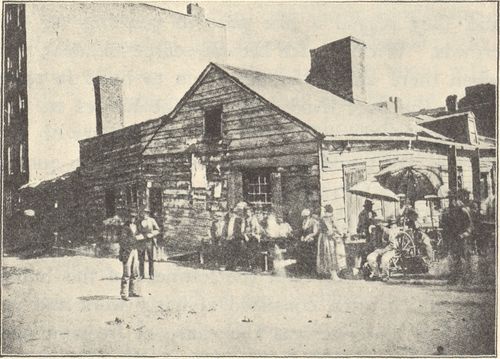
One of the Five Points Fifty Years ago.
Those days came vividly back to me last winter, when in a Wisconsin country town I was rehearsing the story of the long fight, and pointing out its meaning to us all. In the audience sat a sturdy, white-haired, old farmer who followed the recital with keen interest, losing no word. When he saw this picture of one of the Five Points, he spoke out loud: "Yes! that is right. I was there." It turned out that he and his sister had borne a hand in the attack upon that stronghold of the slum by the forces of decency, in 1849 and 1850, which ended in the wiping out of the city's worst disgrace. It was the first pitched battle in the fight. Soon after he had come west and taken homestead land; but the daily repetition during a lifetime of the message to men, which the woods and the fields and God's open sky have in keeping, had not dulled his ears to it, and after fifty years his interest in his brothers in the great city was as keen as ever, his sympathies as quick. He had driven twenty miles across the frozen prairie to hear my story. It is his kind who win such battles, and a few of them go a long way.
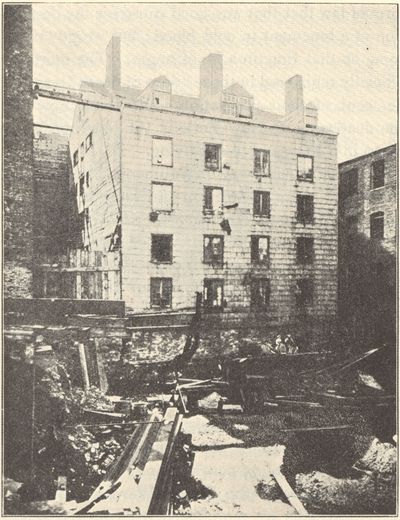
The "Old Church" Tenement.
A dozen steps away in Mulberry Street, called "Death's Thoroughfare" in the same report, were the "Old Church Tenements," part of the Five Points and nearly the worst part. "One of the largest contributors to the hospitals," this repulsive pile had seen the day when men and women sat under its roof and worshipped God. When the congregation grew rich, it handed over its house to the devil and moved up-town. That is not putting it too strong. Counting in the front tenements that shut out what little air and sunshine might otherwise have reached the wretched tenants, it had a population of 360 according to the record, and a mortality of 75 per thousand!
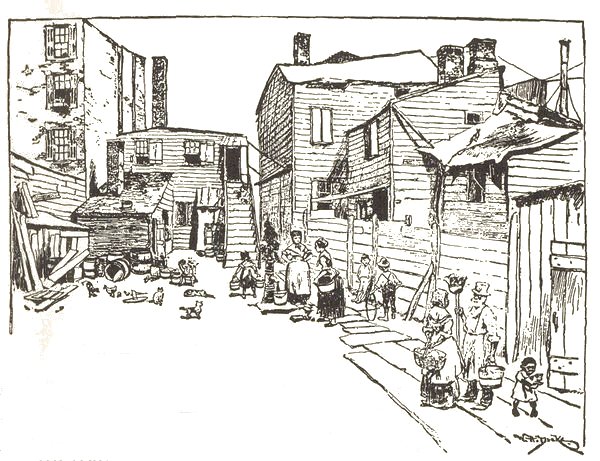
An Old Wooster Street Court.
The sketches of the Fourth Ward and Wooster Street barracks are reproduced from an old report of the Association for Improving the Condition of the Poor. They rightly made out, those early missionaries, that the improvement must begin with the people's homes, or not at all, and allowed no indifference on the part of the public to turn them from their path. It is worth the while of Chicago and the other Western cities that are growing with such joyful metropolitan ambitions, to notice that their slums look to-day very much as New York's did then. In fifty years how will it be? "The offspring of municipal neglect" the Assembly Committee of 1857 called our "tenement-house" system. "Forgetfulness of the poor" was the way a citizens' council put it. It comes to the same thing. Whether seen from the point of view of the citizen, the philanthropist, or the Christian, the slum is the poorest investment a city can make, and once made it is not easily unmade. In a Mississippi river town, when pleading for the turning over to the people's use of some vacant land on the river-shore that would make a fine breathing space, I was told that by and by they would consider it. Just now it was too valuable for factory purposes. When the city had grown opulent, in say twenty-five years, they would be willing to hand it over. Fatal delusion! Men do not grow that kind of sense as they grow rich. The land will be always "too valuable." When we in New York were scandalized at last into making a park of the Mulberry Bend, it cost us a million and a half, and it had made the slum a fixture, not to be dislodged. No! the way to fight the slum is to head it off. It is like fighting a fire. Chasing it up is hard and doubtful work; the chances are that you will not overtake it till the house is burned down.
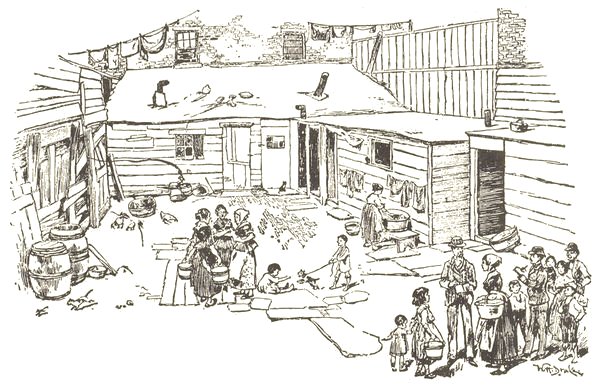
A Fourth Ward Colony in the Bad Old Days.
There were those who thought when the Civil War was over, that a big fire would not be the worst thing that could happen to New York; and, if it could have burned sense into men's minds as it burned up the evidence of their lack of it, they would have been right. But forty per cent—the rent some of the barracks brought—is a powerful damper on sense and conscience, even with the cholera at the door. However, the fear of it gave us the Citizens' Council of Hygiene, and New York heard the truth for once.
Men and women were found living in cellars deep down under the ground. One or two of those holes are left still in Park Street near the Five Points Mission, but they have not been used as living-rooms for a generation. In cellars near the river the tide rose and fell, compelling the tenants "to keep the children in bed till ebb-tide." The plumber had come upon the field, but his coming brought no relief. His was not a case of conscience. "Untrapped soil pipes opened into every floor and poisoned the tenants."
Where the "dens of death" were in Baxter Street, big barracks crowded out the old shanties. More came every day. I remember the story of those shown in the picture. They had been built only a little while when complaint came to the Board of Health of smells in the houses. A sanitary inspector was sent to find the cause. He followed the smell down in the cellar and, digging there, discovered that the waste pipe was a blind. It had simply been run three feet into the ground and was not connected with the sewer.
The houses were built to sell. That they killed the tenants was no concern of builder's. His name, by the way, was Buddensiek. A dozen years after, when it happened that a row of tenements he was building fell down ahead of time, before they were finished and sold, and killed the workmen, he was arrested and sent to Sing Sing for ten years, for manslaughter.
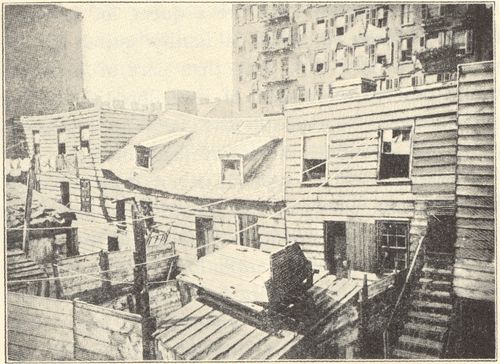
Dens of Death.
That time he had forgotten to put lime in the mortar. It was just sand. When the houses fell in the sight of men, the law was at last able to make him responsible. It failed in the matter of the soil pipe. It does sometimes to this very day. Knocking a man in the head with an axe, or sticking a knife into him, goes against the grain. Slowly poisoning a hundred so that the pockets of one be made to bulge may not even banish a man from respectable society. We are a queer lot in some things. However, that is hardly quite fair to society. It is a fact that that part of it which would deserve the respect of its fellow-citizens has got rid of its tenement-house property in recent years. It speculates in railway shares now.
Twenty cases of typhoid fever from a single house in one year was the record that had gone unconsidered. Bedrooms in tenements were dark closets, utterly without ventilation. There couldn't be any. The houses were built like huge square boxes, covering nearly the whole of the lot. Some light came in at the ends, but the middle was always black. Forty thousand windows, cut by order of the Health Board that first year, gave us a daylight view of the slum: "damp and rotten and dark, walls and banisters sticky with constant moisture." Think of living babies in such hell-holes; and make a note of it, you in the young cities who can still head off the slum where we have to wrestle with it for our sins. Put a brand upon the murderer who would smother babies in dark holes and bedrooms. He is nothing else. Forbid the putting of a house five stories high, or six, on a twenty-five foot lot, unless at least thirty-five per cent of the lot be reserved for sunlight and air. Forbid it absolutely, if you can. It is the devil's job, and you will have to pay his dues in the end, depend on it.
And while you are about it make a note of a fact we let go unheeded too long to our harm, and haven't grasped fully yet. The legislative committee of 1857 said it: "to prevent drunkenness provide every man with a clean and comfortable home." Call it paternalism, crankery, any other hard name you can think of, all the same it goes down underneath the foundation of things. I have known drunkards to wreck homes a plenty in my time; but I have known homes, too, that made drunkards by the shortest cut. I know a dozen now—yes, ten dozen—from which, if I had to live there, I should certainly escape to the saloon with its brightness and cheer as often and as long as I could to brood there perhaps over the fate which sowed desolation in one man's path that another might reap wealth and luxury. That last might not be my way, but it is a human way, and it breeds hatred which is not good mortar for us to build with. It does not bind. Let us remember that and just be sensible about things, or we shall not get anywhere.
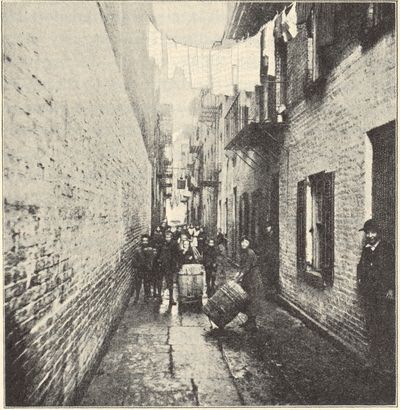
Gotham Court.
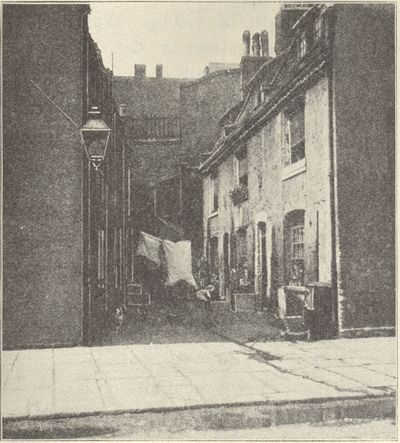
Green Dragon Yard, London.
Going through Whitechapel, London, about the time we were making ready to deal with Gotham Court as it deserved, I photographed Green Dragon yard as typical of what I saw about me. Compare the court and the yard and see the difference between our slum problem and that of Old World cities. Gotham Court contained 142 families when I made a canvass of it in the old days, comprising over 700 persons, not counting the vagrants who infested the cellars. The population of Green Dragon Yard was greater than the sight of it would lead you to expect, for in Whitechapel one-room flats were the rule; but with its utmost crowding it came nowhere near the court. Sullen discontent was the badge of it. Gotham Court was in an active state of warfare at all hours, for its population was evenly divided between Irish and Italians, with only two German families, who caught it from both sides. But there was hope in that, for they were on the move; before the court was torn down, one-third of its tenants were Greeks. Their slum over yonder is dead, black, given over to smoky chimneys and bad draughts, with red-eyed and hopeless men and women forever blowing the bellows on ineffectual fires. Ours is alive if it is with fighting. There is yeast in it, and bright skies without, if not within. I don't believe there is a bellows to be had in New York. Our slum, with its greater crowd, has more urgent need of sharp attention, chiefly because of the overflow of theirs which it receives. But after all, even that represents what still had courage and manhood enough to make it want to get away and do better. We shall "get there" if we don't give up. It sometimes seems to me that their only hope is to get here.
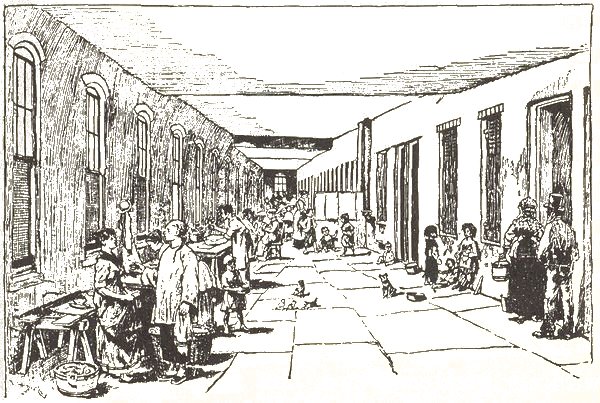
Flagged Hallway in the "Big Flat."
Speaking of the fair beginning of Gotham Court reminds me of the Big Flat in Mott Street, a mighty tenement with room for a hundred families that was another instance of reform still-born; by which I mean that it came before we were ready for it, and willing to back it up; also before we knew just how. That house was built by the philanthropists of those days on such a generous scale that it reached clear through the block to Elizabeth Street. It had not occurred to the builders that the neighborhood was one in which such an arrangement might prove of special convenience to the lawbreakers with which it swarmed. Thieves and thugs made it a runway, and decent people shunned it. Other philanthropists, with the will but without the wisdom that was needed, took it up and tried to make a workingwoman's home of it; but that end was worse than the beginning. The women would have none of the rules that went with the philanthropy, and the Big Flat lapsed back among the slum tenements and became the worst of a bad lot. I speak of it here because just now the recollection of it is a kind of a milestone in the battle with the slum. Twenty years after, A. T. Stewart, the merchant prince, set another in the Park Avenue Hotel which he intended for his working-girls; and that was a worse failure than the first, for it never served the purpose he intended for it. And now, just as I am writing this, they are putting the finishing touches to a real woman's hotel up-town which will not be a failure, though it will hardly reach the same class which the remodellers of the Big Flat had in mind. However, we shall get there, too, now we know the way.
The tenement had grown its logical crop. In the sweating conspiracy it is a prime factor. Its extortionate rates make the need, and the need of the poor was ever the opportunity of their oppressor. What they have to take becomes the standard of all the rest. Sweating is only a modern name for it. The cause is as old as the slum itself.
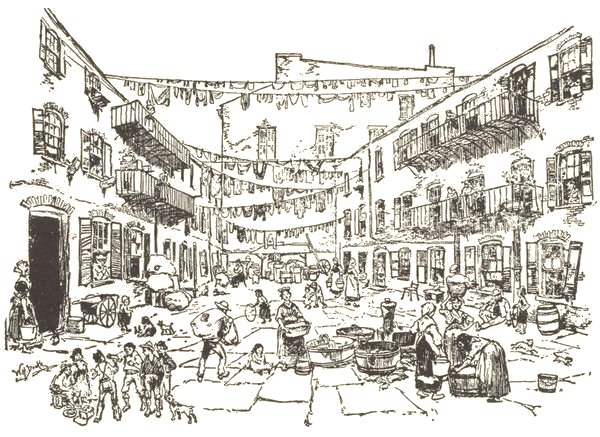
Jersey Street Rookeries.
However, the new light was not without its allies. Chief among them was the onward march of business that wiped out many a foul spot which had sorely, tried the patience of us all. A carriage factory took the place of the Big Flat when it had become a disgusting scandal. Jersey Street, a short block between Mulberry and Crosby streets, to which no Whitechapel slum could hold a candle, became a factory-street. No one lives there now. The last who did was murdered by the gang that grew as naturally out of its wickedness as a toadstool grows on a rotten log. He kept the saloon on the corner of Crosby Street. Saloon and tenements are gone together. Where they were are rows of factories, empty and silent at night. A man may go safely there now at any hour. I should not have advised strangers to try that when it was at its worst, though Police Headquarters was but a block away.
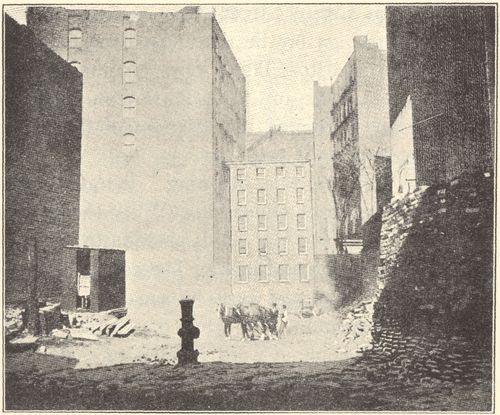
The Survival of the Unfittest.
I photographed that phase of the battle with the slum just before they shut in the last tenement in the block with a factory building in its rear. It stood for a while after that down in a deep sort of pocket with not enough light struggling down on the brightest of days to make out anything clearly in the rooms,—truly a survival of the unfittest; but the tenants stayed. They had access through a hallway on Crosby Street; they had never been used to a yard; as for the darkness, that they had always been used to. They were "manured to the soil," in the words of Mrs. Partington. But at length business claimed the last foot of the block, and peace came to it and to us.
All the while we were learning. It was emphatically a campaign of education. When the cholera threatened there was the old disposition to lie down under the visitation and pray. The council pointed to the fifteen hundred cases of smallpox ferreted out by its inspectors "in a few days," and sternly reminded the people of Lord Palmerston's advice to those who would stay an epidemic with a national fast, that they had better turn to and clean up. We pray nowadays with broom in hand, and the prayer tells. Do not understand me as discouraging the prayer; far from it. But I would lend an edge to it with the broom that cuts. That kind of foolishness we got rid of; the other kind that thinks the individual's interest superior to the public good—that is the thing we have got to fight till we die. But we made notches in that on which to hang arguments that stick. Human life then counted for less than the landlord's profits; to-day it is weighed in the scale against them. Property still has powerful pull. "Vested rights" rise up and confront you, and no matter how loudly you may protest that no man has the right to kill his neighbor, they are still there. No one will contradict you, but they won't yield—till you make them. In a hundred ways you are made to feel that vested rights are sacred, if human life is not. But the glory is that you can make them yield. You couldn't then.
We haven't reached the millennium yet. But let us be glad. A hundred years ago they hanged a woman on Tyburn Hill for stealing a loaf of bread. To-day we destroy the den that helped make her a thief.[Back to Contents]