BATTLE OF THE BIG HOLE. (continued 2)
Reading edition
And the Nez Percés accepted the lesson so taught. So soon as their village was well out of the way of Gibbon's rifles, they started for the British Possessions, and though closely pursued by troops all the way, who thrice overtook and attacked them en route, they made no other stand until General Miles headed them off near Bear Paw Mountain in Northern Montana, and captured nearly all their horses. Then they were compelled to fight or surrender. They made a four days' fight, but it was a spiritless one, and finally succumbed to the inevitable, and laid down their arms.
It has for years been claimed, and repeatedly shown, that one white man was equal to three or four Indians in a fight, position and other things being equal, and rarely has any band of Indians been encountered who would willingly stand their ground and fight white men, either soldiers or citizens, unless certain that they outnumbered the whites to some such extent. But here was a body of Nez Percés who stood bravely up against a force of nearly half their own numbers; who fought so desperately and so gallantly that the troops who assaulted them and at first put them to flight, were afterward compelled to fall back and take cover; who followed these troops; hemmed them in; advanced on them; harassed them with a deadly fire for twenty hours; only withdrawing when they had reason to believe that reinforcements for the troops were at hand.
Yet General Gibbon and his Spartan band of veterans attacked this superior force, charged into its midst, drove it from its camp in confusion, fought it hand-to-hand in the brush, and inflicted on it such a punishment as probably no command of equal numbers has ever before inflicted on Indians under similar conditions and in so short a time. Several of the veterans who were in this action, and who had fought Sioux Indians repeatedly, said afterward that they would rather fight five Sioux than one Nez Percé. It is, therefore, the highest possible tribute to Gibbon and his men, to record the fact that they were able to hold their ground for a day against such a force as this, and to kill and wound so many of them.
Eighty-nine dead Indians were found and buried on the field, nearly three times the number of men lost by General Gibbon, and it is known that a large number of mortally wounded warriors were carried away and hidden during the day and night that the soldiers never found. Ranchmen residing near the battle-field tell us that they find skeletons in the neighboring forests every summer; some of them two or three miles away from the battle-ground; some of them hidden in gulches and among rocks and logs, which they suppose to be those of Indians killed in this fight, and who were doubtless carried away and concealed by their friends, or who, finding themselves mortally wounded, crawled hither and hid themselves to die in seclusion rather than have their bodies fall into the hands of the white men.
Besides, it is said that Joseph carried away with him a number who were so seriously wounded that they died on the trail. He is said to have admitted, after his final capture, that 208 of his people were killed in the Big Hole fight. If this be true, then there were a larger number of Indians killed than of white men engaged. It is a well-known fact, that only about one hundred warriors finally surrendered to General Miles, and that only about one hundred escaped to the British Possessions at the time of the surrender. Hence the conclusion seems just, that 200 or more must have been lost in the fight with Gibbon.
How skillfully General Gibbon planned his attack on the Nez Percés; how quietly and stealthily he moved his little army down Trail Creek and up along the side of the bluff; how carefully he formed it in line of battle within a stone's-throw of the hostile camp without alarming it, and all in the dead of night; how gallantly his men charged through the jungle, waded the river, swept through the camp dealing death to its fleeing occupants; how the men subsequently took and held their position in the mouth of Battle Gulch under the galling fire of these trained warriors, are facts which no one can properly realize and appreciate save those who were there.
But the battle-field tells its own mute story even now. As I walked over it and saw the hundreds of bullet marks on trees, rocks, and logs, and thought of the thousands of other missiles that entered the earth and left no abiding marks, I was impressed with the remarkable accuracy of the shooting done by the Indians. Nearly every tree and every object in the valley and in the mouth of Battle Gulch capable of bearing a bullet mark is cut and scarred in a frightful manner, and some of the trees are literally girdled. Many of the teepee poles that still lie scattered over the river bottom have bullet holes through them, and thousands of empty cartridge-shells still lie scattered over the field, though it is said that thousands more have been carried away by relic hunters or trampled into the earth.
No true American can read the record of this light without feeling proud that he is an American; that he is a brother to the brave men who stood so nobly together under such an ordeal—an ordeal, in short, that will stand in history on a parallel with the charge of Balaklava or the battle of Bunker's Hill.
As an evidence of the severity of this fight, and of the courage displayed by the officers, attention is called to the fact that of the seventeen engaged, seven of them were hit fourteen times, as follows:
General Gibbon, thigh 1
Captain Williams, head and body 2
Captain Logan, head (killed) 1
Lieutenant Bradley, head (killed) 1
Lieutenant Coolidge, both hands and legs 3
Lieutenant English, head, wrist, and back (died of wounds) 3
Lieutenant Woodruff, both thighs and heel 3
Total 14
CHAPTER VI.
Veterans of the civil war, and men who have been years on the frontier, who have participated in many of the most sanguine Indian campaigns ever fought, say this was the most hotly-contested field they were ever on. They tell us that never have they seen such cool and determined fighting, at such short range, kept up for so long a time, by Indians; that never have they known so many bullets placed with such deadly accuracy, and so few to fly wild as in this fight. Nearly every man engaged in the action, white or red, officer, private soldier, or citizen, seemed a cool, deliberate sharpshooter; and the fact that after the first assault both parties kept closely covered all day, alone accounts for the fact that so many survived the fiery ordeal. The Indians did splendid work and elicited from the beleaguered soldiers expressions of admiration for their marksmanship, as well as for their bravery and prowess in fierce, close work.
An old sergeant, who was with the Seventh at Gettysburg, when it aided so nobly in holding Little Round Top, says there was no hotter place on that historic hill than he found in the Big Hole on the 9th of August, 1877.
After the battle General Gibbon issued the following congratulatory order to his men:
[Regimental Orders, No. 27.]
Headquarters Seventh Infantry, Battle-Field of the Big Hole, Montana Territory, Aug. 11, 1877.
The regimental commander congratulates the regiment upon the result of the conflict here with the hostile Nez Percés on the 9th and 10th inst. While mourning for the dead, Capt. William Logan and First Lieut. James H. Bradley and the twenty-one enlisted men, who fell gallantly doing a soldier's duty, we can not but congratulate ourselves that after a stern chase of over 250 miles, during which we twice crossed the rugged divide of the Rocky Mountains, we inflicted upon a more numerous enemy a heavier loss than our own, and held our ground until it gave up the field.
In respect to the memory of the gallant dead, the officers of the regiment will wear the usual badge of mourning for thirty days.
John Gibbon,
Colonel Seventh Infantry, Commanding.
Official: Levi F. Bennett, First Lieutenant and Adjutant Seventh Infantry.
In this connection it is deemed proper to give the following facts in regard to General Gibbon's record as a soldier:
He was born in Pennsylvania and appointed to the Military Academy at West Point from North Carolina. Graduated July 1, 1847, brevet second lieutenant. He was commissioned a second lieutenant September 18, 1847. Served in the Mexican war and in the Seminole war in Florida. Promoted to first lieutenant September 12, 1850. Served as instructor of artillery at West Point 1854 to 1859. Promoted to captain November 2, 1859. Served in Utah 1860-61. Was chief of artillery on General McDowell's staff, October, 1861, to May, 1862. Brigadier-general of volunteers May, 1862.
Was in the battles of Grangeville, Manasas, South Mountain, and Antietam. Brevetted major-general of volunteers for gallant and meritorious conduct at Antietam. He held an important command at the battle of Fredericksburg, where he was severely wounded. Was brevetted lieutenant-colonel U.S.A. for gallant and meritorious services at the battle of Fredericksburg. Was severely wounded at the battle of Gettysburg while commanding the Second Corps, and brevetted colonel U.S.A. for gallant and meritorious service in that action.
He also held an important and responsible command in the Richmond campaign, and was brevetted brigadier-general U.S.A. for gallant and meritorious services at Spotsylvania. Was commissioned major-general of volunteers June 7, 1864. Brevetted major-general U.S.A. for gallant and meritorious conduct in the capture of Petersburg. Mustered out of the volunteer service June 15, 1866, and commissioned a colonel U.S.A. July 28, 1866. Promoted to brigadier-general U.S.A. July 10, 1885, and appointed to the command of the district of the Rocky Mountains. He commanded the column that rescued Reno from the Sioux Indians in June, 1876.
An officer who has served with him several years, and knows him intimately, says:
"He is an able writer and deep thinker, a thorough soldier, and no politician; honest, strict on duty, and genial and kind off duty. He is brave as a man can be in battle. A true and loving husband, a kind father, and the truest kind of a friend. A thorough sportsman, temperate, modest, and as careful of the wellfare of the humblest enlisted man as of his chief of staff." Capt. Constant Williams, in a private letter to the author, under date of December 23, 1888, says: "I wish to bear testimony of the noble bearing of General Gibbon during the whole time the fight was in progress, under the most trying circumstances. His coolness and utter indifference to danger were so marked, and so admirable, that I have ever since that day taken him as my model for a commander."
Yet, notwithstanding this long record of brilliant services and well-merited rewards; notwithstanding this great and good man has grown gray fighting his country's battles; notwithstanding he has acquired, by study and experience, a military education and training second to none ever acquired by an American, a man who was suddenly elevated from private life to the high office of Secretary of War has recently seen fit to publicly reprimand him for what he was pleased to term a disobedience of orders. The alleged offense consisted in General Gibbon's having pardoned a private soldier, who had been by court-martial convicted of a misdemeanor and imprisoned. He had served several months of his term, when General Gibbon, under whose orders the court-martial had been held, deeming him already sufficiently punished, issued a pardon and ordered him released. The One hundred and Twelfth Article of War expressly authorizes such action on the part of department commanders, but the Secretary of War, deeming his power greater than that which makes the laws, had previously issued an order forbidding commanding officers to issue pardons in such cases, and General Gibbon was accordingly severely reprimanded for a violation of this order. He appealed to the President, and that "Man of Destiny," ignoring the organic law of the land, approved the action of his Secretary.
Thus, a man who has rendered such distinguished services to his country as to merit the gratitude and reverence of every loyal American; a man who has spent the best years of his life in fighting his country's battles and in studying and obeying her laws, was insulted and degraded by men who, so far as true moral worth is concerned, are unworthy to sit at the same table with him.
Capt. William Logan entered the regular army before the beginning of the late war, and rose from the ranks through the successive grades of corporal, sergeant, second and first lieutenants. He was commissioned a captain October 4, 1878. He saw a great deal of active service during the civil war, and bore an excellent reputation as a brave soldier.
First Lieut. James H. Bradley had been in the army eleven years, during the greater portion of which time he had been in active service on the frontier; had participated in several Indian campaigns, and had repeatedly distinguished himself for coolness and bravery in the face of danger.
First Lieut. William L. English was commissioned a second lieutenant in the One-hundred and First Regiment, Illinois Volunteers, May 1, 1863. On March 5, 1864, he was promoted to a first lieutenancy, and mustered out of the volunteer service June 7, 1865. He was appointed a second lieutenant in the regular army June 18, 1867, and promoted to the rank of first lieutenant October 24, 1874. His record is also that of a brave and capable officer.
Of the other officers who participated in the fight and survived its dangers, the following facts will no doubt be of interest to the general public:
General Gibbon is now (February, 1888) in command of the Department of the Columbia, with headquarters at Vancouver Barracks, Washington.
Captain Comba is on recruiting service at Pittsburg, Pa. He is within two files of the rank of major, and in the usual course of events will be promoted to that grade within a year or two. Captain Sanno is stationed at Fort McKinney, Wyoming, and Captain Williams at Fort Laramie, Wyoming. Captain Browning died in Paris, May 1, 1882, and Captain Rawn at Lancaster, Pa., October 6, 1887.
Lieutenant Coolidge was promoted to a captaincy, vice Logan, August 9, 1877, and is now stationed at Camp Pilot Butte, Wyoming. Lieutenant Jacobs was promoted to a captaincy in the Quartermaster's Department, 1882, and is now stationed at Atlanta, Ga.
Lieutenant Jackson was made a captain November 14, 1885, and is now stationed at Fort Washakie, Wyoming.
Lieutenant Woodruff was promoted to a captaincy in the Subsistence Department for gallant and meritorious conduct in the battle of the Big Hole, and is now on duty at General Gibbon's headquarters, March, 1878.
Second Lieutenant Van Orsdale was promoted to first lieutenant August 20, 1877, and regimental quartermaster June 1, 1885, and is stationed at Fort Laramie, the present headquarters of the Seventh Regiment.
Lieutenant Harden is detailed at West Point as instructor in tactics.
Lieut. Francis Woodbridge is on indefinite leave of absence at Detroit, Mich., awaiting retirement on account of ill health.
CHAPTER VII.
A grateful country has erected on the Big Hole battle-field a fitting monument, a modest but enduring shaft of solid granite, which marks the scene of the bloody conflict and tells in mute but eloquent words the story of the victory won there. The base of the monument is five feet six inches square; the pedestal is four feet six inches square by three feet seven inches in height, and the height of the entire structure is nine feet ten inches. On the north face of the shaft are carved the words:
ERECTED BY THE UNITED STATES.
On the East Face the Words:
ON THIS FIELD 17 OFFICERS AND 138 MEN OF THE 7TH U.S. INFANTRY, UNDER ITS COLONEL, BVT. MAJOR-GENERAL JOHN GIBBON, WITH 8 OTHER SOLDIERS AND 36 CITIZENS, SURPRISED AND FOUGHT ALL DAY A SUPERIOR FORCE OF NEZ PERCÉ INDIANS, MORE THAN ONE-THIRD OF THE COMMAND BEING KILLED AND WOUNDED.
On the south is inscribed:
TO THE OFFICERS AND SOLDIERS OF THE ARMY, AND CITIZENS OF MONTANA, WHO FELL AT BIG HOLE, AUGUST 9, 1877, IN BATTLE WITH NEZ PERCÉ INDIANS.
And on the west side is a list of the soldiers and citizens killed in the action, which is the same as that already quoted from General Gibbon's report.
THE MONUMENT ON THE BIG HOLE BATTLE-FIELD.
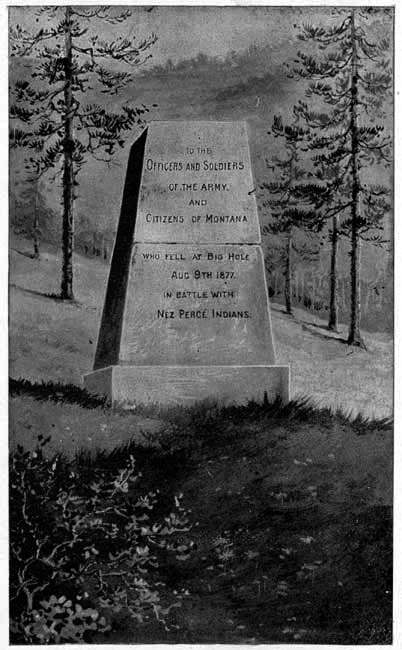
The stone was cut in Concord, N. H., shipped to Dillon, Mont., by rail, and hauled from there to the battle-field by ox teams. It was placed in position in September, 1883, by a detachment of soldiers from Fort Missoula, under command of Capt. J. P. Thompson, of the Third Infantry. It cost about $3,000, an appropriation of that amount having been made for the purpose by Congress.
General Howard followed the Nez Percés through the mountains, and learning that they had determined to take refuge in the British Possessions he sent a courier to General Miles, at Fort Keogh, who, taking the field at the head of six hundred men, headed off the fugitives at Bear Paw Mountains in Northern Montana, and captured them after a desultory fight lasting through four days.
Chief Joseph's reply to General Miles' demand for surrender is a curiosity in the way of Indian rhetoric. It is in these words:
"Tell General Howard I know his heart. What he told me before I have in my heart. I am tired of fighting. Our chiefs are killed. Looking Glass is dead. Too-hul-hul-sote is dead. The old men are all dead. It is the young men who say yes or no. He who led on the young men is dead. It is cold and we have no blankets. The little children are freezing to death. My people, some of them, have run away to the hills, and have no blankets, no food; no one knows where they are—perhaps freezing to death. I want to have time to look for my children and see how many of them I can find. Maybe I shall find them among the dead. Hear me, my chiefs. I am tired; my heart is sick and sad. From where the sun now stands I will fight no more forever."
As stated in Joseph's message, while the negotiations for the surrender were in progress, White Bird, with a few of his followers, escaped through Miles' lines and fled to the north. They were not pursued, and succeeded in time in reaching Woody Mountain, in the Northwest Territory, where Sitting Bull and his band were encamped at the time. When the Sioux saw the Nez Percés coming, they supposed them to be their enemies, the Black Feet, and prepared to fight them, but White Bird halted when within a mile of the Sioux camp, sent in a runner to announce himself, and when the Sioux learned who their visitors were, they received them with open arms.
Major Walsh, of the Northwest mounted police, happened to be in Sitting Bull's camp at the time, and describes White Bird and his people as being the toughest looking party of Indians he had ever seen. Their horses were mere skin and bone; some of them scarcely able to walk. The Indians, men, women, and children, were half naked, some of them with hands and feet frozen, and they had not a pound of food of any kind with them.
Too-hul-hul-sote and Looking Glass were both killed in the fight with Miles.
White Bird is still living near Fort MacLeod, in the Northwest Territory, with his family and a few followers.
After the surrender, Joseph and a few of his retainers were sent to Fort Leavenworth, where they were imprisoned until July 21, 1878, at which time they were placed in charge of the Indian Bureau and located in the Indian Territory. In June, 1885, they were removed to the Colville Reservation, in Washington Territory, where they now live unrestrained. Joseph is hale, hearty, and cheerful, and has accumulated considerable wealth in the way of cattle and horses. He says he will never again go on the war path; that he has had enough of fighting pale-face soldiers; that their bravery is more than a match for the cunning and prowess of the red man.
And to Gibbon's command, more than to any and all others who pursued and fought Joseph and his men, belongs the honor of having broken the proud spirits of these dusky warriors; of having killed their best men; of having defeated them on their chosen field. To Gibbon and his brave men, in short, belong the laurels of the Nez Percé war of 1877.
BY THE SAME AUTHOR.
Cruisings in the Cascades.
A Narrative of Travel, Exploration, Amateur Photography, Hunting, and Fishing, with special chapters on hunting the Grizzly Bear, the Buffalo, Elk, Antelope, Rocky Mountain Goat and Deer; also on Trouting in the Rocky Mountains; on a Montana Roundup; Life among the Cowboys, etc. 12mo. Cloth, $2.00; Half Morocco, $3.00.
Hunting in the Great West.
(Rustlings in the Rockies.) Hunting and Fishing Sketches by Mountain and Stream. 12mo. Cloth. Over 300 pages. Illustrated. Price, 75 cents. Contents: Part I. Rustlings in the Rockies. Part II. In the Big Horn Mountains. Part III. Ten Days in Montana. Part IV. The Gulf Coast of Florida. Part V. Miscellaneous.
Special Books for Sportsmen.
Angler's Guide Book, The, and Tourist's Gazetteer of the Fishing Waters of the United States and Canada. Compiled and edited by William C. Harris, editor, of the "American Angler." 8vo, 249 pages; cloth, $1.00.
The Rand-McNally Official Railway Guide and Handbook. Published monthly by the American Railway Guide Co., with official corrections and revisions to date. Complete, compact and convenient. Accompanied by Rand, McNally & Co.'s Official Railway Map of the United States, Canada and Mexico, and an index to all important railway stations in those countries. Price, per number, 25 cents.
Where the Trout Hide. By Kit Clarke. Illustrated. Containing also a detailed description of a newly opened, easily accessible, and beautiful country, whose waters teem with brook trout, black bass, and land-locked salmon. 16mo, cloth, $1.00; paper, 50 cents.
Wild Fowl Shooting. Their resorts, habits, flight, and most successful method of hunting. By William Bruce Leffingwell. Illustrated. Cloth, $2.50; half morocco, $3.50.
"There is not a book which could have been written that was needed by sportsmen more than one on wild fowl shooting, and one could not have been written which would have covered the subject, in all its points, more thoroughly."—American Field.
Indexed Pocket Maps of every State and Territory in the Union, and of each of the Canadian Provinces, showing in detail the entire railroad system, and locating every station and post office. Each, 25 cents.
Send for complete list of maps and guides.
Rand, McNally & Co., PUBLISHERS, CHICAGO AND NEW YORK.
GUIDE BOOKS.
BAEDEKER'S GUIDES.
The Eastern Alps, including the Bavarian Highlands, the Tyrol, Salzkammergut, Styria, Carinthia, Carniola, and Istria $2.50
England, Wales, and Scotland, as far as Loch Maree and the Cromarty Firth 3.75
London and Its Environs, Including Excursions to Brighton, the Isle of Wight, etc 2.50
The Rhine, from Rotterdam to Constance 2.50
Belgium and Holland 2.00
Northern Germany 2.50
Southern Germany and Austria, including Hungary and Transylvania 2.50
Paris and its Environs 2.50
Central Italy and Rome 2.50
Northern Italy, including Leghorn, Florence, Ravenna, the Island of Corsica, and routes through France, Switzerland, and Austria 2.50
Southern Italy and Sicily, with Excursions to the Lipari Islands, Malta, Sardinia, Tunis, and Corfu 2.50
Norway and Sweden 3.00
Switzerland, and the adjacent portions of Italy, Savoy, and the Tyrol 2.75
The Travelers' Manual of Conversation, In four languages—English, French, German, and Italian 1.25
Palestine and Syria 7.50
Lower Egypt, with the Fayum and the Peninsula of Sinai 5.50
MISCELLANEOUS GUIDES.
Murray's Handbook for Travelers in Ireland $4.00
France. By the author of "Madamoiselle Mori," etc. 1.25
The Land of Greece. Described and illustrated by Chas. Henry Hanson 4.00
Florence. By Augustus J. C. Hare. 1.00
Walks in Rome. By Augustus J. C. Hare 3.50
The Maritime Provinces (Canada). Osgood 1.50
All Round Route and Panoramic Guide (Hudson, St. Lawrence, Niagara, etc.) By C. R. Chisholm 1.50
The Thousand Islands. By F. B. Hough 1.25
General Guide to the United States and Canada. 2 Vols. Part I.—Eastern States and Canada; Part II.—Western and Southern States. Each. 1.25
Rand, McNally & Co.'s Guide to the Pacific Coast, California, Arizona, New Mexico, Colorado, and Kansas. Paper, .75; cloth. 1.00
A Week in Chicago. Profusely illustrated. .25
Pictoral Guide of Chicago. With folded map and many illustrations. .25
Guide Book for Mt. Desert. By Mrs. Clara Barnes 1.00
Rand, McNally & Co.'s Illustrated Guide to Niagara Falls. .25
Official Guide to the Yellowstone National Park. By John Hyde. Cloth, $1.00; paper .50
The Mexican Guide. By Thos. A. Janvier. Revised yearly. 2.50
Any book sent postpaid on receipt of price. Besides the above partial list we keep in stock a large selection of Guide Books, Maps, and works of reference for tourists and travelers. We publish pocket maps of all the American States and Territories, the Canadian Provinces, and Foreign Countries, and can furnish maps and guides to every country and every important city in the world.
Send for complete list to
Rand, McNally & Co., MAP AND BOOK PUBLISHERS, 148 to 154 Monroe St., CHICAGO.
THE
Globe Library
Read The

A New Series of Selected Writings
BY THE BEST AUTHORS. AT POPULAR PRICES.
SOLD
On All Trains, And by Booksellers Generally.
Rand, McNally & Co., PUBLISHERS, CHICAGO AND NEW YORK.
Send for Catalogue.