The Battle of New Orleans
Reading edition
Gulf Coast Campaign, Preceding the Final Struggle.
On the 26th of November, 1814, a fleet of sixty great ships weighed anchor, unfurled their sails, and put to sea, as the smoke lifted and floated away from a signal gun aboard the Tonnant, the flagship of Admiral Sir Alexander Cochrane, from Negril Bay, on the coast of Jamaica. Nearly one half of these vessels were formidable warships, the best of the English navy, well divided between line-of-battle ships of sixty-four, seventy-four, and eighty guns, frigates of forty to fifty guns, and sloops and brigs of twenty to thirty guns each. In all, one thousand pieces of artillery mounted upon the decks of these frowned grimly through as many port-holes, bidding defiance to the navies of the world and safely convoying over thirty transports and provisioning ships, bearing every equipment for siege or battle by sea and for a formidable invasion of an enemy's country by land. Admiral Cochrane, in chief command, and Admiral Malcombe, second in command, were veteran officers whose services and fame are a part of English history.
On board of this fleet was an army and its retinue, computed by good authorities to number fourteen thousand men, made up mainly of the veteran troops of the British military forces recently operating in Spain and France, trained in the campaigns and battles against Napoleon through years of war, and victors in the end in these contests. Major Latour, Chief Engineer of General Jackson's army, in his "Memoirs of the War in Florida and Louisiana in 1814-15," has carefully compiled from British official sources a detailed statement of the regiments, corps, and companies which constituted the army of invasion under Pakenham, at New Orleans, as follows:
Fourth Regiment— King's Own, Lieutenant-colonel Brooks 750 Seventh Regiment— Royal Fusileers, Lieutenant-colonel Blakency 850 Fourteenth Regiment— Duchess of York's Own, Lieutenant-colonel Baker 350 Twenty-first Regiment— Royal Fusileers, Lieutenant-colonel Patterson 900 Fortieth Regiment— Somersetshire, Lieutenant-colonel H. Thornton 1,000 Forty-third Regiment— Monmouth Light Infantry, Lieutenant-colonel Patrickson850 Forty-fourth Regiment— East Essex, Lieutenant-colonel Mullen 750 Eighty-fifth Regiment— Buck Volunteers, Lieutenant-colonel Wm. Thornton 650 Ninety-third Regiment— Highlanders, Lieutenant-colonel Dale 1,100 Ninety-fifth Regiment— Rifle Corps, Major Mitchell 500 First Regiment— West India (colored), Lieutenant-colonel Whitby 700 Fifth Regiment— West India (colored), Lieutenant-colonel Hamilton 700 A detachment from the Sixty-second Regiment 350 Rocket Brigade, Artillery, Engineers, Sappers and Miners 1,500 Royal Marines and sailors from the fleet 3,500 ————— Total 14,450
Including artillerists, marines, and others, seamen of the ships' crews afloat, there were not fewer than eighteen thousand men, veterans in the service of their country in the lines of their respective callings, to complete the equipment of this powerful armada.
At the head of this formidable army of invasion were Lord Edward Pakenham, commander-in-chief; Major-general Samuel Gibbs, commanding the first, Major-general John Lambert, the second, and Major-general John Keene, the third divisions, supported by subordinate officers, than whom none living were braver or more skilled in the science and practice of war. Nearly all had learned their lessons under the great Wellington, the conqueror of Napoleon. Since 1588, when the combined naval and military forces of England were summoned to repel the attempted invasion and conquest of that country by the Spanish Armada, the British Government had not often fitted out and sent against an enemy a combined armament so powerful and so costly as that which rendezvoused in the tropical waters of Negril Bay in the latter autumn days of 1814. Even the fleet of Nelson at the Battle of the Nile, sixteen years before, where he won victory and immortal honors by the destruction of the formidable French fleet, was far inferior in number of vessels, in ordnance, and in men to that of Admiral Cochrane on this expedition. The combined equipment cost England forty millions of dollars.
In October and November of this year, the marshaling of belligerent forces by sea and land from the shores of Europe and America, with orders to rendezvous at a favorable maneuvering point in the West Indies, caused much conjecture as to the object in view. That the War Department of the English Government meditated a winter campaign somewhere upon the southern coasts of the United States was a common belief; that an invasion of Louisiana and the capture and occupation of New Orleans was meant, many surmised. For reasons of State policy, the object of the expedition in view was held a secret until the day of setting sail. Now it was disclosed by those in command that New Orleans was the objective point, and officers and men were animated with the hope that, in a few weeks more, they would be quartered for the winter in the subjugated capital of Louisiana, with a dream that the coveted territory might be occupied and permanently held as a possession of the British Empire.
The Government at Washington was advised that, during the summer and early autumn months of 1814, our implacable enemy was engaged in preparations for a renewal of hostilities on a scale of magnitude and activity beyond anything attempted since the war began; but it seemed not fully to interpret the designs and plans of the British leaders. Especially unfortunate, and finally disastrous to the American arms, was the inaptness and inertness of the Secretary of War, General Armstrong, in failing to adopt, promptly and adequately, measures to meet the emergency. For almost a year after the destruction of the English fleet on Lake Erie by Commodore Perry, and of the English army at the battle of the Thames by General Harrison, a period of comparative repose ensued between the belligerents. The British Government was too much absorbed in delivering the coup-de-main to the great Napoleon to give attention to America. But her opportunity came. The allied powers defeated and decimated the armies of the French Emperor, and forced him to capitulate in his own capital. On the 3d of March, 1814, they entered Paris. On the eleventh of May Napoleon abdicated, and was sent an exile to Elba.
England was at peace with all Europe. Her conquering armies and fleets would be idle for an indefinite period; yet, it would be premature to disband the former or to dismantle the latter. Naturally, attention turned to the favorable policy of employing these vast and ready resources for the chastisement and humiliation of her American enemies, as a fit closing of the war and punishment for their rebellious defiance. Under orders, the troops in France and Spain were marched to Bordeaux and placed in a camp of concentration, from which they were debarked in fleets down the river Garonne, and across the Atlantic to their destinations in America. An English officer with these troops expressed the sentiment of the soldiers and seamen, and of the average citizen of England at this time, in this language: "It was the general opinion that a large proportion of the Peninsular army would be transported to the other side of the Atlantic, that the war would there be carried on with vigor, and that no terms of accommodation would be listened to, except such as a British general should dictate in the Republican Senate."
Overtures for the negotiation-of a treaty of peace had been interchanged between the two nations at war as early as January. By April the American Commissioners were in Europe, though the arrival of the English Commissioners at Ghent for final deliberations was delayed until August. Meanwhile, several thousands of these Peninsular troops were transported to reinforce the army in Canada. On the sixteenth of August a small fleet of British vessels in Chesapeake Bay was reinforced by thirty sail under the command of Admirals Cochrane and Malcombe, one half of which were ships of war. A large part of this flotilla moved up the Potomac and disembarked about six thousand men, under command of General Ross. The battle of Bladensburg was fought on the twenty-fourth, followed immediately by the capture of Washington and the burning of the Government buildings there. A few days after, the combined naval and military British forces were defeated in an attack on Baltimore, General Ross, commander-in-chief, being among the slain. About the same date, Commodore McDonough won a great and crushing victory over the English fleet on Lake Champlain, while the British army of fourteen thousand men, under Sir George Prevost, was signally defeated by the Americans, less than seven thousand in number, at Plattsburg, on the border of New York.
Such was the military situation in the first month of autumn, 1814. Seemingly, the British plenipotentiaries had a motive in reserve for delaying the negotiations for peace. England yet looked upon the United States as her wayward prodigal, and conjured many grievances against the young nation that had rebuked her cruel insolence and pride in two wars. She nursed a spirit of imperious and bitter revenge. A London organ, recently before, had said: "In diplomatic circles it is rumored that our military and naval commanders in America have no power to conclude any armistice or suspension of arms. Terms will be offered to the American Government at the point of the bayonet. America will be left in a much worse situation as a commercial and naval power than she was at the commencement of the war."
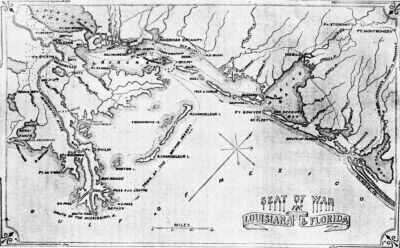
SEAT OF WAR. LOUISIANA & FLORIDA ( click on image for a larger version)
The reverses to the British arms on Lake Champlain, at Plattsburg, and at Baltimore, virtually ended hostilities in the Northern States for the remaining period of the war. Winter approaching, all belligerent forces that could be marshaled would be transferred to the waters of the Gulf for operations on the coast there. The malice and wanton barbarity of the English in burning the national buildings and property at Washington, in the destruction and loot of houses, private and public, on the shores of the Chesapeake and Atlantic, and in repeated military outrages unjustified by the laws of civilized warfare, had fully aroused the Government and the citizenship to the adoption of adequate measures of defense for the Northern and Eastern States. It was too late, however, to altogether repair the injuries done to the army of the Southwest by the tardiness and default of the head of the War Department, which, as General Jackson said in an official report, threatened defeat and disaster to his command at New Orleans. Indignant public sentiment laid the blame of the capture of Washington, and of the humiliating disasters there, to the same negligence and default of this official, which led to his resignation soon after.
General Jackson Assumes Command of the Seventh Military District of the Southwest.
General Andrew Jackson had, in July, 1814, been appointed a major-general in the United States army, and assigned the command of the Southern department, with headquarters at Mobile. His daring and successful campaigns against the Indian allies of the British the year previous had won for him the confidence of the Government and of the people, and distinguished him as the man fitted for the emergency. At the beginning of the war British emissaries busily sought to enlist, arm, and equip all the Indians of the Southern tribes whom they could disaffect, as their allies, and to incite them to a war of massacre, pillage, and destruction against the white settlers, as they did with the savage tribes north of the Ohio River. In this they were successfully aided by Tecumseh, the Shawanee chief, and his brother, the Prophet. These were sons of a Creek mother and a Shawanee brave. By relationship, and by the rude eloquence of the former and the mystic arts and incantations of the latter, they brought into confederacy with Northern tribes—which they had organized as allies of the English in a last hope of destroying American power in the West—almost the entire Creek nation. These savages, though at peace under treaty and largely supported by the fostering aid of our Government, began hostilities after their usual methods of indiscriminate massacre and marauding destruction, regardless of age or sex or condition, against the exposed settlers. The latter sought refuge as they could in the rude stockade stations, but feebly garrisoned. At Fort Mims, on the Alabama River, nearly three hundred old men and women and children, with a small garrison of soldiers, were captured in a surprise attack by a large body of warriors, and all massacred in cold blood. This atrocious outbreak aroused the country, and led to speedy action for defense and terrible chastisement for the guilty perpetrators. The British officers offered rewards for scalps brought in, as under Proctor in the Northwest, and many scalps of men and women murdered were exchanged for this horrible blood-money.
In October, 1813, General Jackson led twenty-five hundred Tennessee militia, who had been speedily called out, into the Creek country in Alabama. A corps of one thousand men from Georgia, and another of several hundred from the territory of Mississippi, invaded the same from different directions. Sanguinary battles with the savages were fought by Jackson's command at Tallasehatche, Talladega, Hillabee, Autosse, Emuckfau, Tohopeka, and other places, with signal success to the American arms in every instance. The villages and towns of the enemy were burned, their fields and gardens laid waste, and the survivors driven to the woods and swamps. Not less than five thousand of the great Ocmulgee nation perished in this war, either in battle or from the ruinous results of their treachery after. Nearly one thousand of the border settlers were sacrificed, one half of whom were women and children or other non-combatants, the victims of the malignant designs and arts of British emissaries. The chief of the Creeks sued for peace, and terms were negotiated by General Jackson on the 14th of August, 1814.
From his headquarters at Mobile, in September, 1814, General Jackson, with sleepless vigilance, was anticipating and watching the movements of the British upon the Gulf coast, and marshaling his forces to resist any attack. There had been reported to him the arrival of a squadron of nine English ships in the harbor of Pensacola. Spain was at peace with our country, and it was due that the Spanish commandant of Florida, yet a province of Spain, should observe a strict neutrality pending hostilities. Instead of this comity of good faith and friendship, the Spanish officials had permitted this territory to become a refuge for the hostile Indians. Here they could safely treat with the British agents, from whom they received the implements of war, supplies of food and clothing, and the pay and emoluments incident to their services as allies in war. In violation of the obligations of neutrality, the Spanish officials not only tolerated this trespass on the territory of Florida, but, truckling to the formidable power and prestige of the great English nation, they dared openly to insult our own Government by giving aid and encouragement to our enemy in their very capital.
The most important and accessible point in Spanish Florida was Pensacola. Here the Governor, Gonzalez Maurequez, held court and dispensed authority over the province. The pride of the Spaniards in the old country and in Florida and Louisiana was deeply wounded over the summary sale of the territory of Louisiana by Napoleon to the United States in 1803; recalling the compulsory cession of the same to France by Spain in 1800. Naturally they resented with spirit what they deemed an indignity to the honor and sovereignty of their nation. The Spanish minister at Washington entered a solemn protest against the transaction; questions of boundaries soon after became a continuing cause of irritating dispute. The Dons contended that all east of the Mississippi River was Florida territory and subject to their jurisdiction. A military demonstration by General Wilkinson, then in command of the army of the Southwest, was ordered from Washington, opposition awed into silence, and the transfer made. In brief time after the boundaries of Florida were fixed on the thirty-first degree of north latitude, and east of a line near to the present boundary between Louisiana and Mississippi. Previously Mobile was the seat of government for Florida, but American aggression made the removal of the Government to Pensacola compulsory, and gave an additional cause of grievance to our sensitive neighbors. Under British auspices and promises of protection, the Governor displayed his resentment.
To confirm the report that came to him at Mobile of the arrival of an English squadron in Pensacola Bay, and of treacherous aid and comfort being given by the Spanish Governor, Jackson sent as spies some friendly Indians to the scene of operations, with instructions to furtively observe all that could be seen and known, and report to him the information. It was confirmed that the ships were in the harbor, and that a camp of English soldiers was in the town; that a considerable body of Indian recruits had been armed and were being drilled, and that runners had been dispatched to the country to invite and bring others to the coast to join them as comrades in arms. A few days after, a friendly courier brought news that several hundred marines had landed from the ships, that Colonel Nichols in command and his staff were guests of Governor Maurequez, and that the British flag was floating with the flag of Spain over one of the Spanish forts.
An order issued about this time by Colonel Nichols to his troops, followed by a proclamation to the people of Louisiana and Kentucky, revealed in visible outlines something of the purposes and plans of the menacing armaments. He advised his command that the troops would probably soon be called upon to endure long and tedious marches through forests and swamps in an enemy's country, and exhorted them to conciliate their Indian allies and "never to give them just cause of offense." He addressed the most inflammatory appeals to the national pride and prejudices of the French people of Louisiana, and to supposed discontented citizens of Kentucky, whose grievances had grown out of their neglect by the National Government or been engendered by the arts of designing politicians and adventurers.
Battle at Mobile Bay—the British Repulsed.
General Jackson strongly suspected that Louisiana would be invaded, and that New Orleans was designed to be the main and final point of attack. Yet he was led to believe that the British would attempt the capture of Mobile first, for strategic reasons. Early in September he reinforced the garrison of Fort Bowyer, situated thirty miles south of Mobile. This fortification, mounting twenty cannon, commanded the entrance to the harbor. It was garrisoned by one hundred and thirty men, under the command of Major William Lawrence. On the fifteenth of September the attack was made by a squadron of four ships of war, assisted by a land force of seven hundred marines and Indians. Though the enemy mounted ninety-two pieces of artillery, in the assault made they were defeated and driven off to sea again, with a loss of two hundred killed and wounded, the flagship of the commander sent to the bottom, and the remaining ships seriously damaged.
Assault and Capture of Pensacola, the Spanish Capital of Florida—the British Driven To Sea.
Incensed at the open and continued violations of neutrality by the Spanish Governor, who had permitted Pensacola to be made a recruiting camp for the arming and drilling of their Indian allies by the British, General Jackson determined to march his army against this seat of government, and to enforce the observance of neutrality on the part of the Spanish commandant at the point of the bayonet if need be. He had removed his headquarters to Fort Montgomery, where by the first of November his command consisted of one thousand regular troops and two thousand militia, mainly from Tennessee and Mississippi—in all, about three thousand men. With these he set out for Pensacola, and on the evening of the sixth of November encamped within two miles of the town. He sent in Major Peire, bearing a flag of truce to the Governor, with a message that Pensacola must no longer be a refuge and camp for the enemies of the United States, and that the town must be surrendered, together with the forts. The messenger was fired on and driven back from Fort St. Michael, over which the British flag had been floating jointly with the flag of Spain. The firing was done by British troops harbored within. Governor Maurequez disavowed knowledge of the outrage, but refused to surrender his authority. The next morning the intrepid Jackson entered the town and carried by storm its defenses, the British retreating to their ships and putting off to sea. Fort Barrancas was blown up by the enemy, to prevent the Americans from turning its guns upon the escaping British vessels. The Spanish commandant made profuse apologies, and pledged that he would in future observe a strict neutrality.
Jackson, fearing another attempt to capture Mobile by the retiring fleet, withdrew from Pensacola and marched for the former place, arriving there on the eleventh of November. At Mobile, messengers from those in highest authority at New Orleans met him, urging that he hasten there with his army and at once begin measures for the defense of that city. Information had been received by W.C. Claiborne, then Governor of Louisiana, from a highly credited source—most unexpected, but most fortunate and welcome—that the vast British armament of ships and men rendezvousing in the West Indies was about ready to sail, and that New Orleans was assuredly the objective point of the expedition.
Lafitte, the Pirate of the Gulf, and His Sea-rovers, Loyal To the American Cause.
The informant was the celebrated Captain Jean Lafitte, the leader of the reputed pirates of the Gulf, who had been outlawed by an edict of our Government. The circumstances were so romantic, and displayed such a patriotic love for and loyalty to our country, that they are worthy of brief mention. As Byron wrote, he
Left a corsair's name to other times, Linked with one virtue and a thousand crimes.
But this does injustice to these marauders of the sea, who put in a plea of extenuation. The disparity of their virtues and their crimes is overwrought in the use of poetic license. Before the period of the conquest of Guadeloupe by the English, the French Government in force on that island had granted permits to numerous privateersmen to prey upon the commerce of the enemy, as our own Government had done in two wars. Now they could no longer enter the ports of that or of any other of the West India islands, with their prizes and cargoes. Lafitte and his daring sea-rovers made of the Bay of Barataria, on the Gulf coast sixty miles south of New Orleans, a place of rendezvous and headquarters for their naval and commercial adventures. From this point they had ready and almost unobserved communication by navigable bayous with New Orleans and the marts beyond. They formed a sequestered colony on the shores of Barataria, and among the bold followers of Lafitte there were nearly one hundred men skilled in navigation, expert in the use of artillery, and familiar with every bay and inlet within one hundred miles of the Crescent City. Their services, if attainable, might be made invaluable in the invasion and investment of New Orleans contemplated by the British, who through their spies kept well informed of the conditions of the environment of the city. The time seemed opportune to win them over. If not pirates under our laws, they were smugglers who found it necessary to market the rich cargoes they captured and brought in as privateersmen. Barred out by other nations, New Orleans was almost the lone market for their wares and for their distribution inland. Many merchants and traders favored this traffic, and had grown rich in doing so, despite the severity of our revenue laws against smuggling and the protests of other nations with whom we were friendly.
One of the Lafitte brothers and other leaders of the outlawed community were under arrest and held for trial in the Federal Court at New Orleans at this time. From Pensacola, Colonel Nichols sent Captains Lockyer, of the navy, and Williams, of the army, as emissaries to offer to the Baratarian outlaws the most enticing terms and the most liberal rewards, provided they would enlist in the service of the British in their invasion of Louisiana. Lafitte received them cautiously, but courteously. He listened to their overtures, and feigned deep interest in their mission. Having fully gained their confidence, they delivered to him sealed packages from Colonel Nichols himself, offering thirty thousand dollars in hand, high commissions in the English service for the officers, and liberal pay for the men, on condition that the Baratarians would ally themselves with the British forces. After the reading of these documents, the emissaries began to enlarge on the subject, insisting on the great advantages to result on enlisting in the service of his Britannic Majesty, and the opportunity afforded of acquiring fame and fortune. They were imprudent enough to disclose to Lafitte the purpose and plans of the great English flotilla in the waters of the Gulf, now ready to enter upon their execution. The army of invasion, supported by the navy of England, would be invincible, and all lower Louisiana would soon be in the possession of the British. They would then penetrate the upper country, and act in concert with the forces in Canada. On plausible pretexts the emissaries were delayed for a day or two, and then returned to their ship lying at anchor outside the pass into the harbor. Lafitte lost little time in visiting New Orleans and laying before Governor Claiborne the letters of Colonel Nichols and the sensational information he had received from the British envoys.
It was this intelligence which was borne in haste to General Jackson at Mobile, by the couriers mentioned previously. The Lafittes promptly tendered the services of themselves, their officers, and their men, in a body to the American army, and pledged to do all in their power, by sea and land, to defeat and repel the invading enemy, on condition that the Government would accept their enlistment, pardon them of all offenses, and remove from over them the ban of outlawry. This was all finally done, and no recruits of Jackson's army rendered more gallant and effective service, for their numbers, in the stirring campaign that followed. They outclassed the English gunners in artillery practice, and showed themselves to be veterans as marines or soldiers.
On receipt of this information of Lafitte, confirmed from other secret and reliable sources, the citizens were aroused. A mass-meeting was held in New Orleans and a Committee of Safety appointed, composed of Edward Livingston, Pierre Fouchet, De la Croix, Benjamin Morgan, Dominique Bouligny, J.A. Destrahan, John Blanque, and Augustine Macarte, who acted in concert with Governor Claiborne, and with the Legislature called into session.
Jackson Arrives in New Orleans.
General Jackson left Mobile on the twenty-first of November and arrived with his little army at New Orleans on the second of December, and established headquarters at 984 (now 406) Royal Street. He found the city well-nigh defenseless, while petty factions divided the councils of leaders and people, especially rife among the members of the Legislature. There was, incident to recent changes of sovereignties and conditions of nationalities, serious disaffection on the part of a most respectable element of the population of Louisiana and Florida toward the American Government. The French and Spaniards, who mainly composed the population, intensely loved their native countries with a patriotic pride. They knew allegiance to no other, until a few years before, by the arbitrary edicts of Napoleon, all of Louisiana was sold and transferred to the United States. Other causes of irritation added to the bitterness of resentment felt by the old Spanish element. Spain tenaciously insisted on enforcing her claims of sovereignty to all territory from the east bank of the Mississippi to the Perdido River, on the east line of Alabama. But the American settlers within the same became turbulent, and in October, 1810, these bold bordermen organized a filibustering force of some strength, captured and took possession of Baton Rouge, killing Commandant Grandpre, who yet asserted there the authority of Spain. When Congress met, in December, 1810, an act was passed in secret session authorizing the President to take military possession of the disputed coast country in certain contingencies. Under orders from Washington, General Wilkinson, with a force of six hundred regulars, marched against Mobile, took possession of the Spanish fort, Charlotte, and caused the garrison to withdraw to Pensacola.
This precipitate action—the British envoy protesting against such informal occupation—was justified at home on the plea of strong grounds of suspicion that England herself might suddenly assert sovereignty over the same territory under secret treaty with Spain. Amid these rude and revolutionary proceedings, all within a decade of years, necessarily there followed a tumult of differing sentiment and contentions among the Spanish, French, and American people of the section. Fortunately the French element were of a nativity whose country had been for generations the inveterate enemy of the English, our common foe. If there were any who felt resentment before over the enforced change of allegiance from beloved France to the stranger sovereignty, when the crisis of campaign and battle came none were more gallant and brave in meeting the invading enemy.
On the ninth of December the great English flotilla appeared off Chandeleur Islands, and came to anchor near to Ship Island, the shallowness of the water not permitting the nearer approach to the main shore of vessels so large. The British authorities yet believed that the destination of this fleet was unknown to the Americans ashore; but in this they were mistaken, as they afterward admitted. The inadequacy of men and means and measures to properly meet and repel such an invading force, as mentioned before, was mainly due to the tardy negligence of the department at Washington. The sleepless vigilance and untiring energy of General Jackson was in marked contrast to this, not only within his own military jurisdiction, but in the whole region around. His trusty spies, pale and dusky, were everywhere, and little escaped his attention. The situation was now critical in the extreme. Fortunately, the unbounded confidence all had in their military chief inspired hope and infused energy among the people. He had never been defeated in battle. If any one could wrest victory now out of the inauspicious and chaotic conditions that threatened disaster, they believed it to be General Jackson.
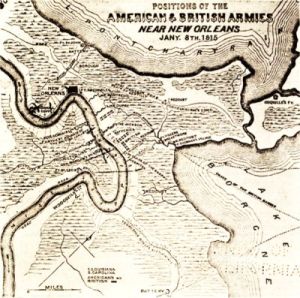
( click on image for a larger version)
Marvelous was the change wrought by his timely appearance on the theater of active operations. The partial attempts to adopt measures of defense were of little avail. The joint committee of the Legislature to act in concert with Governor Claiborne, Commodore Patterson, and the military commandant, had done but little as yet. There was wanting the concentration of power always needed in military operations. Latour, in his "Memoirs of the War of 1814-15," graphically describes the condition of affairs as he saw and knew them to exist:
Confidence was wanting in the civil and military authorities, and a feeling of distrust and gloomy apprehension pervaded the minds of the citizens. Petty disputes on account of two committees of defense, unfortunately countenanced by the presence and influence of several public officials, had driven the people to despondency. They complained, not without cause, that the Legislature wasted time, and consumed the money of the State, in idle discussions, when both time and money should have been devoted to measures of defense. The banks had suspended payment of their notes, and credit was gone. The moneyed men had drawn in their funds, and loaned their money at the ruinous rates of three or four per cent per month. The situation seemed desperate; in case of attack, none could hope to be saved only by miracle, or by the wisdom and genius of a great commander.
After his habit of giving his personal attention to every detail, General Jackson, on his arrival, visited Fort St. Philip, ordered the wooden barracks removed, and had mounted additional heavy artillery. He caused two more batteries to be constructed, one on the opposite bank of the Mississippi, and the other half a mile above, with twenty-four pounders in position, thus fully guarding the approach by the mouth of the river. He then proceeded to Chef Menteur, as far as Bayou Sauvage, and ordered a battery erected at that point. He continued to fortify or obstruct the larger bayous whose waters gave convenient access to the city between the Mississippi and the Gulf.
As early as July before, the Secretary of War, in view of the formidable armaments of England, had made requisition of the several States for ninety-three thousand five hundred men for general defensive purposes, under a law of Congress enacted the previous April. The quota of Kentucky was fifty-five hundred infantry; of Tennessee, twenty-five hundred infantry; of Mississippi territory, five hundred infantry, and of Louisiana, one thousand infantry. That portion of the quota of Kentucky destined for New Orleans, twenty-two hundred men, and a portion of the quota of Tennessee, embarked upon flatboats to float fifteen hundred miles down the Ohio and Mississippi waters, had not arrived on the tenth of December. Through the energetic efforts of the Governor, aided by Major Edward Livingston and the Committee of Safety, the quota of Louisiana was made up. With these, General Coffee's Tennesseans, Major Hinds' Mississippians, and one thousand regular troops, there were less than three thousand men for defensive operations yet available.
Battle of the Gunboats With the Fleet of Barges.
An event was soon to happen which seemed for the time an irreparable disaster to the American cause. Commodore Daniel T. Patterson, in command of the American naval forces, on learning of the approach of the British fleet, sent Lieutenant Thomas Ap Catesby Jones, with five gunboats, one tender, and a dispatch boat toward the passes out to Ship Island, to watch the movements of the British vessels. This little flotilla, barely enough for scout duty at sea, was the extent of our naval forces in the Gulf waters near. The orders were to fall back, if necessary, from near Cat Island to the Rigolets; and there, if hard pressed, to sink or be sunk by the enemy. Moving in waters too shallow for the large English ships to pursue, until the thirteenth, Lieutenant Jones sailed for Bay St. Louis. Sighting a large number of the enemy's barges steering for Pass Christian, he headed for the Rigolets. But the wind having died away and an adverse current set in, the little fleet could get no farther than the channel inside of Melheureux Island, being there partially grounded. Early on the morning of the fourteenth, a flotilla of barges formed in line was discovered coming from the direction of the enemy's ships, evidently to overtake and attack the becalmed gunboats. The two tenders, lying beyond the aid of the latter, were captured after a spirited resistance. The guns of these were now turned upon Lieutenant Jones' gunboats in a combined attack of the fleet of barges, forty-five in number, and a supporting squad of marines. The total equipment was twelve hundred men and forty-five pieces of artillery. The American defensive forces were seven small gunboats, manned by thirty guns and one hundred and eighty men. The enemy's oarsmen advanced their entire fleet in line of battle until the fire from the gunboats caused severe losses and some confusion in the movements of the barges. They then separated in three divisions and renewed the attack. The battle became general, and was contested fiercely for nearly two hours, when the gunboats, overpowered by numbers, were forced to surrender, losing six men killed and thirty-five wounded, among the latter Lieutenants Jones, Speddin, and McKeever, each in command of a boat. Several barges of the enemy were sunk, while their losses in killed and wounded were estimated at two to three hundred. Among the wounded were Captain Lockyer, in command, and other officers.
The preparations for defense on shore were now pushed forward with redoubled energy. General Jackson gave unremitting attention to the fortifying of all points which seemed available for the approach of the enemy; it was impossible to know at what point he might choose to make his first appearance on land. Captain Newman, in command of Fort Petit Coquille, at the Rigolets, next to Lake Pontchartrain, was reinforced, and the order given to defend the post to the last extremity. If compelled to abandon it, he was instructed to fall back on Chef Menteur. Swift messengers were sent to Generals Carroll and Thomas to make all speed possible with the Tennessee and Kentucky troops on their way to New Orleans. Also, a courier was dispatched to General Winchester, commanding at Mobile, warning of the possible danger of another attack on that place, since the loss of the gunboats. Major Lacoste, with the dragoons of Feliciana and his militia battalion of colored men, was directed, with two pieces of artillery, to take post at the confluence of Bayous Sauvage and Chef Menteur, throw up a redoubt, and guard the road. Major Plauche was sent with his battalion to Bayou St. John, north of the city, Major Hughes being in command of Fort St. John. Captain Jugeant was instructed to enlist and form into companies all the Choctaw Indians he could collect, a mission that proved nearly barren of results. The Baratarians, mustered into ranks and drilled for important services under their own officers, Captains Dominique You, Beluche, Sougis, Lagand, and Golson, were divided out to the forts named, and to other places where expert gunners were most needed.
On the eighteenth of December a grand review of the Louisiana troops was held by Jackson in front of the old Cathedral, now Jackson Square. The day was memorable by many incidents, not all in harmony with the purposes and plans of the civil and military leaders of defense. The entire population of the city and vicinity were present to witness the novel scenes, men and women vying with each other in applauding and enthusing the martial ardor of the soldiers on parade. Such an army, hastily improvised in a few brief days from city, country, and towns, made up of a composite of divergent race elements, as was that of the Louisiana contingent with the command of Jackson at New Orleans, was perhaps never paralleled in the history of warfare before. Major Plauche's battalion of uniformed companies was made up mainly of French and Spanish Creoles, with some of American blood, enlisted from the city; and from the same source came Captain Beale's Rifle Company, mostly American residents. The Louisiana militia, under General Morgan, were of the best element of the country parishes, of much the same race-types as Plauche's men, of newer material, and without uniforms. Then came the battalion of Louisiana free men of color, nearly three hundred strong, led by Major Lacoste, and another battalion of men of color, two hundred and fifty in number, commanded by Major Daquin, recruited from the refugees in New Orleans from St. Domingo, who had taken part in the bloody strifes in that island, and who bore like traditional hatred to the English, with all who spoke the French tongue. Add to the above a small detachment of Choctaw Indians; and lastly, the loyal pirates of Lafitte, who were patriotic enough to scorn the gold of England, and brave enough to offer their services and their lives, if need be, to the cause of our country; and together, these give us a picture of the men under review, whom Jackson was to lead to battle in a few days against the best-trained troops of Europe. Though of new material, and suddenly called into service, this provincial contingent of twelve hundred men, animated with the spirit of battle against an invading foe, proved themselves, when ably officered, the equals of the best troops in the field.
Jackson Declares Martial Law.
On the sixteenth, two days before the review, General Jackson issued from his headquarters an order declaring "the city and environs of New Orleans under martial law." This imperious edict was resorted to in the firm belief that only the exercise of supreme military authority could awe into silence all opposition to defensive operations. Every person entering the city was required to report himself to headquarters, and any one departing from it must procure a pass. The street lamps were extinguished at nine o'clock at night, and every one found passing after that hour was subject to arrest. All persons capable of bearing arms who did not volunteer were pressed into the military or naval service. Rumors were rife that British spies were secretly prowling in the city, and coming into the American camp. Reports of disloyal utterances and suspicious proceedings on the part of certain citizens came repeatedly to the ears of the commander-in-chief. More serious yet, he was aroused to fierce anger by personal and direct intelligence that certain leading and influential members of the Legislature favored a formal capitulation and surrender of Louisiana to the enemy, by that body, in the event of a formidable invasion, for the greater security of their persons and property. These persons had circulated a story that Jackson would burn the city and all valuable property in reach rather than let it fall into the hands of the British.
Determined that disloyalty should find no foothold to mar his military plans, or to disaffect the soldiery or citizens, General Jackson, on the day previous to his declaration of martial law, issued the following spirited order:
To the Citizens of New Orleans.
The Major-general commanding, has, with astonishment and regret, learned that great consternation and alarm pervade your city. It is true the enemy is on our coast and threatens to invade our territory; but it is equally true that, with union, energy, and the approbation of Heaven, we will beat him at every point his temerity may induce him to set foot on our soil. The General, with still greater astonishment, has heard that British emissaries have been permitted to propagate seditious reports among you, that the threatened invasion is with a view to restore the country to Spain, from the supposition that some of you would be willing to return to your ancient government. Believe not such incredible tales; your Government is at peace with Spain. It is the vital enemy of your country,—the common enemy of mankind, the highway robber of the world, that threatens you. He has sent his hirelings among you with this false report, to put you off your guard, that you may fall an easy prey. Then look to your liberties, your property, the chastity of your wives and daughters. Take a retrospect of the conduct of the British army at Hampton, and other places where it entered our country, and every bosom which glows with patriotism and virtue, will be inspired with indignation, and pant for the arrival of the hour when we shall meet and revenge these outrages against the laws of civilization and humanity.
The General calls upon the inhabitants of the city to trace this unfounded report to its source, and bring the propagator to condign punishment. The rules and articles of war annex the punishment of death to any person holding secret correspondence with the enemy, creating false alarm, or supplying him with provision. The General announces his determination rigidly to execute the martial law in all cases which may come within his province.
By command. Thomas L. Butler,
Aid-de-camp.
Bayou Bienvenue and the British Spies of The Fishermen's Village.
Bayou Bienvenue, formerly called St. Frances River, drains all the waters of a swamp-basin, of triangular form and about eighty square miles in surface, bounded on the west by New Orleans, on the northwest by Chef Menteur, and on the east by Lake Borgne, into which it empties. It receives the waters of several other bayous from the surrounding cypress swamps and prairies. It is navigable for vessels of one hundred tons burden as far as the junction with old Piernas Canal, twelve miles from its mouth. It is about one hundred and twenty yards in width, and has from six to nine feet of water at the bar, according to the flow of the tides. Its principal branch is Bayou Mazant, which runs to the southwest and receives the waters of the canals of the old plantations of Villere, Lacoste, and Laronde, on and near which the British army encamped, about eight miles below New Orleans. The banks of these bayous, which drain the swamp lands on either side of the Mississippi, are usually about twelve feet below the banks of the river, which have been elevated by the deposit of sediment from overflows for centuries. These slopes, from the banks back to the swamps, usually ten to eighteen hundred yards, drain off the waters and form the tillable lands of the sugar and cotton planters. They are protected from overflows by levees thrown up on the banks of the river. These plantation lands formed the only ground in this country for the encampment of a large army, or available for a march on New Orleans. On nearly all the large sugar plantations canals were cut from the bank of the river running back to the swamp, to furnish at high tides water-power for mills which did the grinding or sawing for the plantations.
Bayous Bienvenue and Mazant, as mentioned, formed a waterway from Lake Borgne to the rear of the plantations of Villere, Lacoste, and Laronde, situated but two or three hours' easy march to the city, to which there was a continuous roadway through the plantation lands between the river and the swamps. The enemy was fully informed of every point of approach by spies within the military lines, and since the capture of the gunboats determined on an attempt to secretly invade the environing country, and to assault and capture New Orleans by surprise. But one mile from Lake Borgne, on the low bank of Bayou Bienvenue, was a village of Spanish and Portuguese fishermen and their families. From the bayous and adjacent lakes they furnished the city markets with fish, and were familiar with every body of water and every nook and inlet for many miles around. A number of these became notorious as spies in the pay of the British. Of this treacherous little colony, the names of Maringuier, Old Luiz, Francisco, Graviella, Antonio el Italiano, El Campechano, Mannellilo, and Garcia became known as connected with this disloyalty. These served the English as pilots to their barges, as guides to the best approaches to New Orleans, and as ready spies within and without. The English commander in charge sent Captain Peddie, of the army, on the twentieth of December, as a spy in the disguise of one of these fishermen, to inspect and report upon the feasibility of entering with the army at the mouth of Bayou Bienvenue, landing at the plantations above and marching suddenly by this route on the city. Old Luiz and two others of the fishermen were his guides. He safely and without suspicion penetrated to Villere's plantation, viewed the field for encampment there, and noted the easy route of approach to the city, without an obstruction in the way. His report being most favorable, the British officer in command decided at once on invasion and attack from this direction.
Five Thousand British Troops enter Bayou Bienvenue and Land near Villere's Plantation.
By Jackson's order, Major Villere, son of General Villere, the owner of the plantation, placed a picket of twelve men at Fisherman's Village on the twenty-first, to watch and report promptly in case the enemy appeared there. After midnight, near the morning of the twenty-third, five advance barges bearing British troops glided noiselessly into Bienvenue from Lake Borgne, capturing the picket of twelve men without firing a gun. Soon after, the first division of the invading army, twenty-five hundred strong, under command of Colonel Thornton, appeared in eighty barges, and passed up the bayous to Villere's canal, where a landing was effected by the dawn of day. After a brief rest and breakfast, the march of two miles was made to Villere's plantation, arriving there at half-past eleven. The troops at once surrounded the house of General Villere, and surprised and made prisoners a company of the Third Louisiana Militia stationed there. Major Villere, after capture, escaped through a window at the risk of his life, reached the river bank and crossed over in a small boat, and hastened to New Orleans with the startling news. Colonel Laronde also escaped, and reached headquarters in the early afternoon; on the day before he had reported the sighting of several suspicious vessels out upon Lake Borgne, seemingly to reconnoiter.
Jackson had ordered Majors Latour and Tatum, of his engineer corps, to reconnoiter in the direction of the Laronde and Lacoste plantations, and to carefully examine this avenue of approach by the enemy. These officers left the city at eleven o'clock, and had reached Laronde's, when they met several persons fleeing toward the city, who told them of the arrival of the British at Villere's, and of the capture of the outpost there. It was then but half-past one o'clock. The two scouts put spurs to their horses, and by two o'clock the General was informed of the facts. With that heroic promptness and intuition characteristic and ever present with him, he exclaimed with fierce emphasis: "By the eternal! the enemy shall not sleep upon our soil!" The invading movement was a complete surprise, and there was not yet a defensive work to obstruct the march of the British upon the coveted city. Only genius and courage of the highest order could have met successfully such an emergency, and Jackson alone seemed equal to the occasion.
Jackson Determines To Attack—bloody Night-battle of the Twenty-third of December.
Orders were issued rapidly, as the report of the alarm-gun gave notice to all to be ready. The troops were stationed within a radius of a few miles of the city, in garrisons. Major Plauche was summoned to bring down his battalion of uniformed volunteers from Bayou St. John, which summons was obeyed in a run all the way. General Coffee, encamped four miles above the city, under similar order, was at headquarters within one hour. Colonel McRae, with the Seventh regulars, Lieutenant Spotts, with two pieces of artillery, and Lieutenant Bellevue, with a detachment of marines, were all formed on the road near Montruil's plantation. Coffee's riflemen and Hinds' Mississippi dragoons formed the advance in the order of march. Beale's Orleans Rifles followed closely after, and by four o'clock these had taken position at Rodrique's Canal. The battalion of men of color, under Major Daquin, the Forty-fourth regulars, under Captain Baker, and Plauche's men, were in close supporting distance.
Commodore Patterson was requested to arm such vessels lying in the river as were ready, and to drop down and take station opposite the enemy. The schooner Carolina was put in position; the sloop of war Louisiana could not steer in the stream. Governor Claiborne, with the First, Second, and Fourth Louisiana Militia, occupied a post in the plain of Gentilly, to cover the city on the side of Chef Menteur. A picket of five mounted men was fired on near the line of Laronde's and Lacoste's plantations, and driven in about four o'clock. A negro was apprehended, who had been sent by the British with printed copies of a proclamation in Spanish and French, in terms as follows: "Louisianians! remain quiet in your houses; your slaves shall be preserved to you, and your property respected. We make war only against Americans." This was signed by Admiral Cochrane and General Keene. Other copies were found.
About nightfall the troops were formed in line of battle, the left composed of a part of Coffee's men, Beale's Rifles, the Mississippi dragoons, and some other mounted riflemen, in all about seven hundred and thirty men, General Coffee in command, Colonel Laronde as guide. Under cover of the darkness, they took position back of the plantation of the latter. The right formed on a perpendicular line from the river to the garden of Laronde's plantation, and on its principal avenue. The artillery occupied the high road, supported by a detachment of marines. On the left of the artillery were stationed the Seventh and Forty-fourth regulars, Plauche's and Daquin's battalions, and a squad of Choctaw Indians, all under the command of Colonel Ross.
The second invading division of the British army, made up of the Twenty-first, Forty-fourth, and Ninety-third Regiments, with a corps of artillery, in all about twenty-five hundred men, was disembarked at the terminus of Villere Canal at half-past seven o'clock in the evening of the twenty-third, just as the roar of the ship's cannon announced the opening of the night battle. At seven o'clock Commodore Patterson had anchored the Carolina in the Mississippi, as requested, in front of the British camp, and but a good musket-shot away. Such was the security felt by the enemy in camp that they stood upon the levee and viewed her as a common boat plying the river. Within thirty minutes she opened upon the enemy a destructive fire which spread consternation and havoc throughout their camp. In half an hour more they were driven out, with many killed and wounded. About eight o'clock the troops on the right, led by Jackson himself, began the attack on the enemy's left. The Seventh and Forty-fourth regulars became hotly engaged along the line, supported by McRae's artillery. Plauche's and Daquin's battalions coming up, the fighting became furious from the road to Laronde's garden. The British were forced back within the limits of Lacoste's plantation, the combatants being often intermingled and fighting hand-to-hand, almost undistinguishable in the darkness of night, made denser by the smoke of battle and the gathering fog.
Meanwhile, Coffee's troops, from the rear of Laronde's plantation, were moved to the boundary limits of Lacoste and Villere, with a view of taking the enemy in the rear. Coffee extended his front and ordered his men to move forward in silence and to fire without orders, taking aim as best they could. They drove the enemy before them, and took a second position in front of Lacoste's plantation. Here was posted the Eighty-fifth Regiment of the British army, which was forced back by the first fire toward their main camp. Captain Beale's Riflemen advanced on the left into the British camp at Villere's, driving the enemy before them and taking some prisoners, but sustained some loss before joining Coffee again. Coffee's division finally took a last position in front of the old levee, near Laronde's boundary, where it harassed the enemy as they fell back, driven by Jackson on the right. By ten o'clock the British had fallen back to their camp in discomfiture, where they were permitted to lay in comparative quiet until morning, except their harassment from the artillery fire of the schooner Carolina. In the darkness and confusion of combat at dead of night lines were broken and order lost at times, until it was difficult to distinguish friends from foes. General Jackson led his troops back to the opening point of the attack and rested them there until morning, when he fell back over one mile to Rodrique's Canal, the position selected for the defense of the city.
Three hundred and fifty of the Louisiana militia, under command of General David Morgan, were stationed at English Turn, seven miles below Villere's, and nearly fourteen miles from New Orleans. Intelligence of the arrival of the British at Villere's, on the twenty-third, reached General Morgan's camp at one o'clock in the afternoon of the day. Officers and men expressed an eagerness to be led against the enemy; but General Morgan, not having then received orders from Jackson to that effect, deemed it prudent to hold them waiting in camp. At half-past seven o'clock, when the guns from the Carolina were heard bringing on the battle, it was found difficult to restrain them longer. Morgan finally, at the urgent request of his officers, gave orders to go forward, which the troops received with ardor. They reached a point near Jumonville's plantation, just below Villere's, when a picket guard in advance met a picket force of the enemy and fired on it; the fire was returned. A reconnoiter failing to discover the numbers and position of the enemy in his front, Morgan took a position in a field until three o'clock in the morning, when he marched his men back to camp. The failure of this command to join issue in this battle, in concert with the other commands of Jackson's army, was apparently most unfortunate. The records do not show what orders, if any, were sent from headquarters by Jackson to General Morgan in summoning his forces in the afternoon of the day for the attack at night. It is barely possible that the General neglected to dispatch an order to, or to communicate with, the commander of so important a body of troops, in numbers nearly one fifth of the entire American forces engaged, in a critical hour when every available soldier was needed on the field of combat. A swift messenger sent by Jackson from headquarters at two o'clock, as to other outpost commands, could easily have reached English Turn at five o'clock. General Morgan knew that the invading army were in bivouac seven miles above. By eight o'clock he could have had his troops in attacking distance of the enemy, and in their rear. When Jackson and Coffee assaulted the British lines at eight o'clock, and drove them back in confusion upon their camp, a spirited surprise attack by Morgan's command in the rear, any moment before nine o'clock, would probably have routed the entire British division engaged and forced them to lay down their arms or retreat to their boats. He did move his command forward, and halt them at some distance from the enemy, but it was probably too late. The battle was over and the opportunity gone.
An after-incident throws a ray of light upon the criticism of the day upon the above affair. Honorable Magloire Guichard, President of the House of Representatives, in his testimony before the Committee of Inquiry on the military measures employed by Jackson against the Legislature, said:
On the twenty-seventh of December, when I got home, I found Colonel Declouet (of Morgan's command), who had just crossed the river. Amid the conversation of the evening, I expressed my surprise at his not having attacked the British from the lower side, on the night of the twenty-third; that had he done so with the men under his command, at the same time with the troops coming from the city, all would have terminated on that evening, and the British would have laid down their arms. He expressed great sorrow that he had not been the master to do so. He declared that this was his intention, but that General Morgan refused to comply with his request. Afterwards, having resolved to come toward midnight to reconnoitre, they had met with a small picket, who fired upon them; they returned the fire, and then retired.
The British loss in this initial night-battle is put by our authorities at four to five hundred in killed, wounded, and prisoners. Their own official reports admit three to five hundred. The Americans had twenty-four killed, one hundred and fifteen wounded, and seventy-four made prisoners. The fall of Colonel Lauderdale, of Mississippi, was much lamented.
So unique in the annals of military experience was this fiercely fought night-battle, so startling in its surprise of the bold and confident Britons, and so characteristic of Jackson's grim humor of war, that it is interesting to know the impressions it made upon the minds of the enemy. With this view, we quote a vivid description from the history of an English officer who was in the campaigns against Napoleon, with Ross and Pakenham in America, and who was a participant in this battle, Captain Robert Gleig. He says:
About half-past seven at night our attention was drawn to a large vessel which seemed to be stealing up the river, opposite our camp, when her anchor was dropped and her sails quietly furled. She was repeatedly hailed, but gave no answer. An alarm spread through our bivouac, and all thought of sleep was abandoned. Several musket shots were fired at her, when we heard a commanding voice cry out: "Give them this for the honor of America!" The words were instantly followed by the flashes of her guns, and a deadly shower of grape swept down numbers in our camp.
Against this dreadful fire we had nothing as yet to oppose. We sought shelter under the levee, and listened in painful silence to the pattering of shot which fell among our troops, and to the shrieks and groans of the wounded who lay near by. The night was dark as pitch. Except the flashes of the enemy's guns, and the glare of our own deserted fires, not an object could be distinguished. In this state we lay helpless for nearly an hour, when a straggling fire of musketry, driving in our pickets, warned us to prepare for a closer and more desperate strife. This fire was presently succeeded by a fearful yell, while the heavens became illuminated on all sides by a semi-circular blaze of musketry.
Rushing from under the bank, the Eighty-fifth and Ninety-fifth Regiments flew to support the pickets; while the Fourth, stealing to the rear, formed close column as a reserve. But to describe this action is out of the question, for it was such a battle as the annals of warfare can hardly parallel. Each officer, as he was able to collect twenty or thirty men around him, advanced into the midst of the enemy, where they fought hand to hand, bayonet to bayonet, and sword to sword, with the tumult and ferocity of Homer's combats before the walls of Troy. Attacked unexpectedly in the dark, and surrounded by enemies before we could arrange to oppose them, no order or discipline of war could be preserved. We were mingled with the Americans before we could tell whether they were friends or foes. The consequence was that more feats of individual gallantry were performed in the course of the conflict than many campaigns might have afforded. The combat having begun at eight in the evening, and long and obstinately contested, continued until three in the morning; but the victory was decidedly ours, for the Americans retreated in the greatest disorder, leaving us in possession of the field. Our losses, however, were enormous. Not less than five hundred men had fallen, many of whom were our first and best officers.
The recall being sounded, our troops were soon brought together, forming in front of the ground where we had at first encamped. Here we remained until the morn, when, to avoid the fire of the vessel, we betook ourselves to the levee on the bank, and lay down. Here we lay for some hours, worn out with fatigue and loss of sleep, and shivering in the cold of a frosty morning, not daring to light a fire or cook a meal. Whenever an attempt was made, the ship's guns opened on us. Thus was our army kept prisoners for an entire day.
This was not a field victory for either combatant, but rather a drawn battle, as each party fell back to the lines occupied at the opening. It was a very great victory for the Americans in its bearings on the final issues of the campaign. The attack of Jackson was to the British like a bolt of lightning from a clear sky. It paralyzed and checked them on the first day, and at the first place of their encampment on shore, and enabled him to adopt measures to beat back the invaders in every attempt they made for a further advance inland. The enemy had found an open way and expected an easy march, with a certainty that the Crescent City, by Christmas Day, would become an easy prey for their "Loot and Lust," as Admiral Cochrane is said to have promised. Instead of a garden of delights, they had walked into a deathtrap at the gate of entrance. Confidence and prestige were shaken in the front of a foe equal in valor and as skilled in arms as themselves. The rude reception given by Jackson had compelled the army of the invaders to halt in its first camp, and to re-form, to reinforce, and to rehabilitate its plans, before daring another step forward. This delay, fatal to the British, probably saved the city. On the next morning early (of the twenty-fourth) the first division of the British army would have been reinforced by the second division landed on the night of the battle, giving five thousand fresh veteran troops in bivouac at Villere's, with which to march upon the city. It was but seven miles distant, with a broad, level highway leading to it. Jackson could have opposed to this army not over two thousand men in the open field, where every advantage would have been with the enemy. With the bravery and discipline the latter showed in the surprise-battle at night, they would have made an irresistible march to victory against the city, had not the invincible Jackson paralyzed them with this first blow. It was a master-stroke, worthy the genius of a great commander.
The valor of the English soldiers was rarely, if ever, surpassed on a bloody field of contest. There was no panic, no rout, no cowering under the murderous fire of the ship's guns, or when the blaze of musketry encircled them in the darkness of the night. Although the ranks were broken and little order prevailed, the men rallied to the calls of the nearest officers, and plunged into the thickest of the strife. Only this veteran discipline and stubborn British courage saved the enemy from rout and worse disaster. Colonel Thornton, the bravest and most skillful of the officers of the English army, as he repeatedly proved himself, commanded on this occasion. General Keene had not yet come up.
The American forces engaged were: United States regulars, Seventh Regiment, Major Peire, four hundred and sixty-five men, and Forty-fourth Regiment, Captain Baker, three hundred and thirty-one men; marines, Lieutenant Bellevue, sixty-six; artillery, McRae, twenty-two; Major Plauche's battalion, two hundred and eighty-seven; Major Daquin's battalion of St. Domingo men of color, two hundred and ten; Choctaws, Captain Jugeant, eighteen; Coffee's Tennessee Brigade, five hundred and sixty-three; Orleans Rifles, Captain Beale, sixty-two; and Mississippi Dragoons, Major Hinds, one hundred and seven; in all, twenty-one hundred and thirty-one men.
Jackson Entrenches at Rodrique's Old Canal Site.
As mentioned, Jackson occupied the line of Rodrique's Canal, two miles above the British camp at Villere's, and five miles below the city. The space from the river here back to the swamp was but seventeen hundred yards, making it an admirable line for defense. Early on the twenty-fourth every available man was put to work throwing up a breastwork on the upper side of the canal, while pieces of artillery were planted at commanding points for immediate emergency. Negroes from the adjacent plantations were called in to expedite the work of building the entrenchment and suitable redoubts, as had been done at other works of fortification and defense. On the twenty-fifth, General Morgan was ordered to abandon the post at English Turn and to move his command of Louisiana militia to a position on the right bank of the river, at Flood's plantation, opposite Jackson's camp.
The Ship Carolina Burned With Hot Shot—Artillery Duel on the Twenty-eighth.
The enemy determined to destroy the ship Carolina, as she lay out in the river, from whose deadly broadsides by day and by night they had been so terribly harassed since the opening of the night battle of the twenty-third. Having brought up their artillery from their landing-place, they erected a battery commanding that part of the river, with a furnace for heating shot. On the twenty-seventh, they opened fire in range, and in fifteen minutes the schooner was set on fire by the red-hot missiles and burned to the water's edge. The fire of the battery was next directed against the Louisiana, a larger war-vessel, the preservation of which was of great importance. Lieutenant Thompson, in command, with the combined efforts of one hundred men of his crew, succeeded under fire of the battery in towing her beyond the range of the guns of the enemy.
On the evening of the twenty-seventh the British moved forward in force, drove in the American advance lines, and occupied Chalmette's plantation, one mile above Laronde's. During the night they began to establish several batteries along the river. At dawn of day on the twenty-eighth they advanced in columns on the road, preceded by several pieces of artillery, some playing upon the Louisiana and others on the American lines. The ship's crew waited until the columns of the enemy were well in range, when they opened upon them a destructive fire, which silenced their guns. While this oblique fire fell upon the flank of the British, the batteries on the American line answered them from the front with much effect. One shot from the Louisiana killed fifteen of the enemy's men. Some of his guns were dismounted, and he was driven from several of his batteries. In seven hours' cannonading the ship fired eight hundred shot. The enemy threw into the American ranks many Congreve rockets, evidently misled in the hope that these ugly-looking missiles would strike terror to the ranks of our troops. These soon learned that they were not so dangerous as they appeared. The infantry this day did not engage in more than heavy picket skirmishing, and in checking the demonstrations of the enemy on our lines. This movement all along the line was evidently a feint in force, to draw from Jackson's army information as to the powers of resistance it might offer and to ascertain its most vulnerable point of attack. The loss of the British this day was estimated at two hundred; that of the Americans much less, as they were mainly sheltered from the enemy's fire. There were nine killed and eight wounded.
Defenses on the West Bank of the River.
Realizing that the enemy might suddenly throw a force across the river, and by a flank movement up the right bank gain a position opposite the city, from which, by shot and shell, he might compel a surrender, Jackson sent Major Latour, chief of his engineer corps, to the west side, with orders to select a position most suitable for a fortified line in the rear of General Morgan's camp. Bois-Gervais Canal, three miles below New Orleans, was fixed upon, and one hundred and fifty negroes from the plantations near at once set to work. In six days they completed the parapet, with a glacis on the opposite side.
Commodore Patterson removed from the Louisiana a number of her guns, which he placed in battery in front of Jordon's plantation, on the right bank, with which he did important service to the end of the campaign. This formidable battery was formed to give a deadly flanking fire on the enemy's ranks from the opposite bank of the river. It was manned and served by sailors, mostly landed from the Carolina when she was burned. They had been enlisted about the city after the gunboats were destroyed; men of all nations, not a third of them speaking the English language. The constant daily fire of this battery caused the British to fall back from Chalmette's and Bienvenue's houses and to seek safer quarters in the rear, after the artillery duels of the twenty-eighth.
Captain Henly, of the late ship Carolina, was placed in command of a strong redoubt on the bank of the river, opposite New Orleans, around which was a fosse twenty-five feet in width, the earth from which was thrown up to form a steep glacis, from the summit of the wall serving as a parapet to the brink of the fosse. Here a battery of two twenty-four pounders commanded at once the road and the river back to the swamp.
The Tennesseans, placed on the left, and operating in the undergrowth of the woods of the swamp, were a continual terror to the British sentinels and outposts. Clad in their brown hunting-dress, they were indistinguishable in the bush, while with their long rifles they picked off some of the British daily. The entrenchment line was being daily strengthened.
A Second Attempt To Breach the American Works, on the First of January—Great Artillery Duel.
On the evening of the twenty-fifth, Sir Edward Pakenham arrived at the British headquarters, and at once assumed chief command of the army in person. He was a favorite of Lord Wellington in the Peninsular campaigns, and held in high esteem by the English Government and people. His presence imparted great enthusiasm to the officers and men of the army, a majority of whom had served under him in other wars. The invading British forces were now swelled to over ten thousand men for present service. On the thirtieth and thirty-first, the enemy was ominously busy in throwing up redoubts and in pushing his offensive works in threatening nearness to our lines. In front of Bienvenue's house he constructed a battery, of hogsheads of sugar taken from the near plantations, the season for grinding the cane and converting the product into sugar having just closed. A redoubt was also begun at a point nearer the wood, fronting the American left, and some guns mounted by the thirty-first. A heavy cannonading was opened on this day, from this and other batteries along the British front, to which our own guns responded, including those of the marine battery across the river, until two in the afternoon.
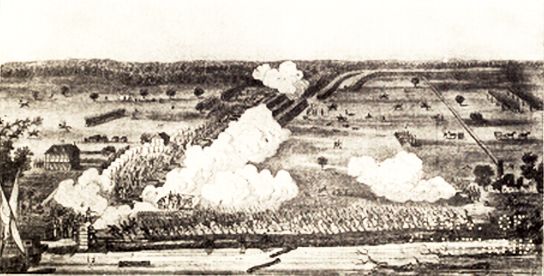
BATTLE OF NEW ORLEANS, JANUARY 8, 1815.
These demonstrative movements of the enemy, with his busy reconnoitering, foreboded an attack in force.
In the night of the thirty-first he erected, under cover of darkness, two other batteries of heavy guns at a distance of six hundred yards from the front of Jackson's entrenchments, on a ditch running along the side of Chalmette's plantation, at distances of three and six hundred yards from the river. During the night the men working on the platforms and mounting the ordnance could be distinctly heard.
On the morning of the 1st of January, 1815, the earth was veiled by a dense fog until eight o'clock. As the misty cloud lifted above the horizon, the enemy opened up a terrific fire from his three batteries in front, mounting respectively two, eight, and eight pieces of heavy cannon. A meteor-like shower of Congreve rockets accompanied the balls, filling the air for fifteen minutes with these missiles of terror. The two batteries nearest the river directed their fire against McCarty's house, some hundreds of yards behind our front line, where Jackson and his staff had their headquarters. In less than ten minutes more than one hundred balls, rockets, and shells struck the house. Bricks, splinters of wood, and broken furniture were sent flying in all directions, making the premises dangerously untenable. General Jackson and his staff occupied the house at the time; yet, strange to say, not a person was even wounded. There is no account that the old hero "ingloriously fled," but it is in evidence that he retired with commendable dispatch to a safer place.
Though the batteries of the enemy were in a better position, on a lower plane, and with a narrower front than those of the Americans, the gunners of the latter fired with more precision and effect on this day, and on other occasions, as their own officers afterward admitted. In an hour's time the fire from the enemy's side began to slacken, and continued to abate until noon, when his two batteries to the right were abandoned. Our balls dismounted several of his guns early in the day, and in the afternoon the greater part of his artillery was dismounted or unfit for service. The carriages of three of the guns on the American side were broken, and two caissons, with over one hundred rounds of ammunition, were blown up by rockets, at which the enemy loudly cheered. The cheeks of the embrasures of our batteries were formed of cotton bales, which the enemy's balls struck, sending the cotton flying through the air. The impression that Jackson's breastwork line was constructed of bales of cotton is a mistake. Bales of cotton were used only at the bottom and sides of the embrasures, for a firmer support for the artillery, beneath a casing of heavy plank. The British, in the absence of cotton bales, used hogsheads of sugar, which were conveniently near, for the same purposes. These our shot easily knocked to pieces, saturating the damp earth around with the saccharine sweets. Our breastworks were more substantially and easily made of the alluvial earth.
The guns of the British batteries nearest the levee were directed in part against the marine battery across the river during the day, but with little effect. Before the close the enemy's guns were silenced, and several of them abandoned. The British columns were in readiness, drawn up in several parallel lines, prudently awaiting in the back ditches and the trenches between the batteries a favorable moment to advance to an assault of our lines. In this they were disappointed; the superiority of the American artillery left them no hope of an advantage by breaching our lines with this arm. That this was their object their own authorities state. The losses this day of the Americans were thirty-five killed and wounded; the enemy admitted a loss of seventy-five. During the night of the first of January, the latter succeeded in removing his heavy guns from the dismantled batteries, dragging them off with much difficulty through the mired earth.
A View From the Enemy's Standpoint.
It is interesting to view a situation from an enemy's standpoint, and to know the impressions made upon an enemy's mind in a great issue like the one of contest. We quote again from Gleig's "Campaigns of the English Army":
It was Christmas Day, and a number of officers, clubbing their scant stocks of provisions, resolved to dine together in memory of former times. But at so melancholy a Christmas dinner, I do not remember to have been present. We dined in a barn; of tableware, of viands, and of good cookery, there was a dismal scarcity. These were matters, however, of minor thought; the want of many well-known and beloved faces thrilled us with pain. While sitting at the table, a loud shriek from outside startled the guests. On running out, we found that a shot from the enemy's ship had cut almost in twain the body of a soldier, and he was gasping in death.
On the twenty-eighth, the British army advanced in full force, supported by ten pieces of artillery, with a view to a final assault. They did not do much more than the bringing on of a heavy artillery duel, in which they were severely worsted and driven back to camp. That the Americans are excellent shots, as well with artillery as with rifles, we had frequent cause to acknowledge; but perhaps on no occasion did they assert their claim to the title of good artillerymen more effectually than on the present. Scarcely a shot passed over, or fell short; but all striking full into our ranks, occasioned terrible havoc. The crash of the fire-locks and the fall of the killed and wounded, caused at first some confusion. In half an hour three of our heavy guns were dismounted, many gunners killed, and the rest obliged to retire. The infantry advanced under a heavy discharge of round and grape shot, until they were checked by a canal in front. A halt was ordered, and the men commanded to shelter themselves in a wet ditch as best they could.
Thus it fared with the left of the army. The right failing to penetrate through the swamp, and faring no better, was compelled to halt. All thought of a general attack for this day was abandoned. It only remained to withdraw the troops from their perilous position with as little loss as possible. This was done, not in a body, but regiment by regiment, under the same discharge which saluted their approach.
There seemed now but one practicable way of assault; to treat these field-works as one would treat a regular fortification, by erecting breaching batteries against them, and silencing, if possible, their guns. To this end three days were employed in landing heavy cannon, bringing up ammunition, and making other preparations, as for a siege. One half of the army was ordered out on the night of the thirty-first, quietly led up to within three hundred yards of the enemy's works, and busily employed in throwing up a chain of works. Before dawn, six batteries were completed, with thirty pieces of heavy cannon mounted, when the troops, before the dawn of day, fell back and concealed themselves behind some thick brush in the rear. The Americans had no idea of what was going on until morning came. This whole district was covered with the stubble of sugar-cane, and every storehouse and barn was filled with large barrels containing sugar. In throwing up the works this sugar was used. Rolling the hogsheads towards the front, they were placed in the parapets of the batteries. Sugar, to the amount of many thousand pounds sterling, was thus disposed of.
On the morning of January 1st, a thick haze obscured the sun, and all objects at the distance of a few yards, for some hours. Finally, as the clouds of fog drifted away, the American camp was fully exposed to view, but three hundred yards away. The different regiments were upon parade, and presented a fine appearance. Mounted officers rode to and fro, bands were playing, and colors floating in the air. All seemed gala, when suddenly our batteries opened. Their ranks were broken; the different corps dispersing, fled in all directions, while the utmost terror and disorder appeared to prevail.
While this consternation lasted among the infantry, their artillery remained silent; but soon recovering confidence, they answered our salute with great precision and rapidity. A heavy cannonade on both sides continued during the day, until our ammunition began to fail—our fire slackening, while that of the enemy redoubled. Landing a number of guns from their flotilla, they increased their artillery to a prodigious amount. They also directed their cannon on the opposite bank against the flank of our batteries, and soon convinced us that all endeavors to surpass them in this mode of fighting would be useless. Once more, we were obliged to retire, leaving our heavy guns to their fate. The fatigue of officers and men, it would be difficult to form a conception of. For two entire nights and days not a man had closed his eyes, except to sleep amid showers of cannon-balls. We retreated, therefore, baffled and disheartened. It must be confessed that a murmur of discontent began to be heard in the camp. The cannon and mortars of the enemy played on our men night and day, from their main position; likewise a deadly fire from eighteen pieces on the opposite bank swept the entire line of our encampment. The duty of a picket was as dangerous as to go into battle. The American sharpshooters harassed them from the time they went on duty till they were relieved; while to light fires served only as marks for the enemy's gunners. The murmurs were not of men anxious to escape from a disagreeable situation; but rather resembled the growlings of a chained animal, when he sees his adversary, but can not reach him. All were eager to bring matters to the issue of a battle, at any sacrifice.
Tennessee and Kentucky Troops Arrive—Government Censured for Neglect.
General Carroll's division of Tennessee troops arrived about this time; also the Louisiana militia were reinforced by several companies from the more distant parishes. On the fourth of January the entire body of Kentucky militia reached New Orleans, twenty-two hundred in number, and went into camp on Prevost's plantation. The day following, seven hundred and fifty of these repaired to the lines, and went into camp in the rear, arms being furnished to but five hundred of the number. There were, at this time, nearly two thousand brave and willing men within Jackson's lines, whose services were lost to the army and to the country for the want of arms. The dangerous delay of the arrival of the troops, and with this, the failure of the arrival of the arms and munitions necessary to equip the men for service, had their beginning in the culpable negligence of the War Department at Washington, of which history has had occasion to complain. But a more immediate cause for the irreparable delay in the arrival of the stores for arming and equipping the troops is found in the conduct of the quartermaster who superintended the shipment of the same from Pittsburgh. Though he was offered a contract to ship these supplies by a steamboat, and to deliver them at New Orleans in ample time for use, for some reason he declined the offer. He then had them loaded on a flatboat and slowly floated to their destination, when there was little or no hope of their arrival in time for use. At the date of the final battle at New Orleans they were afloat somewhere near the mouth of the Ohio River, and of course did not arrive until many days after all need of them was over.
On the twenty-ninth of December, General Jackson wrote to the Secretary of War these words of protest against this failure to make provision for his army in such a crisis as the present:
I lament that I have not the means of carrying on more offensive operations. The Kentucky troops have not arrived, and my effective force at this point does not exceed three thousand men. That of the enemy must be at least double; both prisoners and deserters agreeing in the statement that seven thousand landed from their boats.
When the militia of Kentucky were called for, Governor Shelby was assured that the United States quartermaster would furnish transportation for the troops to New Orleans; but no such officer reported himself, and no relief came from Washington. The men had rendezvoused on the banks of the Ohio in waiting, and here the expedition must have ended had not Colonel Richard Taylor, of Frankfort, then quartermaster of the State militia, on his own credit, borrowed a sum sufficient to meet the immediate emergency. With this he purchased such boats as he could, some of which were unfit for the passage. Camp equippage could not be had in time, and about thirty pots and kettles were bought at Louisville, one to each company of eighty men. At the mouth of the Cumberland River they were detained eight days, with their axes and frows riving boards with which to patch up their old boats. From this point they started with half a supply of rations, to which they added as they could on the way down the Mississippi River. The men knew there was due them an advance of two months' pay when ordered out of the State. The United States quartermaster distributed this pay to the Tennessee troops who had preceded them, but withheld it from the Kentuckians. Believing that they would be furnished suitable clothing or pay, blankets, tents, arms, and munitions with reasonable promptness, they left home with little else than the one suit of clothing they wore, usually of homespun jeans. As a writer has said: "Rarely, if ever, has it been known of such a body of men leaving their homes, unprovided as they were, and risking a difficult passage of fifteen hundred miles in the crudest of barges to meet an enemy. They could have been prompted alone by a patriotic love of country and a defiance of its enemies." This contribution of Kentucky for the defense of Louisiana was made just after she had furnished over ten thousand volunteer troops in the campaigns of Harrison in the Northwest, who made up the larger part of the soldiers in that army for the two years previous, and who recently had won the great victory at the battle of the Thames. Governor Shelby tendered to the government ten thousand more Kentuckians for the army of the Southwest, if they were needed to repel the invaders.
It was in the midst of an unusually severe winter in Louisiana, in a season of almost daily rainfalls, when the Kentucky and part of the Tennessee troops reached their destination. They went into camp without tents or blankets or bedding of straw even, on the open and miry alluvial ground, with the temperature at times at freezing point. This destitution and consequent suffering at once enlisted the attention and sympathies of the public. The Legislature of Louisiana, in session, promptly voted six thousand dollars for relief, to which the generous citizens added by subscription ten thousand dollars more. With these funds materials were purchased. The noble women of New Orleans, almost without an exception, devoted themselves day and night to making up the materials into suitable garments and distributing them as they were most needed. In one week's time the destitute soldiers were supplied and made comfortable. These backwoodsmen, defenders of their country, did not forget till their dying day the generous and timely ministries in a time of trial, in which the women and the men of Louisiana, and especially of New Orleans, seemed to vie; nor did they cease to speak in their praise.
Again, in view of the approaching battle, Jackson, in correspondence with the Secretary of War, complains that the arms from Pittsburgh had not yet arrived, expressing grave apprehensions of the consequences. "Hardly," said he, "one third of the Kentucky troops, so long expected, are armed; and the arms they have are barely fit for use." He presages that the defeat of our armies and the dishonor of the officers commanding, and of the nation, may be consequences chargeable to the neglect of the government.
The American batteries on both sides of the river continued day and night to fire upon and harass the British. Wherever a group of the latter appeared, or an assailable object presented, the American fire was directed to disperse or destroy. This incessant cannonading exercised our gunners in the more skillful use of their pieces, annoyed the enemy in the work of his fortifications, and rendered his nights well-nigh sleepless.
Jackson's Entrenched Line, and the Positions of the Troops and Artillery.
Jackson's lines, five miles below the city, were along the canal, or old mill-race, on the border of the plantations of Rodrique and Chalmette. The old ditch, unused for years, had filled up in part with the washings of the earth from its sides, and grown over with grass. It was chosen because it lay at a point the shortest in distance from the river to the swamp, and thus the more easily defended. Along the upper bank of the canal a parapet was raised, with a banquet behind to stand upon, by earth brought from the rear of the line, thus raising the original embankment. The opposite side of the canal was but little raised, forming a kind of glacis.
Plank and posts from the adjacent fencing were taken to line the parapet and to prevent the earth from falling back into the canal. All this was done at intervals of relief, by the different corps, assisted by labor from the plantations near. It was not until the seventh of January that the whole extent of the breastwork was proof against the enemy's cannon.
The length of the line was less than one mile, more than half of which ran from the river to the wood, the remainder extending into the depths of the wood, taking an oblique direction to the left and terminating in the impassable swamp. The parapet was about five feet in height and from ten to twenty feet thick at the base, extending inland from the river one thousand yards. Beyond that, to the wood and swamp, where artillery could not well be employed, the breastwork was formed of a double row of logs, laid one over the other, leaving a space of two feet, which was filled with earth.
The artillery was distributed on the line as follows:
Battery 1, Captain Humphries, of the United States artillery, consisted of two twelve-pounders and a howitzer, on field carriages, and was located thirty yards from the river, outside the levee.
Battery 2, ninety yards from Battery 1; Lieutenant Norris, of the navy; one twenty-four pounder.
Battery 3, fifty yards from Battery 2; Captains Dominique and Bluche, of the Baratarians; two twenty-four pounders.
Battery 4, twenty yards from Battery 3; Captain Crawly, of the navy, one thirty-two pounder, served by part of the crew of the Carolina.
Battery 5, Colonel Perry and Lieutenant Carr, of the artillery; two six-pounders, one hundred and ninety yards from Battery 4.
Battery 6, thirty-six yards from Battery 5; Lieutenant Bertel; one brass twelve-pounder.
Battery 7, one hundred and ninety yards from Battery 6; Lieutenants Spotts and Chauveau; one eighteen-and one six-pounder.
Battery 8, sixty yards from Battery 7; one brass carronade, next Carroll's and Adair's commands.
Out beyond this last piece the line formed a receding elbow, mentioned above, made unavoidable by great sinks in the soil, filled with water from the canal. Here, and beyond into the wood, the ground was so low that the troops were literally encamped in the water, walking often in mire a foot in depth, their few tents being pitched on small mounds surrounded with water or mud. Amid these discomforts, in this ague-breeding miasm, the Tennesseans, under Generals Coffee and Carroll, and the Kentuckians, under General Adair, for days endured the dangers of battle and privations of camp and campaign. As one historian who was with Jackson's army writes: "They gave an example of the rarest military virtues. Though constantly living and sleeping in the mire, these patriotic men never uttered a complaint or showed the least symptoms of impatience. It was vitally necessary to guard that quarter against an attack on our flank, and to repulse him on the edge of our breastwork, where artillery could not be employed. We had no battery on the center and left for thirteen hundred yards, the nature of the ground not admitting. The Tennesseans and Kentuckians defended this entire two thirds of our line with rifles and muskets only. As anticipated, the enemy made his main assault against these rifles and muskets, in a vain attempt to flank our army."
A view of the positions of the respective corps in Jackson's line will be of interest here. The redoubt on the river, where the right of the line rested, was guarded by a company of the Seventh United States Infantry, commanded by Lieutenant Ross; the artillery was served by a detachment of the Forty-fourth United States Infantry, under Lieutenant Marant. At the extremity of the line, between Battery 1 and the river, was posted Captain Beale's company of New Orleans Rifles, thirty men strong. The Seventh United States Regiment covered the space from Batteries 1 to 3, four hundred and thirty men, commanded by Major Peire. The interval between Batteries 3 and 4 was occupied by Major Plauche's battalion of Louisiana uniformed companies, and by Major Lacoste's battalion of Louisiana men of color, the former two hundred and eighty-nine men, and the latter two hundred and eighty strong. From Batteries 4 to 5, the line was held by Major Daquin's battalion of St. Domingo men of color, one hundred and fifty in number; and next to these were placed the Forty-fourth United States Regulars, two hundred and forty men, commanded by Colonel Baker.