PREFACE (continued 2)
Reading edition
The latter proposition was unanimously agreed to. Their heads were sound. The Army of the Potomac would just halt right there, and allow the Rebel to come up and smash his head against it, to any reasonable extent he desired, as he had to-day. After some two hours the council dissolved, and the officers went their several ways.
Night, sultry and starless, droned on, and it was almost midnight that I found myself peering my way from the line of the Second Corps, back down to the General’s Headquarters, which were an ambulance in the rear, in a little peach orchard. All was silent now but the sound of the ambulances, as they were bringing off the wounded, and you could hear them rattle here and there about the field, and see their lanterns. I am weary and sleepy, almost to such an extent as not to be able to sit on my horse. And my horse can hardly move—the spur will not start him—what can be the reason? I know that he has been touched by two or three bullets to-day, but not to wound or lame him to speak of. Then, in riding by a horse that is hitched, in the dark, I got kicked; had I not a very thick boot, the blow would have been likely to have broken my ankle—it did break my temper as it was—and, as if it would cure matters, I foolishly spurred my horse again. No use, he would but walk. I dismounted; I could not lead him along at all, so out of temper I rode at the slowest possible walk to the Headquarters, which I reached at last. General Hancock and Gibbon were asleep in the ambulance. With a light I found what was the matter with “Billy.” A bullet had entered his chest just in front of my left leg, as I was mounted, and the blood was running down all his side and leg, and the air from his lungs came out of the bullet-hole. I begged his pardon mentally for my cruelty in spurring him, and should have done so in words if he could have understood me. Kind treatment as is due to the wounded he could understand, and he had it. Poor Billy! He and I were first under fire together, and I rode him at the second Bull Run and the first and second Fredericksburg, and at Antietam after brave “Joe” was killed; but I shall never mount him again—Billy’s battles are over.
“George, make my bed here upon the ground by the side of this ambulance. Pull off my sabre and my boots—that will do!” Was ever princely couch or softest down so soft as those rough blankets, there upon the unroofed sod? At midnight they received me for four hours delicious, dreamless oblivion of weariness and of battle. So to me ended the Second of July.
At four o’clock on the morning of the Third, I was awakened by Gen. Gibbon’s pulling me by the foot and saying: “Come, don’t you hear that?” I sprang up to my feet. Where was I? A moment and my dead senses and memory were alive again, and the sound of brisk firing of musketry to the front and right of the Second Corps, and over at the extreme right of our line, where we heard it last in the night, brought all back to my memory. We surely were on the field of battle, and there were palpable evidences to my reason that to-day was to be another of blood. Oh! for a moment the thought of it was sickening to every sense and feeling! But the motion of my horse as I galloped over the crest a few minutes later, and the serene splendor of the morning now breaking through rifted clouds and spreading over the landscape, soon reassured me. Come day of battle! Up Rebel hosts, and thunder with your arms! We are all ready to do and to die for the Republic!
I found a sharp skirmish going on in front of the right of the Second Corps, between our outposts and those of the enemy, but save this—and none of the enemy but his outposts were in sight—all was quiet in that part of the field. On the extreme right of the line the sound of musketry was quite heavy; and this I learned was brought on by the attack of the Second Division, Twelfth Corps, Gen. Geary, upon the enemy in order to drive him out of our works which he had sneaked into yesterday, as I have mentioned. The attack was made at the earliest moment in the morning when it was light enough to discern objects to fire at. The enemy could not use the works, but was confronting Geary in woods, and had the cover of many rocks and trees, so the fight was an irregular one, now breaking out and swelling to a vigorous fight, now subsiding to a few scattering shots; and so it continued by turns until the morning was well advanced, when the enemy was finally wholly repulsed and driven from the pits, and the right of our line was again re-established in the place it first occupied. The heaviest losses the Twelfth Corps sustained in all the battle, occurred during this attack, and they were here quite severe. I heard Gen. Meade express dissatisfaction at Gen. Geary for making this attack, as a thing not ordered and not necessary, as the works of ours were of no intrinsic importance, and had not been captured from us by a fight, and Geary’s position was just as good as they, where he was during the night. And I heard Gen. Meade say that he sent an order to have the fight stopped; but I believe the order was not communicated to Geary until after the repulse of the enemy. Late in the forenoon the enemy again tried to carry our right by storm. We heard that old Rebel Ewell had sworn an oath that he would break our right. He had Stonewall Jackson’s Corps, and possibly imagined himself another Stonewall, but he certainly hankered after the right of our line—and so up through the woods, and over the rocks, and up the steeps he sent his storming parties—our men could see them now in the day time. But all the Rebel’s efforts were fruitless, save in one thing, slaughter to his own men. These assaults were made with great spirit and determination, but as the enemy would come up, our men lying behind their secure defenses would just singe them with the blaze of their muskets, and riddle them, as a hail-storm the tender blades of corn. The Rebel oath was not kept, any more than his former one to support the Constitution of the United States. The Rebel loss was very heavy indeed, here, ours but trifling. I regret that I cannot give more of the details of this fighting upon the right—it was so determined upon the part of the enemy, both last night and this morning—so successful to us. About all that I actually saw of it during its progress, was the smoke, and I heard the discharges. My information is derived from officers who were personally in it. Some of our heavier artillery assisted our infantry in this by firing, with the piece elevated, far from the rear, over the heads of our men, at a distance from the enemy of two miles, I suppose. Of course they could have done no great damage. It was nearly eleven o’clock that the battle in this part of the field subsided, not to be again renewed. All the morning we felt no apprehension for this part of the line, for we knew its strength, and that our troops engaged, the Twelfth Corps and the First Division, Wadsworth’s, of the First, could be trusted.
For the sake of telling one thing at a time, I have anticipated events somewhat, in writing of this fight upon the right. I shall now go back to the starting point, four o’clock this morning, and, as other events occurred during the day, second to none in the battle in importance, which I think I saw as much of as any man living, I will tell you something of them, and what I saw, and how the time moved on. The outpost skirmish that I have mentioned, soon subsided. I suppose it was the natural escape of the wrath which the men had, during the night, hoarded up against each other, and which, as soon as they could see in the morning, they could no longer contain, but must let it off through their musket barrels, at their adversaries. At the commencement of the war such firing would have awaked the whole army and roused it to its feet and to arms; not so now. The men upon the crest lay snoring in their blankets, even though some of the enemy’s bullets dropped among them, as if bullets were as harmless as the drops of dew around them. As the sun arose to-day, the clouds became broken, and we had once more glimpses of sky, and fits of sunshine—a rarity, to cheer us. From the crest, save to the right of the Second Corps, no enemy, not even his outposts could be discovered, along all the position where he so thronged upon the Third Corps yesterday. All was silent there—the wounded horses were limping about the field; the ravages of the conflict were still fearfully visible—the scattered arms and the ground thickly dotted with the dead—but no hostile foe. The men were roused early, in order that the morning meal might be out of the way in time for whatever should occur. Then ensued the hum of an army, not in ranks, chatting in low tones, and running about and jostling among each other, rolling and packing their blankets and tents. They looked like an army of rag-gatherers, while shaking these very useful articles of the soldier’s outfit, for you must know that rain and mud in conjunction have not had the effect to make them clean, and the wear and tear of service have not left them entirely whole. But one could not have told by the appearance of the men, that they were in battle yesterday, and were likely to be again to-day. They packed their knapsacks, boiled their coffee and munched their hard bread, just as usual—just like old soldiers who know what campaigning is; and their talk is far more concerning their present employment—some joke or drollery—than concerning what they saw or did yesterday.
As early as practicable the lines all along the left are revised and reformed, this having been rendered necessary by yesterday’s battle, and also by what is anticipated to-day.
It is the opinion of many of our Generals that the Rebel will not give us battle to-day—that he had enough yesterday—that he will be heading towards the Potomac at the earliest practicable moment, if he has not already done so; but the better, and controlling judgment is, that he will make another grand effort to pierce or turn our lines—that he will either mass and attack the left again, as yesterday, or direct his operations against the left of our center, the position of the Second Corps, and try to sever our line. I infer that Gen. Meade was of the opinion that the attack to-day would be upon the left—this from the disposition he ordered, I know that Gen. Hancock anticipated the attack upon the center.
The dispositions to-day upon the left are as follows:
The Second and Third Divisions of the Second Corps are in the position of yesterday; then on the left come Doubleday’s—the Third Division and Col. Stannard’s brigade of the First Corps; then Colwell’s—the First Division of the Second Corps; then the Third Corps, temporarily under the command of Hancock, since Sickles’ wound. The Third Corps is upon the same ground in part, and on the identical line where it first formed yesterday morning, and where, had it stayed instead of moving out to the front, we should have many more men to-day, and should not have been upon the brink of disaster yesterday. On the left of the Third Corps is the Fifth Corps, with a short front and deep line; then comes the Sixth Corps, all but one brigade, which is sent over to the Twelfth. The Sixth, a splendid Corps, almost intact in the fight of yesterday, is the extreme left of our line, which terminates to the south of Round Top, and runs along its western base, in the woods, and thence to the Cemetery. This Corps is burning to pay off the old scores made on the 4th of May, there back of Fredericksburg. Note well the position of the Second and Third Divisions of the Second Corps—it will become important. There are nearly six thousand men and officers in these two Divisions here upon the field—the losses were quite heavy yesterday, some regiments are detached to other parts of the field—so all told there are less than six thousand men now in the two Divisions, who occupy a line of about a thousand yards. The most of the way along this line upon the crest was a stone fence, constructed of small, rough stones, a good deal of the way badly pulled down, but the men had improved it and patched it with rails from the neighboring fences, and with earth, so as to render it in many places a very passable breastwork against musketry and flying fragments of shells.
These works are so low as to compel the men to kneel or lie down generally to obtain cover. Near the right of the Second Division, and just by the little group of trees that I have mentioned there, this stone fence made a right angle, and extended thence to the front, about twenty or thirty yards, where with another less than a right angle it followed along the crest again.
The lines were conformed to these breastworks and to the nature of the ground upon the crest, so as to occupy the most favorable places, to be covered, and still be able to deliver effective fire upon the enemy should he come there. In some places a second line was so posted as to be able to deliver its fire over the heads of the first line behind the works; but such formation was not practicable all of the way. But all the force of these two divisions was in line, in position, without reserves, and in such a manner that every man of them could have fired his piece at the same instant. The division flags, that of the Second Division, being a white trefoil upon a square blue field, and of the Third Division a blue trefoil upon a white rectangular field, waved behind the divisions at the points where the Generals of Division were supposed to be; the brigade flags, similar to these but with a triangular field, were behind the brigades; and the national flags of the regiments were in the lines of their regiments. To the left of the Second Division, and advanced something over a hundred yards, were posted a part of Stannard’s Brigade two regiments or more, behind a small bush-crowned crest that ran in a direction oblique to the general line. These were well covered by the crest, and wholly concealed by the bushes, so that an advancing enemy would be close upon them before they could be seen. Other troops of Doubleday’s Division were strongly posted in rear of these in the general line.
I could not help wishing all the morning that this line of the two divisions of the Second Corps was stronger; it was so far as numbers constitute strength, the weakest part of our whole line of battle. What if, I thought, the enemy should make an assault here to-day, with two or three heavy lines—a great overwhelming mass; would he not sweep through that thin six thousand?
But I was not General Meade, who alone had power to send other troops there; and he was satisfied with that part of the line as it was. He was early on horseback this morning, and rode along the whole line, looking to it himself, and with glass in hand sweeping the woods and fields in the direction of the enemy, to see if aught of him could be discovered. His manner was calm and serious, but earnest. There was no arrogance of hope, or timidity of fear discernible in his face; but you would have supposed he would do his duty conscientiously and well, and would be willing to abide the result. You would have seen this in his face. He was well pleased with the left of the line to-day, it was so strong with good troops. He had no apprehension for the right where the fight now was going on, on account of the admirable position of our forces there. He was not of the opinion that the enemy would attack the center, our artillery had such sweep there, and this was not the favorite point of attack with the Rebel. Besides, should he attack the center, the General thought he could reinforce it in good season. I heard Gen. Meade speak of these matters to Hancock and some others, at about nine o’clock in the morning, while they were up by the line, near the Second Corps.
No further changes of importance except those mentioned, were made in the disposition of the troops this morning, except to replace some of the batteries that were disabled yesterday by others from the artillery reserve, and to brace up the lines well with guns wherever there were eligible places, from the same source. The line is all in good order again, and we are ready for general battle.
Save the operations upon the right, the enemy so far as we could see, was very quiet all the morning. Occasionally the outposts would fire a little, and then cease. Movements would be discovered which would indicate the attempt on the part of the enemy to post a battery. Our Parrotts would send a few shells to the spot, then silence would follow.
At one of these times a painful accident happened to us, this morning. First Lieut. Henry Ropes, 20th Mass., in Gen. Gibbon’s Division, a most estimable gentleman and officer, intelligent, educated, refined, one of the noble souls that came to the country’s defense, while lying at his post with his regiment, in front of one of the Batteries, which fired over the Infantry, was instantly killed by a badly made shell, which, or some portion of it, fell but a few yards in front of the muzzle of the gun. The same accident killed or wounded several others. The loss of Ropes would have pained us at any time, and in any manner; in this manner his death was doubly painful.
Between ten and eleven o’clock, over in a peach orchard in front of the position of Sickles yesterday, some little show of the enemy’s infantry was discovered; a few shells scattered the gray-backs; they again appeared, and it becoming apparent that they were only posting a skirmish line, no further molestation was offered them. A little after this some of the enemy’s flags could be discerned over near the same quarter, above the top and behind a small crest of a ridge. There seemed to be two or three of them—possibly they were guidons—and they moved too fast to be carried on foot. Possibly, we thought, the enemy is posting some batteries there. We knew in about two hours from this time better about the matter. Eleven o’clock came. The noise of battle has ceased upon the right; not a sound of a gun or musket can be heard on all the field; the sky is bright, with only the white fleecy clouds floating over from the West. The July sun streams down its fire upon the bright iron of the muskets in stacks upon the crest, and the dazzling brass of the Napoleons. The army lolls and longs for the shade, of which some get a hand’s breadth, from a shelter tent stuck upon a ramrod. The silence and sultriness of a July noon are supreme. Now it so happened that just about this time of day a very original and interesting thought occurred to Gen. Gibbon and several of his staff; that it would be a very good thing, and a very good time, to have something to eat. When I announce to you that I had not tasted a mouthful of food since yesterday noon, and that all I had had to drink since that time, but the most miserable muddy warm water, was a little drink of whiskey that Major Biddle, General Meade’s aide-de-camp, gave me last evening, and a cup of strong coffee that I gulped down as I was first mounting this morning, and further, that, save the four or five hours in the night, there was scarcely a moment since that time but that I was in the saddle, you may have some notion of the reason of my assent to this extraordinary proposition. Nor will I mention the doubts I had as to the feasibility of the execution of this very novel proposal, except to say that I knew this morning that our larder was low; not to put too fine a point upon it, that we had nothing but some potatoes and sugar and coffee in the world. And I may as well say here, that of such, in scant proportion, would have been our repast, had it not been for the riding of miles by two persons, one an officer, to procure supplies; and they only succeeded in getting some few chickens, some butter, and one huge loaf of bread, which last was bought of a soldier, because he had grown faint in carrying it, and was afterwards rescued with much difficulty and after a long race from a four-footed hog, which had got hold of and had actually eaten a part of it. “There is a divinity,” etc. Suffice it, this very ingenious and unheard of contemplated proceeding, first announced by the General, was accepted and at once undertaken by his staff. Of the absolute quality of what we had to eat, I could not pretend to judge, but I think an unprejudiced person would have said of the bread that it was good; so of the potatoes before they were boiled. Of the chickens he would have questioned their age, but they were large and in good running order. The toast was good, and the butter. There were those who, when coffee was given them, called for tea, and vice versa, and were so ungracious as to suggest that the water that was used in both might have come from near a barn. Of course it did not. We all came down to the little peach orchard where we had stayed last night, and, wonderful to see and tell, ever mindful of our needs, had it all ready, had our faithful John. There was an enormous pan of stewed chickens, and the potatoes, and toast, all hot, and the bread and the butter, and tea and coffee. There was satisfaction derived from just naming them all over. We called John an angel, and he snickered and said he “knowed” we’d come. General Hancock is of course invited to partake, and without delay we commence operations. Stools are not very numerous, two in all, and these the two Generals have by common consent. Our table was the top of a mess chest. By this the Generals sat. The rest of us sat upon the ground, cross-legged, like the picture of a smoking Turk, and held our plates upon our laps. How delicious was the stewed chicken. I had a cucumber pickle in my saddle bags, the last of a lunch left there two or three days ago, which George brought, and I had half of it. We were just well at it when General Meade rode down to us from the line, accompanied by one of his staff, and by General Gibbon’s invitation, they dismounted and joined us. For the General commanding the Army of the Potomac George, by an effort worthy of the person and the occasion, finds an empty cracker box for a seat. The staff officer must sit upon the ground with the rest of us. Soon Generals Newton and Pleasonton, each with an aide, arrive. By an almost superhuman effort a roll of blankets is found, which, upon a pinch, is long enough to seat these Generals both, and room is made for them. The aides sit with us. And, fortunate to relate, there was enough cooked for us all, and from General Meade to the youngest second lieutenant we all had a most hearty and well relished dinner. Of the “past” we were “secure.” The Generals ate, and after, lighted cigars, and under the flickering shade of a very small tree, discoursed of the incidents of yesterday’s battle and of the probabilities of to-day. General Newton humorously spoke of General Gibbon as “this young North Carolinian,” and how he was becoming arrogant and above his position, because he commanded a corps. General Gibbon retorted by saying that General Newton had not been long enough in such a command, only since yesterday, to enable him to judge of such things. General Meade still thought that the enemy would attack his left again to-day towards evening; but he was ready for them. General Hancock thought that the attack would be upon the position of the Second Corps. It was mentioned that General Hancock would again assume command of the Second Corps from that time, so that General Gibbon would again return to the Second Division.
General Meade spoke of the Provost Guards, that they were good men, and that it would be better to-day to have them in the works than to stop stragglers and skulkers, as these latter would be good for but little even in the works; and so he gave the order that all the Provost Guards should at once temporarily rejoin their regiments. Then General Gibbon called up Captain Farrel, First Minnesota, who commanded the provost guard of his division, and directed him for that day to join the regiment. “Very well, sir,” said the Captain, as he touched his hat and turned away. He was a quiet, excellent gentleman and thorough soldier. I knew him well and esteemed him. I never saw him again. He was killed in two or three hours from that time, and over half of his splendid company were either killed or wounded.
And so the time passed on, each General now and then dispatching some order or message by an officer or orderly, until about half-past twelve, when all the Generals, one by one, first General Meade, rode off their several ways, and General Gibbon and his staff alone remained.
We dozed in the heat, and lolled upon the ground, with half open eyes. Our horses were hitched to the trees munching some oats. A great lull rests upon all the field. Time was heavy, and for want of something better to do, I yawned, and looked at my watch. It was five minutes before one o’clock. I returned my watch to its pocket, and thought possibly that I might go to sleep, and stretched myself upon the ground accordingly. Ex uno disce omnes. My attitude and purpose were those of the General and the rest of the staff.
What sound was that? There was no mistaking it. The distinct sharp sound of one of the enemy’s guns, square over to the front, caused us to open our eyes and turn them in that direction, when we saw directly above the crest the smoke of the bursting shell, and heard its noise. In an instant, before a word was spoken, as if that was the signal gun for general work, loud, startling, booming, the report of gun after gun in rapid succession smote our ears and their shells plunged down and exploded all around us. We sprang to our feet. In briefest time the whole Rebel line to the West was pouring out its thunder and its iron upon our devoted crest. The wildest confusion for a few moments obtained sway among us. The shells came bursting all about. The servants ran terror-stricken for dear life and disappeared. The horses, hitched to the trees or held by the slack hands of orderlies, neighed out in fright, and broke away and plunged riderless through the fields. The General at the first had snatched his sword, and started on foot for the front. I called for my horse; nobody responded. I found him tied to a tree, near by, eating oats, with an air of the greatest composure, which under the circumstances, even then struck me as exceedingly ridiculous. He alone, of all beasts or men near was cool. I am not sure but that I learned a lesson then from a horse. Anxious alone for his oats, while I put on the bridle and adjusted the halter, he delayed me by keeping his head down, so I had time to see one of the horses of our mess wagon struck and torn by a shell. The pair plunge—the driver has lost the reins—horses, driver and wagon go into a heap by a tree. Two mules close at hand, packed with boxes of ammunition, are knocked all to pieces by a shell. General Gibbon’s groom has just mounted his horse and is starting to take the General’s horse to him, when the flying iron meets him and tears open his breast. He drops dead and the horses gallop away. No more than a minute since the first shot was fired, and I am mounted and riding after the General. The mighty din that now rises to heaven and shakes the earth is not all of it the voice of the rebellion; for our guns, the guardian lions of the crest, quick to awake when danger comes, have opened their fiery jaws and begun to roar—the great hoarse roar of battle. I overtake the General half way up to the line. Before we reach the crest his horse is brought by an orderly. Leaving our horses just behind a sharp declivity of the ridge, on foot we go up among the batteries. How the long streams of fire spout from the guns, how the rifled shells hiss, how the smoke deepens and rolls. But where is the infantry? Has it vanished in smoke? Is this a nightmare or a juggler’s devilish trick? All too real. The men of the infantry have seized their arms, and behind their works, behind every rock, in every ditch, wherever there is any shelter, they hug the ground, silent, quiet, unterrified, little harmed. The enemy’s guns now in action are in position at their front of the woods along the second ridge that I have before mentioned and towards their right, behind a small crest in the open field, where we saw the flags this morning. Their line is some two miles long, concave on the side towards us, and their range is from one thousand to eighteen hundred yards. A hundred and twenty-five rebel guns, we estimate, are now active, firing twenty-four pound, twenty, twelve and ten-pound projectiles, solid shot and shells, spherical, conical, spiral. The enemy’s fire is chiefly concentrated upon the position of the Second Corps. From the Cemetery to Round Top, with over a hundred guns, and to all parts of the enemy’s line, our batteries reply, of twenty and ten-pound Parrotts, ten-pound rifled ordnance, and twelve-pound Napoleons, using projectiles as various in shape and name as those of the enemy. Captain Hazard commanding the artillery brigade of the Second Corps was vigilant among the batteries of his command, and they were all doing well. All was going on satisfactorily. We had nothing to do, therefore, but to be observers of the grand spectacle of battle. Captain Wessels, Judge Advocate of the Division, now joined us, and we sat down behind the crest, close to the left of Cushing’s Battery, to bide our time, to see, to be ready to act when the time should come, which might be at any moment. Who can describe such a conflict as is raging around us? To say that it was like a summer storm, with the crash of thunder, the glare of lightning, the shrieking of the wind, and the clatter of hailstones, would be weak. The thunder and lightning of these two hundred and fifty guns and their shells, whose smoke darkens the sky, are incessant, all pervading, in the air above our heads, on the ground at our feet, remote, near, deafening, ear-piercing, astounding; and these hailstones are massy iron, charged with exploding fire. And there is little of human interest in a storm; it is an absorbing element of this. You may see flame and smoke, and hurrying men, and human passion at a great conflagration; but they are all earthly and nothing more. These guns are great infuriate demons, not of the earth, whose mouths blaze with smoky tongues of living fire, and whose murky breath, sulphur-laden, rolls around them and along the ground, the smoke of Hades. These grimy men, rushing, shouting, their souls in frenzy, plying the dusky globes and the igniting spark, are in their league, and but their willing ministers. We thought that at the second Bull Run, at the Antietam and at Fredericksburg on the 11th of December, we had heard heavy cannonading; they were but holiday salutes compared with this. Besides the great ceaseless roar of the guns, which was but the background of the others, a million various minor sounds engaged the ear. The projectiles shriek long and sharp. They hiss, they scream, they growl, they sputter; all sounds of life and rage; and each has its different note, and all are discordant. Was ever such a chorus of sound before? We note the effect of the enemies’ fire among the batteries and along the crest. We see the solid shot strike axle, or pole, or wheel, and the tough iron and heart of oak snap and fly like straws. The great oaks there by Woodruff’s guns heave down their massy branches with a crash, as if the lightning smote them. The shells swoop down among the battery horses standing there apart. A half a dozen horses start, they tumble, their legs stiffen, their vitals and blood smear the ground. And these shot and shells have no respect for men either. We see the poor fellows hobbling back from the crest, or unable to do so, pale and weak, lying on the ground with the mangled stump of an arm or leg, dripping their life-blood away; or with a cheek torn open, or a shoulder mashed. And many, alas! hear not the roar as they stretch upon the ground with upturned faces and open eyes, though a shell should burst at their very ears. Their ears and their bodies this instant are only mud. We saw them but a moment since there among the flame, with brawny arms and muscles of iron wielding the rammer and pushing home the cannon’s plethoric load.
Strange freaks these round shot play! We saw a man coming up from the rear with his full knapsack on, and some canteens of water held by the straps in his hands. He was walking slowly and with apparent unconcern, though the iron hailed around him. A shot struck the knapsack, and it, and its contents flew thirty yards in every direction, the knapsack disappearing like an egg, thrown spitefully against a rock. The soldier stopped and turned about in puzzled surprise, put up one hand to his back to assure himself that the knapsack was not there, and then walked slowly on again unharmed, with not even his coat torn. Near us was a man crouching behind a small disintegrated stone, which was about the size of a common water bucket. He was bent up, with his face to the ground, in the attitude of a Pagan worshipper before his idol. It looked so absurd to see him thus, that I went and said to him, “Do not lie there like a toad. Why not go to your regiment and be a man?” He turned up his face with a stupid, terrified look upon me, and then without a word turned his nose again to the ground. An orderly that was with me at the time, told me a few moments later, that a shot struck the stone, smashing it in a thousand fragments, but did not touch the man, though his head was not six inches from the stone.
All the projectiles that came near us were not so harmless. Not ten yards away from us a shell burst among some small bushes, where sat three or four orderlies holding horses. Two of the men and one horse were killed. Only a few yards off a shell exploded over an open limber box in Cushing’s battery, and at the same instant, another shell over a neighboring box. In both the boxes the ammunition blew up with an explosion that shook the ground, throwing fire and splinters and shells far into the air and all around, and destroying several men. We watched the shells bursting in the air, as they came hissing in all directions. Their flash was a bright gleam of lightning radiating from a point, giving place in the thousandth part of a second to a small, white, puffy cloud, like a fleece of the lightest, whitest wool. These clouds were very numerous. We could not often see the shell before it burst; but sometimes, as we faced towards the enemy, and looked above our heads, the approach would be heralded by a prolonged hiss, which always seemed to me to be a line of something tangible, terminating in a black globe, distinct to the eye, as the sound had been to the ear. The shell would seem to stop, and hang suspended in the air an instant, and then vanish in fire and smoke and noise. We saw the missiles tear and plow the ground. All in rear of the crest for a thousand yards, as well as among the batteries, was the field of their blind fury. Ambulances, passing down the Taneytown road with wounded men, were struck. The hospitals near this road were riddled. The house which was General Meade’s headquarters was shot through several times, and a great many horses of officers and orderlies were lying dead around it. Riderless horses, galloping madly through the fields, were brought up, or down rather, by these invisible horse-tamers, and they would not run any more. Mules with ammunition, pigs wallowing about, cows in the pastures, whatever was animate or inanimate, in all this broad range, were no exception to their blind havoc. The percussion shells would strike, and thunder, and scatter the earth and their whistling fragments; the Whitworth bolts would pound and ricochet, and bowl far away sputtering, with the sound of a mass of hot iron plunged in water; and the great solid shot would smite the unresisting ground with a sounding “thud,” as the strong boxer crashes his iron fist into the jaws of his unguarded adversary. Such were some of the sights and sounds of this great iron battle of missiles. Our artillerymen upon the crest budged not an inch, nor intermitted, but, though caisson and limber were smashed, and guns dismantled, and men and horses killed, there amidst smoke and sweat, they gave back, without grudge, or loss of time in the sending, in kind whatever the enemy sent, globe, and cone, and bolt, hollow or solid, an iron greeting to the rebellion, the compliments of the wrathful Republic. An hour has droned its flight since first the war began. There is no sign of weariness or abatement on either side. So long it seemed, that the din and crashing around began to appear the normal condition of nature there, and fighting man’s element. The General proposed to go among the men and over to the front of the batteries, so at about two o’clock he and I started. We went along the lines of the infantry as they lay there flat upon the earth, a little to the front of the batteries. They were suffering little, and were quiet and cool. How glad we were that the enemy were no better gunners, and that they cut the shell fuses too long. To the question asked the men, “What do you think of this?” the replies would be, “O, this is bully,” “We are getting to like it,” “O, we don’t mind this.” And so they lay under the heaviest cannonade that ever shook the continent, and among them a thousand times more jokes than heads were cracked.
We went down in front of the line some two hundred yards, and as the smoke had a tendency to settle upon a higher plain than where we were, we could see near the ground distinctly all over the fields, as well back to the crest where were our own guns as to the opposite ridge where were those of the enemy. No infantry was in sight, save the skirmishers, and they stood silent and motionless—a row of gray posts through the field on one side confronted by another of blue. Under the grateful shade of some elm trees, where we could see much of the field, we made seats of the ground and sat down. Here all the more repulsive features of the fight were unseen, by reason of the smoke. Man had arranged the scenes, and for a time had taken part in the great drama; but at last, as the plot thickened, conscious of his littleness and inadequacy to the mighty part, he had stepped aside and given place to more powerful actors. So it seemed; for we could see no men about the batteries. On either crest we could see the great flaky streams of fire, and they seemed numberless, of the opposing guns, and their white banks of swift, convolving smoke; but the sound of the discharges was drowned in the universal ocean of sound. Over all the valley the smoke, a sulphury arch, stretched its lurid span; and through it always, shrieking on their unseen courses, thickly flew a myriad iron deaths. With our grim horizon on all sides round toothed thick with battery flame, under that dissonant canopy of warring shells, we sat and heard in silence. What other expression had we that was not mean, for such an awful universe of battle?
A shell struck our breastwork of rails up in sight of us, and a moment afterwards we saw the men bearing some of their wounded companions away from the same spot; and directly two men came from there down toward where we were and sought to get shelter in an excavation near by, where many dead horses, killed in yesterday’s fight, had been thrown. General Gibbon said to these men, more in a tone of kindly expostulation than of command: “My men, do not leave your ranks to try to get shelter here. All these matters are in the hands of God, and nothing that you can do will make you safer in one place than in another.” The men went quietly back to the line at once. The General then said to me: “I am not a member of any church, but I have always had a strong religious feeling; and so in all these battles I have always believed that I was in the hands of God, and that I should be unharmed or not, according to his will. For this reason, I think it is, I am always ready to go where duty calls, no matter how great the danger.” Half-past two o’clock, an hour and a half since the commencement, and still the cannonade did not in the least abate; but soon thereafter some signs of weariness and a little slacking of fire began to be apparent upon both sides. First we saw Brown’s battery retire from the line, too feeble for further battle. Its position was a little to the front of the line. Its commander was wounded, and many of its men were so, or worse; some of its guns had been disabled, many of its horses killed; its ammunition was nearly expended. Other batteries in similar case had been withdrawn before to be replaced by fresh ones, and some were withdrawn afterwards. Soon after the battery named had gone the General and I started to return, passing towards the left of the division, and crossing the ground where the guns had stood. The stricken horses were numerous, and the dead and wounded men lay about, and as we passed these latter, their low, piteous call for water would invariably come to us, if they had yet any voice left. I found canteens of water near—no difficult matter where a battle has been—and held them to livid lips, and even in the faintness of death the eagerness to drink told of their terrible torture of thirst. But we must pass on. Our infantry was still unshaken, and in all the cannonade suffered very little. The batteries had been handled much more severely. I am unable to give any figures. A great number of horses had been killed, in some batteries more than half of all. Guns had been dismounted. A great many caissons, limbers and carriages had been destroyed, and usually from ten to twenty-five men to each battery had been struck, at least along our part of the crest. Altogether the fire of the enemy had injured us much, both in the modes that I have stated, and also by exhausting our ammunition and fouling our guns, so as to render our batteries unfit for further immediate use. The scenes that met our eyes on all hands among the batteries were fearful. All things must end, and the great cannonade was no exception to the general law of earth. In the number of guns active at one time, and in the duration and rapidity of their fire, this artillery engagement, up to this time, must stand alone and pre-eminent in this war. It has not been often, or many times, surpassed in the battles of the world. Two hundred and fifty guns, at least, rapidly fired for two mortal hours. Cipher out the number of tons of gunpowder and iron that made these two hours hideous.
Of the injury of our fire upon the enemy, except the facts that ours was the superior position, if not better served and constructed artillery, and that the enemy’s artillery hereafter during the battle was almost silent, we know little. Of course, during the fight we often saw the enemy’s caissons explode, and the trees rent by our shot crashing about his ears, but we can from these alone infer but little of general results. At three o’clock almost precisely the last shot hummed, and bounded and fell, and the cannonade was over. The purpose of General Lee in all this fire of his guns—we know it now, we did not at the time so well—was to disable our artillery and break up our infantry upon the position of the Second Corps, so as to render them less an impediment to the sweep of his own brigades and divisions over our crest and through our lines. He probably supposed our infantry was massed behind the crest and the batteries; and hence his fire was so high, and his fuses to the shells were cut so long, too long. The Rebel General failed in some of his plans in this behalf, as many generals have failed before and will again. The artillery fight over, men began to breathe more freely, and to ask, What next, I wonder? The battery men were among their guns, some leaning to rest and wipe the sweat from their sooty faces, some were handling ammunition boxes and replenishing those that were empty. Some batteries from the artillery reserve were moving up to take the places of the disabled ones; the smoke was clearing from the crests. There was a pause between acts, with the curtain down, soon to rise upon the great final act, and catastrophe of Gettysburg. We have passed by the left of the Second Division, coming from the First; when we crossed the crest the enemy was not in sight, and all was still—we walked slowly along in the rear of the troops, by the ridge cut off now from a view of the enemy in his position, and were returning to the spot where we had left our horses. General Gibbon had just said that he inclined to the belief that the enemy was falling back, and that the cannonade was only one of his noisy modes of covering the movement. I said that I thought that fifteen minutes would show that, by all his bowling, the Rebel did not mean retreat. We were near our horses when we noticed Brigadier General Hunt, Chief of Artillery of the Army, near Woodruff’s Battery, swiftly moving about on horseback, and apparently in a rapid manner giving some orders about the guns. Thought we, what could this mean? In a moment afterwards we met Captain Wessels and the orderlies who had our horses; they were on foot leading the horses. Captain Wessels was pale, and he said, excited: “General, they say the enemy’s infantry is advancing.” We sprang into our saddles, a score of bounds brought us upon the all-seeing crest. To say that men grew pale and held their breath at what we and they there saw, would not be true. Might not six thousand men be brave and without shade of fear, and yet, before a hostile eighteen thousand, armed, and not five minutes’ march away, turn ashy white? None on that crest now need be told that the enemy is advancing. Every eye could see his legions, an overwhelming resistless tide of an ocean of armed men sweeping upon us! Regiment after regiment and brigade after brigade move from the woods and rapidly take their places in the lines forming the assault. Pickett’s proud division, with some additional troops, hold their right; Pettigrew’s (Worth’s) their left. The first line at short interval is followed by a second, and that a third succeeds; and columns between support the lines. More than half a mile their front extends; more than a thousand yards the dull gray masses deploy, man touching man, rank pressing rank, and line supporting line. The red flags wave, their horsemen gallop up and down; the arms of eighteen thousand men, barrel and bayonet, gleam in the sun, a sloping forest of flashing steel. Right on they move, as with one soul, in perfect order, without impediment of ditch, or wall or stream, over ridge and slope, through orchard and meadow, and cornfield, magnificent, grim, irresistible. All was orderly and still upon our crest; no noise and no confusion. The men had little need of commands, for the survivors of a dozen battles knew well enough what this array in front portended, and, already in their places, they would be prepared to act when the right time should come. The click of the locks as each man raised the hammer to feel with his fingers that the cap was on the nipple; the sharp jar as a musket touched a stone upon the wall when thrust in aiming over it, and the clicking of the iron axles as the guns were rolled up by hand a little further to the front, were quite all the sounds that could be heard. Cap-boxes were slid around to the front of the body; cartridge boxes opened, officers opened their pistol-holsters. Such preparations, little more was needed. The trefoil flags, colors of the brigades and divisions moved to their places in rear; but along the lines in front the grand old ensign that first waved in battle at Saratoga in 1777, and which these people coming would rob of half its stars, stood up, and the west wind kissed it as the sergeants sloped its lance towards the enemy. I believe that not one above whom it then waved but blessed his God that he was loyal to it, and whose heart did not swell with pride towards it, as the emblem of the Republic before that treason’s flaunting rag in front. General Gibbon rode down the lines, cool and calm, and in an unimpassioned voice he said to the men, “Do not hurry, men, and fire too fast, let them come up close before you fire, and then aim low and steadily.” The coolness of their General was reflected in the faces of his men. Five minutes has elapsed since first the enemy have emerged from the woods—no great space of time surely, if measured by the usual standard by which men estimate duration—but it was long enough for us to note and weigh some of the elements of mighty moment that surrounded us; the disparity of numbers between the assailants and the assailed; that few as were our numbers we could not be supported or reinforced until support would not be needed or would be too late; that upon the ability of the two trefoil divisions to hold the crest and repel the assault depended not only their own safety or destruction, but also the honor of the Army of the Potomac and defeat or victory at Gettysburg. Should these advancing men pierce our line and become the entering wedge, driven home, that would sever our army asunder, what hope would there be afterwards, and where the blood-earned fruits of yesterday? It was long enough for the Rebel storm to drift across more than half the space that had at first separated it from us. None, or all, of these considerations either depressed or elevated us. They might have done the former, had we been timid; the latter had we been confident and vain. But, we were there waiting, and ready to do our duty—that done, results could not dishonor us.
Our skirmishers open a spattering fire along the front, and, fighting, retire upon the main line—the first drops, the heralds of the storm, sounding on our windows. Then the thunders of our guns, first Arnold’s then Cushing’s and Woodruff’s and the rest, shake and reverberate again through the air, and their sounding shells smite the enemy. The General said I had better go and tell General Meade of this advance. To gallop to General Meade’s headquarters, to learn there that he had changed them to another part of the field, to dispatch to him by the Signal Corps in General Gibbon’s name the message, “The enemy is advancing his infantry in force upon my front,” and to be again upon the crest, were but the work of a minute. All our available guns are now active, and from the fire of shells, as the range grows shorter and shorter, they change to shrapnel, and from shrapnel to canister; but in spite of shells, and shrapnel and canister, without wavering or halt, the hardy lines of the enemy continue to move on. The Rebel guns make no reply to ours, and no charging shout rings out to-day, as is the Rebel wont; but the courage of these silent men amid our shots seems not to need the stimulus of other noise. The enemy’s right flank sweeps near Stannard’s bushy crest, and his concealed Vermonters rake it with a well-delivered fire of musketry. The gray lines do not halt or reply, but withdrawing a little from that extreme, they still move on. And so across all that broad open ground they have come, nearer and nearer, nearly half the way, with our guns bellowing in their faces, until now a hundred yards, no more, divide our ready left from their advancing right. The eager men there are impatient to begin. Let them. First, Harrow’s breastworks flame; then Hall’s; then Webb’s. As if our bullets were the fire coals that touched off their muskets, the enemy in front halts, and his countless level barrels blaze back upon us. The Second Division is struggling in battle. The rattling storm soon spreads to the right, and the blue trefoils are vieing with the white. All along each hostile front, a thousand yards, with narrowest space between, the volleys blaze and roll; as thick the sound as when a summer hail-storm pelts the city roofs; as thick the fire as when the incessant lightning fringes a summer cloud. When the Rebel infantry had opened fire our batteries soon became silent, and this without their fault, for they were foul by long previous use. They were the targets of the concentrated Rebel bullets, and some of them had expended all their canister. But they were not silent before Rhorty was killed, Woodruff had fallen mortally wounded, and Cushing, firing almost his last canister, had dropped dead among his guns shot through the head by a bullet. The conflict is left to the infantry alone. Unable to find my general when I had returned to the crest after transmitting his message to General Meade, and while riding in the search having witnessed the development of the fight, from the first fire upon the left by the main lines until all of the two divisions were furiously engaged, I gave up hunting as useless—I was convinced General Gibbon could not be on the field; I left him mounted; I could easily have found him now had he so remained—but now, save myself, there was not a mounted officer near the engaged lines—and was riding towards the right of the Second Division, with purpose to stop there, as the most eligible position to watch the further progress of the battle, there to be ready to take part according to my own notions whenever and wherever occasion was presented. The conflict was tremendous, but I had seen no wavering in all our line. Wondering how long the Rebel ranks, deep though they were, could stand our sheltered volleys, I had come near my destination, when—great heaven! were my senses mad? The larger portion of Webb’s brigade—my God, it was true—there by the group of trees and the angles of the wall, was breaking from the cover of their works, and, without orders or reason, with no hand lifted to check them, was falling back, a fear-stricken flock of confusion! The fate of Gettysburg hung upon a spider’s single thread! A great magnificent passion came on me at the instant, not one that overpowers and confounds, but one that blanches the face and sublimes every sense and faculty. My sword, that had always hung idle by my side, the sign of rank only in every battle, I drew, bright and gleaming, the symbol of command. Was not that a fit occasion, and these fugitives the men on whom to try the temper of the Solinzen steel? All rules and proprieties were forgotten; all considerations of person, and danger and safety despised; for, as I met the tide of these rabbits, the damned red flags of the rebellion began to thicken and flaunt along the wall they had just deserted, and one was already waving over one of the guns of the dead Cushing. I ordered these men to “halt,” and “face about” and “fire,” and they heard my voice and gathered my meaning, and obeyed my commands. On some unpatriotic backs of those not quick of comprehension, the flat of my sabre fell not lightly, and at its touch their love of country returned, and, with a look at me as if I were the destroying angel, as I might have become theirs, they again faced the enemy. General Webb soon came to my assistance. He was on foot, but he was active, and did all that one could do to repair the breach, or to avert its calamity. The men that had fallen back, facing the enemy, soon regained confidence in themselves, and became steady. This portion of the wall was lost to us, and the enemy had gained the cover of the reverse side, where he now stormed with fire. But Webb’s men, with their bodies in part protected by the abruptness of the crest, now sent back in the enemies’ faces as fierce a storm. Some scores of venturesome Rebels, that in their first push at the wall had dared to cross at the further angle, and those that had desecrated Cushing’s guns, were promptly shot down, and speedy death met him who should raise his body to cross it again. At this point little could be seen of the enemy, by reason of his cover and the smoke, except the flash of his muskets and his waving flags. These red flags were accumulating at the wall every moment, and they maddened us as the same color does the bull. Webb’s men are falling fast, and he is among them to direct and encourage; but, however well they may now do, with that walled enemy in front, with more than a dozen flags to Webb’s three, it soon becomes apparent that in not many minutes they will be overpowered, or that there will be none alive for the enemy to overpower. Webb, has but three regiments, all small, the 69th, 71st and 72d Pennsylvania—the 106th Pennsylvania, except two companies, is not here to-day—and he must have speedy assistance, or this crest will be lost. Oh, where is Gibbon? where is Hancock?—some general—anybody with the power and the will to support that wasting, melting line? No general came, and no succor! I thought of Hayes upon the right, but from the smoke and war along his front, it was evident that he had enough upon his hands, if he stayed the in-rolling tide of the Rebels there. Doubleday upon the left was too far off and too slow, and on another occasion I had begged him to send his idle regiments to support another line battling with thrice its numbers, and this “Old Sumpter Hero” had declined. As a last resort I resolved to see if Hall and Harrow could not send some of their commands to reinforce Webb. I galloped to the left in the execution of my purpose, and as I attained the rear of Hall’s line, from the nature of the ground and the position of the enemy it was easy to discover the reason and the manner of this gathering of Rebel flags in front of Webb. The enemy, emboldened by his success in gaining our line by the group of trees and the angle of the wall, was concentrating all his right against and was further pressing that point. There was the stress of his assault; there would he drive his fiery wedge to split our line. In front of Harrow’s and Hall’s Brigades he had been able to advance no nearer than when he first halted to deliver fire, and these commands had not yielded an inch. To effect the concentration before Webb, the enemy would march the regiment on his extreme right of each of his lines by the left flank to the rear of the troops, still halted and facing to the front, and so continuing to draw in his right, when they were all massed in the position desired, he would again face them to the front, and advance to the storming. This was the way he made the wall before Webb’s line blaze red with his battle flags, and such was the purpose there of his thick-crowding battalions. Not a moment must be lost. Colonel Hall I found just in rear of his line, sword in hand, cool, vigilant, noting all that passed and directing the battle of his brigade. The fire was constantly diminishing now in his front, in the manner and by the movement of the enemy that I have mentioned, drifting to the right. “How is it going?” Colonel Hall asked me, as I rode up. “Well, but Webb is hotly pressed and must have support, or he will be overpowered. Can you assist him?” “Yes.” “You cannot be too quick.” “I will move my brigade at once.” “Good.” He gave the order, and in briefest time I saw five friendly colors hurrying to the aid of the imperilled three; and each color represented true, battle-tried men, that had not turned back from Rebel fire that day nor yesterday, though their ranks were sadly thinned, to Webb’s brigade, pressed back as it had been from the wall, the distance was not great from Hall’s right. The regiments marched by the right flank. Col. Hall superintended the movement in person. Col. Devereux coolly commanded the 19th Massachusetts. His major, Rice, had already been wounded and carried off. Lieut. Col. Macy, of the 20th Mass., had just had his left hand shot off, and so Capt. Abbott gallantly led over this fine regiment. The 42d New York followed their excellent Colonel Mallon. Lieut. Col. Steele, 7th Mich., had just been killed, and his regiment, and the handful of the 59th N. Y., followed their colors. The movement, as it did, attracting the enemy’s fire, and executed in haste, as it must be, was difficult; but in reasonable time, and in order that is serviceable, if not regular, Hall’s men are fighting gallantly side by side with Webb’s before the all important point. I did not stop to see all this movement of Hall’s, but from him I went at once further to the left, to the 1st brigade. Gen’l Harrow I did not see, but his fighting men would answer my purpose as well. The 19th Me., the 15th Mass., the 32d N. Y. and the shattered old thunderbolt, the 1st Minn.—poor Farrell was dying then upon the ground where he had fallen,—all men that I could find I took over to the right at the double quick.
As we were moving to, and near the other brigade of the division, from my position on horseback I could see that the enemy’s right, under Hall’s fire, was beginning to stagger and to break. “See,” I said to the men, “See the chivalry! See the gray-backs run!” The men saw, and as they swept to their places by the side of Hall and opened fire, they roared, and this in a manner that said more plainly than words—for the deaf could have seen it in their faces, and the blind could have heard it in their voices—the crest is safe!
The whole Division concentrated, and changes of position, and new phases, as well on our part as on that of the enemy, having as indicated occurred, for the purpose of showing the exact present posture of affairs, some further description is necessary. Before the 2d Division the enemy is massed, the main bulk of his force covered by the ground that slopes to his rear, with his front at the stone wall. Between his front and us extends the very apex of the crest. All there are left of the White Trefoil Division—yesterday morning there were three thousand eight hundred, this morning there were less than three thousand—at this moment there are somewhat over two thousand;—twelve regiments in three brigades are below or behind the crest, in such a position that by the exposure of the head and upper part of the body above the crest they can deliver their fire in the enemy’s faces along the top of the wall. By reason of the disorganization incidental in Webb’s brigade to his men’s having broken and fallen back, as mentioned, in the two other brigades to their rapid and difficult change of position under fire, and in all the division in part to severe and continuous battle, formation of companies and regiments in regular ranks is lost; but commands, companies, regiments and brigades are blended and intermixed—an irregular extended mass—men enough, if in order, to form a line of four or five ranks along the whole front of the division. The twelve flags of the regiments wave defiantly at intervals along the front; at the stone wall, at unequal distances from ours of forty, fifty or sixty yards, stream nearly double this number of the battle flags of the enemy. These changes accomplished on either side, and the concentration complete, although no cessation or abatement in the general din of conflict since the commencement had at any time been appreciable, now it was as if a new battle, deadlier, stormier than before, had sprung from the body of the old—a young Phœnix of combat, whose eyes stream lightning, shaking his arrowy wings over the yet glowing ashes of his progenitor. The jostling, swaying lines on either side boil, and roar, and dash their flamy spray, two hostile billows of a fiery ocean. Thick flashes stream from the wall, thick volleys answer from the crest. No threats or expostulation now, only example and encouragement. All depths of passion are stirred, and all combatives fire, down to their deep foundations. Individuality is drowned in a sea of clamor, and timid men, breathing the breath of the multitude, are brave. The frequent dead and wounded lie where they stagger and fall—there is no humanity for them now, and none can be spared to care for them. The men do not cheer or shout; they growl, and over that uneasy sea, heard with the roar of musketry, sweeps the muttered thunder of a storm of growls. Webb, Hall, Devereux, Mallon, Abbott among the men where all are heroes, are doing deeds of note. Now the loyal wave rolls up as if it would overleap its barrier, the crest. Pistols flash with the muskets. My “Forward to the wall” is answered by the Rebel counter-command, “Steady, men!” and the wave swings back. Again it surges, and again it sinks. These men of Pennsylvania, on the soil of their own homesteads, the first and only to flee the wall, must be the first to storm it. “Major—, lead your men over the crest, they will follow.” “By the tactics I understand my place is in rear of the men.” “Your pardon, sir; I see your place is in rear of the men. I thought you were fit to lead.” “Capt. Sapler, come on with your men.” “Let me first stop this fire in the rear, or we shall be hit by our own men.” “Never mind the fire in the rear; let us take care of this in front first.” “Sergeant, forward with your color. Let the Rebels see it close to their eyes once before they die.” The color sergeant of the 72d Pa., grasping the stump of the severed lance in both his hands, waved the flag above his head and rushed towards the wall. “Will you see your color storm the wall alone?” One man only starts to follow. Almost half way to the wall, down go color bearer and color to the ground—the gallant sergeant is dead. The line springs—the crest of the solid ground with a great roar, heaves forward its maddened load, men, arms, smoke, fire, a fighting mass. It rolls to the wall—flash meets flash, the wall is crossed—a moment ensues of thrusts, yells, blows, shots, and undistinguishable conflict, followed by a shout universal that makes the welkin ring again, and the last and bloodiest fight of the great battle of Gettysburg is ended and won.
Many things cannot be described by pen or pencil—such a fight is one. Some hints and incidents may be given, but a description or picture never. From what is told the imagination may for itself construct the scene; otherwise he who never saw can have no adequate idea of what such a battle is.
When the vortex of battle passion had subsided, hopes, fears, rage, joy, of which the maddest and the noisiest was the last, and we were calm enough to look about us, we saw that, as with us, the fight with the Third Division was ended, and that in that division was a repetition of the scenes immediately about us. In that moment the judgment almost refused to credit the senses. Are these abject wretches about us, whom our men are now disarming and driving together in flocks, the jaunty men of Pickett’s Division, whose steady lines and flashing arms but a few moment’s since came sweeping up the slope to destroy us? Are these red cloths that our men toss about in derision the “fiery Southern crosses,” thrice ardent, the battle flags of the rebellion that waved defiance at the wall? We know, but so sudden has been the transition, we yet can scarce believe.
Larger Image
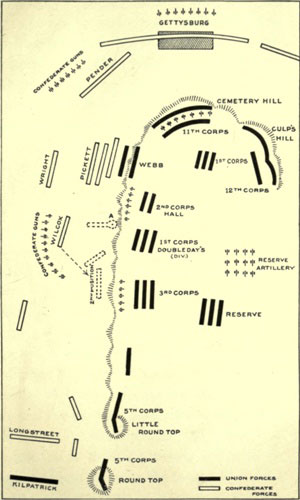
Battle of Gettysburg—Final attack, July 3 (Compiled by C E. Estabrook)
Just as the fight was over, and the first outburst of victory had a little subsided, when all in front of the crest was noise and confusion—prisoners being collected, small parties in pursuit of them far down into the fields, flags waving, officers giving quick, sharp commands to their men—I stood apart for a few moments upon the crest, by that group of trees which ought to be historic forever, a spectator of the thrilling scene around. Some few musket shots were still heard in the Third Division; and the enemy’s guns, almost silent since the advance of his infantry until the moment of his defeat, were dropping a few sullen shells among friend and foe upon the crest. Rebellion fosters such humanity. Near me, saddest sight of the many of such a field and not in keeping with all this noise, were mingled alone the thick dead of Maine and Minnesota, and Michigan and Massachusetts, and the Empire and Keystone States, who, not yet cold, with the blood still oozing from their death-wounds, had given their lives to the country upon that stormy field. So mingled upon that crest let their honored graves be. Look with me about us. These dead have been avenged already. Where the long lines of the enemy’s thousands so proudly advanced, see how thick the silent men of gray are scattered. It is not an hour since these legions were sweeping along so grandly; now sixteen hundred of that fiery mass are strewn among the trampled grass, dead as the clods they load; more than seven thousand, probably eight thousand, are wounded, some there with the dead, in our hands, some fugitive far towards the woods, among them Generals Pettigrew, Garnett, Kemper and Armstead, the last three mortally, and the last one in our hands. “Tell General Hancock,” he said to Lieutenant Mitchell, Hancock’s aide-de-camp, to whom he handed his watch, “that I know I did my country a great wrong when I took up arms against her, for which I am sorry, but for which I cannot live to atone.” Four thousand, not wounded, are prisoners of war. More in number of the captured than the captors. Our men are still “gathering them in.” Some hold up their hands or a handkerchief in sign of submission; some have hugged the ground to escape our bullets and so are taken; few made resistance after the first moment of our crossing the wall; some yield submissively with good grace, some with grim, dogged aspect, showing that but for the other alternative they could not submit to this. Colonels, and all less grades of officers, in the usual proportion are among them, and all are being stripped of their arms. Such of them as escaped wounds and capture are fleeing routed and panic stricken, and disappearing in the woods. Small arms, more thousands than we can count, are in our hands, scattered over the field. And these defiant battle-flags, some inscribed with “First Manassas,” the numerous battles of the Peninsula, “Second Manassas,” “South Mountain,” “Sharpsburg,” (our Antietam), “Fredericksburg,” “Chancellorsville,” and many more names, our men have, and are showing about, over thirty of them.
Such was really the closing scene of the grand drama of Gettysburg. After repeated assaults upon the right and the left, where, and in all of which repulse had been his only success, this persistent and presuming enemy forms his chosen troops, the flower of his army, for a grand assault upon our center. The manner and result of such assault have been told—a loss to the enemy of from twelve thousand to fourteen thousand, killed, wounded and prisoners, and of over thirty battle-flags. This was accomplished by not over six thousand men, with a loss on our part of not over two thousand five hundred killed and wounded.
Would to Heaven General Hancock and Gibbon could have stood there where I did, and have looked upon that field! It would have done two men, to whom the country owes much, good to have been with their men in that moment of victory—to have seen the result of those dispositions which they had made, and of that splendid fighting which men schooled by their discipline, had executed. But they are both severely wounded and have been carried from the field. One person did come then that I was glad to see there, and that was no less than Major General Meade, whom the Army of the Potomac was fortunate enough to have at that time to command it. See how a great General looked upon the field, and what he said and did at the moment, and when he learned of his great victory. To appreciate the incident I give, it should be borne in mind that one coming up from the rear of the line, as did General Meade, could have seen very little of our own men, who had now crossed the crest, and although he could have heard the noise, he could not have told its occasion, or by whom made, until he had actually attained the crest. One who did not know results, so coming, would have been quite as likely to have supposed that our line there had been carried and captured by the enemy—so many gray Rebels were on the crest—as to have discovered the real truth. Such mistake was really made by one of our officers, as I shall relate.
General Meade rode up, accompanied alone by his son, who is his aide-de-camp, an escort, if select, not large for a commander of such an army. The principal horseman was no bedizened hero of some holiday review, but he was a plain man, dressed in a serviceable summer suit of dark blue cloth, without badge or ornament, save the shoulder-straps of his grade, and a light, straight sword of a General or General staff officer. He wore heavy, high-top boots and buff gauntlets, and his soft black felt hat was slouched down over his eyes. His face was very white, not pale, and the lines were marked and earnest and full of care. As he arrived near me, coming up the hill, he asked, in a sharp, eager voice: “How is it going here?” “I believe, General, the enemy’s attack is repulsed,” I answered. Still approaching, and a new light began to come in his face, of gratified surprise, with a touch of incredulity, of which his voice was also the medium, he further asked: “What! Is the assault already repulsed?” his voice quicker and more eager than before. “It is, sir,” I replied. By this time he was on the crest, and when his eye had for an instant swept over the field, taking in just a glance of the whole—the masses of prisoners, the numerous captured flags which the men were derisively flaunting about, the fugitives of the routed enemy, disappearing with the speed of terror in the woods—partly at what I had told him, partly at what he saw, he said, impressively, and his face lighted: “Thank God.” And then his right hand moved as if it would have caught off his hat and waved it; but this gesture he suppressed, and instead he waved his hand, and said “Hurrah!” The son, with more youth in his blood and less rank upon his shoulders, snatched off his cap, and roared out his three “hurrahs” right heartily. The General then surveyed the field, some minutes, in silence. He at length asked who was in command—he had heard that Hancock and Gibbon were wounded—and I told him that General Caldwell was the senior officer of the Corps and General Harrow of the Division. He asked where they were, but before I had time to answer that I did not know, he resumed: “No matter; I will give my orders to you and you will see them executed.” He then gave direction that the troops should be reformed as soon as practicable, and kept in their places, as the enemy might be mad enough to attack again. He also gave directions concerning the posting of some reinforcements which he said would soon be there, adding: “If the enemy does attack, charge him in the flank and sweep him from the field; do you understand.” The General then, a gratified man, galloped in the direction of his headquarters.
Then the work of the field went on. First, the prisoners were collected and sent to the rear. “There go the men,” the Rebels were heard to say, by some of our surgeons who were in Gettysburg, at the time Pickett’s Division marched out to take position—“There go the men that will go through your d—d Yankee lines, for you,” A good many of them did “go through our lines for us,” but in a very different way from the one they intended—not impetuous victors, sweeping away our thin lines with ball and bayonet, but crestfallen captives, without arms, guarded by the true bayonets of the Union, with the cheers of their conquerors ringing in their ears. There was a grim truth after all in this Rebel remark. Collected, the prisoners began their dreary march, a miserable, melancholy stream of dirty gray, to pour over the crest to our rear. Many of the officers were well dressed, fine, proud gentlemen, such men as it would be a pleasure to meet, when the war is over. I had no desire to exult over them, and pity and sympathy were the general feelings of us all upon the occasion. The cheering of our men, and the unceremonious handling of the captured flags was probably not gratifying to the prisoners, but not intended for taunt or insult to the men; they could take no exception to such practices. When the prisoners were turned to the rear and were crossing the crest, Lieut. Col. Morgan, General Hancock’s Chief of Staff, was conducting a battery from the artillery reserve, towards the Second Corps. As he saw the men in gray coming over the hill, he said to the officer in command of the battery: “See up there! The enemy has carried the crest. See them come pouring over! The old Second Corps is gone, and you had better get your battery away from here as quickly as possible, or it will be captured.” The officer was actually giving the order to his men to move back, when close observation discovered that the gray-backs that were coming had no arms, and then the truth flashed upon the minds of the observers. The same mistake was made by others.
In view of the results of that day—the successes of the arms of the country, would not the people of the whole country, standing there upon the crest with General Meade, have said, with him: “Thank God?”
I have no knowledge and little notion of how long a time elapsed from the moment the fire of the infantry commenced, until the enemy was entirely repulsed, in this his grand assault. I judge, from the amount of fighting and the changes of position that occurred, that probably the fight was of nearly an hour’s duration, but I cannot tell, and I have seen none who knew. The time seemed but a very few minutes, when the battle was over.
When the prisoners were cleared away and order was again established upon our crest, where the conflict had impaired it, until between five and six o’clock, I remained upon the field, directing some troops to their position, in conformity to the orders of General Meade. The enemy appeared no more in front of the Second Corps; but while I was engaged as I have mentioned, farther to our left some considerable force of the enemy moved out and made show of attack. Our artillery, now in good order again, in due time opened fire, and the shells scattered the “Butternuts,” as clubs do the gray snow-birds of winter, before they came within range of our infantry. This, save unimportant outpost firing, was the last of the battle.
Of the pursuit of the enemy and the movements of the army subsequent to the battle, until the crossing of the Potomac by Lee and the closing of the campaign, it is not my purpose to write. Suffice it that on the night of the 3d of July the enemy withdrew his left, Ewell’s Corps, from our front, and on the morning of the 4th we again occupied the village of Gettysburg, and on that national day victory was proclaimed to the country; that floods of rain on that day prevented army movements of any considerable magnitude, the day being passed by our army in position upon the field, in burying our dead, and some of those of the enemy, and in making the movements already indicated; that on the 5th the pursuit of the enemy was commenced—his dead were buried by us—and the corps of our army, upon various roads, moved from the battlefield.
With a statement of some of the results of the battle, as to losses and captures, and of what I saw in riding over the field, when the enemy was gone, my account is done.
Our own losses in killed, wounded and missing I estimate at twenty-three thousand. Of the “missing” the larger proportion were prisoners, lost on the 1st of July. Our loss in prisoners, not wounded, probably was four thousand. The losses were distributed among the different army corps about as follows: In the Second Corps, which sustained the heaviest loss of any corps, a little over four thousand five hundred, of whom the missing were a mere nominal number; in the First Corps a little over four thousand, of whom a great many were missing; in the Third Corps four thousand, of whom some were missing; in the Eleventh Corps nearly four thousand, of whom the most were missing; and the rest of the loss, to make the aggregate mentioned, was shared by the Fifth, Sixth and Twelfth Corps and the cavalry. Among these the missing were few; and the losses of the Sixth Corps and of the cavalry were light. I do not think the official reports will show my estimate of our losses to be far from correct, for I have taken great pains to question staff officers upon the subject, and have learned approximate numbers from them. We lost no gun or flag that I have heard of in all the battle. Some small arms, I suppose, were lost on the 1st of July.
The enemy’s loss in killed, wounded and prisoners I estimate at forty thousand, and from the following data and for the following reasons: So far as I can learn we took ten thousand prisoners, who were not wounded—many more than these were captured, but several thousands of them were wounded. I have so far as practicable ascertained the number of dead the enemy left upon the field, approximately, by getting the reports of different burying parties. I think his dead upon the field were five thousand, almost all of whom, save those killed on the first of July, were buried by us—the enemy not having them in their possession. In looking at a great number of tables of killed and wounded in battles I have found that the proportion of the killed to the wounded is as one to five, or more than five, rarely less than five. So with the killed at the number stated, twenty-five thousand mentioned. I think fourteen thousand of the enemy, wounded and unwounded, fell into our hands. Great numbers of his small arms, two or three guns, and forty or more—was there ever such bannered harvest?—of his regimental battle-flags, were captured by us. Some day possibly we may learn the enemy’s loss, but I doubt if he will ever tell truly how many flags he did not take home with him. I have great confidence however in my estimates, for they have been carefully made, and after much inquiry, and with no desire or motive to overestimate the enemy’s loss.
The magnitude of the armies engaged, the number of the casualties, the object sought by the Rebel, the result, will all contribute to give Gettysburg a place among the great historic battles of the world. That General Meade’s concentration was rapid—over thirty miles a day was marched by some of the Corps—that his position was skillfully selected and his dispositions good; that he fought the battle hard and well; that his victory was brilliant and complete, I think all should admit. I cannot but regard it as highly fortunate to us and commendable in General Meade, that the enemy was allowed the initiative, the offensive, in the main battle; that it was much better to allow the Rebel, for his own destruction, to come up and smash his lines and columns upon the defensive solidity of our position, than it would have been to hunt him, for the same purpose, in the woods, or to unearth him from his rifle-pits. In this manner our losses were lighter, and his heavier, than if the case had been reversed. And whatever the books may say of troops fighting the better who make the attack, I am satisfied that in this war, Americans, the Rebels, as well as ourselves, are best on the defensive. The proposition is deducible from the battles of the war, I think, and my own observation confirms it.
But men there are who think that nothing was gained or done well in this battle, because some other general did not have the command, or because any portion of the army of the enemy was permitted to escape capture or destruction. As if one army of a hundred thousand men could encounter another of the same number of as good troops and annihilate it! Military men do not claim or expect this; but the McClellan destroyers do, the doughty knights of purchasable newspaper quills; the formidable warriors from the brothels of politics, men of much warlike experience against honesty and honor, of profound attainments in ignorance, who have the maxims of Napoleon, whose spirit they as little understand as they do most things, to quote, to prove all things; but who, unfortunately, have much influence in the country and with the Government, and so over the army. It is very pleasant for these people, no doubt, at safe distances from guns, in the enjoyment of a lucrative office, or of a fraudulently obtained government contract, surrounded by the luxuries of their own firesides, where mud and flooding storms, and utter weariness never penetrate, to discourse of battles and how campaigns should be conducted and armies of the enemy destroyed. But it should be enough, perhaps, to say that men here, or elsewhere, who have knowledge enough of military affairs to entitle them to express an opinion on such matters, and accurate information enough to realize the nature and the means of this desired destruction of Lee’s army before it crossed the Potomac into Virginia, will be most likely to vindicate the Pennsylvania campaign of Gen. Meade, and to see that he accomplished all that could have been reasonably expected of any general of any army. Complaint has been, and is, made specially against Meade, that he did not attack Lee near Williamsport before he had time to withdraw across the river. These were the facts concerning this matter:
The 13th of July was the earliest day when such an attack, if practicable at all, could have been made. The time before this, since the battle, had been spent in moving the army from the vicinity of the field, finding something of the enemy and concentrating before him. On that day the army was concentrated and in order of battle near the turnpike that leads from Sharpsburg to Hagerstown, Md., the right resting at or near the latter place, the left near Jones’ crossroads, some six miles in the direction of Sharpsburg, and in the following order from left to right: the 12th corps, the 2d, the 5th, the 6th, the 1st, the 11th; the 3d being in reserve behind the 2d. The mean distance to the Potomac was some six miles, and the enemy was between Meade and the river. The Potomac, swelled by the recent rain, was boiling and swift and deep, a magnificent place to have drowned all the Rebel crew. I have not the least doubt but that Gen. Meade would have liked to drown them all, if he could, but they were unwilling to be drowned, and would fight first. To drive them into the river then, they must be routed. Gen. Meade, I believe, favored an attack upon the enemy at that time, and he summoned his corps commanders to a council upon the subject. The 1st corps was represented by William Hayes, the 3d by French, the 5th by Sykes, the 6th by Sedgwick, the 11th by Howard, the 12th by Slocum, and the Cavalry by Pleasanton. Of the eight generals there, Wadsworth, Howard and Pleasanton were in favor of immediate attack, and five, Hayes, French, Sykes, Sedgwick and Slocum were not in favor of attack until better information was obtained of the position and situation of the enemy. Of the pros Wadsworth only temporarily represented the 1st corps in the brief absence of Newton, who, had a battle occurred, would have commanded. Pleasanton, with his horses, would have been a spectator only, and Howard, with the brilliant 11th corps, would have been trusted nowhere but a safe distance from the enemy—not by Gen. Howard’s fault, however, for he is a good and brave man. Such was the position of those who felt sanguinarily inclined. Of the cons were all of the fighting generals of the fighting corps, save the 1st. This, then, was the feeling of these generals—all who would have had no responsibility or part in all probability, hankered for a fight—those who would have had both part and responsibility, did not. The attack was not made. At daylight on the morning of the 14th, strong reconnoissances from the 12th, 2d and 5th corps were the means of discovering that between the enemy, except a thousand or fifteen hundred of his rear guard, who fell into our hands, and the Army of the Potomac, rolled the rapid, unbridged river. The Rebel General, Pettigrew, was here killed. The enemy had constructed bridges, had crossed during all the preceding night, but so close were our cavalry and infantry upon him in the morning, that the bridges were destroyed before his rear guard had all crossed.