THE OPENING BATTLE ON LEXINGTON COMMON.
Reading edition
THE OPENING BATTLE ON LEXINGTON COMMON.
The six companies of light infantry under command of Major Pitcairn were now considerably in advance of the main body under Smith, and up the road somewhat farther than the present high school building, even farther along than where the Woburn road, now Woburn Street, turns off to the eastward. When still nearer Lexington Common, within about one hundred rods of it, they heard the beating of a drum by William Dimond, drummer in Captain Parker's Company. It was the summons for that little band to assemble across the pathway of an invading army. Major Pitcairn accepted it as a challenge, and promptly ordered his soldiers to halt and load their muskets,[106] and then to march on the double quick for Lexington Common.[107]
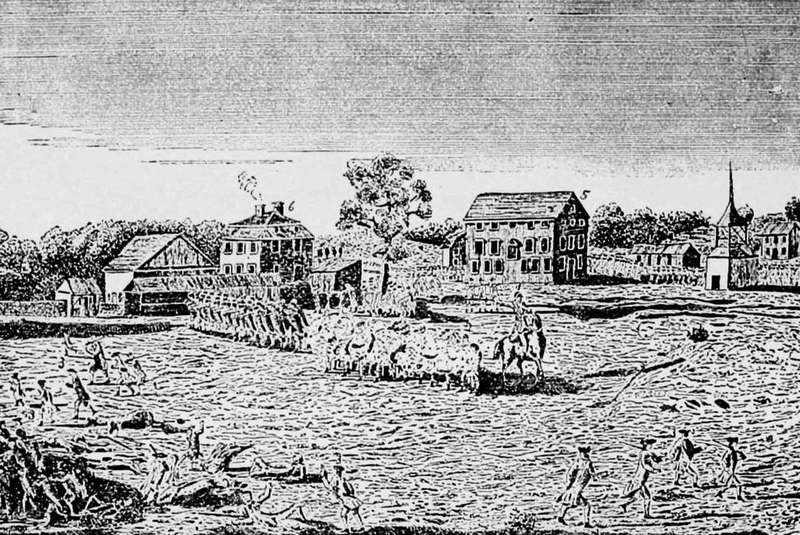
The Battle of Lexington, April 19th, 1775. Plate I.
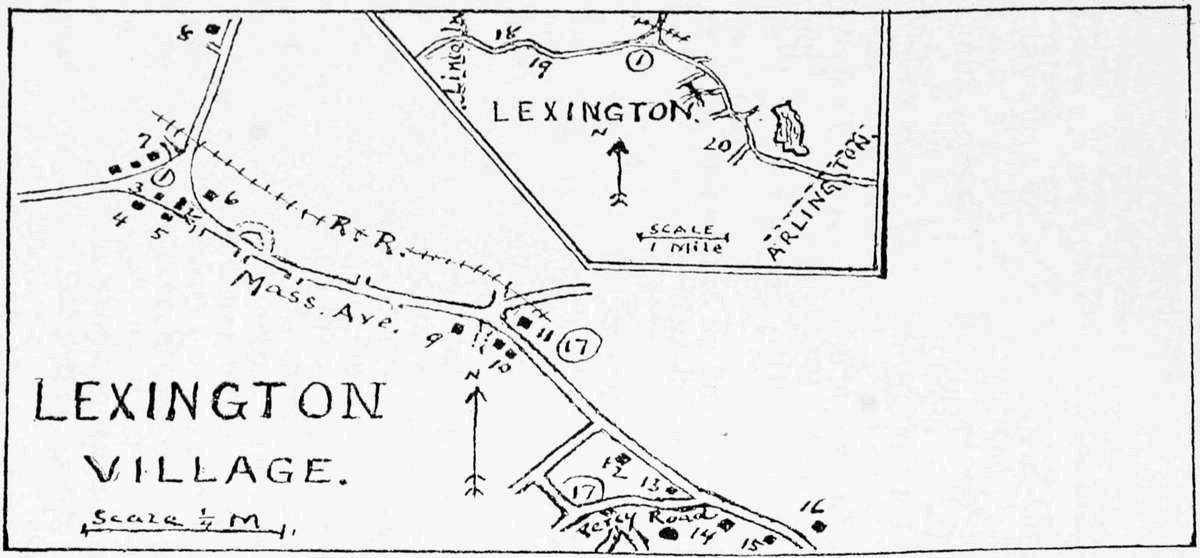
LEXINGTON COMMON AND VICINITY.
1. Lexington Common. 2. Meeting House. 3. Belfry. 4. Marrett Munroe. 5. Emerson. 6. Buckman Tavern. 7. Harrington. 8. Rev. Jonas Clarke. 9. Merriam. 10. Loring. 11. Mead. 12. Mulliken. 13. Bond. 14. Munroe Tavern. 15. Sanderson. 16. Mason. 17. Percy's Cannon. 18. Lieut.-Col. Smith wounded. 19. Hayward mortally wounded. 20. Wellington captured.
Captain John Parker's company numbered, all told, one hundred and twenty men, but only a few more than half answered to this call at day-break, April 19. It will be remembered that Paul Revere did not reach Lexington with his message of alarm until midnight. Many of the minute-men lived too remote to be so quickly summoned. Captain Parker's home was over two miles away, in the southwesterly part of the town, near the Waltham line. He was called at about one o'clock,[108] and stood on the Common before two o'clock with such of his men as had then assembled. We have seen how they answered the roll-call and then dispersed to be within call of the drum, as the night was chilly. Those who lived near, went home, and those who lived too far away, to quickly go and come, repaired to Buckman's Tavern, close at hand.
Captain Parker has been described by his grandson, Theodore Parker, the celebrated Unitarian preacher, as being "a great, tall man, with a large head, and a high, wide brow." His great grand-daughter, Elizabeth S. Parker, has described him as stout, large-framed, medium height, like Rev. Theodore Parker, but with a longer face.[109] We can imagine him as a prudent man, with a quiet, yet firm courage.
Two men from Woburn had just arrived, and it was then a little before five o'clock. They were Sylvanus Wood and Robert Douglass. They had come about three miles, having heard, about an hour before, the ringing of the bell in the Old Belfry, which stood near the church on the Common. As Wood came up he approached Captain Parker and inquired the news. Parker replied that he did not know what to believe, for, half an hour before, a messenger had returned with the assurance that no British were on the way. While talking, another messenger, Thaddeus Bowman, rode up with the startling announcement that the British were within half a mile. They were nearer than that—not even down the road as far as Woburn Street.
Captain Parker then ordered his drummer, William Dimond[110] to beat to arms. The minute-men assembled from their homes and from the Buckman Tavern. They were but few, so few indeed, that he turned to Wood and begged him to join their ranks. Wood consented. Parker asked him if his young companion, meaning Robert Douglass, would also join. And Douglass also enlisted into Captain Parker's Company. These two were indeed brave, for the danger was really then and there.
The minute-men gathered around their captain in the middle of the road, about half way between the meeting-house and the tavern. The meeting-house then stood where the heroic statue of a minute-man in bronze now stands. The tavern is still standing (1912).
Parker then said:
"Every man of you who is equipped, follow me; and those of you who are not equipped, go into the meeting-house and furnish yourselves from the magazine, and immediately join the company."[111] Joseph Comee, Caleb Harrington and Joshua Simonds then went into the meeting-house, to comply with the Captain's command.
Then Parker led those who were equipped, to the northerly end of the Common, where they formed in single line. Sylvanus Wood stepped from the ranks long enough to count them, and has left his sworn statement that there were thirty-eight, "and no more."[112]
In the brief moments which followed others were hastening to join the ranks, and as they arrived Orderly Sergeant William Munroe attempted to form them into a second line, and partially succeeded.[113] Even later still a few more reached the Common, and were back to the British as they wheeled grandly around the easterly end of the meeting-house and at last stood on Lexington Common.[114] Captain Parker's entire force then numbered between sixty and seventy men,[115] ununiformed, scantily armed, poorly disciplined, pitifully few as compared with the three or four hundred of the British.
It is no wonder that one minute-man exclaimed:
"There are so few of us it is folly to stand here."
Captain Parker heard the remark, and answered:
"The first man who offers to run shall be shot down."[116]
On came the British, almost on the run,[117] the light companies of the Tenth Regiment in advance.[118] At their head rode Major John Pitcairn and two other mounted officers.[119]
"Stand your ground," exclaimed Parker; "don't fire unless fired upon. But if they want to have a war let it begin here!"[120]
Major Pitcairn galloped up to within six rods of Captain Parker's foremost line, and exclaimed:
"Lay down your arms, you damned rebels, and disperse."
Captain Parker, seeing the utter hopelessness of armed resistance, gave the order to disperse and not to fire.[121] He did not, however, order his men to lay down their arms. Evidently Pitcairn wished to disarm them, for while they were dispersing he shouted again:—
"Damn you, why don't you lay down your arms?"[122]
But no answer came back, and each one of Capt. Parker's little band retiring from the field, carried his gun with him.
Then one of the other mounted officers, about two rods behind Pitcairn, name unknown, brandished his sword and the regulars huzzaed in unison. He then pointed his pistol towards the minute-men and fired.[123]
Pitcairn was back to that officer, so did not see him fire. He heard the discharge, and easily might have mistaken it as coming from an enemy, for he had not authorized it himself.[124] Furious with passion he gave the order:
"Fire!"
There was hesitation to obey from his men, for he repeated:
"Fire, damn you, fire!"[125]
The first platoon of eight or nine men then fired, evidently over the heads of the minute-men, for none were killed or wounded.[126] Pitcairn saw the effects of that volley and realized that his men did not aim to kill. Then came his next order:
"G——d d——n you, fire at them!"[127]
The second volley surely was fired to kill.
John Munroe, one of the minute-men in line, thought that the first volley was nothing but powder and so remarked to Ebenezer Munroe, who stood next to him. But as the second volley came quickly and with fatal effect, the latter answered that something more than powder was being used for he had received a wound in his arm, and, he added:
"I'll give them the guts of my gun."[128]
These two Munroes then deliberately fired at the British, though the smoke from the latter's guns prevented a deliberate and careful aim.[129] John Munroe, after retreating about ten rods, loaded a second time, with two balls, and fired, but the charge was too heavy, and he lost about a foot from the muzzle end of his gun.[130]
Jonas Parker, cousin to the Captain, was mortally wounded through the body,[131] from the second volley, but having sufficient strength, fired in return. He had but just uttered his determination not to run, and had placed his hat on the ground at his feet, and in it put his bullets and extra flints. The British bullet in his body caused him to sink to his knees, but he heroically endeavored to reload. He could not, before the advancing enemy were upon him, and one of them ended his sufferings with a bayonet thrust.[132]
Jonathan Harrington, Jr., was mortally wounded, but staggered towards his home, on the northerly end of the Common. He fell before reaching there, struggled to his feet again, and staggered almost to his own door, where he expired, just as his wife rushed to meet him. He fell near the barn, then standing in what is now Bedford Street.[133]
Ensign Robert Munroe was killed while attempting to escape. He was just at the edge of the Common, by the wall at Merriam's barn.[134] His daughter, Anna, wife of Daniel Harrington, who lived at the northerly end of the Common, must have seen the tragedy, as must also his two sons, Ebenezer and John, and his two sons-in-law, Daniel Harrington and Lieut. Tidd, all four in line with Captain Parker.
When Parker directed such of his force as were without ammunition to proceed into the meeting-house near by, and supply themselves from the town's stock, as we have written, Joseph Comee, Caleb Harrington and Joshua Simonds entered the sacred edifice for that purpose. Simonds succeeded in getting down from the upper loft to the first balcony, two quarter casks of powder, and had removed the head from one.[135] The opening volley, but a few rods away, indicated to him that hostilities had commenced. He expected to meet his fate. Pointing his gun to the open cask he resolved to blow up the meeting-house, himself and his enemies, rather than to have them enter and capture him.[136] Comee and Harrington attempted to escape, and were running from the westerly end of the meeting-house, when the latter was shot and instantly killed,[137] and the former wounded in the arm. He made his way to the Marrett Munroe house, passed through it and out of the back door, and escaped over the hill at the rear.
Then with savage ferocity the British rushed on, hunting down the fleeing minute-men, as they attempted to escape in all directions. A mounted officer, supposed to be Pitcairn, pursued William Tidd up the North road (now Hancock Street), about thirty rods, calling out to him:
"Damn you, stop, or you are a dead man!"
Thereupon Tidd leaped over a pair of bars, made a stand and discharged his gun at his pursuer, who then retreated to the main body.[138]
Solomon Brown was not idle. Though not in line with Captain Parker's men, he was an active participant. After their second volley, he opened fire from the back door of Buckman's Tavern, and then in order to get a better shot, passed through to the front door, and fired from there. The British retaliated with a return volley, and the bullet holes in the old building still vouch for it. John Buckman, the landlord, remonstrated with Brown, against having his house used as a fort, so the latter took a new position, lying down behind a neighboring stone wall back of the barn, and opened fire again.[139] The British again responded. Their leaden bullets spattered against the wall and from their impact little clouds of stone dust like smoke, told a witness where they struck.[140] Brown's aim was at an officer, and group of soldiers, and subsequently Abijah Harrington saw a pool of blood on the ground where they stood.[141]
John Brown and Samuel Hadley were killed on the edge of the swamp, a little way to the north of the Common. They were retreating, but not beyond the reach of their pursuers' bullets.[142]
Asahel Porter, unarmed, non-combatant, and who had been brought up from Menotomy with Josiah Richardson as prisoners, was killed a few rods over the wall in Buckman's garden, to the eastward of the Tavern. He had been liberated with other prisoners, and had been cautioned not to run, but walk away. After walking a little distance he felt impelled to run, and was pursued by a British bullet, with fatal effect. Richardson walked away, and safely escaped.
The work of the British on Lexington Common, occupying less than half an hour, was now finished. Their casualties were slight, one man of the Tenth Regiment wounded in the thigh, another in the hand, and Major Pitcairn's horse shot in two places.[143] The killing of the minute-men, had, however, wrought the rank and file up to a frenzied pitch of excitement, so much so, that the officers had difficulty in forming them into line again.[144] They succeeded though. In the meantime the main body under Lieut.-Col. Smith arrived, and when they were all in marching order a volley was fired, and huzzas shouted as an expression of victory, and then they proceeded on their way.[145] Just then the sun rose on this new field of battle.[146]
Again the fife and drum, at first harsh and loud, echoing against the neighboring hills; then fainter and fainter, as the troops marched up and over the summit of Concord Hill, a mile away.
And when they were indeed gone, the men and women and children of Lexington came forth from their hiding places and looked upon the scene. We of today, have never seen our Common as they saw it, its turf torn with horses' hoofs, and clotted here and there with human blood; with prostrate figures of men, some with faces upward to the sky, others with theirs smothered helplessly in the dust. One might almost think they were asleep.
Such was the fulfilment of their solemn pledge, that they stood ready to sacrifice "everything dear in life, yea and life itself, in support of the common cause."[147]
Strong and willing arms then bore all of those precious dead into the house of God. And we can imagine, as they came forth, that their faces were turned towards Concord Hill, shining with a patriot's full meaning. We can go with them through the day, as they join the men of Acton; of Concord;—men from all over Middlesex, and Essex, and Norfolk Counties, who also stood so ready to defend the common cause, yea, even with life itself!
The dead on or near Lexington Common were Jonas Parker, Jonathan Harrington, Jr., Ensign Robert Munroe, Isaac Muzzy, John Brown, Samuel Hadley, Caleb Harrington, and Asahel Porter. The wounded were John Robbins, so that he could not write his name or even make his mark;[148] Solomon Pierce; John Tidd, sabre cut on his head by a British officer;[149] Joseph Comee, on his arm;[149] Ebenezer Munroe, Jr., on his arm;[150] Thomas Winship; Nathaniel Farmer; Prince Estabrook (colored) and Jedediah Munroe (who was killed later in the day).
Hardly had the soldiers of King George reached the summit of Concord Hill, a mile away, ere stragglers, wearing the same uniform, were seen coming up the road, apparently without fear or guile. There were five in all, but as they came singly or in twos, were not looked upon as dangerous belligerents. Joshua Simonds emerging from the meeting-house, captured the first one, took his gun away, and gave it to Captain Parker.[151] Deacon Benjamin Brown captured one.[152] Joshua Reed, of Woburn, captured one, took away his gun and other warlike equipments and turned him over to James Reed of Burlington,[153] then called Woburn Precinct. Two more were taken on or near the Common, and their arms, or those of two Britons at all events, carried into Buckman Tavern by Ebenezer Munroe, later given to minute-men, who had none of their own.[154]
Another prisoner, the sixth, was captured by Sylvanus Wood of Woburn, the man who joined Captain Parker's Company, and stood in line to receive the first volley, as the British marched into sight. When they marched away he followed on, up over Concord and Fiske Hills. Arriving at a turn in the road, beyond the latter, he came unexpectedly upon a soldier who for some good reason had dropped out of the ranks. He was seated at the roadside, and his gun leaned at rest beyond his reach. Wood was a little man, about five feet tall, but large in valor. So he demanded the surrender of his enemy. Helpless as he was he could only comply, and Wood marched him back to Lexington Common and placed him in the charge of a Mr. Welsh.[155]
This prisoner also was captured in Lexington, at the bluff near the Bull Tavern, later kept by Mr. Viles. It stood not far from the Lincoln line. He and four of the others taken on Lexington Common were escorted to James Reed's in Burlington by Thomas R. Willard, William Munroe, and E. Welsh.[156]