VII. MELON SHAPED BASKETS
Reading edition
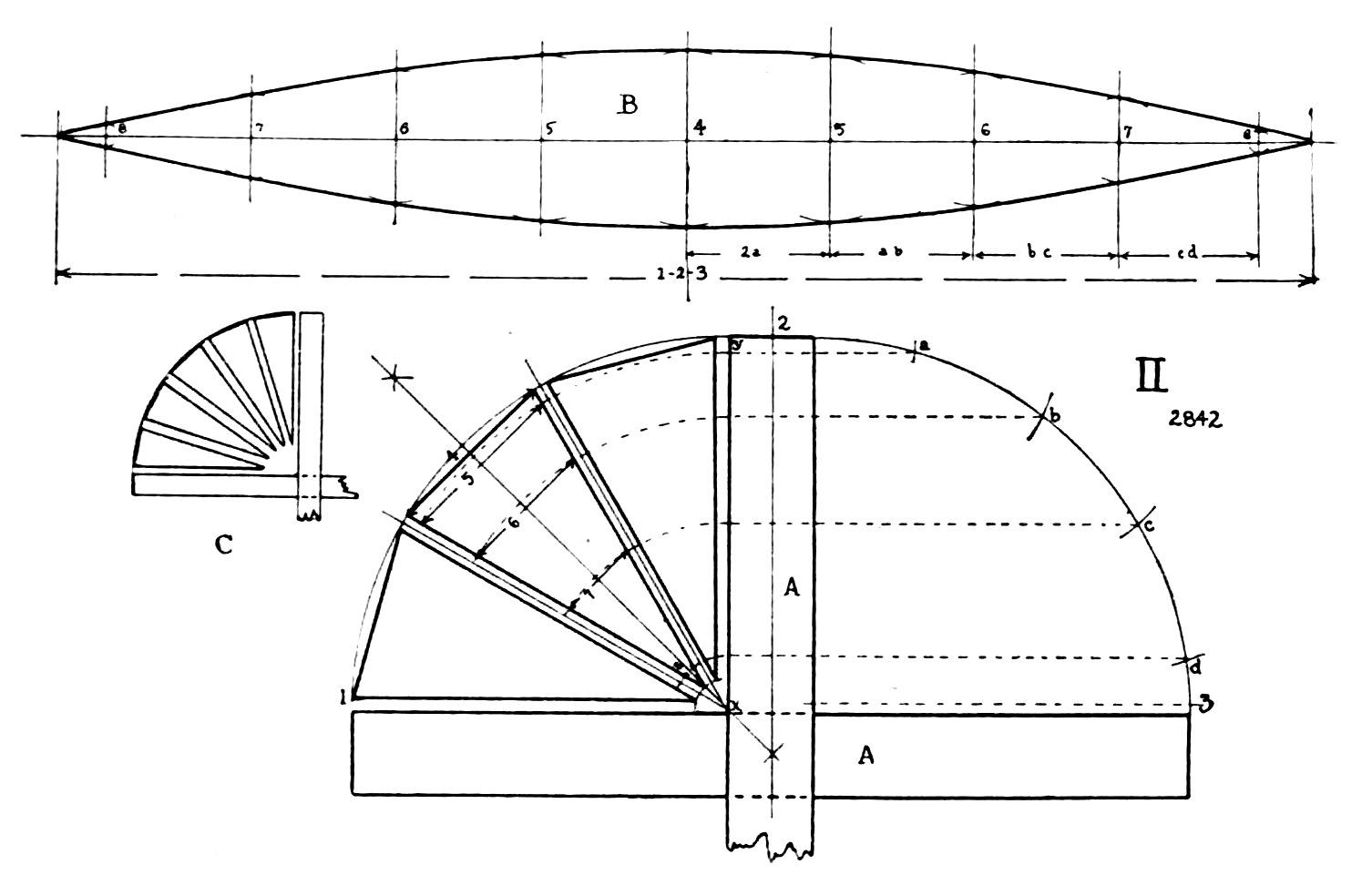
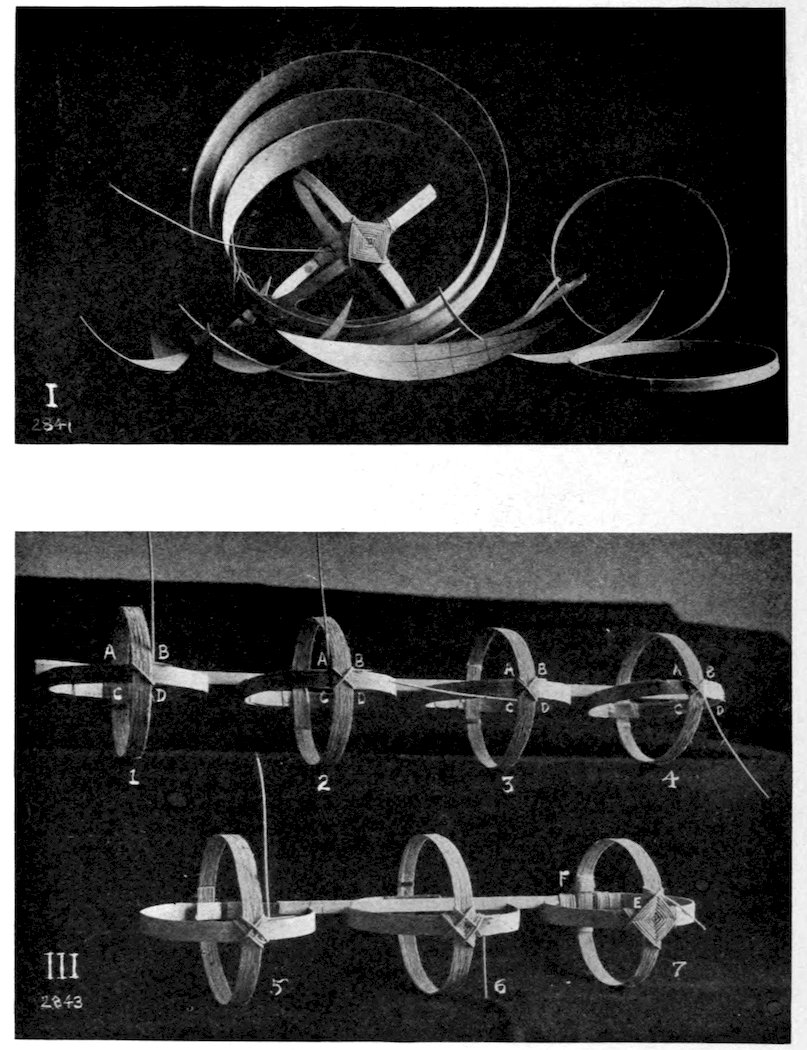
A melon shaped basket seems to me to be the most fascinating of all in its method of construction. Figure I shows the material necessary with the exception of the weavers. Figure II shows the method of determining the shape of the slices or ribs on which the weaving is done.[6] The material with which the two circular ribs are made is stout ash splint. Take two straight pieces the length required for the circumference of the circle allowing about three-fourths of an inch for lap. These may be fastened together to form the two circular rings either by a small bent iron fastener or with fine string. These rings are then placed in the position shown in Figure III, No. 1, perpendicular to each other. The weaver is then placed behind the vertical 53ring on top of the horizontal ring with its ends projecting toward the right in the direction of A-B. The weaver is then brought over from A to D in front of the vertical ring.
Then behind the horizontal ring and up to B, in which position it is shown at No. 1. From thence it goes diagonally across the vertical ring from B to C and upward behind the horizontal, from C to A and assumes the position shown at No. 2. It now goes across from A to D as before, and behind the vertical ring from D to C, below the horizontal; which position is shown at No. 3. From there it goes across the vertical ring from C to B, then behind the vertical from B to A. This method of winding is kept up, as shown at 4, 5, and 6, until a little pocket is formed, as shown at E and F. This process takes place on both ends of the rings. The center ribs on either side are now put into this pocket and the single weaving is commenced, as shown at Figure IV.
Weave three or four rows on one end, then three or four on the other end. This weaving, first on one end and then on the other, must be kept up during the whole construction of the basket.
54
55In the construction of these baskets many will place all the ribs in the pocket at once, but this method of construction is too difficult for an amateur to attempt.
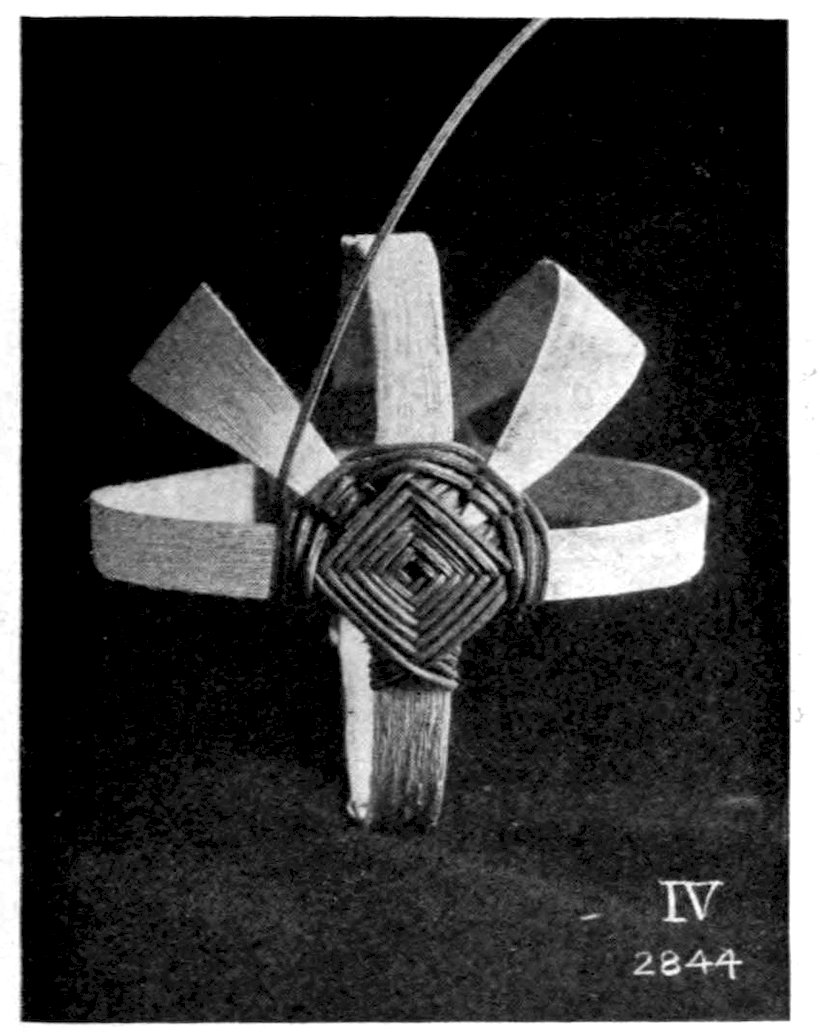
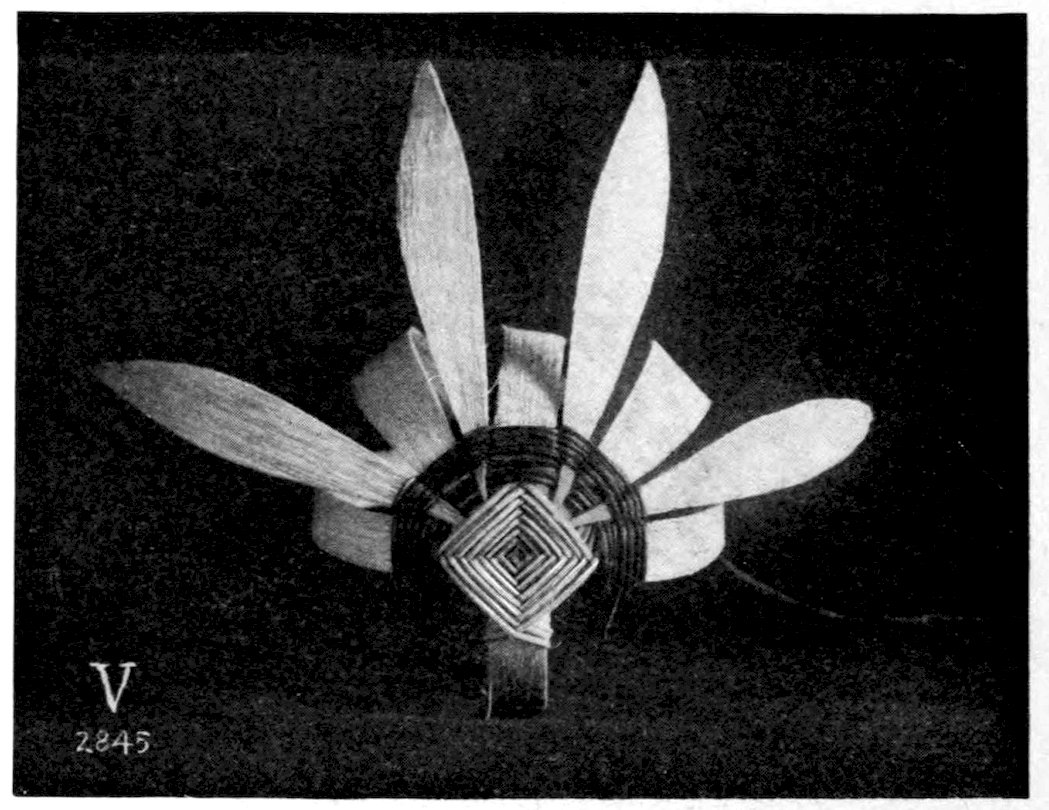
After these two middle ribs have been placed in position and three rows of weaving completed, the other four ribs should be tucked into the pocket on one end and the single weaving continued until four or five rows are woven, as shown in Figure V.
This process has been found to be much easier than to place the ribs in both pockets, because of the fact that in weaving on one end the other ends of the ribs are continually flying out.
After four or five rows are woven the other ends of the ribs may be placed in the opposite pocket and the weaving continued 56as on the opposite end. Great care must be taken in the shaping of these ribs to see that there is a proper distance between them so that the weaver may not be cramped.
The final shape of the basket depends almost entirely upon the nicety with which these ribs are constructed.
If one wishes to construct the basket so that it will be more than a half-sphere in depth, it can be easily done by making a plan of rings and ribs of the shape wanted and laying out these rings and ribs from that. It may be necessary in teaching younger pupils the construction of these baskets for the teacher to do the drawing and laying out of the size and shape of these ribs, but this process should be thoroughly explained.
If difficulty is found in getting heavy ash splint for the rings and ribs, they may be easily constructed from the hoops of a sugar barrel or even wood from a cheese box, both of which must be 57soaked and whittled down thin, say to one-sixteenth of an inch in thickness. One of the best melon shaped baskets which I have seen had its rings and ribs constructed from wood taken from a butter box which was about eight inches in diameter. Too much emphasis cannot be placed on the necessity of getting the foundation features of this construction absolutely accurate. This is truer of this shape than of almost any other.
Where it seems impossible to get either the ash splint or other material spoken of, No. 8 or 10 round reed may be split lengthwise and used in the construction of the rings. If these are to be used it will be found necessary to have a greater number of ribs on which to weave than has been spoken of previously. It does not seem wise, however, to attempt a melon shaped basket over four or five inches in diameter with half round reed as a foundation.
“Think it up a little” and see how broad the field of basketry really may become.
TRANSCRIBER’S NOTES
Typos fixed; non-standard spelling and dialect retained.