Book 24 — CHAPTER XIV.
Reading edition
THAT THE ILIAD WHICH THE WRITER OF THE ODYSSEY KNEW WAS THE SAME AS WHAT WE NOW HAVE.
It remains for me to show that the writer of the Odyssey had the Iliad before her to all intents and purposes as we now have it, and to deal with the manner in which the poem grew under her hands.
In my own copies of the Iliad and Odyssey I have underlined all the passages that are common to both poems, giving the references. It is greatly to be wished that one or other of our University presses would furnish us with an Odyssey in which all the Iliadic passages are printed in a slightly different type and with a reference, somewhat in the style of the extracts from Il. I. and XXIV. here given. The passages are to be found at the end of Dunbar's Concordance to the Odyssey, but the marking of them as they occur in the course of the poem will be more instructive. In my translations of the poems (now finished) I have translated identical passages as nearly as possible in identical words. In the Odyssey I propose to print them in another type and give the references to the Iliad. In the translation of the Iliad there is no use in doing this, for no one supposes that Homer took anything from the Odyssey. The publication, however, of these translations must, I fear, be postponed, but I will give in this Chapter as many instances as I think will be sufficient to satisfy the reader that the Iliad of the writer of the Odyssey was our own Iliad.
I will begin by giving two passages from the Iliad, one from Book I., and the other from Book XXIV., the references in all cases being to the Odyssey. These are perhaps fuller of lines adopted by the writer of the Odyssey than any others in the Iliad, though there are some that run them closely. Lines or parts of lines in the smaller type do not occur in the Odyssey.
The first passage that I will call attention to is Iliad i. 455-485, which is as follows:—
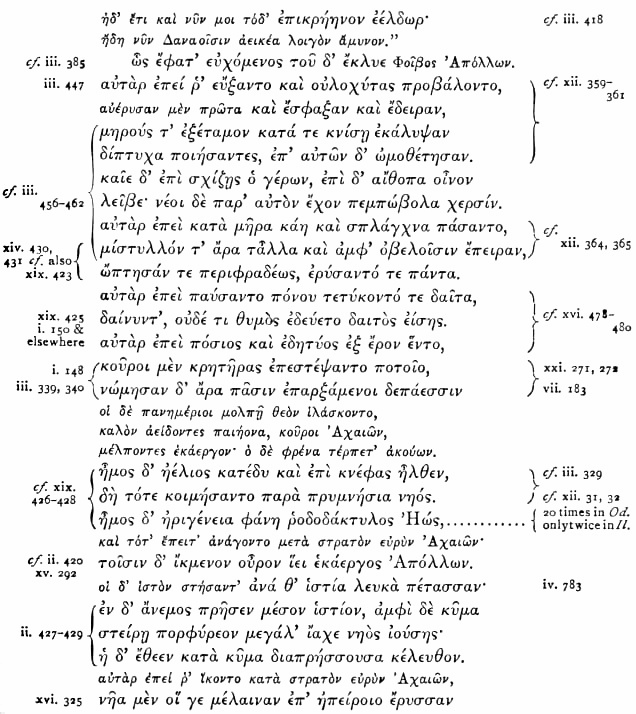
I should perhaps tell the reader that the first Book of the Iliad is one of the few which modern criticism allows to remain in the possession of the poet who wrote what Professor Jebb calls the "primary" Iliad.
The second of the two passages above referred to is Iliad XXIV. 621-651, which runs:—
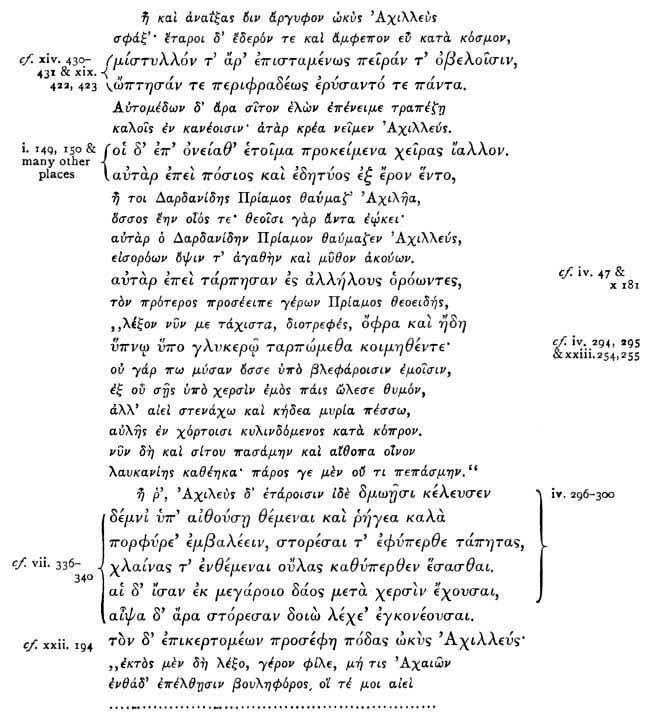
Professor Jebb is disposed to attribute Il. XXIV. to the writer of Il. IX., which he does not ascribe to Homer, and would date circ. B.C. 750-600. I regret that I can go no further with him than that Il. XXIV. and Il. IX. are by the same hand.
It is beyond my scope to point out the slight and perfectly unimportant variations from the Iliad which are found in some of the Odyssean lines to which I have given a reference; they are with hardly an exception such as are occasioned by difference of context. Though unimportant they are not uninteresting, but I must leave them for the reader to examine if he feels inclined to do so.
He will observe that some lines are nearly and some quite common to the two extracts above given, and I should add that not a few other lines are repeated elsewhere in the Iliad, but enough remains that is peculiar to either of the two extracts to convince me that the writer of the Odyssey knew them both. And not only this, but they seem to have risen in her mind as spontaneously, and often no doubt as unconsciously, as passages from the Bible, Prayer-book, and Shakspeare do to ourselves.
If, then, we find the writer so familiar with two such considerable extracts from the first and last Books of the Iliad—for I believe the reader will feel no more doubt than I do, that she knew them, and was borrowing from them—can we avoid thinking it probable that she was acquainted, to say the least of it, with the intermediate Books? Such surely should be the most natural and least strained conclusion to arrive at, but I will proceed to shew that she knew the intermediate Books exceedingly well.
I pass over the way in which Mentor's name is coined from Nestor's (cf. Il. II. 76-77 and Od. ii. 224, 225, and 228), and will go on to the striking case of Ulysses' servant Eurybates. In Od. xix. 218, 219 Penelope has asked Ulysses (who is disguised so that she does not recognise him) for details as to the followers Ulysses had with him on his way to Troy, and Ulysses answers that he had a servant named Eurybates who was hunched in the shoulders (xix. 247). Turning to Il. II. 184 we find that Ulysses had a servant from Ithaca named Eurybates, but he does not seem to have been hunched in the shoulders; on reading further, however, we immediately come to Thersites, "whose shoulders were hunched over his chest" (Il. II. 217, 218). Am I too hasty in concluding that the writer of the Odyssey, wanting an additional detail for Penelope's greater assurance, and not finding one in the Iliad, took the hunchiness off the back of the next man to him and set it on to the back of Eurybates? I do not say that no other hypothesis can be framed in order to support a different conclusion, but I think the one given above will best commend itself to common sense; and the most natural inference from it is that the writer of the Odyssey knew at any rate part of Il. II. much as we have it now.
I often wondered why Menelaus should have been made to return on the self-same day as that on which Orestes was holding the funeral feast of Ægisthus and Clytemnestra; the Greek which tells us that he did so runs:—
αὐτῆμαρ δέ οἱ ἦλθε βοὴν ἀγαθὸς Μενέλαος (Od. iii. 311).
I did not find the explanation till I remembered that in Iliad II. 408, when Agamemnon has been inviting the Achæan chieftains to a banquet, he did not ask Menelaus, for Menelaus came of his own accord:—
αὐτόματος δέ οἱ ἦλθε βοὴν ἀγαθὸς Μενέλαος,
on remembering this I observed that it would be less trouble to make Menelaus come home on the very day of Ægisthus' funeral feast than to alter αὐτόματος in any other way which would leave the rest of the line available. I should be ashamed of the writer of the Odyssey for having done this, unless I believed it to be merely due to unconscious cerebration. That the Odyssean and Iliadic lines are taken the one from the other will approve itself to the instincts of any one who is accustomed to deal with literary questions at all, and it is not conceivable that Menelaus should, in the Iliad, have been made to come uninvited because in the Odyssey he happened to come back on the very day when Orestes was holding Ægisthus' funeral feast; the Iliadic context explains why Menelaus came uninvited—it was because he knew that Agamemnon was too busy to invite him. I infer, therefore, that the writer of the Odyssey again shows herself familiar with a part of Il. II.
I can see no sufficient reason for even questioning that the catalogues of the Achæan and Trojan forces in the second Book of the Iliad were part of the Iliad as it left Homer's hands. They are wanted so as to explain who the people are of whom we are to hear in the body of the poem; their position, is perfectly natural; the Achæan catalogue is prepared in Nestor's speech (II. 360-368); Homer almost tells us that he has had assistance in compiling it, for he invokes the Muse, as he does more than once in later Books, and declares that he knows nothing of his own knowledge, but depends entirely upon what has been told him[1]; the lines quoted or alluded to in the Odyssey are far too marked to allow of our doubting that the writer knew both catalogues familiarly; I cannot within my limits give them, but would call the reader's attention to Il. II. 488, cf. Od. iv. 240; to the considering Sparta and Lacedæmon as two places (Il. II. 580, 581) which the writer of the Odyssey does (iv. 10), though she has abundantly shown that she knew them to be but one; to Il. II. 600, cf. Od. iii. 386; to the end of line 614, θαλάσσια ἔργα μεμήλειν, cf. Od. v. 67, θαλάσσια ἔργα μέμηλειν; to 670, cf. Od. ii. 12; to 673, 674, cf. Od. xi. 469, 470; to Il. II. 706, αὐτοκασγνητος μεγαθύμον Πρωτεσιλάου, which must surely be parent of the line αὐτοκασιγνήτου ὀλοόφρονος Αἰήταο, Od. X. 137; to Il. II. 707, ὁπλότερος γένεῇ ὁ δ᾿ ἅμα πρότερος καὶ ἀρείων, cf. Od. xix. 184, where the same line occurs; to Il. II. 721, ἀλλ᾿ ὁ μὲν ἐν νήσῳ κεῖτο κρατέρ᾿ ἄλγεα πάσχων, cf. Od. v. 13, where the same line occurs, but with κεῖται instead of κεȋτο to suit the context; cf. also Od. v. 395, where we find πατρός, ὃς ἐν νούσῳ κῆται, κρατέρ᾿ ἄλγεα πάσχων, a line which shows how completely the writer of the Odyssey was saturated with the Iliad; to Il. II. 755, Στυγὸς ὕδατός ἐστιν ἀπορρώξ, cf. Od. x. 514, where the same words end the line; to Il. II. 774, δίσκοισιν τέρποντο καὶ αἰγανέῃσιν ἱέντες, cf. Od. iv. 626, and xvii. 168, where the same line occurs; to Il. II. 776, where the horses of the Myrmidons are spoken of as λωτὸν ἐρεπτόμενοι, cf. Od. ix. 97, where the same words are used for Ulysses' men when with the Lotus-eaters; to Il. II. 873, νήπιος, οὐδέ τί οἱ τό γ' ἐπήρκεσε λυγρὸν ὄλεθρον, cf. Od. iv. 292, ἄλγιον, οὐ γάρ οἵ τι τά γ' ἤρκεσε λυγρὸν ὄλεθρον.
None of the passages above quoted or referred to are to be found anywhere else in the Iliad, so that if from the Iliad at all, they are from the catalogues. But having already shown, as I believe, that the writer of the Odyssey knew lines 76, 77, 78, 184, 216, 217, and 408 of Book II., and accepting the rest of the Book as written by Homer, with or without assistance, I shall not argue further in support of my contention that the whole of Book II. was known to, and occasionally borrowed from, by the writer of the Odyssey.
Perhaps the prettiest example of unconscious cerebration in the Odyssey is to be found in the opening line of Od. iii, which runs ἠέλιος δ' ἀνόρουσε λιπὼν περικαλλέα λίμνην, which is taken from Il. v. 20, Ιδαῖος δ' ἀνόρουσε λιπὼν περικαλλέα δίφρον· One is at a loss to conceive how a writer so apparently facile should drift thus on to an Iliadic line of such different signification except as the result of saturation. It is inconceivable that she should have cast about for a line to say that the sun was rising, and thought that Idæus jumping off his chariot would do. She again has this line in her mind when in Book xxii. 95 she writes Τηλέμαχος δ' ἀπόρουσε λιπὼν δολιχόσκιον ἔγχος.
The same kind of unconscious celebration evidenced by the lines last referred to leads her sometimes to repeat lines of her own in a strange way, without probably being at all aware of it. As for example:—
βασιλῆες.....εἰσὶ καὶ ἄλλοι πολλοὶ ἐν ἀμφιάλῳ Ἰθάκῃ νέοι ἠδὲ παλαιοί, (i. 394, 395).
This passage in the following Book becomes:—
εἰσὶ δὲ νῆες πολλαὶ ἐν ἀμφιάλῳ Ἰθάκῃ νέαι ἠδὲ παλαιαί· (ii. 292, 293).
Another similar case is that of the famous line about Sisyphus' stone bounding down hill in a string of dactyls, Od. xi. 598, it runs:—
αὖτις ἔπειτα πέδονδε κυλίνδετο λᾶας ἀναιδής.
"The cruel stone came bounding down again on to the plain." I believe this to be nothing but an unconscious adaptation from the one dactylic line that I can remember in the Iliad, I mean:—
ἀμφοτέρω δὲ τένοντε καὶ ἴστέα λᾶας ἀναιδὴς ἄχρις ἀπηλοίησεν. Il. IV 521, 522.
"The cruel stone shattered the bones of the neck, tendons and all." Granted (which is very doubtful) that there may be an accommodation of sound to sense in the Odyssean line, I contend that the suggestion came from the Iliadic line.
I would gladly go through the whole Iliad calling attention to the use the writer of the Odyssey has made of it, but to do this would require hardly less than a book to itself. I will therefore ask the reader to accept my statement that no one Book in the Iliad shows any marked difference from the others as regards the use that has been made of it, and will limit myself to those Books that have been most generally declared to be later additions—I mean Book X. and Book XVIII.—for I consider that I have already sufficiently shown the writer of the Odyssey to have known Books I., XXIV., and the Catalogues in Book II. It may be well, however, to include Book XI. in my examination, for this is one of the most undoubted, and it will be interesting to note that the writer of the Odyssey has both the most doubted and undoubted Books equally at her fingers' ends. I shall only call attention to passages that do not occur more than once in the Iliad, and will omit the very numerous ones that may be considered as common form.
In Il. X. 141, 142 we find:—
τίφθ' οὔτω;..... Νύκτα δι' ἀμβροσίην, and in Od. ix. 403, 404. τίπτε τόσον..... Νύκτα δι' ἀμβροσίην.
In Il. X. 142, ὅτι δὴ χρείω τόσον ἴκει; Il. Od. ii. 28, τίνα χρειὼ τόσον ἵκει.
Il. X. 158 begins with the words λὰξ ποδὶ κίνησας. So also does Od. XV. 45.
Il. X. 214 has, ὅσσοι γὰρ νήεσσιν ἐπικρατέουσιν ἄριστοι, this line is found Od. i. 245, xvi. 122, xix. 130, but with νήσοισιν instead of νήεσσιν.
Il. X. 220 ends with ὀτρύνει κραδίη καὶ θυμὸς ἀγήνωρ, so also does Od. xviii. 61.
Il. X. 221 has ἀνδρῶν δυσμενέων δῦναι στράτον ἐγγὺς ἐόντων; cf Od. iv. 246, ἀνδρῶν δυσμενέων κατέδυ πόλιν εὐρυάγυιαν·
Il. X. 243, 244 have, πῶς ἂν ἔπειτ' Ὀδυσῆος ἐγὼ θείοιο λαθοίμην, οὗ περὶ μὲν.....
In Od. i. 65, 66 we find the same words only with ὅς instead of οὗ. This is a very convincing case, for the ἔπειτα, which is quite natural in the Iliadic line, is felt to be rather out of place in the Odyssean one, and makes it plain that the Odyssean passage was taken from the Iliadic, not vice versâ.
Il. X. 255 ends with μενοπτόλεμος Θρασυμήδης, so also does Od. iii. 442.
Il. X. 278, 279,.....ἥ τέ μοι αἰεὶ ἐν πάντεσσι πόνοισι παρίστασαι..... cf. Od. xiii. 300, 301,.....ἥ τέ τοι αἰεὶ ἐν πάντεσσι πόνοισι παρίσταμαι..... Il. X 292-295, σοὶ δ᾿ αὖ ἐγὼ ῥέξω βοȗν ἦνιν εὐρυμέτωπον ἀδμήτην, ἣν οὐ πω ὑπὸ ζυγὸν ἤγαγεν ἀνήρ. τήν τοι ἐγὼ ῥέξω χρυσὸν κέρασιν περιχεύας. ὧς ἔφαν εὐχόμενοι, τῶν δ᾿ ἔκλυε Παλλὰς Ἀθήνη.
The first three of these four lines is repeated verbatim in Od. iii. 382-384. In Od. 385 the fourth line becomes ὧς ἔφατ᾿ εὐχόμενος τοȗ δ' ἔκλυε Παλλὰς Ἀθήνη.
Il. X. 351.....ὅσσον τ' ἐπὶ οὖρα πέλονται ἡμιόνων, cf. Od. viii. 124 ἕσσον τ' ἐν νείῳ οὖρον πέλει ἡμιόνοιιν.
Il. X. 400, τὸν δ' ἐπιμειδήσας προσέφη πολύμητις Ὀδύσσευς, this line occurs Od. xxii. 371.
Il. X. 429 ends with δῖοί τε Πελασγοί, so also does Od. xix. 177.
Il. X. 457, φθεγγομένου δ' ἄρα τοῦ γε κάρη κονίῃσιν ἐμίχθη, this line is found Od. xxii. 329.
Il. X. 534, ψεύσομαι ἦ ἒτυμον ἐρέω κέλεται δέ με θυμός. In Od. iv. 140 this line is found.
Il. X. 556, ῥεῖα θεός γ' ἐθέλων καί κ.τ.λ. Cf. Od. iii. 231.
Il. X. 576 ἔς ῥ ἀσαμίνθους βάντες εὐξέστας λούσαντο. See Od. iv. 48, xvii. 87.
Here, then, are seventeen apparent quotations from Book X., omitting any claim on lines which, though they are found in the Odyssey, are also found in other Books of the Iliad, from which, and not from Book X., it may be alleged that the writer of the Odyssey took them. This makes the writer of the Odyssey to have taken about one line in every 33 of the 579 lines of which Book X. consists. Disciples of Wolf—no two of whom, however, are of the same opinion, so it is hard to say who they are—must either meet my theory that the Odyssey is all written at one place, by one hand, and in the eleventh century B.C., with stronger weapons than during the last six years they have shown any signs of possessing, or they must fall back on some Laputan-manner-of-making-books theory, which they will be able to devise better than I can.
I do not forget that the opponents of the genuineness of Il. X. may contend that the passages above given were taken from the Odyssey, but this contention should not be urged in respect of Book X. more than in respect of the other Books, which are all of them equally replete with passages that are found in the Odyssey, and in the case given above of Il. X. 243, 244 and Od. i. 65, 66, it is not easy to doubt that the Iliadic passage is the original, and the Odyssean the copy.
I will now deal with the undoubted Book XI., omitting as in the case of Book X. all lines that occur in other Books, unless I call special attention to them.
The first two lines of Book XI. are identical with the first two of Book V. of the Odyssey, but Il. XI. 2 occurs also in Il. XIX. 2.
Il. XI. 42, 43, ἵππουριν· δεινὸν δὲ λόφος καθύπερθεν ἔνευεν, εἵλετο δ' ἄλκιμα δοῦρε δύω, κεκορυθμένα χαλκῷ.
These two lines are found Od. xxii. 124, 125, but the first of them occurs three or four times elsewhere in the Iliad.
Il. XI. 181, ἀλλ' ὅτε δὴ τάχ' ἔμελλεν ὑπὸ πτόλιν αἰπύ τε τεῖχος ἵξεσθαι τότε δὴ..... cf. Od. iv. 514, 515, ἀλλ' ὅτε δὴ τάχ' ἔμελλεν Μαλείαων ὄρος αἰπύ ἵξεσθαι τότε δὴ.....
Il. xi. 201, προέηκε τεῒν τάδε μυθήσασθαι, cf. Od. iv. 829, where the same words occur.
Il. XI. 253, ἀντικρὺς δὲ δίεδχε φαεκνοῦ δουρὸς ἀκωκή. cf. Od. xix. 453, where the same line occurs but with διῆλθε for δίεσχε.
Il. XI. 531, ὧς ἄρα φωνήσας ἵμασεν καλλίτριχας ἵππους cf. Od. xv. 215, where the same line occurs but with ἔλασεν instead of ἵμασεν.
Il. XI. 624-639. The mess which Hecamedé cooked for Patroclus and Machaon was surely present to the mind of the writer of the Odyssey when she was telling about the mess which Circe cooked for Ulysses' men, Od. X. 234, 235.
Il. XI. 668, 669.....οὐ γὰρ ἐμὴ ἲς ἔσθ', οἵη πάρος ἔσκεν ἐνὶ γναμπτοῖσι μέλεσσιν cf. Od. xi. 393, 394, ἀλλ᾿ οὐγάρ οἱ ἔτ᾿ ἦν ἲς ἔμπεδος οὐδέ τι κȋκυς οἵη περ πάρος ἔσκεν ἐνὶ γναμπτοȋσι μέλεσσιν. Il. XI. 678, 679.....ἀγέλας, τόσα πώεα οἰῶν τόσσα συῶν συβόσια, τόσ' αἰπόλια πλατέ' αἰγῶν.
These lines occur Od. xiv. 100, 101 but with ἀγέλαι instead of ἀγέλας.
Il. XI. 742, τὸν μὲν ἐγὼ προσιόντα βάλον χαλκήρεϊ δουρί. This line is found Od. xiii. 267 but with κατιόντα for προσιόντα.
Il. XI. 777, στῆμεν ἐνὶπροθύροιστι ταφὼν δ' ἀvόρουσεν Ἀχιλλεύς, cf. Od. xvi. 12, ἔστη ἐνὶ προθύροιστι ταφὼν δ' ἀvόρουσε συβώτης.
Here we have only eleven well-marked passages common to both poems, in spite of the fact that Book XI. is nearly 300 lines longer than Book X., but I am precluded from referring to any passages that occur also in any other Book of the Iliad. Running my eye over the underlined lines in my copy of the Iliad, I do not find much, though I admit that there is some, difference between their frequency in Book XI., and in the other Books. Furthermore I own to finding Book XI. perhaps the least interesting and the most perfunctorily written in all the Iliad, and can well believe that the writer of the Odyssey borrowed from it less because she was of the same opinion, but however this may be, the number of common passages above collected is ample to establish the fact that the writer of the Odyssey had Book XI. in her mind as well as Book X.
I will now go on to examine the passages in Il. XVIII. which the writer of the Odyssey has wholly or in part adopted. They are:—
Il. XVIII. 22-24, ὦς φάτο τὸν δ' ἄχεος νεφέλη ἐκάλυψε μέλαινα ἀμφοτέρῃσι δὲ χερσὶν ἑλὼν κόνιν αἰθαλόεσσαν χεύατο κὰκ κεφαλῆς χαρίεν δ' ᾔσχυνε πρόσωπον.
These lines are found Od. xxiv. 315-317 except that as they refer to an old man, instead of, as in the Iliad, to a young one, χαρίεν δ' ᾔσχυνε πρόσωπον has become πολιῆς ἀδινὰ στεναχίζων. The first of the three lines occurs also in Il. XVII. 591.
Il. XVIII. 108, καὶ χόλος ὅς τ' ἐφέηκε πολύφρονά περ χαλεπῆναι, cf. Od. xiv. 464, ἠλεός, ὅς τ' ἐφέηκε πολύφρονά περ μάλ' ἀεῖσαι.
Il. XVIII. 250, Πανθοΐδης· ὁ γὰρ οἶος ὅρα πρόσσω καὶ ὀπίσσω, cf Od. xxiv. 452, where however Πανθοΐδης becomes Μαστορίδης.
Il. XVIII. 344-349,
ἀμφί πυρί στῆσαι τρίποδα μέγαν ὄφρα τάχιστα Πάτροκλον λούσειαν ἄπο βρότον αἱματόεντα. οἱ δὲ λοετροχόον τρίποδ' ἵστασαν ἐν πυρὶ κηλέῳ, ἐν δ' ἄρ' ὔδωρ ἐχέαν, ὑπὸ δὲ ξύλα δαῖον ἑλόντες· γάστρην μὲν τρίποδος πῦρ ἄμφεπε, θέρμετο δ' ὔδωρ αὖτὰρ ἐπεὶ δὴ ζέσσεν ὕδωρ ἐνὶ ἤνοπι χαλκῷ,
cf. Od. viii. 434-437, ὄφρα τάχιστα becomes ὄττι τάχιστα.
Il. XVIII. 345 is omitted. In the following line οί becomes αί, and in the one after this ἑλόντες becomes ἑλοῦσαι·
The last line of the Iliadic passage is not given in Od. viii, but appears without alteration in Od. x. 360.
Il. XVIII. 363, ὅς περ θνητός τ' ἐστὶ καὶ οὐ τόσα μήδεα οἶδεν. This line occurs Od. xx. 46.
Il. XVIII. 385-387,
τίπτε Θέτι τανύπεπλε, ἱκάνεις ἡμέτερoν δῶ αἰδοίη τε φίλη τε; πάρος γε μὲν οὔ τι θαμίζεις. ἀλλ' ἕπεο προτέρω ἵνα τοι πὰρ ξείνια θείω·
Il. XVIII. 424-427,
τίπτε Θέτι τανύπεπλε, ἱκάνεις ἡμέτερὸν δῶ αἰδοίη τε φίλη τε; πάρος γε μὲν οὔ τι θαμίζεις· αὔδα ὅ τι φρονέεις· τελέσαι δέ με θυμὸς ἄνωγεν εἰ δύναμαι τελέσαι γε καὶ εἰ τετελεσμένον ἐστίν.
The Odyssey (v. 87-91) has both these passages combined as follows:—
Τίπτε μοι, Ἐρμεία χρυσόρραπι, εἰλήλουθας αἰδοῖός, τε φίλος τε; πάρος γε μὲν οὔ τι θαμίζεις αὔδα ὁ τι φρονέεις· τελέσαι δέ με θυμὸς ἄνωγεν εἰ δύναμαι τελέσαι γε καὶ εἰ τετελεσμένον ἐστίν. ἀλλ' ἕπεο προτέρω, ἵνα τοι πὰρ ξείνια θείω.
Il. XVIII. 389, 390.....ἐπὶ θρόνου ἀργυροήλου καλοῦ δαιδαλέου· ὑπὸ δὲ θρῆνυς ποσὶν ἦεν·
These lines will be found Od. x. 314, 315.
Il. XVIII. 431, ὅσσ' ἐμοὶ ἐκ πασέων Κρονίδης Ζεὺς ἄλγε' ἔδωκεν·
cf. Od. iv. 722, 723.....πέρι γάρ μοι Ὀλύμπιος ἄλγε' ἔδωκεν ἐκ πασέων, Il. XVIII. 457, τούνεκα νῦν τὰ σὰ γούναθ' ἱκάνομαι αἴ κ' ἐθέλησθα.
This line occurs Od. iii. 92 and Od. iv. 322.
Il. XVIII. 463, θάρσει, μή τοι ταῦτα μετὰ φρεσὶσῇσι μελόντων.
This line occurs Od. xiii. 362, xvi. 436, and xxiv. 357.
Il. XVIII. 486-489 Πληιάδας θ'.....
ἄρκτον θ', ἣν καὶ ἄμαξαν ἐπίκλησιν καλέουσιν, ἥ τ' αὐτοῦ στρέφεται καί τ' Ωρίωνα δοκεύει οἴη δ' ἄμμορος ἐστι λοετρῶν Ὠκέανοιο·
These lines occur Od. v. 272-275.
Il. XVIII. 533, 534, στησάμενοι δ' ἐμάχοντο μάχην ποταμοȋο παρ' ὄχθας βάλλον δ' ἀλλήλους χαλκήρεσιν ἐγχείῃσιν·
These lines are found Od. ix. 54, 55 with παρὰ νηυσὶ θοῆσιν instead of ποταμοῖο παρ' ὄχθας.
Il. XVIII. 604-606,
τερπόμενοι· μετὰ δέ σφιν ἐμέλπετο Θεῖος ἀοιδὸς φορμίζων· δοίω δὲ κυβερνιστῆρε κατ' αὐτοὺς μολπῆς ἐξάρχοντος ἐδίνευον κατὰ μέσον.
These lines occur Od. iv. 17-19.
To meet the possible objection that Il. XVIII. was written later than the Odyssey, and might therefore have borrowed from it, I will quote the context of line 108 as well as the line itself. The passage runs (XVIII. 107-110):—
ὦς ἔρις ἔκ τε θεῶν ἔκ τ' ἀνθρώπων άπόλοιτο καὶ χόλος ὅς τ' ἐφέηκε πολύφρονά περ χαλεπῆναι, ὅς τε πολὺ γλυκίων μέλιτος καταλειβόμενοιο ἀνδρῶν ἐν στήθεσσιν ἀέξεται ἠύτε καπνός.
The context of the Odyssean line which I suppose to be derived from this noble passage is as follows (xiv. 462-465):—
κέκλυθι νῦν Ἐύμαιε, καὶ ἄλλοι πάντες εταῖροι· εὐξάμενός τι ἔπος ἐρέω· οἶνος γὰρ ἀνώγει ἠλεός, ὅς τ' ἐφέηκε πολύφρονά περ μάλ' ἀεȋσαι καὶ θ' ἁπαλόν γελάσαι, καί τ' ὀρχήσαθαι ἀνῆκεν,
Which is the most likely—that the magnificent Iliadic lines were developed from Od. xiv. 464, or that this line is an unconscious adaptation from Il. XVIII. 108? For that the two lines are father and son will hardly be disputed.
Which again commends itself best—that the writer of Il. XVIII. took the heating of Ulysses' bath water to heat water for Patroclus, or that the writer of the Odyssey omitted the line about Patroclus, and used the rest of the passage to heat water for Ulysses' bath?
As regards the two salutations to Thetis (Il. XVIII. 385-387, and 424-427), is it more likely that the writer of Il. XVIII. made two bites of the Odyssean cherry of v. 87-91, or that the writer of the Odyssey, wanting but a single salutation, combined the two Iliadic ones as in the passage above given?
Lastly, is the list of constellations which Vulcan put on to the shield of Achilles more likely to have been amplified from Od. v. 272-275, or these last-named lines to have been taken, with such modification as was necessary, from Il. XVIII. 486-489? Whatever may be the date of the Odyssey, I cannot doubt that Il. XVIII. must be dated earlier; and yet there is no Book of the Iliad about which our eminent Homeric scholars are more full of small complaints, or more unanimous in regarding as an interpolation. If there is one part of the Iliad rather than another in which Homer shows himself unapproachable, it is in his description of the shield of Achilles.
I will again assure the reader that all the Books of the Iliad seem drawn from with the same freedom as that shown in those which I have now dealt with in detail, and also that I can find no part of the Odyssey which borrows any less freely from the Iliad than the rest of the poem; here and there difference of subject leads the writer to go three or four pages without a single Iliadic cento, but this is rare. One or two, or even sometimes three or four, Iliadic passages in a page is nearer the average, but of these some will be what may be called common form.
Their frequency raises no suggestion of plagiarism any more than the Biblical quotations in Pilgrim's Progress would do if the references were cut out. They are so built into the context as to be structural, not ornamental; and to preclude the idea of their having been added by copyists or editors. They seem to be the spontaneous outcome of the fullness of the writer's knowledge of the Iliad. It is also evident that she is not making a resumé of other people's works; she is telling the story de novo from the point of view of herself, her home, her countrymen, and the whole island of Sicily. Other peoples and places may be tolerated, but they raise no enthusiasm in her mind.
Nevertheless, a certain similarity of style and feeling between the Odyssey and all the poems of the Epic cycle is certain to have existed, and indeed can be proved to have existed from the fragments of the lost poems that still remain. In all art, whether literary, pictorial, musical, or architectural, a certain character will be common to a certain age and country. Every age has its stock subjects for artistic treatment; the reason for this is that it is convenient for the reader, spectator, or listener, to be familiar with the main outlines of the story. Written literature is freer in this respect than painting or sculpture, for it can explain and prepare the reader better for what is coming. Literature which, though written, is intended mainly for recitation before an audience few of whom can read, exists only on condition of its appealing instantly to the understanding, and will, therefore, deal only with what the hearer is supposed already to know in outline. The writer may take any part of the stock national subjects that he or she likes, and within reasonable limits may treat it according to his or her fancy, but it must hitch on to the old familiar story, and hence will arise a certain similarity of style between all poems of the same class that belong to the same age, language, and people. This holds just as good for the medieval Italian painters as it does for the Epic cycle. They offer us a similarity in dissimilarity and a dissimilarity in similarity.
When we remember, however, that the style of the Odyssey must not only perforce gravitate towards that of all the other then existing epic poems, but also that the writer's mind is as strongly leavened with the mind of Homer, let alone the other Cyclic poets, as we have seen it to be, it is not surprising that the veneer of virility thus given to a woman's work should have concealed the less patent, but far more conclusive, evidence that the writer was not of the same sex as the man, or men, from whom she was borrowing.
At the same time, in spite of the use she makes of Homer, I think she was angry with him, and perhaps jealous; on which head I will say more in my next Chapter. Possibly the way he laughs at women and teases them, not because he dislikes them, but because he enjoys playing with them, irritates her; she was not disposed to play on such a serious subject. We have seen how she retorts on him for having made a tripod worth three times as much as a good serviceable woman of all work. His utter contempt, again, for the gods, which he is at no pains to conceal, would be offensive to a writer who never permits herself to go beyond the occasional mild irreverence of the Vicar's daughter. Therefore, she treats Homer, as its seems to me, not without a certain hardness; and this is the only serious fault I have to find with her.
For example, she takes the concluding lines of Hector's farewell to Andromache, a passage which one would have thought she would have shrunk from turning to common uses, and puts it into the mouth of Telemachus when he is simply telling his mother to take herself off. She does this in i. 356-359 and again in xxi. 350-353. This is not as it should be. Nor yet again is her taking the water that was heated to wash the blood from the body of poor Patroclus (Il. XVIII. 344 &c.) and using it for Ulysses' bath (Od. viii. 434-437). Surely the disrespect here is deeper than any that can be found in Homer towards the gods.
But, whatever the spirit may have been in which the writer of the Odyssey has treated the Iliad, I cannot doubt that that she knew this poem exceedingly well in the shape in which we have it, and this is the point which I have thought it worth while to endeavour to substantiate at such length in the foregoing Chapter.