Chapter III · THE THEATRE (continued 2)
Reading edition
When we turn from the stage to the stage-buildings of this period, our information is very incomplete owing to the scanty nature of the ruins. But it is probable that the stage-buildings began about this period to assume a more imposing appearance than in former times. We have seen that in the case of the earlier buildings there is some doubt whether the upper stories were made of wood or of stone. After the beginning of the third century it is probable that stone began to be used for all stories alike.[425] The buildings must also have been of a considerable height, to allow of a suitable back-scene above the tall proscenium.[426] As to the decoration of the wall at the back of the stage nothing is known. In the later Greek theatres, built in the Roman fashion, this wall was constructed in an elaborate architectural design. It usually consisted of two or three rows of columns, rising one above the other, and each surmounted with appropriate entablatures and pediments. Its height was often as great at the top of the auditorium—an arrangement which was found to improve the acoustic properties of the theatre. Back-walls of this sumptuous character are still in part preserved in the Graeco-Roman theatres of Aspendos, Tauromenium, and various other cities. But it is uncertain how far they can be traced back into or beyond the Hellenistic period.[427] It is still keenly disputed whether the supporting walls for the stage-buildings, found in the ruins of different theatres, are really strong enough to bear the weight of two stories. As regards the doors which led from the back-wall on to the stage there is no positive evidence to be obtained from the existing ruins. But Pollux and Vitruvius state that they were three in number.[428]
The most essential difference between the theatre which we are considering and that of the fifth century lay in the substitution of a tall and narrow stage for a low and comparatively deep one. This change was far more important than a mere change of material from wood to stone. The question naturally arises, what was the reason for the alteration? The answer is to be found in the fact that the Greek drama itself passed through a no less radical transformation at the same time. In the course of the fourth century it was gradually transformed from a choral to a non-choral drama. When we come to the third century we find that the chorus, which once played the chief part both in tragedy and comedy, had sunk into insignificance. It was often discarded altogether. When retained, it had nothing to do but to sing interludes between the successive acts. Its presence no more implied that the play was a choral play than the presence of the band in a modern theatre implies that the performance is an opera. The old intercourse between actors and chorus was a thing of the past.[429] The low deep stage was no longer necessary, to enable actors and chorus to converse together, or to supply room, when required, for the presence of the chorus by the side of the actors. Under these circumstances it would obviously be an advantage to make the stage as high as possible, in order to improve the view of the upper rows of spectators. The ancient theatres were of enormous size. At Athens, for example, the topmost tier of seats was 300 feet distant from the stage, and 100 feet above the level of the orchestra. In such a theatre, the higher the stage, the better would be the view of the majority of the audience. It was doubtless for this reason that the stage was raised to about ten or twelve feet in the course of the third century. At the same time its depth was necessarily diminished, in order that the spectators in the lowest rows might be able to see down to the end of it. The loss of depth was of no importance in the acting of a play, because of the practical exclusion of the chorus from the stage.
In connexion with this subject a difficulty has been raised by some scholars which deserves consideration. It is generally admitted that the Vitruvian stage was well adapted for the later kind of drama. But from the fourth century down to Roman times the theatre was used quite as much for the revival of old plays as for the representation of new ones. It is contended that the ancient plays, with their intimate connexion between actors and chorus, could not possibly have been exhibited on a stage which was raised twelve feet above the level of the orchestra. In answer to this objection it may be pointed out that the only ancient plays which were ever revived during the period with which we are now dealing were those of Sophocles and Euripides. Aeschylus and Aristophanes had gone out of fashion. The plays of Sophocles and Euripides could easily have been adapted for the Vitruvian stage by excisions and modifications in the choral part. If the chorus, as sometimes happened, took an important share in the dialogue, its part on such occasions might be given to extra characters on the stage. That the old plays were revised and adapted in this manner at a later period is proved by the express testimony of Dion Chrysostomus,[430] and there is no improbability in assuming that the same practice had begun to prevail as early as the third century B.C. It might, however, sometimes be necessary, during the revival of the ancient dramas, to provide a means of communication between stage and orchestra. In such cases temporary wooden steps were placed in front of the proscenium. There is ample evidence for the use of this contrivance. Pollux tells us that when the players entered by the orchestra they ascended the stage by means of steps.[431] Athenaeus, the writer on military engines, speaks of the steps which were placed in front of the stage for the use of the actors.[432] Steps of this kind are depicted in several vase-paintings from Magna Graecia, belonging to the third century B.C., and representing theatrical scenes.[433] There is also a wall-painting at Herculaneum, which shows us one of these flights of steps standing by itself, with an actor’s mask at the top.[434] From these indications we see that, although there was no permanent means of communication between stage and orchestra in the Hellenistic theatres, a temporary connexion could always be supplied when necessary.
§ 9. Puchstein’s Theory of the Stage-buildings.
The theory of Puchstein, already so often alluded to, ascribes to Lycurgus the construction of the proscenium consisting of stone columns and pinakes, and throws back to the end of the fifth century the Lycurgean structures usually so called. His principal ground for this change of date lies in the development which he traces in the form of the columns in question.[435] He thinks it certain that the use of full columns must have preceded that of half-columns, and that columns without special contrivances for holding pinakes must be earlier than simple ones. Thus the full columns of the proscenia of Athens, Sicyon, and the Peiraeeus, which have no such contrivances, will belong to the earliest period of stone proscenia; they will be earlier than those of Megalopolis and Eretria, which have rims for holding the pinakes, and still earlier than the plain half-columns of Epidaurus and the grooved half-columns of Priene, Assos, Delos, Pleuron, Oropus, &c. The proscenia of Priene, Pleuron, and Delos appear to belong to the third century B.C.; and Puchstein accordingly throws back the Athenian columned proscenium to the latter half of the fourth century, the time of Lycurgus. The theory is at least plausible; but it is not certain. Development is not always in a straight line or in logical order, and does not always require intervals of many years between one stage and another; different experiments may be tried simultaneously in different cases, and recurrence to old types, or preservation of them after new ones have been invented, is a common thing in the history of architecture. The form of the proscenium, therefore, cannot be used with certainty as a chronological criterion, though it may be very suggestive. It follows, in Puchstein’s view, from the earlier dating of the stone proscenium, that the so-called Lycurgean stage-building, with its deep side-wings, must have been erected some time before Lycurgus, towards the end of the fifth or beginning of the fourth century. The date which Puchstein suggests for the stone proscenium at Athens is certainly more probable on a priori grounds than that given by Dörpfeld. According to Dörpfeld’s chronology, the earliest stage-buildings at Athens were apparently later than those at Eretria and other Greek cities. Dörpfeld has conceded that the old skene at Eretria is of the fourth or fifth century, and may be older than the Lycurgean.[436] But it is hard to believe that the city in which the drama was first developed should not have been the first also to provide itself with a permanent stage.
Professor E. A. Gardner also shows reasons of a technical character in favour of the earlier date.[437] The foundations of the chryselephantine statue of Dionysus by Alcamenes are of conglomerate and breccia. Alcamenes was at work during the latter half of the fifth century; and the later temple in the precinct below the theatre was built to contain this statue. Now, as Professor Gardner points out, it is unlikely that the Athenians would have undertaken so costly a work in the later part of the Peloponnesian war. On the other hand, there is no trace of the use of breccia in foundations in the Periclean age. The temple probably therefore dates from the time between the Peace of Nicias in 421 B.C. and the Sicilian expedition in 415 B.C. And if the temple was built then, it is not unlikely that the theatre may have been begun at the same time. The fact that the architectural technique of the theatre, particularly in the use of conglomerate blocks, is the same as that of the temple points the same way. The work may have begun about B.C. 420, and progressed gradually and continuously up to the time of Lycurgus. The exact year in which the higher stage was erected cannot, of course, be fixed.[438]
Puchstein also doubts whether the whole of the existing auditorium was built in the time of Lycurgus.[439] There is a fragment of a wall (not marked) in front of a—a in the plan, which Dörpfeld does not mention in his text, though he marks it in one of his plans.[440] This, Puchstein suggests, is the supporting wall of an auditorium older than the Lycurgean. Besides this he finds evidence of stone seats in the fifth century. It has already been mentioned that a stone built into the western wing of the auditorium contains a fifth-century inscription.[441] This inscription consists of the words βολῆς ὑπηρετῶν, and was probably part of a seat-step, reserved for the servants of the βουλή. If so, there must have been a stone auditorium before the time of Lycurgus.
A further point in Puchstein’s theory concerns the height of the stage in the building which he assigns to the fifth century.[442] The only possible purpose of the deep side-wings was to enclose a stage. The analogy of later theatres of the same type, such as those of Tyndaris and Segesta, where traces of the stage still remain, render any other conclusion indefensible. No other hypothesis has any support from any monuments whatever. This stage may have been of wood, proscenium and all, and this would account for its disappearance; or it may have had slight stone supports, which might easily have left no trace. The height of this old stage at Athens may be determined approximately by a comparison with the almost contemporary stage-buildings at Eretria, where there is evidence to show that the stage must have been not less than nine or ten feet from the ground. But this does not mean that still earlier the stage was not, as previously contended,[443] a comparatively low one, such as would be suitable for the plays of Aeschylus and the earlier plays of Aristophanes. Nor is the existence of a high stage about 400 B.C. inconsistent with the presence of a chorus, as Dörpfeld thinks.[444] The decision depends not on the presence of a chorus, but on the intimacy of the connexion between the chorus and the actors. As long as they freely commingled together, the stage must have been moderately low. But when the chorus ceased to take any active part in the play, the raising of the stage would do no harm, and would be an advantage, as giving the audience a better view of the actors. Now it was precisely towards the end of the fifth century that the chorus began to lose its old significance, and to assume the functions of mere singers of interludes.[445] Hence there would be nothing surprising if it were proved, and not merely rendered likely, as by Puchstein, that at this date the stage began to be of a greater height than formerly.
§ 10. The Stage-buildings in Roman Times.
We have now followed the development of the stage-buildings from the old wooden erections of the fifth century to the more solid and elaborate structures of the Hellenistic period. All that remains is to trace their history during the later ages of Roman supremacy. We have shown that at Athens the stage-buildings were practically reconstructed after the Roman fashion in the time of Nero. The same tendency had already become prevalent in other places at a much earlier period. After the middle of the first century B.C. most of the new theatres built by the Greeks were constructed in the Roman style. The majority of the old ones began about the same time to be altered and modified under Roman influence. This latter process, however, was never carried out universally. It was confined mainly to the more outlying parts of the Hellenic world, such as Sicily and Asia Minor. In Greece proper it was a comparatively rare occurrence. Athens and Argos are the only cities on the Greek mainland which are known to have Romanized their theatres. Still, looking at the Greek world as a whole, it may be said that from the time of the Christian era the great majority of Hellenic theatres were adapted to the Roman model. It was at this period that the stage-buildings began to be constructed on a more lofty scale, and their front adorned with the gorgeous architectural embellishments which we have previously described. Some idea of their magnificence may be obtained from the existing remains, and especially from those of the theatre at Aspendos, which is well preserved. A restoration of part of the interior of this theatre (Fig. 10) is here inserted.[446] The back-wall erected at Athens in the time of Nero was of the same type, though smaller in size. Façades of this imposing character may perhaps be thought too elaborate for the back-wall of a theatre. When dramas were being performed, and they were covered with painted scenery, their architectural beauty would be concealed from the eyes of the spectators. But ancient theatres were regularly used, not only for dramatic performances, but also for various other purposes, both artistic and political. On such occasions, when the stage was without scenic decoration, the architectural grandeur of the back-wall would add greatly to the beauty of the stage-buildings, and form a pleasing object to the eye. Probably, too, at many of the dramatic exhibitions, when the action was laid before a temple or palace, painted scenery was dispensed with, and the architectural façade supplied an appropriate background.
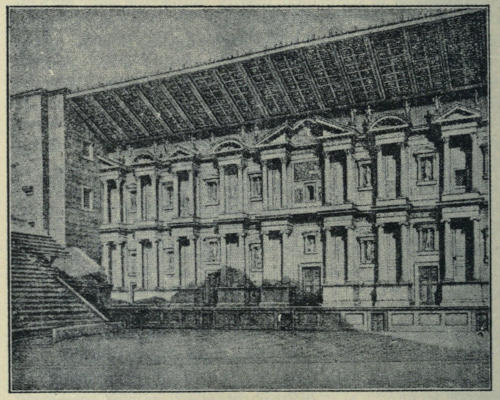
Fig. 10.
It will be seen from the illustration that in the theatre of Aspendos there were five doors at the back of the stage. There was a large door in the centre, and two smaller ones on each side. The same arrangement was generally adopted in Graeco-Roman theatres. But Pollux and Vitruvius speak of three doors as the regulation number.[447] Possibly, therefore, the five doors of the later theatres were not all used during the dramatic representations. When the stage was prepared for the performance of a play, the two doors on the outside may have been covered up with scenery; or temporary side-wings may have been erected in front of them. Another noticeable feature in the theatre of Aspendos is the roof over the stage. Traces of a similar roof are also found at Orange, and justify the conclusion that in most theatres of the Roman type the stage was covered over.[448] Whether the same practice prevailed in the Hellenistic theatres there is no evidence to show. But the convenience of the arrangement is so obvious, that we can hardly doubt that it began to be employed at a comparatively early period.
In a large number of cases the process of Romanizing the Greek theatres was not carried out completely. Many theatres, whether built or reconstructed on the new model, still retained features which were essentially Greek. This was the case at Athens. The Greek stage was usually the same length as one diameter of the orchestra. The Roman stage was twice as long, and extended some distance into the wings of the auditorium on each side. There was no open space between the auditorium and the side-wings; the place of the old Greek ‘parodoi’ was supplied by vaulted subways. But at Athens, when the Neronian alterations were made, the stage was not prolonged in the Roman style, but remained of the same length as before. The entrances into the orchestra at a and g were thus left open (Fig. 3). In many other places, especially in Asia Minor, the Romanization was of a still more partial kind. In theatres such as those of Termessos, Perge, and Sagalassos the general outline of the building was hardly affected by the change. The front line of the stage was not pushed forward; the orchestra still remained nearly a complete circle; open passages were left between the auditorium and the stage-buildings. The only important alteration was in the size of the stage, which was lengthened at each end, and deepened by throwing the front of the stage-buildings farther back. The height of the stage was but slightly diminished. In a Roman theatre it was usually five feet. But the stages at Termessos, Sagalassos, and Patara vary from eight feet to nine, and were therefore very little lower than the ordinary stage of the Vitruvian type.[449]
These examples show how trifling in many cases was the difference between the Graeco-Roman theatres and those of the purely Greek type. They also throw some light on another question of considerable interest. In Roman theatres all performances were confined to the stage; the orchestra was given up to spectators of distinguished rank. It may be asked whether the Greeks, when they built their theatres in the Roman style, adopted the same custom. The answer seems to be that they did not. It is most improbable that theatres should have been constructed in Asia Minor with the old full-sized orchestra, unless this orchestra had been intended as a place for choral performances. The fact that in many of these theatres the stage was eight or nine feet high proves the same thing. If the spectators had been placed immediately in front of it, their view would have been very much obstructed. We know, too, that in the Athenian theatre, even after the Roman stage had been introduced, the marble thrones round the orchestra continued to be the chief seats of honour. Hence it is evident that the orchestra must have been still a place for the performers, and not a place for distinguished spectators. The chief purpose of the Greeks, in Romanizing their theatres, was to provide a deep and capacious stage for spectacles of the Roman type, such as pantomimes and pyrrhic ballets. The old Greek performances were given as before in the orchestra. As far as the drama is concerned, the orchestra would seldom be required at this period, the lyrical part of tragedy and comedy having now practically disappeared. But the choral and musical competitions still flourished as vigorously as ever, and these were kept to their original place, and not transferred to the stage.
§ 11. Exceptional Stage-buildings.
The stage-buildings which we have hitherto described have been those of the normal type. But there are several places in which peculiar and exceptional structures were erected, either for reasons connected with the nature of the ground, or for mere love of variety. Some of these may be worth mentioning. The theatre at Pergamon was apparently built about the beginning of the second century B.C.[450] But the stage-buildings, instead of being made of stone, as was usual at that period, consisted of temporary wooden erections, which were put up and taken down at each festival. Stone blocks were let into the ground, with holes for the reception of the beams by which the building was supported. When the performances were over, the whole apparatus might be removed in a short time. It was only at a later period that permanent stage-buildings were constructed. The reason for this curious arrangement, according to Dörpfeld, was to leave the way open to a temple in the neighbourhood. As the auditorium lay on a terrace, with not much room in front of it, permanent stage-buildings would have filled up the whole space, and blocked the passage to the temple.
Another remarkable instance of deviation from the ordinary practice is supplied by the theatre at Megalopolis.[451] In this theatre (Fig. 11) the place of the stage-buildings was taken by a vast council-chamber, called the Thersilion, which faced towards the auditorium. Its façade consisted of a vestibule, 26 feet high, and resting on a flight of five steps. Originally, when dramas were to be performed, a temporary wooden stage was erected in front of the Thersilion. The foundation-wall for a stage of this kind has been discovered, and lies at a distance of 24 feet from the columns of the vestibule. It is obvious therefore that the vestibule cannot itself have formed the background. A stage 24 feet across would have been far too deep for a Greek theatre. Temporary scenic decorations must have been erected some feet in front of the council-chamber. In later times a stone proscenium of the ordinary type was erected on the site of the old wooden one. But when this was done, it is probable that the Thersilion had fallen into ruins. Otherwise the beauty of its appearance would have been altogether marred by the stone structure in front of it.
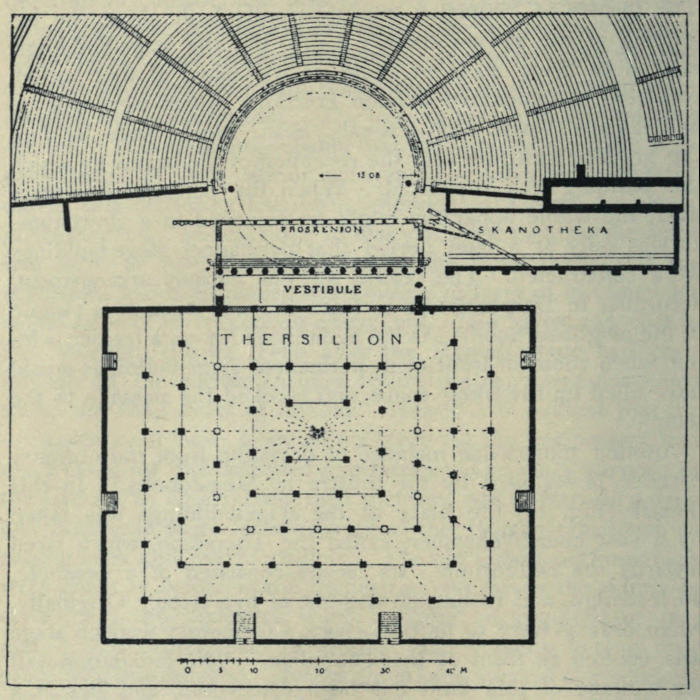
Fig. 11.
But the most peculiar of the stage-buildings which have hitherto been discovered is that at Delos. A representation of the ground-plan (Fig. 12) is inserted on the next page.[452] This building consisted of a single oblong room. In front of it was an ordinary proscenium, about ten feet deep, and eight or nine feet high, resting on half-columns. The spaces between the columns were filled, as usual, with painted boards. The curious feature is that this same proscenium was continued in a modified form round the rest of the building, so as to serve as a portico. On the sides and in the rear it rested on rectangular pillars instead of on columns. The spaces between the pillars were considerably wider than the spaces between the columns, and were left open, instead of being filled up with boards. Porticoes of this kind were often erected close to the stage-buildings, as a shelter from the rain; but the position of the one at Delos is altogether exceptional. Another remarkable feature in this building is the fact that the proscenium was open at each end, and was not even enclosed with a wall. When dramas were being performed, wooden side-wings must have been put up for the occasion.[453]
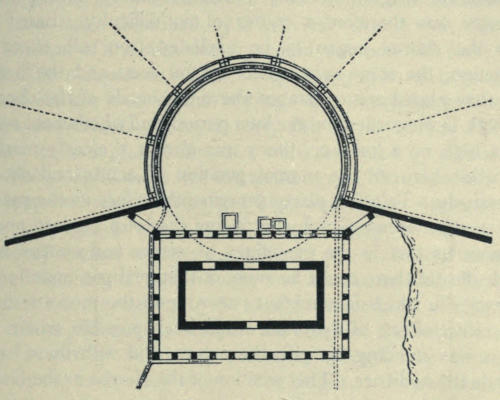
Fig. 12.
§ 12. Wieseler’s Theory of the Greek Stage.
In a Greek dramatic performance the relative position occupied by actors and chorus was quite unlike anything to be seen in a modern theatre. The actors appeared upon a raised platform, the chorus performed in the orchestra underneath. When the actors were present, and the dialogue was proceeding, the chorus stood with their backs towards the audience, and their faces towards the stage.[454] In the early period the stage was only of moderate height, and communication between stage and orchestra was therefore a matter of no difficulty. Later on, when the chorus began to be excluded from all share in the action, the stage was raised several feet, and the actors were thus placed some distance above the heads of the chorus. But both in the earlier and the later period, and whether the stage was a high or a low one, there was always a clearly marked distinction between the normal position of actors and chorus respectively. This fact places prominently before us the radical difference between a Greek chorus and that of a modern opera. It shows us that in the groupings of actors and chorus in a Greek theatre there could be none of that realistic imitation of ordinary life which is sometimes seen upon the modern stage. To produce effects of this kind would be impossible, where the chorus was standing beneath the actors, and with their backs towards the audience. This position of the chorus in the Greek theatre, which seems peculiar to our modern notions, was not due to any abstract considerations of propriety, but was merely the result of the peculiar circumstances under which the Greek drama was developed. Originally the performance was almost entirely lyrical, and the stage and the actors were a mere appendage. The chorus, being the principal performers, and the most prominent object of attention, occupied the central position in the orchestra. The actors were placed on a stage behind them, so as to be visible to the spectators. Eventually the dialogue between the actors completely overshadowed the songs of the chorus, and the lyrical element in the performance was treated as a kind of interlude. But the chorus still continued to occupy that prominent position in the theatre which its original importance had assigned to it.
Since the beginning of the last century various difficulties have been raised in connexion with this subject, and various theories have been invented for the purpose of removing the supposed difficulties. All this speculation appears to have had its origin in the same source. Until quite recent years it was assumed by every scholar that the stage of the fifth century must have been of the same height and structure as the later stage described by Vitruvius. But it was felt that the dramas of the fifth century could not possibly have been written for a theatre in which the actors were raised about twelve feet above the level of the chorus. The relationship between actors and chorus in these early dramas is far too close to allow it to be supposed that they were separated by a barrier of this kind. Still, there was the testimony of Vitruvius, who said the stage was about twelve feet high, and whose measurements were supposed to apply to all theatres, early as well as late. The first attempt to meet the difficulty was made by Hermann, at the beginning of the century; and his theory was afterwards adopted and developed by Wieseler. According to this view the chorus did not stand upon the level of the orchestra, but upon a sort of subsidiary platform, erected immediately in front of the twelve-foot stage. The height of the platform, they said, was so arranged as to bring the chorus into moderate proximity to the actors, without concealing them from the view of the audience. This platform for the chorus was generally accepted by writers upon the Greek drama until about ten years ago. Its existence was defended, partly on general grounds, partly by an appeal to certain passages in ancient authors. To take the ancient authorities first. Hermann supposed that the platform was called ‘orchestra’ in a narrower sense. He cited a passage in Suidas, where the orchestra is described as coming next to the ‘skene’, and as being a wooden erection on which mimes performed. But in this passage the context clearly proves that the word ‘orchestra’ is used in its later sense as the ‘stage’.[455] Wieseler endeavoured to prove that the platform for the chorus was denoted by the word ‘thymele’. Now ‘thymele’, as we have seen, was a word which had a great many meanings in connexion with the theatre. It denoted, first, the altar of Dionysus; secondly, the orchestra; thirdly, the stage.[456] If the passages are carefully examined in which it is asserted that ‘thymele’ denotes a platform for the chorus in front of the stage, it will be found that in the majority of them the word is much more naturally explained as meaning the stage itself, or the orchestra. In one or two cases the language used is apparently due to a confusion between the different meanings of the term. In no case is there a clear and definite description of a platform standing half-way up between the orchestra and the stage.[457] If such a platform had really existed, it seems incredible that there should have been no mention of it. As far, then, as ancient authorities are concerned, the theory as to the existence of a platform for the chorus finds no support.
On general grounds there are several fatal objections to the theory. In the first place, if it were correct, we should have to believe that the Greeks first of all constructed an orchestra for the chorus to perform in; then built a stage twelve feet high; then, finding they had made their stage a great deal too lofty, got out of the difficulty by erecting a platform each year, to bring the chorus within reach of the actors. To suppose that the Greeks acted in this way would be to suppose that they were altogether deficient in common sense. In the second place, it must not be forgotten that the performances at the City Dionysia consisted of dithyrambs as well as dramas. The dithyrambic chorus consisted of fifty members, and stood in a circular position. They must therefore have required a very considerable space for their performances. The oblong platform in front of the stage would not have been large enough to accommodate them, but would have been large enough to encroach very extensively upon the orchestra, and to drive the dithyrambic choruses into one end of it. That such was the case is most improbable. In the third place, in the recently excavated Greek theatres there are no traces of any appliances for the erection of the supposed platform. We should have expected to find holes in the floor of the orchestra, and sockets in the hyposkenion, for the reception of the beams by which the platform was supported. But there is no theatre in which any such traces are to be found. Fourthly, on the floor of the orchestra at Epidaurus a large circle is marked out with a stone border immediately in front of the stage (Fig. 6). It is difficult to resist the conclusion that this circle was intended for the performances of the chorus. For these reasons, combined with the silence of ancient writers, there appears to be no doubt that the platform for the chorus in front of the stage must be regarded as a fiction of modern times.
All the difficulties which this platform was invented to explain will disappear, if we assume that the stage of the fifth century was considerably lower than that of later times. It was only in the earlier period of the drama that a close communication between actors and chorus was required. In the subsequent epoch the existence of a lofty stage presents no difficulty. And the assumption of a low stage for the period of Aeschylus and his immediate successors is on general grounds the most natural one. We are told that originally, when the drama was still a lyrical performance, the coryphaeus used to mount upon a small table, in the intervals between the odes, in order to converse with the rest of the chorus. Later on, an actor was substituted for the coryphaeus. Later still, in the course of the fifth century, a second and a third actor were introduced. Now it is absurd to suppose that, while the coryphaeus was replaced in this tentative way by a gradually increasing number of actors, the old table on which he performed should have been suddenly converted into a complete Vitruvian stage, twelve feet high, and fifty feet long. It is much more natural to imagine that the development of the stage was also a slow and experimental process, and that in the fifth century its size was intermediate between the low table of the sixth century and the tall proscenium of later times. The few traces of archaeological evidence which we possess concerning the early stage are distinctly in favour of this view. It is also supported by the well-known description in Horace. Horace, in his account of the development of Greek tragedy, tells us that Aeschylus ‘erected a stage on beams of moderate size’.[458] Horace’s information, as we know, was derived from Greek sources. Hence it appears that the ordinary Greek tradition favoured the belief that the early stage was a low one, and that it contrasted in this respect with the stage of later times.
§ 13. Dörpfeld’s Theory of the Greek Stage.
Another theory of a far more revolutionary kind has been propounded in recent years by Höpken[459], and amplified and developed by Dörpfeld. Dörpfeld assumes, like Wieseler, that the proscenium of the fifth century must have been of the same height as that described by Vitruvius. But he gets out of the consequent difficulty by supposing that the proscenium was intended, not as a stage for the actors, but as a background. He denies the existence of a stage in purely Greek theatres either of the earlier or of the later period. He believes that in all Greek theatres the actors and the chorus performed together in the orchestra. The proscenium represented the palace or other building before which the action took place. The front-wall of the stage-buildings immediately behind the proscenium represented merely the sky. This theory has been the subject of much discussion and controversy during the last twenty years. As it has been accepted by several scholars, it will be necessary to consider it in detail. I propose in the present section to explain the grounds on which, as it seems to me, it must be regarded as untenable; and to discuss at length the evidence on which the belief in the existence of a Greek stage is founded. In dealing with this subject it will be convenient to divide the period covered by the Greek drama into two parts, and to consider first the later part, from about 300 B.C. onwards; and then to return to the earlier period, that of the fourth and fifth centuries. The evidence in the two cases is somewhat different, and will be more clearly understood if taken separately.
1. The Later Stage.—First, then, as to the later or ‘Hellenistic’ period. Recent excavations, as was previously pointed out, have now given us a fairly clear idea as to the shape and structure of the stage-buildings during this period. We now know that from the beginning of the third century onwards, or, if Puchstein is right, from a considerably earlier date, the stage-buildings in an ordinary Greek theatre, though varying in detail, conformed to the same general type. They consisted of a long rectangular structure, in front of which was a narrow platform, usually about twelve feet high and ten feet deep. This platform was called the ‘proskenion’. In the third century it appears to have been generally made of wood. But in the course of the second and first centuries, or in the fourth century, if Puchstein is right, a stone proscenium was substituted for the old wooden ones in almost every theatre. What then was the purpose of this proscenium, this long platform, twelve feet high and ten feet deep, which we find in all Greek theatres after the fourth century? For an answer to this question we naturally turn to Vitruvius, who wrote a book about architecture towards the end of the first century B.C., and in the course of it gave a detailed description of Greek and Roman theatres. Vitruvius tells us that every Greek theatre has a stage, and that this stage is from ten to twelve feet high and about ten feet deep. Its narrowness is due to the fact that it is only used by the actors in tragedy and comedy; all other performers appear in the orchestra.[460] He adds that the Roman stage is much lower and much deeper, and this for two reasons. It had to be deeper, because all the performers appeared upon it. It had to be lower, because in a Roman theatre the spectators sat in the orchestra, and would not therefore have been able to see over the top of a twelve-foot stage.[461] Here then we seem to have a clear and final answer to our question. The proscenium which we find in all Greek theatres after about 300 B.C., and in some perhaps a century earlier, answers exactly to the description of Vitruvius. It must therefore have been intended to serve as a stage.
Dörpfeld, it is well known, refuses to accept this conclusion. But his method of dealing with the testimony of Vitruvius has changed since he wrote his book on the Greek theatre. He then supposed that Vitruvius had been guilty of an error. While admitting that he was correct in his measurements of the Greek proscenium, he asserted that he had made a mistake as to its purpose; that he had confused the background of the Hellenistic theatre with the stage of the Roman.[462] But this explanation is one which it is impossible to accept. It is absurd to suppose that Vitruvius was mistaken. He was a professional architect, writing about his own special subject, and writing at the very time when many of these Greek proscenia were being erected. His remark about the Greek stage is not introduced as an obiter dictum, but is made the basis of the distinction which he draws between Greek and Roman theatres. He had evidently therefore thought about the subject. But even if we suppose that he could make a mistake of this kind, even if we suppose that he had never been in Greece, and never seen a Greek play acted there, still it is incredible that such an absurd error should have remained uncorrected in his book. The connexion between Greece and Rome was so intimate, that there must have been thousands of people in Rome who had seen Greek plays performed in a Greek theatre, and knew how it was done. If Vitruvius had made this absurd blunder, some one would have been sure to point it out to him, and he would have had it corrected.
Since the publication of his book Dörpfeld has shifted his ground on this question.[463] He now suggests a new method of explaining away the testimony of Vitruvius. He supposes that Vitruvius, when speaking of the stage in the Greek theatre, was referring, not to the ordinary Greek theatre, but to the peculiar type of Graeco-Roman theatre found in various cities of Asia Minor, such as Termessos and Sagalassos. These theatres, as we have shown, exhibited a sort of transition between the Greek and the Roman model. While their general design was Greek, their stages were partially lowered and deepened, so as to come nearer to the Roman practice.[464] In theatres of this kind Dörpfeld admits that the actors performed upon the stage; and he contends that it is to them that Vitruvius refers, and not to the regular Greek theatres, in which the actors always appeared in the orchestra. But in the first place it is difficult to believe that Vitruvius, when he speaks of the ‘Greek’ theatre, should mean something quite different. Why should he describe as ‘Greek’ a type of building which was not found in Greece proper, and which was essentially a combination of Greek and Roman attributes? In the second place, the evidence of the existing remains is inconsistent with the new hypothesis. Vitruvius says that the proscenium in the Greek theatre should be from ten to twelve feet high, and in ordinary cases about ten feet deep. Now what do we find in the remains of the regular Greek theatres? We find that in the great majority of cases the height and depth answer exactly to this description. But when we turn to the Asia Minor theatres what do we find? The average height is from eight to nine feet, the average depth from twelve to eighteen. In the face of these measurements it is useless to contend that Vitruvius is alluding to the Asia Minor theatres. The type which he describes is the ordinary Hellenistic type.[465]
The two facts already mentioned—first, the fact that Vitruvius tells us that every Greek theatre should possess a stage of a certain height, and secondly, the fact that all Greek theatres after about 300 B.C. are found to possess a stage corresponding to his description—these two facts appear sufficient in themselves to decide the whole question. But there is no lack of further evidence. Various ancient writers may be cited as witnesses. Pollux, in his description of the Greek theatre, says that ‘the stage is appropriated to the actors, the orchestra to the chorus’.[466] Later on he says that the actors, when they ‘enter by the orchestra, ascend the stage by means of steps’.[467] The scholiasts to the extant dramas often speak of the performance in a Greek theatre as being partly in the orchestra and partly on the stage. The commentator on the Frogs asserts that the scene with Charon and the ferry-boat must be ‘either upon the logeion, or in the orchestra’. Later on he says that Dionysus here appears ‘not on the logeion, but in the orchestra’. The scholiast on the Knights discusses the question why the sausage-seller should ‘ascend from the parodos on to the logeion’. There are other scholia to the same effect, which it would be tedious to quote.[468] In these passages from the scholiasts and from Pollux the point to notice is the following. They do not merely say that there was a stage in Greek theatres, but they describe the performance as one partly on the stage, and partly in the orchestra. Dörpfeld says they are all mistaken; that they lived after the Christian era, and were confusing the Greek theatre with the Roman. But this would not account for their mistake, if mistake there were. In Roman theatres all performances were confined to the stage; the orchestra was occupied by senators and other distinguished persons. How then can Pollux and the scholiasts have got this notion of a performance in which stage and orchestra were used at the same time? There was nothing in the Roman practice to suggest it. It can only have been derived from the Greek theatre. But apart from this, the suggestion that Pollux and the scholiasts were misled by their recollection of Roman customs is not a fortunate one. It implies that their writings were the result of personal observation. But no one can read a page of them without perceiving that they were merely compilations from Alexandrian sources. The scholiasts in many cases mention their authorities, and these authorities often go back as far as Aristophanes and Aristarchus, and even beyond. They do indeed confuse the evidence a good deal, when they try to reconcile different statements, or when they misapply statements of earlier authorities to particular passages, and explain the passages wrongly; but the statements themselves are due to Alexandrian tradition, not to their own observations. When they say that Greek dramas were performed partly on the stage and partly in the orchestra, it is evident that the Alexandrians thought the same. The testimony of Pollux and the scholiasts is really testimony of the third century B.C.
Another writer whose words appear to be decisive on this question is Horace. His statement about Aeschylus, to the effect that he ‘erected a stage on beams (or posts) of moderate size’, has already been quoted.[469] It is true that Horace is often inaccurate in his description of the early Greek drama. It may be contended, therefore, that his account of the reforms of Aeschylus is only of doubtful authority. But one thing is certain, that Horace, in describing the development of the Greek theatre, would never have mentioned the erection of a stage, unless a stage had been a regular part of the Greek theatres of his own day. Dörpfeld, in dealing with this passage, offers two alternatives. He first suggests that ‘pulpitum’ means the ‘stage-buildings’. But he cites no authority for such a meaning, and none is to be found. The word ‘pulpitum’ in Latin always means a stage or platform. Then, if the first alternative seems unsatisfactory, he suggests that Horace has made a slip, and that he was confusing the Greek stage with the Roman.[470] But Horace, as we know, was for a long time in Athens, and must have often seen Greek plays performed. It is hardly conceivable, therefore, that he should have made a mistake on such a simple matter as the presence or absence of a stage.
To turn next to the archaeological evidence. Excavations have brought to light several facts which bear closely upon this subject of the stage. The evidence derived from this source appears to be even more fatal to the new theory than the literary testimony. One of the most convincing proofs is that afforded by the structure of the stage-buildings at Sicyon, Eretria, and Oropus.[471] We have seen that, according to Dörpfeld’s view, the proscenium was the background, and the action of the drama took place in front of it, in the orchestra. Obviously, if this was so, the most important part of the stage-buildings must have been the rooms immediately behind the proscenium, or in other words, behind the back-scene. Now what do we find at Sicyon? We find that one-third of the space behind the proscenium consisted of solid rock. The Sicyonians, in order to save the expense of erecting a lofty auditorium, excavated their theatre out of the rock to a depth of about twelve feet. But they attached so little importance to the rooms behind the proscenium, that they did not take the trouble to excavate the whole of this part. They left one-third of it as it was. It was only when they came to the first floor of the stage-building, the floor on a level with the top of the proscenium, that they provided clear room from end to end of the structure. Their conduct, on Dörpfeld’s theory, was very peculiar.[472] But the people of Eretria acted in a still stranger manner. They too excavated their theatre out of the rock. But they left the whole of the space behind the proscenium unexcavated. Consequently at Eretria the ground-floor of the stage-buildings was on a level, not with the floor of the orchestra, but with the top of the proscenium. There could hardly be a more decisive proof that at Eretria the actors appeared, not in front of the proscenium, but on the top of it. Then there is the case of Oropus. Here the stage-buildings were built upon the ground, and the rooms behind the proscenium were originally open from end to end. But later on the Oropians proceeded to fill up the greater part of the space with earth, and left only a narrow passage immediately behind the proscenium. Such conduct is irreconcilable with the supposition that the proscenium was the back-scene.[473]
Another proof is afforded by the height of the proscenium. The normal height, as already shown, was about twelve feet. But some proscenia, such as those at Athens and the Peiraeeus, were as much as thirteen feet. On the other hand others were considerably less. That of Oropus, for instance, was only about eight feet high; and the columns which supported the entablature were only six feet six inches.[474] On Dörpfeld’s view these proscenia, with their architectural front, represented the palace or other building before which the action took place. What then are we to think of a palace about fifty feet long, and only eight feet in height? The background at Oropus during the performance of a tragedy must have been a most peculiar one. We should remember that the Greek tragic actor walked upon ‘cothurni’, which added about six inches to his stature. He also wore a mask with a lofty ‘onkos’, which raised his height by another six inches. Consequently the Greek tragic actor, when equipped for the stage, can hardly have stood less than about six feet six. This being so, if Dörpfeld’s view is correct, it follows that the actor who took the part of the king at Oropus must have been just about the same height as the columns which supported the roof of his own palace. When he made his entrance through the central door of the palace, he would have to bend his head, in order to avoid knocking it against the cross-beams. Surely the theory is a weak one which involves such ridiculous consequences. If the Greeks had adopted a background of this absurdly diminutive height, without any reason for doing so, this fact alone would have been strange enough. But it must appear stranger still that, having once adopted it, they should proceed to add about twelve inches to the stature of their actors, in order to make the disproportion between the size of the actors and the size of the palace still more preposterous.[475]
The reason which Dörpfeld gives for the lowness of the proscenium—the background, as he calls it—is as follows. He says that such proscenia were first erected at Athens in the fifth century, and were intended to represent an ordinary house of that period. But the ordinary Athenian house of the fifth century was, he asserts, about twelve feet high.[476] To this theory there are several answers. In the first place, as we have seen, some proscenia were only about eight or nine feet in height; which is far lower than any ordinary Greek house, either at Athens or elsewhere. In the second place there is no clear evidence to show that the Athenian house of the fifth century was twelve feet high. From the remains lately discovered at Delos it appears that in the better class of houses there even the first story was more than twelve feet.[477] But granting, for the sake of argument, that an Athenian house of the fifth century was of the size which Dörpfeld supposes, it is difficult to see what this has got to do with the height of the scenic background. The Athenian theatre, we should remember, was developed originally as a place for tragedy rather than as a place for comedy. The background therefore must have been intended to represent, in most cases, a palace or a temple. But why should this palace or temple have been made the same height as an ordinary house? Moreover, the proportions must have appeared extraordinary. A structure about fifty feet long, and twelve feet high, would be altogether unlike any palace or temple. Dörpfeld replies to this that it is impossible on the stage to represent buildings as large as they really are; that in modern scene-paintings the representations of palaces and temples are much reduced in size as compared with the originals.[478] This is quite true. But they are reduced to scale, and in a proper proportion. A modern scene-painter, in representing St. Paul’s, would no doubt have to make his representation much smaller than the actual St. Paul’s. But in diminishing the height he would diminish the width at the same time. No modern scene-painter would produce a temple fifty feet long and twelve feet high; nor can we suppose that the ancients would have put up with a similar disproportion.
Again, there is the question as to the doors in the proscenium. If it was the background, it ought to have had three doors, the usual number in a Greek back-scene, as Pollux and Vitruvius tell us. But in most of the proscenia discovered there is only one door. In two of the proscenia, those at Megalopolis and Thespiae, there is no door of any kind. Even the single door, when it is found, is very narrow for the central door of the back-scene. At Epidaurus it is only four feet wide, at Oropus only 3 feet 8 inches, at Delos only 3 feet 3 inches.[479] A door so narrow as this would be altogether unsuitable as the central door of the palace, and quite inconsistent with the use of the ekkyklema. When we come to the Graeco-Roman theatres, where the wall at the back of the stage has in many cases been preserved, there we find everything corresponding closely with the descriptions of the grammarians. There is always the requisite number of doors, and the central door is of considerable width. At Termessos it is about seven feet.[480] As regards the absence of the three doors in the proscenium Dörpfeld gives the following explanation. These Hellenistic proscenia, as we see from the remains, consisted of an entablature resting on columns. The spaces between the columns were filled in with wooden boards. Dörpfeld suggests that when doors were required they might be provided ad libitum by removing the intervening boards.[481] But if three doors were regularly required in the dramatic performances, it is most improbable that they should not have been provided as a permanent fixture in the proscenium. It is most improbable that the Greeks should have put themselves to the trouble of opening out these temporary doors at each festival. In any case we can hardly doubt that, if the proscenium had been the back-scene, the Greeks would always have provided at least one permanent door, and would not, as at Megalopolis and Thespiae, have erected proscenia in which there was no door of any kind. The absence of a door in these two places seems to prove conclusively that communication between the orchestra and the space behind the proscenium was a matter of no importance.
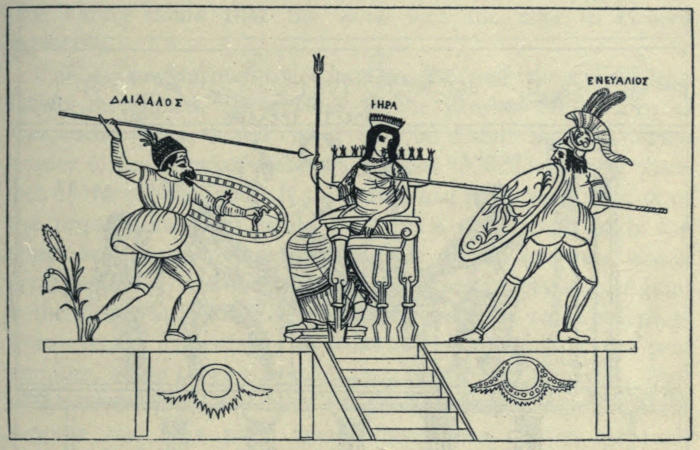
Fig. 13.
Another piece of archaeological evidence is supplied by the vase-paintings found in the Greek cities of South Italy.[482] Two specimens are here inserted.[483] These paintings, which have already been briefly referred to, belong to the third century B.C. They represent comic scenes acted by the Phlyakes. The Phlyakes were a sort of farcical comedians, whose performances were not unlike those of the oldest Attic comedy. In many of these paintings they are represented as acting on a stage.[484] The stage, in most cases, is obviously made of wood, and varies in character from a rude and simple platform to an erection of some solidity. In one or two instances, however, it is a tall and elaborate structure, apparently built of stone, and adorned with columns in front, just like the proscenia we have been discussing.[485] Often there is a flight of steps leading down to the orchestra.[486] In one case the action is taking place partly on the stage and partly in the orchestra. One of the actors is represented as actually ascending the steps to the stage.[487] This evidence seems to prove beyond a doubt that in the Greek cities of South Italy, during the third century B.C., performances were sometimes given in theatres with a tall stage, and that both stage and orchestra were employed for the purpose, and were connected by steps.
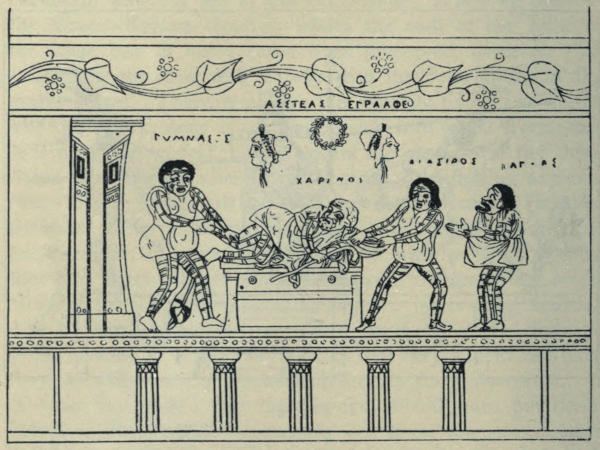
Fig. 14.
Dörpfeld now admits that this was the case. But he contends that the arrangement was an exceptional one, intended only for the farces of the Phlyakes. For these performances, he allows, wooden stages were erected, and the exhibition took place partly on the stage and partly in the orchestra. But the regular dramas—the tragedies, and the comedies—were performed solely in the orchestra.[488] All this, however, is the purest assumption.[489] There is not a particle of evidence to support it. It is altogether improbable that a different arrangement should have been adopted in the case of these farces, and in the case of the regular drama. Besides this, as we have already pointed out, in one or two of the paintings the stage on which the Phlyakes are performing is apparently a permanent stone erection, and not a mere temporary platform of wood. It seems certain, therefore, that the Greeks of South Italy during the third century B.C. provided a stage for their actors in all dramatic performances; and, this being so, we can hardly doubt that the same was the case in Greece generally.
One or two further objections to the new theory may be briefly mentioned. If we look at the plan of the theatre at Epidaurus (Figs. 6 and 7), it will be found that the stone border of the circular orchestra reaches to within two or three feet of the proscenium. If the actors had performed in front of the proscenium, they would have been sometimes inside the stone border, and sometimes outside of it; and the whole arrangement strikes one as awkward and unsymmetrical. Again, in the theatre at Delos (Fig. 12), statues and other votive offerings were erected immediately in front of the columns of the proscenium. The bases on which they rested still remain.[490] But, if the proscenium had been the background, it is difficult to suppose that this place would have been chosen for such erections. When the proscenium was uncovered by scenery, and represented an ancient palace, these votive offerings and statues would have been altogether inappropriate as a part of the back-scene. When painted decorations were to be set up, they would have formed an inconvenient obstacle in the way of the mechanical arrangements. And if they were required to serve as scenery, why were they only employed at Delos? The probability therefore is that they were a mere architectural decoration of the stage-front.[491]
We have now gone through the principal arguments, literary and archaeological, which demonstrate the existence of a stage during the Hellenistic period. It remains to consider the reasons which induce Dörpfeld, in spite of this apparently overwhelming evidence, to deny the existence of such a stage. And in judging this question we must remember the fact already mentioned, that the chorus, at this time, had ceased to take an active share in the play, and that its functions were hardly more important than those of a band of musicians in a modern theatre. To turn now to Dörpfeld’s reasons. He says, in the first place, that these proscenia of the Vitruvian type would have been too narrow for the performance of a play.[492] But their narrowness has often been exaggerated, owing to inaccurate calculations. None of them, as it now appears, were less than from nine to ten feet in depth.[493] But a stage about ten feet deep, and from fifty to sixty feet long, would be amply sufficient for the performance of a Greek play, when the chorus was confined to the orchestra. The fact has been proved by actual experiment. Most English scholars have probably seen the Greek plays produced in the open-air theatre at Bradfield. The stage there is only ten feet deep and thirty feet long. Yet every one who has been present at one of these performances must admit that there was plenty of room upon the stage. I am informed that on one occasion, in the funeral procession in the Alcestis, as many as sixty people were brought upon the stage at the same time, and without any inconvenient crowding.[494] It is clear then that the Vitruvian stage, which was just as deep and twice as long as that at Bradfield, would have been large enough to accommodate the chorus as well as the actors in an ancient Greek drama, and would have been more than large enough for the performance of a play in which the chorus was practically confined to the orchestra.
Dörpfeld further objects that these Hellenistic proscenia were too high to have served as a stage, since the spectators in the front rows would have been too far below the actors to see the latter properly.[495] It is only in the Asiatic theatres, where the front seats of the auditorium were raised so as to give a good view of the actors, that he will allow that the actors appeared on the high stage; in such cases the height of the seats would make a ten-foot stage virtually equivalent to a five-foot one, such as the Romans employed. But in the first place, we find that at Mantinea also the lowest seats were raised four feet above the orchestra, so that this is not a peculiarity of Asiatic theatres.[496] In the second place, if these proscenia were too high for a stage, they would have been much too low for a background. Their height varied from eight to thirteen feet; and a stage of thirteen feet would be far less of an anomaly than a back-scene of eight feet. Further, it has been shown by Maass[497] that the height of the proscenium varies very regularly with the distance of the proscenium from the central point of the circle of the auditorium. The nearer this point, the lower the stage. The object of this can only have been to accommodate the height of the stage to the view of the audience. It would be inexplicable unless the actors were on the top of the proscenium. It seems also to be proved that in most cases the greater part of the actor’s person would easily be visible from the greater number of seats,[498] including the lowest or front rows. When it was necessary, as it was through the greater part of the fifth century, for chorus and actors to communicate more or less intimately with one another, the stage was lower, and the view from some seats therefore less good; but when the chorus ceased to take a share in the dialogue, it became both possible and natural to raise the height of the stage and so improve the view.
Another objection of Dörpfeld’s is that in the existing proscenia there is no trace of any means of communication between the stage and the orchestra.[499] But we have shown that such communication was seldom required at this time, owing to the insignificance of the chorus; and that, when it was wanted, it was supplied by temporary wooden steps. Dörpfeld replies that, if the stage was thirteen feet high, the steps must have been so large as to project a long way into the orchestra, and produce an unsightly appearance. But this result could have been avoided without difficulty. Where the stage was exceptionally lofty, the steps might have been placed in a parallel line to it. At Tralles, where there is a proscenium of the Graeco-Roman type, and nearly ten feet high, such steps are actually found, lying parallel to the stage, and on each side of the door which leads out from the front wall of the stage into the orchestra.[500] A similar arrangement might easily have been adopted, when necessary, in the Hellenistic theatres.
In support of his theory Dörpfeld brings forward an argument based on the theatre at Megalopolis (Fig. 11). We have already described the peculiar construction of this theatre, in which the Thersilion took the place of the ordinary stage-buildings. In front of the Thersilion, and twenty-four feet distant from it, is the foundation-wall of a wooden proscenium. This proscenium, however, appears to have been of later date than the original theatre. Dörpfeld supposes that, before its erection, the actors performed their parts immediately in front of the Thersilion, and on the level of the orchestra. He bases his belief on the following grounds. The façade of the Thersilion rested on a flight of five steps, each about thirteen inches high. To one side of the Thersilion was a building, apparently called the Skanotheka, and probably used for storing the scenic decorations. In this building are the remains of a low wall, running in the same straight line as the bottom of the flight of steps, and about the same length as the stage must have been. Dörpfeld supposes that this wall was used, in the original state of the theatre, for working a ‘scaena ductilis’. He supposes that, when dramas were to be performed, a wooden scene-painting was pushed out along this wall immediately in front of the lowest step of the Thersilion, and served as a background. The actors in front of it must have been on the floor of the orchestra.[501] But this arrangement appears to be impossible. If the back-scene had been placed in the position he supposes, immediately in front of the steep flight of steps, the representation of dramas would have been little short of ridiculous. The actor entering from the back-scene would have had to come down these steps to reach the threshold of the door. At first little more than his legs would have been seen, at any rate by the spectators in the upper part of the theatre. His whole person would hardly have become visible until he reached the lowest step. For a tragic actor to make his entrance in this way would have been far from dignified. Also, in plays like the Hippolytus and the Alcestis, when a sick woman on a couch had to be carried out, it would have been extremely awkward to have to carry her down a flight of steps as steep as those at Megalopolis. The ekkyklema would, of course, have been quite impossible to work. Again, it seems certain that the supposed ‘scaena ductilis’ would itself be quite unworkable. Is it likely that a huge painted board, more than a hundred feet long and more than twenty-five feet high, was pulled out in front of the Thersilion to serve as a back-scene? The ‘scaena ductilis’ (cf. Serv. ad Verg. Georg. iii. 24), which Dörpfeld thinks was such as has been described, was not a contrivance of this sort, but was a small affair, a variety of the ‘scaena versilis’ or periaktos; it was drawn apart, to disclose a new scene behind, and was not drawn across the stage. Moreover, the construction of ancient theatres, even of those with side-wings, shows that there was no room and no opportunity for the hauling to and fro of huge boards such as Dörpfeld imagines. It is true that much remains obscure in regard to the theatre at Megalopolis; but this solution at least is out of the question.[502] Although, therefore, the Skanotheka at Megalopolis may very likely have been used for the storage of scenery, it is clear that this scenery, when used, cannot have been put up in the place which Dörpfeld suggests.
Another argument against the ordinary theory is based by Dörpfeld on the remains of the theatre at Delos (Fig. 12). We have shown that at Delos the proscenium was continued, though in a different form, round the sides and back of the stage-buildings.[503] Dörpfeld argues that it cannot have been a stage, as it would be absurd to erect a stage all round the stage-buildings.[504] If this is so, we might reply that it cannot have been a background either, since it would be equally absurd to construct a background in the same position. But as a matter of fact there is nothing in the arrangement at Delos which conflicts in any way with the ordinary opinion about the Greek stage. The erection at the sides and the back of the stage-buildings, though of the same height as the erection in front, was different in structure, and formed an open portico. The erection in front was like the usual Hellenistic proscenium, and must have been designed for the same purpose. If the proscenium in other theatres was intended for a stage, it must have been intended for a stage at Delos.
Dörpfeld has a theory about the origin of the Roman stage, which he brings forward as a strong argument in favour of his other views. According to Vitruvius the Roman stage was developed out of the Greek. The difference in size was due to the following reasons. The Romans preferred to give up the orchestra to the spectators and to transfer all performances to the stage. It was necessary, therefore, to deepen the stage, in order to find room for the additional performers. It was also necessary to lower it, in order to allow the spectators in the orchestra to have a clear view.[505] Dörpfeld says that this account of the matter is erroneous. According to his theory the Roman stage was discovered by accident rather than by design. The Romans, when they first began to adapt the Greek theatre to their own purposes, found the orchestra too large, and consequently divided it in two. The half nearest the auditorium they dug out to a depth of five feet, and placed spectators there. The other half they used for theatrical and other performances, just as it had been used by the Greeks. In this way they found that they had got what was practically a stage five feet high; and for the future, instead of digging out the nearer half of the orchestra, they started on the level, and built a raised stage. The Roman stage therefore represents, not the Greek proscenium, but the further half of the Greek orchestra; and this fact proves that it was in the orchestra that the Greek actors performed.[506] This theory is no doubt extremely ingenious. But unfortunately it appears to be inconsistent with the facts of the case. If it was true, we should expect to find the stage in all Roman theatres occupying the site of one half of the Greek orchestra, and the back of the Roman stage corresponding to the front of the Greek proscenium. Now in the normal Roman theatre this is more or less the case. The Romans eventually reduced their orchestra to a semicircle, and brought their stage forward to the position described by Dörpfeld. But the Graeco-Roman theatres of Asia Minor, to which we have already referred, fail entirely to correspond to his hypothesis. These theatres were among the earliest to be built in the Roman fashion, and might therefore be expected, more than any others, to exemplify the process of transition which he describes. But what do we find? We find that the stage, so far from occupying one half of the orchestra, stands in exactly the same position as the old Greek proscenium. The orchestra in these theatres still forms nearly a complete circle. The stage is deepened by pushing the back-scene more into the rear. Further than this, the height of the stage is not five feet, as it ought to be, but from eight to nine feet.[507] These examples seem to prove that Vitruvius is more correct than Dörpfeld in his view of the matter; and that the Roman stage was really a modification of the Greek. When we find in these Asia Minor theatres a Roman stage standing in exactly the same position as the proscenium in the Greek theatres, and differing only in being longer and deeper, and two or three feet lower, we can hardly resist the conclusion that the Greek proscenium was the prototype of the Roman, and that it was intended for the same purpose.
The proscenium in a Greek theatre was called, among other names, the ‘logeion’ or ‘speaking-place’. It is so called by Vitruvius, and the word ‘logeion’ occurs in Delian inscriptions as early as the third century B.C.[508]. This being so, we are naturally led to ask how this fact is to be reconciled with Dörpfeld’s theory. If the proscenium was the background, and not the stage, why should it have been called ‘logeion’ or the speaking-place? Dörpfeld gives the following answer. He says that in Greek tragedies the gods, when exhibited in a supernatural manner, used to make their appearance on the palace roof, or, in other words, on the proscenium; and that it was therefore called the ‘theologeion’, or for shortness the ‘logeion’.[509] But this statement will not bear examination. The usual device for revealing gods in supernatural splendour was the mechane, and not the theologeion. Even when the theologeion was employed, there is no evidence to show that it was identical with the palace roof.[510] The contrivance for enabling actors to stand on the roof of a palace or other building was called the ‘distegia’. Instances of its employment are rare. In the extant dramas there are only eight or nine certain examples.[511] If, therefore, the proscenium really represented the building in the background, the top of it cannot have been called the ‘speaking-place’ because the actors spoke from it. Eight or nine instances out of forty-four dramas are insufficient to justify us in regarding it as a regular speaking-place. The plain statement of Vitruvius, that the ‘pulpitum’ of the actors was in Greek called ‘logeion’, Dörpfeld attempts to get round by supposing that the place which had been the ‘theologeion’, or, more shortly, ‘logeion’—the speaking-place of gods—retained its name by a natural conservatism when employed by actors. This is ingenious; but it is surely far more natural to suppose that it was called ‘logeion’ all along because it was the regular speaking-place for all actors, and not only for occasional gods.[512]
We have now considered the principal arguments which can be brought forward on either side concerning this stage question, as far as it relates to the later period. Some minor points have been omitted; but they would not affect the question very much either way. The result appears to show that, at any rate as far as the later period is concerned, the evidence in favour of a stage altogether outweighs any considerations which can be adduced on the other side.
2. The Earlier Stage. We now come to the earlier and more important period, the period of the fifth century, when the drama was still in reality a choral drama, and the fourth century, during which the chorus was rapidly declining in importance, but was still commonly employed.
For the fourth century we have the testimony of Aristotle. Aristotle in many places speaks of the songs of the actors as τὰ ἀπὸ τῆς σκηνῆς, in opposition to the songs of the chorus, τὰ τοῦ χοροῦ.[513] Further he speaks of the actor’s part as being played ἐπὶ τῆς σκηνῆς.[514] According to the usual interpretation of these passages, he means that the actors played their part ‘upon the stage’, and sang their songs ‘from the stage’. Dörpfeld, however, proposes in these cases to translate the word σκηνή as the ‘background’, and not as the ‘stage’. He supposes Aristotle to mean that the actors performed ‘at the background’, and sang their songs ‘from the background’. He denies that the two expressions imply the existence of a stage.[515] Now the translations which he suggests may be possible, as far as the Greek is concerned. But it is very difficult to believe that they are the right translations in these particular passages of Aristotle. Aristotle’s words seem to clearly imply that there was some essential and conspicuous difference between the position of the actors and that of the chorus.[516] But if, as Dörpfeld thinks, they all performed together in the orchestra, there would be no such distinguishing mark. It is true that the actors might, for the most part, be rather nearer to the stage-buildings; and the chorus might, for the most part, be rather more distant from them. But practically they would be standing in the same place; there would be no pronounced difference. Aristotle’s words appear to be explicable only on the supposition that the actors appeared upon a stage, the chorus in the orchestra.
For the fifth century we have the evidence supplied by the use of certain words in Aristophanes. In three places, where an actor is approaching the back-scene, he is said to ‘mount up’ (ἀναβαίνειν).[517] In two other places, where he is leaving the back-scene, he is said to ‘go down’ (καταβαίνειν).[518] In all these passages there is nothing in the circumstances of the drama to suggest that the action was taking place on raised ground. The expressions can only refer, as the scholiast says, to the stage. It has been proposed to translate the two words as ‘come on’ and ‘depart’ respectively.[519] But such a usage of the terms is otherwise unknown in Greek. Moreover, in one place—the scene in the Knights—this translation is proved to be impossible. Here Demosthenes calls out to the sausage-seller, ‘mount up here’ (ἀνάβαινε δεῦρο). He then shows him the people, the markets, and the harbours; and tells him that he will be lord of all. But this is not enough. He says, ‘you have not seen all yet’, and bids him ‘mount up on to this table also’; and then proceeds to show him the islands round about.[520] These words show conclusively that ἀναβαίνειν must mean ‘mount up’ in the previous passage, and likewise determine the meaning of this word, and of καταβαίνειν, in the parallel passages.
The extant dramas have been carefully ransacked during the last few years,[521] and it is not likely that many new points will now be discovered. Much of the evidence that has been brought forward on both sides of the question is really of little value. It depends upon a too scrupulous and literal interpretation of the text, or upon a forgetfulness of the fact that there is much that is conventional in all dramatic performances. For instance, when old men are approaching the palace, and complain of the steepness of the way, this fact is supposed to be a proof of the existence of a stage.[522] It is suggested that they enter by the orchestra, and that the ascent of which they complain is the ascent on to the stage. But, if this was so, these old men must have timed their entrance very exactly, so as to reach the foot of the stage just when they came to the verses in which they began to grumble about the ascent. And this, combined with the obvious inadequacy of the ascent on to the stage to represent a really fatiguing road, would make the whole proceeding rather ludicrous. It seems more natural to assume that their remarks had no reference to the stage, and that the steepness of which they complain was left to the imagination of the spectators. Then again, the appearances of ghosts and spectres are cited as evidence in favour of a stage. It is said that they could not be made to appear from underground, unless there was a raised platform out of which they ascended. Now there is no doubt that in the later theatre ghosts were made to arise from beneath the earth. Pollux gives a description of the mechanism by which it was done. But there is no certain proof that they made their appearance in this way during the fifth century. It would be unsafe, therefore, to infer anything from these spectral apparitions concerning the structure of the early theatre. Again, there are those scenes in which the chorus might be expected to enter the palace, but fail to do so. For instance, when Medea’s children are being murdered, and call out for help, the chorus, after proposing to rush to their assistance, eventually remain where they are and sing an ode.[523] But it is unnecessary, in this and in similar cases, to explain their inaction by supposing that there was any difficulty in passing from the orchestra to the palace because of the stage which lay between. A sufficient reason is to be found in the fact that, if they had gone into the palace, the scene of action would have been left empty.
It will be best to disregard all evidence of this inconclusive kind, and to confine our attention to those points which really throw light upon the question as to the relative position of actors and chorus during the fifth century. The following facts seem to be established. It is evident that the chorus sometimes entered and sometimes departed through the back-scene. Instances are not very common; there are only about six in the extant dramas.[524] Still, they undoubtedly occur. It is evident, too, that the actors sometimes entered by the orchestra. They must have done so when they entered along with the chorus, and they probably did so when they entered in chariots or wagons.[525] This gives us about seven instances where the actors came in by the orchestra. They may have done so much more frequently. This is a point which will be considered later on. But these seven cases are the only ones for which there is any convincing evidence. On the other hand, it was a common thing for actors and chorus to depart together through the orchestra. Many plays end in this way, such as the Eumenides and the Septem. In Aristophanes it is a favourite form of conclusion for actors and chorus to go off through the orchestra in a joyful procession.[526] The general result then is this, that it was plainly permissible in the fifth century for the chorus to enter or leave by the back-scene, and for the actors to enter or leave by the orchestra; though the last of these practices is the only one of which there are many certain examples. But when we pass on from these entrances and exits, and look at the rest of the play, we find that it is very unusual, during the course of the action, for the chorus to come on the stage, or for the actors to go into the orchestra. The instances in which, apart from entrances and exits, the actors and the chorus can be shown to have come into close physical contact with one another, are remarkably few. We may mention, as examples, the scene in which the chorus tries to prevent Creon from seizing Antigone, and the scene where the farmers mount the stage to draw the statue of Peace out of the well. Opinions may differ as to individual cases, but the total number of instances of this kind does not amount, at the outside, to more than about fifteen.[527] The conclusion we may draw from this evidence is as follows. There was nothing in the fifth century theatre to prevent the actors from moving into the place occupied by the chorus, and there was nothing to prevent the chorus moving into the place occupied by the actors. But, except when they were entering or leaving the scene of action, they do not appear to have done so usually, but to have kept apart from one another.
What then does all this prove as regards the stage? On the one hand, it proves conclusively that the stage of the fifth century cannot have been as high as the ordinary later or Hellenistic stage. If the fifth-century stage had been twelve feet above the level of the orchestra, there would have been the greatest awkwardness in actors and chorus passing from one place to the other. But, on the other hand, it does not in any way exclude the possibility of there having been a stage of some kind or another. If we suppose that the fifth-century stage was lower and deeper than that of later times, and that it was connected with the orchestra by a long flight of steps, or by a sloping ascent, all difficulties about the performance of the extant dramas disappear. Actors and chorus could easily pass from stage to orchestra, or vice versa. The fact that they so seldom came into contact with one another, except when entering or leaving the theatre, is a strong confirmation of the view that there was a stage of some kind, and that it was reserved in most cases for the actors, while the usual place for the chorus was in the orchestra.
The main reason for the employment of a stage must have been to make the actors clearly visible to the audience, and to prevent the view of them being impeded by the chorus in the orchestra. A few feet of elevation would be sufficient to produce this result. Dörpfeld, it is true, denies that any such precaution was necessary. He denies that the actors, even without a stage, would have been hidden from view by the chorus.[528] But if we look at the plan of a Greek theatre, it is clear that if the actors were in the orchestra, and the chorus stood in front of them, the chorus must have obstructed the view of a great many of the spectators. In fact we have ancient testimony to that effect. The tragic chorus stood in three rows. We are told that the worst and most ungainly choristers (the ‘laurostatae’, as they were called) were placed in the middle row, because they were not clearly seen by the spectators.[529] But, however the chorus stood, there could only have been one row between these ‘laurostatae’ and the audience. If, then, the actors had been in the orchestra, with three rows of choristers in front of them, the obstruction to the view would obviously have been very much greater. And it is important to remember that the spectators who would have suffered most by this arrangement would have been the occupants of the lowest tiers of seats. Now these seats were reserved as seats of honour, and were confined to high officials and distinguished citizens. Hence, if Dörpfeld’s theory is correct, the distinction which the Athenians bestowed upon their leading citizens cannot have been one of very much value. The benches which they assigned to them must have been the worst seats for view in the whole theatre.[530]
Dörpfeld further objects that, if we suppose a low stage at Athens in the fifth century, the history of the Greek stage becomes a very fantastic and peculiar affair. We have first a stage of five or six feet, then in the next period it rises to about twelve feet, then later on in the Roman period it suddenly drops to five again. His own theory, he says, is much simpler. There was no stage at all till the Roman period, and then a stage of five feet was erected.[531] But the figures given by Dörpfeld are quite fallacious. There was no sudden rise and fall of the kind he describes. We have no means of determining the exact height of the stage during the fifth century. But when we come to the later period we find that it was not fixed at twelve feet, but varied from eight to thirteen. There was no settled rule. Architects naturally tried new experiments. Different heights were adopted in different places. Probably there was just the same variety and love of experiment in the early period. Again, when we come to the Roman period, we do not find that the height of the stage was suddenly fixed at five feet. In many places it was as much as eight or nine. Wherever we look in the history of the Greek theatre, we perceive a gradual transition from one type of stage to another; and the reasons for the successive changes are generally to be explained by the varying circumstances of the contemporary drama.
The archaeological evidence on the subject of the early stage has already been discussed.[532] Unfortunately it amounts to very little. The oldest stage-buildings, being made of wood, have disappeared without leaving any trace behind them. However, such evidence as can be obtained tends to confirm the testimony of the dramas themselves, and to show that the stage of the fifth century was lower and deeper than that of subsequent times. There is also this point to be taken into consideration. The existence of a lofty stage during the Hellenistic period and perhaps from the fourth century onwards appears to be now proved by irresistible testimony. This being so, it is altogether improbable on general grounds that there should have been no stage at all during the preceding period. To suppose that the Greeks began without any stage of any kind, and then after so long a time suddenly erected a stage about twelve feet high, is a most unlikely hypothesis. But if we imagine that a stage existed from the first, and that it was a low one in the fifth century, and was then gradually raised in consequence of the changed character of the drama, the process becomes much more intelligible. The presence of a stage during the later period is strong presumptive evidence in favour of an earlier one.[533]
The last few years have been prolific in new theories on the subject of the stage. Most of them may be regarded as developments or modifications of Dörpfeld’s views. Before leaving this subject it may be well to give a brief account of the more important of them. Bethe considers that there can no longer be any doubt as to the existence of the Hellenistic stage. He also agrees that the passages in Aristophanes prove the use of a low stage at the time when Aristophanes wrote. But for the greater part of the fifth century he denies its existence. He considers that the first Greek stage was erected in 427 or in 426, and that this date was an important epoch in the development of the theatre. He founds his belief on the fact that after this date there is no further instance of the use of the ekkyklema, while before this date there is no example of the use of the mechane, the theologeion, and the drop-scene.[534] But, in the first place, it is by no means clear why the presence or absence of these contrivances should involve the existence or non-existence of a stage. In the second place, his dates are open to question. There is no proof, as we shall see later on, that the machinery which he mentions was introduced or discontinued at the time specified. Another theory has been put forward by Weissmann. He, too, accepts the Hellenistic stage, but agrees with Dörpfeld that in the fifth century actors and chorus performed on the same level. However, he thinks that the passages in which old men complain of the steepness of the road prove that there must have been a raised platform which they had to ascend. As one of these passages—that in the Hercules Furens—is spoken by the chorus, he comes to the conclusion that there was a large platform for actors and chorus combined. This platform extended from the back-scene over a considerable part of the orchestra, and on it stood the actors and chorus, both on the same level.[535] To this it may be answered, that the evidence on which he relies is far too slight a justification for such a sweeping hypothesis. Also on general grounds it is inconceivable that the Greeks, when they already possessed an orchestra which was admirably adapted for choral performances, should have taken the trouble to erect a huge platform on the top of it. Christ agrees in the main with Weissmann. He accepts the Hellenistic stage for the later period, and also the platform for the chorus in the orchestra during the fifth century. But he thinks the passages in Aristophanes prove that the actors even then stood higher than the chorus. He therefore supposes two stages: one immediately before the back-scene, for the actors; and another larger and lower one in the orchestra, for the use of the chorus.[536] He thus eventually comes round to the same conclusion as Wieseler, though by a very different process. His theory, however, is open to the same objections as that of Weissmann. This orchestral platform is utterly improbable in itself, and is unsupported by any sufficient evidence. Lastly, there is Robert’s hypothesis. Robert denies the existence of a stage during the fifth century; but supposes that one was erected in the course of the fourth century for the performance of new plays, in which there was practically no chorus. Henceforth new plays were acted on the stage, old plays in front of it, in the orchestra.[537] But it is impossible to suppose that in the same theatre, and at the same festival, the proscenium should have served at one time as a stage, and at another time as a background. Nor is there anything in the ancient authorities to support such a view.
§ 14. Various Details.
To return to the subject of the construction of the theatre in general. It is obvious that, considering the enormous size of the building, and the immense numbers of spectators which it was intended to accommodate, the greatest attention must have been bestowed upon its acoustic properties. Vitruvius is most emphatic upon the necessity of keeping this object in view, when choosing a site for a theatre. The situation against the side of a hill, and the gentle and symmetrical upward slope of the tiers of seats, are mentioned as qualities by which acoustic excellence was ensured. The height of the stage-buildings was also of great importance. It was found that the best results were obtained by making them exactly the same height as the uppermost parts of the auditorium.[538] That this was the ordinary practice during the Roman period is proved by the remains of various theatres, such as those of Aspendos and Orange. But whether, at any time during the Greek period, stage-buildings were constructed on this enormous scale is very doubtful. Another matter on which the ancient architects insisted was the wooden flooring of the stage, which tended to make the voices of the actors more audible. When Alexander the Great wished to have a stage built entirely of bronze, it was pointed out to him that this material would be fatal from the acoustic point of view.[539] Vitruvius mentions a peculiar practice which was adopted for the purpose of adding resonance to the voices of the actors. Hollow vessels of bronze, of different tones, were suspended in niches in various parts of the auditorium. When a sound was uttered of the same tone as that of any of the vessels, its resonance was increased. He states that this custom, though not adopted in Rome, existed in many Greek and Italian theatres; and that Mummius, after his capture of Corinth, brought back several of these vessels from the theatre there.[540] In the remains of the existing theatres no traces are to be found of the niches he describes. It is probable that the whole plan was merely an experiment adopted in a few special cases. As far as Athens was concerned, no such extraneous assistance to the voice was necessary. Experiments at the present day have shown that the acoustic properties of the theatre of Dionysus are excellent; and this must have been still more the case when the stage-buildings were standing. Probably therefore, in spite of the vast numbers of the audience, the persons in the back rows could hear the words spoken in the orchestra and upon the stage much more clearly than might at first have been supposed.