Introductory material (continued 2)
Reading edition
The manufacture and testing of the “core” of the Atlantic Cable having been completed at the Gutta Percha works as described, a telegraphic line was thereby produced which, without further addition of material or substance, beyond that of copper and gutta percha, proportionable to any required increase in its length, would be perfect as an electrical communicator through the longest distances and in the deepest water, in which element moreover it appears to be chemically indestructible, if the experience of some fourteen years may be taken as evidence. At this point, however, the final form to be assumed by the deep-sea Cable was subject to important mechanical considerations, which came into play across the path of those purely electrical; and upon the manner in which these considerations are met and dealt with, depend, not merely the primarily successful submersion, but the ultimate durability and commercial value of deep-sea Cables.
The problem in the case of the Atlantic Telegraph enterprise may be thus stated. Given a submarine telegraph core like that already described, constructed on the best known principles and perfect as to its electrical conductivity and insulation—it is required to lower the same through the sea to a maximum depth of two and a-half miles, so as not merely not to allow the insulating medium to be torn or strained, but so as not even to bring its normal elasticity into play against the more tensile but perfectly inelastic material of the conductor. For if the core were lowered into very deep water like that referred to without further protection, even supposing it to escape actual fracture by the adoption of extraordinary precaution and by the aid of fine weather, it is evident that whenever, as would be highly probable, either in the act of paying out, during the lifting or manœuvring of the ship, or even from the effects of its own weight, the gutta percha sheath became extended to the limit of its elasticity, the copper in the centre would be stretched to a corresponding extent, and, the tension being removed, the gutta percha in returning to its original length would pull back the now elongated copper, which thenceforward would in every such case “buckle up,” and exert a constant lateral thrust against the gutta percha; ending, probably, in its ultimate escape to the outside, and the consequent destruction of the core as an electrical agent. Moreover, in the event of an electrical fault being discovered in any submerged portion of the Cable during the process of “paying-out” in deep water, it is of paramount importance towards its recovery and repair, that the engineer should have such an assurance in the quality and strength of his materials as will enable him confidently to exert a known force in hauling back the injured part, without apprehension of damage to the vital portion of the Cable.
The solution of this question must therefore be found in adding mechanical strength externally to the core, by surrounding it with such materials and in such a manner as to relieve it from all that strain which it will unavoidably meet in depositing it in its required position. In the case of the original Atlantic Cable this was attempted by first surrounding the core with tarred hemp, which in its turn was enveloped spirally by eighteen strands of iron wire; each strand consisting of seven No. 22½ gauge wires. The entire weight of the Cable so formed was, in air 20 cwt. per knot, and in water 13·3 per knot. Being capable of bearing its own weight in about five miles perpendicular depth of water, and the greatest depth on the route being two-and a half miles, its strength was calculated at about as much again as was absolutely requisite for the work. This was thought at the time to be a sufficient margin, and certainly in 1858, owing to the greatly improved machinery employed, this Cable was payed-out with great facility and without undue strain, although portions of it had been lost by breaking during several previous attempts in the same summer. Subsequent investigation and experience, however, led to the conclusion, that in respect, not only to its mechanical properties, but especially with regard to its relative specific gravity, and to other points in its construction, the Cable of 1858 was very imperfect; and, with a view to ensure every practicable improvement in the structure of their new line, the promoters of the undertaking, so soon as they found themselves in funds, during 1863, issued advertisements with a view to stimulate inquiry into the subject, inviting tenders for Cables suitable for the proposed work. The specimens that were sent in, as the result of this public appeal, were submitted to the scientific advisers of the Company, who, after careful experiments with all the specimens, unanimously recommended the Atlantic Company to adopt the principle of the Cable proposed by Glass, Elliot, & Co., whose experience and success in this description of work are well known. The Committee, however, stipulated that they should settle the actual material of which the Cable was to be ultimately composed, and that these should be carefully and separately experimented on before finally deciding upon it; and in consequence of this stipulation upwards of one hundred and twenty different specimens, being chiefly variations of the principle adopted by the Committee, were manufactured and subjected to very severe experiment, as were also the various descriptions and quantities of iron, hemp, and Manilla proposed as components of these respective Cables. The result of it all was that the Committee recommended the Cable that was adopted as being, in their opinion, “the one most calculated to insure success in the present state of our experimental knowledge respecting deep-sea Cables,” taking care at the same time, by enforcing a stringent specification and constant supervision, to guard against any possible laxity in the details of its construction. The Cable so decided on weighed 35¾ cwt. per knot in air, but in water it did not exceed 14 cwt., being only a fraction heavier in that medium than the old Cable, though bearing more than twice the strain—the breaking strain of the new Cable being 7 tons 15 cwt. In water it was capable of bearing eleven miles of its own length perpendicularly suspended, and consequently had a margin of strength of more than four and a-half times that which was absolutely requisite for the deepest water. The core having been received from the gutta percha works, and carefully tested to note its electrical condition, was first taken to receive its padding of jute yarn, whereby the gutta percha would be protected against any pressure from the external iron sheath, which latter succeeded the jute. On former occasions this padding of jute had been saturated in a mixture of tar before being applied to the gutta percha; but experience had shown that this proceeding might lead to serious fallacies as to the electrical state of the core, cases having been repeatedly found where faults existed in the core itself—amounting to an almost total loss of insulation—which, however, were only discovered after being submerged and worked through, owing to the partial insulation conferred for a time upon the bad place by means of the tarred wrapping. The Atlantic core, therefore, was wrapped with jute which had been simply tanned in a solution of catechu, in order to preserve it from decay, and as fast as the wrapping proceeded the wrapped core was coiled into water, in which, not only at this stage, but ever afterwards until finally deposited in the sea, the Cable, complete or incomplete, was stored, and the water being able to freely pass through the tarred jute to the core, the least loss of insulation was at once apparent by the facility offered by the water to conduct away to earth the whole or a portion of the testing current.
The iron wire with which the jute cover was surrounded was specially prepared for this purpose, and is termed by the makers (Messrs. Webster & Horsfall) “Homogeneous Iron.” It was manufactured and rolled into rods at their works at Killamarsh, near Sheffield, and drawn at their wire factory at Hay mills, near Birmingham. This wire approaches to steel in regard to strength, but by some peculiarity in the mode of preparing it, is deprived entirely of that springiness which prohibits altogether the use of steel as a covering for the outsides of submarine cables. Ten wires were laid spirally round the core, and each of these wires was of No. 13 gauge, and was under contract to bear a strain of 850 to 1,100 lb., with an elongation of half an inch in every fifty inches within those breaking limits. The Cable, as completed and surrounded by these wires, had not the slightest tendency to spring, as would be the case if the metal were hard steel, and could be handled with great facility.
Before, however, these ten wires surrounded the core, each separate wire had to be itself covered with a jacket of tarred Manilla yarn, the object of which is at once to protect the iron from rust and to lighten the specific gravity of the mass, while adding also in some degree to the strength of the external portion of the Cable. The wire was drawn horizontally forward over a drum through a hollow cylinder, on the outside of which bobbins filled with Manilla yarn revolved vertically, and the yarns from these bobbins, being made to converge around the wire as it issued from the end of the cylinder, were thus spun tightly round the former. These Manilla-covered wires being wound upon large drums ready for use, the core, which we left some time back surrounded with jute, was passed round several sheaves, which conducted it below the floor of the factory, from whence it was drawn up again through a hole in the centre of a circular table, around the circumference of which were ten receptacles for ten drums, containing the Manilla-covered wire. Between these drums massive iron rods, fastened to the circumference of the table, rose, and converged around a small hollow cone of iron through the upper flooring of the factory, at a height of 12 or 14 feet above the table. The jute-covered core was pulled up vertically, and passed on straight through the hollow interior of the cone already mentioned, which latter formed the apex of the converging rods. This done, the ten wires from the ten drums were drawn up over the outside of the same cone, and as they rose beyond it converged around the core, which latter, being free from the revolving part of the machinery, was simply drawn out; while the circular table being now set revolving by steam power, the ten wires from the drums were spun in a spiral around the core, thus completing the Cable, which was hauled out of the factory by the hands of men, who at the same time coiled it into large iron tanks, where it was covered with water, and was daily subjected to the most careful electrical tests, both by the very experienced staff of the contractors and by the agents of the Atlantic Telegraph Company.
The distance from the western coast of Ireland to the spot in Trinity Bay, Newfoundland, selected as the landing-place for the Cable, was a little over 1,600 nautical miles, and the length of Cable contracted for, to cover this distance, including the “slack,” was 2,300 knots, which left a margin of 700 knots, to cover the inequalities of the sea-bed, and to allow for contingencies. On the first occasion 2,500 statute miles were taken to sea, the distance to the Newfoundland terminus on that occasion being 1,640 nautical miles; and, after losing 385 miles in 1857, and setting apart a further quantity for experiments upon paying-out machinery, sufficient new Cable was manufactured to enable the Niagara and Agamemnon to sail in 1858 with an aggregate of 2,963 statute miles on board the two ships, of which about 450 statute miles were lost in the two first attempts of that year, and 2,110 miles were finally laid and worked through.
The greatly increased weight and size of the Cable would have made the question of stowage a very embarrassing one had it not been for the existence of the Great Eastern steamship, there being no two ordinary ships afloat that would be capable of containing, in a form convenient for paying-out, the great bulk presented by 2,300 miles of a Cable of such dimensions. This bulk, and the now acknowledged necessity for keeping Cables continuously in water, made their influence to be felt in a very expensive manner to the Company and to the contractors throughout the progress of the work, even at this early stage. The works at Morden Wharf had to be to a very large extent remodelled to meet these contingencies. Eight enormous tanks, made of five-eighths and half-inch plate iron, perfectly watertight, and very fine specimens of this description of work, were erected on those premises, and these tanks then received an aggregate of 80 miles of Cable per week. Four of the tanks were circular in shape, and each contained 153 miles of cable, being 34 ft. in diameter and 12 ft. deep. The other four were slightly elliptical, being 36 ft. long by 27 ft. wide, and 12 ft. deep, and contained each 140 miles. The contents of all these, as they became full, were transferred to the Great Eastern at Sheerness, for which service the Lords of the Admiralty granted the loan of two sailing-ships, laid up in ordinary at Chatham, namely—the Amethyst and the Iris.[4] These ships had to undergo very considerable alteration to render them suitable for the work, portions of the main deck having to be removed—fore and aft—to make room for watertight tanks, which here, as elsewhere, were to be the medium for holding the Cable. The dimensions of the two tanks on board the Amethyst were 29 ft. diameter by 14 ft. 6 in. in depth, and each held 153 miles of Cable; of those on the Iris, one was 29 ft. diameter and 14 ft. 6 in. deep, and held 153 miles, and the other held 110 miles, and was 24 ft. wide, and 17 ft. deep.
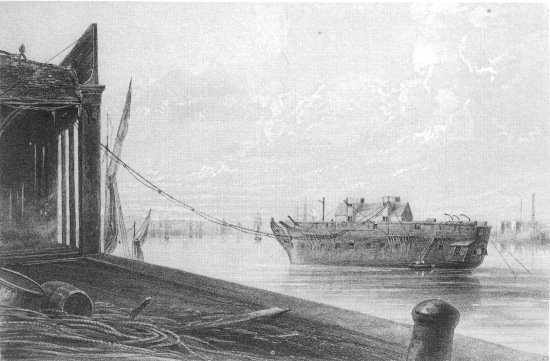
[larger view] F. Jones, lith from a drawing by R. Dudley London, Day & Sons, Limited, Lith. THE CABLE PASSED FROM THE WORKS INTO THE HULK LYING IN THE THAMES AT GREENWICH.
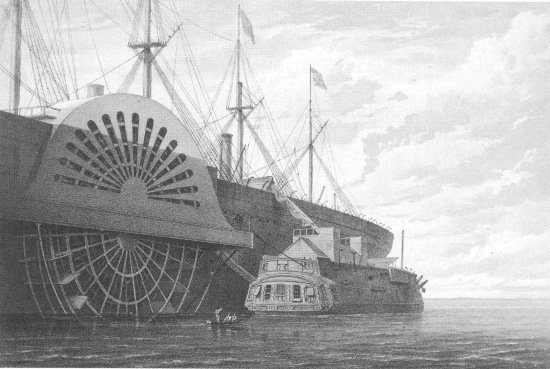
[larger view] T. Picken, lith from a drawing by R. Dudley London, Day & Sons, Limited, Lith. THE OLD FRIGATE WITH HER FREIGHT OF CABLE ALONGSIDE THE “GREAT EASTERN” AT SHEERNESS.
The Great Eastern steamship was fitted up with three tanks to receive the Cable, one situated in the forehold, one in the afterhold, and the third nearly amidships. The bottoms and the first tier of plates were of five-eighths iron, and each tank, when completed to this height, and tested as to its tightness by filling it with water, and found or made to be perfectly watertight, was let down from its temporary supports on to a bed of Portland cement, three inches in thickness, and the building up and riveting of the remaining tiers was continued. The beams beneath each tank were shored up from the floor beneath it down to the kelson with nine inches Baltic baulk timber, and it will give some idea of the magnitude of the work to state that upwards of 300 loads of this material were required for this purpose alone. The dimensions of the fore tank were 51 ft. 6 in. diameter by 20 ft. 6 in. in depth, and its capacity was for 693 miles of Cable. The middle tank was 58 ft. 6 in. broad, and 20 ft. 6 in. deep, and held 899 miles of Cable, and the after tank was 58 ft. wide and 20 ft. 6 in. deep, and contained 898 miles. The three tanks were therefore capable of containing in all 2,490 miles of the new Cable.
The experience gained on board the Agamemnon and Niagara, and the practical knowledge obtained by the telegraphic engineers, were turned to good account in erecting the new machinery on the deck of the Great Eastern for paying-out the Cable.
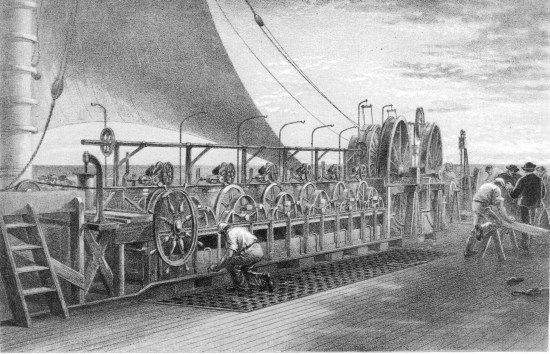
Over the hold was a light wrought-iron V wheel, the speed of which was regulated by a friction wheel on the same shaft. This was connected with the paying-out machinery by a wrought-iron trough, in which, at intervals, were smaller wrought-iron V wheels, and at the angles vertical guide wheels. The paying-out machinery consisted of a series of V wheels and jockey or riding wheels (six in number); upon the shafts of the V wheels were friction wheels, with brake straps weighted by levers and running in tanks filled with water: and upon the shafts of the jockey wheels were also friction straps and levers, with weights to hold the Cable and keep it taut round the drum. Immediately before the drum was a small guide wheel, placed under an apparatus called the knife, for keeping the first turn of the Cable on the drum from riding or getting over another turn. The knives, of which there were two, could be removed and adjusted with the greatest ease by slides similar to a slide-rest of an ordinary turning-lathe. One knife only was used, the other being kept ready to replace it if necessary. The drum, round which the Cable passed, was 6 feet diameter and 1 foot broad, and upon the same shaft were fixed two Appold’s brakes, running in tanks filled with water. There was also a duplicate drum and pair of Appold’s brakes fitted in position and ready for use in case of accident. Upon the overhanging ends of the shafts of the drums driving pulleys were fitted, which could be connected by a leather belt for the purpose of bringing into use the duplicate brakes, if the working brakes should be out of order. Between the duplicate drum and the stern wheel were placed the dynamometer and intermediate wheels for indicating the strain upon the Cable. The dynamometer wheel was placed midway between the two intermediate wheels, and the strain was indicated by the rising or falling of the dynamometer wheel on a graduated scale of cwts. attached to the guide rods of the dynamometer slide. The stern wheel, over which the Cable passed when leaving the ship, was a strong V wheel, supported on wrought-iron girders overhanging the stern, and the Cable was protected from injury by the flanges of this wheel by a bell-mouthed cast-iron shield surrounding half its circumference.
Close to the dynamometer was placed an apparatus similar to a double-purchase crab, or winch, fitted with two steering wheels, for lifting the jockey or riding wheels with their weights and the weights on the main brakes of the drum, as indications were shown upon the dynamometer scale.
All the brake wheels ran in tanks supplied with water by pipes from the paddle-box tanks of the ship.
The Cable passed over the wrought-iron V wheel over the tank along the trough, between the V wheels and jockey wheels in a straight line; four turns round the drum where the knife comes into action over the first intermediate wheel, under the dynamometer wheel, and over the other intermediate and stern wheels into the sea.
[larger view] From a drawing by R. Dudley London, Day & Sons, Limited, Lith. PAYING-OUT MACHINERY.
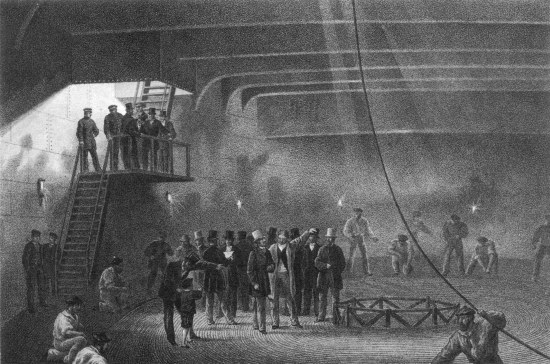
[larger view] T. Picken, lith from a drawing by R. Dudley London, Day & Sons, Limited, Lith. COILING THE CABLE IN THE AFTER TANK ON BOARD THE GREAT EASTERN AT SHEERNESS. VISIT OF H.R.H. THE PRINCE OF WALES ON MAY 24th.
This dynamometer was only a heavy wheel resting on the rope, but fixed in an upright frame, which allowed it to slide freely up and down, and on this frame were marked the figures which showed exactly the strain in pounds on the Cable. Thus, when the strain was low the Cable slackened, and the dynamometer sunk low with it; when, on the contrary, the strain was great, the Cable was drawn “taut,” and on it the dynamometer rose to its full height. When it sunk too low, the Cable was generally running away too fast, and the brakes had to be applied to check it; when, on the contrary, it rose rapidly the tension was dangerous, and the brakes had to be almost opened to relieve it. The simplicity of the apparatus for opening and shutting the brakes was most beautiful. Opposite the dynamometer was placed a tiller-wheel, and the man in charge of it never let it go or slackened in his attention for an instant, but watched the rise and fall of the dynamometer as a sailor at the wheel watches his compass. A single movement of this wheel to the right put the brakes on, a turn to the left opened them. A good and experienced brakeman would generally contrive to avoid either extreme of a high or low strain, though there were few duties connected with the laying of submarine cables which were more anxious and more responsible while they last, than those connected with the management of the brakes. The whole machine worked beautifully, and with so little friction that when the brakes were removed, a weight of 200 lb. was sufficient to draw the Cable through it.
In order to guard against any possible sources of accident, every preparation was made in case of the worst, and, in the event of very bad weather, for cutting the Cable adrift and buoying it. For this purpose a wire rope of great strength, and no less than five miles long, having a distinctive mark at every 100 fathoms, was taken in the Great Eastern. This, of course, was only carried in case of desperate eventualities arising, and in the earnest hope that not an inch of it would ever be required. If, as unfortunately happened, its services were wanted, the Cable could be firmly made fast to its extremity, and so many hundred fathoms of the wire rope, according to the depth of water the Cable was in, measured out. To the other end of the rope an immense buoy was attached, and the whole would then be cut adrift and left to itself till better weather.
On the 24th of May, His Royal Highness the Prince of Wales, accompanied by many distinguished personages, paid a long visit to the Great Eastern, for the purpose of inspecting the arrangements made for laying the Cable. His Royal Highness was received by Mr. Pender, the Chairman of the Telegraph Construction Company; Mr. Glass, Managing Director; and a large number of the electricians and officers connected with the undertaking. After partaking of breakfast, the Prince visited each portion of the ship, and witnessed the transmission of a message sent through the coils, which then represented in length 1,395 nautical miles. The signals transmitted were seven words, “I WISH SUCCESS TO THE ATLANTIC CABLE,” and were received at the other end of the coils in the course of a few seconds—a rate of speed which spoke hopefully of success.
On Monday, the 29th of May, the last mile of this gigantic Cable was completed at Glass, Elliot, & Co.’s works; an event celebrated in the presence of all the eminent scientific men who had laboured so zealously in the promotion of the undertaking at Greenwich. When the tinkling of the bell gave notice that the machine was empty, and the last coil of the Cable stowed away, the mighty work, the accomplishment of which was their dream by night and their study by day, stood completed. For eight long months the huge machines had been in a constant whirl, manufacturing those twenty-three hundred nautical miles of Cable destined to perform a mission so important, and yet it would be difficult to point to a single hour during which they did not yield something to cause care and anxiety.
On Wednesday, the 14th of June, the Amethyst completed her final visit, and commenced to deliver the last instalment of the Cable to the Great Eastern.
On the 24th the Great Eastern left the Medway for the Nore, carrying 7000 tons of Cable, 2000 tons of iron tanks, and 7000 tons of coal. At the Nore she took in 1,500 additional tons of coal, which brought her total dead-weight to 21,000 tons.
Mr. Gooch, M.P., Chairman of the Great Eastern Company and Director of the Telegraph Construction and Maintenance Company; Mr. Barber (Great Eastern), Mr. Cyrus Field, Captain Hamilton, Directors of the Atlantic Telegraph Company; M. Jules Despescher; Mr. H. O’Neil, A.R.A.; Mr. Brassey, Mr. Fairbairn, Mr. Dudley, the representatives of some of the principal journals, and several visitors, went round in the vessel from the Nore to Ireland.
The whole of the arrangements for paying-out and landing the Cable were in charge of Mr. Canning, principal Engineer to the Telegraph Construction and Maintenance Company, Mr. Clifford being in charge of the machinery. These gentlemen were assisted by Mr. Temple, Mr. London, and eight experienced engineers and mechanists. A corps of Cable layers was furnished by the Telegraph Construction and Maintenance Company.
The Electrical Staff consisted of
C. V. de SautyChief.
H. SaundersElectrician to the Malta and Alexandria Telegraph.
Willoughby SmithElectrician to the Gutta Percha Company.
W. W. BiddulphAssistant Electrician.
H. DonovanDo.
O. SmithDo.
J. ClarkDo.
J. T. SmithInstrument Clerk from Malta and Alexandria Telegraph.
J. GottDo.Do.Do.
L. SchaeferMechanician.
The Staff at Valentia was composed of
J. MaySuperintendent.
T. BrownAssistant Electrician.
W. CrockerDo.
G. StevensonInstrument Clerk from Malta and Alexandria Telegraph.
E. GeorgeDo.Do.Do.
H. FisherDo.Do.Do.
All the arrangements at Valentia were under the direction of Mr. Glass.
Mr. Varley, chief electrician to the Atlantic Telegraph Company, was appointed to report on the laying of the Cable, and to see that the conditions of the contract were complied with. Associated with him was Professor W. Thomson, LL.D., F.R.S., of Glasgow. His staff was composed of Mr. Deacon, Mr. Medley, Mr. Trippe, and Mr. Perry.
Several young gentlemen interested in engineering and science were accommodated with a passage on board.
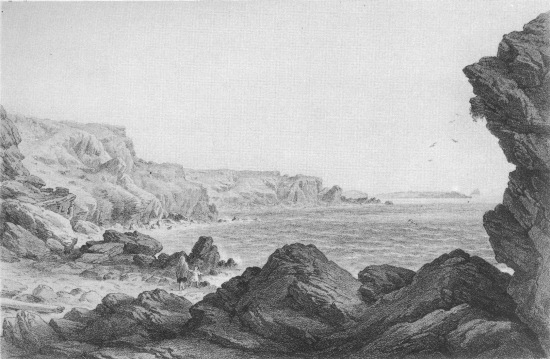
At noon on July 15th the Great Eastern, in charge of Mr. Moore, Trinity pilot, drawing 34 ft. 4 in. forward, and 28 ft. 6 in. aft, got up her anchor, and at midnight on July 16th was off the Lizard. On Monday, 17th, she came up with the screw steamer Caroline, freighted with 27 miles of the Irish shore end of the Cable, weighing 540 tons, and took her in tow. Then a gale set in, which gave occasion to the Great Eastern to show her fine qualities as a sea-boat when properly handled. Even those who were most prejudiced or most diffident, admitted that on that score no vessel could behave better. This trial gave every one, from Captain Anderson down, additional reason to be satisfied with the fitness of the great ship for the task on which she was engaged. Next day, Tuesday, July 18th, she encountered off the Irish coast a strong gale with high westerly sea, through which she ran at the rate of six knots an hour. The Caroline, which rolled so heavily and pitched so vigorously as to excite serious apprehensions, broke the tow rope in the course of the day, and ran for Valentia harbour, where she arrived safely, piloted by the Great Eastern; and the Great Eastern, passing inside the Skelligs, stood in close to Valentia Lighthouse, and sent a boat ashore to communicate. H.M.S. Terrible, Captain Napier, and H.M.S. Sphinx, Captain V. Hamilton, were visible in the offing, having sailed at the end of the previous week from Queenstown for the rendezvous, outside Valentia. Captain Anderson having fired a gun to announce his arrival, steamed for Berehaven, in Bantry Bay, and anchored inside the island on Wednesday morning, July 19th, in 17 fathoms. Here the Great Eastern lay, preparing for her great errand—perhaps, as it may prove, her exclusive “mission,”—on Thursday, 20th, Friday, 21st, and Saturday, 22nd July, whilst the Caroline was landing the shore end of the Cable in Foilhummerum Bay in Valentia. During her stay in Bantry Bay, many visitors, high and low, came on board the Great Ship, but it was believed all over the country that she was going to Foilhummerum. The greater portion of those anxious to see her made the best of their way to that secluded spot, to which there was once more attached an interest of a civilised character; for, if country legends be true, there must have been some regard paid to Foilhummerum Bay by no less a person than Oliver Cromwell, testified yet by the grey walls of a ruined fort, and traces of a moat and outer wall, on the greensward above the point which forms the northern entrance to the lonely bay. This crisp greensward, glistening with salt, lies in a thin crust over the cliffs, which rise sheerly from the sea some three or four hundred feet; and for what Oliver Cromwell or any one else could have erected a fortalice thereon, may well baffle conjecture, unless the builder, having a far-reaching mind, saw the importance of watching the most westerly portion of Europe, or anticipated the day when Valentia would be recognised as one of the landmarks created by the necessities of commercial and social existence. Taking advantage of the shelter afforded by a gradual descent inland of the soil, a few cabins have been placed by the natives—half-fishermen, half-husbandmen—Archytas-like, spanning land and sea, and making but poor subsistence from their efforts on both. The little bay, which is not much above a mile in length, contracts from a breadth of half so much, into a watery cul-de-sac, terminated by steep banks of shale, earth, and high cliff, furrowed by watercourses; and on the southernmost side it is locked in by the projecting ledges of rock forming the northern entrance to the Port Magee channel. It is so guarded from wind and sea, that on one side only is it open to their united action, but as the entrance looks nearly west, the full roll of the Atlantic may break in upon it when the wind is from that point; and indeed there is not wanting evidence that the wild ocean swell must tumble in there with frightful violence. Jagged fragments of masts and spars are wedged into the rocks immovably by the waves, and the cliffs are gnawed out by the restless teeth of the hungry water into deep caves. But then a sea from that point would run parallel with the line of the Cable, and would sweep along with and not athwart its course, so that the strands would not be driven to and fro and ground out against the bottom. Except for a couple of hundred feet near the shore at the top of this cove, indeed, the bottom is sandy, and the rocks inside the sand line were calculated to form a protection to the Cable, once deposited, as the greater part of its course lay through a channel which had been cleared of the boulders with the intention of rolling them back again at low water, to cover in the shore end. Lieutenant White, and the hardy and hard-working sailors of the Coastguard Station at Valentia, had been indefatigable in sounding and buoying out a channel from the beach clear out to sea, within which the Caroline was to drop the Cable. A few yards back from the cliff, at the head of the cove, the temporary Telegraph Station reared its proportions in imitation of a dwarf Brompton boiler—a building of wood much beslavered with tar and pitch, of exceeding plainness, and let us hope of corresponding utility. Inside were many of the adjuncts of comfort, not to speak of telegraphic luxury, galvanometers, wires, batteries, magnets, Siemens’s and B. A. unit cases, and the like, as well as properties which gave the place a false air of campaigning. A passage led from end to end, with rooms for living and sleeping in to the right and left, and an instrument room at the far extremity. Here, on a narrow platform, were the signal and speaking apparatus connected with the wires from the end of the Cable, which was secured inside the house. Outside the wires were carried by posts in the ordinary way to the station at Valentia, whence they were conveyed to Killarney, and placed in communication with the general Telegraphic system over the world. The Telegraphic staff and operators were lodged in primitive apartments like the sections of a Crimean hut, and did not possess any large personal facility for enjoying social intercourse with the outer world, although so much intelligence passed through their fingers. But Foilhummerum may in time become a place with something more real than a future. If vessels from the westward do not like to make their number outside, there is nothing to prevent their running into Valentia for the purpose, at all events. On the plateau between the station and the cliff, day after day hundreds of the country people assembled, and remained watching with exemplary patience for the Big Ship. They came from the mainland across Port Magee, or flocked in all kinds of boats from points along the coast, dressed in their best, and inclined to make the most of their holiday, and a few yachts came round from Cork and Bantry with less rustic visitors. Tents were soon improvised by the aid of sails, some cloths of canvas, and oars and boathooks, inside which bucolic refreshment could be obtained. Mighty pots of potatoes seethed over peat fires outside, and the reek from within came forth strongly suggestive of whisky and bacon. Flags fluttered—the Irish green, with harp, crown surmounted; Fitzgerald, green with its blazon of knight on horse rampant, and motto of “Malahar aboo”—faint suspicion of Stars and Stripes and Union Jack, and one temperance banner, audaciously mendacious, as it flaunted over John Barleycorn. Nor was music wanting. The fiddler and the piper had found out the island and the festive spot, and seated on a bank, played planxty and jig to a couple or two in the very limited circle formed in the soft earth by plastic feet or ponderous shoemasonry, around which, sitting and standing, was a dense crowd of spell-bound, delighted spectators. In the bay below danced the light canvas-covered canoe or coracle in which the native fishermen will face the mountain billows of the Atlantic when no other boat will venture forth; and large yawls filled with country people passed to and fro, and the bright groupings of colour formed on the cliffs and on the waters by the red, scarlet, and green shawls of the women and girls, lighted up the scene wonderfully.
[larger view] T. Picken, lith from a drawing by R. Dudley London, Day & Sons, Limited, Lith. FOILHUMMERUM BAY, VALENCIA, LOOKING SEAWARDS FROM THE POINT AT WHICH THE CABLE REACHES THE SHORE.
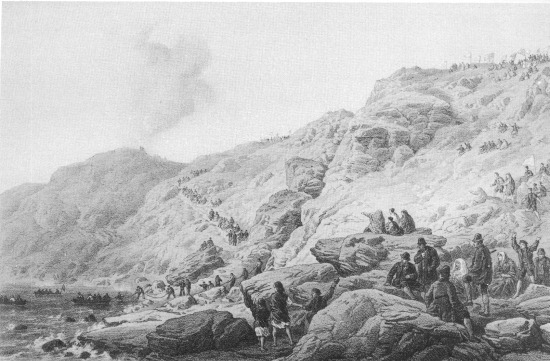
[larger view] T. Picken, lith from a drawing by R. Dudley London, Day & Sons, Limited, Lith. THE CLIFFS FOILHUMMERUM BAY, POINT OF THE LANDING OF THE SHORE END OF CABLE JULY 22ND.
It would be gratifying if in such a primitive spot one could shut his eyes to the painful evidence that the vices of civilisation—if they be so—had crept in and lapt the souls of the people in dangerous pleasures. But it could not be denied that the spirit of gambling and gourmandise were there. Seated in a ditch, with a board on their knees, four men were playing “Spoil Five” with cards, for discrimination of which a special gift must have been required; but they were as silent, eager, and grave, as though they had been Union or Portland champions contesting last trick and rub. Near them was one who summoned mankind to tempt capricious Fortune by means of an iron skewer, rotating an axis above a piece of tarpaulin stretched on a rude table, which was enlivened by rays of vivid colour. At the end of each ray was an object of art—the guerdon of success—an old penknife, brass tobacco-box, tooth-comb, thimble, wooden nutmeg, or the like. A very scarecrow professor of legerdemain and knavery hid his pea, and challenged detection, and divided public attention with a wizard who presided over a wooden circle with a spinning needle in the centre to point to radii, at end of which were copper moneys deposited by the adventurers, who generally saw them whisked off into the magician’s grimy pocket. An ancient woman, spinning, and guarding a basket of most atrabilious confectionery, and a stall garnished with buttons and gingerbread, completed the attractions of Foilhummerum during this festive time.
The matter of wonder was, what the people flocked to see, for it must soon have been known the Great Eastern was not there. The Hawk and the Caroline, as they went into Valentia, did duty successfully for the Big Ship, and the steam-yacht Alexandra, belonging to the Dublin Ballast Board, and H.M. tender Advice, created a sensation as they appeared in the offing on their way to the same rendezvous. All that related to the Cable and the laying of it possessed the utmost interest for the country people, simply because the Cable went westwards across the ocean to the home of their hopes. Many of the poor people believed that it would facilitate communications with their friends in the land to which their thoughts are for ever tending, remembering perhaps the words of Lord Carlisle when he told them of the advantages the Telegraphic Cable would confer upon them.
The village of Knightstown witnessed an unusual influx of visitors, and those whom the hospitable roof of Glenleam could not stretch its willing eaves over, found something more than shelter in the inn and in the comfortable houses which acted as its succursales on the occasion. But there was in the midst of all the pleasurable excitement of the moment a tinge of dissatisfaction, because the people had persuaded themselves that if they were not to see the Great Eastern in the harbour, they would at least have H.M.S.S. Terrible and Sphinx, and the satellites of the Leviathan in their anchorage, and all they beheld of the men of war was their smoke and faint outlines on the distant horizon.
The Terrible and Sphinx might have coaled in Valentia, and waited there for the arrival of the Great Eastern, of which they could have heard by telegraph, instead of towing colliers to Cork and going into Berehaven, where there is no telegraph. Now, as to this harbour, let it be admitted at once that its entrance is only 180 yards broad. But the “Narrows” of Valentia Harbour is like a very short neck to a bottle, and after less than a ship’s length, the channel enlarges sufficiently to allow several vessels to sail abreast in water which is never rough enough to prevent the passage of boats to Begennis or Renard Point. Indeed, Capt. Wolfe’s report to the Hydrographer to the Admiralty expresses an opinion that the Needles’ passage is more intricate and dangerous. The Skelligs on one side and the Blasketts on the other mark the approach very distinctly. Inside, there is 600 acres, or more than a square mile, of harbour, with good holding ground, having a maximum of six furlongs and a minimum of three furlongs water.
The disappointment caused by the cautious indifference of the Terrible and Sphinx to the advantages of lying snugly inside Valentia Harbour was felt acutely. The Knight of Kerry, who has taken such an interest in the undertaking, and all the inhabitants, regarded it as a mark of distrust in the safety of the anchorage and in the facility of access to it, which was without any justification, and some ascribed it to less creditable influences and objects; but no one could believe that the officers in command of the ships kept out at sea in such weather, wearying the crews and wasting coals, without direct orders, or that they would hesitate to run in, if left to themselves, as soon as it was evident the point of rendezvous ten miles from shore was not intended as a permanent station. The harbour had been visited by H.M.S.S. Stromboli, Hecate, Leopard, Cyclops, the U.S. frigate Susquehanna, and many large merchantmen, including the Carrier Dove, a vessel of 2,400 tons.
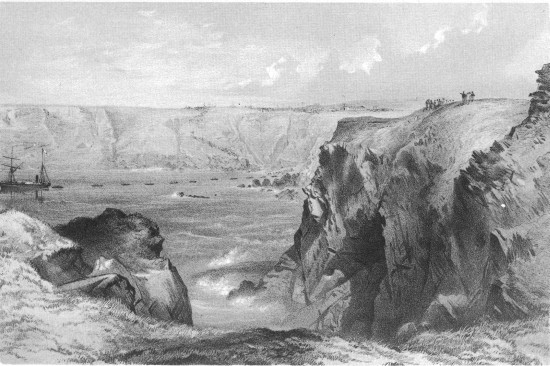
On July 19th a channel was made down the cliff to the beach for the shore end of the Cable, which was carried down in an outer case through a culvert of masonry, and deposited in a cut made as far into the sea as the state of the tide would admit. On the 21st an “earth” Cable, with a zinc earth, on Mr. Varley’s plan, was carried out into the bay from the station, and safely deposited outside the channel marked for the Cable. The Caroline went round from Valentia to Foilhummerum, and on July 22nd the shore end of the Cable was carried from her over a bridge formed of twenty-five yawls belonging to the district, amid great cheering, and hauled up the cliffs to the station. The safe arrival of the terminal wire in the building, in the presence of a large assemblage, took place at 12·45, Greenwich time, and as the day was fine, the scene, to which the fleet of boats in the bay gave unusual animation, was witnessed to the greatest advantage.
When the excitement caused by the landing of the Cable was abated, the Knight of Kerry was called on to speak to the people assembled outside the Instrument Room, and said:—“I feel that in the presence of so many who have taken an active and a useful part in this undertaking, it may seem almost presumptuous in me to open my mouth on this occasion; but from the very beginning I have felt an interest which I am sure the humblest person here has also felt in the success of this the greatest undertaking of modern times. I believe there never has been an undertaking in which, not to speak disparagingly of the commercial spirit and the great resources and strength of the land, that valuable spirit has been mixed up with so much that is of a higher nature, combining all the most noble sentiments of our minds, and the feelings intended for the most beneficial purpose, which are calculated to cement one great universe, I may say, with another. I do not think we should be quite silent when such an undertaking has been inaugurated. It has been discussed whether this ceremony should be opened with a prayer or not. Whether that shall be done or not, I am sure there is not a person present who does not feel the utmost thankfulness to the Giver of all Good for having enabled those who have taken an active part in it to bring this great undertaking to what I am sure will have a happy issue. I do not think anything could be fitly added to the sentiment of the first message which was conveyed, namely—‘Glory to God in the highest, on earth peace, good will toward men.’ I shall not detain you with another word, but will only ask you all to give the heartiest cheers for the success of the undertaking. I will also take the liberty of asking you, when you have done that, to give three cheers for a gentleman who has come here at great inconvenience, and has done us very great honour in doing so, and who deserves them, not only from his position and character, but also from the interest which he has always shown in this undertaking. I call upon you to give three hearty cheers for Sir Robert Peel.”
[larger view] G. McCulloch, lith from a drawing by R. Dudley London, Day & Sons, Limited, Lith. FOILHUMMERUM BAY, VALENCIA FROM “CROMWELL FORT” THE CAROLINE AND BOATS LAYING THE EARTH WIRE JULY 21st.
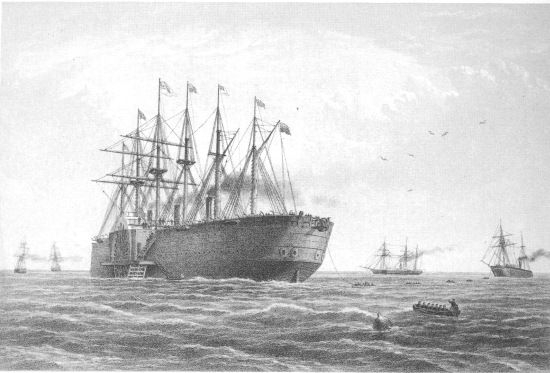
[larger view] T. Picken, lith from a drawing by R. Dudley THE GREAT EASTERN UNDER WEIGH JULY 23rd. (ESCORT AND OTHER SHIPS INTRODUCED BEING THE TERRIBLE, THE SPHINX, THE HAWK & THE CAROLINE)
The meeting responded very heartily to the call, and when silence was restored, Sir Robert Peel said: “Gentlemen, as the Knight of Kerry has well observed, this is one of the most important works that this country could have been engaged in, inasmuch as it tends to draw us together in a link of amity and friendship with a mighty continent on the other side of the Atlantic. I trust, as the Knight of Kerry has so justly observed, that it may tend not only to promote the peace and commerce of the world, but that it may also lead to a union of feeling and to good fellowship between those two great countries; and I trust that as it has been so happily inaugurated to-day, so it may be successful under the exertions of those who have taken part in it to-day and for some time past. Gentlemen, I think the progress of this undertaking deserves that we should pay the highest compliment to those who have been actively engaged in carrying it out to the stage at which it has arrived. We are about to lay down, at the very bottom of the mighty Atlantic, which beats against your shores with everlasting pulsations, this silver-toned zone, to join the United Kingdom and America. Along that silver-toned zone, I trust, may pass words which will tend to promote the commerce and the interest of the two countries; and I am sure we will offer up prayers for the success of an undertaking, to the accomplishment of which persevering industry and all the mechanical skill of the age have been brought to bear. Nothing has been wanting in human skill, and therefore for the future, as now, let us trust the hand of Divine Providence will be upon it; and that as the great vessel is about to steam across the Atlantic no mishaps or misfortune may occur to imperil or obstruct the success of the work which has now been so happily commenced. I ask you all to give a cheer in honour of my noble friend here, the Knight of Kerry, who has just begun the work.”
The demand was enthusiastically complied with, for the Knight is an immense favourite with all the dwellers in his little dominion.
Sir Robert Peel then said: “Now, gentlemen, probably one of the first messages that will be sent by this Cable will be a communication from the Sovereign of this great country to the great ruler of the mighty continent at the other side of the Atlantic. I will ask you to give three cheers for her Majesty the Queen.” (Cheers.) Sir Robert Peel in conclusion, said: “I give you, with hearty good will, health and happiness to the ruler of the United States, President Johnson.” (The toast was received with loud cheers.)
Mr. Glass, who was called on to acknowledge the hearty reception given to his name and the Company’s, said: “On behalf of myself and those connected with me in this undertaking, I beg to return you thanks. I am glad that our labours have been appreciated by those around us. I assure you that the work that has been so far completed has been a source of great anxiety to us all; but that anxiety has been relieved very much by the fact that we have now landed a Cable which we one and all believe to be perfect. I believe that nothing can interfere with the successful laying of the Cable but the hand of the Almighty, who rules the winds and waves. So far as human skill has gone, I believe we have produced all that can be desired. We now offer up our prayers to the Almighty that He will grant success to our undertaking.”
The Doxology was then sung, with which this part of the proceedings closed, and the electricians busied themselves with securing the shore end confided to their charge in its new home.
At 2 o’clock in the afternoon the Caroline, towed by the Hawk, and attended by the Princess Alexandra and Advice, proceeded to sea, veering out the shore end of the Cable in the channel marked by Lieutenant White, and at 10·30 p.m. buoyed the end 26 miles W.N.W. of Valentia, in 75 fathoms of water. A message was sent through the Cable to Foilhummerum, and a dispatch was forwarded to the Great Eastern, in Bantry Bay, to come round with all speed. This order was obeyed with such diligence that her appearance off the harbour of Valentia was reported in Knightstown soon after 7 o’clock next morning, July 23. H.M.S. Terrible and H.M.S. Sphinx were in company. The Hawk, which returned from the Caroline in the course of the night, got up steam and left Valentia Harbour about 10 o’clock a.m., July 23, with a party of visitors and passengers for the Great Eastern, among the former being Sir R. Peel, the Knight of Kerry, and Captain Lord John Hay. By 3 p.m. the Hawk had reached the flotilla, which lay around the buoy, preparing for the great enterprise. She was just in time; the end of the shore Cable was about to be spliced and joined with the landward end of the main Cable from the after tank of the Great Eastern, and the boats of the Great Ship and of the two men-of-war, were engaged in carrying the end of the main Cable to the Caroline. Sir R. Peel, the Knight of Kerry, Lord John Hay, Mr. Canning, and others, got on board the Great Eastern in successive trips of the Hawk’s boats; but the ladies, who had come so far and had suffered too in order to see the famous vessel, could not venture, as there was a swell on which made it difficult to embark or approach the gangway ladders. After an hour’s enjoyment of the almost terrestrial steadiness of the Great Eastern, the visitors departed, amid loud cheers, to the Hawk, and at 5·10 p.m. it was reported by the electricians that the tests of the splice between the main Cable and the shore end were complete, and that the shore end was much improved in its electrical condition by its immersion in the water. The boats were hoisted in by the men-of-war and by the Great Eastern, adieux and good wishes were exchanged, and, with hearts full of confidence, all on board set about the work before them.
The bight of the Cable was slipped from the Caroline, at 7·15 p.m., and the Great Eastern stood slowly on her course N.W.¼W. Then the Terrible and Sphinx, which had ranged up alongside, and sent their crews into the shrouds and up to the tops to give her a parting cheer, delivered their friendly broadsides with vigour, and received a similar greeting. Their colours were hauled down, and as the sun set a broad stream of golden light was thrown across the smooth billows towards their bows as if to indicate and illumine the path marked out by the hand of Heaven. The brake was eased, and as the Great Eastern moved ahead the machinery of the paying-out apparatus began to work, drums rolled, wheels whirled, and out spun the black line of the Cable, and dropped in a graceful curve into the sea over the stern wheel. The Cable came up with ease from the after tank, and was payed-out with the utmost regularity from the apparatus. The system of signals to and from the ship was at once in play between the electricians on board and those at Foilhummerum. On board there were two representative bodies—the electricians of the Telegraph Construction and Maintenance Company, under M. de Sauty, and the electricians of the Atlantic Telegraph Company, Mr. Varley, Professor Thomson, and assistants. The former were to test the electrical state of the Cable as it was being payed-out, and to keep up signals between the ship and the shore. The latter, who had no power of interference or control, were simply to report on the testing, and to certify, on their arrival in Newfoundland, whether the Cable fulfilled the conditions specified in the contract. The mechanical arrangements for paying-out the cable were in charge of Mr. Canning, engineer-in-chief to the Telegraph Construction and Maintenance Company, who might be considered as having supreme control over the ship ad hoc. In the space on deck between the captain’s state-room and the entrance to the grand saloon, was the Testing-Room—a darkened chamber, into which were led conducting wires from the ends of the Cable, for the ordeal to which they were subjected by the electricians, at a table whereon were placed galvanometers and insulation and resistance-testing machines.
The instructions for signalling, determined upon by the electricians of the Telegraphic Construction and Maintenance Company, were as follows:—
1. During the paying-out of the Cable, from the moment of starting until the end is landed at Newfoundland, electrical tests will be applied without intermission.
2. The tests will be for insulation, for continuity, and to determine the resistance of the conductor, the whole length of Cable being joined up in one length.
3. Each series of tests will commence at the hour (Greenwich time), and will last one hour.
4. The insulation test will consist of 30 minutes’ electrification of the Cable, commencing at the hour, and lasting till 30 minutes past the hour. Readings of the galvanometer to be taken every minute, commencing one minute after contact with the battery, the battery to consist of 40 cells.
5. At 30 minutes past the hour signals will be received from the shore for 10 minutes. Unless the ship wishes to communicate with shore by special speaking instruments, in which case, instead of receiving signals from the shore, ship will put on a C to E current to oppose deflection on shore. Galvanometer to arrest shore attention, and when joined, give the call as in paragraph 9: the ordinary signals will be 5 reversals of 2 minutes each.
6. At 40 minutes, C of Cable will be taken to 10 minutes.
7. At 50 minutes signals will be sent to the shore, and for the ordinary signals 5 reversals, 2 minutes each, commencing C to E.
8. Then a repetition of the same tests to be made and continued without any interval.
9. In case it becomes necessary to speak to shore by speaking instruments, the signal will be given at the 50 minutes, and at the 30 minutes, as in paragraph 5, by sending 8¼ minutes’ reversals, commencing Z to E, and changing over to the speaking instruments, on receiving acknowledgment of call from shore (which will be also 8¼ minutes’ reversals), communication or message to be sent, and when acknowledgment of message and reply (if any) is received, then the system of testing is to be resumed, as if no interruption had taken place.
10. Every 50 nauts. of Cable payed-out will be signalled at the same time (viz., at the 50 mins.), thus, instead of 5 reversals of 2 minutes, 10 reversals of 1 minute will be made commencing Z to E.
11. Every 50 nauts. distance run will be signalled to the shore; the signal will be 2 reversals (commencing Z to E), each 2 minutes’ duration—2 reversals, each 1 minute’s duration, and 2 reversals, each 2 minutes’ duration.
12. Should any defect in signals be perceived, or bad time kept, notice will be given to the shore by signalling at the 50 minutes—thus, by giving 2 reversals of 5 minutes’ duration, commencing Z to E.
13. In sounding, signal will be one current of 10 minutes’ duration, Z to E.
14. Land-in-sight signal will be likewise one current of 10 minutes’ duration, Z to E.
15. Greenwich time will be kept, but a column will be devoted in journals and sheets to ship’s time.
16. After the insulation test is taken, it is to be worked out thus—The same deflection at the 15th minute’s reading will be obtained with the same battery through resistance, and a shunt to the galvanometer. The amount of resistance multiplied by multiplying power of the shunt, and galvanometer multiplied by the length of the Cable, will give the G. p. R. pr. nt.
17. The copper resistance of the Cable will be taken after 5 minutes’ electrification.
18. No change in the instruments, wires, or connections (other than the batteries, if necessary), to be made on any account, unless such instruments, &c., become defective—any necessary change to be made as quickly as possible.
19. Should the rolling of the ship generate a magnetic current of sufficient strength to embarrass the signals, a stronger current for the signals will be put on on shore, and a shunt used with the galvanometer on board, notice to the shore to put on more power will be given by one current of 5 minutes, commencing Z to E, and 5 reversals of 1 minute’s duration.
20. The iron earth of the Cable will be used both on board and on shore—other earths, however, to be in readiness for use, if necessary.
21. Full particulars of every test and every occurrence in the testing-room to be entered in journal, together with the name of the electricians on duty, and the time of their coming on and going off duty.
22. After the end is landed, should signals fail, the paying-out system to be resumed until signals are re-established.
23. In case of a minute fault appearing, such as will partially affect the signalling, but which will not stop the communication entirely, notice will be given to shore to reduce battery power. Such notice will be given at the 50 minutes, by sending 5 reversals of 1 minute each, commencing Z to E, and 1 current of 5 minutes’ duration.
24. A proper supply of lamps, glasses, oil, and wicks; instrument ink and instrument paper, in sufficient quantities; paraffin, wicks, and spare lamp-glasses for the instrument lamps; lamp-brushes, tools, sulphate of copper, stationery, &c., to be always ready for use.
25. No person except those on duty, and the engineers and the officers authorised by the Atlantic Telegraph Company, to be allowed in the instrument room on any pretence.
26. The batteries to be kept in an efficient state, especially those for sending reversals—their force taken periodically, and if any variety occur, they must be renewed, or brought up to the original force.
27. Supplies of every material needful for such purpose to be in constant readiness.
28. The actual end of the Cable to be brought to the instrument tables, and well insulated.
SHIP’S SIGNALS.
29. Ordinary.—5 reversals, commencing C to E, each 2 minutes.
To open communication.—8 reversals, commencing Z to E, each ¼ minute.
50 nauts. payed out.—10 reversals, commencing Z to E, each 1 minute.
50 nauts. distance run, signal will be, 2 reversals, each 2 minutes, commencing Z to E.
50 nauts. distance run, signal will be, 2 reversals, each 1 minutes, commencing Z to E.
50 nauts. distance run, signal will be, 2 reversals, each 2 minutes, commencing Z to E.
Defective signals.—2 reversals, commencing Z to E, each 5 minutes.
In soundings.—1 current of 10 minutes, Z to E.
Land in sight.—1 current of 10 minutes, Z to E.
Notice to increase power.—1 current of 5 minutes, commencing Z to E, and 5 reversals of 1 minute’s duration.
Notice to reduce power.—5 reversals of 1 minute, commencing Z to E, and 1 current of 5 minutes.
SHORE.
1. During the paying-out of the Cable, from the moment of starting until the end is landed at Newfoundland, a system of testing will be applied without intermission.
2. The tests will be for insulation, for continuity, and to determine the copper resistance of the conductor.
3. Each series of tests will commence at the hour (Greenwich time), and will last 1 hour. Both the insulation and C R tests will be made on board.
4. The insulation test will be made on board, and to enable that to be done, the end of the Cable must be insulated on shore for 30 minutes, commencing at the hour.
5. At the 30 minutes past the hour, signals will be sent to the ship for 10 minutes. Should ship at this time desire to open communication, ship will put on a current so as to oppose shore’s current on his galvanometer, to arrest shore’s attention, and will, when gained, give the call as in paragraph 10.
6. The ordinary signal will be 5 reversals of 2 minutes’ duration, commencing C to E.
7. At the 40 minutes, Cable to be put to earth direct, without any instrument being in circuit.
8. At the 50 minutes, signals will be received from the ship. The ordinary signal will be 5 reversals, each 2 minutes’ duration.
9. Then a repetition of the same series to be made and continued.
10. Should ship desire to open communication by special speaking instruments, notice will be received by a signal of 8 reversals (giving a deflection the opposite to the ordinary signals) of ¼ minute’s duration.
11. After returning the same signal to the ship as an acknowledgment, the speaking instruments to be put in circuit, and the message from the ship received, and when acknowledgment of message, or reply, is given, the regular system of signals to be resumed as if no interruption had occurred.
12. Every 50 nauts. of the Cable payed-out will be signalled to the shore by signal (instead of the ordinary signals). This signal will be 10 reversals of 1 minute each—the first current giving a deflection the opposite side to the first current of the ordinary signals.
13. Every 50 nauts. distance run will be signalled to the shore: the signal will be 2 reversals of 2 minutes’ duration, 2 reversals of 1 minute’s duration, and 2 reversals of 2 minutes’ duration—the first current giving a deflection opposite to the first deflection of the first current of the ordinary signal.
14. Should ship receive weak or defective signals, or bad time kept, notice will be given by sending 2 reversals of 5 minutes each, commencing the opposite side to the ordinary signals.
15. When the ship gets into soundings, notice will be given by sending one current of 10 minutes’ duration, the opposite side to the first current of the ordinary signals.
16. When land is in sight, notice will be given by the same signal.
17. Greenwich time to be kept, but a column to be devoted to local time in the journals and sheets.
18. No change in instruments, wires, or connections (other than the batteries, if necessary), to be made on any account, unless such instruments become defective, and any necessary change to be made as quickly as possible.
19. Should the rolling of the ship generate a magnetic current of sufficient strength to embarrass the signals, a stronger current for the signals must be put on by shore on receiving notice from the ship; the notice will be given by 1 current of 5 minutes’, and 5 reversals of 1 minute’s duration.
20. The iron earth of the Cable to be used both on board and on shore: copper earths, however, will be in readiness for use if necessary.
21. Full particulars of every occurrence in the testing-room will be entered in journals, together with the names of the electricians on duty, and the time of their coming on and going off duty.
22. When the end is landed at Newfoundland, should signals fail at any time, the paying-out system to be resumed until signals pass again freely.
23. On receiving a signal of 5 reversals of 1 minute’s, and a current of 5 minutes’ duration, shore must reduce the battery power used for sending reversals by one-half, and on a repetition of the same signal again reduce the power one-half, until (should notice continue to be given to that effect) the minimum of power be reached.
24. Shore must not have the privilege of opening a conversation, or to use or call for the use of the special speaking instruments, under any circumstances, except to give notice of any accident that may cause an interruption of signals, or that may affect the safety of the Cable or signals.
25. Should any interruption of signals from the ship occur by reason of an accident on board, shore will continue to free the Cable at the usual time, and to put to earth direct at the usual time, and in the intervals to put into circuit with the Cable a galvanometer, and watch the same for signals, and continue doing so until communication with the ship is restored, or information is received by other means from the ship.
26. On re-establishment of communication, shore must not ask any questions, but take the resumption of signals as an indication of all being well again, and will continue to follow the series of tests as if nothing had happened.
27. Shore will take time from the ship; should any irregularity in the reception of signals from the ship occur, such irregularity must be entered in journals, and must not form a ground for shore’s altering his time, but shore must follow blindly every change (should one take place), as if the most correct time had been kept.
28. A proper supply of lamps, glasses, oil, and wicks; instrument ink and instrument paper, in sufficient quantities; paraffin, wicks, and spare lamp-glasses for the instrument lamps; lamp-brushes, tools, sulphate of copper, stationery, &c., to be always ready for use.
29. No person, except those on duty, and the officers authorised by the Atlantic Telegraph Company, to be allowed in the instrument room on any pretence.
30. The batteries to be kept in an efficient state, especially those for sending reversals—their force taken periodically, and if any variation occur, they must be renewed, or brought up to the original force.
31. Supplies of all materials necessary for such purpose to be in constant readiness.
32. The actual end of the Cable to be brought to the instrument tables, and well insulated.
SHORE SIGNALS.
33. Ordinary.—5 reversals, each two minutes, commencing C to E.
34. To open communication on acknowledgment.—8 reversals, each ¼ minute, commencing Z to E.
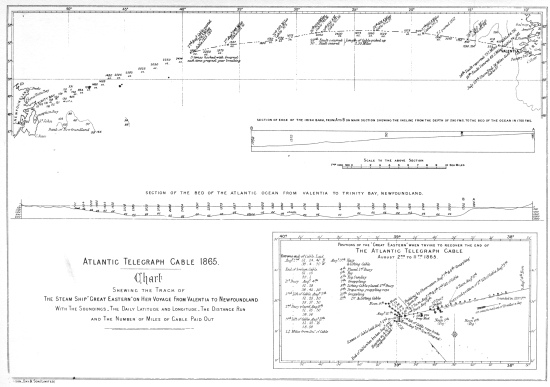
As the voyage of the Great Eastern promised to be so interesting to electricians and engineers, several young gentlemen who worked in the testing-room and in the engineer’s department received a passage, as we have mentioned, but there was no person on board who was not in some way or other engaged on the business of both companies, or connected with the management of the ship. The voyage commenced most favourably. The rate of speed was increased to 3 knots, then to 4 knots, then to 5 knots, and finally, to 6½ knots an hour, and the Cable flew from each coiled flake as if it were eager to push up through the controlling bands of the so-called crinoline, and to plunge into the sea. At 10·p.m., Greenwich time, 50 miles of Cable had been payed-out, and the process continued to midnight with equal ease and regularity. In order to make each day’s proceedings distinct, and to take the reader over the course so that he can follow the expedition readily by the aid of the accompanying chart, I propose recording events in the form of a diary.
[larger view] [largest view]
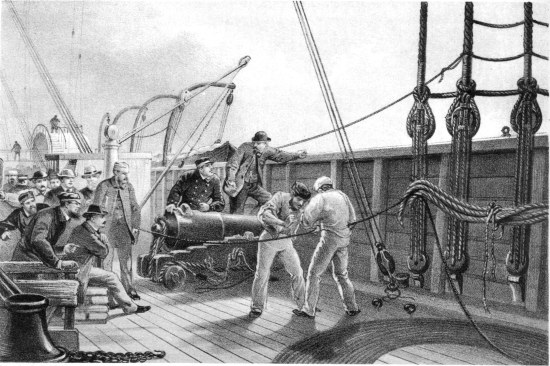
[larger view] From a drawing by R. Dudley London. D.T & Sou. Limited. Lilh. SPLICING THE CABLE (AFTER THE FIRST ACCIDENT) ON BOARD THE GREAT EASTERN JULY 25TH.
Monday, July 24th.—The morning was exceedingly fine, and the ship proceeded steadily at an average rate of 6 knots an hour, with a light favouring wind and a calm sea. Those who were up betimes had just taken a turn or two on deck, watching for the early dawn, when they observed some commotion in the neighbourhood of the Testing-Room, and soon afterwards the ship’s engines were slowed and stopped. According to Professor Thomson’s galvanometer, which is used in the system employed in testing, a ray of light reflected from a tiny mirror suspended to a magnet travels along a scale, and indicates the resistance to the passage of the current along the Cable by the deflection of the magnet, which is marked by the course of this speck of light. If the light of the mirror travels beyond the index, or out of bounds, an escape of the current is taking place in the Cable, and what is technically called a fault has occurred. At 3·15 a.m., when 84 miles of Cable had been paid out, the electrician on duty saw the light suddenly glide to the end of the scale, and then vanish. The whole staff were at once aroused—the news soon flew through the ship. After testing the Cable for some time by signalling to and from the shore, Mr. de Sauty satisfied himself that the fault which had occurred was of a serious character, and measures were taken accordingly to rig up the picking-up apparatus at the bow, to take in the Cable till the defective portion was reached and cut out. Such an early interruption to our progress caused a little chagrin, but the veterans of submarine telegraphy thought nothing of it. Whilst the electricians were testing, to obtain data respecting the locality of the fault, the fires were got up in the boilers of two small engines on deck to work the picking-up machinery. At 4 a.m. a gun was fired by the Great Eastern to call the attention of the Terrible and Sphinx to our proceedings, and they were also informed by signal of the injury. Notwithstanding the skill and experience of the scientific gentlemen on board, there was a great vagueness of opinion among them respecting the place where the fault lay. Some believed the defective part was near the shore, and probably at the splice of the shore end with the main Cable; others thought it was eastward or westward of the same place; and calculations, varied by uncertain indications given by the currents showing that the fault itself was of a variable character, and permitted the currents of electricity to escape irregularly, were made by the scientific staff, which fixed it at points from 22 to 42 miles—one at 60 miles—from the ship. But repeated observations gave closer results. Mr. Varley came to the conclusion that the fault was not very far from the ship; and Mr. Sanders, a gentleman who had much experience in fault-finding, arrived at the conviction that it was not more than 9 or 10 miles astern.
The best test taken by Mr. Saunders, 1·30 a.m., Greenwich time, July 25, after the Cable had been cut down to 78·5 miles, gave—
Resistance, shore end disconnected,2,600units.
““ to earth,312“
Let a and b be the lengths of Cable-conductor, having resistances equal to the first and second of these numbers; l the length of Cable, and D the distance of the fault. The ordinary formula gives
D=b-√ (a-b)(l-b)
Hence, l being 78·5, and a and b being calculated from the observed copper-resistance of the conductor in the after-tank, and various assumed temperatures of the sea, we should have, were the measurements perfect, results as follows:—
Hence 4·42 units at 59° temperature 6·7 miles.
4·37 “ 53° “ 10·1“
4·25 “ 40° “ 22·0“
4·02 “ 35° “ 27·2“
This would give 22 miles for the most probable distance of the fault, as 40° is the most probable mean temperature of the first submerged length of 75 miles. The true distance proved to be very nearly 3 miles. The discrepance is owing partly of course to want of absolute accuracy in the measurements, but probably more to the variation of the resistance of the fault during the interval between the two measurements.
Iron chains were lashed firmly to the Cable at the stern, and secured to the wire rope carried round outside the ship to the picking-up apparatus at the bows. As the paying-out stopped, a strain came on the Cable, which was down in 400 fathoms of water, and it needed nice management to keep the ship steady, as she had no steerage way. The Cable, having been shackled and secured, was severed at 8·50 a.m., and flew with its shackling into the sea, plump astern. The stoppers which held the wire rope were released, and the rope was payed-out rapidly as the Cable sunk, in order that the ship’s head might be brought round, if possible, so as to take the Cable in over the bows in a straight line with its course.
The Great Eastern dropped to leeward when her engines stopped. When the end of the Cable was got in over the bows, and the picking-up engine was set to work, it was discovered that the locomotive boiler intended to keep up a head of steam for the machinery, was defective. Steam was then supplied by one of the boilers of the ship: the drums and wheels of the picking-up machinery began to revolve, slowly dragging in the Cable over the bows, with a strain which at times rose from 10 cwt. to 30 cwt., leaving a very large margin before the breaking point was reached. The ship’s bows were kept up to the line of the Cable with great cleverness, and Mr. Canning and his assistants were perfectly satisfied with their progress. It would be too much to expect that all on board should be so easily contented; for in fact the process of picking-up is of the slowest—a mile an hour was considered to be a fair rate of speed, and a mile and a-quarter was something to be very thankful for. Still, the prospect of returning to Ireland and getting back to the shore end, at the highest of these retrogressive celerities, did not prove attractive. Our position, by observation at noon, was Lat. 52° 2´ 30´´, Long. 12° 17´ 30´´. As the Cable was in fair working order, Mr. Canning transmitted a message to Mr. Glass at Knightstown, to send out the Hawk, in order that he might return in her, and ascertain if the shore end of the Cable were defective. If that were not the case, he proposed to sacrifice the portion of Cable already laid, to return and make a new splice of the main line with the shore end, and to start afresh. In the course of the evening a message was received from Mr. Glass, informing Mr. Canning that the Hawk should be sent out as soon as she had coaled the Caroline. The Terrible sent her First Lieutenant, Mr. Prowse, on board, to see if she could render us any assistance. The Sphinx was busied in taking soundings all round the ship, which showed depths varying from 400 to 480 fathoms. The operation of picking up proceeded all day and all night—the weather being fine but cloudy.
Tuesday, July 25th.—The Hawk was observed soon after daybreak coming towards the Great Eastern. The wind was still light and the sea moderate. All during the night the process of picking up was carefully carried on, the Big Ship behaving beautifully, and hanging lightly over the Cable, as if fearful of breaking the slender cord which swayed up and down in the ocean. Indeed, so delicately did she answer her helm and coil in the film of thread-like Cable over her bows, that she put one in mind of an elephant taking up a straw in its proboscis. At 7·15 a.m., Greenwich time, 9½ miles of Cable had been picked up from the sea, and the thin greyish coating of mud which dropped from it showed that the bed of the Atlantic here was of a soft ooze. The Cable had been cut twice on board, to enable the electricians to apply tests separately to the coils in the tanks. At 9 a.m., ship’s time, when somewhat more than 10¼ miles had been hauled in, to the joy of all the “fault” was discovered. The Cable came in with flagrant evidence of the mischief. The cause of so much anxiety, delay, and bitter disappointment turned out to be a piece of wire of the same kind as that used in the protecting strands of the Cable itself. It was two inches long or so—rather bent in the middle, with one end sharp and bright, as if from a sharp fracture or being cut by a pair of pliers—the other end blunt and jagged. This piece of wire had been forced through the outer covering of the Cable into the gutta percha, so as to injure the insulation, but no one could tell how it got into the tank. The general impression was, that it was a piece of Cable or other wire which had been accidently carried into the tank, and forced into the coil by the pressure of the paying-out machinery as the Cable flew between the jockey-wheels.
Measures were at once taken to make a new splice and joint, rejecting the Cable picked up, a good deal of which had been strained in the process. Signals were made to the fleet that the enemy had been detected, at 9 a.m., and the Terrible replied, “I congratulate you.” First a splice was made in the Cable where it had been cut, for the purpose of testing between the after and fore tanks, and all admired the neatness and strength with which it was performed—the conducting wires soldered and lapped over—the gutta percha heated and moulded on the junction; and, finally, the strands carried over the core and secured. During the operation the Hawk returned to Valentia with our letters, and with the good news, which, however, must have been anticipated by the Cable itself. The splice and joint of the end of Cable towards the shore and the end from the after tank was next made. Then these splices were carefully tested and found perfect, and the stream of electricity was once more sent direct to Valentia. After a detention of some twelve hours, the paying-out machinery was again put in action, and the Cable glided out rapidly astern. All seemed to go well. About half a mile of wire had been paid out, when suddenly all communication between the shore and ship ceased altogether! From great contentment there was sudden blank despair! The operators were in consternation. The news spread from end to end of the ship, which again lay in restless quiet on the waters. The faces of the most cheerful became overcast—gloomy forebodings filled men’s minds all at once. Why had the Hawk been sent back? Why were not more tests made before she left? Away worked the electricians in their room, connecting and disconnecting, putting in and taking out stops—intensifying and reducing currents. Not a sign! Not a shadow of a sign! Mr. de Sauty suggested they had got hold of the wrong wires, and professors opined that the operators had done wrong in spending time over the splice between the two tanks at the critical moment when they should have been watching the signals from the shore. Anxious groups gathered round the Testing-Room, and the bolder popped in their heads, as if they could learn anything from the dumb mute wires and the clicking of the chronometers, or from the silent operators who bent over the instruments. At 3·15 p.m. the Cable between the two tanks was again cut, and examination was made to make sure no error had been made in the communications. Again the wearisome energy of the picking-up apparatus was to be called into play—once more the Cable was to be shackled and thrown overboard, and hauled up to the bows and pulled out of the water. Such a Penelope’s web in 24 hours, all out of this single thread, was surely disheartening. The Cable in the fore and the main tanks answered to the tests most perfectly. But that Cable which went seaward was sullen, and broke not its sulky silence. Even the gentle equanimity and confidence of Mr. Field were shaken in that supreme hour, and in his heart he may for a moment have sheltered, though he did not nurture, the thought that the dream of his life was indeed but a chimæra. Who could bear up against a life of picking-up? And our paying-out seemed to have such an undue share of the reverse process attached to it! But there was a change in the fortunes of the ship and of its freight. The index light suddenly reappeared on its path in the Testing-Room, and the wearied watchers were gladdened by the lighting of the beacon of hope once more. Again there was one of those mutations to which the flesh of submarine telegraph layers is born heir, and after a few moments of breathless solicitude, it was announced that the signals between the ship and the shore had been restored, and that every instant developed their strength. Mr. de Sauty came out of the Testing-Room to inform Professor Thomson of the fact, and Mr. Canning’s operations at the bows of the ship for picking up were most gratefully suspended by the intelligence that the machinery would not be required. At 4·15 p.m. the ship steamed on ahead again, and the Terrible and Sphinx were signalled to come on, 37 hours and 10 minutes having been lost by the fault, and consequent detentions. Our position, at noon was found to be, Lat. 51° 58´, Long. 12° 11´; total distance from Valentia, 66½ miles; total Cable payed-out 74 miles (per centage of slack being 14 miles), distance from Heart’s Content, 1,596 miles. The communication with shore continued to improve, and was, in the language of telegraphers, O. K. The alternations of hope and fear to which we had been exposed were now pleasantly terminated for the evening, and the saloon became the scene of joyous and animated conversation, and of a good deal of scientific discussion, till the approach of midnight.
The cause of the detention was argued fully, but it was not easy to determine how it came to pass the signalling had been interrupted; it was generally accounted for by the supposition that the order of the tests had become deranged whilst the splices were being made on board, and some of the electricians were inclined to think that the system was defective, because the intervals were so long that the fault might be overboard some time before it could be detected.
As the sea and wind rose a little, the speed of the ship was diminished from 6½ knots to 5 knots, at which rate the Cable ran out beautifully throughout the night.
July 26th.—The course of the Cable ran smoothly all throughout the night. At 8 a.m. the Great Eastern was 150 miles from Valentia, and 161½ miles of Cable, including the shore end, had been laid—the loss by slack being only 7·63 per cent. The morning was hazy, and a strong wind from the north-west brought up rather a heavy sea, but the Great Eastern was as steady as a Thames steamer; indeed the stability of the vessel was a never-ending theme of admiration. Our consorts were not so indifferent to the roll of the Atlantic. The Terrible thumped through the heavy sea, and buried her bows in foam with dogged determination. The Sphinx gave very unmistakable indications of having a harder enigma than she bargained for, as she engaged in her task of taking soundings, which now had become important. We were getting into deep water, having passed the bank on which there is only 200 fathoms, and had come suddenly to the slope beginning with 700 fathoms, and running in one degree to 1,750 fathoms. This slope is not, however, severer than that of Holborn-hill, though it looks very severe upon the map. Towards noon the sea and wind increased. The Sphinx, which first sent down topgallant masts, finally sent down topmasts, but was unable to make head in the sea way, and dropped further and further astern. At noon our course was W.N.W. ¾ W., the wind being strong on the port bow, and the weather thick all round, with drizzling mist. Our position was made out to be Lat 52° 18´ 42´´, Long. 15° 10´´, distance run 111½ miles, Cable paid out 125 miles, total distance from Valentia 178 miles. At 1·45 p.m. the Terrible signalled that the Sphinx was unable to keep up with us, but the Cable was running so easily it was resolved not to diminish our speed. Later in the afternoon, the Terrible sent down topgallant masts; later again, she signalled that we were going too fast for the Sphinx; but as the Great Eastern was not exceeding 6½ knots an hour, at which rate the Cable rolled off easily from the drums, the engineers did not think it advisable to reduce her speed, and so the Sphinx was left further astern, till at length she was hull down on the grey horizon. Each hour it became more important to know what depth of water we were in; and the inconvenience of parting with the Sphinx was felt, as well, perhaps, as the defective nature of the arrangements with the Admiralty, which had furnished only one sounding apparatus. The Terrible had got no deep-sea sounding apparatus. There was none on board of the Great Eastern. In deep-sea soundings a special apparatus is requisite, and the leads and the lines ordinarily used by men-of-war only penetrate the upper strata of the waters of the Atlantic. It was conjectured that we had passed over the 2,050 fathoms’ soundings, and the Cable proved, by a slightly increased pressure on the dynamometer, that its trail was lengthening in the watery waste ere it ruffled the smooth surface of the ooze two miles below. The insulation tests showed an improvement, and the transmission of signals between the ship and the shore afforded most satisfactory indications. At night the wind came round to the north-west, the sea somewhat decreased, and as evening closed in, the Terrible drew up on our beam, working two boilers; but when night fell, the Sphinx was scarcely visible on the distant horizon.
[larger view] E. Walker, lith from a drawing by R. Dudley London, Day & Sons. Limited, Lith. VIEW (LOOKING AFT) FROM THE PORT PADDLE BOX OF GREAT EASTERN SHOWING THE TROUGH FOR CABLE &c.
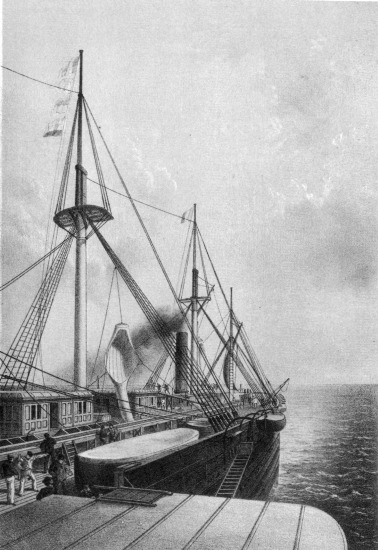
[larger view] G. McCulloch, lith from a drawing by R. Dudley London, Day & Sons, Limited, Lith. THE FORGE ON DECK. NIGHT OF AUGUST 9TH PREPARING THE IRON PLATING FOR CAPSTAN.
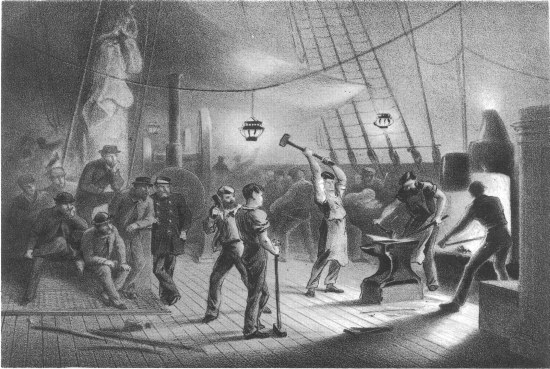
July 27th.—Morning broke on a bright bounding sea and clear blue sky. From the Testing-Room came gratifying reports of the improved insulation of the Cable, which had been caused by the immersion of the Cable in colder water. We were now approaching an undulation in the bed of the Atlantic in which the soundings decreased rather abruptly from 2,100 to 1,529 fathoms. The engineers were perfectly satisfied with the manner in which the machinery was working, and the mode in which the Cable ran out. The complete success of the enterprise, after this fair start, appeared to be a matter beyond doubt. The fore tank was now got ready for the paying-out of the Cable as soon as the coils in the after tank should be exhausted, and the framework for the crinoline was erected over the hatchway. At noon, our position by observation was Lat. 52° 34´ 30´´, Long. 19° 0´ 30´´, distance run 141 miles, distance from Valentia 320 miles, Cable paid out 158 miles. The Terrible was on our port beam at some distance, but the Sphinx was nowhere visible, although our speed had not much exceeded 6 knots an hour. There was in the universal benevolence of the moment a feeling of sympathy for our lagging guardians. The conviction grew that the work was nearly accomplished. Some were planning out journeys through the United States, others speculated on the probability of sport in Newfoundland: the date of our arrival was already determined upon. The sound of the piano, a tribute to our own contentment, rose from the saloon, and now and then the notes of a violin became entwined in the melodious labyrinth through which the amateur professors wandered with uncertain fingers. The artists sketched vigorously. Men stretched their legs lustily along the decks, or penetrated, with easy curiosity for the first time into the recesses of the Leviathan that bore them. None of them indeed found out the hiding-place of the ghost who haunts the ship; but they discovered crypts under the tanks, and meandered and crept about the shafts and boilers of the tremendous gloominess—vast and dark as the Halls of Eblis. The ghost on board the Great Eastern, to which I have alluded, is believed to be the disembodied essence of a poor plate-riveter, who disappeared in some aperture of the nascent ship, never to be seen of mortal eye again, and who was supposed to have been riveted up by the hammers of preparation so closely that not even his spirit could escape. And so it, or he, is heard at all hours, with ghostly hammer, tap-tap-tapping on the iron walls of his prison as incessant as that cruel Raven, even through the clangour of donkey-engines and the crash of matter. There was now and then a slight indication of unsteadiness, which made one uncertain whether the wine was very strong or the Great Eastern unusually frolicsome; but, as a matter of fact and truth, not a man aboard could imagine as he sat in the grand saloon that he was at sea at all. Every hour on board the ship increased our regard for all her qualities, except her capacity of making noise and producing smoke, but both of these were tokens and necessary conditions of her high working energies.
July 28th.—A night more of joyous progress—all going on most successfully—not a hitch in Cable, machinery, or ship. It was worth while to go aft and look at the Cable as, every inch scanned by watchful eyes, and noted in books, it flew through the whole apparatus of jockeys and drums and dynamometers, and then in a gentle curve skimmed the surface of the ocean more than 200 feet astern ere it went “plump, plunging down amid the assembly of the whales.” Our course was N.W. ½ W., and the wind at W.N.W., not too strong, was just what we desired. The Terrible kept on our port beam. The Sphinx was not to be seen. Our position at noon was Lat. 52° 45´, Long. 23° 18´ 4´´ (another reading gave 23° 15´ 45´´), distance run since yesterday 155½ miles, Cable paid out 174 miles. Distance from Valentia 474 miles; distance from Heart’s Content 1,188·5 miles. The water was supposed to vary from 1,529 to 1950 fathoms in depth. There was something almost monotonous in our success; no ships to be seen, only our severe-looking consort, with her black hull and two funnels and paddle-boxes, on the round blue shield of which the Great Eastern was the boss. Even the sea-birds had begun to leave us, and a whale and a few porpoises which revealed their beauties to a favoured few were regarded as an envied treat. As the departure of the Sphinx had left one flank open, and that the most vulnerable, the Great Eastern signalled to the Terrible to prevent any vessel from the N.W. crossing our course, and soon afterwards the man-of-war steamed and took up her station on our starboard quarter, where she remained throughout the day and night. There was a sense of companionship in seeing her near us.
Saturday, July 29th.—“Everything has gone on most admirably during the night.” Such was the report from electricians, and engineers, and officers this morning. The electrical condition of the Cable furnished results most satisfactory to Mr. Varley and to Professor Thomson. The tests showed that in copper-resistance, insulation, and every other particular, the Cable was exhibiting an excellence far beyond the specified standard. Coil after coil whirled off from the tank and passed away to sea as easily as the lightning flash itself; and Valentia was joined to us by a lengthening thread, which seemed stronger and more sentient as it lengthened. In the night the Terrible had vanished, but she came in sight in the morning, and drew up closer to us. As the sea was calm, and the Cable ran out so beautifully, the speed of the steamer, and consequent rate of paying-out of the Cable, were increased; and it looked as if there was really no limit to the velocity at which the process could be conducted under favouring circumstances. Yes; “Heart’s Content” on August 5th was certain. What could prevent it? The fault which had occurred was caused by an accident most unlikely to happen again. So we pored over our maps and marked out the soundings in the little bay in Newfoundland, and imagined what sort of place it was, as men will do of spots they have never visited.
At noon our position was, Lat. 52° 33´ 30´´ (another reading, 52° 38´ 30´´), Long. 27° 40´. Distance run, 160 miles. Distance from Valentia, 634·4 miles. Distance to Heart’s Content, 1,028 miles. The Great Eastern had passed over the valley in the plateau where the Atlantic deepens to 2,400 fathoms. At 9 a.m. we had shoaled our water to 2000 fathoms, or 2 nautical miles.