Volume 12 / Part 3 — THE GROWTH OF CONTINENTS.
Reading edition
Return to Table of Contents
Before entering upon a sketch of the growth of the European Continent from the earliest times until it reached its present dimensions and outlines, I will say something of the growth of continents in general, connecting these remarks with a few words of explanation respecting some geological terms, which, although in constant use, are nevertheless not clearly defined. I will explain, at the outset, the meaning I attach to them and the sense in which I use them, that there may be no misunderstanding between me and my readers on this point. The words Age, Epoch, Period, Formation, may be found on almost every page of any modern work on geology; but if we sift the matter carefully, we shall find that there is a great uncertainty as to the significance of these terms, and that scarcely any two geologists use them in the same sense. Indeed, I shall not be held blameless in this respect myself; for, on looking over preceding articles, I find that I have, from old habit, used somewhat indiscriminately names which should have a perfectly definite and invariable meaning.
As long as zoölogical nomenclature was uncontrolled by any principle, the same vagueness and indecision prevailed here also. The words Genus, Order, Class, as well as those applied to the most comprehensive division of all in the animal kingdom, the primary branches or types, were used indiscriminately, and often allowed to include under one name animals differing essentially in their structural character. It is only since it has been found that all these groups are susceptible of limitation, according to distinct categories of structure, that our nomenclature has assumed a more precise and definite significance. Even now there is still some inconsistency among zoölogists as to the use of special terms, arising from their individual differences in appreciating, structural features; but I believe it to be, nevertheless, true, that general orders, classes, etc., are not merely larger or smaller groups of the same kind, but are really based upon distinct categories of structure. As soon as such a principle is admitted in geology, and investigators recognize certain physical and organic conditions, more or less general in their action, as characteristic of all those chapters in geological history designated as Ages, Epochs, Periods, Formations, etc., all vagueness will vanish from the scientific nomenclature of this department also, and there will be no hesitation as to the use of words for which we shall then have a positive, definite meaning.
Although the fivefold division of Werner, by which he separated the rocks into Primitive, Transition, Secondary, Alluvial, and Volcanic, proved to be based on a partial misapprehension of the nature of the earth-crust, yet it led to their subsequent division into the three great groups now known as the Primary, or Palaeozoic, as they are sometimes called, because here are found the first organic remains, the Secondary, and the Tertiary. I have said in a previous article that the general unity of character prevailing throughout these three divisions, so that, taken from the broadest point of view, each one seems a unit in time, justifies the application to them of that term, Age, by which we distinguish in human history those periods marked throughout by one prevailing tendency;—as we say the age of Egyptian or Greek or Roman civilization,—the age of stone or iron or bronze. I believe that this division of geological history into these great sections or chapters is founded upon a recognition of the general features by which they are characterized.
Passing over the time when the first stratified deposits were accumulated under a universal ocean in which neither animals nor plants existed, there was an age in the physical history of the world when the lands consisted of low islands,—when neither great depths nor lofty heights diversified the surface of the earth,—when both the animal and vegetable creation, however numerous, was inferior to the later ones, and comparatively uniform in character,—when marine Cryptogams were the highest plants, and Fishes were the highest animals. And this broad statement holds good for the whole of that time, even though it was not without its minor changes, its new forms of animal and vegetable life, its variations of level, its upheavals and subsidences; for, nevertheless, through its whole duration, it was the age of low detached lands,—it was the age of Cryptogams,—it was the age of Fishes. From its beginning to its close, no higher type in the animal kingdom, no loftier group in the vegetable world, made its appearance.
There was an age in the physical history of the world when great ranges of mountains bound together in everlasting chains the islands which had already grown to continental dimensions,—when wide tracts of land, hitherto insular in character, became soldered into one by the upheaval of Plutonic masses which stretched across them all and riveted them forever with bolts of granite, of porphyry, and of basalt. Thus did the Rocky Mountains and the Andes bind together North and South America; the Pyrenees united Spain to France; the Alps, the Caucasus, and the Himalayas bound Europe to Asia. The class of Mammalia were now at the head of the animal kingdom; huge quadrupeds possessed the earth, and dwelt in forests characterized by plants of a higher order than any preceding ones,—the Beeches, Birches, Maples, Oaks, and Poplars of the Tertiaries. But though the continents had assumed their permanent outlines, extensive tracts of land still remained covered with ocean. Inland seas, sheets of water like the Mediterranean, so unique in our world, were then numerous. Physically speaking, this was the age of continents broken by large inland seas; while in the organic world it was the age of Mammalia among animals, and of extensive Dicotyledonous forests among plants. In a certain sense it was the age of completion,—the one which ushered in the crowning work of creation.
There was an age in the physical history of the world (it is in its infancy still) when Man, with the animals and plants that were to accompany him, was introduced upon the globe, which had acquired all its modern characters. At last the continents were redeemed from the water, and all the earth was given to this new being for his home. Among all the types born into the animal kingdom before, there had never been one to which positive limits had not been set by a law of geographical distribution absolutely impassable to all. For Man alone those boundaries were removed. He, with the domestic animals and plants which were to be the companions of all his pilgrimages, could wander over the whole earth and choose his home. Placed at the head of creation, gifted with intellect to make both animals and plants subservient to his destinies, his introduction upon the earth marks the last great division in the history of our planet. To designate these great divisions in time, I would urge, for the reasons above stated, that the term which is indeed often, though not invariably, applied to them, be exclusively adopted,—that of the Ages of Nature.
But these Ages are themselves susceptible of subdivisions, which should also be accurately defined. What is the nature of these subdivisions? They are all connected with sudden physical changes in the earth's surface, more or less limited in their action, these changes being themselves related to important alterations in the organic world. Although I have stated that one general character prevailed during each of the Ages, yet there was nevertheless a constant progressive action running through them all, and at various intervals both the organic and the physical world received a sudden impulse in consequence of marked and violent changes in the earth-crust, bringing up new elevations, while at the same time the existing animal creation was brought to a close, and a new set of beings was introduced. These changes are not yet accurately defined in America, because the age of her mountains is not known with sufficient accuracy; but their limits have been very extensively traced in Europe, and this coincidence of the various upheavals with the introduction of a new population differing entirely from, the preceding one has been demonstrated so clearly that it may be considered as an ascertained law. What name, then, is most appropriate for the divisions thus marked by sudden and violent changes? It seems to me, from their generally accepted meaning, that the word Epoch or Era, both of which have been widely, though indiscriminately, used in geology, is especially applicable here. In their common use, they imply a condition of things determined by some decisive event. In speaking of human affairs, we say, "It was an epoch or an era in history,"—or in a more limited sense, "It was an epoch in the life of such or such a man." It at once conveys the idea of an important change connected with or brought about by some striking occurrence. Such were those divisions in the history of the earth when a violent convulsion in the surface of the globe and a change in its inhabitants ushered in a new aspect of things.
I have said that we owe to Élie de Beaumont the discovery of this connection between the successive upheavals and the different sets of animals and plants which have followed each other on the globe. We have seen in the preceding article upon the formation of mountains, that the dislocations thus produced show the interruptions between successive deposits: as, for instance, where certain strata are raised upon the sides of a mountain, while other strata rest unconformably, as it is called, above them at its base,—this term, unconformable, signifying merely that the two sets of strata are placed at an entirely different angle, and must therefore belong to two distinct sets of deposits. But there are two series of geological facts connected with this result which are often confounded, though they arise from very different causes. One is that described above, in which a certain series of beds having been raised out of their natural horizontal position, another series has been deposited upon them, thus resting unconformably above. The other is where, one set of beds having been deposited over any given region, at a later time, in consequence of a recession of the sea-shore, for instance, or of some other gradual disturbance of the surface, the next set of beds accumulated above them cover a somewhat different area, and are therefore not conformable with the first, though parallel with them. This difference, however slight, is sufficient to show that some shifting of the ground on which they were accumulated must have taken place between the two series of deposits.
This distinction must not be confounded with that made by Élie de Beaumont: we owe it to D'Orbigny, who first pointed out the importance of distinguishing the dislocations produced by gradual movements of the earth from those caused by mountain-upheavals. The former are much more numerous than the latter, and in every epoch geologists have distinguished a number of such changes in the surface of the earth, accompanied by the introduction of a new set of animals, though the changes in the organic world are not so striking as those which coincide with the mountain-upheavals. Still, to the eye of the geologist they are quite as distinct, though less evident to the ordinary observer. To these divisions it seems to me that the name of Period is rightly applied, because they seem to have been brought about by the steady action of time, and by gradual changes, rather than by any sudden or violent convulsion.
It was from the Jura itself that one of the great epochs in the history of the globe received its name. It was in a deep gorge of the Jura, that, more than half a century ago, Leopold von Buch first perceived the mode of formation of mountains; and it was at the foot of the Jura, in the neighborhood of Neufchatel, that the investigations were made which first led to the recognition of the changes connected with the Periods. As I shall have occasion hereafter to enter into this subject more at length, I will only allude briefly here to the circumstances. In so doing I am anticipating the true geological order, because I must treat of the Jurassic and Cretaceous deposits, which are still far in advance of us; but as it was by the study of these deposits that the circumscription of the Periods, as I have defined them above, was first ascertained, I must allude to them in this connection.
Facing the range of the Jura from the Lake of Neufchatel, there seems to be but one uninterrupted slope by which it descends to the shore of the lake. It will, however, be noticed by the most careless observer that this slope is divided by the difference in vegetation into two strongly marked bands of color: the lower and more gradual descent being of a lighter green, while the upper portion is covered by the deeper hue of the forest-trees, the Beeches, Birches, Maples, etc., above which come the Pines. When the vegetation is fully expanded, this marked division along the whole side of the range into two broad bands of green, the lighter below and the darker above, becomes very striking. The lighter band represents the cultivated portion of the slope, the vineyards, the farms, the orchards, covering the gentler, more gradual part of the descent; and the whole of this cultivated tract, stretching a hundred miles east and west, belongs to the Cretaceous epoch. The upper slope of the range, where the forest-growth comes in, is Jurassic. Facing the range, you do not, as I have said, perceive any difference in the angle of inclination; but the border-line between the two bands of green does in fact mark the point at which the Cretaceous beds abut with a gentler slope against the Jurassic strata, which continue their sharper descent, and are lost to view beneath them.
This is one of the instances in which the contact of two epochs is most directly traced. There is no question, from the relation of the deposits, that the Jura in its upheaval carried with it the strata previously accumulated. At its base there was then no lake, but an extensive stretch of ocean; for the whole plain of Switzerland was under water, and many thousand years elapsed before the Alps arose to set a new boundary to the sea and inclose that inland sheet of water, gradually to be filled up by more modern accumulations, and transformed into the fertile plain which now lies between the Jura and the Alps. If the reader will for a moment transport himself in imagination to the time when the southern side of the Jurassic range sloped directly down to the ocean, he will easily understand how this second series of deposits was collected at its base, as materials are collected now along any sea-shore. They must, of course, have been accumulated horizontally, since no loose materials could keep their place even at so moderate an angle as that of the present lower slope of the range; but we shall see hereafter that there were many subsequent perturbations of this region, and that these Cretaceous deposits, after they had become consolidated, were raised by later upheavals from their original position to that which they now occupy on the lower slope of the Jura, resting immediately, but in geological language unconformably, against it. The two adjoining wood-cuts are merely theoretical, showing by lines the past and the present relation of these deposits; but they may assist the reader to understand my meaning.
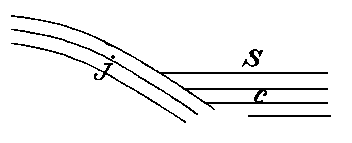
Figure 1 represents the Jura before the Alps were raised, with the Cretaceous deposits accumulating beneath the sea at its base. The line marked S indicates the ocean-level; the letter c, the Cretaceous deposits; the letter j, the Jurassic strata, lifted on the side of the mountain.
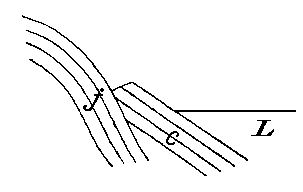
Figure 2 represents the Jura at the present time, when the later upheavals have lifted the Jurassic strata to a sharper inclination with the Cretaceous deposits, now raised and forming the lower slope of the mountain, at the base of which is the Lake of Neufchatel.
Although this change of inclination is hardly perceptible, as one looks up against the face of the Jura range, there is a transverse cut across it which seems intended to give us a diagram of its internal structure. Behind the city of Neufchatel rises the mountain of Chaumont, so called from its bald head, for neither tree nor shrub grows on its summit. Straight through this mountain, from its northern to its southern side, there is a natural road, formed by a split in the mountain from top to bottom. In this transverse cut, which forms one of the most romantic and picturesque gorges leading into the heart of the Jura range, you get a profile view of the change in the inclination of the strata, and can easily distinguish the point of juncture between the two sets of deposits. But even after this dislocation of strata had been perceived, it was not known that it indicated the commencement of a new epoch, and it is here that my own share in the work, such as it is, belongs. Accustomed as a boy to ramble about in the beautiful gorges and valleys of the Jura, and in riper years, as my interest in science increased, to study its formation with closer attention, this difference in the inclination of the slope had not escaped my observation. I was, however, still more attracted by the fossils it contained than by its geological character: and, indeed, there is no better locality for the study of extinct forms of life than the Jura. In all its breaks and ravines, wherever the inner surface of the rock is exposed, it is full of organic remains; and to take a handful of soil from the road-side is often to gather a handful of shells. It is actually built of the remains of animals, and there are no coral reefs in existing seas presenting a better opportunity for study to the naturalist than the coral reefs of the Jura. Being already tolerably familiar with the fossils of the Jura, it occurred to me to compare those of the upper and lower slope; and to my surprise I found that they were everywhere different, and that those of the lower slope were invariably Cretaceous in character, while those of the upper slope were Jurassic. In the course of this investigation I discovered three periods in the Cretaceous and four in the Jurassic epoch, all characterized by different fossils. This led to a more thorough investigation of the different sets of strata, resulting in the establishment by D'Orbigny of a still greater number of periods, marked by the successive deposits of the Jurassic and Cretaceous seas, all of which contained different organic remains. The attention of geologists being once turned in this direction, the other epochs were studied with the same view, and all were found to be susceptible of division into a greater or less number of such periods.
Age of Man Present.
Tertiary Age: Age of Mammalia Pliocene with at least twelve Periods.
Miocene
Eocene
Secondary Age: Age of Reptiles Cretaceous with at least twenty Periods.
Jurassic
Triassic with eight or nine Periods.
Permian
Carboniferous
Palæozoic or Primary Age: Age of Fishes Devonian with ten or twelve Periods.
Silurian
It will be noticed by those who have any knowledge of geological divisions, that in this diagram I consider the Carboniferous epoch as forming a part of the Secondary age. Some geologists have been inclined, from the marked and peculiar character of its vegetation, to set it apart as forming in itself a distinct geological age, while others have united it with the Palæozoic age. For many years I myself adopted the latter of these two views, and associated the Carboniferous epoch with the Palæozoic age. But it is the misfortune of progress that one is forced not only to unlearn a great deal, but, if one has been in the habit of communicating his ideas to others, to destroy much of his own work. I now find myself in this predicament; and after teaching my students for years that the Carboniferous epoch belongs to the Palæozoic or Primary age, I am convinced—and this conviction grows upon me constantly as I free myself from old prepossessions and bias on the subject—that with the Carboniferous epoch we have the opening of the Secondary age in the history of the world. A more intimate acquaintance with organic remains has shown me that there is a closer relation between the character of the animal and vegetable world of the Carboniferous epoch, as compared with that of the Permian and Triassic epochs, than between that of the Carboniferous epoch and any preceding one. Neither do I see any reason for separating it from the others as a distinct age. The plants as well as the animals of the two subsequent epochs seem to me to show, on the contrary, the same pervading character, indicating that the Carboniferous epoch makes an integral part of that great division which I have characterized as the Secondary age.
Within the Periods there is a still more limited kind of geological division, founded upon the special character of local deposits. These I would call geological Formations, indicating concrete local deposits, having no cosmic character, but circumscribed within comparatively narrow areas, as distinguished from the other terms, Ages, Epochs, Periods, which have a more universal meaning, and are, as it were, cosmopolitan in their application. Let me illustrate my meaning by some formations of the present time. The accumulations along the coast of Florida are composed chiefly of coral sand, mixed of course with the remains of the animals belonging to that locality; those along the coast of the Southern States consist principally of loam, which the rivers bring down from their swamps and low, muddy grounds; those upon the shores of the Middle States are made up of clay from the disintegration of the eastern slopes of the Alleghanies; while those farther north, along our own coast, are mostly formed of sand from the New-England granites. Such deposits are the local work of one period, containing the organic remains belonging to the time and place. From the geological point of view, I would call them Formations; from the naturalist's point of view, I would call them Zoölogical Provinces.
Of course, in urging the application of these names, I do not intend to assume any dictatorship in the matter of geological nomenclature. But I do feel very strongly the confusion arising from an indiscriminate use of terms, and that, whatever names be selected as most appropriate or descriptive for these divisions, geologists should agree to use them in the same sense.
There is one other geological term, bequeathed to us by a great authority, and which cannot be changed for the better: I mean that of Geological Horizon, applied by Humboldt to the whole extent of any one geological division,—as, for instance, the Silurian horizon, including the whole extent of the Silurian epoch. It indicates one level in time, as the horizon which limits our view indicates the farthest extension of the plain on which we stand in space.
We left America at the close of the Carboniferous epoch, when the central part of the United States was already raised above the water. Let us now give a glance at Europe in those early days, and see how far her physical history has advanced. What European countries loom up for us out of the Azoic sea, corresponding in time and character to the low range of hills which first defined the northern boundary of the United States? what did the Silurian and Devonian epochs add to these earliest tracts of dry land in the Old World? and where do we find the coal basins which show us the sites of her Carboniferous forests? Since the relation between the epochs of comparative tranquillity and the successive upheavals has been so carefully traced in Europe, I will endeavor, while giving a sketch of that early European world, to point out, at the same time, the connection of the different systems of upheaval with the successive stratified deposits, without, however, entering into such details as must necessarily become technical and tedious.
In the European ocean of the Azoic epoch we find five islands of considerable size. The largest of these is at the North. Scandinavia had even then almost her present outlines; for Norway, Sweden, Finland, and Lapland, all of which are chiefly granitic in character, were among the first lands to be raised. Between Sweden and Norway, there is, however, still a large tract of land under water, forming an extensive lake or a large inland sea in the heart of the country. If the reader will take the trouble to look on any geological map of Europe, he will see an extensive patch of Silurian rock in the centre of Sweden and Norway. This represents that sheet of water gradually to be filled by the accumulation of Silurian deposits and afterwards raised by a later disturbance. There is another mass of land far to the southeast of this Scandinavian island, which we may designate as the Bohemian island, for it lies in the region now called Bohemia, though it includes, also, a part of Saxony and Moravia. The northwest corner of France, that promontory which we now call Bretagne, with a part of Normandy adjoining it, formed another island; while to the southeast of it lay the central plateau of France. Great Britain was not forgotten in this early world; for a part of the Scotch hills, some of the Welsh mountains, and a small elevation here and there in Ireland, already formed a little archipelago in that region. By a most careful analysis of the structure of the rocks in these ancient patches of land, tracing all the dislocations of strata, all the indications of any disturbance of the earth-crust whatsoever, Élie de Beaumont has detected and classified four systems of upheavals, previous to the Silurian epoch, to which he refers these islands in the Azoic sea. He has named them the systems of La Vendée, of Finistère, of Longmynd, and of Morbihan. These names have, for the present, only a local significance,—being derived, like so many of the geological names, from the places where the investigations of the phenomena were first undertaken,—but in course of time will, no doubt, apply to all the contemporaneous upheavals, wherever they may be traced, just as we now have Silurian, Devonian, Permian, and Jurassic deposits in America as well as in Europe.
The Silurian and Devonian epochs seem to have been instrumental rather in enlarging the tracts of land already raised than in adding new ones; yet to these two epochs is traced the upheaval of a large and important island to the northeast of France. We may call it the Belgian island, since it covered the ground of modern Belgium; but it also extended considerably beyond these limits, and included much of the Northern Rhine region. A portion only of this tract, to which belongs the central mass of the Vosges and the Black Forest, was lifted during the Silurian epoch,—which also enlarged considerably Wales and Scotland, the Bohemian island, the island of Bretagne, and Scandinavia. During this epoch the sheet of water between Norway and Sweden became dry land; a considerable tract was added to their northern extremity on the Arctic shore; while a broad band of Silurian deposits, lying now between Finland and Russia, enlarged that region. The Silurian epoch has been referred by Élie de Beaumont to the system of upheaval called by him the system of Westmoreland and Hundsrück,—again merely in reference to the spots at which these upheavals were first studied, the centres, as it were, from which the investigations spread. But in their geological significance they indicate all the oscillations and disturbances of the soil throughout the region over which the Silurian deposits have been traced in Europe. The Devonian epoch added greatly to the outlines of the Belgian island. To it belongs the region of the Ardennes, lying between France and Belgium, the Eifelgebirge, and a new disturbance of the Vosges, by which that region was also extended. The island of Bretagne was greatly increased by the Devonian deposits, and Bohemia also gained in dimensions, while the central plateau of France remained much the same as before. The changes of the Devonian epoch are traced by Élie de Beaumont to a system of upheavals called the Ballons of the Vosges and of Normandy,—so called from the rounded, balloon-like domes characteristic of the mountains of that time. To the Carboniferous epoch belong the mountain-systems of Forey, (to the west of Lyons,) of the North of England, and of the Netherlands. These three systems of upheaval have also been traced by Élie de Beaumont; and in the depressions formed between their elevations we find the coal-basins of Central France, of England, and of Germany. During all these epochs, in Europe as in America, every such dislocation of the surface was attended by a change in the animal creation.
If we take now a general view of the aspect of Europe at the close of the Carboniferous epoch, we shall see that the large island of Scandinavia is completed, while the islands of Bohemia and Belgium have approached each other by their gradual increase till they are divided only by a comparatively narrow channel. The island of Belgium, that of Bretagne, and that of the central plateau of France, form together a triangle, of which the plateau is the lowest point, while Belgium and Bretagne form the other two corners. Between the plateau and Belgium flows a channel, which we may call the Burgundian channel, since it covers old Burgundy; between the plateau and Bretagne is another channel, which from its position we may call the Bordeaux channel. The space inclosed between these three masses of land is filled by open sea. To trace the gradual closing of these channels and the filling up of the ocean by constantly increasing accumulations, as well as by upheavals, will be the object of the next article.