Volume 1 — GOLD, SILVER, AND JEWEL WORK (continued 2)
Reading edition
Riaño and Baron de la Vega de Hoz extract from Cean Bermudez a copious list of silversmiths who worked in Spain all through the Middle Ages. This long array of isolated names and dates is neither interesting nor informative. Newer and more attractive notices have been discovered subsequently. Thus, in the National Library at Madrid, Don Manuel G. Simancas has disinterred quite recently the copy made by a Jesuit of a series of thirteenth-century accounts relating to various craftsmen of the reign of Sancho the Fourth (“the Brave”). Two of them are concerning early orfebreros:—
“Juan Yanez. By letters of the king and queen to Johan Yanez, goldsmith, brother of Ferran García, scrivener to the king; for three chalices received from him by the king, CCCCLXXVIII maravedis.”
The second entry says:—
“Bartolomé Rinalt. And he paid Bartolomé Rinalt for jewels which the queen bought from him to present to Doña Marina Suarez, nurse of the Infante Don Pedro, MCCCL maravedis.”[51]
Among Spain's gold and silver craftsmen of the fifteenth century we find the names of Juan de Castelnou, together with his son Jaime, who worked at Valencia; of Lope Rodríguez de Villareal, Ruby, and Juan Gonzalez, all three of whom worked at Toledo; and of Juan de Segovia, a friar of Guadalupe. Papers concerning Juan Gonzalez, and dated 1425, 1427, and 1431, are published among the Documentos Inéditos of Zarco del Valle. One of Segovia's masterpieces was a silver salt-cellar in the form of a lion tearing open a pomegranate—clearly allusive to the conquest of Granada from the Moors. Upon their visiting the monastery, Ferdinand and Isabella saw and, as was natural, conceived a fancy for this salt-cellar; and so, whether from inclination or necessity, the brotherhood induced them to accept it.
Sixteenth-century plateros of renown were Juan Donante, Mateo and Nicolás (whose surnames are unknown)—all three of whom worked at Seville; and Duarte Rodríguez and Fernando Ballesteros, natives of that city. In or about the year 1524 were working at Toledo the silversmiths Pedro Herreros and Hernando de Valles, together with Diego Vazquez, Andres Ordoñez, Hernando de Carrión, Diego de Valdivieso, Juan Domingo de Villanueva, Diego Abedo de Villandrando, Juan Tello de Morata, Francisco de Reinalte, Hans Belta, and Francisco Merino. Several of these men were natives of Toledo.
Among the silversmiths of sixteenth-century Cordova were Diego de Alfaro and his son Francisco, Francisco de Baena, Alonso Casas, Alonso del Castillo, Luis de Cordoba, Sebastián de Cordoba, Cristóbal de Escalante, Juan Gonzalez, Diego Fernandez, Diego Hernandez Rubio (son of Sebastián de Cordoba), Rodrigo de León, Gómez Luque, Ginés Martinez, Melchor de los Reyes (silversmith and enameller), Andrés de Roa, Pedro de Roa, Alonso Sanchez, Jerónimo Sanchez de la Cruz, Martin Sanchez de la Cruz (Jerónimo's son), Pedro Sanchez de Luque, Alonso de Sevilla, Juan Urbano, and Lucas de Valdés.
Not much is told us of the lives and labours of these artists. The best reputed of them as a craftsman was Rodrigo de León, who stood next after Juan Ruiz, el Sandolino. Ramírez de Arellano, from whom I have collected these data, publishes a number of León's agreements or contracts, which from their length and dryness I do not here repeat. In 1603 we find him official silversmith to the cathedral, under the title of “platero de martillo (“silversmith of hammered work”) de la obra de la catedral desta ciudad.”
Francisco de Alfaro, although a Cordovese by birth, resided commonly at Seville. In 1578 he received 446,163 maravedis for making four silver candlesticks for use in celebrating divine service. These candlesticks are still in the cathedral.
Sebastián de Cordoba was one of the foremost artists of his age. He died in 1587, leaving, together with other children, a son, Diego, who also won some reputation as a silversmith. Ramírez de Arellano publishes a full relation of the property which Sebastián de Cordoba bequeathed at his decease, as well as of the money which was owing to him. Among the former, or the “movable effects,” we read of “Isabel, a Morisco woman, native of the kingdom of Granada; her age thirty-four years, a little less or more.” The same inventory includes a curious and complete account of all the tools and apparatus in Sebastián's workshop.
But the quaintest notice of them all, though it does not apprise us of his merit as a silversmith, is that concerning Cristóbal de Escalante. Cristóbal suffered, we are told, from “certain sores produced by humours in his left leg; wherefore the said leg undergoes a change and swells.” He therefore makes a contract with one Juan Jiménez, “servant in the Royal Stables of His Majesty the King,” and duly examined as a herbalist (“licensed,” in the actual phrase, “to remedy this kind of ailments”), who is to heal his leg “by means of the divine will of the cure.” As soon as Cristóbal shall be thoroughly well, “in so much that his ailing leg shall be the other's equal in the fatness and the form thereof,” he is to pay Jiménez five-and-fifty reales, “having already given him ten reales on account.”
Probably, as Señor Ramírez de Arellano facetiously supposes, Cristóbal, after such a course of treatment, would be lame for all his life. At any rate, he died in 1605, though whether from the gentle handling of the stableman and herbalist is not recorded in these entries.
Still keeping to the sixteenth century, in other parts of Spain we find the silversmiths Baltasar Alvarez and Juan de Benavente, working at Palencia; Alonso de Dueñas at Salamanca; and Juan de Orna at Burgos, about the same time that the foreigners Jacomi de Trezzo and Leo Leoni were engaged at the Escorial. Cuenca, too, boasted three excellent silver-workers in the family of Becerril, mentioned by Juan de Arfe in company with other craftsmen of the time of the Renaissance.[52] Stirling says of Cuenca and the Becerriles: “They made for the cathedral its great custodia, which was one of the most costly and celebrated pieces of church plate in Spain. They began it in 1528, and, though ready for use in 1546, it was not finished till 1573. It was a three-storied edifice, of a florid classical design, crowned with a dome, and enriched with numberless groups and statues, and an inner shrine of jewelled gold; it contained 616 marks of silver, and cost 17,725½ ducats, a sum which can barely have paid the ingenious artists for the labour of forty-five years. In the War of Independence, this splendid prize fell into the hands of the French General Caulaincourt, by whom it was forthwith turned into five-franc pieces, bearing the image and superscription of Napoleon.”[53]
A more reliable notice says that this custodia was begun by Alonso Becerril and finished by his brother Francisco. The third member of this family of artists, Cristóbal, who flourished towards the end of the sixteenth century, was Francisco's son.
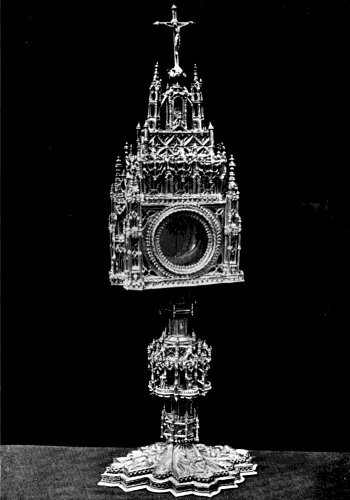
GOTHIC CUSTODIA (15th Century)
Towards the close of the Gothic and during the earlier phases of the Renaissance movement in this country, enormous quantities of gold and silver began to be employed in making these custodias or monstrances of her temples; so that the fifteenth century may well be called, in Spanish craftsmanship, the “age of the custodia.” A century ago the reverend Townsend, loyal to the Low Church prejudices of his day, spoke of this object with something of a sneer as “the depository of the Host, or, according to the ideas of a Catholic, the throne of the Most High, when, upon solemn festivals, He appears to command the adoration of mankind.” Riaño's description is more technical. “The name of custodia,” he says, “is given in Spain, not only to the monstrance or ostensoir where the Blessed Sacrament is exposed, but also to a sort of temple or tabernacle, of large size, made also of silver, inside which is placed the monstrance, which is carried in procession on Corpus Christi day (Plate xvi.). In order to distinguish these objects one from another, the name of viril is given to the object which holds the consecrated Host; it is generally made of rock crystal, with a gold stem and mount ornamented with precious stones. The small tabernacles are generally objects of the greatest importance, both from their artistic and intrinsic value.” A third description of the monstrance, written in quaint and antiquated Spanish verse by Juan de Arfe, is truthfully if not melodiously translated into English rhyme by Stirling:—
“Custodia is a temple of rich plate, Wrought for the glory of our Saviour true, Where, into wafer transubstantiate, He shows his Godhead and his Manhood too, That holiest ark of old to imitate, Fashioned by Bezaleel, the cunning Jew, Chosen of God to work His sov'ran will, And greatly gifted with celestial skill.”[54]
Notwithstanding that the monstrance of Toledo, surmounted by a cross of solid gold, turns the scale at ten thousand nine hundred ounces, and that of Avila at one hundred and forty pounds, the weight of nearly all of these custodias is far exceeded by the value of their workmanship. The style employed in their construction is the Gothic, the Renaissance, or the two combined. Custodias of the eastern parts of Spain are more affected than the others by Italian influence, noticeable both in decorative motives which recall the Florentine, and in the use, together with the silver-work, of painting and enamels. In other parts of Spain the dominating influence is the later Gothic. Among the former or Levantine class of monstrances, the most important are those of Barcelona, Vich, Gerona, and Palma de Mallorca; and of the others, those of Cordova, Cadiz, Sahagún, Zamora, Salamanca, and Toledo—this last, according to Bertaut de Rouen, “à la manière d'un clocher percé à jour, d'ouvrage de filigrane, et plein de figures.” Custodias in the purest classic or Renaissance style are those of Seville, Valladolid, Palencia, Avila, Jaen, Madrid, Segovia, Zaragoza, Santiago, and Orense.
Juan de Arfe y Villafañe, who may be called the Cellini of Spain's custodia-makers, was born at León in 1535. He was the son of Antonio de Arfe, and grandson of Enrique de Arfe, a German who had married a Spanish wife and made his home in Spain. The family of Juan, including his brother Antonio, were all distinguished craftsmen, and he himself informs us that his grandfather excelled in Gothic platería, as may be judged from the custodias, by Enrique's hand, of Cordova, León, Toledo, and Sahagún, and many smaller objects, such as incensories, crosiers, and paxes.
The father of Juan, Antonio de Arfe, worked in silver in the Renaissance or Plateresque styles, and executed in the florid manner the custodias of Santiago de Galicia and Medina de Rioseco; but the training and tastes of Juan himself were sternly classical. His work in consequence has a certain coldness, largely atoned for by its exquisite correctness of design and unimpeachable proportions. Arfe's ideal in these matters may readily be judged of from his written verdict on the Greco-Roman architecture. “The Escorial,” he says, in the preface to his description of the custodia of Seville cathedral, “because it follows the rules of ancient art, competes in general perfection, size, or splendour with the most distinguished buildings of the Asiatics, Greeks, and Romans, and displays magnificence and truth in all its detail.”
In point of versatility Juan de Arfe was a kind of Spanish Leonardo. His book, De Varia Conmensuración, etc., published in 1585, is divided into four parts, and deals, the first part with the practice of geometry, the second with human anatomy, the third with animals, and the fourth with architecture and silver-work for use in churches.
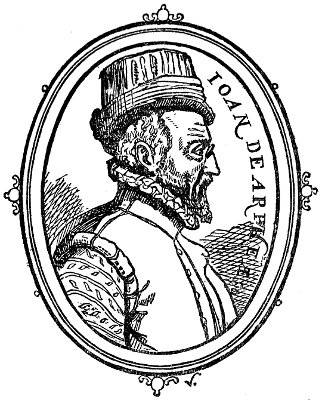
This book is prefaced by the portrait of the author, given above. It shows us—what he really was—a quiet, cultured, gentle-hearted man. Indeed, while Arfe was studying anatomy at Salamanca, it gave him pain to lacerate the bodies even of the dead. “I was witness,” he records, “to the flaying of several pauper men and women whom the law had executed; but these experiments, besides being horrible and cruel, I saw to be of little service to my studies in anatomy.”
Arfe's workmanship of the custodia of Avila cathedral, which he began in 1564 and terminated in 1571, won for him an early and extended fame. He also made the custodia of Burgos (brutally melted during the Spanish War of Independence), and those of Valladolid (finished in 1590), Lugo, Osma, and the Hermandad del Santísimo at Madrid. The custodia of Palencia is also thought by some to be his handiwork.
But Arfe's crowning labour was the Greco-Roman custodia of Seville cathedral (Plate xvii.). The chapter of this temple selected his design in 1580, and nominated the licentiate Pacheco to assist him with the statuettes. Pacheco also carried out his portion of the task with skill and judgment. A rare pamphlet, written by Arfe and published at Seville in 1587, gives a minute description of the whole custodia. In Appendix C, I render this description into English, together with a similarly detailed notice of the custodia (1513 A.D.) of Cordova. This last, which we have seen to be the work of Juan de Arfe's grandfather, Enrique, is not to be surpassed for fairy grace and lightness, seeming, in the eloquent metaphor of a modern writer, “to have been conceived in a dream, and executed with the breath.”
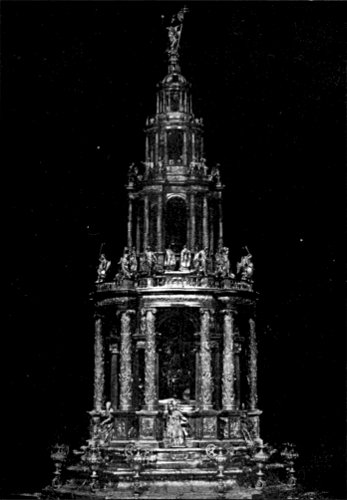
CUSTODIA OF SEVILLE CATHEDRAL (By Juan de Arfe. Late 16th Century)
Spain in the seventeenth century had reached the lowest depth of her decadence and impoverishment; and yet we find that century an age—to quote a Spanish term—of “gallantries and pearls,” in which a craze for reckless luxury continued to prevail in every quarter. Narratives innumerable inform us of the life and doings of that prodigal court and prodigal aristocracy; their ruinous and incessant festivals; the fortunes that were thrown away on furniture, and jewels, and costume. True, we are told by Bertaut de Rouen that, except upon their numerous holidays, the costume of the Spanish men was plain enough. This author, who calls them otherwise “debauched and ignorant,” says that their clothes were all of “méchante frise,” and adds that they continually took snuff, “dont ils ont toujours les narines pleines, ce qui fait qu'ils n'ont que des mouchoirs de laine, de toile grise, et peinte comme de la toile de la Chine.” The same traveller, attending an ordinary reception in the royal palace at Madrid, was unable to distinguish the nobles from the lower orders, except that, by the privilege peculiar to this country, the former kept their hats on in the presence of the sovereign. Even of Philip himself he says: “Le Roy d'Espagne estoit debout avec un habit fort simple et fort ressemblant à tous ses portraits”; alluding, probably, to those of Philip the Fourth by Velazquez, in which the monarch wears a plain cloth doublet.
But when the Spaniard dressed himself for any scene of gala show, his spendthrift inclinations swelled into a positive disease. The women, too, squandered enormous sums on finery. The Marchioness of Liche, said to have been the loveliest Española of that day, is spoken of by Bertaut as wearing “un corps de brocard d'argent avec de grandes basques à leur mode, la jupe d'une autre étoffe avec grand nombre de pierreries, et cela luy fetoit fort bien.” An anonymous manuscript of the period, published by Gayangos in the Revista de España for 1884, describes the fiestas celebrated at Valladolid in 1605, in honour of the English ambassador and his retinue. In this relation the Duke of Lerma is quoted as possessing a yearly income of three hundred thousand cruzados, besides “as much again in jewellery and furniture, and gold and silver services.” At the state banquets which were given at that wasteful court, even the pies and tarts were washed with gold or silver; and at a single feast the dishes of various kinds of fare amounted to two thousand and two hundred. At the banquet given by the Duke of Lerma, three special sideboards were constructed to sustain the weight of four hundred pieces of silver, “all of them of delicate design and exquisitely wrought of silver, gold, and enamel, together with innumerable objects of glass and crystal of capricious form, with handles, lids, and feet of finest gold.”
The whole of Spain's nobility was congregated at these festivals, “richly attired with quantities of pearls and oriental gems,” while everybody, young and old alike, wore “diamond buttons and brooches on cloaks and doublets,” feather plumes with costly medals, gold chains with emeralds, and other ornaments. The ladies of the aristocracy were also “clothed in costliest style, as well as loaded with diamonds and pearls and hair-ornaments of pearls and gold, such as the women of Castile lay by for these solemnities.”
The Spanish churches, too, continued to be veritable storehouses of treasure. The manuscript published by Gayangos says that in 1605 the church of La Merced at Valladolid had its altars “covered with beautiful gold and silver vessels, of which there are a great many in the whole of Castilla la Vieja, and particularly here at Valladolid.” Bertaut de Rouen's notice of the shrine of Montserrat in Cataluña has been inserted previously. In 1775 Swinburne wrote of the same temple:—“In the sacristy and passages leading to it are presses and cupboards full of relics and ornaments of gold, silver, and precious stones; they pointed out to us, as the most remarkable, two crowns for the Virgin and her Son, of inestimable value, some large diamond rings, an excellent cameo of Medusa's head, the Roman emperors in alabaster, the sword of Saint Ignatius, and the chest that contains the ashes of a famous brother, John Guarin, of whom they relate the same story as that given in the Spectator of a Turkish santon and the Sultan's daughter…. Immense is the quantity of votive offerings to this miraculous statue; and as nothing can be rejected or otherwise disposed of, the shelves are crowded with the most whimsical ex votos, viz., silver legs, fingers, breasts, earrings, watches, two-wheeled chaises, boats, carts, and such-like trumpery.”
Many pragmatics from the Crown vainly endeavoured to suppress or mitigate the popular extravagance. Such was the royal letter of 1611, which forbade, among the laity, the wearing of “gold jewels with decoration or enamel in relief, or points with pearls or other stones.” Smaller jewels, of the kind known as joyeles and brincos,[55] were limited to a single stone, together with its pearl pendant. The jewellery of the women was exempted from these laws, though even here were certain limitations. Rings for the finger might, however, bear enamel-work, or any kind of stone. Enamel was also allowed in gold buttons and chains for the men's caps, as well as in the badges worn by the knights of the military orders.
“It is forbidden,” continues this pragmatic, “to make any object of gold, silver, or other metal with work in relief, or the likeness of a person; nor shall any object be gilt, excepting drinking vessels, and the weight of these shall not exceed three marks. All other silver shall be flat and plain, without gilding; but this does not apply to objects intended for religious worship.”
“All niello-work is prohibited, as are silver brasiers and buffets.”[56]
What I may call the private jewel-work of Spain, largely retains throughout its history the characteristic lack of finish of all the Visigothic treasure found at Guarrazar. From first to last, until extinguished or absorbed by foreign influences two centuries ago, it strives to compensate in ponderous and bulky splendour for what it lacks in delicacy, elegance, and taste. It is just the jewellery we should expect to find among a military people who once upon a time possessed great riches simultaneously with little education, and who, from this and other causes, such as the strenuous opposition of the national church to pagan sentiments expressed in fleshly form, were never genuinely or profoundly art-loving. Long residence and observation in their midst induce me to affirm that as a race the Spaniards are and always have been hostile, or at least indifferent, to the arts; and that their most illustrious artists have made their power manifest and raised themselves to eminence despite the people—not, as in Italy, on the supporting shoulders of the people.
Dazzle and show monopolized, and to a great extent monopolize still, the preference of this race. The Spanish breast-ornaments of the seventeenth century, preserved at South Kensington and reproduced by Riaño on pages 37 and 39 of his handbook, are strongly reminiscent of the Visigothic ornaments. Who would imagine that a thousand years had come and gone between the execution of the new and of the old? As late as the reign of Charles the Second the culture of a Spanish lady of high birth was little, if at all, superior to a savage's. “False stones enchant them,” wrote Countess d'Aulnoy. “Although they possess many jewels of considerable value and the finest quality, it is their whim to carry on their person wretched bits of glass cut in the coarsest fashion, just like those which pedlars in my country sell to country girls who have seen nobody but the village curate, and nothing but their flocks of sheep. Dames of the aristocracy adorn themselves with these pieces of glass, that are worth nothing at all; yet they purchase them at high prices. When I asked them why they like false diamonds, they told me they prefer them to the genuine as being larger. Indeed, they sometimes wear them of the bigness of an egg.” Even where the stones were real, the Spanish taste in setting and in wearing them was no less execrable. The Countess says: “the ladies here possess great stores of beautiful precious stones, and do not wear, like Frenchwomen, a single article of jewellery, but nine or ten together, some of diamonds, others of rubies, pearls, emeralds, and turquoises, wretchedly mounted, since they are almost wholly covered with the gold. When I inquired the cause of this, they told me the jewels were so made because the gold was as beautiful as the gems. I suppose, however, the real reason is the backwardness of the craftsmen, who can do no better work than this, excepting Verbec, who has no lack of skill, and would turn out excellent jewels if he took the trouble to finish them.”
“In the neck of their bodices the ladies fasten pins profusely set with precious stones. Hanging from the pin, and fastened at the lower end to the side of their dress, is a string of pearls or diamonds. They wear no necklace, but bracelets on their wrists and rings on their fingers, as well as long earrings of so great a weight that I know not how they can support them. Hanging from these earrings they display whatever finery they may fancy. I have seen some ladies who wore good-sized watches hanging from their ears, strings of precious stones, English keys of dainty make, and little bells. They also wear the agnus, together with little images about their neck and arms, or in their hair. They dress their hair in various ways, and always go with it uncovered, using many hairpins in the form of coloured flies or butterflies of diamonds, emeralds, and rubies.”
Book-worm authorities, addicted to “dry bones” of letters, are prone just now to doubt this visit of Countess d'Aulnoy to the capital of Spain. But if such patient doubters will compare her narrative with those of other foreigners, e.g. Bertaut de Rouen, or the manuscript description of Valladolid, written by a Portuguese, and now in the British Museum library, their scepticism will—or should—be done away with on the moment. The letters of the countess make it plain by copious inner testimony that she actually performed her Spanish visit; and though from time to time she over-colours or misreads the truth, it was the very usages of Spain that were absurd and out of joint, and not, except in isolated instances, the sprightly and observant Frenchwoman's account of them.[57]
Elsewhere the Countess says: “Utensils of common metal are not employed here, but only those of silver or of ware. I hear that a little while ago, upon the death of the Duke of Alburquerque, six weeks were needed to make out an inventory of his gold and silver services. His house contained fourteen hundred dozen plates, five hundred large dishes, and seven hundred of a smaller size, with all the other pieces in proportion, and forty silver ladders for climbing his sideboard, made in grades like an altar in a spacious hall.”
These statements have been proved in later years. Dating from 1560, an inventory of the ducal house of Alburquerque was found not many years ago. In it we find the detailed list of gold and silver; cups and dishes, bowls and basins, plates and salt-cellars, trenchers, wine and water flagons, sauce-spoons, salad-spoons, conserve-spoons, and innumerable other articles. Here, too, we find, upon the mighty sideboard mounted by its forty silver stairs, such objects as the following:—
“A gold cup with festoon-work above and beneath, wrought with leaves in relief. At the top of the foot there issue some leaves that fall down over a small gold staple, and below this, about the narrowest part of the foot, are leaves in relief and several dolphins. The broad part of the foot is decorated with festoons. The lid of this cup is wrought with leaves in relief, and on the crest thereof is a lion, crowned. The cup weighs three hundred and fifty-one castellanos and a half.”
“A Castilian jar from which my lord the duke was wont to drink, weighing two marks and five ounces.”[58]
“A cup with a high foot, gilt all over, with the figure of a woman in its midst, and decorated in four places in the Roman manner.”
“A flagon of white silver, flat beneath the stem, with a screw-top surmounted by a small lion; for cooling water.”
“A small silver dish, of the kind they call meat-warmers.”
“A large silver seal for sealing provisions, with the arms of my lord the duke, Don Francisco.”
“A large silver vessel, embossed, with a savage on top.”
“A gold horse, enamelled in white upon a gold plate enamelled in green and open at the top; also a wolf, upon another gold plate enamelled in green, with lettering round about it; also a green enamelled lizard upon blue enamel; and a gold toothpick with four pieces enamelled in green, white, and rose; also a small gold column enamelled in black and rose.”
“A silver lemon-squeezer, gilt and chiselled, with white scroll-work about the mesh thereof, through which the lemon-juice is strained.”
“A large round silver salt-cellar, in two halves, gilt all over, with scales about the body, and two thick twisted threads about the flat part. One side of it is perforated.”
Among the property of the duchess, Doña Mencía Enriquez, we find “a small gold padlock, which opens and closes by means of letters”; two gold bangles; a gold necklace consisting of forty-two pieces “enamelled with some B's”;[59] a gold signet ring with the duchess's arms; and “a gold and niello box with relics, for wearing round the neck.” Also, resting on a table covered with silver plates, “a box of combs; the said box wrought in gold upon blue leather, containing five combs, a looking-glass, a little brush, and other fittings; girt with a cord in gold and blue silk.”
The seventeenth century and a race of native Spanish kings declined and passed away together. A dynasty of France succeeded to the throne of Spain, and with the foreigner came a fresh reactionary movement towards the neo-classic art, coupled with the canons of French taste. Henceforth a century of slow political reform goes hand in hand with slow suppression of the salient parts of Spanish character. Madrid transforms or travesties herself into a miniature Versailles, and national arts and crafts belong henceforward to a Frenchified society which found its painter in Goya, just as the preceding and eminently Spanish society had found its painter in Velazquez.
Another of the causes of the falling-off in Spanish orfebrería at this time, is stated to have been the craftsmen's overwhelming tendency to substitute the slighter though venerable and beautiful gold or silver filigree (Plate xviii.), for more artistic and ambitious, if less showy work in massive metal. Thus, in 1699, a supplementary chapter of the Ordinances of Seville complained in bitter phrases of this tendency, denouncing it as “a source of fraud and detriment to the republic,” and deploring that “of the last few years we have forsaken our goodly usages of older times, in the matter of the drawings entrusted to the candidates who come before us for examination.”
In the same year the goldsmiths' and the silversmiths' guild of Seville enacted that none of its members were to work in filigree, unless they were qualified to execute the other work as well. Such efforts to suppress this evil were not new. More than a century before, on April 15th, 1567, the inspectors of the guild had entered the shop of Luis de Alvarado, silversmith, and seized some filigree earrings “of the work that is forbidden,” breaking these objects on the spot, and imposing a fine of half-a-dozen ducats on the peccant of obvious Alvarado.[60]
The modern gold and silver work of Spain is thus exempted from a lengthy notice, seeing that its typical and national characteristics have succumbed, or very nearly so. I may, however, mention the giant silver candelabra in the cathedral of Palma de Mallorca, which were made at Barcelona, between 1704 and 1718, by Juan Matons and three of his assistants. They measure eight feet high by four feet and a quarter across, weigh more than eight thousand ounces, and cost 21,942 pounds, 15 sueldos, and 11 dineros of Majorcan money. The State seized them during the Napoleonic wars, in order to melt them down for money; but the chapter of the cathedral bought them back for eleven thousand dollars.
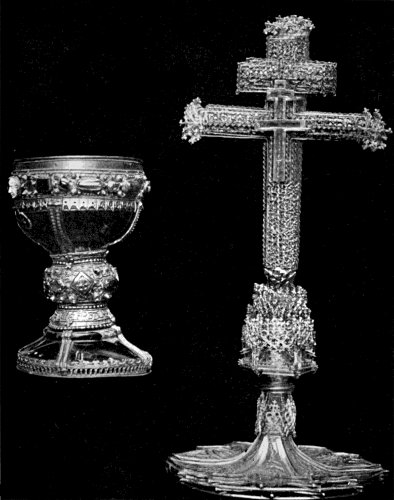
EARLY CHALICE AND CROSS IN FILIGREE GOLD-WORK (Church of Saint Isidore, León)
During this century Riaño mentions several factories of silver articles established at Madrid, including that of Isaac and Michael Naudin (1772) and the Escuela de Platería (1778), protected by Charles the Third; but since the work of these was purely in the French or English manner, they call for no particular notice. The principal objects they produced were “inkstands, dishes, dinner-services, chocolate-stands, cruets, knives and forks, together with buckles, needle-cases, brooches, snuff-boxes, frames for miniatures, and similar trinkets.”
Early in the nineteenth century Laborde wrote that “the fabrication of articles of gold and silver might become an important object in a country where these metals abound; but it is neglected, and the demand is almost entirely supplied from foreign markets. What little they do in this branch at home is usually very ill executed, and exorbitantly dear. Madrid, however, begins to possess some good workmen; encouragement would increase their number and facilitate the means of improvement; but manual labour is there excessively dear. Hence the Spaniards prefer foreign articles of this kind, which, notwithstanding the expense of carriage, the enormous duties that they pay, and the profits of the merchants, are still cheaper than those made at home.”
Several of the inherent characteristics of the national orfebrería may yet be noticed somewhat faintly in the ornaments and jewels of the Spanish peasants, though even these are being discarded. A century ago Laborde described the dress of the Mauregata women, near Astorga, in the kingdom of León. “They wear large earrings, a kind of white turban, flat and widened like a hat, and their hair parted on the forehead. They have a chemise closed over the chest, and a brown corset buttoned, with large sleeves opening behind. Their petticoats and veils are also brown. Over all they wear immense coral necklaces, which descend from the neck to the knee; they twist them several times round the neck, pass them over the shoulders, where a row is fastened, forming a kind of bandage over the bosom. Then another row lower than this; in short, a third and fourth row at some distance from each other. The last falls over the knee, with a large cross on the right side. These necklaces or chaplets are ornamented with a great many silver medals, stamped with the figure of saints. They only wear these decorations when not working, or on festivals.”
I have a manuscript account in French of Spanish regional costumes at the same period. The dress of the peasant women of Valencia is thus described: “Elle se coiffe toujours en cheveux, de la manière appelée castaña, et elle y passe une aiguille en argent que l'on nomme rascamoño; quelque fois elle se pare d'un grand peigne (peineta) en argent doré. Son cou este orné d'une chaine d'or ou d'argent (cadena del cuello) à laquelle est suspendue une croix ou un reliquaire.” This was the Valencian peasant's dress for every day. On festivals the same woman would adorn her ears with “pendants (arracadas) de pierres fausses; mais lorsque la jardinière est riche, elles sont fines. Une relique (relicario) dans un petit médaillon en argent, est suspendue à son cou; ainsi qu'un chapelet très mince (rosario) en argent doré.”
The peasant women of Iviza, in the Balearics, are described in the same manuscript as wearing “un collier en verre, quelque fois en argent, et rarement en or”; while Laborde wrote of Minorca, another of these islands, that “the ladies are always elegantly adorned; their ornaments consist of necklaces, earrings, bracelets, rings, and chaplets. The peasants wear these also.” Of the women of Barcelona he said: “Silk stockings are very common in every class; and their shoes are embroidered with silk, gold, silver, pearls, and spangles.”
But Spain, like Italy or Switzerland, or many another country, is throwing off her regional costumes, of which these various jewels form a prominent and even an essential feature. More rarely now we come across the gold and seed-pearl necklaces of Salamanca, the Moorish filigree silver-work of Cordova, the silver-gilt necklaces of Santiago, and the heavy arracadas, hung with emeralds and sapphires, of Cataluña. Murcia, nevertheless, retains her Platería, a street of venerable aspect and associations, where to this hour the oriental-looking silver pendants of the neighbourhood are made and trafficked in.
Footnotes:
Poem of Ferran Gonzalvez (13th century).