DANCING TEMPOS
Reading edition
ONE must possess an inherent sense of rhythm in order to become a successful stage dancer. To be able to walk or dance to music in perfect time, and find enjoyment in doing it, is one of the first essentials. I can tell by the way a person walks across the floor when an orchestra or any musical instrument is rendering a sprightly bit of dance music, whether or not the walker has the dancing sense that is so necessary to perfection in the art.
In dancing, the term "rhythm" refers to the coincidence of movement and music, and is the symmetrical regulation of time and the periodical repetition of the same arrangement. The measure of speed in music and dancing is designated as "tempo." It is the "time" in which a musical composition is written, and is shown upon the "staff" by figures. Of the many kinds of dance measures, the most common are what are known as 2-4, 3-4, 4-4, and 6-8.
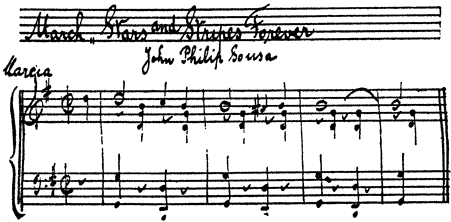
Used by Permission of The John Church Company, Owner of the Copyright
[Listen] [PDF]
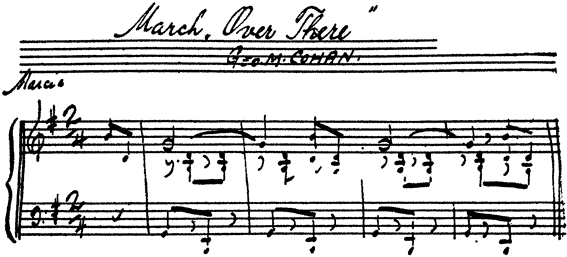
Copyright by Leo Feist, Inc., Used by Special Permission
[Listen] [PDF]
Among the 2-4 rhythms, the principal ones are the March, which is indicated either in "Alla Breve" (C), as "The Stars and Stripes Forever," or in 2-4, as the more rollicking "Over There," or the well known Cake Walk, "Georgia Camp Meeting." By increasing the tempo of the 2-4 March it becomes the One Step dance.
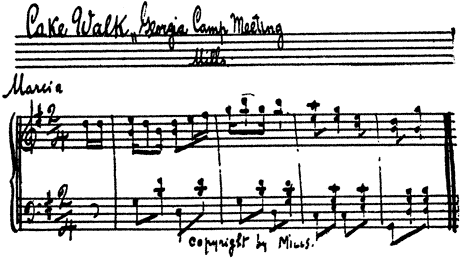
[Listen] [PDF]
Marches are also written in 6-8. Then they are called Two Steps, as "The Handicap March," and Sousa's "Washington Post" March.
[Listen] [PDF]
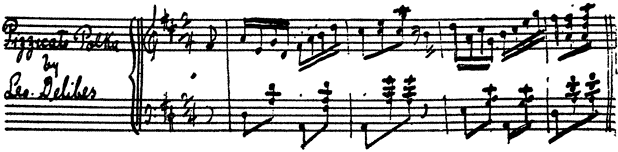
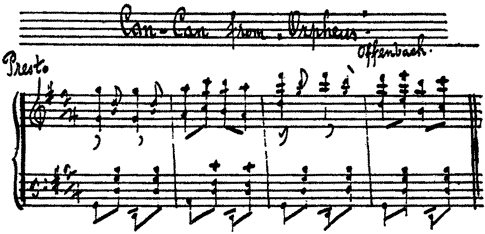
Among the other 2-4 rhythms are the Polka, suitable for Ballet work. The "Pizzicato Polka" is a very good example of this type. The Gallop and Can Can are in a very fast 2-4 tempo.
[Listen] [PDF]
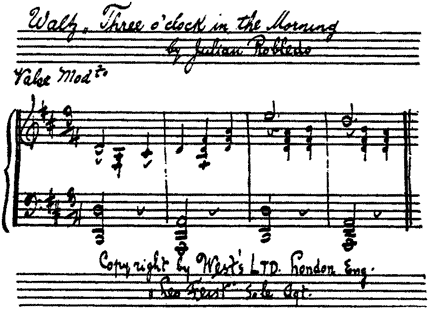
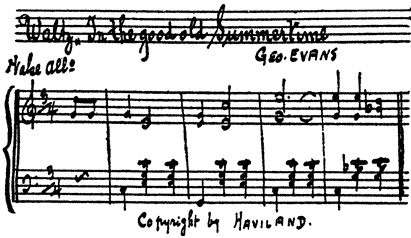
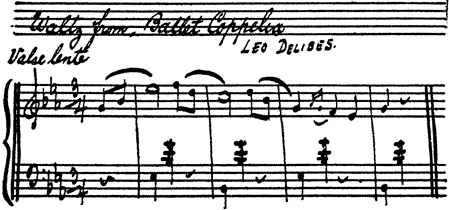
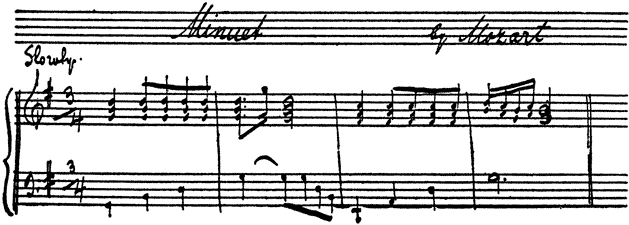
Waltzes are in 3-4, played sometimes in a lively tempo, one in a bar, or slow, 3 in a bar. "Three o'Clock in the Morning," a ballroom waltz is in the slow tempo, while "In the Good Old Summertime" is more rapid, adapted for fast movements and waltz clogs. "Valse Coppelia," played one in a bar, is the type for dainty Ballet work. The stately Minuet is in 3-4 time.
[Listen] [PDF]
[Listen] [PDF]
[Listen] [PDF]
[Listen] [PDF]
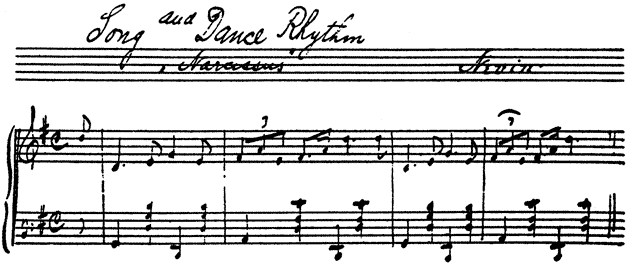
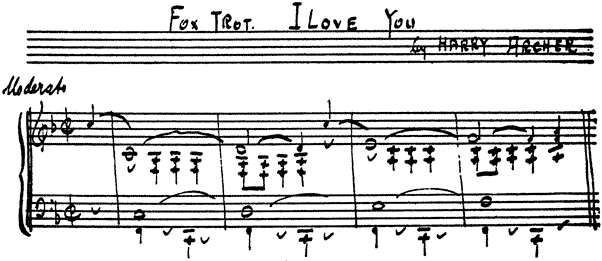
The Gavotte, played 4 in a bar, is principally suitable for Ballet, while the Song and Dance ("Narcissus"), on account of its rhythm, is mainly adapted for the soft shoe and its kindred dances. It is also in 4-4. The Fox Trot is written "Alla Breve," 2 in a bar in moderate tempo. It has a somewhat strict rhythm, while the "Charleston," played usually in the same tempo, is rhythmically different. As one can notice, it has an anticipated second beat.
Perhaps the most popular music for the Charleston dance is the Charleston number from "Runnin' Wild."
[Listen] [PDF]
Copyright by Leo Feist, Inc., Used by Special Permission
[Listen] [PDF]
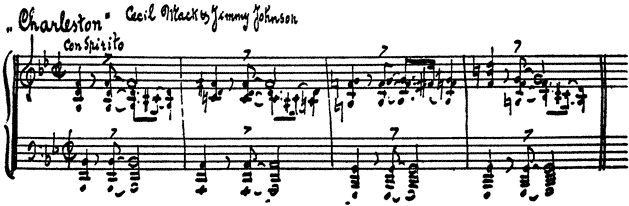
Copyright MCMXXIII by Harms, Inc., N.Y.
[Listen] [PDF]
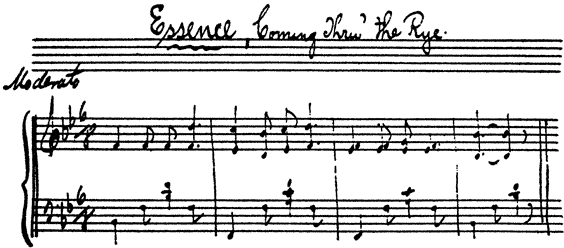
There are a great many varieties of national dances, all having a peculiar rhythm of their own, portraying the character of their people. Among these are the "American" characteristic dances, as "The Rube Dance" and the peculiar rhythm of the Stop Buck, the "Essence" played in moderate 6-8 tempo, as in "Comin' Through the Rye."
[Listen] [PDF]
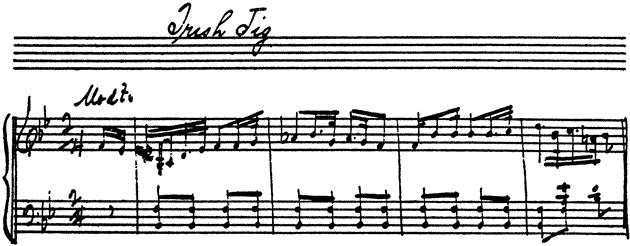
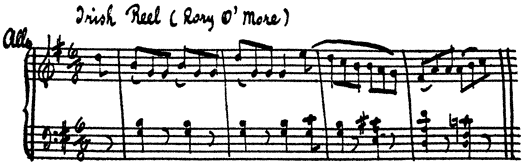
Among the Irish Dances, the most popular are the Jig, a fast 2-4; and the Reel, a fast 6-8. The Scotch have their "Highland Fling," a fast 4-4, and there is the Hornpipe.
[Listen] [PDF]
[Listen] [PDF]
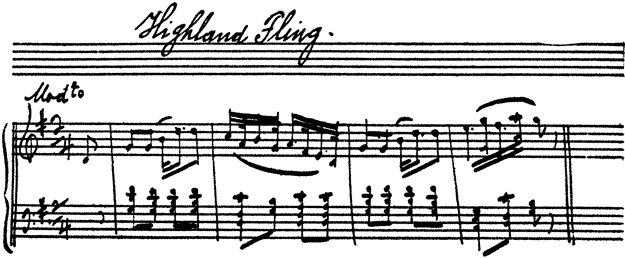
[Listen] [PDF]
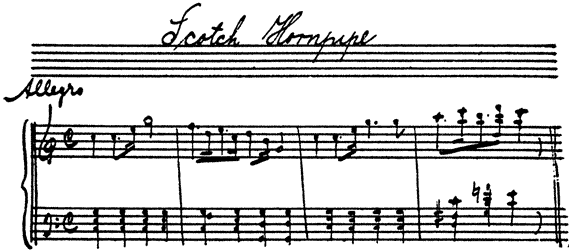
[Listen] [PDF]
The Spanish dancers are particularly fond of the Waltz, played lively, and when still more increased in tempo it becomes the "Fandango," a wild and merry dance. The Tango is in 2-4, played in moderately slow tempo; its rhythm is also adapted for the Habanera.
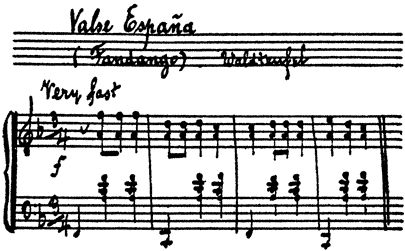
[Listen] [PDF]
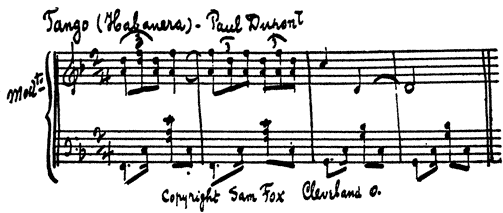
("Rosita" Tango Fox Trot)
[Listen] [PDF]
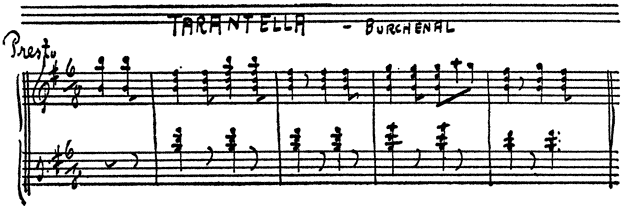
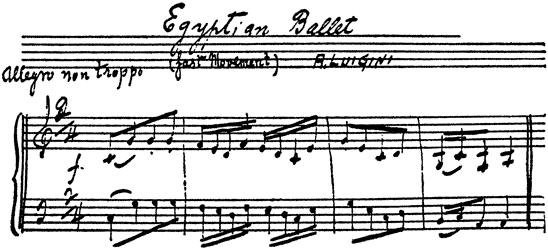
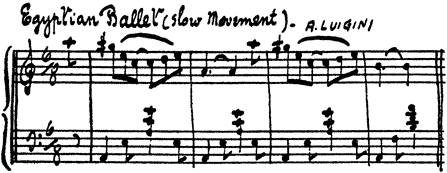
The Italians have their "Tarantella." It is played very fast. It is supposed to cure the bite of the tarantula, hence the furious tempo. The Egyptian (Oriental) Dance is of a more sensuous type, either moderately fast in 2-4 or slow (in 6-8).
The Soft Shoe Dance is played 4 in a bar in Schottisch tempo.
[Listen] [PDF]
[Listen] [PDF]
Most any 2-4 March movement is suitable for "buck" dances, but they must be in syncopated rhythm with characteristic melodies and accompaniments and not what is called straight marches, but must have the right atmosphere musically in order to inspire the dancer.
[Listen] [PDF]
There are a number of very good dance albums published annually with popular dance melodies and piano arrangements. Among the best are those published by Leo Feist, Inc., Jerome H. Remick & Company, Shapiro, Bernstein & Company, Harms, Inc., and M. Witmark & Sons, all of New York.