THE ART OF ILLUSTRATION.
Reading edition
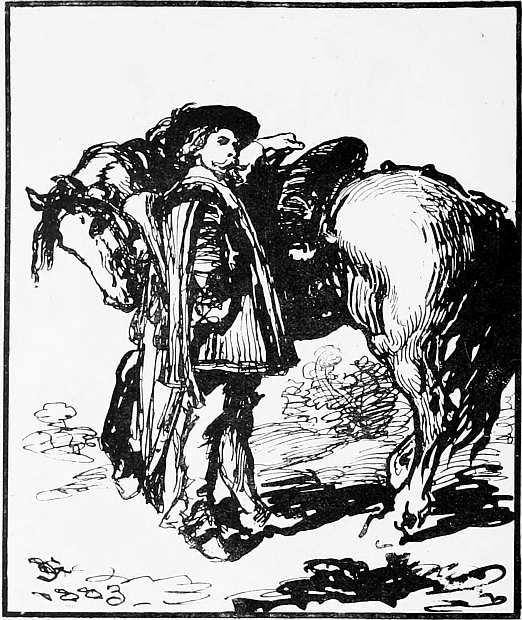
“THE TRUMPETER.” (SIR JOHN GILBERT, R.A.) (Drawn in pen and ink, from his picture in the Royal Academy, 1883.) [Size of drawing, 5½ by 4¾ in. Photo-zinc process.]
The Art of Illustration.
BY
HENRY BLACKBURN,
Editor of “Academy Notes,” Cantor Lecturer on Illustration, &c.
WITH
NINETY-FIVE ILLUSTRATIONS.
SECOND EDITION.
LONDON: W. H. ALLEN & CO., Limited,
13, WATERLOO PLACE, S.W. 1896.
PRINTED BY WYMAN AND SONS, LIMITED, LONDON, W.C.
DEDICATED TO
SIR JOHN GILBERT, R.A.,
ONE OF THE PRINCIPAL PIONEERS
OF BOOK AND NEWSPAPER ILLUSTRATION.
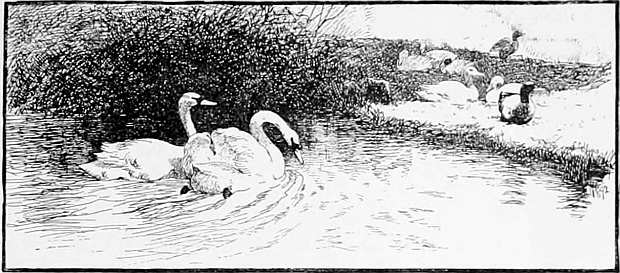
(PEN-AND-INK DRAWING FROM HIS PICTURE, BY MR. CHARLES COLLINS, 1892.) [Photo-zinc process.]
PREFACE.

HE object of this book is to explain the modern systems of Book and Newspaper Illustration, and especially the methods of drawing for what is commonly called “process,” on which so many artists are now engaged.
There is almost a revolution in illustration at the present time, and both old and young—teachers and scholars—are in want of a handbook for reference when turning to the new methods. The illustrator of to-day is called upon suddenly to take the place of the wood engraver in interpreting tone into line, and requires practical information which this book is intended to supply.
The most important branch of illustration treated of is line drawing, as it is practically out of reach of competition by the photographer, and is, moreover, the kind of drawing most easily reproduced and printed at the type press; but wash drawing, drawing upon grained papers, and the modern appliances for reproduction, are all treated of.
The best instructors in drawing for process are, after all, the painters of pictures who know so well how to express themselves in black and white, and to whom I owe many obligations. There is a wide distinction between their treatment of “illustration” and the so-called “pen-and-ink” artist.
The “genius” who strikes out a wonderful path of his own, whose scratches and splashes appear in so many books and newspapers, is of the “butterfly” order of being—a creation, so to speak, of the processes, and is not to be emulated or imitated. There is no reason but custom why, in drawing for process, a man’s coat should be made to look like straw, or the background (if there be a background) have the appearance of fireworks. No ability on the part of the illustrator will make these things tolerable in the near future. There is a reaction already, and signs of a better and more sober treatment of illustration, which only requires a better understanding of the requirements and limitations of the processes, to make it equal to some of the best work of the past.
The modern illustrator has much to learn—more than he imagines—in drawing for the processes. A study of examples by masters of line drawing—such as Holbein, Menzell, Fortuny or Sandys—or of the best work of the etchers, will not tell the student of to-day exactly what he requires to know; for they are nearly all misleading as to the principles upon which modern process work is based.
In painting we learn everything from the past—everything that it is best to know. In engraving also, we learn from the past the best way to interpret colour into line, but in drawing for the processes there is practically no “past” to refer to; at the same time the advance of the photographer into the domain of illustration renders it of vital importance to artists to put forth their best work in black and white, and it throws great responsibility upon art teachers to give a good groundwork of education to the illustrator of the future. In all this, education—general education—will take a wider part.
The Illustrations have been selected to show the possibilities of “process” work in educated, capable hands, rather than any tours de force in drawing, or exploits of genius. They are all of modern work, and are printed on the same sheets as the letterpress.
All the Illustrations in this book have been reproduced by mechanical processes, excepting nine (marked on the list), which are engraved on wood.
Acknowledgments are due to the Council of the Society of Arts for permission to reprint a portion of the Cantor Lectures on “Illustration” from their Journal; to the Editors of the National Review and the Nineteenth Century, for permission to reprint several pages from articles in those reviews; to the Editors and Publishers who have lent illustrations; and above all, to the artists whose works adorn these pages.
H. B.
123, Victoria Street, Westminster.
May, 1894.
CONTENTS.
PAGE.
CHAPTER I.—Introductory 1
CHAPTER II.—Elementary Illustration 15
Diagrams—Daily Illustrated Newspapers—Pictorial v. Verbal Description.
CHAPTER III.—Artistic Illustrations 40
Education of the Illustrator—Line Drawing for Process—Sketching from Life—Examples of Line Drawing.
CHAPTER IV.—The Processes 102
“Photo zinco”—Gelatine Process—Grained Papers—Mechanical Dots—“Half-tone” Process—Wash Drawing—Illustrations from Photographs—Sketch, Graphic, &c.—Daniel Vierge.
CHAPTER V.—Wood Engraving 182
CHAPTER VI.—The Decorative Page 197
CHAPTER VII.—Author, Illustrator, & Publisher 211
Students’ Drawings 223
Appendix 233
LIST OF ILLUSTRATIONS.
[The copyright of all pictures sketched in this book is strictly reserved.]
PAGE.
“The Trumpeter.” Sir John Gilbert, R.A. (Process) vi
Swans. Charles Collins ” ix
“Ashes of Roses.” G. H. Boughton, A.R.A. ” 5
“Badminton in the Studio.” R. W. Macbeth, A.R.A. ” 6
“A Son of Pan.” William Padgett ” 11
“Home by the Ferry.” Edward Stott ” 12
Man in Chain Armour. Lancelot Speed ” 14
“Greeting.” The Hon. Mrs. Boyle ” 15
Diagrams (5) ” 19-32
View above Blankenburg (Wood) 38
The Curvature of the World’s Surface ” 39
“Tiresome Dog.” E. K. Johnson (Process) 43
“Frustrated.” Walter Hunt ” 44
“On the Riviera.” Ellen Montalba ” 46
“Landscape with Trees.” M. R. Corbet ” 47
“An Odd Volume.” H. S. Marks, R.A. ” 49
“A Select Committee.” H. S. Marks, R.A. ” 50
“The Rose Queen.” G. D. Leslie, R.A. ” 52
“Finding of the Infant St. George.” C. M. Gere ” 56
“A Ploughboy.” G. Clausen ” 59, 61
“Blowing Bubbles.” C. E. Wilson ” 65
“Cathedral, from Ox Body Lane.” H. Railton ” 69
“By Unfrequented Ways.” W. H. Gore ” 70, 71
“Adversity.” Fred. Hall ” 73, 75
“A Willowy Stream.” Maud Naftel ” 76
“Twins.” Stanley Berkeley ” 79
“The Dark Island.” Alfred East ” 80
“A Portrait.” T. C. Gotch ” 83
Sir John Tenniel. Edwin Ward ” 87
The Rt. Hon. John Morley. Edwin Ward ” 90
“Nothing venture, nothing have.” E. P. Sanguinetti ” 92, 93
“On the Terrace.” E. A. Rowe ” 94
“For the Squire.” Sir John Millais, Bart., R.A. ” 97
“The Stopped Key.” H. S. Marks, R.A. ” 100
Nymph and Cupid. Henry Holiday ” 101
Illustration to “The Blue Poetry Book.” L. Speed ” 102
A Portrait. T. Blake Wirgman. ” 103
“Forget Me Not.” Henry Ryland ” 105
“Baby’s Own.” G. Hillyard Swinstead ” 107
“A Silent Pool.” E. W. Waite ” 108
“The Miller’s Daughter.” E. K. Johnson ” 111
“The End of the Chapter.” W. Rainey. ” 112
“In the Pas de Calais.” J. P. Beadle ” 113
“Golden Days.” F. Stuart Richardson ” 114
“Twilight.” Hume Nisbet ” 115
“Le Dent du Géant.” E. T. Compton ” 116, 117
Landscape. A. M. Lindstrom ” 119
Volendam. C. J. Watson ” 123
“Old Woman and Grandchild.” Hugh Cameron ” 125
“An Arrest.” Melton Prior ” 127
“Sunrise in the Severn Valley.” M. R. Corbet ” 129
“The Adjutant’s Love Story.” H. R. Millar ” 131
Illustrations from “The Blue Poetry Book.” L. Speed ” 134, 5, 7
“Seine Boats.” Louis Grier ” 138
“There is the Priory.” W. H. Wollen ” 139
From “Andersen’s Fairy Tales.” J. R. Weguelin ” 141, 143
“Two’s company, three’s none.” H. J. Walker ” 147
Illustration from “Black and White.” C. G. Manton ” 149
“A Sunny Land.” George Wetherbee ” 150
Decorative Design. The late Randolph Caldecott ” 151
Sketch in wash (part of picture) from “Sketch ” 155
“The Brook.” Arnold Helcké ” 157
From a Photograph from Life. By Mr. H. S. Mendelssohn (“Sketch”) ” 161
From a Photograph from Life. By Messrs. Cameron & Smith (“Studio”) ” 165
From a Photograph from Life (“Graphic”) (Wood) 169
“Proud Maisie.” Lancelot Speed (Process) 173
From “Pablo de Segovia.” Daniel Vierge ” 177
Drinking Horn from “Eric Bright Eyes.” L. Speed ” 181
Heading from “Grimm’s Household Stories.” W. Crane (Wood) 182
Photograph from Life. “The Century Magazine” ” 187
“Driving Home the Pigs.” John Pedder (Process) 193
Joan of Arc’s House at Rouen. Samuel Prout (Wood) 195
Heading from “Grimm’s Household Stories.” W. Crane ” 197
Decorative Page. A. J. Gaskin (Process) 199
Decorative Page from “The Six Swans.” W. Crane (Wood) 201
Title Page of “The Hobby Horse.” Selwyn Image ” 205
Viking Ship from “Eric Bright Eyes.” L. Speed (Process) 208
“Scarlet Poppies.” W. J. Muckley ” 209
“Take Care.” W. B. Baird ” 222
Spanish Woman. Ina Bidder ” 225
Children Reading. Estelle d’Avigdor ” 227
Sketch from Life. G. C. Marks ” 229
Bough of Common Furze. William French ” 231