VI FIGHTERS OF THE SKY (continued 2)
Reading edition
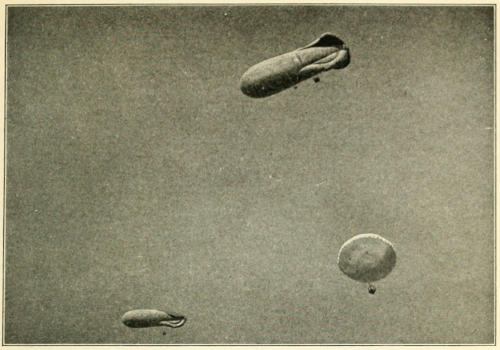
A BASKET PARACHUTE DROP.
The basket parachute brings men, instrument, and records safely to the ground.
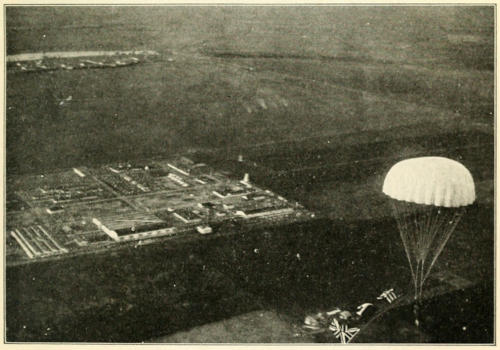
BALLOONIST MAKING A PARACHUTE JUMP FROM AN ALTITUDE OF 7,900 FEET.
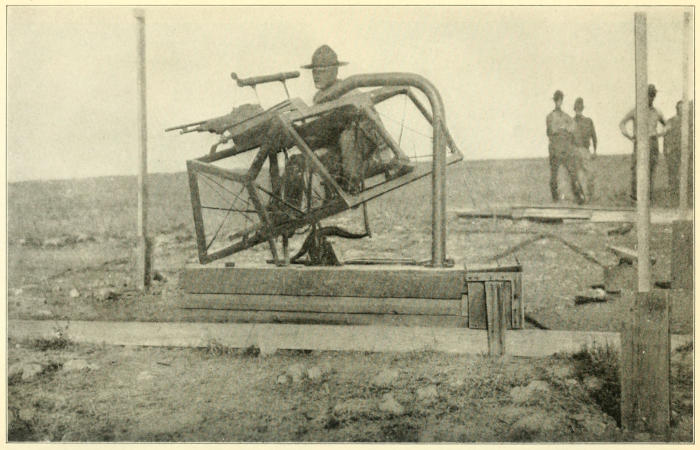
TRAINING THE STUDENT AVIATOR.
“By means of a machine known as the Ruggles ‘Orientator,’ he could, while on the ground, be put through every possible evolution experienced in actual flying.”
It is interesting to note that the use of parachutes is relatively new compared even with ballooning. The man who developed the parachute and who first descended safely to earth by its means—Thomas S. Baldwin—now holds a major’s commission in the American Air Service, and during the war had direct charge of the inspection of all army balloons and parachutes. As the result of a life spent in performing aerial exploits of all kinds, under all conditions and in all parts of the world, Major Baldwin knows what is and what is not safe, so that when a balloon or parachute was sent into action the observer always had the satisfaction of knowing that the world’s most famous balloonist had given it his O. K.
Speaking of parachute jumps reminds me of an incident which actually occurred on one of the American sectors toward the close of the war. Despite the fact that only one American balloonist lost his life in making a parachute jump—and in that case the fatality was caused by the burning balloon falling on and setting fire to the parachute—a very considerable element of risk is involved in the performance. In fact, it became the custom to recommend a man making a parachute jump for the Distinguished Service Cross, or, if he was operating with the French, for the Croix de Guerre.
Just before the opening of the Argonne offensive an observation balloon over the American lines was attacked by a German plane and sent down in flames, the observer escaping by means of his parachute.
“You’ll get the D. S. C. all right,” his friends greeted him, as he disentangled himself from the parachute harness.
“We’re sending up another balloon in a few minutes,” said the commanding officer. “Want to try it again?”
“Surest thing you know, sir,” replied the grinning youngster.
But before the second balloon had been in the air an hour another enemy plane swooped down upon it, like a hawk on a chicken-yard, and it too burst into flame. Again the observer floated to safety beneath his parachute.
“I guess I’ve got that D. S. C. copper-riveted this time,” he remarked; but, when a third balloon ascended, he was in the basket. Once more a German plane came tearing down the skies, a stream of bullets ripped the silken gas-bag, and for the third time that day the observer reached the earth by the parachute route.
“You’ll probably get the Croix de Guerre as well as the D. S. C.,” his friends assured him. “The French are strong for this sort of thing. They may even give you the Legion of Honor.”
Treading on air, the youngster returned to balloon headquarters. Tacked on the bulletin-board in the hallway was a General Order. He paused to glance at it. This is what he read:
“It is hereby directed that the custom of recommending officers making parachute jumps for the Distinguished Service Cross or other decorations be discontinued.”
Though the question of providing proper clothing for our flying-men and balloon observers did not loom large when compared with the vast problems involved in the production of engines, spruce, balloon cloth, bombs, and machine-guns, it was nevertheless an exceedingly important one, for an aviator cannot do his work if he is cold, and it is always bitterly cold in the higher air-lanes. A man flying at 20,000 feet, say, suffers more from the cold than he would on the ice-fields at the North Pole. Aviators are commissioned officers, and when not at work wear the regular uniform, which, as in the case of all officers, is furnished by the officer himself. But the clothing required for work in the air, being of a highly special character and very expensive, is loaned to the flyers by the government. In view of this, it is a source of satisfaction to know that it was frankly admitted on the front that our flyers were by far the best and most efficiently equipped of any nation.
After many tests and much development, the following outfit was devised: On the head was worn, in moderate weather, first a woollen hood, or helmet, so designed as to fit closely over the entire head and shoulders. In extremely cold weather, or for high-flight work, there was worn a silk hood of like design and double thickness, having between its layers an electrically heated unit connected by copper-wire cables extending through the suit proper with the generator on the engine of the plane. Over this silk hood was worn a soft-leather helmet lined with fur, the face was entirely covered with a wool-lined leather mask, and the eyes were protected by goggles. When it was necessary for the aviator to use the radiotelephone, however, the fur-lined helmet was replaced by the radio helmet, a leather affair somewhat similar in design to the other but so fashioned as to contain the receivers of a wireless telephone. For high-flight work, in addition to the above equipment, a rubber oxygen mask, which contained a transmitter permitting the wearer to speak as well as hear by wireless, was also worn. This mask was attached by a flexible tube to a tank of oxygen carried in the plane, being so arranged that it automatically fed the aviator with the amount of oxygen required for the altitude at which he was flying.
Over the body was worn a one-piece flying suit of waterproof, airproof material, reaching from throat to feet, buttoned tightly at wrists and ankles, and lined throughout with fur. Through these suits, between the fur and the outer coverings, were placed wire cables terminating in snap-fasteners at neck, wrists, and ankles, to which could be attached silk-covered wires leading to other electrical heating units in the helmets, gloves, and moccasins, all of which were warmed by a current drawn from the generator on the engine. Hence, though our aviators not infrequently flew in a temperature of thirty degrees below zero, they were as warm and comfortable as though they were sitting before a log fire at home—much more comfortable, in fact, than were their relatives and friends in America on the fireless Sundays which made uncomfortable the first winter of the war. On his hands the aviator wore, in addition to the electrically heated gloves, a pair of muskrat gauntlets extending nearly to the elbow; on his feet, over the electrically heated moccasins, another pair of moccasins, lined with sheepswool, reaching almost to the knees. It is scarcely necessary to add that our air-fighters spent more time in dressing than does a chorus-girl in a comic opera, and that when they were dressed they looked like a cross between an Arctic explorer and a deep-sea diver.
The question of obtaining the fur for lining this clothing presented a perplexing problem, for there were required vast quantities of pelts or skins of extreme warmth and sufficiently strong to withstand rough usage, but not too bulky or heavy. After considerable investigation it was found that these requirements were met by the skin of the Nuchwang dog, which inhabits one of the provinces of north China, though I have no doubt that sable or ermine would have answered the purpose equally well had cost been no consideration. The demands of the American Air Service required practically all of these skins that could be had in China and necessitated the lifting of an embargo to bring them into the United States, which, thanks to the co-operation of the War Trade Board, was obtained. The last purchase before the Armistice was signed called for 500,000 of these dog-skins. A strange thing, was it not, that the lust for power of one William Hohenzollern, late of Berlin and Potsdam, should bring about, among countless other things, the slaughter of half a million dogs in far-off China? Though figures are, as a rule, dry things, the magnitude of the Air Service’s clothing problem can be better appreciated by my giving a few of them. The work in hand for air-clothing when the Armistice was signed involved upward of $5,000,000. Fifty thousand fur-lined flying suits at $36.25; over a 100,000 leather helmets at $4.50; a like number of leather coats at prices ranging from $10 to $30, and 80,000 goggles at $3.50 a pair reflect the major items and explain how the government spent some of the money which you paid for your Liberty Bonds.
Though in this chapter I have attempted to sketch the manifold phases of America’s preparation for obtaining supremacy in the sky, I have purposely left until the last the most important phase of all—the flying-men themselves. The personnel side of the Air Service, including the selection, training, organization, and operation of the flying forces, developed, within the year following America’s declaration of war, into one of the most remarkable educational systems in this or any other country, with a larger student body and a more diverse curriculum than any university in the world. Teaching men to fly, to send messages by wireless, to operate machine-guns in the air, to gauge the effectiveness of artillery-fire by its bursts, to read and make maps, to operate gas-engines, and to travel hundreds of miles by compass; teaching other men to read the enemy’s strategy from aerial photographs, and still others to repair instruments, ignition systems, propellers, airplane wings, and motors, required a vast network of schools and flying-fields, a huge force of instructors, many of whom themselves had to be trained, and an amazing mass of equipment and curricula.
The pilot is the heart and brain of the whole flying apparatus. Parts of the airplane may break without serious result, but when the pilot breaks, even momentarily, nothing is left to direct the flight. The man and the machine come crashing to the ground. The early view that any one who “had the nerve” could fly caused hundreds of unnecessary deaths and an enormous avoidable waste of material. The lesson, for which we paid in bitter and costly experience, was that it is essential to choose flyers who are especially fitted for particular work, and then to keep them in condition to perform their duties at all times by using the same thought and care which is expended in the feeding, exercising, and conditioning of a race-horse. Nature, remember, never intended man to fly in the same sense that she did not intend him for life in a submarine. Conditions are unnatural from the time he leaves the ground until he returns. There are countless obstacles which he must overcome. He flies in an atmosphere deficient in that oxygen which is “the breath of life”; he is subjected in war to the shell-fire of antiaircraft guns and attack by enemy aircraft; he travels through space at a speed far exceeding that of the fastest express-train. In attaining altitudes and breathing rarefied air, the flyer is shaking his fist in the face of nature.
It is imperative, therefore, to classify the flyer for the kind of work he is physically capable of performing. Some men are not able to fly at higher levels than a few thousand feet without suffering deleterious effects, while others may operate at five miles above the surface of the earth without physical harm. It is necessary to know a flyer’s limitations before his training is specialized, for the saving of time and money, and, indeed, the flyer himself. Just as the trainer of a varsity track team classifies his available material into sprinters, distance men, broad jumpers, high jumpers, and weight throwers, so the director of a flying-school must classify his material into men fitted for combat, observation, and bombing. It would be an obvious waste of time and effort to train a man for combat work at high altitudes and then discover that his physical limitations permitted only of his doing bombing work at comparatively low levels. In order to accomplish this work of classification, branch research medical laboratories were established at the various flying-fields, which, by means of certain standardized tests, especially the one on the “rebreather” machine, placed the flyers in their proper categories. The rebreathing tests were conducted in a room so designed, by the gradual expulsion of its oxygen, as to create the exact and various conditions that would exist at any known altitude. Physicians and physiological experts, themselves supplied with oxygen through tubes, remained in the room throughout the tests, closely observing the effect produced on the candidate by the gradual decrease of the oxygen supply. It was soon found that a man’s faculty to respond to sight, sound, and touch becomes more dormant as the air becomes more rarefied, and it was to offset this condition that the oxygen apparatus which I have described in preceding pages was designed. The effect of low oxygen upon the mental process varies greatly, however, according to the individual. He usually becomes mentally inefficient at an altitude at which there is as yet no serious failure of his vital bodily functions. By simple tests of mental alertness during these rebreathing experiments, such as directing the candidate to press designated buttons controlling electric lights of certain colors, controlling a volume of sound by operating a pedal with his feet, and the like, it was easy to determine that one flier would lose his mental alertness at 15,000 feet, while another would retain full control of his faculties at nearly double that height.
In order to accomplish the best results, a comprehensive programme was undertaken, providing for the standardization of both tests and examiners. Sixty-seven military units were established, each examining from ten to sixty applicants a day, there being required, in addition to the complete physical examination embracing all the features ordinarily required of men entering the military service, rigid tests of the special senses of vision, hearing, and motion sensing. Yet, despite the severity of the tests to which the candidates were subjected, the records show that 70.7% of the applicants qualified. But the work of the surgeons did not end when they had passed a man as physically fitted for training as an aviator. On the contrary, it had only begun. The candidate was not only kept under the closest medical observation during his training days, but this observation did not relax even after he had become a fully fledged flyer with the silver wings embroidered on his breast, for the “flight surgeon” who was attached to every squadron was instructed to keep the flyers physically fit and to carefully investigate the causes of all such accidents as might be attributed to the mental or physical failure of the flyers themselves. Keeping the flyer fit was by no means as simple a matter as it sounds, for it included seeing that the men took the necessary amount of physical exercise, the provision of proper recreation, watching the state of fatigue of the individual, making arrangements for leave or furlough, determining the quantity and nature of their food and the questions of alcohol and tobacco, and re-examining them at frequent intervals. Any one who knows how temperamental many flying-men are inclined to be will realize that the flight surgeons held no sinecures.
During the last few months of the war an apparatus was perfected whereby students could acquire flying experience and training without leaving the ground. This machine, known as the “Ruggles Orientator,” is a modification of the universal joint, composed of three concentric rings so pivoted as to permit the fuselage, which is pivoted within the innermost ring, to be put through every possible evolution experienced in actual flying—the candidate being able to experience, while safely on the ground, the sensations of nose-diving, tail-diving, side-slipping, looping the loop, and all the rest—everything, in fact, except forward progression. I feel certain that a man of Mr. Ruggles’s amazing ingenuity could have satisfied both the parent and child of the ancient verse:
“‘Mother, may I go in to swim?’ ‘Yes, my darling daughter. Hang your hose on a hickory limb, And don’t go near the water.’”