FASHION'S SLAVES.
Reading edition
BY B. O. FLOWER.
The last session of the International Council of Women discussed no question of greater importance to civilization than that of dress reform. The fact that this world's congress, representing the most thoughtful, conscientious, and broad-minded women of our age, has taken up this subject with a firm determination to accomplish a revolution which shall mean health and happiness to the oncoming generation, is itself a prophecy pregnant with promise of a substantial and enduring reform. It will not be surprising if in the near future it is found that this earnest though somewhat timid discussion marked a distinct step in the world's progress; certainly it was the most significant and authoritative utterance from united womanhood that has yet been made touching a problem which most vitally affects civilization.
To the student of sociology nothing is more perplexing or discouraging than society's persistency in blindly clinging to old standards and outgrown ideals which can no longer be defended by reason; and this is nowhere more marked than in the social world where fashion has successfully defied all true standards of art, principles of common sense, rules of hygiene and what is still more important, the laws of ethics which underlie all stable or enduring civilizations.
At the very threshold of this discussion, I ask the reader to, as far as possible, divest his mind of all prejudice arising from preconceived opinions, and view in a perfectly candid and judicial manner this problem upon which the last word will not be spoken until woman is emancipated. As long as free discussion is tabooed and conservatism finds it possible to dismiss the question with a flippant jest, a ribald joke, or a basely unjust imputation, the old order will stand; partly because woman feels her helplessness and largely because so few people stop to trace cause and effect or patiently reason upon results of the most serious character. Conservatism is strongly entrenched in the minds of the millions, and to a certain degree mental lethargy broods over the world. It is true that in woman's sphere to-day mental activity is more marked than in any other age, and the best brains and most thoughtful women of our time are boldly denouncing the bondage of fashion and bravely pleading for such radical reforms in dress as will secure to womanhood health and comfort, while being genuinely artistic and graceful, breathing true refinement and conforming to æsthetic principles rather than the caprice of fashion. To me there is something infinitely pathetic in the brave protests that have from time to time flashed from the outraged sensibilities of those who represent the very flower of American womanhood, when discussing this subject, for running through their almost every utterance is the plaintive note of helplessness, mingled with the consciousness of the justice of the cause for which they plead. The talented and universally respected Mrs. Abba Woolson Gould some years ago thus gave expression to her feelings when writing of the long, heavy, disease-producing skirts of women:
Do what we will with them, they still add enormously to the weight of clothing, prevent cleanliness of attire about the ankles, overheat by their tops the lower portion of the body, impede locomotion, and invite accidents. In short, they are uncomfortable, unhealthy, unsafe, and unmanageable. Convinced of this fact by patient and almost fruitless attempts to remove their objectionable qualities, the earnest dress-reformer is loath to believe that skirts hanging below the knee are not transitory features in woman's attire, as similar features have been in the dress of men, and surely destined to disappear with the tight hour-glass waists and other monstrosities of the present costume.... Any changes the wisest of us can to-day propose are only a mitigation of an evil which can never be done away till women emerge from this vast swaying, undefined, and indefinable mass of drapery into the shape God gave to His human beings.
Mary A. Livermore voices a sad and terrible truth when she observes:
The invalidism of young girls is usually attributed to every cause but the right one; to hard study—co-education—which, it is said, compels overwork that the girl student may keep up with the young men of her class; too much exercise, or lack of rest and quiet at certain periods when nature demands it. All the while the physician is silent concerning the glove-fitting, steel-clasped corset, the heavy, dragging skirts, the bands engirding the body, the pinching, deforming boot, and the ruinous social dissipation of fashionable society. These will account for much of the feebleness of young women and girls. For they exhaust nervous force, make freedom of movement a painful impossibility, and frequently shipwreck the young girl before she is out of port.
We have a theory, generally accepted in civilized society, which we never formulate in speech but to which we are very loyal in practical life. This theory, put in plain language, is as follows: God knows how to make boys; and, when He sends a boy into the world, it is safe to allow him to grow to manhood as God made him. He may be too tall or too short, for our notions, too stout or too thin, too light or too dark. Nevertheless, it is right, for God knows how to make boys. But when God sends a girl into the world, it is not safe to allow her to grow to womanhood as He has made her. Some one must take her and improve her figure, and give her the shape in which it is proper for her to grow.
Accordingly, the young girl comes some day from the dressmaker with this demand: "Mme. —— (the dressmaker) says that I am getting into horrid shape, and must have a pair of corsets immediately." The corsets are bought and worn, and the physical deterioration begins.
Miss Frances E. Willard thus touchingly refers to the bondage of fashion:
"But there came a day—alas! the day of my youth—on which I was as literally caught out of the fields and pastures as was ever a young colt; confronted by a long dress that had been made for me, corsets and high-heeled shoes that had been bought, hair-pins and ribbons for my straying locks, and I was told that it simply 'wouldn't answer' to 'run wild' another day. Company from the city was expected; I must be made presentable; 'I had got to look like other folks.'
"That was a long time ago, but I have never known a single physically reasonable day since that sweet May morning, when I cried in vain for longer lease of liberty."
Mrs. Frances E. Russell, whose significant paper read at the Woman's Council elicited universal approbation, in the following extract from her able essay in The Arena sounds a more hopeful note than her illustrious predecessors, for she is nearer the dawn, and the horizon of woman's freedom is broadening:
The fiction that women have no legs is now fully discredited, for in the show windows of the largest dry goods stores stand dummies of the female figure dressed only in the combination undersuit made of wool or silk "tights," covering the whole body, except the head, hands, and feet. By this time everyone must know that woman, like man, is a biped. Can anyone give a good reason why she must lift an unnecessary weight of clothing with every step she takes,—pushing forward folds of restricting drapery and using almost constantly, not only her hands, but her mental power and nervous energy to keep her skirts neat and out of the way of harm to herself and others?
Much discussion has been wasted over the question whether a woman should carry the burden of her voluminous drapery from the shoulders or the hips. Why must she carry this unnecessary weight at all?
Now let us join hands, all lovers of liberty, in earnest co-operation to free American women from the dominion of foreign fashion. Let us, as intelligent women, with the aid and encouragement of all good men, take this important matter into our own hands and provide ourselves with convenient garments; a costume that shall say to all beholders that we are equipped for reasonable service to humanity.
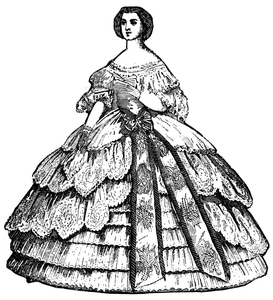
From 1860 to 1865. The era of hoop-skirts.
Conservative critics have so frequently misrepresented those who have honestly pleaded for dress reform, that it is no longer safe to be frank, and this fact alone has constrained numbers of earnest writers from expressing their sentiments who have felt it their duty to speak in behalf of health, beauty, and common sense; indeed so certain is one to be misrepresented who handles this subject in anything like a reasonable and unconventional manner, and so surely will his views be assailed as improper, owing to the age-long cast of conventional thought, that were it not that this question so intimately affects fundamental, ethical, and hygienic laws, and bears such a vitally important relation to true progress, I frankly admit that I doubt whether I should have the courage to discuss it. But I find it impossible to remain silent, believing as I do most profoundly that the baleful artificial standards so long tolerated must be abolished, that the fetish of the nineteenth century civilization must be overthrown, and that it is all-important that people be thoroughly acquainted with the far-reaching and basic significance of this problem, through courageous and persistent agitation and education, in order that manhood and womanhood be brought up to the ethical plane which marks enduring civilization. In the examination of this subject I desire to very briefly notice it from æsthetic, hygienic, and ethical points of view. It is a singular fact that every effort made toward a healthful and common sense reform in woman's apparel has been assailed as inartistic or immoral; while fashions at once disgusting, indecent, destructive to life and health, and degrading to womanhood have been readily sanctioned by conventionalism. This antagonistic attitude toward any movement for an improvement in woman's attire founded on the laws of health, art, comfort, and common sense was characteristically expressed in a recent editorial in a leading Boston daily, wherein the writer solemnly observed:
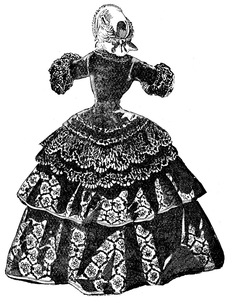
From 1860 to 1865. The hoop-skirt era. The difficult feat of tying on a bonnet.
The simple truth is, the great majority of the women appreciate the fact that it is their mission to be beautiful, and the dress reformers have never yet devised any garment to assist the women in fulfilling this mission.
The author of the above fairly represents the attitude of conventional thought,—its servility to fashion, its antagonism to reformative moves. The implied falsehood that fashion represents beauty and art, or is the servant of æstheticism has been reiterated so often that thousands have accepted it as truth.
In order to expose its falsity, I have reproduced in this paper plates taken from leading American and English fashion monthlies during the past three decades, in each of which it is noticeable that extremes have been reached. In 1860-65, the hoop-skirt held sway, and the wasp waist was typical of beauty. Then no lady was correctly attired according to the prevailing idea who did not present a spectacle curiously suggestive of a moving circus tent. During this era four or five fashionably dressed women completely filled an ordinary drawing-room; while the sidewalk was often practically monopolized by moving monstrosities, save when in front or behind the formidable swinging cages moved escorts, who with no less servility than American womanhood bowed to the frivolous and criminal caprice of the modern Babylon.
1870 to 1875. The era of the enormous bustle and train of sweeping dimensions. 1870 to 1875. The era of the enormous bustle and train of sweeping dimensions.
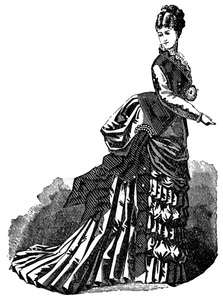
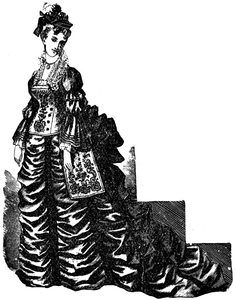
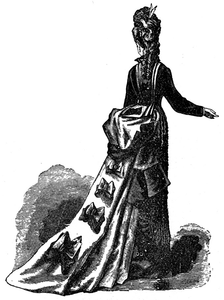
1870 to 1875: "Suggesting in some instances a toboggan slide; in others, the unseemly hump on the back of a camel."
When we examine the prevailing styles which marked this period, we are struck with amazement at the power exerted by fashion over the intellect and judgment of society. Imagine the shame and humiliation of a woman of fashion, endowed by nature or afflicted by disease with such an unsightly hump on the back as characterized the fashionable toilet of this period!
The reaction in favor of a more sensible dress which followed was of brief duration. During this time, however, the long trains were seldom seen, and thoughtful women began to hope that the arbitrary rule of fashion was over. It was not long, however, before the panier period arrived, and what was popularly known as the pull-back was accepted as the correct style in fashion's world. Of this latter conceit little need be said, for it has so recently passed from view that all remember its peculiarity, which to the ordinary observer seemed to be a settled determination on the part of its originators to render walking as difficult and fatiguing as possible, while fully exposing the outline of the wearer's body below the waist at every step. What in '60 or '70 would have been accounted the height of indecency, is in the eighties perfectly proper in the fashionable world. During this time it was not enough to have the skirts very narrow, they must at every step give the outline of the limbs [or as our Minnesota solon would put it, nether limbs], hence we find the pull-backs in which "two shy knees appeared clad in a single trouser."
1878. The period of the tie-back, narrow skirts, and enormous trains. The tie-backs of 1878 and 1879.
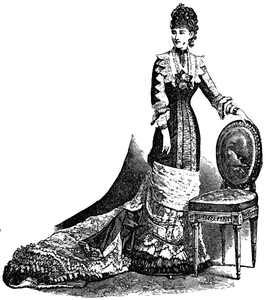
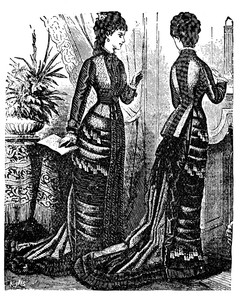
The pull-back of 1886. Fashionable walking costume early in the seventies. Woman appreciating the fact "that it is her mission to be beautiful." See page 405.
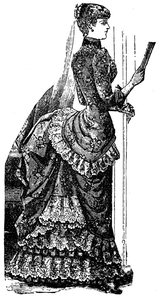
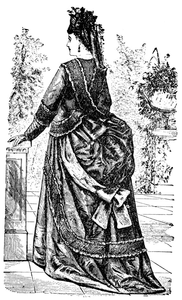
Such have been the inconsistencies, incongruities, and absurdities of fashion as illustrated in the past three decades, in view of which one may well ask whether in fashion's eyes women are such paragons of ugliness that these ever-varying styles (introduced, we are seriously informed, to conserve to her beauty,) are absolutely essential, and by what rule of art can we explain the fact that the ponderous hoopskirt was the essential requirement of beauty in the sixties and the enormous bustles demanded in the seventies. The truth is, fashion is supremely indifferent alike to all laws of art and beauty, health and life, decency and propriety—a fact that must be patent to any thoughtful person who examines the prevailing styles of a generation. I submit that the wildest extremes to which well-meaning but injudicious dress reformers have gone in the past have been marked by nothing more inartistic than the costume of the reigning belle in 1860. Each successive decade has been marked by an extreme which, surveyed from the vantage ground of the present, is as ridiculously absurd as it has been wanting in beauty Nowhere have the laws of true art been so severely ignored as in the realm of fashion. Yet this view of the problem palls into insignificance when we come to examine the question from the standpoint of health and life.
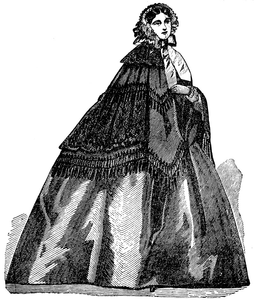
Fashionable walking costume in the early sixties. Woman appreciating the fact "that it is her mission to be beautiful." See page 405.
One would think that after thousands of years of sickness and death, with all the advantages of increased education and a broadening intellectual horizon, we would have arrived at such an appreciation of the value of health and the solemn duty we owe to posterity, as to compel this consideration to enter into our thoughts when we adopted styles of dress; yet nowhere is the weakness of our present civilization more marked or its hollowness so visible, even to the superficial thinker, as in the realm of fashion, where every consideration of health and even of life, and all sense of responsibility to future generations are brushed aside as trivialities not to be seriously considered. In vain have physicians and physiologists written, lectured, and demonstrated the fatal results of yielding to fashion. The learned Doctor Trall in writing on this subject wisely observes:
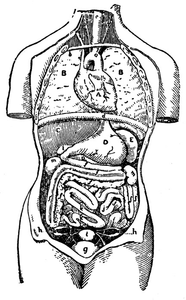
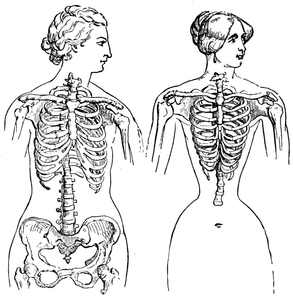
The internal viscera. Anterior view of thorax in the Venus of Medicis. The same in a fashionable corset-wearing lady of to-day.
In speaking of the destructiveness to health caused by woman's dress, Prof. Oscar B. Moss, M. D., declares:
Although the corset is the chief source of constraint to the kidneys, liver, stomach, pancreas, and spleen, forcing them upward to encroach upon the diaphragm and compressing the lungs and heart, its evils are rivalled by those resulting from suspending the skirts from the waist and hips, by which means the pelvic organs are forced downward and often permanently displaced. Now, add to these errors a belt drawn snugly around the waist, and we have before us a combination of the most malignant elements of dress which it would be possible to invent.
The waist belt enforces the evils which the corset and skirts inaugurate. Every proposition of anatomy and physiology bearing upon this subject appeals to reason. Did the abdominal organs require for their well-being less room than we find in the economy of nature, less room would have been provided. Nature bestows not grudgingly, neither does she lavish beyond the requirements of perfect health.
The same laws which govern the nutrition of muscles, apply also to the vital organs. Pressure that impedes circulation of blood through them must suppress their functions proportionally. With the lungs, heart, and digestive organs impaired by external devices, which force them into abnormal relations, health is impossible. Every other part of the body—nay, life itself—depends upon the perfection of these organs. The ancients fittingly called them the tripod of life.
Consumption, heart disease, dyspepsia, and the multiform phases of uterine and ovarian diseases are among the natural and frequent consequences of compressing the internal organs. Men could not endure such physical indignities as women inflict upon themselves. Should they attempt to do so, they would not long hold the proud position of "bread winners," which is now theirs by virtue of their more robust qualities.
Street costume. Spring, 1884. Street costume. Summer, 1891. (Compare waist with anterior view of thorax of corset-wearing lady of to-day.) See page 412.
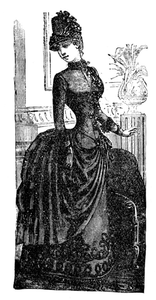
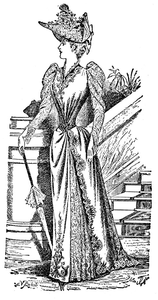
1860 1872
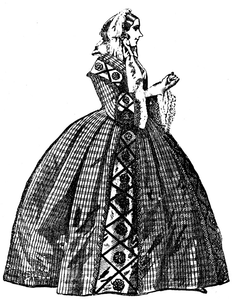
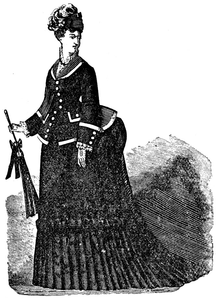
1878 1886
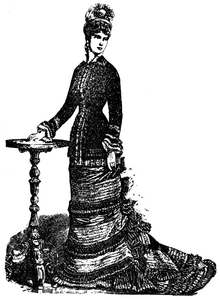
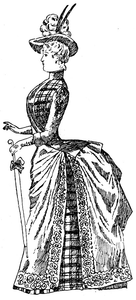
VAGARIES OF FASHION. PREVAILING STYLES IN WALKING COSTUMES DURING THE PAST THIRTY YEARS.
I answer not past, but they are assuming other forms. Since 1890 dawned, the evils in some respects have been aggravated; for it must not be forgotten that the daughters of the present decade have, in order to be fashionable, compressed beyond all healthful bounds the flesh of their arms, retarding circulation and inviting pneumonia and other ills. And in order to look stylish, thousands of women wear dress waists so tight that no free movement of the upper body is possible; indeed in numbers of instances ladies are compelled to put their bonnets on before attempting the painful ordeal of getting into their glove-fitting dress waists. Many young women to-day, yielding to the spell of fashion, place the corset next to their flesh, while a still greater number have merely the thinnest possible undershirt between the flesh and the corset, after which they tightly draw the dress waist until it meets. This seems incredible, but it is vouched for by several ladies of my acquaintance, among whom are physicians whose large practice among their sisters gives them peculiar facilities for knowing the absolute facts. Health, posterity, and all the instincts of the higher self are ruthlessly sacrificed to the fickle folly of fashion's criminal caprice. And we must not forget that even now the sweeping train is coming in vogue and correctly attired ladies must consent to carry the germs of death with quantities of filth from the streets of our metropolitan cities into their homes of wealth and refinement. The corset and high-heeled shoes, the two most deadly foes to maternity and posterity, are also seen at the present time, on every hand.
If outraged nature could show the procession of mothers sacrificed on fashion's altar during the past generation, or unveil the suffering and deformity being borne by posterity at the present time, through this slavery, the world would be thrilled with an indescribable horror. Health, comfort, and human life have paid the penalty of a criminal servitude to the modern juggernaut, before whose car millions of our women are bowing in abject servility, knowing full well that at each turn of its wheel new pains or fresh diseases will be inflicted. And what power controls and gives life to this mistress of modern civilization? At whose behest is this crime against reason, life, and posterity perpetrated? The cupidity of the shrewd and unscrupulous and the caprice of the shallow and frivolous.
Vagaries of Fashion. A belle in the eighties. Vagaries of Fashion. A belle early in the sixties.
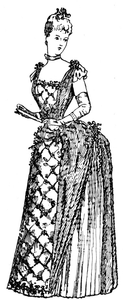
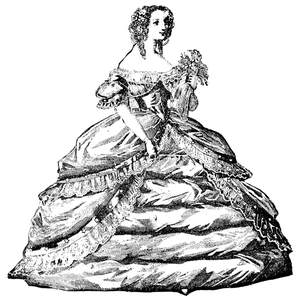
The moral aspect of this subject is even more grave than the hygienic. Anything which injures the physical body, whether it be licentiousness, intemperance, gluttony, or vicious modes of dress, is necessarily evil from an ethical point of view. Not simply because the law of our being decrees that whatever drains or destroys the physical vitality must sooner or later sap the vital forces of the brain; but also because anything is ethically destructive which chains the mind to the realm of animality, when, unfettered, it should be unfolding in spiritual strength and glory. Thus it will be readily seen that any article of clothing which presses upon the vitals of the body so as to cause displacement of the delicate organism, or so cumbersome as to cause general fatigue, anything, as is the case with high heels, which throws the body out of its equilibrium, or any article of dress which makes the mind ever conscious of the body by virtue of its uncomfortableness, is injurious from an ethical point of view. This fact which has been so generally overlooked will become more apparent, if for the sake of illustration we suppose for a moment that a plant is endowed with reason and sensation, and obeying the general law of its being, and the persuasive and inspiring influence of the sun and rain, is struggling to rise heavenward, and give to the radiant world above its impearled wealth—its gorgeous bloom, its marvellous fragrance and fruit; but by virtue of the bonds of a prison-house below,—a small pot or a rocky encasement, its lifework is thwarted, its bloom, perfume, and fruit, if they come at all, are stunted, limited, and imperfect. For generations woman's condition has been like that of the plant, the wealth of her nature has been dwarfed, the marvellous richness of her life has been marred by the imprisoned conditions of her body, and infinitely more sad and far-reaching have been the baleful consequences upon millions of her offspring, dwarfed, weakly, sickly, enfeebled in body and soul. A mother whose thoughts have voluntarily or involuntarily been held in the atmosphere of the physical nature, necessarily imparts to her child a legacy of animality which, like the corpse of a dead being, clings to the soul throughout its pilgrimage. Terrible as have been fashion's ravages on woman's physical health, the curse which she has exerted when the ethical aspect of the case is entertained, far transcends it.
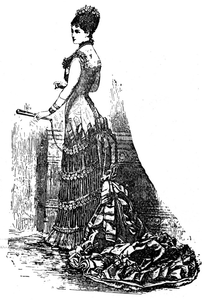
It is a curious fact that almost all the opposition from women to proposed reforms in woman's dress comes from two extremes in society. Those who do no independent thinking, taking all their thoughts and opinions from the expressed views of the men with whom they associate, and the profoundly earnest and thoughtful, but conservative women of society. The opposition of the former class is merely the echo of husbands, brothers, fathers, and lovers; but the others are moved by conviction, and for this reason their views are worthy of consideration. They fear that any radical change will exert an immoral influence. Their minds are swayed by ancient thought which throughout all ages has cast its baleful shadow over the brain of the world. They are held under the spell of a conservatism which unquestioningly tolerates established institutions and existing orders, but has no confidence in aught that proposes to break with these, even though the new has reason and common sense clearly on its side. Thus time and again fashions have been tolerated, although known to be morally enervating and singularly repulsive to all refined sensibilities; while proposals from without for reforms based on the laws of health and beauty have called forth the most determined opposition from this conscientious class, merely because the proposed innovations have not conformed to ideas entertained by virtue of prevailing fashions, and have been therefore regarded immoral. And herein lies an important point to be considered. Anything which is radically unlike prevailing standards or styles to which we have become accustomed will impress most persons as being immodest or indecent. The unusual in dress is usually denounced as immoral because we are all prone to allow our prejudice to obscure our reason and o'ersway our judgment. This point must be recognized before any real reform can be accomplished. When humanity has grown sufficiently wise to reason broadly and view problems on their own merits, aside from preconceived opinion or inherited prejudice, real instead of false standards of morality will prevail, and we shall cease to condemn anything as pernicious simply because it is unusual, radically unlike that to which we have been accustomed or revolutionary in its tendency. Let me make this if possible more apparent by an illustration, because it bears such an important relation to the main issue. If men had for ages worn long flowing robes, completely enveloping their bodies, but on a certain day with one accord exchanged them for a costume similar to that now seen throughout the civilized world, society would experience a distinct shock; immoral, indecent, pernicious, and vulgar would mildly express the sentiment of conventional thought, until the same society had become accustomed to the change. To us at the present time it is difficult to conceive how women of sense and refinement submitted to the swinging-cage paraphernalia of the sixties, or the Grecian bend of a later date. Yet in those days the severely plain skirts of the present would have seemed positively indecent. It has been necessary to dwell on this thought in order to sufficiently remove existing prejudice to enable a fair consideration of the question in its broader aspects. I have also introduced fair examples of prevailing fashions during the past generation and reproductions of Greek, Shakespearian and other simple costumes worn at the present time by the queens of the stage, to show by comparison how infinitely more graceful, beautiful, comfortable, healthful, and by their very elements of comfort and healthfulness, ethically superior, are these costumes to those which conventionalism sanctioned in the sixties, seventies, and eighties. Is there anything immodest, indecent, or suggestive of impropriety in Mary Anderson in the graceful Grecian costume of Parthenia, presented on the preceding page? Of the tens of thousands of people who have witnessed the performances of Madame Modjeska, Miss Anderson, Julia Marlowe, or Margaret Mather in the costumes given in this paper, it is not probable that a perceptible number have seen aught improper or even injuriously suggestive, notwithstanding they are so radically unconventional. Surely no mind accustomed to think broadly and view problems on all sides, and unaccustomed to revel in the sewer of sensualism would see in the attire of these estimable ladies aught but costumes at once graceful, refined, and apparently infinitely more comfortable and healthful than those represented in any of the fashion plates I have reproduced, and which millions of women of good sense have under the stress of conventionalism been compelled to wear. Let us compare Miss Anderson's Grecian costume with the dress of a society belle in the seventies, which required from twenty to thirty yards of material, and when completed and fitted transformed the wearer into a monstrosity with an unsightly hump on the back, and a street cleaner of immense dimensions trailing for several feet in her rear.
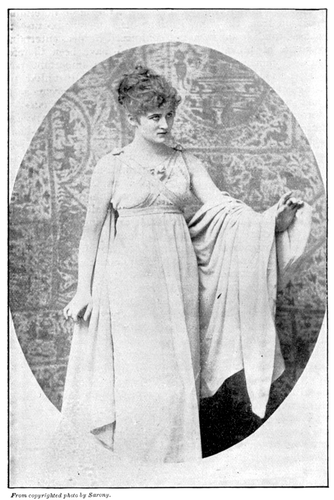
From copyrighted photo by Sarony.
MARY ANDERSON AS PARTHENIA.
From artistic, hygienic, economical, and ethical points of view, to say nothing of common sense and comfort, is not the simple and beautiful costume of Parthenia incomparably superior to that which marked the second decade of the past generation? Would not woman to-day clothed in close-fitting garments of silk or woollen fabric, with an outer robe or loose dress fashioned something after the order of the ancient Grecian or Roman pattern, be far more beautiful than she is as a slave to fashion's fickle fancy, while the requirements of life, health, and comfort would be fully met? Again, let us compare one of the plates of the sixties with its wonderful expanse of skirt to the simple, graceful attire of Miss Marlowe as Viola in the "Twelfth Night," and laying aside all preconceived opinions (with the influence which we have seen the unusual plays in fashioning our ideas of propriety,) does not our reason and common sense sustain the view that the latter is far more refined, simple, and less vulgarly ostentatious than the inflated garment of the early sixties? Or if we compare the pictures of Modjeska and Miss Marlowe in Shakespearian roles, or that of the former in the neat and graceful gathered gown, and Miss Mather in the simple peasant dress, are they not one and all far more chaste, artistic, sensible, and healthful than the hoop-skirt, bustle, and train, or the tie-back? Do not, however, understand that I advocate the introduction of any of these costumes. It is for woman and woman alone to decide what she will wear, and in this paper I am merely seeking to second the splendid work that has by her been inaugurated, and by speaking as one of the younger men of this decade, to voice what I believe American womanhood will find to be the sentiment of the rising generation, whenever she makes a concerted effort to emancipate herself from the slavery of Parisian fashions. There are many evidences that the hour is ripe for a sensible revolt, and that if the movement is guided by wise and judicious minds it will be a success. Two things seem to me to be of paramount importance.
From copyrighted photo by Falk, N. Y. JULIA MARLOWE. HELENA MODJESKA.
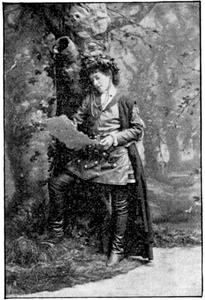
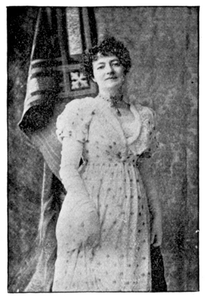
MARGARET MATHER. HELENA MODJESKA.
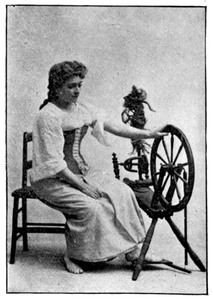
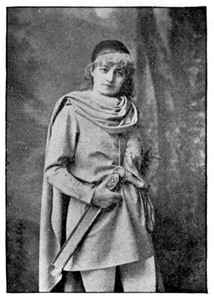
(1.) The commission of women acting for the Council should decide definitely upon the nature and extent of changes desired. The ideal costume should be clearly defined and ever present in their mind. But it would be exceedingly unwise to attempt any radical change at once. This has been more than anything the secret of the partial or total failures of the movements of this character in the past. The changes should be gradually made. Every spring and autumn let an advance step be taken, and in order to do this an American fashion commission or bureau should be established, under the auspices of the dress reform committee of the Women's Council, which at stated intervals should issue bulletins and illustrated fashion plates. If the ideal is kept constantly in view, and every season slight changes are made toward the desired garment, the victory will, I believe, be a comparatively easy one, for the splendid common sense of the American women and men will cordially second the movement. Concerted action, a clearly defined ideal toward which to move, and gradual changes—these are points which it seems to me are vitally important. One reason why the most ridiculous and inartistic extremes in fashion have been generally adopted is found in this policy of gradual introduction, a fact which must impress anyone who carefully examines the fashions of the past. First there has been a slight alteration, shortly becoming more pronounced, and with each season it has grown more marked, although perhaps not for four or six years has the extreme been reached. At every step there have been complaints from various quarters, but steadily and persistently has the fashion been pushed until it reached its climax, after which we have had its gradual decline. This was the history of the hoop skirt and the Grecian bend, and has been that of most of the extremes which have marked the past, and we can readily believe that in no other way could womanhood have been insnared by such supreme and criminal folly as has characterized fashion's caprices in unnumbered instances.
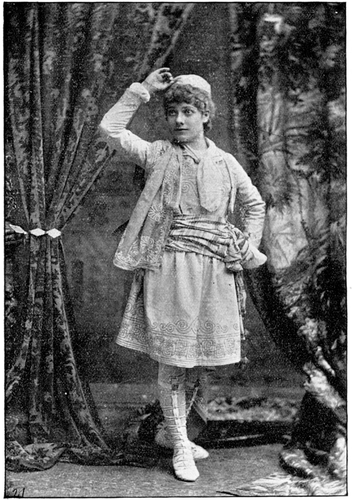
From copyrighted photo by Falk, N. Y.
MISS MARLOWE AS VIOLA.
Another encouraging sign of the times is the increasing demand on the great and fashionable house of Liberty & Co., of London, for the Greek and other simple costumes by fashionable ladies, who are using them largely for home wear. I have reproduced two recent styles of dresses made by Liberty. All fabrics used are rich, soft, and elegant, and the effect is said to be gratifying to lovers of art, as well as far more healthful and comfortable than the conventional dress. The most important fact, however, is the effect or influence which is sure to follow this breaking away from the ruling fashions in wealthy circles. When conventionalism in dress is fully discredited, practical reform is certain to follow. The knell of the one means the triumph of the other.
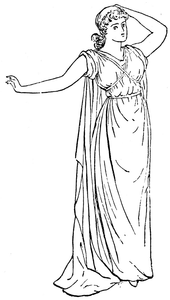
Some of Liberty's recent dresses. The Grecian Costume.
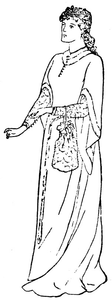
Some of Liberty's recent dresses. The Juliet.
Believing as I do that the cycle of woman has dawned, and that through her humanity will reach a higher and nobler civilization than the world has yet known, I feel the most profound interest in all that affects her health, comfort, and happiness; for as I have before observed, her exaltation means the elevation of the race. A broader liberty and more liberal meed of justice for her mean a higher civilization, and the solution of weighty and fundamental problems which will never be equitably adjusted until we have brought into political and social life more of the splendid spirit of altruism, which is one of her most conspicuous characteristics. I believe that morality, education, practical reform, and enduring progress wait upon her complete emancipation from the bondage of fashion, prejudice, superstition, and conservatism.