PART II.
Reading edition
BY CAMILLE FLAMMARION.
The human soul would seem to be a spiritual substance, endowed with psychical force, capable of acting outside bodily limits. This force, like all others, may be transmissible into the form of electricity or heat, or may be capable of bringing into activity certain latent energies while it yet remains intimately united with our mental being.
We propound questions to the table, already impressed with our nervous impetus, on subjects interesting to ourselves; and then we ourselves unconsciously inspire the responses. The table speaks to us in our own language, giving back our own ideas, within the limits of our own knowledge, conversing with us about our opinions and views, as we might discuss them with ourselves. This is absolutely the reflection—direct or remote, precise or vague—of our own feelings and thoughts. All my efforts to establish the identity of a stranger spirit, unknown to the persons present, have failed.
On the other hand, attentive examination of different communications leads us toward a conclusion as to their origin. When amidst the Marquis de Mirville’s revelations, one is in the full swing of Roman Catholic diabolism—demons, spirits, purgatory, miracles, prayers,—nothing is lacking. With the Count de Gasparin, we are in the bosom of Rational Protestantism, which is absolutely the opposite of the other. Here are no present miracles, no devils, but simply a physical agency, a fluid obedient to volition. In the experiences of Eugene Nus’s circle, we find the language of Fourier discoursing about the phalanstery, about racial solidarity, and socialistic religion. Therein are found earthly music chanted in space,—songs of Saturn and Jupiter dictated under the influence of Alyre Bureau, who was the musician for the spiritualist society of Allan-Kardec. Here we have disembodied spirits of all ranks, and this is the apostolate of their reincarnation.
In the United States, on the contrary, the moving tables declare that the hypothesis of reincarnation is absurd and misleading; and it may be assumed that none of the persons present, especially the ladies, would for one moment admit the possibility of being some day reincarnated beneath the skin of a negro. A brilliant imagination, like that of Sardou, will picture to us Jupiter’s castles; a musician may receive the revelation of a musical composition, more or less charming; an astronomer may be favored with astronomical communications. Is this physical auto-suggestion? Not absolutely, since the force goes outside of ourselves, in order to act. It is rather mental suggestion; yet an idea cannot be suggested to a piece of wood. This is, therefore, the direct action of the mind. I cannot find a better name for it than psychical force, a term, as already stated, which I have used since 1865, and which has since become the fashion.
The action of mind, outside the body, has other testimony, however. Magnetism, hypnotism, suggestion, telepathy prove this every day. It cannot be disputed that here also we encounter many illusions.
Some ten years ago a learned physician at Nice, Doctor Barety, the author of “La Force Neurique Rayonnante et Circulante” (The Radiation and Circulation of Nervous Force) devoted himself to ingenious experiments in the distant transmission of thought as observable in a magnetized person. In these experiments, in which I assisted, it seemed to me that the subject’s sense of hearing amply sufficed to explain the results.
Take one case. The subject began to count aloud, while the magnetizer was in an adjoining room, the door standing open between them. At a certain moment the doctor, with all his energy, projected his “nervous fluid” from his hands, and the magnetized subject forthwith ceased counting; yet the doctor’s linen cuffs made enough noise to indicate what he commanded, though no word was spoken. During the experiments at Salpétrière and at Ivry, to which Doctor Luys was kind enough to invite me, I thought I observed that a previous knowledge of the sequence of the experiments furnished a wide margin for the exercise of the personal faculties of the young women upon whom the experiments were made. These suspicions, however, did not prevent certain facts in regard to mental suggestion from being absolutely incontestable.
Here is one among others:—
Doctor Ochorowiez was attending a lady troubled with long-standing hysterio-epilepsy, aggravated by a maniacal inclination to suicide. Madame M. was twenty-seven years of age, and had a vigorous constitution. She appeared to be in excellent health. Her active and gay temperament was united with extreme moral sensibility. Her character was specially truthful. Her profound goodness was tinctured with a tendency toward self-sacrifice. Her intelligence was remarkable. Her talents were many, and her perceptive faculties were good. At times she would display a lack of willpower, and an element of painful indecision; while at other times she showed exceptional firmness. The slightest moral fatigue, any unexpected impression, though of trifling importance, whether agreeable or otherwise, reacted, although slowly and imperceptibly, upon her vaso-motor nerves, and brought on convulsive attacks and a nervous swoon. Writes Dr. Ochorowiez in his work on Mental Suggestion:
One day, or rather one night, her attack being over (including a phase of delirium), the patient fell quietly asleep. Awaking suddenly, and seeing us (one of her female friends and myself) still near her, she begged us to go away, and not to tire ourselves needlessly on her account. She was so persistent that, fearing a nervous crisis, we departed. I went slowly downstairs, for she resided on the fourth story, and I paused several times to listen attentively, troubled by an evil presentiment; for she had wounded herself several times a few days before. I had already reached the courtyard, when I paused again, asking myself whether or not I ought to go away.
All at once her window opened with a slam, and I saw the sick woman leaning out with a rapid motion. I rushed to the spot where she might fall; and mechanically, without attaching any great importance to the impulse, I concentrated all my will in one great desire to oppose her precipitation.
The patient was influenced, however, though already leaning far out, and retreated slowly and spasmodically from the window. The same movements were repeated five times in succession, until the patient, seemingly fatigued, at last remained motionless, her back leaning against the casement of the window, which was still open.
She could not see me, as I was in the shadow far below, and it was night. At that moment, her friend, Mademoiselle X., ran in, and caught madame in her arms. I heard them struggling together, and hastened up the stairs to mademoiselle’s assistance. I found the invalid in a frenzy of excitement. She did not recognize us, but mistook us for robbers. I could only draw her away from the window by using violence enough to throw her upon her knees. Several times she tried to bite me; but after much trouble, I succeeded in replacing the poor lady in her bed. While maintaining my grasp with one hand, I induced a contraction of her arms, and finally put her to sleep.
When again in a somnambulistic state, her first words were: “Thanks!—pardon!”
Then she told me that she positively intended to throw herself out of the window, but that each time she felt as if she were “stayed from below.”
“How so?”
“I do not know.”
“Did you have any suspicion of my presence?”
“No! it was precisely because I believed you away, that I proposed to carry out my design. However, it seemed to me at times that you were near me, or behind me, and that you did not want me to fall.”
Here is another experiment still more striking. Pierre Janet, Professor of Philosophy in the Havre Lycée, and Monsieur Gibert, a physician, selected as a subject for their observation a certain woman, a native of Brittany. She was fifty years old, robust, and moderately sensitive to hypnotic influences. On October 10, 1885, they agreed upon the following command:
To-morrow, at noon, lock the doors of your house.
w.
This suggestion Dr. Janet inscribed upon a sheet of paper, which he carried about in his pocket, not communicating its purport to anybody. Dr. Gibert made the suggestion by placing his forehead against the woman’s, while she was in a lethargic slumber; and for a few moments he concentrated his mind upon the mental command he was giving.
Writes Janet concerning this incident:
On the morrow we went to the house, at fifteen minutes before twelve, and found the entrance barricaded and the doors locked. Inquiry proved that madame herself had closed them. When I asked her, next day, why she had done such a strange thing, she replied: “I felt very tired, and did not want you to come in and put me to sleep.”
She was greatly agitated at the time. She continually wandered about the garden, and I saw her pluck a rose, and go towards the letter-box, which was near the gate. These actions were of no importance; but it is curious to note that these last actions were precisely those the day before we had thought of ordering her to perform, though we afterwards decided upon a different suggestion, namely, that of locking the doors. Undoubtedly his first suggestion occupied Gibert’s mind while he was giving the second, and had a corresponding influence over the woman.
Here is still another experiment, related by Doctor Dusart:
Every day, before leaving a certain young patient, I commanded her to sleep until a specified hour the next day. Once I came away, forgetting this precaution, and I was seven hundred yards away before I thought of it. Being unable to retrace my steps, I said to myself that my wish might perhaps be felt, notwithstanding the distance, since a silent suggestion was sometimes obeyed at an interval of one or two yards. I therefore formulated my command that she should sleep until eight o’clock the next morning, and then kept on my way. The next day I called again, at half-past seven, and found my patient still asleep.
“How happens it that you are still asleep?”
“Why, Monsieur, I am obeying your orders.”
“You are mistaken. I went away without giving any such command!”
“That is so! but five minutes later I distinctly heard you tell me to sleep until eight o’clock.”
As it was not yet eight, and as eight was the hour I usually indicated, the possibility suggested itself that her awakening was the result of an illusion, arising from habit, and perhaps, after all, this was a case of simple coincidence. In order to make a clean breast of it, and leave no room for doubt, I ordered the invalid to sleep until she should receive a command to awake.
During the day, having a few spare moments, I resolved to complete the experiment. On leaving my house, seven kilometers away, I mentally gave the order for her to wake up. I noticed that it was two o’clock. On reaching the house I found her awake. Her parents, following my advice, had noted the precise time of her awakening. It was the very hour at which I gave the command.
This experiment was repeated several times, at different hours, and always with kindred results.
This is really very interesting; but here is something which appears more extraordinary.
On the first of January I discontinued my visits, and my relations to the family ceased. I had not even heard them spoken of; yet on January 12, as I was making some visits in an opposite direction, ten kilometers away from my former patient, I found myself wondering if it was still possible to make her hear my mental commands, despite the distance separating us, despite the cessation of my relations to the family, and despite the intervention of a third party, the father himself, who was magnetizing his daughter. I therefore bade the patient not fall asleep. Half an hour later, reflecting that if, by some extraordinary chance, my command was obeyed, this might prejudice the mind of the unfortunate girl against me, I withdrew my prohibition, and dismissed it from my thoughts. On the following morning, at six o’clock, I was greatly surprised by the arrival of a messenger, bringing me a letter from the father of the young lady, in which he informed me that on the day before, January 12, at ten o’clock in the forenoon, he was unable to put his daughter to sleep, except by a prolonged and disagreeable struggle. When she at last fell asleep she declared that if she had resisted, it was because of my command, and that she finally fell asleep only because I permitted it.
These declarations had been made before witnesses, whom the father had asked to countersign his report. I have preserved this letter, and have added a few circumstantial details thereto.
It is, therefore, probable that, with an exact knowledge or phenomenal conditions, we may eventually be able to mentally transmit entire thoughts to distant points, as is done now by telephone.
Independently of magnetism, it is difficult not to believe that two persons, mutually dear to each other, although separated by certain circumstances, may remain united by their thoughts, with a tenacity which nothing can disturb, especially if the circumstances are grave. The thoughts of the one react upon the mind of the other, as if the beatings of one heart could transmit themselves to another heart. There is a certain psychical tie between the two; and at the time when one especially concentrates his voluntary force upon the other, it is not unusual for the latter to feel the reaction, and be plunged into a revery even more intense. The transmission of thought—or, to speak more exactly, suggestion,—is, under these conditions, a matter for observation, which might frequently be applied.
I shall not here consider the phenomena of telepathy or ghosts. Readers of The Arena have been favored with Mr. Wallace’s excellent articles on this point, and it would be superfluous to reconsider it. No doubt our readers are also acquainted with the examples reported in my work called Urania, and have long been aware that I believe in the possibility of communications between invisible beings and ourselves. In the point of view at which I have placed myself in this technical and essentially scientific outline, I have taken care to carefully distinguish the things seen by myself from those which I have not seen.
I do not belong to the same class with those who say: “We have not seen it, and therefore it cannot be.” There are honest people everywhere. There are, perhaps, few exact observers, capable of reporting facts, without changing anything in their recitals; but there are witnesses we cannot well gainsay.
Here, for example, is a letter among many recently addressed to me, relative to certain extraordinary facts.
Your work, Urania, has prompted me to bring to your knowledge an event which I heard related by the very person to whom it happened,-a Danish physician, named Vogler, residing at Gudum, near Alborg, in Jutland.
Vogler is a man of robust health, both in mind and body. He has an upright and positive disposition, without the least tendency (but quite the contrary) to nervous excitability.
He related to me the following story, which I have often heard confirmed by others as the unadorned and exact truth.
When a young man, studying medicine, he travelled in Germany with Count Schimmuelmann, a noted name among the nobility of Holstein, who was about his own age. They hired a small house in a German university town where they proposed to stay for sometime. The Count lived in the apartments on the ground floor, while Vogler occupied the next story; and the street door, as well as the stairway, were used by themselves alone. One night, when Mr. Vogler was reading in bed, he suddenly heard the door at the foot of the stairs open and shut; but he did not pay any attention to it, believing the Count had just come in. A few moments later he heard slow and tired footsteps ascend the stairs, and stop at his chamber door. He saw the door open, but nobody appeared. The footsteps did not cease, however, for he heard them on the floor, advancing from the door to the bed. He could see absolutely nothing, although the light was continuously burning; and he could not understand the affair, not recognizing the footsteps. When the steps had drawn very near the bed, he heard a great sigh, which he at once recognized as that of his grandmother, whom he had left in good health at their home in Denmark. At the same instant he also recognized the step, which was, indeed, the halting and aged step of his grandmother. Looking at his watch, which he had placed under his pillow, Vogler noted the exact hour, and made a memorandum of it, for he at once surmised that his grandmother might be dying at the very instant. At a later day he received a letter from the paternal home, announcing the sudden death of his grandmother, who particularly cherished him above the other grandchildren. This established the fact that her death occurred at the very hour indicated. In this manner did the venerable woman take leave of her grandson, who did not even know of her illness.
Edward Hambro Counselor-at-law, and Secretary of Public Works in the City of Christiana.
Here, as may be seen, is a fact, observed as precisely as a scientific experiment; and it might be added to those I have published in Urania.
I will adduce one more fact, which was observed very long ago, in 1784, by my great-grandfather, on my mother’s side.
It occurred in Illand, a little village in the county of Bar, which to-day belongs to the Department of Haute-Marne, not far from the native place of both my maternal grandfather and myself. In childhood I spent all my vacations there among the vine-planted hills, face to face with gracious landscapes, amid forests alive with bird songs. The house yet stands in which the incident happened. It is at the entrance of the village, on the right, and is called the Chateau. One evening my great-grandmother, on returning from her work in the fields, perceived, by the huge chimney-corner (which can still be seen), her brother, who had been dead several months. He was seated, and seemed to be warming himself. “My God!” she exclaimed in affright, “it’s our dead Rolet!” and then she ran away. Her husband, entering in his turn, also saw his brother-in-law sitting by the fireplace. At that critical moment one of the farm hands uttered an oath, and the apparition vanished.
I give this narrative as it was related to me. No misgivings as to the reality of the vision existed in the minds of the personages in my grandmother’s household.
Allow me to mention another illustration. In February, 1889, I received from H. Van der Kerkhare the following communication, relating to an article I had published about this class of phenomena.
While in Texas, on August 25, 1874, towards sunset, I was smoking my after-dinner pipe in a room on the ground floor of the house I occupied. I was facing the wall, with a door on my right opening towards the northwest. Here is a diagram of the scene.
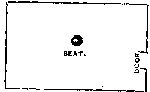
Suddenly I saw my old grandfather in the doorway. I was in that semi-conscious state of well-being and quietude natural to a man with a good appetite who has dined satisfactorily. I was not at all astonished to see my grandfather there. In fact, I was vegetating just then, thinking of nothing in particular. Nevertheless, I said to myself:—“It is droll that the rays of the setting sun should pour gold and purple through the least folds of my grandfather’s garments and face.” In fact, the setting sun was red, and threw its last horizontal rays diagonally athwart the doorway. Grandfather had a beneficent countenance. He smiled and seemed happy. All at once he disappeared along with the vanishing sun, and I roused myself as from a dream, but with the conviction that I had seen an apparition. Six weeks afterwards I was apprised by letter that my grandfather had died on the night of August 25 and 26 between one and two o’clock. Well, there is a difference of five and one-half hours between the longitude of Belgium, where my grandfather died, and the longitude of Texas where I was, and where the sun set at about seven o’clock.
It would be easy to cite a large number of similar cases. Let me end this section with the following conclusion of Ch. Richet, the learned editor of the Revue Scientifique:—
Unless we discredit the value of all human testimony, these stories are veritable and accurate. Whenever kindred incidents are reproduced by experiment, telepathy will no longer be disputed, but admitted as a natural phenomenon, as well proven as the rotation of the earth, or as the contagion of tuberculosis. To-day’s audacious theories will, in a few years, seem almost like infantile truisms.
We have now come to the closing section of this already long essay,—namely, to the explanation of such phenomena as table-tipping, spirit rapping and dictation, and distant transmission of thought. Let us confess that it is much easier to unfold and discuss such facts, than to determine their modus operandi. I will add that, even if in the present state of our knowledge, it is impossible to explain these facts, there is no shadow of a reason for rejecting them.
The theory with which we conclude has been anticipated by the preceding sections.
What is the universe? What is nature? What are beings? What are things?
From astronomy to physiology, everything constrains us to allow the existence of at least two elements—force and matter.
The order and laws of the universe, together with human thought and consciousness, lead us to admit (besides force and matter) a third element—intelligence; for speaking only of the constituency of our planet, no chemical combination whatever has ever been known to produce an idea.
Force directs. Matter obeys.
Force is invisible and so is matter.
All matter whatsoever is composed of atoms, too infinitesimal for our perception, and even invisible beneath the most powerful microscope but whose existence is demonstrated by chemistry, as well as by physics. The molecules of iron, gold, hydrogen, oxygen, carbon, appear to be groups of atoms. Even if we deny the existence of atoms, and admit only the existence of molecules, they also are invisible.
Matter, therefore, in its very essence, is invisible. Our eyes behold only motion and transitory forms. Our hands touch only appearances. Hardness and softness, heat and cold, weight and lightness, are relative, not absolute conditions.
What we call matter is only an effect produced upon our senses by the motion of atoms,—that is to say, by our unceasing receptivity to sensations.
The universe is a dynamic conglomerate. Atoms are in perpetual motion, caused by forces. All is movement. Heat, light, electricity, terrestrial magnetism, do not exist as independent agents. They are but modes of motion. That which actually exists is force. It is force that sustains the universe. It is force that projects the earth into space. It is force that constitutes living creatures.
The human soul is a principle of force. Thought is a dynamic act. Psychical force acts upon the matter composing our bodies, and actuates all our members to fulfil their tasks. Like all forces, psychical force can transform itself, can become electricity, heat, light, motion; for these are all modes of motion. Psychical force is itself in motion.
It can act outside the limits of the human organism, and can temporarily animate a table. I place my hands on a round table, with a firm desire to see it obey my will. I communicate to it a certain heat, a certain electricity, a certain polarization, or a certain other something we have not yet discovered. The stand becomes, so to speak, an extension of my body, and submits to the influence of my will. I look at a person. I take his hand. I thus act upon him.
More than this. If the brain of another person vibrates in unison with mine, or has at one in harmony with the keynote of my own brain, I can act upon him, even from a distance.
If I emit a sound a few yards from a piano, those piano-strings which are in harmony with my utterance will vibrate, and themselves send forth a kindred sound, easily distinguishable.
A telegraph wire transmits a despatch: A neighboring wire is influenced by induction; and it has been possible, by the aid of this second and separate wire, to read messages sent over the first.
There is still more to be said. The principle of the transformation of force to-day opens to us new views which might well be called marvellous. We every day make use of the telephone, without thinking that it is, in itself, more astonishing than all the occult facts considered in this paper.
You speak. Your voice is transmitted ten or twenty thousand kilometers, from Paris to Marseilles, and even farther away. You think it is your own voice which is heard and recognized at the other end of the wire; but it is not; your voice has not made the journey. Sound of itself, in its ordinary state, is not transmitted with anything like the rapidity attending this flight over the copper wire. If it were otherwise, we should have to wait seven hours and twenty-four seconds for a response, whereas there is no appreciable delay in the telephonic passage of sound. The usual vocal velocity becomes electric velocity, and the interval between the terminal stations of the wire is traversed instantaneously. On reaching its destination, the current again transforms itself into sound through its encounter with a medial, an environment like that at its starting-point.
Is the conductive wire indispensable? By no means! Is there a connecting wire between the sun and the earth? Yet the spots on the sun occasion rebounds in the variations of terrestrial magnetism. In the photophone the conductive wire has already been dispensed with, and a ray of light is used in its place. You speak behind a mirror, and thus cause it to vibrate. These vibrations modify the reflection of light from the vibrating mirror, which thus bears along your voice, with which it becomes charged. Selenium, the chemical element used in the operation, transmits the sound to the telephone, and your spoken word is reproduced.
The principal of the transformation of forces is undoubtedly one of the most prolific in modern physics. Heat can be transformed into mechanical motion; mechanical motion may be transformed into heat. Electricity is transformable into magnetism; and, reciprocally, magnetism may change into electricity, into light. The motion of the mill-wheel serves to illuminate your house. From Paris you can light a lamp in Brussels. When you act from afar upon another mind, it is not your thought which travels, as a mental condition; but your thought traverses the intervening ether through a series of vibrations as yet unknown to us, and only becomes thought again when brought into contact with another brain, because the last transference brings the impulse into a medium akin to that from which it started. It is therefore necessary that this second brain should be in sympathy with yours; that is to say, using one of Doctor Ochorowiez’s expressions, that “the dynamic tone” of the receiver should be in accord with your own. It is, moreover, noticeable that there are periods when veritable thought-currents affect thousands of brains at the same moment. At the bottom of all this there is but one principle, and that is identical with the relation existing between the magnet and the iron, between the sun and the earth,—namely, the transmission and transformation of motion. Herbert Spencer has said:—
The discovery that matter, so simple in appearance, is wonderfully complicated in its vital structure,—and that other discovery, that its molecules, oscillating with a rapidity almost infinite, convey their impressions to the surrounding ether, which, in turn, transmits them over inconceivable distances, in an inconceivably short space of time,—these discoveries lead us to the even more marvellous discovery, that any kind of molecules are affected in a special manner by molecules of the same kind, though situated in the most distant regions of space.
It requires but one step more for the admission that psychical communications may be established between an inhabitant of Mars and an inhabitant of the earth.
We are often asked what all these studies amount to. That is still unknown. If they should end in a scientific proof of the existence and immortality of the soul, these investigations would forthwith surpass in value all other human sciences put together, without a single exception.
It must be acknowledged that this reason is a sufficient authorization for us not to despise this class of researches. But this argument is needless. These investigations relate to the unknown, and that reason is all-sufficient.
Did Galvani in examining the convulsions of his frogs, have any idea of the immense, the prodigious, the universal part which electric science was to perform in less than a century? Denis Papin and Robert Fulton, Benjamin Franklin and James Watts, Jouffroy and Daguerre,—all the inventors, all the searchers after truth,—were they wrong in losing themselves in their pursuit of the unknown? It is such men who cause the advance of humanity. It is to them mankind owes its progress.
If it were proved, we say, that there exists outside of us, and even within us, an immaterial and spiritual force, which eludes the known processes of nature, and the acknowledged laws of life,—and which reveals itself by other processes and other laws, which do not supplant the first, but take an equal place beside them, this new knowledge might enlighten somewhat the shadows which now conceal the great secret of the origin and destiny of such poor beings as ourselves.
First of all, let us seek the truth. To be sure, Taine has written very wittily: “I never thought that a truth could be of any practical use!” but we may not be of the same mind, and may think, on the contrary, that the search for truth is the prime object of men’s intellectual existence.