Volume 4 / Part 1 — SOCIETY’S EXILES.
Reading edition
BY B. O. FLOWER.
It is difficult to over-estimate the gravity of the problem presented by those compelled to exist in the slums of our populous cities, even when considered from a purely economic point of view. From the midst of this commonwealth of degradation there goes forth a moral contagion, scourging society in all its ramifications, coupled with an atmosphere of physical decay—an atmosphere reeking with filth, heavy with foul odors, laden with disease. In time of any contagion the social cellar becomes the hotbed of death, sending forth myriads of fatal germs which permeate the air for miles around, causing thousands to die because society is too short-sighted to understand that the interest of its humblest member is the interest of all. The slums of our cities are the reservoirs of physical and moral death, an enormous expense to the State, a constant menace to society, a reality whose shadow is at once colossal and portentous. In time of social upheavals they will prove magazines of destruction; for while revolution will not originate in them, once let a popular uprising take form and the cellars will reinforce it in a manner more terrible than words can portray. Considered ethically, the problem is even more embarrassing and deplorable; here, as nowhere else in civilized society, thousands of our fellowmen are exiled from the enjoyments of civilization, forced into life’s lowest strata of existence, branded with that fatal word scum. If they aspire to rise, society shrinks from them; they seem of another world; they are of another world; driven into the darkness of a hopeless existence, viewed much as were lepers in olden times. Over their heads perpetually rests the dread of eviction, of sickness, and of failure to obtain sufficient work to keep life in the forms of their loved ones, making existence a perpetual nightmare, from which death alone brings release. Say not that they do not feel this; I have talked with them; I have seen the agony born of a fear that rests heavy on their souls stamped in their wrinkled faces and peering forth from great pathetic eyes. For them winter has real terror, for they possess neither clothes to keep comfortable the body, nor means with which to properly warm their miserable tenements. Summer is scarcely less frightful in their quarters, with the heat at once stifling, suffocating, almost intolerable; heat which acting on the myriad germs of disease produces fever, often ending in death, or, what is still more dreaded, chronic invalidism. Starvation, misery, and vice, trinity of despair, haunt their every step. The Golden Rule,—the foundation of true civilization, the keynote of human happiness,—reaches not their wretched quarters. Placed by society under the ban, life is one long and terrible night. But tragic as is the fate of the present generation, still more appalling is the picture when we contemplate the thousands of little waves of life yearly washed into the cellar of being; fragile, helpless innocents, responsible in no way for their presence or environment, yet condemned to a fate more frightful than the beasts of the field; human beings wandering in the dark, existing in the sewer, ever feeling the crushing weight of the gay world above, which thinks little and cares less for them. Infinitely pathetic is their lot.
The causes that have operated to produce these conditions are numerous and complex, the most apparent being the immense influx of immigration from the crowded centres of the old world; the glamor of city life, which has allured thousands from the country, fascinating them from afar much as the gaudy colors and tinsel before the footlights dazzle the vision of a child; the rapid growth of the saloon, rendered well-nigh impregnable by the wealth of the liquor power; the wonderful labor-saving inventions, which in the hands of greed and avarice, instead of mitigating the burdens of the people, have greatly augmented them, by glutting the market with labor; the opportunities given by the government through grants, special privileges, and protective measures for rapid accumulation of wealth by the few; the power which this wealth has given its possessors over the less fortunate; the spread of that fevered mental condition which subjects all finer feelings and holier aspirations to the acquisition of gold and the gratification of carnal appetites, and which is manifest in such a startling degree in the gambler’s world, which to dignify we call the realm of speculation; the desire for vulgar ostentation and luxurious indulgence, in a word the fatal fever for gold which has infested the social atmosphere, and taken possession of hundreds of thousands of our people, chilling their hearts, benumbing their conscience, choking all divine impulses and refined sensibilities; the cowardice and lethargy of the Church, which has grown rich in gold and poor in the possession of moral energy, which no longer dares to denounce the money changers, or alarm those who day by day are anæsthetizing their own souls, while adding to the misery of the world. The church has become, to a great extent, subsidized by gold, saying in effect, “I am rich and increased in goods and have need of nothing,” apparently ignorant of the fact that she “is wretched, poor, blind, and naked,” that she has signally failed in her mission of establishing on earth an ideal brotherhood. Instead of lifting her children into that lofty spiritual realm where each feels the misery of his brother, she has so far surrendered to the mammon of unrighteousness that, without the slightest fear of having their consciences disturbed, men find comfort in her soft-cushioned pews, who are wringing from ten to thirty per cent. profit from their fellowmen in the wretched tenement districts, or who refuse to pay more than twelve cents a pair for the making of pants, forty-five cents a dozen for flannel shirts, seventy-five cents a dozen for knee pants, and twenty-five cents a dozen for neckties. I refer not to the many noble exceptions, but I indict the great body of wealthy and fashionable churches, whose ministers do not know and take no steps to find out the misery that is dependent upon the avarice of their parishioners. Then again back of all this is the defective education which has developed all save character in man; education which has trained the brain but shriveled the soul. Last but by no means least is land speculation which has resulted in keeping large tracts of land idle which otherwise would have blossomed with happy homes. To these influences we must add the general ignorance of the people regarding the nature, extent, and growing proportions of the misery and want in the New World which is spreading as an Eastern plague in the filth of an oriental city.
It is not my present purpose to dwell further on the causes which have produced these conditions. I wish to bring home to the mind and heart of the reader a true conception of life in the slums, by citing typical cases illustrating a condition prevalent in every great city of the Union and increasing in its extent every year. I shall confine myself to uninvited want as found in civilized Boston, because I am personally acquainted with the condition of affairs here, and because Boston has long claimed the proud distinction of being practically free from poverty.
I shall briefly describe scenes which fell under my personal observation during an afternoon tour through the slums of the North End, confining myself to a few typical cases which fairly represent the condition of numbers of families who are suffering through uninvited poverty, a fact which I have fully verified by subsequent visits to the wretched homes of our very poor. I purposely omit in this paper describing any members of that terrible commonwealth where misery, vice, degradation, and crime are inseparably interwoven. This class belongs to a lower stratum; they have graduated downward. Feeling that society’s hand is against them, Ishmael-like they raise their hand against society. They complement the uninvited poor; both are largely a product of unjust and inequitable social conditions.
The scenes I am about to describe were witnessed one afternoon in April. The day was sunless and dreary, strangely in keeping with the environment of the exiles of society who dwell in the slums. The sobbing rain, the sad, low murmur of the wind under the eaves and through the narrow alleys, the cheerless frowning sky above, were in perfect harmony with the pathetic drama of life I was witnessing. Everything seemed pitched in a minor key, save now and then there swelled forth splendid notes of manly heroism and womanly courage, as boldly contrasting with the dead level of life as do the full rich notes of Wagner’s grandest strains with the plaintive melody of a simple ballad sung by a shepherd lad. I was accompanied in this instance by the Rev. Walter Swaffield, of the Bethel Mission, and his assistant, Rev. W. J. English.
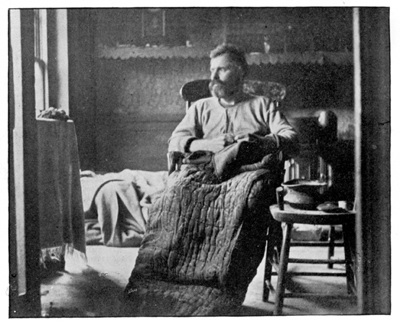
INVALID IN CHAIR (SEE NOTE).
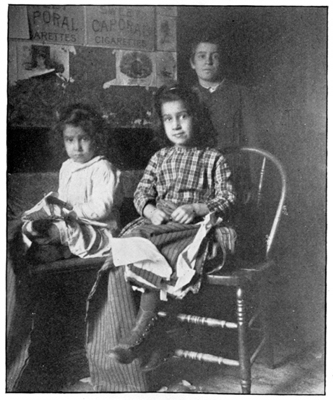
CONSTANCE AND MAGGIE (SEE NOTE).
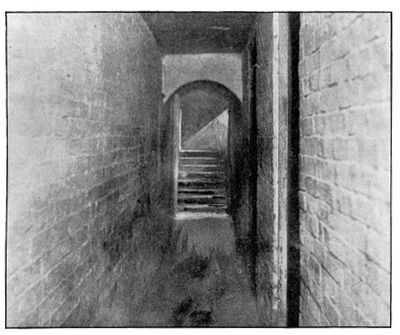
CELLARWAY LEADING TO UNDER-GROUND APARTMENTS (SEE NOTE).
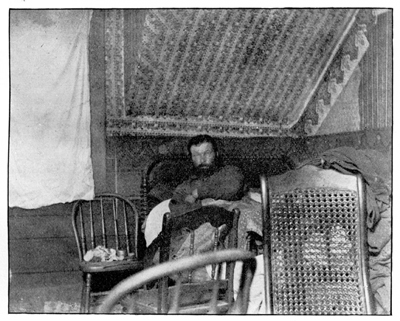
SICK MAN IN UNDER-GROUND APARTMENT (SEE NOTE).
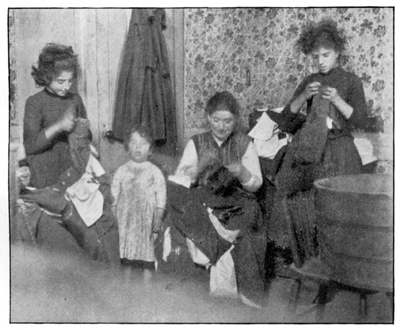
PORTUGUESE WIDOW AND THREE CHILDREN (SEE NOTE).
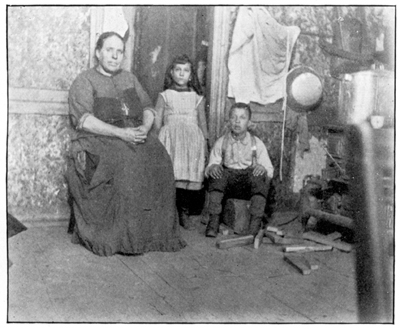
WIDOW AND TWO CHILDREN IN UNDER-GROUND TENEMENT (SEE NOTE).
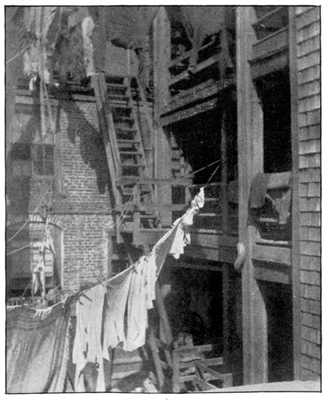
EXTERIOR OF A NORTH END TENEMENT HOUSE (SEE NOTE).
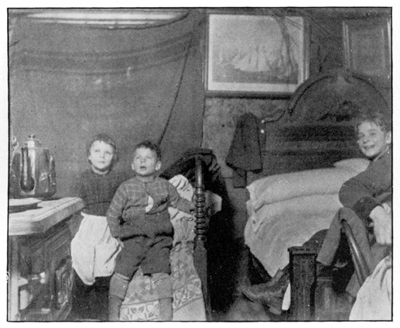
UNDER-GROUND TENEMENT WITH TWO BEDS (SEE NOTE).
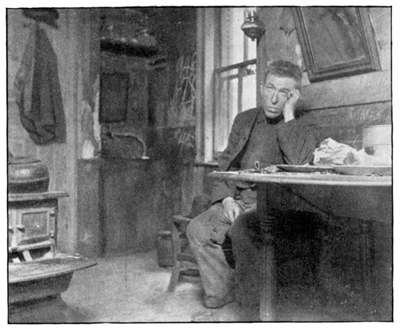
OUT OF WORK (SEE NOTE).
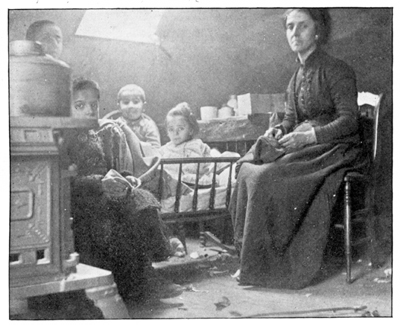
PORTUGUESE WIDOW IN ATTIC (SEE NOTE).
I thought as I studied the anxious and sorrowful countenance of that mother, how hard, indeed, is the lot of the very poor. They have to buy coal by the basketful and pay almost double price, likewise food and all life’s necessities. They are compelled to live in frightful disease-fostering quarters, and pay exorbitant rents for the accommodations they receive. When sick they are not always free from imposition, even when they receive aid in the name of charity, and sometimes theology under the cloak of religion oppresses them. This last thought had been suggested by seeing in our rounds some half-starved women dropping pennies into the hands of Sisters of Charity, who were even here in the midst of terrible want, exacting from the starving money for a church whose coffers groan with wealth. O religion, ineffably radiant and exalting in thy pure influence, how thou art often debased by thy professed followers! How much injustice is meted out to the very poor, and how many crimes are still committed under thy cloak and in thy holy name! Even this poor widow had bitterly suffered through priests who belong to a great communion, claiming to follow Him who cried, “Come unto me all ye who are weary and heavy laden, and I will give you rest,” as will be seen by the following, related to me by Rev. Walter Swaffield, who was personally cognizant of the facts. The husband of this widow was out of work for a time; being too ill to engage in steady work, he found it impossible to pay the required ten cents for seats in the church to which he belonged, and was consequently excluded from his sitting. Shortly after he fell sick, his wife sought the priest, imploring him to administer the sacrament, and later extreme unction, which he positively refused, leaving the poor man to die without the consolation of the Church he had from infancy been taught to love and revere.
It is not strange that many in this world of misery become embittered against society; that they sometimes learn to hate all who live in comfort, and who represent the established order of things, and from the rank of the patient, uncomplaining struggler descend to a lower zone, where the moral nature is eclipsed by degradation and crime, and life takes on a deeper shade of horror. This class of people exist on the brink of a precipice. Socially, they may be likened to the physical condition of Victor Hugo’s Claude Frollo after Quasimodo had hurled him from the tower of Notre Dame. You remember the sickening sensation produced by that wonderful piece of descriptive work, depicting the false priest hanging to the eaves, vainly striving to ascend, feeling the leaden gutter to which he was holding slowly giving away. His hands send momentary messages to the brain, warning it that endurance is almost exhausted. Below he sees the sharp formidable spires of Saint-Jean-de-Ronde, and immediately under him, two hundred feet from where he hangs, are the hard pavement, where men appear like pigmies. Above stands the avenging hunchback ready to hurl him back if he succeed in climbing over the eaves. So these poor people have ever below them starvation, eviction, and sickness. Above stands Quasimodo in the form of a three-headed monster: a soulless landlord, the slave master who pays only starvation wages, and disease, the natural complement of the wretched squalor permitted by the one, and the slow starvation necessarily incident to the prices paid by the other. Their lot is even more terrible when it is remembered that their fall carries with it the fate of their loved ones. In addition to the multitude who are condemned to suffer through uninvited poverty, with no hopeful outlook before them, there is another class who are constantly on the brink of real distress, and who are liable at any time, to suffer bitterly because they are proud-spirited and will almost starve to death before they ask for aid. Space prevents me from citing more than one illustration of this character. In an apartment house we found an American woman with a babe two weeks old and a little girl. The place was scrupulously clean, something very rare in this zone of life. The woman, of course, was weak from illness and, as yet, unable to take in any work to speak of. Her husband has been out of employment for a few weeks, but had just shipped on board a sailing vessel for a cruise of several months. The woman did not intimate that they were in great need, as she hoped to soon be enabled to make some money, and the portion of her husband’s wages she was allowed to draw, paid the rent. A week ago, however, the little girl came to the Bethel Mission asking for a loaf of bread. “We have had nothing to eat since Monday morning,” she said, “and the little baby cries all the time because mamma can give it no milk.” It was Wednesday evening when the child visited the Mission. An investigation substantiated the truth of the child’s words. The mother, too proud to beg, struggled with fate, hoping and praying to be able to succeed without asking for aid, but seeing her babe starving to death, she yielded. This case finds many counterparts where a little aid bridges over a period of frightful want, after which the unfortunate are able, in a measure, to take care of themselves.
I find it impossible in this paper to touch upon other cases I desired to describe. The above illustrations however, typical of the life and environment of hundreds of families, are sufficient to emphasize a condition which exists in our midst and which is yearly growing, both in extent and in intensity of bitterness; a condition that is little understood by those who are not actually brought in contact with the circumstances as they exist, a condition at once revolting and appalling to every sense of humanity and justice. We cannot afford to remain ignorant of the real status of life in our midst, any more than we can afford to sacrifice truth to optimism. It has become a habit with some to make light of these grim and terrible facts, to minify the suffering experienced, or to try and impute the terrible condition to drink. This may be pleasant but it will never alter conditions or aid the cause of reform. It is our duty to honestly face the deplorable conditions, and courageously set to work to ameliorate the suffering, and bring about radical reformatory measures calculated to invest life with a rich, new significance for this multitude so long exiles from joy, gladness, and comfort.
Let us now examine a broader aspect of this problem. So long as the wretched, filthy dens of dirt, vermin, and disease stand as the only shelter for the children of the scum, so long will moral and physical contagion flourish and send forth death-dealing germs; so long will crime and degradation increase, demanding more policemen, more numerous judiciary, and larger prisons. No great permanent or far-reaching reformation can be brought about until the habitations of the people are radically improved. The recognition of this fact has already led to a practical palliative measure for relief that must challenge the admiration of all thoughtful persons interested in the welfare of society’s exiles. It is a step in the direction of justice. It is not merely a work of charity; it is, I think, the most feasible immediate measure that can be employed which will change the whole aspect of life for tens of thousands, making existence mean something, and giving a wonderful significance to the now meaningless word home. I refer to the erection of model tenement apartments in our overcrowded sections, such, for example, as the Victoria Square dwelling of Liverpool. Here, on the former site of miserable tenement houses, sheltering more than a thousand people, stands to-day a palatial structure built around a hollow square, the major part of which is utilized as a large shrub-encircled playground for the children. The halls and stairways of the building are broad, light, and airy; the ventilation and sanitary arrangements perfect. The apartments are divided into one, two, and three rooms each. No room is smaller than 13 × 8 feet 6 inches; most of them are 12 × 13 feet 4 inches. All the ceilings are 9 feet high. A superintendent looks after the building. The tenants are expected to be orderly, and to keep their apartments clean. The roomy character of halls and chambers may be inferred from the fact that there are only two hundred and seventy-five apartments in the entire building. The returns on the total expenditure of the building, which was $338,800.00, it is estimated will be at least 4½ per cent, while the rents are as follows: $1.44 per week for the three-room tenement, $1.08 per week for those containing two large rooms, and 54 cents for the one-room quarters. In Boston, the rents for the dreadful one-room cellar are $1.00 a week; for the two-room tenements above the cellars, the rent, so far as I heard, ranged from $1.50 to $2.50; three rooms were, of course, much higher. The rooms also are far smaller here than those in the beautiful, healthful, and inviting Victoria Square apartments. Yet it will be observed that the Shylock landlords receive more than double the rental paid in this building for dens which would be a disgrace to barbarism. A similar experiment, in many respects even more remarkable than that recently inaugurated by the Liverpool co-operation, is exhibited in the Peabody dwellings in London. These apartments have been in successful operation for so many years, while the results attending them have been so marked and salutary, that no discussion of this subject would be complete that failed to give some of the most important facts relating to them. I know of no single act of philanthropy that towers so nobly above the sordid greed of the struggling multitude of millionaires, as does this splendid work of George Peabody, by which to-day twenty thousand people, who but for him would be in the depths of the slums, are fronting a bright future, and with souls full of hope are struggling into a higher civilization. It will be remembered that Mr. Peabody donated at intervals extending over a period of eleven years, or from 1862 to 1873, £500,000 or $2,500,000 to this project of relieving the poor. He specified that his purpose was to ameliorate the condition of the poor and needy of London, and promote their comfort and happiness, making only the following conditions:—
“First and foremost amongst them is the limitation of its uses, absolutely and, exclusively, to such purposes as may be calculated directly to ameliorate the condition and augment the comforts of the poor, who, either by birth or established residence, form a recognized portion of the population of London.
“Secondly, it is my intention that now, and for all time, there shall be a rigid exclusion from the management of this fund, of any influences calculated to impart to it a character either sectarian as regards religion, or exclusive in relation to party politics.
“Thirdly, it is my wish that the sole qualification for a participation in the benefits of the fund shall be an ascertained and continued condition of life, such as brings the individual within the description (in the ordinary sense of the word) of the poor of London: combined with moral character, and good conduct as a member of society.”
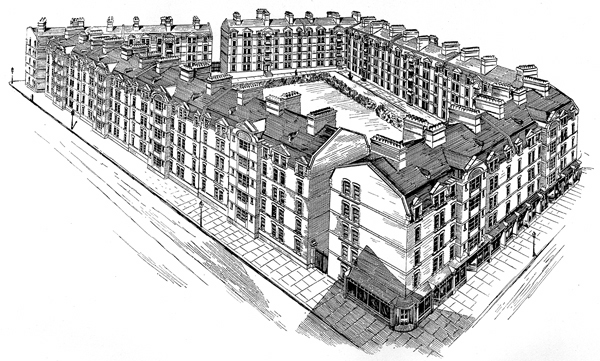
THE VICTORIA SQUARE APARTMENT HOUSE, LIVERPOOL, ENG.
Realizing that little could be hoped for from individuals or their offspring, who were condemned to a life in vile dens, where the squalor and wretchedness was only equalled by the poisonous, disease-breeding atmosphere and the general filth which characterized the tenement districts, the trustees Mr. Peabody selected to carry forward his work, engaged in the erection of a large building accommodating over two hundred, at a cost of $136,500. This apartment house, which is substantially uniform with the seventeen additional buildings since constructed from the Peabody fund, is five stories high, built around a hollow square, thus giving plenty of fresh air and sunshine to the rear as well as the front of the entire building. The square affords a large playground for the children where they are in no danger of being run over by vehicles, and where they are under the immediate eye of many of the parents. The building is divided into tenements of one, two, and three room apartments, according to the requirements of the occupant. There are also nine stores on the ground floor, which bring a rental of something over $1,500 a year for each of the buildings. By careful, honest, and conscientious business management, the original sum of $2,500,000 has been almost doubled, while comfortable, healthful homes have been procured for an army of over 20,000 persons. Some of the apartments contain four rooms, many three, some two, others one. The average rent is about $1.15 for an apartment. The average price for three-room apartments in the wretched tenements of London, is from $1.45 a week. In the Peabody dwellings, the death rate is .96 per one thousand below the average in London. Thus it will be seen that while large, healthful, airy, and cheerful homes have been provided for over 20,000 at a lower figure than the wretched disease-fostering and crime-breeding tenements of soulless Shylocks, the Peabody fund has, since 1862, grown to nearly $5,000,000, or almost twice the sum given for the work by the great philanthropist. No words can adequately describe the magnitude of this splendid work, any more than we can measure the good it has accomplished, the crime prevented, or the lives that through it have grown to ornament and bless society. In the Liverpool experiment, the work has been prosecuted by the municipal government. In the Peabody dwellings, it has, of course, been the work of an individual, carried on by a board of high-minded, honorable, and philanthropic gentlemen. To my mind, it seems far more practicable for philanthropic, monied men to prosecute this work as a business investment, specifying in their wills that rents shall not rise above a figure necessary to insure a fair interest on the money, rather than leave it for city governments, as in the latter case it would be in great danger of becoming an additional stronghold for unscrupulous city officials to use for political purposes. I know of no field where men with millions can so bless the race as by following Mr. Peabody’s example in our great cities. If, instead of willing every year princely sums to old, rich, and conservative educational institutions, which already possess far more money than they require,—wealthy persons would bequeath sums for the erection of buildings after the manner of the Victoria Square or the Peabody Dwellings, a wonderful transformation would soon appear in our cities. Crime would diminish, life would rise to a higher level, and from the hearts and brains of tens of thousands, a great and terrible load would be lifted. Yet noble and praiseworthy as is this work, we must not lose sight of the fact, that at best it is only a palliative measure: a grand, noble, beneficent work which challenges our admiration, and should receive our cordial support; still it is only a palliative.
There is a broader aspect still, a nobler work to be accomplished. As long as speculation continues in that great gift of God to man, land, the problem will be unsettled. So long as the landlords find that the more wretched, filthy, rickety, and loathsome a building is, the lower will be the taxes, he will continue to make some of the ever-increasing army of bread winners dwell in his foul, disease-impregnated dens.
The present economic system is being rapidly outgrown. Man’s increasing intelligence, sense of justice, and the humanitarian spirit of the age, demand radical changes, which will come immeasurably nearer securing equal opportunities for all persons than the past dreamed possible. No sudden or rash measure calculated to convulse business and work great suffering should be entertained, but our future action should rest on a broad, settled policy founded upon justice, tempered by moderation, keeping in view the great work of banishing uninvited poverty, and elevating to a higher level the great struggling millions without for a moment sacrificing individualism. Indeed, a truer democracy in which a higher interpretation of justice, and a broader conception of individual freedom, and a more sacred regard for liberty, should be the watchword of the future.