Chapter VI · THE RONDO.
Reading edition
The study of the suite contained in the last chapter has brought us for the first time into contact with a cyclic form. We have seen that, as instruments developed, as the technique of playing them advanced, and as the themes and their harmonies became more plastic, composers naturally sought some larger plan than that afforded by a single dance form; they thus arrived at the suite. But the suite was inclined to be monotonous. The same key was used for all the separate movements, there was an almost invariable stated length for each, and the rhythms were too insistent to admit of great variety of expression. So composers began to experiment with other forms, chief among which was the sonata.[14]
Through all the rest of this book we shall be dealing directly or indirectly with the musical forms that go to make up the complete sonata. In the present chapter we shall deal with one of its simplest and most primitive types of structure, the rondo.
Sonatas were written as far back as the seventeenth century. Kuhnau's celebrated "Bible Sonatas," crude attempts at program music, are among the notable examples of primitive sonatas. These were indeed "sound-pieces," but their resemblance to a real sonata, as we understand the term, is slight. Bach and Handel each wrote sonatas; and some of Bach's are masterly examples of the then prevailing style. His sonata for violin and piano in F-minor (number V in Peters' edition) may be studied as an example of the form. It contains four movements, the first, second, and fourth of which are purely polyphonic, the third being one of those beautiful meditative pieces of a somewhat rhapsodical style in which Bach seems to have specially delighted. Italian contemporaries of Bach also wrote sonatas, and some of those by D. Scarlatti (1683-1757) and A. Corelli (1653-1713) were of considerable importance in the development of the form. All these early specimens, however, were either vague and indeterminate in form, or were hampered in their expression by the old polyphonic methods. The modern sonata first begins to emerge in the work of Philip Emanuel Bach, son of John Sebastian, and his compositions in this style will be the subject of a later chapter.
I. DERIVATION OF THE RONDO.
Our investigations into the formal element of early dance music have thus far revealed two plans, "binary" and "ternary," i. e., two-part and three-part. For such short pieces as the inventions of Bach, and for many of the separate dances in suites, the two-part form was adequate, but when instrumental music began to develop on broader lines, so that each of the halves was extended to a considerable length, the advantage of the three-part form with its "restatement after contrast" was readily perceived, and it came to be frequently used.
Among the early experiments in form we find a kind of extension of ternary form by the repetition of its separate parts. Such pieces sometimes consist of but one stable phrase (A) with alternating phrases of an indefinite character, while others alternate two set phrases, as: A, B, A, B, A, B, A, etc. The one fixed principle in these pieces seems to be that they should end with the phrase with which they began. In primitive songs this fixed part constituted the chorus, with which the solo melody alternated, having, of course, different words for each verse.
[PNG] Audio content is not currently supported on your device.
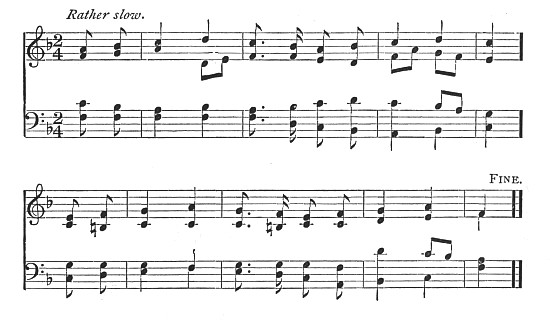
FIGURE XXII. NOUEL DE LAS FLOUS. (CAROL OF THE FLOWERS)
Chorus. Come with us, sweet flowers, and worship Christ the Lord, Let your perfumes hover round the Babe adored.
1st & 2nd Sopranos.
Chorus. Come with us, &c. (D.C.)
1. Modest violet, hiding in the grassy shade, Thou canst say how humble He for us is made. Come with us, &c.
2. Lily fair, low bending in the sun's warm light, Thou dost tell that He is pure as thou art white. Come with us, &c.
3. As thou, Pansy, shinest forth in bright array, So doth He His majesty to man display. Come with us, &c.
4. As thou, Rose, wide-opening dost thy scent impart, So His love expanding, draws each sinful heart. Come with us, &c.
"The question is sometimes raised whether in the primitive carol the chorus began, or whether, as in many of our own popular songs, it waited until the end of the first solo verse. Probably the former is of the greater antiquity; in any case, it is from it that the rondo[15] is derived."—Hadow, "Sonata Form."
An example of this primitive type of carol will be found in Figure XXII.
This is an ancient carol from the old province of Bas-Quercy (now Lot-et-Garonne) in the southwestern part of France.
The obvious weakness of this form, when applied to instrumental music, is its monotony. One would soon weary of a bald repetition over and over again of two phrases or two melodies to which no variety was imparted, such as the change of words supplies in the foregoing carol. In order to avoid this disadvantage the natural step to take would be to impart, by some means or other, variety to the music; and this was soon perceived by composers. The idea of a fixed part remained, i. e., the chief musical idea was retained in its original form, but the secondary melodies were varied. Once this change had taken place the rondo became a frequent medium of musical expression. Specimens of the early rondo may be found in Purcell's song, "I Attempt from Love's Sickness to Fly," and in Bach's, "Passepied en Rondeau," from the fifth English Suite. The formula for these two pieces is A, B, A, C, A.
Another interesting point is the plan of the harmony of the contrasting sections in the rondo. The first of these (B) would naturally follow the prevailing custom for "sections of contrast," and be in the dominant, or, if the piece were in minor, in the relative major (see Chapter II.); but the second (C) offered a further means of variety, and the instinct of composers led them to treat it in a free manner and not confine it to any one key. Each of the examples of rondo form referred to above adopts this method of procedure.
While this early form of the rondo possessed a certain charm, it was somewhat rigid in effect, since the various sections were separated from each other by a full close or complete pause. They were like little blocks that fitted together into a definite, if somewhat stiff pattern.
II. A RONDO BY COUPERIN.
The primitive rondo was chiefly cultivated by the French harpsichord composers of the early eighteenth century, of whom Couperin (1668-1733) and Rameau (1683-1764) were the most distinguished. Reference has been made in our chapter on "The Suite" to the "Ordres" of these composers, and to the perfecting, at the end of the seventeenth century, of the instrument for which they were written, the harpsichord. The strings of the harpsichord were not struck by hammers, as in the modern pianoforte, but plucked by quills, as the strings of a banjo are plucked by the fingers of the player. It has been said of the harpsichord that it produced "a scratch with a tone at the end of it." The tone produced in this primitive way was weak and of brief duration, so that composers not only had to keep re-enforcing a tone by striking it again, as in the trills and other ornaments so characteristic of their music, but had to avoid altogether any long sustained passages such as are common in modern music. They had also to substitute for the polyphonic style, the entire effectiveness of which depends upon the sustainment of its melodies, a homophonic or one-voiced style which, while distinct from that usual in modern piano music, was historically an important factor in its development.
EXAMPLE FOR ANALYSIS, No. 8.
Couperin: "Les Moissonneurs" ("The Harvesters").
This na?e and delightful piece is a good example of the prevailing style of French domestic music in the eighteenth century. It is notable for its character of elegance; it is salon music, but at the same time it reveals a certain mimetic quality common among the French. The swing of its rhythm seems to catch a little of the idea conveyed by the title. Couperin's pieces have been called "a sort of refined ballet music," and they are, as a whole, based on well defined rhythmic movement. But we may trace in them the gradual progress away from dance forms and towards a freer and more idealized expression.
Couperin was called by his contemporaries "Le Grand," and was an important figure in the musical life of Paris during the reign of Louis XIV. His influence extended beyond France; even John Sebastian Bach adopts some of his methods in writing his French suites.
"Les Moissonneurs" may be formally tabulated as follows:
FIGURE XXIII. STRUCTURAL PLAN OF COUPERIN'S "LES MOISSONEURS."
Section Measures Notes
A [16]1-9 Entirely in tonic key with pause at end. (The key is B-flat major.)
B 10-14 Modulating to the dominant and ending thereon.
A 15-23 An exact repetition of the first A.
C 24-32 Entirely in relative minor key with pause at end.
A 33-41 An exact repetition of the first A.
D 42-56 Beginning in tonic; modulating to C minor and back again.
A 57-65 An exact repetition of the first A.
An examination of this rondo will reveal that the subsidiary portions—B. C. and D.—are episodes rather than distinct themes. Their melodies, instead of being entirely new as in the more highly developed rondos of Haydn and Mozart, are either literal copies of the chief melody, or close imitations of it, in related keys; so that the chief variety imparted by them is a variety of harmony. The plan of these harmonies should be carefully noted, particularly the use of the home key in the section marked D. This method of unifying a melody or a whole piece, by coming back to the original key at the end, embodying as it does an important ?thetic principle, has been pointed out several times already. We may say, then, that the structure of this piece is "harmonic" rather than "thematic." In all instrumental music of any consequence this harmonic element is of great importance.
The use of the word "Couplet" to describe the episodes seems to indicate the derivation of these rondos from the old song and chorus like the "Carol of the Flowers." In fact, one gets from this piece a decided impression as of a fixed[17] part in somewhat rigid form, and with comparatively full "harmonies," alternating with verses (couplets) in which the right hand plays, as it were, a solo melody against an unobtrusive accompaniment.
III. FROM COUPERIN TO MOZART.
This form of the rondo[18] persisted until the time of Haydn and Mozart, and our next example for analysis is from that period. During the century that elapsed between Couperin and Mozart the piano was so perfected as to displace the harpsichord. The invention of the damper pedal entirely changed the style of writing for the piano, and the necessity for filling out the melody with elaborate ornamentation no longer existed. The greater power and better action of the new instruments also afforded composers a much wider scope.
But more important still, during this century Philip Emanuel Bach (1714-1788) had written some pianoforte works that advanced the art into a new realm. In the eighth chapter we shall study one of his pianoforte sonatas, but it may be said here that both Haydn and Mozart freely acknowledged their great debt to him. This study is postponed for the moment because he did not affect the form of the rondo.
Franz Josef Haydn (1732-1809), who spent many years as Kapellmeister to Prince Esterhazy and who, in consequence, lived more or less isolated from the world, made many interesting experiments with musical forms. He may be said to be the father of the symphony and the string quartet, and several of his piano sonatas contain movements that are obviously attempts at creating new forms or combining old ones in new ways.
His ninth[19] piano sonata, for example, has for its finale a curious and interesting combination of the rondo and the variation form, while the finale to the third sonata is marked "Tempo di Minuetto." Such experiments are always to be found when we examine the work of creative minds.
[PNG] Audio content is not currently supported on your device.
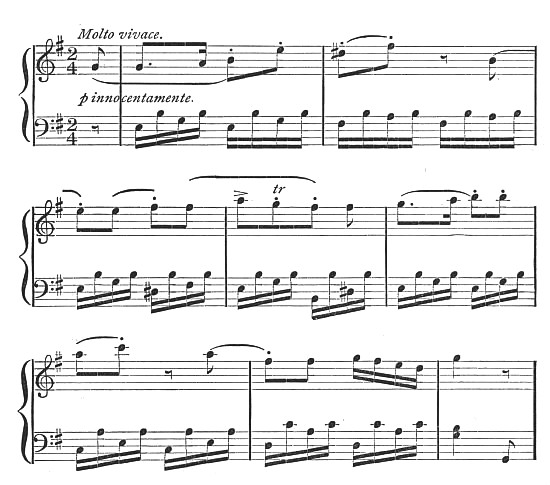
FIGURE XXIV.
Haydn's sonatas thus provide us with a link in the chain that binds Mozart to his predecessors. The foregoing quotation from Haydn's second sonata will illustrate the primitive nature of some of his rondo themes (Figure XXIV). This theme is, in effect, a jolly dance tune without pretensions to dignity, and against it is placed a conventional pattern accompaniment.
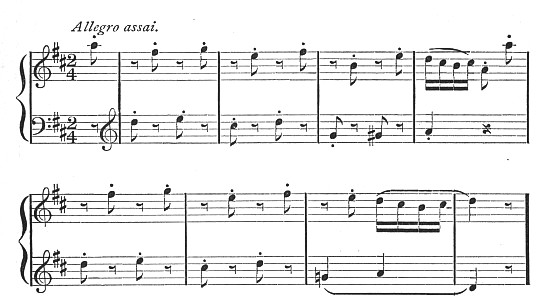
Another rondo theme from Haydn may be cited to illustrate his gentle humor.
[PNG] Audio content is not currently supported on your device.
FIGURE XXV.
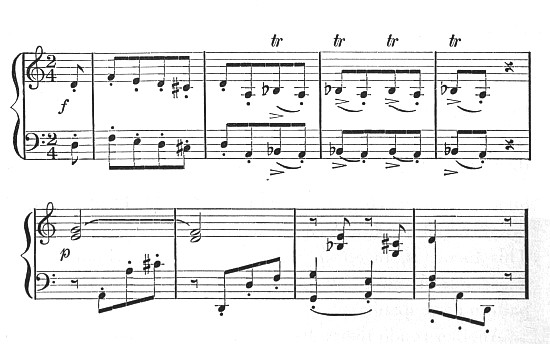
This has for its first episode, or secondary theme, the following vividly contrasting passage:
[PNG] Audio content is not currently supported on your device.
FIGURE XXVI.
These two quotations illustrate the childlike na?et? of Haydn's nature. He is never tragic; his pieces are like delightful pictures of rural life painted by an artist who was himself country born and bred and who feels the natural charm of the simplest, commonest things. Haydn's pictures are flooded with sunlight.
IV. A RONDO BY MOZART.
Wolfgang Amadeus Mozart (1756-1791), aside from his supreme greatness as a composer, represents the culmination of what is called the "Classical" period. The tendency away from strict polyphony and towards a free homophonic style has already been noted. It was the peasant-born Haydn who first subordinated polyphony, producing long instrumental pieces based on song melodies. His symphonies and string quartets are bubbling over with melodiousness. Often frankly adopting folk tunes, or inventing themes in the same style, he produced great works that depend hardly at all on the interweaving of themes, but have as their basis rather the exposition of single melodies as the raison d'?re of the music. Not by any means lacking in erudition, Haydn turns to na?e melody as his natural means of expression.
Along with this element, and as a component part of what we call "classic," is that perfection of form and style that particularly distinguishes the music of Mozart.
"His works are often cited as the most perfect illustrations of the classic idea in music,—this term referring in a general way to the absence of individualism in conformity to a general type of style and form, na?et? as opposed to self-consciousness, symmetry of outline, highest finish of detail, purity of sound, loftiness and serenity of mood."—Dickinson, "The Study of the History of Music."
EXAMPLE FOR ANALYSIS, No. 9.
Mozart: Rondo from Piano Sonata in B-flat major.
This rondo is the last of the three movements of this characteristic sonata. Mozart's piano sonatas seldom have more than three movements, and of these the rondo is last, the plan being to present the more highly organized movements first, and to end, as in the suite, with a bright and cheerful piece. The rondos of this period were lively and rhythmically energetic. While not essentially dance-like, they nevertheless were ultimately derived from the dance, and lacked the meditative and sentimental qualities to be found in slow movements. It is from one of these two sources—the dance tune and the folk-song—that all these sonata movements sprang. Contributory streams entered here and there—the polyphonic influence is discernible; Italian opera lends its fluent vocal style and occasionally its love of display in elaborate cadenzas; and, of course, the idiom of the piano—the peculiar manner of writing that the instrument requires—is always present.
The first theme of this movement, for example, suggests motion; one can almost imagine the opening section (measures 1-16) as suited to the first evolution in a dance, and the second (beginning at measure 16) as the strain intended for a new set of dancers, while the chords in measure 17 quite vividly suggest the steps of a dance. The left hand part is largely in the familiar idiom of the piano of Mozart's time, though there is occasionally polyphonic treatment—as in measures 1-8. The various divisions of the piece are strongly marked by cadences, sometimes preceded by formal patterns of scales, or other meaningless passages, as at 144-147, such as Wagner likened to "the clatter of dishes at a royal banquet." Sequences, so familiar in the music of Bach, frequently appear here, and were, indeed, a part of the phraseology of the time. The passage between measures 189 and 193 is, in this respect, especially notable because of the harsh dissonance between E-flat and D at measure 191.
The cadenza is an interesting and unusual factor in this rondo. A cadenza always occurred in certain types of operatic arias, and in the concerto was introduced to display the skill of the performer, but it is unusual to find one in a rondo.
FIGURE XXVII. STRUCTURAL PLAN OF MOZART'S RONDO IN B-FLAT MAJOR.
Section Measures Notes
A 1-24 Chief theme in two sections (1-8 and 9-24), the last slightly extended.
B 24-40 First contrasting theme in dominant. Measures 36-40 constitute a codetta to this section.
A 41-64 Chief theme as before, but modulating (62) to the relative minor.
C 64-111 Second contrasting theme in two parts: 1st in G-minor (64-75), 2nd in E-flat major (76-90). This section is concluded by a passage in C-minor based on motive from chief theme, and by a codetta (105-111) similar to that in B.
A 112-148 Chief theme as before, but extended.
B 148-172 First contrasting theme now in tonic, and with an extended codetta.
A 173-224 Free treatment of chief theme, and other material: motive from codetta extensively used (179-196); cadenza (198); epilogue, or coda (213).
This rondo flows on happily from beginning to end without touching either great heights or depths. It is a good example of a style of piano music intended more for the domestic circle than for the concert room. It shows that "absence of individualism in conformity to a general type of style and form" referred to by Dickinson, i. e., one does not feel in listening to it the obtrusion of a personal point of view; there are no idiosyncrasies such as are continually appearing in more modern music. There is here also that "purity of sound" that characterizes Mozart's music. There are no elisions, no subtleties of musical language, no suggested meanings such as one finds, for example, in Schumann. There is the same placidity, the same clearness of meaning, the same lucidity of diction that we find in the poetry of Mozart's day. Musical language was not then overlaid with secondary significance as it has since become.
An examination of Figure XXVII will reveal a considerable advance in this rondo over that of Couperin. The last section (A) in particular fulfills its office of providing, as it were, a kind of denouement to the whole piece; the interest is skillfully made to center or come to a climax here, and the stiff angularity that characterizes the older rondo is conspicuously absent. And while the scheme of harmonies in this rondo has many elements in common with that of "Les Moissonneurs," there are here excursions, by the way, into other keys giving variety and warmth of color. But, most important of all, the recurrence of the first contrasting theme (at measure 148) in the tonic key after having first appeared in the dominant (measure 24) gives to this piece a real strength, or stoutness of construction. It is as though there were certain strands in the fabric that run entirely through it and make it firm, whereas the Couperin rondo seems to be made by putting together a series of little blocks.
Another important point of contrast between these two rondos is in the matter of themes. Where Couperin has only one, which he presents in a variety of charming forms, but from which little that is new is evolved, Mozart has three distinct contrasting themes, and a little codetta motive; and all these germinate, even if but slightly, into new musical developments. The codetta passage, in particular, sprouts and blossoms (179-196) in a most delightful manner, the little germ having first appeared (36) as an unpromising and monotonous succession of single notes.
We referred at some length, in the chapter on "The Dance and Its Development," to this germination of musical thought as of the greatest importance in composition. The reader will readily understand that the highest form of an art like music, in which the element of time enters as a vital matter—in which the message of the composer comes to us in successive sounds—must depend on something more than the beauty of its several and successive melodies. In the first place, the limit of such a succession would soon be reached; the mind, after having taken in a certain number of melodies, would lose track of the first ones and be left in utter confusion. The obvious device of repeating the first phrase or melody at the point where, otherwise, this confusion would result, has been the determining motive of many of the simple forms we have thus far studied. But this, after all, is a primitive method, and it is obvious that its possibilities are limited. The rondo is, in effect, the furthest point to which this plan can go.
The fundamental quality in anything living—be it the state, the church, the family or the human body—is organism, the relation of all the parts to the whole. So in the greatest music as in the greatest literature, everything germinates from certain fundamental ideas, and nothing is extraneous. This rondo of Mozart represents a certain tendency of his to string beautiful melodies together—for his fund of melodies was well nigh inexhaustible. But he was too great a master not to see the weakness of such a procedure, and in works like his G-minor symphony he has left nearly perfect examples of this higher form of musical development;—perfect, that is, within his own horizon—a wider view was to unfold itself from that height to which Beethoven finally struggled.
SUGGESTIONS FOR COLLATERAL READING.
Parry: "The Evolution of the Art of Music," pp. 52 and 241. Dickinson: "The Study of the History of Music," Chapter XIV. Goetschius: "The Homophonic Forms of Musical Composition," p. 203. Mason: "Beethoven and His Forerunners," Chapter IV. Hadow: "Sonata Form," Chapter IX.
LIST OF SUPPLEMENTARY PIECES FOR STUDY.
Haydn: Finale of Sonata in D-major, No. 7 (Schirmer Ed.). Finale of Sonata in D-major, No. 9 (Schirmer Ed.). Mozart: Finale of Sonata in F-major, No. 17 (Schirmer Ed.).
FOOTNOTES: