Front matter (continued 4)
Reading edition
As I went out into the big hall, I looked regretfully at the library door, with a mental vision of the pleasure of spending an evening in converse with Miss Kendrick setting my pulses to beating. But with Spartan resolve, I crushed down my emotions with the notion that it was my duty to attend the Nob Hill meeting of the agitators.
"Oh, you aren't going without so much as saying 'How is Moon Ying?' are you?" said a piquant voice; and at the words, I turned to see Miss Kendrick coming down the stairs. Her light dress and graceful motions suggested the vision of a fairy floating down from some celestial region with the benevolent purpose of cheering the life of mortals--a purpose that met my instant and hearty approval. At the sound of her voice, the reasons that had drawn me toward the Nob Hill meeting were whisked away like so many scraps of paper before the summer breeze, and I stammered out some clumsy expression of my pleasure in remaining.
"Well," said Miss Kendrick, "I've heard that appearances are deceptive, and now I'm sure of it. You were a very good imitation of a man planning an escape." And she led the way into the library.
"There was something in the appearance," I said. "I was wishing to escape from the duty of going down town."
"Oh, if it's a matter of duty, I shouldn't think of interfering."
"I can't see now why I thought it so," I returned, "but I was suspecting there might be the chance of a fight."
"Well, if there's to be any fighting," said Miss Kendrick in some alarm, "I'll give you a bit of advice, and that is to keep out of it."
"There's to be a meeting of the anti-Chinese clubs to-night up by the Stanford-Hopkins houses, and it may start a riot," I explained. "I didn't know but I ought to go to it."
"The curiosity of these men!" she sighed. "And they talk of the inquisitiveness of women. Why, you might have fifty riots, and you'd never see me going near one of them--not if I heard of it beforehand."
"I hope not. But it isn't altogether curiosity that would lead me to attend."
"You don't mean that you have any crazy idea of trying to stop the fighting if it begins?"
"Well, no."
"Then you just leave the business of the police to the police," she said. "I'm beginning to believe that you need a guardian."
"I believe so, too," I replied, with the thought that I saw a very desirable person for the place. I was tempted to say as much, but Miss Kendrick responded hastily:
"I wouldn't envy him his position." Then she added: "I'm not sorry I interrupted you in your foolishness, but I shouldn't have done so if I hadn't wanted to take counsel with you."
I wished she had chosen a more complimentary way of putting it, but professed myself all readiness to listen.
"There was a Chinaman here a little while ago," she began, and then she described in detail her interview with the little old man in the hall.
As she told her tale my thoughts were busy with the insistent question--where had I seen the Chinaman before?
"Now, what does that mean?" she demanded, when her tale was done.
As she asked the question the problem was solved. A sudden picture flashed into my mind of the old Chinaman who had posed as the girl's father after she had been stolen.
"It means nothing, I think--some peddler with silk handkerchiefs to sell, perhaps," I replied, with an effort to put a careless indifference into my voice.
"You think nothing of the kind," said Miss Kendrick. "I don't see why you treat me like a child. I'm not a child, and I am wishing that you would discover it." She spoke with a little of wistfulness in her voice and manner. "Tell me honestly what you think about the visit of the Chinaman?" she said pleadingly.
I reflected a minute on her request, and she broke forth in rapid words:
"Do you think, if I am afraid, that you can make me confident by telling me that the dark won't bite me? Perhaps I am afraid--sometimes I do feel horribly scared--but don't you think I counted all the dangers before I made you bring poor little Moon Ying? There's one thing I'm more afraid of than all the rest of things put together, and that is the unknown thing. Let me know of a danger, and I'll be scared, and face it. But when I know it's there, and don't know what it is--that's the time I want to run. Now I saw in your face that you knew, or thought you knew, and were afraid. Please tell me what it is that you think."
She looked into my eyes with such a mixture of pleading and command that my reluctance to confide my fears to her melted away.
"The man," I replied, "was beyond doubt the old pirate who had Moon Ying in charge for the Hop Sing Tong."
"And you think he was on a reconnoitering expedition for his wicked society?"
"I have no doubt of it."
She considered the matter with a grave face and downcast eyes, and I regretted that I had confided my fears to her so bluntly. Then she asked:
"Do you think the highbinders will come here?"
"No, I don't. I do not believe there is courage enough in all the tongs in Chinatown to attack this house. They have a pretty clear idea of the sort of vengeance that would be taken on them, if they tried such a thing. The burning of Los Angeles' Chinatown was a lesson that they will remember a long time."
"Do you think it possible that your wicked tongsters might hire some white men to do what they don't dare do themselves?"
Miss Kendrick spoke in such tone that I demanded sharply:
"What put that idea into your head?"
"I suppose I ought to have told you at first, but the fact is that it's just this minute I've put two and two together and made five out of them. Now this is the way of it: A little while before the old Chinaman was here, a white man came to the back door and asked for something to eat. The cook set out some victuals for him, but he didn't seem to have the appetite of a starving man. What he did have was a consuming curiosity about the family. After a good many questions, he asked if there were any Chinese about the place. The cook said 'No,' and then he asked if there wasn't a Chinese girl here. I can't get out of the cook just what she did tell him, but I have no doubt he had the whole story out of her. I'm sure the fellow knows this minute just what room the girl is in, and who waits on her, and what she has for dinner, and how many people are about the place, and whatever else he wanted to find out."
I balanced my suspicions between the possibility that the fellow was a spy for the tongs, and the chance that he was an agent of the anti-coolie clubs, and then asked for a description of him.
"Well," said Miss Kendrick, "he's a most remarkable-looking creature, and I'm sure you ought to have no difficulty in finding him. I asked three of the servants who saw him, and took down their descriptions, and all you have to do is to look for a tall, short, middle-sized young man, with yellowish, brown, black hair, and black and blue (or possibly green) eyes, with and without a mustache, wearing a slouch derby hat, and dressed in dark, light-colored clothes--and then you'll have the man."
"I'm sure the police ought to be able to lay their hands on him at once," I said. "But it's no matter. I can hardly imagine the tongs hiring a gang of burglars to steal the girl. However, I'll have men enough around here to give them other things to think about if they come near the house."
"Well, then, I shall sleep easier," said Miss Kendrick with a sigh of relief. "It's a comfort to one's mind to know that there's some one looking after your safety. It's not strong-minded, but it's much more satisfying than having the responsibility one's self." She paid this tribute to the protecting hand of man with an infinitely charming condescension, and then at a sound from without changed her tone to earnest admonition: "And now I hear Mercy coming, and you're not to say a word of worriments."
"Mum's the word," I replied, pleased to enter into the bonds of conspiracy; and a moment later Miss Fillmore entered, breathless, followed by Mr. Baldwin clothed in supercilious indignation.
"Why, what's the matter?" cried Miss Kendrick, starting up impulsively, and embracing Miss Fillmore.
"Oh, my dear," returned her friend in a disturbed voice, "it's nothing much, I think--" She hesitated in evident unwillingness to alarm her hostess, but Mr. Baldwin's indignation was repressed by no such consideration.
"It's another demonstration by Mr. Hampden's friends," he said with something of heat in his cold cynical voice. "That blatherskite Kearney has led a crowd of hoodlums up Nob Hill, and it looks as though there would be wild times before the night is over. We passed a gang of the riffraff a few minutes ago, and they were headed up California Street, yelling like wild Indians about burning down the Stanford and Hopkins places. It's a fine pass that this toleration of the worst elements has brought us to. There's just one way to deal with those fellows, and that's to call out the troops and mow them down. If we were under a city government that had the first notion of protecting life and property, it would have had the whole gang in jail without waiting for murder and arson."
With this threat in the air, the Nob Hill meeting became a matter of immediate interest. If a riot should start at that point, it might be followed by an attack on the Van Ness Avenue district, and it evidently behooved me to judge for myself the temper and designs of the crowd.
"If my friends are engaged in any such desperate business, I'm afraid it's my duty to keep them from getting any further into mischief," I said; "so I'll bid you a good evening."
"You don't mean you are going out into that mob, do you?" cried Miss Kendrick.
"That is my present purpose," I replied with some exultation at the anxiety betrayed in her tone and look.
"Well, I'm sure you're old enough to know better, but I see you are an obstinate man-creature, and it's no use to say anything to you. But when you get there, I hope you'll remember that you're not a regiment of soldiers, and leave the business of the police to the police."
"Send word if you're arrested," said Mr. Baldwin scornfully, "and I'll see what can be done about bail."
I bowed my thanks, and went out into the hall where I found Miss Fillmore awaiting me.
"Do you think Mr. Parks is in that mob?" she asked, with a charming air of embarrassment.
"I don't doubt it," I replied.
"He is so impulsive," she said. "I saw him this afternoon, and he was very much excited over something that happened to Mr. Merwin. I am very much afraid he will let his feelings run away with him to-night."
There was a depth of anxiety in her eyes that Parks ought to have been proud to inspire, and even with the call of conflict urging me to be gone, I spoke a few words of comfort, and reflected on the mysteries of attraction that should draw together the gentle Mercy and the impassioned leader of revolt against society.
"If you find him to-night, try to restrain him," she pleaded. "It is his good heart--his sympathy with the suffering--that brings him into these troubles."
"I shall do all I can," I promised.
Outside the house, I stopped for a few minutes to see that my watchmen were on duty, and to learn if they had observed any signs of trouble.
"No," said Andrews, the head watchman, "there's been nothing worse than a gang of hoodlums going up toward Nob Hill, and yelling like Comanches. But one of 'em makes me a bit suspicious, for as he passes, he says, 'That's the house.' I says to myself that there's a chance he means this one, so I've cautioned the boys to be wide awake."
"How many are on duty to-night?"
"Four besides myself--Reardon and Selfridge, Hunt and Carr."
"Well, get two more to stand watch with you to-morrow night, and till further orders." And with Andrews' assurance that he knew two trustworthy men for the place, I ran down the steps and hastened up the street toward Nob Hill.
As I reached the plateau, the meeting appeared to have resolved itself into small groups, that now scattered, now coalesced, and then scattered again, with shouts and cries of men. There were roars of anger followed by jeers, and shouted orders, and the elements of disorder circled hither and thither in aimless dispersion. Hoodlums elbowed me from the sidewalk. A policeman caught me by the arm and whirled me around with a curt order to "Git out of this now," and I recognized that the forces of law and order had replied to the challenge of the agitators.
I pressed my way forward, by avoiding the scattered police, and at last reached the corner of Mason and California Streets by the Hopkins mansion. There was still a mob of a thousand or more, struggling about a shouting group, thinning from moment to moment, under the efforts of the police.
I caught a glimpse of Parks, with mouth open and fist raised. Then he disappeared; a company of police appeared in the speaker's place, and the mob melted away with marvelous rapidity. The police formed in company front, swept along the block, and then with a right-about-face returned, and broke up into twos and threes in chase of groups of disorder.
As the upper block was nearly cleared, I caught sight of a policeman with whom I had a nodding acquaintance.
"You've got a handful of trouble to-night," I said, as he paused for breath.
"Throuble by the armful," he said indignantly. "That blatherskite Kearney ought to be in the tanks, with all that gang of fish-horn shouters that follows him. He's making us more throuble than all the haythin divils between Goat Island and Washerwoman's Bay, and that's not sayin' a little."
"I didn't get here in time to hear what he said."
The policeman gave an indignant snort, and paused to order a trio of young men to "git home and out of here now."
"Well," he said, turning to me again, "you needn't lose slape for what you've missed. He told that crowd of howling hoodlums that these houses here was built with the loot squeezed out of their pockets, whin hiven knows that they wouldn't do enough wurruk in tin thousand years to build wan side of that fince. Thin he says to 'em, 'What's the matter wid yez is thot the railroad hires the haythins instead of puttin' youse on the job'--as if those hoods would lave town and lift pick and shovel on the grade to save their sowls from the Ould Wan himself. An' at last he says, 'I give the leprous corporation jist thirty days to fire their haythin shovelers, an' if they don't, I'll lade yez up here to hang Stanford and Crocker out of their own windows, an' burn their houses on top of thim.' Thin some drunken hood yells, 'Hang 'em now!' An' with that we clubs 'em good and hard. Now we've got 'em on the run, an' we've got ordhers to keep 'em on the run till they've had enough."
"Was Kearney arrested?" I asked.
"I think not, sor, but some of the gang with him was."
"Is there any danger of an attack on the houses on Van Ness Avenue?"
"It don't look so, sor. The hoodlums don't seem to be looking above wash-houses now, an' most of thim are ready to hunt their holes. Well, good night to ye, sor. I must head off this gang here." And he ran up Mason Street flourishing his club in chase of a dozen venturesome boys.
CHAPTER XVII
BIG SAM'S WARNING
With the deliquescence of the elements of disorder, I was relieved of the immediate fear of danger to Wharton Kendrick's place, and my thoughts recurred to Parks. From his sudden disappearance at the rush of the police, I could scarce doubt that he was under arrest, and the remembrance of Mercy's anxious face turned my steps toward the Old City Hall to learn the extent of his troubles, and the chances of securing his release.
Kearny Street was thronged with groups of excited men, and I approached the old municipal building through a surging mob that was kept in motion by the police.
"They've got Kearney in there!" cried a frenzied follower of the agitators, pointing to the Old City Hall. "Let's take him out."
"No, they haven't!" called another. "They didn't dare arrest him."
A policeman brought down a club impartially on the head of the inciter of disorder and the friend of peace, with gruff orders to "Move on!" And through many difficulties I made my way to the door on Merchant Street that opened to the City Prison. The entrance was well guarded by several stout policemen, but my card secured admission. At the inner gate, however, I was halted for a heart-searching catechism as to my profession, standing, and present purposes; but at last the gate swung open, and I stood by the desk sergeant, and questioned him in regard to the arrested.
A dozen men were being searched, and their torn clothing and hard faces testified to the rough treatment they had received--and earned.
"Parks?" said the desk sergeant, running his finger down his list. "He isn't booked under that name. Look at Cell Three, and see if you find him there." He pointed across the passage where a crowd of prisoners was herded behind bars, like wild animals in the cages at a menagerie. In the cage to which he pointed, a score of rough men had been thrust, and were glaring out fiercely or sullenly according to their nature. Parks was not among them, and I was turning away with a sigh of relief, when I heard my name called with unmistakable Chinese intonation.
"Misseh Hampden!" called the voice once more, and I turned to an adjoining cage to see a mixed crowd of Chinese and whites seated on a bench in sullen dejection. Then the Chinaman nearest me rose and came to the bars, and I recognized the smiling Kwan Luey.
"Why, Kwan Luey!" I exclaimed. "What are you doing here?"
"Oh, p'liceman say catch-em play fan-tan my place--bling-em jail--all same fool--bling Kwan Luey."
I recalled that keeping a gambling game was supposed to be a part of Kwan Luey's multifarious activities, and expressed my hope that this would be a warning to him.
"Nev' mind," said Kwan Luey cheerfully. "Plitty soon my cousin him come bling bail--one hund' dollah fo' me--ten dollah piecee fo' them." And Kwan Luey smiled with pride at the distinction recognized in the disparity of the price of freedom. "You catch-em letteh all same I lite-em?"
"I think I kept the letter," I said, remembering the tangled verbiage that had called me to his store to receive Big Sam's money under the disguise of a prize in the lottery, and wondering what he could want with it.
"No--no," he protested, catching the idea in my mind. "I lite-em new letteh. You no get-em?"
"No."
Kwan Luey looked disappointed.
"Maybe you likee see Big Sam, eh?" he said with an insinuating air.
"Oh, Big Sam wants to see me, does he?"
"You likee see Big Sam," repeated Kwan Luey with the air of one stating a recognized fact. "Maybe him show you how pick plenty good ticket, eh?"
"Does he want to see me to-night?"
"I no know--him no say. Too many p'lice--too many hoodlum--maybe you no likee," said Kwan Luey, with a judicial view of the obstacles to an interview with the King of Chinatown.
I decided that I would take the chances, though it was approaching midnight, when my attention was attracted by the voice of Parks, and I turned to see him at the desk. My heart sank with the thought of Mercy's disappointment, when it was buoyed up once more by the discovery that he was not in custody. Instead of standing there a prisoner, he was piling little stacks of gold before the desk sergeant, and I divined that he was producing bail for those followers who had been so unfortunate as to fall into the hands of the police. As he shoved the last of the stacks across the desk and took the receipt that was offered him, he caught sight of me.
"What brings you here?" he cried in surprise.
"I have come, like yourself, on an errand of mercy. But I am the one who has the greater reason to be surprised." I marveled at his rashness in daring to enter the prison, and marveled still more that he was not put under arrest where he stood. Then I reflected that it was most unlikely that the policemen on guard at the prison had seen him at the Nob Hill meeting or at the rescue of Merwin; and if his description was on the books it was not definite enough to serve for identification.
"By heavens! They call this law!" he cried, waving his hand around at the prison. "Do you know, sir, that they have set Baumgartner's bail at five hundred dollars, and threaten to rearrest him as he sets foot out of prison, if I secure his release with that sum!"
"Then I think you had better save your five hundred," I replied.
"You can take it coolly, Hampden, but I can't. It makes my blood boil. If I had my way, I'd be here taking these men out with ax and sledge, instead of with gold. I'd have done it anyhow if they had had the courage to arrest Kearney. They didn't dare!" And he looked threateningly around the prison, and then counted the members of his band for whom the authorities had accepted bail. "Pass out," he said to them, and as he brought up the rear of his party, I followed him. They were of the typical hoodlum class, their insolence curbed for the moment by the shadow of the prison, and they slouched with resentful fear from the watchful eyes of the police. One figure among them stirred a dormant memory, and then, as the band scattered in the street, I recalled to mind the spy whose gift of an overcoat had opened the door of the fates. He was gone before I could speak, and I turned to Parks.
"How did you escape arrest?" I asked.
"Escape!" cried Parks. "I courted arrest, but the coward hounds of aristocracy had not the courage to lay hands on any of the leaders. They know as well as I that the wrath of an outraged people would not leave one stone of the jail upon another, if they ventured to seize Kearney, or even so humble a person as I."
"To tell you the truth, I came down here expecting to find you in custody, and to see what I could do toward getting you out. No, you needn't thank me for it. Give your thanks to a young lady who is paying you the compliment of more worry than you are worth. I came to relieve her anxiety--not yours."
Parks halted as we reached the corner of Merchant and Kearny Streets, and I saw the tense and angry lines soften on his face.
"Hampden, I won't pretend to misunderstand you. You're right. I'm not worth her worry--nor is any man. I am grateful; but I tell you, as I tell her, that our private interests, hopes, affections, are nothing compared with the great cause of the people."
"Well, for her sake, I hope you'll keep out of jail."
Parks took off his hat, and shook his mane with an angry nod.
"A few more days," he cried, "and this cowardly set of time-servers will be begging my protection instead of threatening my liberty."
"Are you ready to strike a blow?" I asked with sudden interest.
"Never mind," he said darkly. "We await only the word from our brethren in the East. You can see the crisis approaching there. The railroad strikes have spread from the Atlantic to the Missouri. The frightened bloodsuckers of society are calling out the troops in the desperate hope of prolonging their hold on the labor and productive resources of the country. When the hour strikes--"
Parks had gradually raised his voice in oratorical fervor, despite the nearness of the police headquarters, but at this moment he was interrupted by a tall, strong-faced man, who seized him by the shoulder and whispered something in his ear.
"Hampden," said Parks, "I am called. Will you be kind enough to send word that I am safe? I shall see your friend to-morrow." And with a nod he plunged into the crowd that blocked Kearny Street and disappeared.
At the drug store on the corner I scribbled a note that should set Miss Fillmore's mind at rest, and with some difficulty found a messenger who would deliver it. Then with misgivings I shouldered my way through the crowd, crossed the Plaza, and entered Chinatown.
The echoes of the Nob Hill meeting reverberated here as well as about the Old City Hall, but with a far different note. In place of the illuminated streets, the gay lanterns and the open doors of invitation of other days, there were barred entrances everywhere; the lights, where seen at all, flickered behind closed shutters, and the darkened buildings were surrounded with an atmosphere of sullen watchfulness. There was evident fear that the meeting on the hill was but the prelude to an attack on Chinatown, and Chinatown was prepared.
The entrance to Big Sam'e house was closed and barred, like the other doors of Waverly Place, but lights shone through the chinks in the shutters, and there were sounds of men stirring behind; so without hesitation I gave a resounding rap on the panel. The noises within ceased suddenly, but there was no response to my summons. I rapped again, and then a third time, before a singsong voice cried through the door:
"Wha' fo'? What you wan'?"
"I want to see Big Sam," I explained.
"No catch-em Big Sam," returned the voice harshly.
"You tell Big Sam Mr. Hampden here to see him," I cried. "He send tell me come. You sabby tell him now--right away."
There was a sudden outbreak of Chinese voices in argument and protest, and then silence followed for so long that I was about to rap again, when the same voice called through the door:
"How many you come?"
"One man."
There were sounds of a barricade removed, and the door opened cautiously for a few inches while its guardian reconnoitered. Reassured by my solitary figure, he stood aside for me to pass.
At the last moment my lagging judgment suggested the folly of putting myself as a hostage in the hands of the yellow men in such a time of storm. But it was too late to retreat with honor, and I slipped through the opening with all the boldness and self-possession I could assume, and saw the door bolted and barricaded against other intrusion. I looked narrowly about me.
Within the store that formed the entrance to Big Sam's establishment were twenty or thirty Chinese, and in the smoky light of the lamps I could distinguish the expression of suspicion and hatred that had escaped from behind the "no-sabby" mask of the coolie. The passions of the meeting on the hill had stirred an answering passion in the breasts of the yellow man, and I saw that in this place, at least, he was armed and ready for battle. The band pretended to take no notice of me, but the running fire of conversation that followed my entrance told me by its unmistakable accents that my coming had roused the instincts of combat, as the sight of the prey rouses the hunting instincts of the tiger.
Without a word a Chinaman beckoned me to follow him, and with some trepidation I stumbled up the stair in his footsteps. He stood aside at the entrance to Big Sam's room of state, motioned me to enter, and as I stepped in, he closed the door behind me.
For a moment I was disturbed to find that I was the only person in the room, and looked about with curiosity to know whether I was spied upon from some hidden post of observation. After my experience on the previous visit, I could not doubt that more than one hidden entrance led to the room, and I suspected that more than one pair of eyes watched me from hidden peep-holes. The dark carved wood of the furniture and walls, and the figures in the intricately embroidered hangings glowered at me with something of the repressed hostility of the guards down-stairs. The life and turmoil of the city from which I had just come seemed already at a vast distance from that oriental hall, and I could not but reflect how easy it would be to make certain that I never returned to the modern San Francisco that seemed now to lie so far away.
With a discretion that would recommend me in the eyes of any watcher, I took a chair far enough from the desk to avoid the suspicion of a wish to pry into Big Sam's papers, and surveyed the apartment as I impatiently awaited the coming of its owner.
Suddenly the voice of Big Sam sounded behind me.
"I am always glad to welcome Mr. Hampden--even when he is the bearer of bad news."
I had heard no sound of his entry, and turned with a start at his voice. Then I exclaimed in surprise. Instead of Big Sam, in his Chinese costume, I saw an American gentleman regarding me with an impassive face. His light plaid suit was of fashionable cut, and no detail of costume was wanting. But for the voice, I should have supposed, at first glance, that another visitor had followed me into Big Sam's reception-room, and it was only a closer look that revealed the features of Big Sam himself. A touch of art had lightened the color of his skin, and only the eyes and cheek-bones suggested his Asiatic origin.
"I hope it is no bad news that brings me," I said, as Big Sam advanced to shake my hand. "I think I bring none myself."
Big Sam seated himself behind his desk, looking incongruously out of place--a modern American as master of an oriental domain.
"In this time of broils and alarms, one's first thought must be of sudden evil," he said gravely. "You may guess, by my disguise, I have been observing how your people comport themselves when they assemble to consider the interests of their race. I have been much edified."
In his American dress, and with his perfect command of English, I had no doubt that he might have brushed shoulders with Kearney himself without rousing suspicion of his nationality.
"It has been an inspiring evening," I replied with a gravity equal to his own. "I see you have prepared for trouble."
"I am not insensible to the advantages or rights of self-defense," he said dryly. "But I trust that you have found nothing incorrect in our attitude--if I may borrow a phrase from your diplomats. I would be unwilling to take any course objectionable to the country that is my host--possibly a somewhat unwilling host, if I may judge by the words I have heard to-night." Big Sam looked at me with the inscrutable irony of the Orient.
"I can see no ground for complaint," I replied. "I have come to learn, not to reprove or to warn."
"I am, as ever, at your service."
"I was happy enough to meet our estimable friend Kwan Luey--under somewhat difficult and depressing circumstances, I may add--and he was so insistent in his assumption that I wished to see you that I thought it wise to test his theory before I went to sleep."
The shadow of a smile swept across Big Sam's face.
"Kwan Luey has his moments of divination," he said, and then fell silent.
"May I inquire what particularly I wished to see you about?" I asked at last.
Big Sam's eyes studied me keenly.
"I warned you--not so long ago, Mr. Hampden--that strange events were preparing in your city. May I ask what is now your opinion on them? I am interested to hear."
"I must congratulate you on the accuracy of your information, though I am still at a loss to surmise why you should have been selected for the confidence. And as for the disorders, they are but a temporary effervescence, which will die away, or be suppressed. But there is one thing permanent about them. They are a crude expression of the resolve of our race to hold the continent for itself."
"Crude indeed!" said Big Sam with energy. "And will destroy itself by its own violence. I have here a paper showing the sentiment of your people in the Eastern States. It makes a protest against the policy that would exclude us."
"I shan't begrudge you the pleasure you can get out of that sort of comment. But I can assure you that race feeling will prevail."
"Over private interest? I believe not. And the private interest of your governing classes is with the free admission of my people. But enough of that. Where is your charge--and mine--Moon Ying?"
He threw this question at me as though he hoped to surprise some admission.
"She is still with Miss Kendrick."
"What arrangements have you made to protect her?"
"Protect her? From what? Are the highbinders so desperate as to think of attacking Mr. Kendrick's house? I trust you will warn them that this would be something far more serious than all Kearney's oratory. It would mean the destruction of Chinatown."
"I understand you," said Big Sam suavely. "I have no doubt that an attack by the tongs on Mr. Kendrick's house would bring a terrible reprisal. Fortunately there are few among my people who do not understand that quite as well as you."
"Nevertheless there is something you fear," I said, as Big Sam hesitated.
"You must understand, Mr. Hampden, that this girl is a very desirable piece of property. There is her money value, which is considerable. And there is the further consideration that the possession of her would give a tong a certain power and distinction. The contest has come to be a point of honor--or perhaps you would say dishonor. At all events the tongs have not ceased to plan to recover her, and I have information that the Hop Sing Tong has devised a plan to seize her by force. It would, of course, be suicide for them to carry out the plan themselves. But what they can not do themselves can be done by white men. Your race is not more scrupulous than mine, Mr. Hampden. I have reason to believe that the Hop Sing Tong has found a gang of white men who are ready, for a money consideration, to break into Mr. Kendrick's house and carry off the girl."
This warning struck me with the force of a physical blow. It was scarcely possible that Big Sam could be mistaken, and I must reckon on the attack as an imminent danger. And in swift imagination I could hear the screams of Laura Kendrick and Mercy Fillmore joining those of Moon Ying, as they struggled in the grasp of ruffians, and could see the crackling flames as the raiders left destruction behind them.
"I have had reason to-night to surmise that something was afoot," I said, "but I did not suspect this." And then I retailed to Big Sam the story of the visit of the old Chinaman, the attack of the three raiders of the early morning, and the questioning of the mysterious tramp.
"The old man is Chung Toy, sometimes known to your people as 'Little John.' He was, you will remember, the custodian of the girl. He is now in the employ of the Hop Sings. The white men I can suppose were spies, sent to reconnoiter, though I am puzzled about the morning raiders."
"Does your information go so far as to suggest when the attack will be made?"
"No."
"And have you any word of advice?"
"Advice? Yes. I should advise that you return the girl to my custody. I confess that she would be an embarrassment--"
"You will not be put in any such awkward position," I interrupted. "I can speak for Miss Kendrick, and say that she will keep the girl till the conditions are fulfilled."
"Then," said Big Sam composedly, "I leave to your best judgment the way to meet the danger." And with a bow that signified the end of the interview, he clapped his hands, and a young Chinaman appeared to conduct me down the stairs. And as I passed the sullen guards, and heard the door bolted and barred behind me, I admired the diplomacy with which Big Sam had washed his hands of his responsibilities, and left them to me.
CHAPTER XVIII
LITTLE JOHN AS A MAN OF ACTION
Big Sam's warning was enough to drive me once more to the Kendrick house to make certain that all was secure. I could suppose, from his words, that he did not expect an immediate attack, yet it was by no means unlikely that Little John's ruffians would take advantage of the disorders of the night to make their attack. But all was quiet in the neighborhood, and Andrews reported nothing more threatening than a few disorderly hoodlums who had gone shouting past an hour or two before.
I confided to Andrews the warning of an intended attack, and directed him to engage six men instead of the two I had previously ordered.
"I think I can find the right sort," he said. "There's some boys I used to know up in Nevada when we were holding down some claims against big odds. Six of 'em would chew up a hundred of these cigarette-smoking hoods." And he told with keen enjoyment of the adventurous days of the claim-jumpers, when a man's life and property depended on his strength and courage and sureness of aim.
I paced the watch with him till the stars began to pale before the coming day, and then gladly sought home and bed. My sleep was troubled with vague, indefinable dreams of coming danger, and it was late when I rose with the presentiment that a crisis was approaching.
It was a Sunday morning, yet the apprehensions roused by my dreams found abundant reinforcement when I was once more astir. The echoes from the Nob Hill meeting were still to be heard in the city, rousing apprehension among the orderly. The newspapers treated it as the sensation of the day, yet, from their comments, I saw that they had no conception of the real designs that lay behind the activity of the anti-coolie agitators. Clark reported to me that the Council of Nine had been in session till long after midnight, and that the anti-coolie clubs had been ordered to hold daily drills. One of the two spies who were detailed to keep watch on Peter Bolton came at noon with the report that Bolton had reached his office before seven o'clock in the morning, where he had received a visit from Waldorf, Parks and Reddick, the three most active members of the Council. As they left Bolton's office, Reddick had been heard to say, "Before the week ends, we shall be masters of the city." And as a final fillip to anxiety, I found at my office a tangle-worded letter, which I recognized as the product of Kwan Luey's pen, that recalled the warnings I had received from Big Sam.
With this accumulation of mental disturbance, I took my way at last to the Kendrick house, to lay the tale of impending dangers before my client, and to give hint to the young ladies of the need for caution.
On my arrival, I found the house in confusion. There was sound of excited voices within, and, as I touched the bell, a servant rushed out and down the steps without taking time to close the door. I entered without ceremony, and a moment later met Laura Kendrick coming down the stairs, her face clouded with fear and indignation.
"Oh, I'm so glad you've come!" she said with a gasp of relief, and the look of fear faded out of her eyes. "We've been scared out of a year's growth, and it's one of the mercies of Providence that we haven't lost Moon Ying. It's not often I've wanted to be a policeman, but I did to-day."
"Well, I'll be your policeman, if you'll only tell me what it's all about."
"It's a comfort to have you say so, but I'm afraid you're too late. He must be ever so far away by this time."
"Who is it? What has happened?" I demanded eagerly.
"Somebody tried to steal Moon Ying--that's what has happened," said Laura Kendrick indignantly.
"Who did it? When? Did they attack the house?" I cried, startled at the promptness with which my warnings had been fulfilled.
"Come right up-stairs," said Laura, impulsively seizing my arm and leading me. "You shall hear at first-hand for yourself."
This sudden captivity gave me so pleasant a thrill that for a moment I forgot Moon Ying and my responsibilities, and betrayed such inclination to loiter that I was sharply ordered to "walk faster." So in a minute or two I found myself entering a room where Moon Ying, with pale and frightened face, leaned back among the pillows that covered a reclining chair, and Mercy Fillmore, at Moon Ying's side, looked at us with anxious eyes.
"This is Mr. Hampden, Moon Ying--the man who rescued you from Chinatown," said Laura. "Tell him what happened to you."
Moon Ying's resources of English were scant at best, and between fright, excitement and shyness, it took much prompting and explanation from Laura and Mercy before her story was fairly begun. But when all the tangled threads were straightened out the tale ran thus:
Moon Ying had of late spent an hour or two in the middle of the day, taking the air and the sun, on the lawn behind the house. An hour before she had been assisted to her sunny corner by Mercy, who had, after a time, returned to the house. Suddenly the back gate had opened, and a Chinaman had slipped in.
"How many?" I demanded.
"One--jus' one," replied Moon Ying.
"How him look?"
"Him small man--old man--all same Chung Toy you one time see," said Moon Ying in her plaintive voice.
The picture of Little John with his wizened face, his white, horse-hair mustache and his scant chin-whiskers, rose before me.
"Did he come alone?" I asked, incredulous of his boldness in venturing thus by himself.
"Him say two men come 'longside him, but I no see. Him talk velly soft--say I come Chinatown, him makee me velly nice dless--get velly fine house--find me velly good husband. I tell him go 'way, I too muchee sabby him. One time I thlink him good man--now I heap sabby him tell big lie--no got nice dless--no got fine house--no got good husband--I all time stlay Miss Kenlick. Him get velly mad--him say velly bad thling. Then him say I no go alongside him, two men come takee me so--" and Moon Ying raised her pretty little hands and gripped fiercely at the air, with the motion of one throttling a victim.
"What you do then?"
"I cly velly loud--likee so--" and Moon Ying let out a feminine screech that caused Laura and Mercy to cover their ears. "Then Chung Toy catchee me, so--," and she seized her arm roughly,--"put hand so--," and she covered her mouth with her palm. "I cly one time again. Miss Kenlick come. Miss Muh See come. One man come. Chung Toy him lun away."
"Did you see him?" I asked of Laura.
"Indeed I did; and I could have caught him, too, if I hadn't been such a goose as to be scared into a graven image. But by the time I came to life he was out of the gate. But it was the same man who was here last evening; and if he had any one with him, they took precious good care not to show themselves. He went in such a hurry that he left behind him a peddler's basket. It had a few silk handkerchiefs in it. I suppose he was going to make them an excuse, if he had been stopped on coming in."
"Where were my men? There should have been two of them on hand to stop such fellows. I must look into this." And the spirit of judgment rose stern within me.
"Well," said Laura, "there was one of your men here, and the other was sick, so you needn't look so cross. This one was at the front of the house, and he ran around to the back at Moon Ying's scream. When he got there that awful creature was out of the yard, so I got him to help us carry Moon Ying into the house. Then he went out the back gate, but by that time there was no heathen in sight anywhere. But I've sent one of the servants for the police and the doctor, and I want your miserable Chung Toy put in jail where he'll be out of mischief." And she gave her head a determined nod, as though his fate were settled beyond recall.
"I'll have a warrant out before night," I said, with anger tingling in my nerves, "and he'll be laid by the heels in the City Prison if he dares show himself on the street."
"I don't think jail is a very good place, even for bad people," said Mercy, "for it makes them worse; but I shall feel easier if that man is locked up. It is too dangerous to have him at large."
"I suppose you don't need any instructions," I said, "but I'll venture to suggest that Moon Ying had better take the air from an up-stairs window for a few days."
"I hope we have sense enough to know that much," returned Laura soberly, "though I don't blame you for thinking we haven't. I shan't dare let her out of doors unless there's a regiment of soldiers about the house."
"I'll have a few more men here to-morrow; but you'd better keep her in till I give the word that all is safe."
Laura Kendrick looked sharply at me.
"You needn't try to hide it," she said. "I see in your face that there's something more you're afraid of, and you'd better tell it now rather than later."
"I wasn't intending to conceal it. In fact, I was going to warn you against letting strange white men into the house. I've had a warning that leads me to believe that the fellow who was here asking questions yesterday is one of a gang hired by the highbinders to recover Moon Ying. They are much more dangerous than Little John, but if we don't give them a chance they won't hurt us."
Moon Ying had followed our conversation with eager attention; and though many of the words were beyond her understanding, she had caught the meaning of what we said.
"Too bad--too velly bad," she said, with sudden resolution evident in her face. "Bad man come, makee you 'flaid, maybe shoot. I go 'way, bad man no come."
"Indeed you shan't go away," cried Laura. "There's no place on earth you could be safe, even if we did let you go."
"I go Big Sam. Him velly big man. No bad man catch-em me in Big Sam's house. No bad man catch-em you when me-gone."
At these words, Laura impulsively flung her arms about Moon Ying.
"You dear creature!" she cried. "Nobody shall hurt you here--and nobody will hurt us, either. My uncle can protect you much better than Big Sam, and Big Sam himself has said so."
Moon Ying tried to express more fully her fear that her presence brought danger to the household, but her language was unequal to her thought, and Laura and Mercy both talked at once to assure her that they feared nothing, and would refuse to give her up, even though all the tongs of Chinatown should come in force to demand her; so Moon Ying at last with a sigh of grateful content said:
"I likee stay--I likee you." And Laura on one side, and Mercy on the other, twined their arms about her with a laugh that was almost a sob.
It was a pretty picture of the sisterhood of Occident and Orient, and I admired it, with something of the feminine emotions raising a lump in my throat, when I was observed by the lady of the house.
"Go away," she said. "This is no place for men." And in spite of my remonstrance that I was in perfect harmony with my surroundings, I was driven forth, and went down-stairs to find Wharton Kendrick taking a Sunday afternoon nap in his den.
He gave me a sleepy greeting, but roused himself to attention at my account of the Nob Hill meeting, the midnight session of the Council of Nine, the morning meeting in Bolton's office, and the warning from Big Sam.
"Hm-m! Well, put on enough watchmen to see that we don't wake up to find our throats cut," he said. "I dare say P. Bolton is egging them on all around to do something for their money. But so far as the business goes, I think I've got everything shipshape and ready for storm. The syndicate is strong enough to protect the market, and the police can handle the Cheap John revolution, and I don't believe anybody is going to attack the house; so there's nothing to worry about. But you'd better keep in touch with your anarchist friends a little closer than you've been doing. If we can get warning over night of any particular deviltry they are going to start, it might be worth a hundred thousand dollars. Hallo! what's this?" he cried as a servant brought him a card. "Show him in." And before I could escape, General Wilson bustled through the door, his ruddy face aglow in the frame of his bristling yellow-gray side-whiskers, and his short stout frame radiating energy at every step.
"Why, God bless my soul! Kendrick--Hampden--I find you with your heads together like a pair of conspirators in the theater. Hope I don't interrupt. It does me good, Hampden, to see you youngsters pulling along in double harness with the war-horses like Kendrick and me; and you can't find a better one to pull with than Kendrick; he's the salt of the earth."
I professed myself glad to see the general, and Wharton Kendrick greeted him jovially.
"I don't believe in doing business on Sunday," said General Wilson. "In fact, I lost a million-dollar trade with Jim Fisk once, because I wouldn't sign the contract on the Sabbath, and on Monday Jim was chasing after something else. But I thought you'd like to know that I got a telegram from my people about that swamp-land deal. Here it is, and you see they'll come up to that eight hundred thousand dollar offer. That's the limit, and it won't last long at that. I don't like to boast, Kendrick, but I'll tell you that there isn't another man on the footstool that could have got 'em up to that point--I'm the only one that could do it; and, by George, I'm astonished at my own success, the way things are looking in the East with those confounded railroad strikes and rumors of riot. Now, I want you to understand that I'm not asking you to take up with the offer to-day, for of course you remember the Sabbath just as I do. But you can have a good chance to think it over. You know well enough that you're going to take the offer, so I'll warn you that I'll drop around in the morning and get your acceptance."
"Hold on, hold on, Wilson. You're running as wild as a mustang colt. I'm not so sure about this thing. I've got to have more time to consider it. I said I'd let you have the land for eight hundred and fifty thousand, but I believe I'm a fool to let it go for any such figure. However, I'll let it stand for a couple of days. I've got some affairs booked for to-morrow that will take all my time. But if you'll come in on Tuesday with your eight hundred and fifty thousand you can have the land. After that it'll cost you more."
"Kendrick, I'll wait another day for you, if I have to telegraph that I've broken a leg. Business, sir, is, next to war, man's most important pursuit; but even business must give way to the call of friendship. You'll see me coming into your office on Tuesday morning, Kendrick, like a conquering hero, ready to receive your sword--or your pen, which is mightier yet--but at eight hundred thousand, mind you."
"Come, come, Wilson, you're getting ahead of your horses," said Kendrick with a laugh. "I'm thinking of getting up a company to reclaim those lands, and if I conclude to do it, I won't sell for double the money."
"Talk as long as you like, Kendrick; but I've got a sixth sense that tells me when a bargain's made, and it never fails me. I can tell, nine times out of ten, when the other fellow has concluded to take my figures before he knows it himself, and that gift has saved me a pretty penny more than once. Why, when the Ohio Midland was enlarging its Chicago terminal, there was one piece we had to have--but the story's too long to tell. However, I made a hundred thousand dollars the best of the bargain by knowing what the other fellow was going to do before he knew it himself."
Wharton Kendrick gave a hearty laugh at General Wilson's diplomacy.
"Well, I shall take warning by that and hold out for my hundred thousand--or, I should say, fifty thousand, as I've given you a price."
"You're getting your extra hundred thousand with the price I'm offering you," said the general testily, "and I know well enough you'll not be fool enough to refuse it, especially after such a row as you had on Nob Hill last night. I hope my New York clients don't hear of it, or everything will be off. I was there, sir, and of all the howling mobs I ever saw, this beat anything since the draft riots. Why, sir, that blatant beast, Kearney, shouted arson and manslaughter, and another fellow called for the overturn of society, and if it hadn't been for the police, I believe they would have worked up the crowd to the point of blood-letting." Then General Wilson went at such length into the proper methods of handling mobs that I seized upon a favorable moment to slip out the door.
As I left the boom-boom of General Wilson's voice behind me, I caught sight of Mercy Fillmore's perplexed and anxious face.
"Oh, I thought you had gone," she said, "but I'm glad you haven't, for I want to thank you for your thoughtful note of last night. And now Mr. Parks has sent me word that he is too busy to come up this afternoon, and I was wondering how I could get a few lines to him. I am so afraid he is planning something very reckless--something that will get him into trouble. If I did not fear that he would be angry, I should go down and speak to him myself."
"If that is all that's worrying you, I'll see that he gets your letter--that is, if you can give me any idea where he is to be found."
"He wrote that he should be detained all the afternoon at Mr. Blasius' place, with some very important committee meetings." The idea of Mercy's seeking Parks in the House of Blazes struck me as slightly amusing, but I forebore to enlighten her as to the social position of H. Blasius, and she continued: "Now if you know where that is, you might send one of your men down there with this note." And she handed me an envelope addressed to "Mr. Gerald Parks." "You are sure it is not asking too much of you? I hope you are enough interested in him to wish to keep him from trouble."
I assured her that I was glad to be of service, and she thanked me with a dash of color in her pale face.
CHAPTER XIX
MISCHIEF AFOOT
My first thought in accepting Mercy Fillmore's commission had been to intrust her letter to one of my men. But once outside the house, it dawned upon me that I held in my hand a provident excuse to seek the conspirators in their lair. The hint by which Parks had roused such enviable anxiety corroborated the information I had received from my spy service. The campaign of action was evidently at hand, and I might possibly learn from a personal visit what I could not learn through others--provided I could pass unchallenged through the doors of the House of Blazes. The letter I held was a card of admission certain to be honored, if Parks were there. For the rest, chance must serve to expose or to conceal the plans that were keeping the agitators' committees in prolonged session.
H. Blasius received me with reserve born of suspicion, and his bleary eyes searched my face coldly at my name and my demand for Parks.
"Meestaire Park? Why do you want him?" he inquired at last.
"I have a very important message for him," I replied.
"Gif to me ze message," said Blasius. "When Meestaire Park he come, he shall have it."
"I couldn't give it to you," I said. "I am to deliver it into his hands only. And I can tell you that he will be very angry if there's any delay about it."
H. Blasius' pasty face took on an expression of dismay at the thought of an angry Parks, and with a grumbling of French interjections that suggested the cracking of his ill-regulated internal machinery, he waddled to a doorway at the end of the bar, and disappeared up a box stairway.
I looked around the saloon at the dozen or more men who lounged about in varying degrees of alcoholic stupefaction, and had just noted a group of men half concealed at a table at the farther end of the L of the room, when a rapid step descended the stairs, and Parks appeared.
"Hampden!" he cried, shaking my hand. "What can I do for you? It is a surprise to see you here."
"If I need an apology for intruding, here is a good one." And I held out Mercy's letter.
Parks seized it with a start of emotion as he recognized the handwriting, looked about with apparent thought of the profanation of reading Mercy's words in that place, and then giving me a nod to follow him, strode to a secluded table and opened the letter. His face lost something of its aggressive resolution as he read and re-read the pages.
"Hampden," he said in a softened voice, "did you ever realize that the sympathies of women are individual and concrete? The welfare of the masses is but a shadow to them, except as they see it through some one they know and care for. Here my petty personal welfare is put before the interests of the whole people!" And he laid a monitory finger on the letter. "I am asked to give up an enterprise of the greatest moment lest I shall get my head cracked or be thrown into prison."
"Would you have her think otherwise?"
He looked at the letter without answering. Then he thrust it into his pocket, gave his head a shake, and his face was once more dominated by the aggressive spirit of the agitator.
"I don't deny it is pleasant to be considered worth a moment of anxiety; but it is weakening to the resolution. It is something that must have no part in my life."
"Good heavens, Parks! You don't mean to say that you would give up the chance to get a girl like Mercy Fillmore, just for the sake of making speeches about--" It was on the tip of my tongue to say "the riffraff," but in deference to the prejudices of my listener, I ended weakly with "--people who don't care a snap of their fingers for you?"
Parks was silent for some seconds, and he studied the table with a far-away look in his eyes.
"Do you think I have a chance?" he asked.
"Great Scott, man, how much encouragement do you want? Why, if a young lady I could name--and won't--showed half as much interest in my personal safety as this girl is showing in yours, I'd be down on my knees at once."
He looked in my eyes, with something of frank boyishness, for the first time, showing under the enthusiast and dreamer.
"I don't mind confessing to you, Hampden, that I've been in love with that girl ever since we were school children together. But I think you overestimate her interest in me. She is a very sympathetic person, and--" He did not finish the sentence, but gave his hand a wave that made her anxieties include the entire circle of her acquaintance. "It was her work among the suffering poor that led me to the studies that have shown me the rights of man and the wrongs of society. But, I have resolved, Hampden, before I say a word, to accomplish something--to make myself known--to strike a blow for the regeneration of mankind that shall make the nations ring."
His voice had risen in the oratorical fervor of his last sentence, until it attracted attention from the group at the lower end of the room, and a chorus of voices called "Parks! Parks!"
"Here!" responded Parks. "What's wanted?" And rising, with a wave of the hand that summoned me to follow him, he strode to the farther end of the L where a group of five or six men sat around a table.
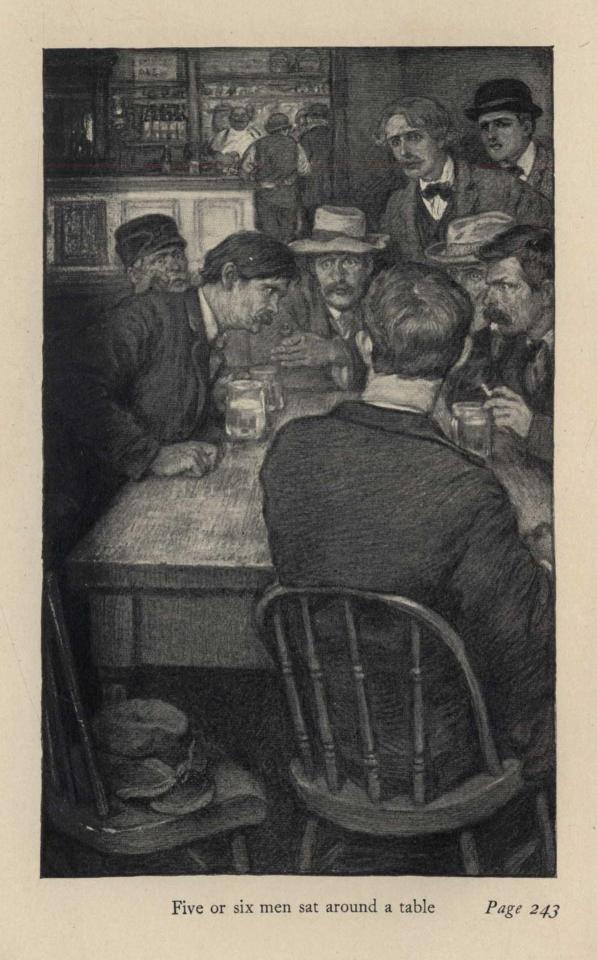
Five or six men sat around a table
Dominating the group, I recognized Denis Kearney, talking with grandiose bonhomie to his companions. There was a self-satisfied look on his face, and something of arrogance was added to his bearing. A brief experience of public applause had banished the simplicity from his countenance, and in its place had come the indefinable lines of calculation, ambition and authority. He was leaning back in his tilted chair, but came to his feet as we approached. He shook hands warmly with Parks, and remembered me as though he were conferring a favor.
"I've shaken thousands of hands this day," he said as he gave me a grip. "It's harder worrk than hefting barrels, but it's worrk in a good cause. We'll drive the haythins into the say in a month."
Parks introduced me with a wave of the hand to the men about the table, and Kearney continued:
"Well, we'd better be thinkin' of the program for to-morrow night, and how to get our tarriers out. I've got something to say about the police interferin' with our meeting last night that ought to raise the timperature about forty degrees."
"I've been thinking about the speeches," said Parks, "and I've concluded it's time to swing 'em round."
"Swing 'em round to what?" demanded a tall man with a black mustache, who had been introduced to me as Enos.
"The overthrow of capitalism," responded Parks, his face aglow. "The Chinese cry is a good thing to rouse 'em with, but the Chinese question is only a little corner of the real issue before the people. Capitalism, plutocracy--these must be put down before the people can come to their rights, and it's time we told 'em so."
There was a minute of silence, and the agitators looked about the table as if each sought to read the others' thoughts.
"That's all well enough, Parks," said Kearney at last, "but we've tried 'em on that, an' it's no go. Whin I tell 'em the haythin is taking the bread out of their mouths and ivery pigtail ought to be driven into the say, they holler till I can't hear me own voice. But whin I tell thim that society has got to be reorganized, an' that times will niver be right till the collective capital of the nation is administhered by the nation's ripresintatives--those are the worrds, aren't they, Parks?--they shake their heads and say, 'What th' divil is he dhrivin' at?' I can git five thousand men to follow me to Chinatown to-night to burn the haythin out if I but say th' worrd, but I couldn't git fifty to follow me to the City Hall to turn th' mayor out."
The others nodded assent to Kearney's words; but Parks' face had been growing blacker and blacker, and now he broke forth impetuously:
"By heavens! If they don't see their own interests, they must be made to see them. What are our tongues given us for but to tell them of the things they can't see for themselves? The wrong, degradation and poverty we see about us are no more due to the petty evils of Chinese competition than to the wearing of machine-made shoes. They are due to the control of industry by capital--to the system that puts a thousand men to work for the benefit of one man instead of for the benefit of all men. The Chinese now do injure the white man. But you put the capital and labor of the nation under control of the nation's representatives, and the labor of the Chinese would injure nobody--would help instead of hurt. The more the Chinaman produced, the more there would be to divide, and the less the Chinaman lived on, the more there would be for the rest of us. We must make capital the servant, not the master, of mankind. Wipe out the old system! Bring in the new!" Parks had grown more and more excited as he talked, and his hair stood out aggressively from the emphatic nods with which he had pointed his declamation.
"Do you mean that you want us to start a rebellion?" growled Enos.
"Successful rebellions are revolutions," cried Parks, "and it is a revolution that society demands."
"Well, society isn't demanding it out loud," said Kearney.
"We must work through the ballot-box," said Enos, "we must keep within the law."
At this word there was a harsh croak behind me, and I turned to see the white pasty face of H. Blasius gloating over us, his fat forefinger pointed at Enos.
"Law!" he cried. "It is ze superstition of politique imposed on us by ze capitalist, as ze superstition of moral is imposed on us by ze priest. When we say Non--no more for us--zen it is gone--we are free. Let us say Pouf! away! we make laws to suit ourself. Eh, mes braves?"
"Pooh!" said Enos. "You're talking nonsense."
"Nonsense? Poltron!" answered Blasius with contempt. "It take but a few barricade and two free t'ousand men to defend zem, and--boum! We have ze city. I was of ze Commune, and I tell you so. And instead of Marchons, you say Nonsense. Eh-h, cowarrd!"
Enos jumped to his feet, his dark face flushing angrily. His fists were doubled, and if Blasius had been a younger man, I should have witnessed the beginning of civil war in the camp of the agitators. But Enos held his arm before the gray hairs of the ex-Communard, and before the quarrel could be warmed by further words, there was an interruption that turned all thoughts from private disputes. A man burst through the swinging doors of the saloon and ran down to our table.
"Waldorf!" cried Parks.
I looked with interest at this leader of the Council of Nine--a tall, large-faced man, whose square jaw, spare cheeks, and bulging brows gave promise of force.
"It has come!" he cried.
"What?" cried Parks, springing to his feet. "The word from the brethren?"
"Just as good," said Waldorf, waving a newspaper excitedly before the group. "See this!" And as he unfolded the sheet we could see the printed announcement of an extra edition.
Parks seized the paper, and cried out the headlines:
"Riot and Bloodshed--Pittsburgh in Flames--Railroad Shops Wrecked by a Furious Mob--Troops Cooped up in the Roundhouse and Compelled to Surrender! Fighting in Baltimore. Mob Law Rules a Dozen Cities."
The men about the table looked at one another in silence, and the pallor of fear or excitement spread upon their faces.
"That's the signal," said Waldorf. "I wish we were better prepared."
"Prepare'!" cried Blasius scornfully. "We need no more. We have arrms. We can make ze barricade. We have leaders--plans. All we need is ze brave heart, and--boum!--we arre ze government!"
"What are you going to do?" asked Kearney uneasily. I saw that he was not in the full confidence of the Council of Nine, and was disturbed at this glimpse of its plans.
"Here's what we are going to do," said Parks, who had resumed his seat and scribbled a few words on a sheet of paper. "This news settles the plans for to-morrow night's meeting, and this is the way we'll call it." And he read out his composition with fervor:
NOTICE OF MEETING
The working-men and women of San Francisco will meet en masse this (Monday) evening, at 7:30, on the City Hall lots, to express their sympathy and take other action in regard to their fellow workmen at Pittsburgh and Baltimore. Prominent speakers will address the meeting. By order of
COMMITTEE.
"Hm-m!" said Kearney, with no evidence of enthusiasm in his tone. "That'll bring 'em out, I suppose."
"Just the thing!" said Waldorf, with warm appreciation of his colleague's work. "It should call out every man and woman who is in sympathy with the oppressed toilers. 'To express sympathy and take other action in regard to their fellow workmen.' That's well put, Parks."
"What other action are you going to take?" asked Enos suspiciously.
"Come to the meeting and see," said Parks.
CHAPTER XX
ON THE SAND-LOTS
City Hall Avenue and the vacant lots below it bustled with the activity of an arriving circus. Two bonfires blazing fiercely sent the crackling sparks flying skyward, and cast so warm a glow on the faces of those who approached them, that even the small boys, who dared one another to feed the flames, shielded their eyes with uplifted arm, and made their bows before the altar of the God of Fire in reverse of the customary attitude of respect.
A wooden platform had been erected near the lower end of the triangle of vacant lots, and a row of gasoline torches blazed about it. Groups of men were gathered here and there about the sandy space, listening to impromptu orators arguing in dissonant chorus over the significance of the eastern riots, or denouncing the Chinese as the source of all industrial and social woes.
The groups were in a state of flux, swelling where the voices rose loudest, and melting away where the discussion sank to a conversational monotone. But the most active elements of the crowd were the bands of young men, hardly more than boys, who formed into gangs of ten to twenty, and roughly pushed and jostled their way through the crowd with cries that indicated their disesteem for the Chinese, their regard for Kearney and for the Pittsburgh rioters, and their especial disapproval of the police.
Behind the bonfires and torches, the dark groups and eddying streams of men, rose the half-built New City Hall. Touched here and there with the red glow of the bonfires in front, and framed in silhouette by the dying shimmer of the sunset behind, it looked like some ancient, majestic ruin--far different in outline from the ruin it was to become, when thirty years later it was racked by earthquake, and swept by a mighty conflagration--yet one that furnished a striking background for the turbulent scene enacted before it.
As I entered the crowded space from the Market Street side, I had noted these details before I discovered Parks standing by the platform and glancing impatiently about him.
"Hampden," he cried, "I am glad to see that you have joined this great outpouring of the people. You shall have a seat with me on the platform."
"I wouldn't miss the fun for fifteen cents. But what are you going to do? What's your plan?"
"We shall follow the wishes of our fellow-citizens," said Parks, with a nod of mystery, importing designs that could not be revealed until the moment of execution. "But the first thing is to have the speeches delivered, and we are away behind time. The meeting ought to have been called to order twenty minutes ago, but the procession is late, of course. I never knew one that wasn't." And he looked irritably into Market Street, and made some unfavorable comments on the marshals of the parade.
"Here it comes now!" exclaimed another member of the group, as a blare of horns, the thump of a drum and a confused sound of cheering disturbed the air.
The procession soon came into sight as it advanced up Market Street and turned into the sand-lots. At its head marched a brass band, and scattered here and there in the trailing line were a few hundred torches--spoil from the election campaign of the preceding year. While the attention of all was fixed on the manoeuvers of the marching clubs, I felt my sleeve plucked, and turned to find Clark beside me. Without looking at me he slipped a piece of paper into my hand, and moved away. I held the paper under one of the gasoline torches, and read:
Some mischief ahead. Jim Morgan has been hiring men. Had 20 or 30 young fellows cooped up near hdqrs. this p.m. They are marching up with the clubs.
I puzzled for a little over the particular variety of mischief that was imported by this activity of Bolton's agent, and then stepping behind Clark, said:
"Keep as close to the gang as you can. If you find out what they are up to, bring me word at once. I'll be on the platform here."
Without appearing to notice me, Clark gave a signal that he understood, and as he moved away Parks tapped me on the shoulder.
"Here! We must start this thing now," he said. "We're over half an hour late. Come up on the platform. Where in the name of Halifax can Kearney be? He hasn't come up with the clubs, and he hasn't sent any word."
I suggested the theory of sickness.
"He's sick of the job--that's my opinion," said Parks savagely. "He's full of fighting talk when there's no trouble in sight, but when there's a chance to strike a blow for the people, he's for hanging back. He hasn't had any ginger in his talk about this meeting. You heard him last night. He was about as warm as a fish then, and his pulse has been going down ever since. Well, we can't wait any longer, so here goes." And pushing to the front of the platform, he pounded on an improvised desk and called for order.
It was by the eye rather than by the ear that he caught the attention of the throng, for in the babel of amateur oratory that filled the square, his voice was lost. But at his appeals, silence spread in concentric rings about the platform, until the arguing groups melted into the mass of humanity that pressed toward the speakers' stand.
I paid but perfunctory attention to the speeches. Under Parks' guidance a man named D'Arcy was chosen chairman of the meeting, and speaker vied with speaker in expressing sympathy with their brave brethren of Pittsburgh, in declaring admiration for the courage with which they had beaten down the hireling soldiery of the brutalized money lords, in denouncing the policy that had called out the troops to settle a mere business dispute between workmen and employers, in bewailing the hard lot of the workmen of San Francisco, and in assailing the Chinese as the cause of the local industrial woes. It was not the inflammatory speeches that drew the major part of my attention, nor even the riotous applause that followed those speakers who expressed their approval of violence as a cure for low wages or no wages. Some subtle sense of divination drew my eyes and thoughts to certain currents and eddies in the crowd, where lines of men appeared to move with common purpose through the great gathering. The lines would grow in length as they proceeded, then would swirl into a group, and break or unfold into two or three new lines that would push out in different directions to form new centers of excitement. Some plan of action was evidently preparing.
In the midst of a speaker's appeal to the sacred rights of labor against the wrongs of coolie immigration, a man swung himself over the back rail of the platform and whispered to Parks.
"What's that?" demanded Parks incredulously.
The man repeated his statement.
"When did it happen?"
"About seven o'clock."
Parks' face grew black with suppressed storm, and the man continued:
"He said you could rouse the town about it if you thought best, but for himself he didn't want the course of the law interfered with."
"What do you think, Hampden?" said Parks, in my ear. "Kearney's arrested!"
"What's he been doing now?"
"Oh, it's his Nob Hill speech. He threatened to hang Stanford and Crocker, you know; and they've jailed him for that."
"Well," I said cheerfully, "are you going to follow your example by leading the mob to rescue him?"
"I'd take five thousand men down to the City Prison and have him out in half an hour, if I was sure he hadn't contrived this arrest himself," replied Parks darkly.
"What put that into your head?" I asked in surprise.
"Never mind," said Parks with an angry shake of his head. "I've a right to my suspicions." Then he turned to his messenger and growled: "Don't say anything about this. I'll announce it later if it seems best. I'll have to think it over a little. I'll wait till Reddick has spoken, anyhow."
Reddick, as the mouthpiece of the Council of Nine, gave a speech filled with denunciations of social and industrial conditions, and with the roars of applause that he evoked, the currents and eddies of men grew stronger. As he drew toward the close of his address, I felt a touch from behind, and turned to find Clark beckoning for attention. As I bent to him, he whispered in my ear:
"Those fellows of Morgan's are trying to stir up a rumpus. They are going through the crowd now passing the word that it's time to burn out the rich fellows that have brought in the Chinese, and that the place to begin is on Van Ness Avenue, and finish with Nob Hill and Chinatown. There's going to be trouble as soon as the meeting breaks up."
This alarming information revealed Bolton's purpose, whatever might be the plans of the Council of Nine, and though the meeting seemed likely to be prolonged for an hour or two more, I scribbled a note on the back of one of Wharton Kendrick's cards and handed it to Clark, saying:
"Get down to the Old City Hall, see Chief Ellis, or whoever is in charge, and tell him that Kendrick's place is to be attacked. Ask him to send as many men as he can spare to keep the avenue clear. That card will get you a chance to speak with him, and you can tell him what the gang is doing. I am going up to Kendrick's before the meeting closes and get ready for trouble."
"I'll do the best I can, sir," said Clark, with evident doubt of his power to influence so important a man as the chief of police, and in a moment had disappeared into McAllister Street.
While I had been engaged with Clark, Reddick had ended his speech with a fiery peroration that brought a roar of applause, during which a stout, red-faced man climbed to the platform and took his place.
"This is all wrong, men," were the first words I heard from the new speaker. "We can't help the cause of labor by getting into a row with the police. We can't get more wages by hunting a fight with the militia. We can't even get a better job by punching a Chinaman's head."
"Who the devil is this?" cried Reddick angrily. "He's a hell-hound of plutocracy. Who asked him to speak?"
"Stop him, D'Arcy," said Parks. "He'll be a wet blanket on the meeting."
So far from being a wet blanket, the speaker had a remarkably enlivening influence on the crowd. The elements that had been roused to enthusiasm by fiery speeches, culminating in Reddick's red-pepper harangue, were in no mood to listen to this sort of talk, and catcalls, hoots and cries of dissent drowned his words.
"This agitation don't do us no good," shouted the volunteer orator. "It hurts us. It scares away capital. I lost two jobs by it myself."
"Sit down! Dry up! Get off the platform!" came in volleys from the audience, and the chairman, with a pull at the speaker's coat tails, paraphrased the demand.
"I won't sit down!" shouted the unknown. "I'm an American citizen and as good as any of you."
"Throw him off!" cried Reddick; and suiting action to word, he seized the speaker about the waist.
The unknown resented this interference by whirling about, and planting a blow on Reddick's face that sent him to the floor with a thump. But the militant friend of order was seized by a dozen men before he could make another movement, and with a struggle was hustled to the side of the platform and dropped over the rail.
The scene of violence was contagious. During the altercation on the platform the signs of disorder in the crowd had multiplied, and at the sight of the blow that laid Reddick on his back, a mighty roar rose on the air, and the whole throng appeared to break into tumultuous motion. The great mass was shaken to its confines with a sudden blind impulse of conflict, the thousands of faces tossed and eddied about like sea waves ruffled by cross-currents, and a surge of men broke against the platform.
"Hold on," shouted Parks, springing to the front. "There's four more speakers to be heard, and the resolutions to be passed." But in the uproar his voice was overwhelmed, and in a moment the hoodlum mob was upon us. A conflux of wolfish faces centered upon the platform, and with cries of "Kill the Chinese! Down with the coolie-lovers!" they tore at the supports. The platform went down with a crash of breaking boards and screaming men, and the flaming gasoline torches that lighted the stand fell forward with the uprights to which they were fastened, only to be raised in the van as the standards of the hoodlum mob.
The downfall of the platform sent half the group sprawling on the ground among its ruins. But at the first warning crack I had seized Parks as he was about to be pitched forward under the feet of the attacking forces, and dragged him to the back rail. This frail support held for a space against the wrench of the falling front, and offered us a moment's safety.
"This is an outrage!" cried Parks, as we scrambled to the ground. "The money of the railroad or the Six Companies has paid for this assault on a peaceable meeting. But I am not going to be silenced by a pack of hoodlums. Come up to the City Hall steps, and we will finish our speeches and pass our resolutions."
"Better let bad enough alone," I said. "You'd much better come with me to see to Miss Fillmore's safety."
But Parks had not waited to hear the end of my words, and was already on his way to the Hall of Records, shouting at the top of his voice, "Follow me, all members of the International Clubs!" while I struggled to press my way through the division of the mob that was sweeping up Leavenworth Street. As I reached the corner I heard one of the leaders shout:
"Come on, youse fellows! We'll burn out Millionaire's Row on Van Ness Avenue. They's the ones that gets rich by bringing in the coolies!" And his suggestion was approved with a roar.
This was, I could no longer doubt, a part of the scheme that had been hatching in the fertile brain of Peter Bolton. It was for this that Jim Morgan had hired and trained his ruffians, and the objective point of the mob in front of me was the home of Wharton Kendrick.
It was of this that my sixth sense had warned me, even before Clark had spoken; and yet I had loitered in the belief that there was plenty of time to reach the place before the close of the meeting should loose the forces of disorder. And now, with a sudden gust of passion all evil things had thrown away restraint, the mob with roars of rage was swarming in different directions, smashing doors and windows, and shouting its war-cries with cheers and curses, while I was still by the City Hall, trying to force past the throng that streamed up Leavenworth Street.
I had got as far as Tyler Street (later to become famous as Golden Gate Avenue), when I found the way blockaded. The crowd had halted, packed into a dense mass about the corner, and shouts and yells, the crash of breaking wood and the tinkle of falling glass told that the wild beast had found an object on which to vent its rage. By the light of the street-lamps and the flare of the torches carried by the mob, I saw that the point of attack was a low, wooden building, and a painted sign above the door told that therein Ah Ging did washing and ironing.
I had barely discerned so much when the sign disappeared, and a moment later the form of a Chinaman was framed in the doorway above the crowd, amid a gang of hoodlum captors. For an instant I could see the wild, terror-stricken face, its brown skin turned to a sickly yellow, its eyes rolling in the red glare of the torches with the instinct of the animal seeking despairingly some path of escape. Then at a blow from behind the Chinaman gave a scream and plunged headlong down the steps.
The end was shut out from my sight, but I was shaken by the qualms of deathly sickness at this wanton barbarity, as the maelstrom of struggling bodies closed in upon its victim, and his death-cries were drowned in the chorus of yells, jeers and animal ejaculations of rage with which the collective beast accompanied the murder of Ah Ging.
CHAPTER XXI
BATTLE
As I came within sight of the Kendrick house, breathless, shaken with scenes of brutality, and torn with apprehensions, I found that my fears were realized. A disorderly mob of two or three hundred men had gathered in front of the place, their groans and hoots filling the air, and the score or more of torches they carried throwing a smoky glare on the buildings.
The mob had not yet ventured to attack the place, and I was relieved to see that Andrews and his men still held the steps and guarded the walls; but the riotous elements were lashing the crowd into the courage to attack the little band that looked down upon them.
Suddenly, as I reached the confines of the crowd, a silence fell, and I started with surprise to see Wharton Kendrick walk down the steps to the level of the garden, and then advance to the iron fence that surmounted the retaining wall. From this point of vantage he surveyed the mob with a good-humored smile and waved his hand in cheerful greeting. I trembled with anxiety at his rashness, but something in his personal magnetism held them for him to speak.
"Well, boys," he cried in his full hearty voice, "what can I do for you? Have I been nominated for mayor, or is this just a serenade?"
A laugh here and there showed the good impression he had made on his audience, and a hasty voice from the leaders of the mob shouted:
"We want you to fire your Chinese!"
"The Chinese?" he said, affecting to misunderstand the cry. "You've come to the right shop if you want a good little talk on that question. As I told Senator Morton the other day, I'm the original Chinese exclusionist--not excepting Bill Nye and Truthful James. Ask the reporters to take a front seat."
I had never suspected Wharton Kendrick of oratorical ability, but he showed all the arts of the stump speaker, and with a few pat anecdotes stated his position, and appealed to the men to trust the settlement of the problem to the substantial men of the State.
The leaders of the mob were quick to see the danger to their schemes, and tried several interruptions, which Kendrick blandly ignored. At last one of them shouted as comment on his profession of faith:
"Then why don't you discharge your Chinese help?"
This thrust renewed the cries of anger from the mob, and a wolfish look came on the faces about me.
"Why," returned Kendrick with a jovial laugh, "for the same reason that the rabbit couldn't cut off his tail--because he didn't have one. I don't know any reason why I shouldn't hire a Chinese cook if I wanted one, as long as they are permitted to come into the country; but I don't want one. My servants are all white."
The reply raised a laugh, and a few enthusiastic rioters shouted "Hooray for Kendrick!"
"Shut up, you fools!" cried the leaders; and the voice that had called on Kendrick to discharge his Chinese shouted:
"It's a lie about there not being any Chinese in de house!"
"The honorable gentleman has forgotten to speak the truth," retorted Kendrick good-humoredly. "I keep no Chinese."
"Aw, what's de use talkin' like dat?" shouted the voice. "There's a Chinese girl in de house dis minute."
"Quite true," admitted Kendrick candidly. "The poor creature was wounded, and we took her in to save her from the highbinders. You surely wouldn't have us turn her out. She's not a servant. She's a guest."
The explanation was lost on half the crowd in the clamor that had been raised. One of the mob leaders shouted:
"Where there's a Chinese girl there's a dozen Chinese men,"--an opinion that renewed the jeers and catcalls.
"Aw, the place is full of coolies! Smoke 'em out!" cried another, waving a torch.
Even with this renewal of hostile sentiment, the leaders of the mob would scarce have been able to spur their followers to violence but for the arrival of a reinforcement of another hundred hoodlums, shouting, swearing, and laden with the spoil of looted wash-houses. They came straight for the Kendrick house, and I had no doubt that they were directed thither by the same mind that had sent the first company to the siege.
While the play between Kendrick and the mob had been going on, I had edged my way toward the steps by those alternate arts of diplomatic and aggressive pressure which enable one to make progress through a crowd. The arrival of the hoodlum reinforcement brought me assistance as unwelcome as it was unexpected.
Wharton Kendrick faced the new-comers with a confident smile, and appealed with a jest to "the gentlemen in a hurry" for a hearing. But the hoodlum arrivals had not fallen under the spell of his personality, and their courage and wrath had been inflamed by their success in their wash-house raids. With shouts of "Gangway! gangway! Smoke out the coolies!" they charged forward in a wedge that struck the standing crowd directly behind me. There was a shock of meeting bodies, a grunt that might have come from a giant in sudden distress, and the crowd crumpled together like the telescoping cars of a railroad collision; the men in the center were lifted off their feet, and the crowd was forced forward and scattered in disorder.
Standing directly in the line of shock, I was thrown forward with amazing force, scraped against the stone wall, and flung headlong on to the lower step of the flight that led to Wharton Kendrick's garden. At the same moment there was an outburst of wrathful yells, and a shower of stones rattled about me. I felt a smart crack from a falling stick on my shoulder as I scrambled to my feet, and looking upward I was just in time to see Kendrick struck by a flying missile, reel backward, fling up his arms with a whirling motion, and fall heavily on to the grass.
I faced about and whipped out my revolver, when:
"Stand back there!" came from above in a determined voice.
"Stand back there!" I repeated. And at the command and the show of revolvers, the advancing hoodlums swerved aside into the street with a sudden cooling of their ardor for battle.
"Is that you, Mr. Hampden?" came from above, and I recognized the voice of Andrews, the head watchman for the night.
"Yes," I replied. "Be ready to shoot if I give the word." And walking backward I climbed the steps till I stood on the landing and looked down on the mob. Then with an eye on the tossing, circling array of faces below, I knelt over Wharton Kendrick. He was limp and still. A long cut extended from his forehead well back into his hair, and the blood flowing from it had moistened his face and dyed his thinning locks.