Book 4 — A DESCRIPTION Of the WARDS of Constantinople.
Reading edition
The first Region, or Ward.

THE first Ward contains in it, the House of Placidia Augusta; the House of the most illustrious Marina; the Bagnio’s of Arcadius; twenty nine Streets; an Hundred and eighteen large Houses; two Portico’s of a great Length; fifteen private Bagnio’s; four publick, and fifteen private Mills; and four Gradus. It was governed by one Curator, who had under his Charge, the whole Ward. There was also one Vernaculus, who was Messenger of the Ward, was also Assistant to him, and entirely at his Command. It had also twenty five Collegiati, chosen out of the several Bodies of Tradesmen, whose Office it was to direct and assist in Cases of Fire. There were also five Vico-Magistri, whose Business it was to watch the City by Night.
Thus far my Author. I shall here add a Remark made by Gyllius, it not being foreign to our Purpose, viz. That those whom P. Victor and S. Rufus, believed to have been called the Denunciatores in antient Rome, here in new Rome, he calls Vernaculi. Neither of them mention the Collegiati, tho’ all Historians take Notice of the Vico-Magistri, who with more Propriety of the Latin Tongue, should rather have been called Vicorum Magistri, as appears, he tells us, by an Inscription yet remaining in the Capitol of Old Rome, which is as follows.
IMP. CAESARI DIVI. TRAIANI PARTHICI FIL. DIVI NERVAE NEPOTI. TRAIANO HADRIANO. AVG. PONTIF. MAXIMO. TRIBVNIC. POTESTAT. XX. IMP. II. CON. III. P. MAGISTRI VICORVM XIIII.
NOTES.
The first Ward.] ’Tis evident from Pliny, and also from Tacitus, in that Part of his History, where he mentions the Burning of the City by Nero, that antient Rome was divided into fourteen Regions, or Wards. Sex. Rufus, and P. Victor, who had pass’d the Consular Dignity, have given us some short Descriptions of them. As to the Wards of New Rome, they are here described as I found them placed before the Notitia Utriusque Imperii. Constantinople, which was a kind of Representation of Old Rome, was likewise after her Example, as Justinian observes in his 43ᵈ Novel, divided into fourteen Wards; and he calls them Regions or Wards. There were many Monuments of Antiquity carried thither from Old Rome, and many new ones made there, which I could by no Means pass by, as the Accounts of them may be necessary to the Knowledge of both Places. And therefore to explain and illustrate them the more, I have subjoined some Annotations of my own; and have also taken Notice, as they fell in my Way, of some Observations made in my Comments on the Notitia, &c. The Author of the Description observes this Method. The Churches, and other Matters which are most Material, he treats of in the first Place, then he mentions what is less Important, in the same Order, in every Ward; as the Streets, Houses, Bagnio’s, Mills, the Gradus, then the Curator, Vernaculus, the Collegiati, and last of all, the Vico-Magistri. In the thirteenth Ward, through a Mistake, the Streets are omitted, which Error I have taken Care to correct, as I have also another in the fourteenth Ward, where he has left out the Curator, the Vernaculus, the Collegiati, and the Vico-Magistri. He mentions only fourteen Churches, in seven Wards; whereas at Rome, there was not a Street without some Temple or other, and some had two. I shall make my Annotations upon every Monument of Antiquity, in the same Ward, and in the same Place, that I find it.
The House of Placidia Augusta.] This Lady was the Daughter of Theodosius the Great, and Sister of Arcadius and Honorius. When New Rome was taken by Alaric, King of the Goths and Vandals, he carried her away into Captivity, who afterward married his Kinsman and Successor Athaulfus. Upon his Death, she was restored to her Countrey, and being married again to Constantius, she had by him two Sons, Valentinian and Honoriades; as Eutropius, Zonaras, Cedrinus, and other Historians tell us.
The House of the most illustrious Marina.] Marina was the Daughter of Arcadius, who being honoured with the Title of the Most Illustrious, as Cedrinus writes, continued a Virgin. The Title of the Most Illustrious, is discovered by an antient Inscription to have been first given to Valerianus the Younger, about the Year of our Lord 260. Afterwards it was given to Severinus, and Maximinus Cæsar, and at Length it was ascribed to Ladies of the highest Birth. This sometimes entitled them to a Share in the Government; for whosoever was dignified with this Character, was allowed to wear a Purple Habit, laced round with Gold, and took Place of the Præfecti, (the Mayors or Chief Magistrates of the City) as Zosimus observes, who will have it, that this Honour was first instituted by Constantine; tho’ ’tis very evident, that this Dignity was conferred long before his Time.
The Bagnio’s of Arcadius.] They were so called, because they were built by him, as Procopius writes in his 1st Orat. concerning the Buildings of Justinian. As you sail, says he, out of the Propontis, to the Eastern Coast, you see a Publick Bagnio, call’d the Arcadian Bagnio, which is a great Ornament to the City. In this Place Justinian built a Court, which lies before the City, so near to the Sea, that they who walk upon the Shore, may hold a Discourse with any of the Ships Crew, as they sail by them. The Account I shall give of the Curiosities of this Court, is as follows. The Court it self is a very beautiful Building, and is fann’d with gentle Breezes. ’Tis paved with delicate Marble, and adorned with stately Pillars, which afford a delectable Prospect, even to a Brightness, which seems to rival a Meridian Sun-shine. There are also many other Curiosities which adorn this Court, some of which are Pieces of most elegant Workmanship, both in Brass and Stone. Thus far Procopius. The Bagnio’s here mentioned are probably the same with those which are called the Xerolophus, which Cedrinus tells us were built by Arcadius. The Xerolophus, says he, was built by Arcadius, the Pillars of which are all like that Pillar, which Theodosius erected in the Taurus. Socrates in his Seventh Book, Chap. 1. attests, that this Building stood in the Forum of Arcadius. For speaking of one Sabbatius a Heretick, he says, that the People rais’d a Tax to oppose Sesonnicus their Bishop, in a Place of the City which is called Ξηρόλοφος, in the Forum of Arcadius. Thus Socrates. This was certainly a Building which consisted of several Apartments, which induces me to believe it was the Bagnio’s here mentioned. For Nicephorus Gregoras, in his Seventh Book, Chap. 1. writes, That Athanasius, Patriarch of Constantinople, resided some Time in the Apartments of the Xerolophus. The Word Xerolophus, says Suidas, signifies a Dry Unction, and the Place was called so, because, when any Body was anointed there, they never used to bath, and adds; That this Place was formerly famous for Oracles, and that answers were given to Enquiries there made, from a Tripos. There were also in the same Place sixteen private Apartments, with Winding-Stairs. I have seen it in an antient Greek Author, that there were here twelve Buildings with Winding-Stairs, as also the Columns of Diana, Severus, Marcianus, and the Statues of Valentinian, and Theodosius the Less. Justinian also quotes an Inscription there, taken out of the Fifth Book of Xenophon’s Anabasis. Zonaras also writes, that when Leo Isaurus was Emperor of Constantinople, the Statue of Arcadius, placed upon a Pillar in the Xerolophus, was thrown down by an Earthquake. The Bagnio’s here mentioned were called Publick, or Imperial Bagnio’s; whereas those which were built by private Persons were called Thermæ, or Baths.
A Hundred and eighteen Houses.] I take the Word Houses in this Place, to signifie the Dwelling Houses of some of the principal Men of the City, as the Great Mens Houses at Rome were distinguished by standing by themselves, and having no other Houses adjoining to them.
Two Portico’s of a great Length.] These Portico’s, as at present, were not joined to Houses, so as to seem a Part of them, but were built separate from them, contrived for the Pleasure of Walking, and refreshing the Mind. Hence it is, that Strabo, Lib. V. de Geogra. where he is describing the Parts of Rome, calls the Portico of Livia the περίπατον, or Walk. Pliny is of the same Opinion in his Fourth Book, Chap. 1. Strabo tells us in another Place, that the Cumani of Æolis borrowed Money to build a Portico, and that when they failed, as to the Time of Payment, the Person, who gave them Credit, laid them under a Prohibition not to walk in it, but only when it rained; and when the Cryer called aloud to them to enter the Portico, it passed into a Proverb, That the Cumani dared not to enter their Portico without the Leave of the Cryer. These are the same Kind of Portico’s which Ulpian means, where he mentions the Portico’s, which had no Houses adjoining to them. Tacitus, Lib. XV. speaking of the Burning of Rome by Nero, takes Notice of these Ambulatory Portico’s, when he tells us, that the Portico’s which were dedicated to Pleasure, were most of them destroyed by Fire. There was a Portico of this Sort at Athens, Part of which, as Pliny records, Lib. XXXV. Cap. 3. was painted by Myco, who was paid for it; and the other Part was finished gratis by Polygnotus, an eminent Painter. It was for this Reason, that ’twas call’d Porticus varia, or ποικίλη. This is the same Portico in which Zeno taught, and for which he was called the Father of the Stoicks. Suidas says, that it was customary to adorn such Portico’s with Silver and Marble Statues, as appears by a Will mentioned by Marcellus, which runs thus, My Will and Pleasure is, that my Heir, at his own Expence, build in my native Countrey a Publick Portico, in which, I desire my Silver and Marble Statues may be reposited. I believe my Author understands in this Clause of the Will, the same Kind of Portico’s with those I now comment upon, which were of so considerable a Length, that they reached from the Imperial Palace, to the Forum of Constantine. For Procopius writes, in his First Orat. de Ædif. Justin. That in the Reign of Justinian, the Church of St. Sophia, and both the long Portico’s, stretching themselves as far as the Forum of Constantine, were burnt down. The same Fact is testified by Cedrinus, who says, that both these Portico’s were consumed by Fire, in the Reign of Basiliscus, altho’ after these Casualities, they were always rebuilt. I would observe, that every Ward at Constantinople had in it some Portico’s, though some Wards at Rome had none.
Four Gradus.] The Word, which is here called Gradus, signifies a Tribunal, which was ascended by Marble Steps, to receive the Bread which was to be distributed among the common People, and which, was therefore called, Panis Gradilis. Valentinian tells us, that the carrying the Panis Gradilis from one Tribunal to another, is strictly forbidden. He also commands in Cod. Theod. that every one receive the Panis Gradilis from the Tribunal. From which Passages it is plain, that this Gradus was a famous Tribunal, from whence they used to distribute Bread. For Constantine, as Metaphrastes writes, bestowed every Day upon the Poor, eighty Thousand Loaves. Socrates, Lib. II. Cap. 13. says expressly, that he gave Daily eighty Thousand Bushels of Corn to the Poor; besides, as Suidas adds, Wine, and Flesh, and Oil. These were therefore Gradus, or Tribunals, erected in this Ward for that Purpose.
It was governed by one Curator, who had under his Charge the whole Ward.] The Curators (who seem something like our Aldermen) were first instituted by Augustus, and by Suetonius, Cap. XXX. are called Magistratus. He divided, says he, meaning Augustus, the City into Streets and Wards, and commanded that the Wards should be governed by a Magistrate, chosen by Lot yearly, and that the Streets should be governed by a Master elected out of the common People. Afterwards, in the Room of these, Alexander Augustus appointed fourteen Curators. Lampridius tells us, that Rome chose fourteen Curators, out of the most eminent Citizens, and obliged them to assist the Prefect of the City, so that all, or most of them attended, when any Thing was transacted for the good of the Publick. It was a principal Part of their Business to decide Causes, and to take Care of Orphans, and the Poor.
There was also one Vernaculus who was Messenger of the Ward, he assisted the Curator, and was entirely at his Command.] The Business of this Officer was to be subservient to the Curator, and give Notice to, and summon the Citizens to meet in all Matters, which more immediately related to the Ward. Their Office was the same, mentioned by S. Rufus, and P. Victor, who give them at Old Rome, the Name of Denunciatores. Two of which were appointed to assist in every Ward.
It had also twenty five Collegiati, chosen out of the several Bodies of Tradesmen, whose Business it was, to direct and assist in Cases of Fire.] At Rome the Præfectus Vigilum commanded in Chief the seven Companies of Freemen appointed for a constant Watch to the City. This Office was instituted by Augustus, who placed a single Company over two Wards, as is observed by Suetonius, and Dion. Lib. LV. and by Paullus, Lib. de Offi. præ. Vigil. These Men were chosen out of the several Bodies of the Tradesmen, whose Business was the same with those at Rome; and were called Collegiati. The Number of them was always stated, and unalterable so that when one of them died, the Prefect of the City filled up the Vacancy with one of his own Body. Honorius and Theodosius, in their Letters Mandatory to Æstius Prefect of the City, will and command, That the Number of five hundred sixty three be the standing Number of them, and that no Person presume by any Authority whatsoever, to alter that Number; so that it shall be lawful to you only, in the Presence of the Body Corporate, when any Person is deceased, or otherways removed, to elect, and nominate one to succeed him out of the same Body Corporate of which he was a Member: These Collegiati are chosen out of thirty five Corporations of Tradesmen, which are particularly specified in a Letter sent by Constantine to Maximus, and are discharged upon their Election from all other Offices whatsoever. In this first Ward, there were only twenty five of them, in others more or less, who made up the Number a Hundred and sixty, or a Hundred and sixty three. To complete the Number of which, as appears from the first Book of Zeno de Collegiat. Thirty seven or forty, are wanting in the last Ward. The Word Collegiati, in other Places, sometimes signifies the Deacons who buried the Dead; and sometimes it is taken for Freemen, as in Lib. XLI. Co. Theod. de Op. Pub.
There were also five Vico-Magistri, whose Business it was to watch the City by Night.] These were originally instituted by Augustus. Suetonius, in the Life of Augustus, Chap. XXX. writes, that the City was divided into Streets and Wards, and adds, that Augustus commanded, that the Magistrates of the Wards should be annually chosen by Lot. The Streets were governed by the Vico-Magistri, who were elected out of the Commons, in the Neighbourhood of the Streets, over which they presided; so that as those who governed the Wards were called Curatores, so they who governed the Streets were called Vico-Magistri. ’Tis very probable, that these Magistrates had some Soldiers under their Command to prevent Robberies, and other Outrages committed in the Night, as Old Rome had its Vigils, or Watchmen, who were all Soldiers. There were two, three, or four Vico-Magistri appointed over every Street at Rome: At Constantinople every Ward had but five, so that the whole Number of them is Seventy; although my Author in his Summary View of the City, which follows hereafter, reckons no more than sixty five.
The Second Ward.
THE second Ward, after an easy, and almost imperceptible Ascent above its Level from the lesser Theatre, falls with a deep Precipice down to the Sea. This Ward contains in it, the Great Church of St. Sophia; the Old Church; the Senate-House; a Tribunal with Porphyry Steps; the Bagnio’s of Zeuxippus; a Theatre; an Amphitheatre; thirty four Streets; ninety eight large Houses; four great Portico’s; thirteen private Baths; four private Mills, and four Gradus. It has also one Curator, one Vernaculus, thirty five Collegiati, and five Vico-Magistri.
NOTES.
The great Church of St. Sophia.] This Church, some say, was built by Constantine, others by Constantius. It was afterwards burnt down, and rebuilt by Justinian, and was then look’d upon as the finest and most beautiful Church in the whole World. Periander, and others, whose Works are still extant, have described at large the Delicacy and Magnificence of this wonderful Piece of Architecture. Evagrius writes, that this Church measured in Length a Hundred and ninety Foot, in Breadth a Hundred and fifteen; and that from the Pavement to the Top of the Cupola, it was an Hundred and eighty Foot high.
The Old Church.] I suppose the Author here means one of those Churches which were built by Constantine, some of which are mentioned by Procopius, in Lib. de Ædif. Justinian.
The Senate-House.] In this Place they held their Senate, which, as Sozomen affirms, was built by Constantine the Great, where he commanded the same yearly Solemnity to be celebrated on the Calends of Jan. as was done at Rome. It was burnt down, upon a Sedition occasioned by an Attempt to banish St. Chrysostom out of the City, and was rebuilt, as Procopius tells us, with greater Splendor.
A Tribunal with Porphyry Steps.] This Tribunal was made of Porphyry Marble, which Word in Latin, signifies Purple, because Porphyry Marble is of a Purple Colour.
The Bagnio’s of Zeuxippus.] These Bagnio’s were famous for a Portico, which run round the Houses and Shops adjoining to them. There was a yearly Revenue assigned for lighting the Lamps of this Bagnio, and repairing them. Theodosius in Lib. de Op. Pub. writes thus; Because there are many Houses and Shops adjoining the Portico’s of Zeuxippus, we will and command, that the yearly Income of the said Houses and Shops, without any Pretence or Excuse to the contrary, be paid into our Imperial Bagnio, for purchasing Lights, and for the Repairs of the said Bagnio’s. This Passage is part of a Letter which he wrote to Severinus, Prefect of the City, (not Prætor) as it stands in the Codex Theodos. de Op. Pub. These Bagnio’s formerly stood near the Imperial Palace, and were afterwards called the Bagnio’s of the Numeri, as Nicephorus writes, Lib. IX. Cap. 9. Sozomen and Socrates take Notice of the same Bagnio’s. I believe they were first built by Zeuxippus, who persecuted the Christians at Byzantium, much about the Time of Nero; and who among other of his Severities, forced St. Andrew to fly to Argyropolis. If I mistake not, he was at that Time Lieutenant of Macedonia and Thrace. These Bagnio’s were enlarged and beautified by Severus the Emperor, for which Reason they were afterwards called the Bagnio’s of Severus. After this they were called Balnea Numerorum, because great Numbers of Soldiers use to bath there. Zosimus, in his second Book writes, that these Bagnio’s formerly stood in a Peninsula. In antient Times, says he, Constantinople had a Port at the End of the Bagnio’s, which were built by Severus the Emperor, when he was reconciled to the Byzantians, for opening the Gates of the City to Niger, his Enemy. Suidas says, that a Poet named Christodorus, celebrated the Statues and Images of Zeuxippus in Verse, among which he is very particular in the Praises of the Statue of Hesiod. Procopius, in his First Book, de Ædif. Justinian. tells us, that these Bagnio’s were rebuilt by Justinian, but were called the Zeuxippum, because in this Place they used to run their Horses in Pairs, as the Word Zeuxippus signifies in the Greek. St. Gregory Nazianzen takes Notice of them in his Oration to the Arians, and in another which he made concerning himself. I am not, says he, taking a Journey to a new Jerusalem, that is to the Zeuxippum; for that Place was laid in Ashes in the Reign of Justinian. The Bagnio’s of Severus, as Cedrinus relates, which were call’d the Zeuxippum, were consumed by Fire. In this Place was a very delightful Variety of Prospects. All the ingenious Contrivances of Art were here expressed in Marble and Stone, and the most elaborate Workmanship of Antiquity. In short, the Designs here were so matchless and inimitable, that they seemed to want nothing but a Soul to animate, and inform them. Among other surprizing Pieces of antient Skill, was the Statue of old Homer. The Figure was finished very naturally, and in his Looks might be observed a great Thoughtfulness, with a Mixture of much Uneasiness and Trouble. This Place was also beautified with brazen Pillars, which had been here set up in Honour of those great Personages, who had been renowned for their Learning or Virtue, through the whole World.
An Amphitheatre.] This stands near the Sea Shore. You must pass by it, as you go to the Imperial Palace, and the Port of Julian, between which Places there were formerly Lime Kilns, which were commanded to be filled up by Theodosius the Less, as the Reader may see in Lib. ult. Cod. Theod. We will and command, says he, that all Lime-kilns, standing on any Ground, between the Sea Shore, the Amphitheatre, and the Port of St. Julian, be entirely demolished, for the Benefit and Health of our most great and magnificent City, and by Reason of the Nearness they stand to our Imperial Palace; and we do hereby prohibit all Persons whatsoever for the future, to burn any Lime in those Places.
The Third Ward.
THE third Ward, at the Entrance of it, is a Level Ground, and stands, in Part, where the Circus is built; but descends, at the End of it, with a very great Declivity down to the Sea, and contains, the same Circus Maximus; the House of Pulcheria Augusta; the new Port; a Portico of a Semi-circular Figure, made after the Likeness of the Greek Letter Sigma, which was formerly wrote thus, C; the Tribunal of the Forum of Constantine; seven Streets; ninety four great Houses; five large Portico’s; eleven private Bagnio’s; and nine private Mills. It had one Curator, one Vernaculus, twenty one Collegiati, and five Vico-Magistri.
NOTES.
The House of Pulcheria Augusta.] This Lady was the Sister of Theodosius the Less, who continued for some Time unmarried. When her Brother was dead, she married Martian, and made him Emperor. Zonaras, Cedrinus, Zosimus, Nicephorus, and other Historians have mentioned many Things of her. She had also another House in the eleventh Ward.
The New Port.] This probably is the same Port that was built by Julian the Apostate. There was another Port in the sixth Ward called Portus Neorius, because there was a Dock there for building Ships.
A Portico of a Semi-circular Figure.] The Greek Letter Σ, as ’tis now wrote, was formerly wrote C. Zonaras and Cedrinus often take Notice of this Portico.
The Fourth Ward.
THE fourth Ward extends itself in a long Vale, the Hills rising on the Right and Left from the Miliarium Aureum through a Vale, to a plain level Ground. It contains, the Miliarium Aureum; the Augusteum; a Basilica; a Nympheum; the Portico of Phanio; a Marble Galley, the Monument of a naval Victory; the Church of St. Menna; a Stadium; The Stairs of Timasius; thirty two Streets; three hundred and seventy five great Houses; four large Portico’s; seven private Baths; five private Mills; and seven Gradus. It is presided by one Curator, assisted by one Vernaculus, forty Collegiati, and five Vico-Magistri.
NOTES.
The Miliarium Aureum.] Cedrinus, speaking of the Miliarium Aureum, writes thus: Under the Roof of the Miliarium Aureum were placed the Statues of Constantine the Great, and his Mother, with a Cross between them. Behind him stands Trajan, and near his Mother is the Statue of Ælius Hadrianus on Horseback. There is a Clock here, which was set up by Justinian. There was also a Miliarium Aureum at Rome, erected in the Forum by Augustus, from whence they used to adjust the Distances of Places, and the Mensuration of Miles, all the Roads of Italy meeting at the Foot of it, as ’tis observed by Plutarch, Dion, P. Victor, and others. Yet Æmilius Macer is of another Opinion. A Mile, says he, is not to be computed from the Miliarium, but from the Houses, upon the Skirts of the City, to the Place to which you measure. As then there was a Miliarium Aureum at Rome, so there was at Constantinople, which imitated Old Rome as near as it could; tho’ at Rome it was built in the Figure of a Pillar, at Constantinople it was another kind of Building, as is evident from what is above-mentioned by Cedrinus; and is also attested by Suidas, who writes, that under the Roof of the Miliarium, stood the Cross, the Figures of Constantine and Helena, the Image of Fortune, and many other Statues. He calls it not the Miliarium, but the Milium.
The Augusteum.] This was a large Pillar of Brass, erected by Justinian, as Cedrinus relates, who tells us, that in the fifteenth Year of the Reign of Justinian, was finished the great brazen Pillar, which is called the Augusteum. Upon it was placed the Statue of Justinian on Horseback, holding in his Right Hand an Apple, in Imitation of a Globe, to signify that the whole World was subject to his Government. He sat with his Right Hand stretched out, pointing to the Persians to stand off, and not to approach his Dominions. All the Coverings of the Passage of Entrance into the Imperial Palace, were made of gilded Brass. This is still called the Brazen Passage, as the Pillar is call’d the Augusteum. Procopius speaks largely of it in his Oration de Ædif. Justin. where he writes, that not the Pillar, but the Place where the Pillar stood, was called the Augusteum, as it was also the Macellum. The principal Pillar, says he, is to be admired for its Size, yet is it no regular and uniform Structure, but made of Stones of a vast Compass. The Pedestal and Top of it is covered with the most refined Brass, which by cramping its Stones together, does at the same Time both strengthen and adorn it. The Brass, as to its Lustre, is not much inferior to pure Gold, and at least of equal Worth and Beauty with the finest Silver. At the Top of this Pillar was placed a very large Horse cast in Brass, facing the East, wonderful in his Kind, in a walking Posture, with his Head bending downwards, lifting up his near Fore-Foot, as though he would paw the Ground. His Off-Foot is fixed to the Pedestal, on which he stands; and his Hind-Feet are so closely contracted, as if he was rising upon his Speed. Upon him sits the Statue of the Emperor in Brass, whom they call Achilles, because he is somewhat like him. He has no Boots, but his Feet are bound round with a kind of Sandals. He is armed with a radiant Breast-plate and Head-piece, and looks, you would fancy, as if he were marching, in a war-like Posture, against the Persians. In his left Hand he bears a Globe, by which ’tis signified, that the Earth and the Sea is subject to his Power. He is not equipped either with Sword nor Spear. There’s a Cross fixed upon the Globe, intimating, that under its auspicious Influence, he arrived to the Imperial Dignity; and that all Success in War is to be attributed to the Omnipotency of the Saviour of Mankind. His Right Hand, which is open, is stretched Eastward, and seems to forbid the barbarous Nations to approach his Territories. Below this Place, stands the Forum called Augustum. This Forum stands before the Imperial Palace; ’tis surrounded with Pillars, and the Inhabitants call it Augustum. Eastward from hence stands the Curia, or Prætorium, which was built by Justinian, where the old Romans, in the Beginning of the new Year used, as Suidas observes, to perform a solemn Festival. Phavorinus relates, that the Flesh-Market was the same with the Augusteum. It was so called, says Suidas, because the Curatores, and Senastophori of the Wards, used every Year, on the Ides of October, to dance in Honour of Augustus, or because the Statues of Constantine, and Helena his Mother, were erected there.
A Basilica.] This was one of the most magnificent Basilica’s in the World, which Cedrinus takes Notice of, when he tells us, that a Fire began at the Middle of the Chalcopratia, which consumed both the Portico’s before mentioned, all the neighbouring Buildings, and the Basilica, which contained a Collection of a Hundred and twenty Thousand Books. There was a Curiosity very particular in this Library, which was the Gut of a Dragon, on which were inscribed in Golden Characters, the Iliads and Odysses of Homer, with the History of the Atchievements of other Heroes. The Roof of this Basilica was supported with many Ranges of Pillars, as we see at present in some Churches, which are many of them built after the same Manner with the Basilica’s. One of these Basilica’s is described by Virgil, in his seventh Æneid.
A stately Palace in the City’s Height, Sublime upon a hundred Pillars stood, With gloomy Groves, religiously obscure, Laurentian Picus’ Palace; where the Kings, The first Inauguration of their Sway, The Sceptres, and the regal Fasces took. Trapp’s Virg.
In these Basilica’s they used to plead, and admit to Audience publick Ambassadors; and, indeed, most of the publick Affairs were transacted here. This I am speaking of was finely gilded, and made of a delicate Marble. Theodosius, in his Letters Mandatory to Cyrus, Prefect of the City, means this Basilica, in the following Words: We will and command, that the Basilica gilt with Gold, and shining with Marble, be no Ways shaded or darkened with Statues, or Pictures placed before it. I believe Zonaras understands the same Building in his Leo Magnus, where he says, that the Building called the Domus Maxima, in which the Senate, and some of the principal Citizens met to deliberate upon publick Affairs, was burnt down; nay, that the Emperor himself came thither in solemn Pomp, when he entered upon his Consular Dignity. It was a Work of surprising Beauty and Splendor. Justinian tells us in his 81st Novel, that the inferior Judges used to sit there in small Apartments. Suidas writes, that this Basilica stood behind the Miliarium, and that there was placed in it, amidst several others, a golden Statue. Among other Curiosities here, there is an Elephant, cast at the Expence of Severus, on the Account of a certain Banker, who killed his Keeper, and gave his Body to be devoured by a wild Beast; which the Elephant seeing, in a Rage slew the Banker. Severus, to preserve the Memory of the Fact, ordered the Elephant and his Keeper to be cast in Brass, and both the Figures, in the Consulship of Julian, were carried to Constantinople, and placed in the Basilica.
A Nympheum.] This, as Zonaras and Cedrinus tell us, was a spacious Building, in which they used to celebrate Marriage, when they had not Houses large enough for that Purpose. Suidas mentions, that in the Forum of this Ward, there was a Spring continually running, which filled the Bagnio of the Nympheum. Theodosius, in another Letter to Cyrus above-mentioned, writes thus. I command you, by Virtue of your prefectorial Authority, to appoint, as you shall judge convenient, what Share of Water be allotted to our Imperial Bagnio’s, and what Quantity may be sufficient for the Bagnio’s of the Nympheum.
The Portico of Phanio.] Suidas tells us, that Phanio is a Place where they carried the Filth of the City. This, probably, is the same Portico, which the Emperor Zeno tells us, reached from the Miliarium, as far as the Capitol, and is supported with four Ranges of Pillars, between which he allows, in his Cod. de Priv. Ædif. a Privilege to build little Shops.
A Marble Galley.] This was set up in Memory of a Victory, which Zosimus, in his fifth Book tells us, Trajutus, Admiral of Arcadius’s Fleet, obtain’d over Gaina, near Chersonesus.
The Church of St. Menna.] This Person was an Egyptian Soldier, who suffer’d Martyrdom under Dioclesian, in Phrygia: This Church was built by Constantine, who, as Eusebius reports in his Life, Book III. Chap. 4. built also other Churches in honour of the Martyrs.
A Stadium.] This was a square Area, design’d, as Suidas observes, for Martial Exercises. The Grecians generally made them two hundred Foot long, and sometimes more. This Area was surrounded with a Portico, and Pillars. The Grecians used them sometimes in Merriment, and Dancing, and sometimes in more manly Diversions, as Wrestling, fighting at Gauntlets, &c. The Portico, on the South Side of it, was double Wall’d, to secure it from the Violence of the Northern Storms. In the Stadium, stood an Ephebeum, with Seats all round it, where they held publick Disputations in Philosophy, and where Youth was train’d up in Literature, and Science. In ancient Times, when Books were scarce, they used to improve themselves by Dispute, and Argumentation. On each Side of the Ephebeum, there were Bagnio’s, in which the Combatants anointed themselves, before they enter’d the Lifts. The Stadium fac’d the Sea, as Procopius observes in his Book de Ædif Justin. In a Place, says he, near the Sea, at present call’d the Stadium, (a Place formerly appropriated to Games, and Martial Exercises) Justinian, and his Consort Theodora, built some large Hospitals.
The Stairs of Timasius.] These were three Steps, at the Foot of a Hill, leading down to the Sea, which were built by Timasius. ’Tis very probable, that they were made of Marble, and were something remarkable, because my Author takes Notice of them. There was Custom paid at these Stairs, for the Repairs of the City Aqueduct; as appears from the Cod. Theod. Aquæduc. We will, says he, that all the Customs, which are, or may be collected at the Stairs of this our City of Constantinople, be expended in the Repairs of the common Aque-duct. I am of Opinion, that this Custom was payable by such Ships as unladed their Freight there. Justinian in his 159ᵗʰ Novel takes notice of a Clause in the Codicil of the Will of Hierius, where he bequeaths to his Kinsman Hierius the Suburbs Coparium, with all the Stairs thereunto belonging. Cedrinus writes, That in the Reign of Copronymus the Emperor, the Sea was froze by the Severity of the Weather, and that upon a sudden Thaw, a large Cake of Ice bore against, and demolish’d the Stairs of the Imperial Palace at Constantinople. Timasius, who built these Stairs, was General of the Infantry to Theodosius the Great, and was train’d up in the Art of War from the Time of Valens the Emperor. At last being falsely, and injuriously accused by Eutropius, the Chamberlain of Arcadius, he was banish’d into Oasis. Zosimus, speaking of him in his fifth Book, says, that he was the Father of Syagrius, who was entitled Pater Patriæ.
The Fifth Ward.
THE fifth Ward, a great Part of it is full of Windings, and Turnings, and is lengthen’d by an adjoining Plain. There are many useful Buildings in this Ward, which contains the Bagnio’s of Honorius; the Cistern of Theodosius; the Prytaneum; the Bagnio’s of Eudocia; the Strategium, in which stands the Forum of Theodosius, and the Thebean Obelisk; the Store-houses for Oil; a Nympheum; the Granaries of Troas; the Granaries of Valens, and Constantius: It contains also the Prosphorian Port; the Stairs of Chalcedon; twenty three Streets; a hundred and eighty four great Houses; seven large Portico’s; eleven private Baths; seven publick, and two private Mills; nine Gradus, and two Flesh-Markets: It had one Curator, one Vernaculus, forty Collegiati, and five Vice-Magistri.
NOTES.
The Cistern of Theodosius.] This Cistern was a subterraneous Cavern, arched at top, which was supply’d, not with Spring, but with Rain Water only. Petrus Gyllius in his Antiquities of Constantinople, tells us, that when he resided at that City, he discover’d a subterraneous Cistern there; which he shewed to the Proprietors of the Land where it was, who, before, were intirely ignorant of it. It was, says he, 336 Foot in length, 182 Foot broad, and 224 in compass. The Roof of it was supported with Marble Pillars, placed at twelve Foot distance from each other. Every Pillar was near nine Foot high. They stand, lengthways, in twelve Ranges; broad-ways, in twenty eight. In Winter-time, when the Aque-duct pours itself with more Violence into it, it fills up to the Middle of the Capitals of the Columns. It has sometimes Fish in it, which the Master, who overlooks it, skiffing about in a small Boat, kills with a Spear.
A Prytaneum.] There was at Athens a Tower call’d the Prytaneum, where their Senators, and wise Men met upon publick Affairs, and where Persons, who deserv’d well of the Commonwealth, were maintain’d at the Publick Charge, as ’tis observ’d by Cicero, Lib. primo de Orat. In Conformity to Athens, there was also at Constantinople a spacious Building, near the Imperial Cistern, where a Person, eminent in Wisdom and Learning, instructed twelve young Men in such Arts and Sciences, as might qualify them to be serviceable to the Publick. Cedrinus in his History of Leo Isaurus, writes, that, near the Royal Cistern, there was a venerable Pyle of Building, over which there presided a Master, who had under him, according to ancient Custom, twelve Scholars, of sober Life, and a good Share of Learning. These, when they had run through the whole Compass of human Literature, apply’d themselves very diligently to the Study of Divinity, and were had in so high Estimation, that the Emperors themselves look’d upon it as an Injury to their Character, to transact any thing of Importance, without their Advice. This Institution was afterwards suppress’d by Leo. Zonaras is more express, and large upon this Occasion; there was, says he, a House in the Basilica, near the Forum Ærarium, large enough for a Palace, in which were reported many ancient Manuscripts of Human, and Divine Learning, and where a sufficient Maintenance was allow’d for a Person of distinguish’d Knowledge whom they call’d the Oecumenical Doctor. He had under him twelve Fellows, who lived at the publick Cost, and instructed such as desired to be their Pupils. The Emperors also, concludes he, consulted them in the most arduous Affairs of State. But Leo the Emperor, when he could not prevail with them to declare themselves the same profess’d Enemies to Images, in Church-worship, with himself, destroy’d them, and their Library, in the Night by Fire. As therefore it was customary in other Nations to maintain at the common Charge Persons who might prove useful to the Publick, so was it here; and therefore, I conceive, that as the Prytaneum at Constantinople took its Name from that of Athens, so was it originally instituted for Purposes, much of the same Nature.
The Bagnio’s of Eudocia.] These Bagnio’s were so call’d, because they were built by Eudocia the Wife of Theodosius the Less. Before she was converted to the Christian Faith, she was called Athenais. Zonaras, Nicephorus, and others have wrote much concerning her. She had some Houses in the tenth Ward; where I shall speak more of her.
The Strategium.] This, I look upon, to be the Place, where the General’s Troops liv’d, and pitch’d their Tents. Here was the Forum of Theodosius, and the Thebean Obelisk which was brought from Thebes in Ægypt to Constantinople, and there squat’d.
The Granaries of Troas.] These Granaries contain’d the Corn, and other Commodities which were brought from Troas; as those Granaries were call’d the Granaries of Alexandria, in which the Corn was laid up, that was brought from Alexandria. Troas is a Countrey of Phrygia, situate near the Hellespont, not far from Constantinople.
The Granary of Valens.] This was built by Valens. It is probably the same Granary, in which was placed the Statue of Manaim, who march’d his Army against the Scythians. There was kept here a brazen Bushel, which was the common Standard, by which Corn was bought, and sold. Valens commanded that twelve Bushels of Wheat should be sold at the Price of an Aureus, (in English Coin 17s. 1d. ob. qua.) and commanded a Sailor’s Hand to be cut off, who had eluded the Force of that Law by Tricks, and Evasions, and in Memory of the Fact, order’d a Brazen Hand to be hung up in the Granary.
They had also at Constantinople Store-houses where they reposited their Gold, and Silver, and Jewels. For Paulus a Lawyer informs us, that ’twas customary to lay up in Store-houses the most valuable Part of their Estates. Lampridius also mentions some Store-houses built by Alexander, where private Persons, who had no Conveniency in their own Houses, used to lay up their Gold, their Silver, their Jewels, and their Corn, and that the Masters of the Store-houses were obliged to keep them safe at their Peril.
The Prosphorian Port.] Here they used to unlade all kinds of Provisions; for the Word προσφορὸν in the Greek signifies any thing that is brought to Market.
The Stairs of Chalcedon.] These were a convenient Descent by Steps, where they went on Board, when they sail’d for Chalcedon, which lay over against Constantinople.
Two Flesh-Markets.] All kind of Provisions were sold here.
The Sixth Ward.
THE sixth Ward, upon the Entrance of it, is a short Piece of level Ground, all the rest is upon the Descent; for it extends itself from the Forum of Constantine to the Stairs, where you ferry over to Sycæna. It contains the Porphyry Pillar of Constantine; the Senate-house in the same Place; the Neorian Port; the Stairs of Sycæna; twenty two Streets; four hundred and eighty four great Houses; one large Portico; nine private Baths; one publick, and seventeen private Mills; it has also one Curator, one Vernaculus; forty nine Collegiati, and five Vico-Magistri.
NOTES.
The Porphyry Pillar of Constantine.] This Pillar stood in the Forum of Constantine, which was pav’d with square Stones. Zonaras, speaking of Nicephorus Phocas the Emperor, has this Passage: The People curse Nicephorus even to the pav’d Forum, in which is erected the round Porphyry Pillar. Cedrinus in his History tells us, that Constantine in the twenty fourth Year of his Reign, built a Forum with two Rostrums, or Pleading Desks made in the form of Pulpits, and that he plac’d in the Forum, a Pillar which he brought from Rome. It was one solid Piece of Porphyry Marble, and was bound with three Fasciæ, or Wreaths of Brass round it, with Inscriptions upon them. On the Top of it he erected his own Statue, with this Inscription, CONSTANTINUS. It blazed like the Sun, was made by the famous Phidias, and was brought from Athens. Upon the Pedestal of the Pillar were carved in Basso Relievo, the seven and twelve Baskets of Fragments, which were taken up in the Miracles of the Loaves and Fishes, and beneath were inscribed the following Verses.
To thee, O Saviour, Lord of th’ Universe, Who rulest the unmeasurable Globe With deepest Knowledge, I this People offer; May they be thine; I conquer’d them for thee. I lay m’ Imperial Sceptre at thy Feet, With all the mighty Force and Pow’r of Rome. Let thy good Providence with watchful Eye Look down, and guard the City from all Ills.
Zonaras mentions the same Thing, tho’ in different Words. He placed, says he, meaning Constantine, the round Porphyry Pillar which he brought from Rome, in the Forum, paved with square Stones. For this Reason it was called by the Greeks Πλακότον. At the Top of the Pillar he placed his own Statue in Brass, which for its Largeness, and the Exquisiteness of its Work, was scarce to be matched in the whole World, as being finished to the Life, by an antient and eminent Statuary. It was thought that it was originally designed for Apollo, and brought from Troy; but Constantine gave it his own Name, making some Alteration by fattening some of those Nails in the Head of it, with which the Jews crucified the Lord of Life. This Statue continued standing upon the Pillar till very lately, when in the Reign of Alexius Comnenus, it was thrown down by an Earthquake, and crushed some People to Death. Nicephorus in the Fourth Book, Chap. 8. of his Eccles. Hist. gives a better Description of it. He built, says he, a large Porphyry Pillar, upon which he placed his own Statue, holding in his right Hand a Globe, with a Cross fixed upon it. By this Symbol he intimated, that by Virtue of that invincible Trophy the Cross, the whole Earth and Sea was subject to his Power. Gyllius writes, that this Pillar was made of eight Stones, and that at the Joints of it, it was covered round with Wreathed Laurels made of Brass, so that you could not perceive where it was cemented; but that upon the Removal of the Brass-work, you might easily discern that it was a jointed Structure, and that the Number of the Stones might be plainly seen. This Pillar is eighty six Foot high, besides the Basis, the Steps, and the Pedestal.
The Senate-House, in the same Place.] This Building stood on the North Side of the Forum of Constantine. The Senators and principal Men of the City used to assemble here upon publick Affairs, and the Emperor took upon him in this Place the Consular Habit. It was curiously beautified with Brass, and Porphyry Marble. Zonaras, and Cedrinus tell us, that in the Reign of Leo the Great, it was destroyed by Fire.
The Neorian Port.] This was the Haven, or Dock, where they built their shipping, from whence the Gate, which hands near it, is called by some Writers, the Gate of the Neorium; but by Zonaras, and Cedrinus, as will appear in my Notes upon the twelfth Ward, it was called Porta Aurea, the gilded or beautiful Gate. Some have given it the Name of the Imperial Gate, because it joins to the Palace.
The Stairs of Sycæna.] These are the Stairs upon the Shore, from whence you go off to a neighbouring Island called Sycæna but which at present is called Pera. In the Creek here, there are many Thousand small Boats, more in Number than at Venice. They are generally called Ferry-boats, because they carry their Fare to and fro’ across the River.
One large Portico.] This Portico reached as far as the Forum of Constantine, and was burnt down in a tumultuous Manner, in the Reign of Justinian.
The Seventh Ward.
THE seventh Ward, if compared with the former, lies more upon the Level, although at the Extremity on one Side of it, it falls with a greater Declivity into the Sea. It stretches its self with very long Portico’s, from the right Hand of the Pillar of Constantine, to the Forum of Theodosius; as it does also on another Side of it as far as the Sea, by Portico’s extended in the same Manner. It contains in it three Churches, that of St. Irene; St. Anastasia, and St. Paul; the Pillar of Theodosius, which you ascend on the Inside by Winding Stairs; two large Equestrian Statues; Part of the Forum of Theodosius; the Bagnio’s of Corosia; eighty five Streets; seven hundred and eleven great Houses; six large Portico’s; eleven private Baths; twelve private Mills; and sixteen Gradus. It is governed by one Curator, has one Vernaculus, eighty Collegiati, and five Vico-Magistri.
NOTES.
The Church of St. Irene.] This Church stood in a Street of this Ward, which was called Taurus. It was called the Church of St. Irene, i. e. of Peace; and which, as Socrates and Cedrinus inform us, was built by Constantine the Great, and burnt down in the Reign of Justinian.
The Church of St. Anastasia.] The Reliques of St. Anastasia, in the first Year of Leo the Great, were brought from Syrmium to Constantinople, and reposited in this Church which was built by the Catholicks, because St. Gregory Nazianzen had there revived the Doctrine of the Holy Trinity, or as Sozomen reports, because a Woman big with Child falling from a Gallery over the Church-porch died upon the Spot, and revived by the Prevalency of the Prayers of the Congregation.
But it seems to me more agreeable to Truth, that there were at Constantinople two Churches which went under this Name: One was the Church of the Novatians, which was pull’d down by the Arians, and which was afterwards rebuilt by them, as Sozomen observes, Lib. IV. Cap. 19, and was therefore call’d the Church of St. Anastasia. The other was so call’d, from the Revival of the Doctrine of the Trinity, just mentioned. The Church here meant was anciently the House of Nicobulus, where St. Gregory Nazianzen was hospitably entertained by him, as appears in his Oration to the Hundred and fifty Bishops. This House was afterwards made a Church, and became a most magnificent Basilica. But Sozomen tells us, Lib. V. Cap. 5. That the Church was so called for the Reason above-mentioned. Martian, one of the Principal, and most wealthy Citizens, built there a large and beautiful Church. The Reliques of Anastasia, were reposited there, because the Church bore her Name.
The Pillar of Theodosius, which is ascended on the Inside by Winding Stairs.] Zonaras, in his Life of Justinian, writes concerning this Pillar as follows: In the seventeenth Year of his Reign, says he, the great Pillar placed before the Porch of the great Church was finished, upon which he placed his own Statue on Horseback. In the same Place had stood formerly the Pillar of Theodosius, supporting a silver Statue, made at the Cost of his Son Arcadius. This Statue was seven Thousand four hundred Pound in Weight. Justinian took down the Statue, and demolished the Pillar, and laid them both up; so that the Statue, with the Stones of the Pillar, is to be seen at this Day. As the Treatise, I am, upon was wrote when this Pillar was standing, it must of Consequence be wrote before the Time of Justinian. Cedrinus, in his Life of Zeno, speaks of this Pillar in another Manner, or else he is speaking of another Pillar. In the Street called Taurus, says he, Theodosius the Great erected a Pillar, on which was carved the History of his Battles with the Scythians, and the Trophies of his Success. This Pillar, continues he, has Winding-Stairs within it. At the Top of it, in a Place where two Ways meet, sat Theodosius on Horseback, with his right Hand stretched towards the City, and pointing downwards to the Trophies carved upon it. This Pillar, with the Statue, was thrown down by an Earthquake in the fourth Year of the Reign of Zeno the Emperor. The same Historian, speaking of Anastasius, says, that he ordered to be melted down many of the Statues, and other Curiosities set up by Constantine the Great, out of which his own Statue was made, which he placed upon the Pillar in the Taurus. For before the Statue of Theodosius the Great was placed there, the Pillar of Anastasius was thrown down, and dashed to Pieces by an Earthquake.
Two large Equestrian Statues.] One of these was the Statue of Theodosius the Great. The other is unknown.
The Bagnio’s of Corosia.] These Bagnio’s took their Name from Corosia, the Daughter of Valens the Emperor, as Sozomen observes in the Ninth Chapter of his Sixth Book. Martian, says he, a Man of consummate Learning, and great Austerity of Life, who had formerly been one of the Emperor’s Life-Guard, but at that Time a Priest, was a Novatian, and Tutor to Anastasius and Corosia, the Son and Daughter of Valens, in the Rudiments of Grammar. He adds, that there were some Bagnio’s at Constantinople that were named from them.
The Eighth Ward.
THE eighth Ward, on the Side of the Taurus, is not bounded by the Sea, and may be looked upon to be rather a narrow, than a broad Piece of Ground; yet is this Defect sufficiently amended by its great Length. It contains part of the Forum of Constantine, a Portico on the left Side of it, reaching as far as the Taurus; the Basilica of Theodosius; the Capitol; twenty two Streets; a hundred and eight spacious Houses; five large Portico’s; fifteen private Baths; five private Mills; five Gradus, and two Flesh Markets. It has one Curator, one Vernaculus, seventeen Collegiati, and five Vico-Magistri.
NOTES.
This Ward is wholly encompassed by the Land, and contains part of the Taurus, which was a Street of Constantinople. Zonaras in his Life of Nicephorus Botoniates, takes Notice of it, and tells us, that it contained Part of the Forum of Constantine, a Portico on the left Side of it, reaching as far as the Taurus, the Basilica of Theodosius, and the Capitol: In such magnificent Buildings, more especially, did Constantinople much resemble Old Rome.
The Ninth Ward.
THE ninth Ward is all a Declivity, and bounded by the Sea. It contains the two Churches of Cænopolis, and Omonæa; the Granaries of Alexandria; the House of the most illustrious Arcadia; the Bagnio’s of Anastasia; the Granaries of Theodosius; sixteen Streets; a hundred and sixteen great Houses; two large Portico’s; fifteen private Baths; fifteen private, and four publick Mills. ’Tis governed by one Curator, one Vernaculus, thirty eight Collegiati, and five Vico-Magistri.
NOTES.
The two Churches of Cænopolis, and Omonæa.] I am of Opinion, that the first of these Churches took its Name from some Place in the City. Perhaps it was call’d so from a Spring without the Porta Aurea, which had made the Ground foul, and oozy. Leo, before he came to the Government, as the Story goes, anointed the Eyes of a blind Man with the Dirt of that Place, and he recover’d his Sight. When he arriv’d afterwards to the Imperial Dignity, he dedicated a Church to the Virgin Mary, who foretold his Accession to the Government. Nicephorus, in Lib. XV. Cap. 25. Hist. Ecclesiast. (and Procopius confirms it) says, that in the Suburbs, which was called Fons, or the Spring, Justinian repair’d the Church of the Blessed Virgin. The other Church is call’d Ὁμόνοια, or the Church of Concord; because, probably in the Times of Heathenism, the Temple of Concord stood there; as there were no less than three such Temples at Rome. One of which was dedicated to her by M. Furius Camillus, upon a Suppression of a Military Tumult; the second by M. Manlius Prætor, upon quelling such another Tumult in Gaul; and the third in the Forum Romanum, near the Græcostasis, by L. Opimius the Consul, upon the Defeat of Gracchus and his Party, in Opposition to the strongest Resentments of the People; so that the Inscription over this Temple was Opus Vecordiæ, and not Concordiæ. There was also another Temple dedicated to Concord, which was either built, or repair’d by Livia Augusta, as is observed by St. Austin. Lib. III. Cap. 2. de Civit. Dei. One of these Temples was repaired by Constantine for Christian Worship, as is evident from an antient Inscription in the Lateran.
The Granaries of Alexandria.] There were yearly carried from Alexandria to Constantinople, eight Millions of Medimni of Wheat, (each Medimnus of Attick Measure consisted of six Bushels) for which the Masters of the Ships by an Edict of Justinian, received the Sum of ninety Thousand Aurei. There was antiently rais’d by Order of the Senate, and the principal Inhabitants, the Sum of six hundred and eleven Pounds in Gold, which was lodged in the Hands of the Prefect of the City, for purchasing Provision; to which the Emperor added another Import, for purchasing Corn from Alexandria, Lib. III. Cod. Theod. de Frumen. Urb. Constan. This Corn, when brought to Constantinople, was laid up in Granaries, which were therefore called the Granaries of Alexandria.
The House of the most illustrious Arcadia.] This Lady, as Cedrinus relates, was the Daughter of Arcadius. She had another House in the tenth Ward. Arcadius had by the Empress Eudocia, three Daughters, Pulcheria, Marina, and Arcadia, who all lived in a State of Celibacy.
The Bagnio’s of Anastasia.] These Bagnio’s were so call’d from Anastasia, the Daughter of Valens, as others were from her Sister Carosia abovementioned. Marcellinus, in his Seventeenth Book observes, that these Bagnio’s took their Name from Anastasia. Paulas Diaconus tells us in his Thirteenth Book, that there’s a very large House in Constantinople called Carya, which signifies a Nut: For, says he, there stands in the Porch of this House a Nut-tree, on which, as the Report goes, St. Achatius suffered Martyrdom. Upon this Account, there is also an Oratory built in the same Place. Procopius also mentions a Man, who went to the Bagnio’s of Anastasia, which took their Name, says he, from the Sister of Constantine.
The Tenth Ward.
THE tenth Ward, on the other Side of the City, is divided from the ninth by a broad Way, yet is it much more upon the Level; nor is it, in any Part of it uneven, but near the Sea Shore. ’Tis of a proportionable Length and Breadth, and contains in it; the Church of St. Achatius; the Bagnio’s of Constantine; the House of Augusta Placidia; the House of Augusta Eudocia; the House of the most illustrious Arcadia; a large Nympheum; twenty Streets; six hundred and thirty six great Houses; six large Portico’s; twenty two private Baths; two publick, and sixteen private Mills; and twelve Gradus. It has one Curator, one Vernaculus, ninety Collegiati, and five Vico-Magistri.
NOTES.
The Church of St. Achatius.] This good Man suffered Death at Constantinople, as I just observed, upon a Nut-tree, which Nicephorus says, remained in the Middle of the Church, sacred to his Memory in the Reign of Arcadius, though he was martyr’d in the Time of Dioclesian an hundred Years before. For, speaking of Procopius the Tyrant, The Church, says he, which was demolished with Age, was rebuilt, and beautified by Justinian. And Procopius the Historian tells us in Lib. de Ædif Just. That Justinian rebuilt it from the Ground, and that it cast such a Lustre, that it struck the Spectators with Admiration, its Marble being very glossy, and white as Snow. He adds farther, that this Church was called the Martyrdom of St. Achatius, because he was buried there, which happened on the sixth of May.
The Bagnio’s of Constantine.] Gyllius says they were the Bagnio’s of Constantius, and which, indeed, are often mentioned by Sozomen, Socrates, and Suidas; but ’tis more probable that these Bagnio’s were built by Constantine, who was indefatigable in beautifying the City with many Decorations.
The House of Placidia Augusta.] This Lady was the Daughter of Theodosius the Less, who afterwards resided in Italy, with her Brother Honorius.
The House of Augusta Eudocia.] She was the most learned Woman of her Age, and wrote the Life of Christ in Greek Hexameters, after the Manner of Homer. At last being suspected by her Husband of Adultery, and divorc’d, she went to Jerusalem, but upon the Death of Theodosius, as Zonaras and Nicephorus write, returned again to Constantinople.
The Eleventh Ward.
THE eleventh Ward, much wider in Compass than the former, is, in no part of it, bounded by the Sea. The whole of it, level and rising Ground, contains, the Church of the Apostles; the Palace of Flacilla; the House of Augusta Pulcheria; the Brazen Bull; the Cistern of Arcadius; the Cistern of Modestus; five hundred and three great Houses; four large Portico’s; fourteen private Baths; one publick, and three private Mills; and seven Gradus. It has one Curator; one Vernaculus; thirty seven Collegiati, and five Vico-Magistri.
NOTES.
The Church of the Apostles.] Cedrinus and Eusebius write, that this Church was rebuilt by Constantine. Eusebius, Lib. IV. Cap. 58. de Vita Const. says, that to perpetuate the Memory of the Apostles, he began to build a Church, in the City called after his own Name. When he had built the Church to a very great Height, he beautify’d it with Stones of all Kinds, and inlay’d it with Variety of the most delicate Marble, from the Pavement to the Top of the Church; and having closed the Roof with Arches of the best Workmanship, he gilded it over. The Top of the Church, on the Outside of it, was cover’d with Brass, to secure it from the Violence of the Weather, part of which was also gilded; so that the amazing Splendour of it, reflected the Rays of the Sun to a very great Distance. The inward part of the Church he cover’d with Net-work, which was artificially made of Brass and Gold. Thus beautifully was the Church adorn’d by the great Care and Application of the Emperor. Before it stood a spacious Court, with an open Gallery round it. The Church and the Gallery were wholly surrounded with Portico’s. The Palace, the Bagnio’s, the Walks, and many Houses built for the Accommodation of those who look’d after them, had all of them the Conveniency of some Portico. In this Church was laid the Body of Constantine, in a golden Chest, the twelve Apostles standing round his Tomb. This is attested by Socrates. This Church was afterwards rebeautified by Justinian. For Procopius, Lib. de Ædif. Just. speaks of it thus: There was, says he, an ancient Church at Constantinople, just sinking with Age. This Church, for the Reverence he bore to it, was repair’d by Justinian, where the Masons and Workmen found three wooden Chests or Coffins, which proved by their Inscriptions, that the Bodies of St. Luke, St. Andrew and Timothy, were interr’d there, and which were viewed by Justinian, and the Christians of those Times, with the greatest Admiration.
The Palace of Flacilla.] If we read it Falcilla, it is meant of another Daughter of Arcadius; if Placilla, she was the Wife of Theodosius the Great, whom Paulus Diaconus calls Flacilla.
The Brazen Bull.] This Bull, Cedrinus writes, was brought from Troy. There was, says he, a Stove in which St. Antipas the Martyr was burnt to Death. Some are of Opinion, that this Stove was the Brazen Bull here mention’d, which was invented by Perillus, who was forced to undergo the same Torment by Phalaris, a cruel Tyrant of Agrigentum. Zonaras relates, that Phocas the Tyrant was burnt in a Bull, i. e. in a brazen Stove made in the Shape of a Bull, brought from Pergamus, which Place gave its Name to a Place near Constantinople.
The Cistern of Modestus.] Modestus was first chief Governour of the East, and was afterwards, Præfectus Prætorio, or General of the Life-Guard to Valens. As he was an Arian, he persecuted the Catholicks. Afterwards he was recovered from a dangerous Illness by the Prayers of St. Basil, as ’tis recorded by Gregory Nazianzen in his Funeral Oration upon him. I take this to be the same Person who built the Cistern here mention’d.
The Twelfth Ward.
THE twelfth Ward, from the Entrance of the City at the Porta Aurea, is a long way upon the Level. ’Tis extended on the left Side of it by a gentle Descent, and is bounded by the Sea. This Ward is better guarded, and more handsomly beautified than any other, the Walls rising higher here than in any other part of the City. It contains the Porta Aurea; the Portico’s of Troas; the Forum of Theodosius; A Column with winding Stairs in its Inside; the Mint, or Treasury; the Port of Theodosius; eleven Streets; three hundred and sixty three great Houses; three large Portico’s; five private Baths; five private Mills, and nine Gradus. It has one Curator, one Vernaculus, thirty four Collegiati, and five Vico-Magistri.
NOTES.
The Porta Aurea.] The Greeks call it ὡραία both on the account of its own Beautifulness, and that of the neighbouring Buildings; so that it is a palpable Mistake in those who call it Porta Neoria from the Dock, which is near to it. I take this to be the same Gate which Zonaras mentions in his Life of Leo the Philosopher. He calls it the Western Gate of the Golden Triclinium, from whence it is call’d the Porta Aurea, as is observ’d by Nicetas in his Life of Alexius Ducas, Marzulfus, and in the History of their Atchievements, after they had taken the City; as also by Nicephorus Gregoras, in his Treatise entituled, The Entry of Michael Palæologus into the City. In this Gate it is reported, the Elephants were stabled, which were much like those with which Theodosius made his publick Entry into Constantinople, as ’tis mention’d by Cedrinus. Some Historians tell us, that they were transported to Constantinople from the Temple of Mars Atheniensis. This Gate stood Easterly, facing the Sea, and as Nicephorus observes, overlook’d the Imperial Citadel through the City to a great Distance, and that from thence you might look very far backwards into the Inland Countries. This Gate, in a direct Line, was distant from the Sea-shore fourteen thousand and seventy five Feet, so that the City was about three Miles in Length.
The Portico’s of Troas.] I believe these Portico’s took their Name either from the People of Troas, who, while they continued there, built them; or from some Part of the City so call’d, or because some Goods and Merchandize were imported thither from Troas, as I observed before of the Granaries of Troas.
A Column with winding Stairs on its Inside.] Upon this Pillar was erected the Statue of Theodosius, which, as Zonaras writes, was near the Porta Aurea, and fell down in the Reign of Leo Isaurus. Gyllius is of Opinion, that this was the Statue of Arcadius, that the Shaft of it, with the Pedestal and Capital, consisted of twenty one Stones; and adds, that the Battels of Theodosius were carv’d upon it.
The Thirteenth Ward.
THE thirteenth Ward is call’d the Sycæne Ward, which is divided from the City by a narrow Bay of the Sea, and maintains an Intercourse with it by Boats, and small Vessels. It stands wholly upon the Side of it, except a broad Tract of Land, which lies Level, at the Foot of it, near the Sea-shore. It contains one Church, the Bagnio’s and Forum of Honorius; A Theatre; A Dock for Ship-building; four hundred and thirty one great Houses; one large Portico; five private Bagnio’s; one publick, and four private Mills; with eight Gradus. It has one Curator, one Vernaculus, thirty four Collegiati, and five Vico-Magistri.
NOTES.
The Sycene Ward.] This Ward is a Peninsula divided from Constantinople by a small Bay of the City. ’Tis at present call’d Galata, or Pera. Stephanus (de Urbibus) tells us, that Sycæ is a small City over against New Rome, which in his Time was called Justiniana. But Justinian himself, Novel. 59. Cap. 5. places it so far within the new Walls of the City, that, as he says, it ought to be looked upon as a Part of it. It was named by the Greeks Sycæna, from the great Produce it bears of the best Figs, as is observed by Cedrinus and Dionysius a Byzantian. ’Tis not inhabited at present by the Franks, for so the Greeks call the Latines. Gyllius is of Opinion that it was called Galata, because Brennus, Captain General of the Gauls, whom the Greeks call Γαλάται marched thither with his Army. It was also called Pera, that is, the Ferry, or Peræa, and stood on the other Side of the Water; as Josephus relates, that Judæa was on the other Side of Jordan; and as Strabo mentions a Place, which he says was on the other Side of Euphrates. Anastasius in his Constitutions calls it Sycæ, or the Ferry of Sycæ, where he commands the Dead to be bury’d without Fee, or Reward. ’Tis divided by a Hill that runs from North to South, and is bounded on each Side by two Vales, of a Mile in Length. Its Walls are four Thousand four Hundred Paces in Compass. Near to it, Justinian in his 159ᵗʰ Nov. seems to fix the Suburbs called Coparium: And Socrates in his 30ᵗʰ Chap. of his Eccles. Hist. tells us, that there’s a Place just against the City, which is called Sycæ. The Church of the Novatians was translated hither in the Reign of Constantine.
It maintained an Intercourse with Constantinople, by Boats and small Vessels.] There were in the Bay here many Thousands of small Boats, far exceeding the Number of those which are at Venice to carry Passengers from one Shore to the other, so that this Peninsula might reasonably be looked upon as a Part of the City. ’Tis almost surrounded with Mountains, at the Foot of which, towards the Sea, it lies all upon a Level to the opposite Shore. It contained a Church, the Forum, and Theatre of Honorius, and many other Ornaments and Curiosities in common with other Wards. There stood here a magnificent Church dedicated to St. Irene, which was built by Pertinax, who had pass’d the Consular Dignity, and was then Patriarch of Constantinople: And Constantine, when he had beautified the Ward with many stately Buildings, enclosed it with a Wall, as ’tis recorded by Cardinal Baronius in his Annals of the Year 314.
The Dock.] There was also a Place in this Ward where they built their Ships.
The Author has taken no Notice of two Streets which belonged to this Ward, and which would complete the Number of three hundred and twenty two Streets, mentioned in the Conclusion of his Treatise; but without the Addition of them, we can reckon them three hundred and twenty and no more.
The Fourteenth Ward.
Although this Ward is look’d upon to be a fourteenth Part of the City, yet because it is divided from the other Wards by an intermediate Space of Land, and enclosed within its own Walls, it makes the Figure of a small City by it self. The Entrance of it at the Gate is somewhat upon the Level; but the right Side of it, rising into an Ascent, almost to the Middle of the broad Way, falls into a deep Descent, and ends afterwards near the Sea in a Plain. It contains a Church; the Palace; a Nympheum; some Baths; a Theatre; a Lusorium; a Wooden Bridge; eleven Streets; a hundred and sixty seven great Houses; two large Portico’s; five private Baths; one publick, and one private Mill; with five Gradus.
NOTES.
The fourteenth Ward, which is enclosed within its own Walls, makes the Figure of a kind of small City by it self.] It was antiently looked upon to be a small City, because one of the Emperors had built there an Imperial Citadel. ’Tis very mountainous about it, and it descends towards the Sea, into the Bosom of a Plain. The Name of the Church in this Ward is not known at present.
A Palace.] This is the Place of Imperial Residence, which was antiently called Palatium, because Augustus dwelt in Mount Palatine at Rome. The Dwelling-House of Romulus was also called by the same Name. Wherefore, says Dion, speaking of Augustus, let the Emperor be where he pleases, yet the Place where he constantly dwells, is always called his Palace.
A Lusorium.] This probably was the same Place with the Ludus Venatorius, in which the Combatants exercised themselves before they engaged with wild Beasts; yet is it more probable, that it was so called from the Naves Lusoriæ, which were built there, of which Marcellinus takes Notice in his sixth Book, as also the Code of Theodosius de Lusoriis Danubii.
A Wooden Bridge.] Suidas writes, that near the Church of St. Mamas, there was a Bridge which consisted of twelve Arches, for there was a great Flood of Waters there. I believe this was after chang’d into a Stone Bridge.
Five Gradus, or Stairs.] At the End of this Ward, after the five Gradus, I would correct the Omission of my Author, by comparing this with the other Wards, and adding one Curator, one Vernaculus, thirty seven Collegiati, and five Vico-Magistri.
The Author, in his following summary View of the City, mentions five hundred and sixty Collegiati, but to complete the Number of them, there are wanting seven. Theodosius the Less has added three in Lib. de Commer. & Mercat. and makes the Number of them to be five hundred and sixty three.
A Summary View of the whole City.
Having taken a particular View of the City, as divided into Wards, I shall now, continues my Author, give the Reader a more large and general Description of it, to shew that its Beauty and Magnificence is not only to be ascribed to Art and good Workmanship, but that Nature herself by the Mediation of the Elements, has happily contributed to its Security and Defence. The divine Providence has with so much Wisdom consulted the Preservation of its Inhabitants, even to future Ages, that a long Tract of Land, in the Nature of a Promontory, full of Windings and Harbours in its Sides, facing the Chaps of the Black-Sea, narrow in Breadth, is strongly fortified by the Sea. The Isthmus, the only Part of the City not bounded by the Sea, is at the same Time strengthened with a double Wall with numerous Towers on its Ramparts. The City thus enclosed and defended, contains in the Whole the following Buildings. Five Palaces; fourteen Churches; five divine Houses of the Augustæ; three of the most illustrious Ladies; eight Bagnio’s; two Basilica’s; four Fora’s; two Senate-Houses; five Granaries, or Store-Houses; two Theatres; two Lusoria; four Havens; one Circo; four Cisterns; four Nymphea; three hundred and twenty two Streets; four Thousand three hundred and eight large Houses; fifty two Portico’s; a hundred and fifty three private Baths; twenty publick, and a hundred and twenty private Mills; a hundred and seventeen Gradus; five Flesh Markets; one Porphyry Pillar; two Pillars with winding Stairs; one Colossus; one Golden Tetrapylum; the Forum of Augustus; the Capitol; the Mint, or Treasury; and three Gradus by the Sea-Shore. It was under the Care and Government of fourteen Curators, fourteen Vernaculi, five hundred and sixty Collegiati, and sixty five Vico-Magistri. The Length of the City from the Porta Aurea in a direct Line to the Sea-Shore, is fourteen Thousand and seventy five Feet; the Breadth of it, six Thousand one Hundred and fifty. Thus concludes the Author of the Description, I shall now go on with my
NOTES.
It has five Palaces.] Old Rome, instead of these, has one Thousand one hundred and eighty Houses.
Fourteen Churches.] Rome had four Hundred and twenty four Temples.
Five divine Houses of the Augustæ, and of those who bore the Title of the Most Illustrious three.] The Houses of those Ladies, who bore the Title of Augustæ were called Divine. They had also other Marks of Imperiality and Honour conferr’d upon them. By the Mistake of the Writer these Houses were reckoned six, though they were no more in Number than five only, viz. two of Placidia, two of Pulcheria, and one of Eudocia, the Wife of Theodosius. As to the Houses belonging to the Ladies, entitled the Most Illustrious, one of them belonged to Marina, and the other two to Arcadia, and bore the same Title with themselves.
Eight Bagnio’s.] Victor writes, that at Rome there were eleven.
Two Basilica’s.] There were ten of them at Rome.
Four Fora’s.] At Rome there were eleven; Victor says nineteen.
Two Senate-Houses.] At Rome, as Victor says, there were three; one stood between the Capitol, and the Forum Romanum, where was the Temple of Concord; another by the Porta Capena, and a third in the Temple of Bellona, which stood in the Circo of Flaminius, where the Foreign Ambassadors resided, because they would not allow them Admittance into the City.
Five Granaries.] At Rome there were two hundred and ninety two.
Two Theatres.] At Rome there were three.
Two Lusoria.] At Rome, according to Victor, there were sixteen.
Four Havens.] At Rome there was but one.
One Circo.] At Rome there were two.
Four Cisterns.] At Rome there were none.
Four Nymphea.] At Rome there were fifteen.
Three hundred and twenty two Streets.] At Rome four Hundred and twenty four.
Four Thousand three hundred and eighteen large Houses.] At Rome there were forty six Thousand six hundred and two Insulæ, and one Thousand seven hundred and eighty large Houses. The Houses here mentioned were large roof’d Buildings, tyl’d at Top four Ways; the Insulæ were roof’d Buildings, tyl’d only before and behind.
Forty two Portico’s.] At Rome there were six only.
A hundred and fifty three private Baths.] At Rome there were eight hundred and fifty six.
Twenty publick, and a hundred and twenty private Mills.] At Rome two hundred and fifty four.
A hundred and seventeen Gradus.] At Rome none.
Five Flesh-Markets.] At Rome two only.
Five hundred and sixty Collegiati.] It is apparent that thirty seven of them are omitted in the last Ward. There was no such Office at Rome, yet there were, instead of them, Watchmen divided into seven Companies, whose Business, according to Dion and Suetonius, was much the same with that of the Collegiati.
Sixty five Vico-magistri.] It should be read seventy; for five of them are omitted in the last Ward. At Rome the Number of Collegiati was six hundred and seventy two.
A Porphyry Pillar.] There was no such Pillar, as Cedrinus says, at Rome, tho’ this was brought from thence. Gyllius writes, that this Pillar was made of square marble Stones, and that it stood in the Hippodrom.
Two Pillars with Winding-Stairs in the Inside of them.] There was the same Number at Rome.
One Colossus.] At Rome there were two. ’Tis omitted in the Description of the Wards, as many other Things of Note are.
The Golden Tetrapylum.] Gyllius quotes an unknown Author who will have this Tetrapylum to have been a Quadrangle with Portico’s round it, having Four Gates, and was formerly call’d Quadrivium. The Latines call it a Stadium. But there’s no such Place to be found in the Wards of the City, unless it be the Stadium in the Fourth Ward, which is omitted in the Summary View of the City. Cedrinus, in his Life of Leo Magnus, mentions this Tetrapylum. Evagrius in the twenty eighth Chapter of his third Book tells us, that it was built by the Senator Mammianus, in the Reign of Zeno. He built, says he, two stately Portico’s of exquisite Workmanship, and beautify’d them with a neat glossy Marble. As to the Tetrapylum built by Mammianus, there are not, as Gyllius tells us, the least Remains of it. Victor writes, that there was a Pentapylum in the tenth Ward of Rome.
The Augusteum.] This was the Forum of Augustus.
The Capitol.] At Rome, as Victor writes, there were two; the old and the new Capitol.
The Mint, or Treasury.] There was no such Place at Rome.
Three Gradus by the Sea-Shore.] There were no such Stairs at Rome, yet they had their Lakes, their Naval Fights, &c.
The City is reported to have had twenty three Gates. Laonicus Chalcondylus, in his History of the Ottomans, tells us, that Constantinople contains in compass a hundred and eleven Furlongs, which is more than thirteen Italian Miles. ’Tis generally thought to be eighteen Miles in Circumference. Besides the foremention’d Curiosities, Constantinople has been famous for the Aqueduct of Hadrian, which furnish’d the Palace, the Nymphea, and the Bagnio’s with a Sufficiency of Waters, as Theodosius mentions in a Letter to Cyrus, Prefect of the City. The Bagnio’s of Achilles are also mention’d by him, where he says, that these Bagnio’s were supply’d with Water convey’d into them from the said Aqueduct by leaden Pipes. Cedrinus says, that these Bagnio’s were built near the Strategium, and took their Name from an Altar, which was dedicated to Ajax and Achilles: And Cassiodorus relates, that the Fire, which happen’d in the Reign of Constantine the Great, burnt down the City, as far as the Bagnio’s of Achilles.
Some Account of the Suburbs as they are mention’d in the Codes and Law-Books.
Procopius tells us, in his first Book de Ædif. Justin. that the Hepdomum was one Part of the Suburbs of Constantinople. Justinian, says he, built another Church dedicate to St. Theodora in a Place call’d the Hepdomum, which in the Greek signifies the Seventh. Zonaras, in the Life of Phocas, mentions the same Thing, as does also Cedrinus in the Life of Arcadius and Justin, with many others. In this Place were many Laws enacted; and Zonaras writes, that Theodosius the Great built a Church there, in Honour of St. John Baptist. Gyllius says, that ’tis at present enclos’d within the Walls of the City, that it stands upon the sixth Hill, and that ’tis call’d Hepdomum, or Seventh, as denoting the Number of the Suburbs of the City.
The Blachernæ.] This is another Part of the Suburbs, mention’d by Justinian in his 151ˢᵗ Nov. where he says, that Hierius bequeath’d by Will to his Son Anthemius the Suburbs in the Blachernæ. Zonaras writes, that Pulcheria, the Sister of Theodosius the Less, built a Church to the Blessed Virgin in this Place, which, as Procopius tells us, was repair’d by Justinian. Cedrinus observes, that the Emperor Justin, Nephew of Justinian, enlarg’d it with two Arches. Suidas reports, that Anastasius the Emperor built there a large Triclinium and Tiberius a Bagnio, as Zonaras writes. It took its Name of the Blachernæ, as Gyllius believes, upon the Authority of Dionysius a Byzantian Writer, from some Person, who was formerly a kind of a petty King there. It was situate near the Sea, in the Place, as Nicephorus observes in his 15ᵗʰ Book Chap. 25ᵗʰ of his Eccl. Hist. where Leo the Great built a Church to the Virgin Mary.
The Monastery of Studius was another Part of the Suburbs of Constantinople, in which, as Justinian observes, in his 6ᵗʰ Chap. Novel 59ᵗʰ. was kept a large Bier, for the Burial of the Dead. The following Account is given of Studius by Nicephorus, in his 15ᵗʰ Book, Chap. 25ᵗʰ of his Eccles. Hist. An eminent Citizen of Rome, says he, nam’d Studius, came from thence to Constantinople, where he built a Church to the Memory of St. John Baptist, and that divine Service might be celebrated there with more Decency and Solemnity, he took some Monks out of the Monastery of the Ἀκοίμητοι, who were so call’d, because some of them were always waking to attend divine Worship. The heavenly-minded Marcellinus built them a Monastery, in which they continually sang Hymns to God, their Society being divided into three Tribes for that Purpose. Thus far Nicephorus. Upon this Occasion Studius was made Consul, as appears by an Inscription over the Gate of his own Monastery, which runs thus:
This Pyle was rais’d by Studius’ bounteous Hand: Great Actions greatest Honours should command. In just Acknowledgment, the grateful Town, Repay’d the Founder with a Consul’s Gown.
This happen’d in the Reign of Leo the Emperor.
The Coparia, as is plain from the 159ᵗʰ Nov. of Justinian, was another Part of the Suburbs, and was bequeath’d, as appears by the Codicil of Hierius’s Will to his Niece.
There was also another Part of the Suburbs in the Promontory of the Creek of Sosthenium, which was formerly in the Possession of Ardaburus, General of the Army to Theodosius the Less. The Right of it afterwards came to Hierius, who was Præfectus Prætorio, or General of the Life-Guard to the Emperor Zeno. Nicephorus in the 50ᵗʰ Chap. of his 7ᵗʰ Book of Eccl. Hist. gives this Reason why it was call’d Sosthenium, ’Tis recorded, says he, that the Argonauts of Greece, when they arriv’d here, began to plunder the Countrey, but were defeated by Amycus, who was then Governor of the Place, and being dispers’d, they wander’d about till they came to a woody unhospitable Place, where they took shelter in a large Thicket of Trees; that in this Calamity Virtue came down to them from Heaven in a human Shape, having Wings like an Eagle, and by her Oracle foretold, that if they would venture another Battle, they should conquer Amycus. Directed by this Advice, they engag’d them again, obtain’d an entire Victory over them, slew him, and all his Forces; and that to express their Gratitude to the Vision, they built a Temple, and erected a Statue to her, in the Shape she appear’d to them, which gave the Place the Name of Sosthenium, because they secur’d themselves by the second Battle.
Bytharium, or Philotheum.] This was also another Part of the Suburbs, and is mention’d as such in 159ᵗʰ Nov. of Justinian.
The Porta Veneta is mentioned by Procopius in his History of the Persian War; who, speaking of some military Officer, tells us, that when he came to the Porta Veneta, which stands on the Right Hand of the Palace, he halted and determin’d to march to Hypalium. This Gate seems to take its Name from the Suburbs call’d in Venetis, probably because the Venetian Faction, a Company of Chariot-Racers dress’d in Sky-colour’d Cloths, dwelt there.
Procopius also takes Notice of the Pontichium by the Ferry, and also of the Rusiniana, as two other Parts of the Suburbs. These Places he mentions in his 1ˢᵗ Book of the Persian War; as does also Sozomen in the 21ˢᵗ Chap. Book the 8ᵗʰ.
Of the present Buildings of Constantinople.
Gyllius assures us, that the whole City, at present, is under a visible Decay, as to its Buildings; that the Houses are low and mean, and that there’s little or nothing to be seen of its ancient Beauty and Magnificence, except in a few of their Basha’s Houses, their Mosques, their Bagnio’s, and their Caravansera’s, which are all very noble Buildings, and are as follows.
There are at least three hundred Mosques built with Marble, cover’d with Lead, and shining with glossy marble Pillars.
There are above a hundred publick Bagnio’s, both for Men and Women, which are very spacious.
There are also about the same Number of Caravansera’s; the most eminent of which are adorn’d with Fountains, which are constantly supply’d with Water from the Fields adjoining the Suburbs, and which also supply the whole City.
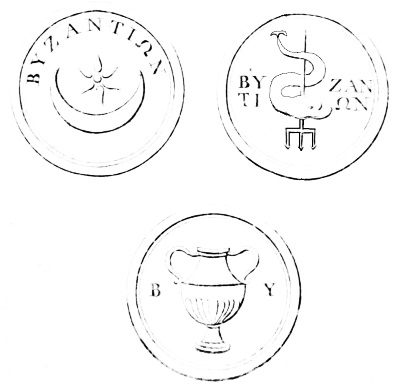
BYZANTIΩNBYZANTIΩN B Y