THE ANTIQUITIES OF BRIDGNORTH. PART II. (continued 2)
Reading edition
The Bishops after a short term of imprisonment were admitted to bail, and at the ensuing Sessions were impeached at Westminster Hall on a charge of publishing a seditious libel. Every circumstance which took place on this memorable occasion is full of interest, and historians have thought the most minute details not unworthy of record. On their way to the scene of trial, the Bishops, it is mentioned, received every possible expression of reverence and sympathy from the populace, who formed a lane for their passage, through which as they moved, many kissed their hands and their garments, and many fell on their knees and earnestly asked their blessing. Westminster Hall never witnessed such a scene as their trial presented. As it proceeded, the interest felt by the spectators was intense; and when at length the verdict was given by the foreman of the Jury, “Not Guilty,” the profound silence which had reigned throughout the court was broken by the most tumultuous acclamations. The multitudes assembled there raised, in spite of the menace of the Solicitor General, such a shout as shook the old fabric of Westminster Hall, and conveyed, quicker than the speediest messenger could do, the tidings to the city. The Bishops on leaving the court immediately repaired to Whitehall Chapel, to return thanks to God for their deliverance, and other churches were thronged by multitudes who assembled in them for the same purpose. “The bells rung from every tower, every house was illuminated, and bonfires were kindled in every street.” The joy was not confined to London, it was propagated throughout the kingdom, and felt in the remotest villages. Bridgnorth, as we have seen, fully shared in it. Our streets on the occasion echoed with loud shouts of triumph—the river Severn reflected on its stream the blaze of many a bonfire—and the tuneful bells of St. Leonard’s and St. Mary’s rang incessantly night and day to celebrate the event.
I have thus brought before the reader the few historical notices which I have been able to collect, respecting Bridgnorth, from the time of Alfred the Great to the close of the reign of James II. I am aware how much more interest would attach to these if they had been skilfully handled, inasmuch as they touch on some very important events, and memorable epochs of our national history. Those indeed who feel the force of local attachment may read them with interest, whatever defects may be apparent in the mode of bringing them together, and it is for such readers that they have been collected. I am aware also, that I have dwelt much longer on certain facts in our history than many would think at all necessary, or than was exactly pertinent to my subject. My reason is, that some would read these things here, who would not be likely to read them elsewhere; and I thought it advisable, on account of their importance, that they should be known in detail. Besides, I was anxious to make this little work more useful in its character, than it would have been if I had confined myself to a statement of the facts relating to our town, without connecting them with the general history of England. As it is, the review which we have taken, ought not to be without its moral influence. Many generations of men have thus passed rapidly before us: having acted their parts in quick succession, they have disappeared from the stage of life. They had “their exits and their entrances,” and now are seen no more. It is natural for us to reflect, how utterly unimportant to them it now is in what capacity they appeared—whether as kings or subjects—whether as masters or as slaves—whether they were honoured or dishonoured—illustrious or obscure—prosperous or unfortunate. It matters not to them now, whether their projects succeeded or failed—whether the enterprises they so keenly entered on issued in triumph or disaster. Their restless activities have been put a stop to. The hand of death has arrested them. The same destiny awaits ourselves. We too shall soon make our exit; and the interests which now so deeply engage us—the circumstances which now press on us in all their vivid reality—the scenes which are now before our eyes, and the busy part we take in them—will ere long be reckoned among the things that have been; and nothing will be left us, but the character which we have acquired in passing through them—our fitness or unfitness for a better state: and this reflection I desire to leave on the mind of the reader.
It would seem, however, scarcely natural for me to close these pages, without expressing a wish for the future welfare of a place, the scattered notices of whose past history I have here collected. I have been too long, and too intimately connected with it, not to feel the wish. In Bridgnorth I have passed more than twenty years. I reckon them the happiest of my life. I have good reason for doing so. Many domestic blessings—many social pleasures—many natural enjoyments—have here been allotted to me. Here “the lines have fallen to me in pleasant places,” and in the fair scenes of nature which surround us, there has been open to me a source of “unreproved pleasures,” of which it is my own fault if I have not largely partaken. Here too I have formed acquaintances, which have ripened into friendships—friendships which have yielded me something more than mere enjoyment—and which I have reason to hope will last as long as life itself. But still closer ties bind me to this place. Here I have been entrusted with the care of souls, and have been called to minister in the Church of God. This consideration necessarily outweighs every other, and prompts me with the most earnest wishes for the welfare of a place, between many of the inhabitants of which and myself there is so strict and sacred a fellowship. And not from these alone, but from those also with whom I am not thus officially connected—from the inhabitants of St. Mary’s parish, as well as from those of St. Leonard’s, I have received such proofs of kindness and regard during my ministry here, as make me feel an interest in everything that can concern their well-being. May they prosper in every way—as a community, and as individuals—in their civil and commercial interests—in their social, moral, and religious condition. May they secure to themselves that which has “the promise of the life that now is, and of that which is to come:” that when things temporal shall give place to things eternal—when the changes and chances of this mortal life shall cease—and all the vicissitudes which so painfully diversify the history of this world have passed away—they may have their lot and part in that kingdom which cannot be moved, and “of whose government and peace there shall be no end.”
Finis.
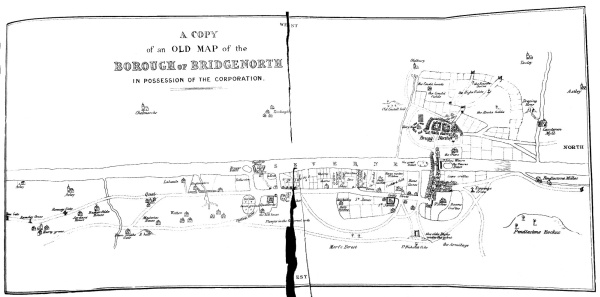
[Click map to view hi-res image.]