Volume 5 — CHAPTER XXXVIII ANNELIDS AND CŒLENTERATES
Reading edition
The important class of the annelids contains those creatures which we generally call worms. There are a great many of these, but we shall only be able to mention one or two.
The Common Earthworm
This worm is really a most interesting as well as a most useful animal. The way in which it crawls is decidedly curious. On the lower part of every one of the rings of which its body is made up, with the sole exception of the head, are four pairs of short, stiff, little bristles, projecting outward from the skin. The worm really hitches itself along by means of these bristles. First it takes hold of the ground with those underneath the front rings, then it draws up its body and takes hold with those underneath the hind ones, and then it pushes its head forward and repeats the process; and so on, over and over again.
If you take a worm and pass it between your finger and thumb from the tail-end toward the head, you can feel these little bristles quite easily.
A worm does not often leave its burrow, however, but generally keeps the tip of its body just inside the entrance, so that it can retreat in a moment in case of danger.
Worms make their burrows in a very odd manner, for they actually eat their way down into the ground, swallowing mouthful after mouthful of earth until their bodies can contain no more. Meanwhile they have been absorbing nourishment from this soil; but presently they come up to the surface and pour out the mold which they have swallowed in the form of what we call a worm-cast, after which they go down again and swallow more, and so on until the burrow is sufficiently deep.
You will be surprised, we think, to hear how much earth is swallowed by the worms in this way. Just think of it. Every year, in every acre of agricultural land all over the country, worms bring up from below, on an average, and spread over the surface in the form of worm-casts, no less than fourteen tons of earth, or about seven large cartloads!
This is why worms are such useful creatures. They are always, as it were, digging and plowing the soil. After a time the earth at the surface becomes exhausted. Nearly all the nourishment is sucked out of it by the roots of the plants. But the worms are always bringing up fresh, rich, unused soil from below, and spreading it over the surface in the form of what farmers call a top-dressing. They are doing, in fact, exactly what we do when we dig our gardens or plow our fields—burying the used-up soil that it may rest, and bringing up fresh mold to take its place.
But, besides turning the soil over, they manure it; for almost every night from early spring to late autumn worms are busy dragging down leaves into their burrows. With some of these leaves they line their tunnels, with some they close the entrances, and on some they feed. And most of them decay before very long and turn into leaf-mold, which is just about the very best manure that there is. So you see, the worms do not merely turn the soil over, they enrich it as well, and help very largely indeed to keep it in such a condition that plants can continue to grow in it.
The Lugworm
The similar lugworm lives in sandy mud on the sea-shore; and when the tide is out you may often see its casts in thousands. It is very largely used by fishermen as bait. When it is carefully washed it is really quite a handsome creature, for sometimes it is deep crimson in color, and sometimes dark green, while on its back are twenty-six little scarlet tufts, arranged in pairs, which are really the gills by which the worm breathes.
The burrows of the lugworm are not quite like those of the earthworm, for as its tunnels through the sand it pours out a kind of glue-like liquid, which very soon hardens and lines the walls, so as to form a kind of tube and prevent the sides from falling in.
The Terebella
This worm forms very much stronger tubes. It is common on many parts of our coasts. But it is not very easily found, for at the slightest alarm it retreats to the very bottom of its burrow, which nearly always runs under large stones and rocks.
The terebella makes its tube by means of the little feelers, or tentacles, which spring from the front part of its body. These have a most wonderful power of grasp, and one after another little grains of sand are seized by them, and carefully arranged in position. And when the tube is quite finished, the animal constructs a little tuft of sandy threads, so to speak, round the entrance, which you may often see in the pools left among the rocks by the retreating tide.
The Sea-Mouse
Looking far more like a hairy slug than a worm, the sea-mouse also belongs to the class of the annelids. You can easily find this creature by hunting in muddy pools among the rocks just above low-water mark; and most likely you will consider it as one of the dingiest and most unattractive-looking animals that you have ever seen. But if you rinse it two or three times over in clean water till every atom of mud has been washed out of its bristly coat, you may change your opinion. For now you will see all the colors of the rainbow playing over it—crimson, purple, orange, blue, and vivid green—just as if every hair were a prism. It would be difficult, indeed, to find any creature more beautiful in the waters of the sea. This bristly coat is really a kind of filter, which strains out the mud from the water that passes to the gills.
Leeches
Leeches, too, are annelids, living in fresh water instead of salt water. They are famous for their blood-sucking habits, and when we examine their mouths through a microscope we find that they are provided with three sets of very small saw-like teeth, which are set in the form of a triangle. When a leech wants to suck the blood of an animal, it fastens itself to the skin of its victim by means of its sucker-like lips, and then saws out a tiny triangular piece of skin. That is why it is so difficult to stop the bleeding after a leech has bitten one. An actual hole is left in the skin, which does not heal over for some little time. And a great deal of blood is generally taken by the leech itself, which will go on sucking away until its body is stretched out to at least double its former size.
That is rather a big meal to take, isn't it? But then such meals come very seldom. Indeed, when a leech has once gorged itself thoroughly with blood, it will often take no more food at all for a whole year afterward!
Leeches lay their eggs in little masses, called cocoons, which they place in the clay-banks of the pools in which they live. In each of these cocoons there are from six to sixteen eggs.
We now come to the last great class of animals about which we shall be able to tell you—that of the cœlenterates. It contains three most interesting groups of creatures.
Jellyfishes
You may have seen plenty of jellyfishes if at any time you have been staying at the seaside, for they are often flung up on the beach by the retreating tide. But if you were to go and look for them two or three hours after seeing them, on a bright sunny day, you would find that they had disappeared. All that would be left of them would be a number of ring-like marks in the sand, with just a few threads of animal matter in the middle of each. The reason would be that they had evaporated! That sounds rather strange, doesn't it? But the fact is that the greater part of the body of a jellyfish is nothing but water! It is quite true that if you cut it in half the water does not run away. But then that is equally true of a cucumber; and cucumbers, too, are made almost entirely of water. The reason is the same in both cases. The water is contained in a very large number of tiny cells; and when you cut either the animal or the vegetable across, only a few of these cells are divided, and only a small quantity of the water escapes.
Round the edge of the disk of a jellyfish which has just been flung up by the waves you will find a number of long, slender threads. These are its fishing-lines, with which it captures its prey, and they are made in a very curious manner. All the way along they are set with a double row of very tiny cells, in each of which is coiled up an extremely sharp and slender dart. These cells are so formed that at the very slightest touch they fly open, and the little darts spring out; and, besides this, the darts are poisoned. So as soon as any small creature swims up against these threads a number of the venomed darts bury themselves in its body, and the poison acts so quickly that in a very few seconds it is dead. Then other threads come closing in all round it, and in a very short time it is forced into the mouth and swallowed.
Some jellyfishes are so poisonous that they are most dangerous even to man. Only one of these, however, is found in the North Atlantic, almost all the jellyfishes that one finds lying about on the beach being perfectly harmless. But if, when you are bathing, you see a yellowish-brown jellyfish about as big as a soup-plate swimming near you in the water, be sure to get out of its way as fast as you possibly can; for if its threads should touch any part of your body, you are almost sure to be very badly stung. There is very little doubt, indeed, that many swimmers have been killed by these creatures; while thousands of unwary bathers have been laid up for days, or even weeks, from the effects of their poison.
Sea-Anemones
What beautiful creatures are these—just like flowers growing under the sea! Some are like dahlias, some like chrysanthemums, and some like daisies, of all shades of crimson, and purple, and orange, and green, and it is very hard to believe that they are really living animals.
The tentacles of these creatures, which look so like the petals of flowers, are set with little cells containing poisoned darts, just like the fishing-threads of the jellyfishes. They can be spread out or drawn back into the body at will, and when they have all been withdrawn the anemone seems to be nothing more than a shapeless lump of colored jelly.
Anemones spend the greater part of their lives clinging to the surface of a rock at the bottom of the water, the broad base of the body acting just like a big sucker. They can crawl about, however, at will, and sometimes they will rise to the surface of the sea, turn upside down, hollow their bodies into the form of little boats, and then float away, perhaps for quite a long distance.
But few sea-anemones are seen on our eastern coast, because, except in the cool north, there are few rocks. On the warmer and rockier shores of California and northward, however, these lovely creatures occur in great variety.
Corals
Last upon our list come those most wonderful little creatures which are known as corals.
These are often called coral insects, but that is a great mistake. For they have nothing to do with insects at all, and are as different from them in every way as they can possibly be. They are properly called polyps, and we can best describe them, perhaps as very small sea-anemones. But they have one property which the anemones do not possess, namely, the power of extracting lime out of the sea-water and building it up round themselves in the form of coral.
These creatures may be roughly divided into two groups, the one consisting of the simple corals, which only live together in very small numbers, and the other of the reef-builders, which live in vast colonies, and build up masses of coral of enormous size. The latter are by far the more interesting, and the way in which they build up immense banks of coral is very wonderful indeed.
Remember, first of all, that these animals multiply in two different ways—sometimes by eggs, and sometimes by little buds, so to speak, which grow out of the body of the parent. The polyps which hatch out from eggs swim about for some little time quite freely. But after a few days they fasten themselves down to the surface of a submerged rock, and after that they never move again. Other polyps soon come and settle down by them, and before very long there will be thousands upon thousands of the little animals all growing, as it were, close together, and all gradually building up coral underneath and round the margins of their bodies.
When they reach their full size they begin to multiply by "budding." Baby polyps sprout out all over their bodies, and these, instead of swimming about for a few days like those which are hatched from eggs, remain fixed where they are for the whole of their lives. Then they, in their turn, begin to deposit coral, and as they have nowhere else to put it they place it on the bodies of their parents, which before very long are completely covered in. Now, you see, there is a second layer of coral on the top of the first. Then in due course of time a third layer is formed upon the second, and a fourth layer upon the third, each generation being built in by the one that comes after it, till at last the coral bank rises above the surface of the water. Then the work has to stop; for these little creatures cannot live unless the waves can constantly break over them. But although the bank cannot be raised higher it can still be extended on all sides; and so the little polyps go working on, year after year, till at last the results of their labor are almost too wonderful to realize.
Coral Banks
These coral banks take three different forms.
First, there are the fringing reefs. These are great banks of coral surrounding the shores of a tropical island, or running for long distances on the coasts of the mainland. The island of Mauritius, for example, is entirely surrounded by a fringing reef. These reefs often spread out for miles into the sea, and they are only broken here and there by narrow passages, where some river or stream is flowing out. For the polyps cannot live in fresh water.
Next, there are barrier reefs. These are great walls of coral at a distance from the shore, with deep water between the two. For the polyps are unable to work at a greater depth than about thirty fathoms, or one hundred and eighty feet, below the surface; and it often happens that while there is deep water close to the shores of a tropical island, there is shallow water farther out. In such a case the polyps have to build out at sea, instead of close into the land, and there is a kind of moat between the coral bank and the shore. In this case the bank is called a barrier reef, and sometimes it is of enormous size. The Great Barrier Reef, for instance, runs for no less than 1250 miles along the northeast coast of Australia.
Then, thirdly, there are coral islands, or atolls. There are thousands of these wonderful islands in the Pacific and the Indian oceans, and others are still being slowly pushed up out of the sea. They always take the form of more or less circular rings, in the center of which is a lake of sea-water called a lagoon. The coral bank of which they consist is seldom more than a few hundred feet wide, but sometimes the islands are very large indeed. The biggest of all is ninety miles long and sixty miles broad, while several others are not very much smaller. Soon after they rise to the surface of the sea a kind of soil is deposited upon them, made up partly of powdered coral, ground up by the action of the waves, and partly of decaying vegetable matter which has been flung up on them. Then sea-birds bring mud upon their feet from the mainland, or from another island at a distance, and leave some of it behind them when they settle down to rest; and in that mud are seeds of plants, which soon begin to sprout and grow. So in a very few years the island is covered with low vegetation. Then one day, perhaps, a floating cocoanut is flung up, and that, too, takes root and grows, so that in course of time there is a palm-tree. Other palm-trees, of course, follow; and the result is that the first glimpse which a traveler gets of a coral island is nearly always that of a row of palm-trees upon the horizon.
The simple corals live in almost all parts of the ocean. Some of them are occasionally dredged up off our coasts, and can live in very cold water. But the reef-builders are only found in warm seas, and are never found working far outside the boundaries of the tropics.
How wonderful it seems that tiny creatures such as these polyps, which really do not appear to be much more than little lumps of living jelly, should be able to build up these vast masses of coral from out of the depths of the sea! One cannot help wondering what the results of their work will be if the world should last for a few thousand years longer. It would really seem that by that time the tropical seas will be choked up with coral islands, and the lagoons inside them will be filled up with coral too; so that not merely islands, but continents, will have been raised from the ocean by some of the smallest and weakest and most insignificant of all living animals!
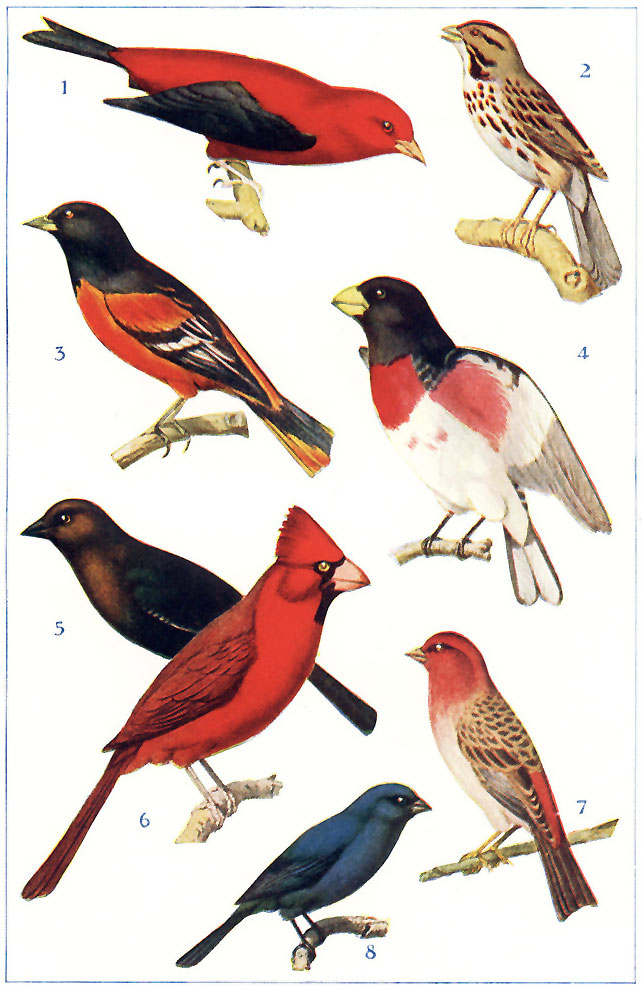
NORTH AMERICAN SEED-EATING SONG-BIRDS
1. Scarlet Tanager, or Black-winged Redbird. 2. Song Sparrow. 3. Baltimore Oriole.
4. Rose-breasted Grosbeak. 5. Cowbird. 6. Cardinal Grosbeak. 7. Purple Finch.
8. Indigo Finch. All are adult males.