INTRODUCTION. (continued 2)
Reading edition
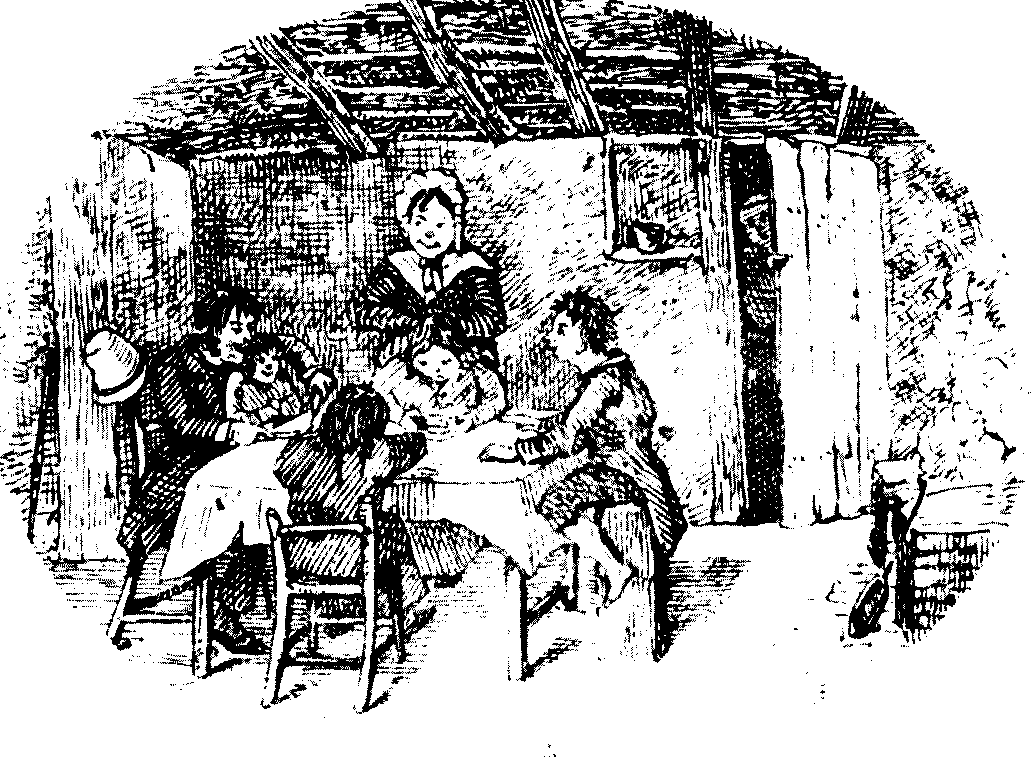
Sure it makes me feel hungry, although I've just dined.
"Well, Patrick, my boy, you're a fisherman clever! Such a dainty repast a monarch saw never; Sure it makes me feel hungry, although I've just dined. But as eating two dinners seems greedy inclined, I will just call this tea; but I'm not such a baste As to eat all myself—you must each have a taste. Come here, Mike, we're old friends, you must sit on my knee; And pray girls, get chairs, quick; they are near cold I see; For the time I should come your ma guessed so near right, They were out of the pot ere I came within sight. But pray what's this black stuff? Pat, you rogue, come confess, For I'm sure it was you made this horrible mess. What! 'tis fish-sauce, you say? 'Twill a source prove of pain, And will beckon the trout to your mouth back again." Now all are supplied, But when you divide What is small 'mong a number, there's not much a-piece. 'Twas a sum, Murphy thought, In division called short. He had multiplied rather, if they'd so increase. But skill failed to contrive;— So the two into five Went only just once and none over. While the girls from each other Cast sly looks at their mother, Whose thoughts to the cupboard run over. Shall we eat it or leave it? their eyes seemed to say, Quite forgetting that looks will their secrets betray. While in vain the poor dame may nod, frown, or may wink, For whatever she means they can none of them think. Meanwhile the poor friar half stifled remains, And gives vent to his thoughts in the following strains:— "O, cruel Miss Fortune, my dinner thus stealing! I wish that I never had thought of concealing. O do spare but a tail for one mouthful, I pray thee! I could relish roast jackass, without sauce or gravy, I so hungry have got; while this cupboard's so close, That I'm speckled with dew like a morn-gathered rose. I would quickly escape, if it were not for shame. Let me see if I cannot some good excuse frame, As a cure for this terrible fasting. Can I make it appear that for something I've sought? But, O dear me, I fear that I here shall find naught Save the cats and myself who just past in. But, hark! some one's speaking—I'll hear what they're saying, I may chance get off free by a moment's delaying. "A delicious repast This," said Murphy; "when last I was feasted on trout was in good O'Neal's time. I considered him then Among wisest of men, Till he drowned him in drink, which I thought quite a crime. For, pray, who in his senses would be after leaving Such a family sweet at his loss to be grieving? Sure, though I am single, and have not much wealth, I would give all the world for such treasures myself. Now, dear Mistress O'Neal, you've a very snug home, 'Tis a thousand of pities you live all alone With no male to protect you. I know a young fellow Who the place of your slave would supply very well. O He's just the right size; is not ugly, very. Has a voice for a song; is lively and merry. Can hedge, ditch, reap, and sow; can attend to a farm; While his heart is so soft he a flea would not harm. Then he dotes upon children, from Pat's age to Mike's, And those sweet babes of your'n are the sort that he likes. Sure you'll take him at once on my recommendation; For although he's ne'er been in a like situation, He has made it his business to please all the ladies; Ev'ry wish, although nonsense, directly obeyed is." Then her hands clasping tight, on his knees down he plumped, (While the echoing walls cried to hear the floor thumped), Saying, "Sweetest of angels! my darling! my deary! Do just listen a moment, I pray thee, and hear me. For you know that of nectar you are the sweet essence, Those who fail to admire you, than none sure have less sense. 'Tis myself is the slave in whose praise I was speaking, Who, when wedded to you, would be prouder than the king. Then consent to be mine—dearest one, don't say No, Or I out of my senses shall certainly go." Now the good dame the whole, From the depth of her soul, Believed—-and her feelings could scarcely control (She, 'tis true, had preferred That the monk had not heard, For where he was hid he must catch ev'ry word), But, much pleased altogether, She was pondering whether To escape out of hearing if she could endeavour. So she said, "Mr. Murphy, if outside you'll walk, On the subject you've mentioned we'll have a short talk, Though I cannot afford a man-servant to keep— It would ruin me quite!" But her plan was too deep For poor Murphy to guess; who, not knowing her reason, Thought she lov'd some one else, and despising such treason Cried, "Oh, treat me not falsely; my love is most true, And I never will love any other than you. Oh, I cannot thus leave you—I will not depart Till you say, 'I am thine!' thou delight of my heart! O 'tis cruel to keep me thus long in suspense; Your mistaking my meaning is all a pretence. But you women delight so to bother and tease us, When your study should be to make much of and please us; Like an angler ere landing his fish plays about Just for sport, when he knows he might pull him straight out. But remember, there's many a good fish been lost By the snap of a line, which a dinner has cost." "That is meant sure, for me," thought the friar; "no doubt. How I wish the good dame could have coaxed the chap out! For 'tis plain as my face, she's in love with the man; And he jealous may grow, while do all that I can I much trouble may find in him undeceiving. Those fellows are often so hard of believing!" But not long could poor Peter discov'ry put off, For he's all at once seized with a tickling cough, Which to strangle he tries, but in vain; though he pokes His red fist in his mouth till he very nigh chokes; For escape it would find, like a boiler of steam: Wherein water expands to such size that 'twould seem It must verily burst, when the safety-valve opes And the vapour unfettered from darkness elopes. So it was with the monk; had his cough not dispersed, Sure his lungs from the pressure had certainly burst. "Hush!" said Murphy; "what's that?" "Oh, 'tis naught but the cat," Said the dame, while her voice seemed confusing: "She has been there all day, And is most like at play With her kittens, who are so amusing." But the cough was repeated, And the dame felt defeated, While quick Murphy tore open the door; Crying, "Come out, you sinner! Can such charms as yours win her, While I love from my very heart's core? But I'll make you pay dear For thus listening here." And he raised up his foot for a kick. When the dame rushed between, Or a struggle there'd been Which on hearing would turn your heart sick. For, though choking, could Peter scarce utter a word, Of which Murphy enraged not a syllable heard, But he took up his hat to be gone. "For your sake, dame, I spare That old wretch, but take care That I never him catch out alone. For, as sure as I live, Such a hiding I'll give, As shall make him feel sore in each bone." Then he turned on his heel and went out of the door; When, recov'ring his voice, Peter called to implore Him a moment to stop, as he wished to explain How in such a position by chance he became. "Which as soon as I've done I shall surely expect You'll apologize, too, for your want of respect." Murphy turned and re-turned, With a frown sat him down, And a glance which bespoke great attention. "Sir, proceed; but take heed. To deceive, I believe Is your plan, and your present intention." (But, alas! when a thing we much wish to be true, We are apt to believe it is really so, too. So the news Murphy heard was so sweet to his ear That of present detection the monk had no fear.) "Hush, hush, unbeliever!" the friar exclaimed; "Such terms, in my presence, should ne'er once be named. For of Mary's a monk I've the honour to be; Which, if not so enraged, by my dress you might see. Now although there's no reason why I should explain, Still, as 'tis for your good, if you choose to remain I will tell all I know, when with pleasure you'll find, That instead of a foe I am friendly inclined. First, your love from its source and beginning I've traced, Which on Widow O'Neal for her beauty was placed, Till the various graces which decked out her mind, To obtain her esteem made you feel more inclined; While you felt in your heart you would rather have died, Than ere chance to behold her another man's bride. Now, is it not so? Yes, I see by those eyes; No wonder at first they are filled with surprise, To hear me your thoughts and your actions disclose, But we monks know far more than you mortals suppose, And that what I affirm is correct, hear, and know, For the thoughts of your heart at this moment I'll show. You are thinking why I, In a cupboard should fly, As if of my actions ashamed, When a dinner I'd got Of nice trout, smoking hot. It looks as if I should be blamed. But so certain I was, and convinced in my mind, That the question to pop you felt strongly inclined, Which should make you despair, or else happy for life (I just mean about making this good dame your wife), That I thought I had better slip out of the way, Lest my presence might check what you wished so to say: It is true I regretted my dinner to lose, But to cross all my plans I at once did refuse; For an in'trest I take In the match, for her sake, For I'm positive sure she a good wife will make. And as now on that point you seem both resolved quite, I am ready this moment your hands to unite, For your hearts by each other have long been held tight." "Oh, forgive me! dear father," cried Murphy, with glee: "Thus your acts to mistake, what a fool I must be! Sure your pardon I crave for the words that I might In my flurry have said, in the moment of fright; It was catching you hid made me think all not right, But upon that head now I am satisfied quite. Still I fear, though I'm anxious my fate to unite With this beautiful dame, that it can't be to-night; For the dress is not bought which I meant to provide her, And the friends are not asked she would fain have beside her. Then, besides, there's not whisky enough in the house To intoxicate more than a newly-weaned mouse: But the day after next, if my charmer is willing, I will snap, for her eyes are than fish-hooks more killing. Oh, then say, dearest, say, Will it suit you that day, From O'Neal into Murphy to change? But if you would delay I will cheerful obey— For I would not your plans disarrange." Now the widow scarce knew What on earth she should do, There was nothing, she thought, to prevent it; And although she had rather have been all alone, Than the state of her heart 'fore another to own, Still refusing he might think she meant it. And the chance would be gone, Which her hopes had upborne, For a twelvemonth and some few days more. So she said, "If you please, sir, I find on reflection, That I really have not got the slightest objection, But I could not be ready before; For a bit of a party we must have at night, As there's many I've promised I would then invite, Who, neglected, would feel very sore. I should next week have liked, but had rather a fear That with washing or baking it might interfere, So we'll make it the day you wished for." She had scarcely said this, When a good hearty kiss Flew plump on her lips ripe as cherry; While an arm round her waist At the moment was placed,— She did not dislike it much very. Then the friar took leave, While the good people grieve That he of his meal was bereft; For he'd not been the least fed, Though in fancy he feasted (As that now was all that was left) On the banquet to come, When he'd surely make one Of the guests on the grand bridal day: When right good farm-house cheer, With prime ale and strong beer, And proof whisky, would make all hearts gay.

'Twas a day of days, And birds to its praise Their very best lays Sung out. While the sheep and cows, Who their carols rouse O'er the meadows, browse About. Not a cloud was seen The bright sun between And the pastures green, When forth The good widow crept, Who had scarcely slept, Though 'twas bright thoughts kept Sleep off. She was up with the sun, As there's much to be done, And great numbers of things to provide For the grand bridal meal (Ere her fate she may seal), But in showing her skill feels much pride. There's the butter to make, All the new bread to bake, And a very large plum-cake beside; While she'd think with much dread She's not properly wed If aught ill to that cake should betide. Yea, she has quite a doubt If a marriage without Would be legal, if lawyers it tried. Now Jonas the miller (her uncle) for dower Had sent her a sack of the best wheaten flour; So on tarts, puddings, pies, she may work away fast As she likes, for materials her time out will last. She is rambling now To look after the cow, Who of course to a distance would stray. But she did not get cross, Though of time thus there's loss, For p'rhaps Murphy might chance come that way. He had toiled away fast, For the day or two past, To make the house fit for his bride. As he felt quite inclined, And had made up his mind, That there 'twould be best to reside. "Sure this morning he's late," Thought the dame, as a gate She approached which led into a lane, When a voice loud in song Was heard strolling along; Oh, she thought it a beautiful strain! "Oh, my love she is merry, And beautiful, very; Her lips are as red as a ripe juicy cherry. "Her neck than snow's whiter, Her eyes than stars brighter, Her step than the gentle gazelle's is far lighter. "Her fine sculptured nose is Surrounded with roses, And tulips, whose sweetness fresh beauty discloses. "Than the lark her voice sweeter, Yea, so perfect 's each feature, She is without doubt a most beautiful creature." "Oh, good morning, dear Murphy," the dame cried with pleasure, As she stept into sight when he finished the measure, "A most beautiful song that, and sung with much feeling; Quite enraptured, all care from my heart it seemed stealing, Like the music of birds, which will sometimes come creeping O'er our dreams in that state betwixt waking and sleeping." "Ah, you've listening been! I myself have betrayed, And the praises you've heard of a beautiful maid. Now, as oft I've heard said by those proverb-wise elves, That sly listeners never hear good of themselves, It could ne'er have been you to whose praise I sung out: But I see by that smile that there lingers a doubt, And you still think 'tis you from the kind of description. Well, 'tis true you seem made after such a prescription; But it does not do justice, as I can assure ye. I'll remand you till eve, when assemble the jury, And then if this gown that I've bought you'll appear in, The verdict of guilty I'm certain of hearing: For all of your guests will of envy be dying,— The women, because you their charms are out-vieing; The men, 'cause I've won you while vain they were trying." Then on they walked, And blithely talked Of happiness in store. The cow soon caught Was homeward brought,— Her rambling days are o'er; For Murphy all the hedges patched, The wicket swung and firmly latched, As it had hung before. The rotten roof with great dispatch Received an outer coat of thatch, While boards soon frame a door. And time he in the garden found To sort the bed from paths around, And with the weeds wage war. Meanwhile the hours onward rolled, The clock the time had often told, The dame her cooking had completed, The pots and pans had all retreated, The house in ev'ry point seemed righted, Naught's out of place but those invited, Just to witness the sticking of two soles together, Tight as e'er gutta percha has stuck unto leather. Now although 'tis not late The dame likes not to wait, It puts her in such a great fidget; There is nothing to do She can put her hand to, Or her fever would crawl to each digit. The fair maidens for hours Had been decking with flow'rs The kitchen, and made it look gay As a ribbon-clad sweep Who from chimneys may creep To dance round a green (first of May). 'Tis a quarter to five, And the guests fast arrive, And each with him some present brings: One a roast pig had got, One a goose smoking hot, And numbers of other nice things. There were rabbits and hares, And prime roast-ducks in pairs, And pigeons delightfully cooked. Like a pic-nic it seemed, But might well have been deemed A banquet, so noble it looked. But a fear rising lest Some nice girl might like best To hear how the bride than the victuals were dress'd, In few words I'll express, Although feminine dress Is out of my line I must really confess; For when I've had a look, it Has but been to hook it,— I never then thought I might chance have to book it. So I beg you'll excuse Me if strange terms I use,— Such a trifling request you will scarcely refuse. Now the gown Murphy gave her, That expense he might save her, Though not quite bran new, still looked elegant rather, Of a sky-coloured blue, Without flounces, 'tis true, And being scanty in skirt rather tight round her drew; It was smothered with bows, Which descended in rows From her fine swelling chest to her neat little toes, Just like scarlet-runners,— Love, sure, they had won hers, If at the beginning had been but for fun hers. At the top it was low, That her neck it might show, As white as a turnip or two-days'-back snow. Then her rather red face embedded in lace, With large green rosette, garnished to heighten each grace. But a bright crimson shawl Was her pride above all, Whose folds graceful descended the ground down to fall. The young ladies in white Will appear towards night, Their frocks from the mangle are not yet dry quite. So like grubs they appear, Till through starching they're clear, And then prouder than butterflies up their heads rear. With sweet roses entwined They their fair brows will bind, To make most of themselves they are really inclined. Little Michael was drest Out in his very best, With a pinafore over, lest they might be messed. He had watched with great int'rest the good things provided, And much longed for the time when they should be divided. "O you beautiful creature!" said Flannagan Ted, "How I wish it was me, and not Murphy instead; I quite think we must fight till there's one of us kilt, Unless he runs away that no blood may be spilt." "Oh, the false, faithless man!" cried a beauty beside him; "When I thought him so true, sure his words have belied him! To speak so in my presence,—oh, really, 'tis shocking! How often do men seem our best feelings mocking!' But the good dame replied, with a kind-hearted smile, "'Twas but flattery, Clare, his heart's your's all the while." Yet the beautiful maid still continued to pout, Till a loud, smacking kiss, rubbed the wrinkles all out. Look! there's old Farmer Jonas arrived in his cart, With a pair of twin daughters and wife dressed so smart, Whose plump cheeks are so covered with ribbons and bows, That like owl from out ivy appears each peak'd nose. That the maidens were fair is a fib I can't tell you, And, what was most strange, 'twas a fact they both well knew, For their eyes tow'rds each other were friendly inclined, While their locks would bring carrots at once to your mind. But their tempers were sweet as the extract of bees, And where'er they might go they were certain to please. The old farmer himself is a jovial fellow, With a loud, pealing laugh, as melodious and mellow As the music of calves when for mammy they bellow. In stature he's stumpy, approaching to fat, With a very broad face and a still broader hat, Which, perched all on one side, like an avalanche sat; And so brightly would twinkle his little black eyes (When he uttered his jokes, which would often arise) That like di'monds they gleamed of first water and size. His good lady, however, was quite his reverse,— She was scraggy and lanky, and, what was far worse, For ever was teased with a terrible cough, That threatened each moment to carry her off. Now old Jonas was richer than any around, He'd a farm and a mill—besides acres of ground, Where the ripe, waving corn, like an ocean appears, While than even King Midas he boasts longer ears; And like to that fabulous monarch of old, Whatever he touch'd was transformed into gold. No harm to his horses there ever befel, And his cattle had never at all felt unwell. His crops were all good, and increased fast his store;— Thus contented he lives, nor once wishes for more. By all ranks he is held in the greatest esteem; Which is justly his due, as will presently seem, For his house, always open, scarce wanted a door, And was styled a depôt for the wants of the poor. "Dear Uncle, to see you it gives me much pleasure, The present you sent me was really a treasure," The young widow exclaimed, as a kiss on her brow Was descending, as light as a bird on a bough. "Dearest Aunt and sweet cousins, I felt it most kind, That the state of my wardrobe you still kept in mind, For without those fair garments, though hidden from view, I had sorely been puzzled whatever to do: They're a beautiful fit, though the hooks will not meet; Still the gown fastened over them keeps all things neat." Now they all are arrived but the bridegroom and priest, But of guests at a wedding they form not the least; And the dame gets more anxious her true love to see, Who had left to adorn, but had promised to be Back in less than no time—but his word had not kept. She was angry and vexed, and had certainly wept, But she would not her friends should suppose her infirm, And so tries to explain why he does not return. Which, while she is doing, I'll try and describe The friends of the bridegroom as well as the bride. There is Jerry Maguire (Who has brought, by desire, His fiddle to strike up a dance), He has long, curly hair, Which delights ev'ry fair, Who at him oft cast a sly glance. He is not very tall, Yet looks down upon all, And considers himself just the thing, In his rough, white frock coat, Green cravat round his throat, And broad collar turned down o'er each wing. His young sister's there too (Quite a picture to view), A sweet, rosy-cheeked, plump, little maid, Who appears rather shy, And will cast down her eye When she's spoke to, as if she's afraid. Close beside her there sat, Full of kind, friendly chat, Her young cousins, the Misses Delhay, With their big brother Sam, Who, quite certain I am, Is in love with Maguire's sister May. For attention he paid her, Such presents oft made her, And ever was close by her side, While the mother oft winks, When she's asked how she thinks Pretty May would look dressed like a bride. In a corner remote, Where each look she may note, At this very moment she's sitting, And attention scarce pays To what old Jonas says, Who is rather fidgetty getting. For she scarcely had spoke, Though a pun and a joke On the bride and the wedding he made; So for fear they'd be lost, He uprose—the room crossed, And them safe to the widow conveyed; Who said, "Dear me, how funny!" and laughed till she cried With a fit of convulsions, which nigh cracked her side (As a prelude to draw all attention). "I must tell it them, uncle, although you say nay." "And screw up your dear mouth in that comical way?" "'Tis is a great deal too good not to mention." "I've a riddle to ask, though against me the jest,— Why are you all betrayed, and not one e'er a guest? What, can none of you guess? Why, through those who so late are, There is nowhere a guest, for each person's a waiter!" "What a dreadful bad pun!" whispered Samuel Delhay, As his red lips approached nigh the ear of fair May; But perceiving he's watched, he could do nothing more, Than just smile for a moment, and them back withdraw. But I now must return without further delay, To describe all the guests of the grand wedding day. There is tall Miss O'Riley, In a queerish old style she Appears to be made; by the cut of her phiz Though a spinster,—'tis sure, She can flirting endure; Her age when truth calculates right is Forty—but, O dear me, pray what am I about? I shall get by the fair sex kicked certainly out; I should only have said what is true, by the bye, That though out of her teens she has ne'er got a tie. But pray who is that beauty of very great size, Who can't sit on one chair though she struggling tries, With large gooseberry eyes, and complexion as sallow As a half-melted dip of inferior tallow? By her beak her I know, which is long and red, rather— She is spouse to the man who is Flanagan's father. Now, O'Flanagan's self is as brown as a berry, Tallish, stout-built, ferocious, and fightable, very; For no fray could you name in which he hadn't been, While where'er he may go his shillaly is seen Tucked under his arm, whence in less than a minute It would leap to his hand, and deal blows ere quite in it. He is partial to racing, to gambling, to liquor, Can the value of horses than dealers tell quicker; Can run, wrestle, and fight, any man in the village, And, when safe from detection, objects not to pillage; I don't housebreaking mean, but just causing a sheep To have unpleasant dreams, and to walk in its sleep. Now, although much disliked by most people, yet still, Go wherever you may, there you certainly will Meet O'Flanagan John—though he's only invited Just to keep his wrath cool, which oft boils when he's slighted; And like steam must find vent in some malice-fraught trick, Or will burst into flame like a smould'ring rick. His son, Flanagan Ted, is a nice little feller, At least, so says Clare—and pray, who should know weller? He is tall, handsome, well-made, and folks say they never Have beheld a young man more polite, or so clever. Near, of course, to his side, Sat his young future bride, Who seems much inclined to be jealous. Speaks he but to another, She her thoughts can scarce smother, And sighs like a pair of new bellows. Her old father and brother are somewhere about,— With O'Flanagan talking, I have not a doubt, Of the state of the crops, for of him land they rent, (Not, p'rhaps, over well-tilled, but of wondrous extent), Near O'Flanagan Lodge, which are fixed by entail, Or, through winds often raised, they ere now had set sail. Now O'Donoghue senior's a cunning, shrewd man, Who had sketched out his life to the following plan:— "Just take care of your money when once, 'tis obtained; For a penny when saved is a penny well gained." He is short, ugly, shrivelled, and bowed down with care; What is styled a spare man, or a man all could spare. He is harsh, much despised by the people around, For the lab'rers in him a severe master found. And the poor never called, for they knew 'twas no use, As he gave naught away but a show'r of abuse. It was not quite respect made him seek for his daughter Such a partner for life, but he wisely had taught her His favourite maxim of—Get all you can; For 'tis money alone manufactures the man. Young O'Donoghue, too, Is a bit of a screw, For he wears an old coat which has never been new. The plain English of which is, That, in spite of their riches, 'Twas a pair and a half of his father's old breeches. He has shouldered two legs—for the tails split another; While his back took a seat which his neck too will cover. Now they're all introduced but a queer little man, With broad nose, bushy hair, and complexion like tan; Who a foreigner seems, quite a fresh importation, An exotic transplanted from some foreign nation. "But what has delayed them?" Uncle Jonas exclaimed; "Some harm has waylaid them; Or they're to be blamed. For I hoped ere this time to have given away This good dame, who I fear on my hands still must stay. I bestowed her before, but just like a bad penny She returns to my pocket, though welcome as any. For of her and the children it must be allowed I with justice have reason to be truly proud." "We had better begin, Food thus spoilt becomes sin," Exclaimed Flanagan John, with a ravenous grin; "For, believe when I say, Scarce a toothful to-day I have eat, that I honour to all things might pay. I now too feel quite sinking, While I cannot help thinking They've mistook the day." He continued by winking; When his speech was cut short by a loud joyful shout From young Patrick O'Neal, who had kept the look-out. "Here is Murphy a-coming! Hurrah! hurrah! Our mother's young husband! Our handsome new Pa!" "Oh, I'm covered with blushes, one heap of confusion; Sure to pop in so late appears quite an intrusion. But I thought of a proverb which Truth conveys over, Which says, 'Coming, though late, is still better than never.' But you all will forgive, my excuse when you've heard— Yet just now on that subject I'll speak not a word; I've delayed you too long—for the present at least. When you're fed, I'll tell all. But, pray, where is the priest? I can't see his dear face. What! forgotten to call? Oh then, sure, by good luck, I'm not last after all." "Oh," said Jonas, "like you He some excuse too Most likely will give us for coming so late. But as hunger grows stronger, We will tarry no longer, For hunger will not for a priest even wait." "Stay, for him I'll atone, 'Tis no fault of his own," Said Murphy; I'm certain he'd choose (From the little I know), Through great dangers to go, Than such a superb banquet lose."

Who has never beheld when an old lady slips On the pavement of wood, which her toe upward trips, A dense crowd bustle round, quick as bees to a hive, While in vain she, though fainting, for fresh air may strive? Or when, at the close of a hot summer's day, As the sun tints the lake with his bright crimson ray, Who has never remarked how the fishes will rise If you throw in some bread, while to seize on the prize They will upset each other, and splutter about, Till their heads and their tails from the river peep out? So exactly it was at the time I am speaking, Ev'ry one for himself is the best place out seeking, Taking care a nice dish shall stand nearly before him, With some fair one by side he would fain have adore him. Now a passage to quote from an elegant Poet, Whose name I can't tell, for I really don't know it; It is not from Byron, or Chaucer, or Pope, Or Milton, or Cowper, and I therefore must hope You won't search through their writings to find it— Let me see, is it Shakespeare's? no, 'tis n't his either; Nor More's, Prior's, Dryden's—of theirs it is neither. Where can I have read it? I cannot remember, I might waste all my time from Spring to December, In trying to think—so don't mind it. But I've heard that you ought, When you borrow a thought, Just to mention the place whence you brought it. Still, although this seems right, 'Tis not possible quite, To kill even a flea till you've caught it. The quotation I'd note Was a fable one wrote, As a means to convey information. Like a sandwich, between May a moral be seen, Wrapped up in a pleasant narration. Once the Lion invited to hunt and to dine, And to taste a few skins of his favourite wine, All his friends of the forest—who said they'd be there, In the sports of the chase and the victuals to share; Then the cunning fox scampered the country around, Just to stop up the holes, and survey well the ground; While the wolves have agreed to act dogs for the day, And the jackall has orders to search out for prey. There's his highness, Lord Camel, and Sir Grisly Bear, With his tall Polish friend, who continues to wear That long warm furry mantle, which looks just like snow, And descends in short flakes till it wraps round each toe. Majors Leopard and Tiger, just fresh from Bombay, Of the proud native corps, have, undoubted, the sway, Who would rather prefer to lie dead on the field Than retreat from the foe, or the slightest point yield. Count Panther and young Lord Hyena together Are chatting, and making remarks on the weather; The Count thinks it will rain, though at present 'tis clear; While Lord Hyena laughs at the very idea. The Grand Sultan Elephant cannot go out To the hunt, as he has an attack of the gout; But says of objections he has not the least To come in at the death, and make one at the feast. Now before they set out, just by way of a lunch, Of bread and of buffalo each takes a hunch; With strong bottled stout of Dame Lion's own brewing, From wild roots extracted, by boiling or stewing. "To the chase!" cried the king; "to the chase! to the chase! Time is running along at a steam-engine pace; Some hours will be left still for eating and drinking, At the close of the day, when old Sol is a-sinking." "Swift away, then, away! to the forest away!" Exclaims each noble guest; "let us banish delay." Mr. Jackall just then of some prey caught the scent, And the wolves, too, appeared on some sport all intent; So away they dash over the tall mountain's brow; Tally-ho! tally-ho! they are in the chase now; With roaring and yelling the woods are resounding, O'er hedges and ditches like wild steeds they're bounding, Through forests, through brushwood, through brambles, and brier, No danger can daunt, no fatigue can them tire; Till a beautiful deer lies defunct on the ground, While the wolves are lip-smacking and howling around. The next moment young Reynard aroused from its lair, From just under their noses, a splendid large hare; Who scampers away over two or more fields, When his life to the fangs of his deadly foe yields. Tally-ho! tally-ho! two fine bucks are now seen, One has taken the water, the other the green. In pursuit they divide—in a dish such a pair Would for even a monarch be delicate fare. Through the stream, o'er the glade, up the hill's rugged side, Down the vale, o'er the plain, like Niagara's tide, On, resistless, they roll; till their furious speed Has o'ertaken their victims; and now they must bleed. Like the torrent they fell, and quite spent on the ground, Overthrown and downcast they expired with a bound. Hunting thus they continued, till good old dame Eve Tucked her sun up in bed, as a hint they should leave. She's expecting a neighbour to call—Mistress Night; So to make sure he's safe she has put out his light. Then they give o'er the chase, and search out for the track Which shall lead to the cave, while each wolf on his back Swings a buck, or a fawn, or a bundle of hares, And like light'ning back home to dame Lion repairs; Who dissects the rich dainties, and spreads out the board, And most anxiously waits the return of her lord. Mr. Reynard had two or three visits to pay, So he made an excuse from the party to stray. Truly generous friends, those of his may be thought, Did we judge from the geese, fowls, and ducks that he brought. Still he feels much annoyed that he so long has tarried, And lays all the fault on the birds that he carried.
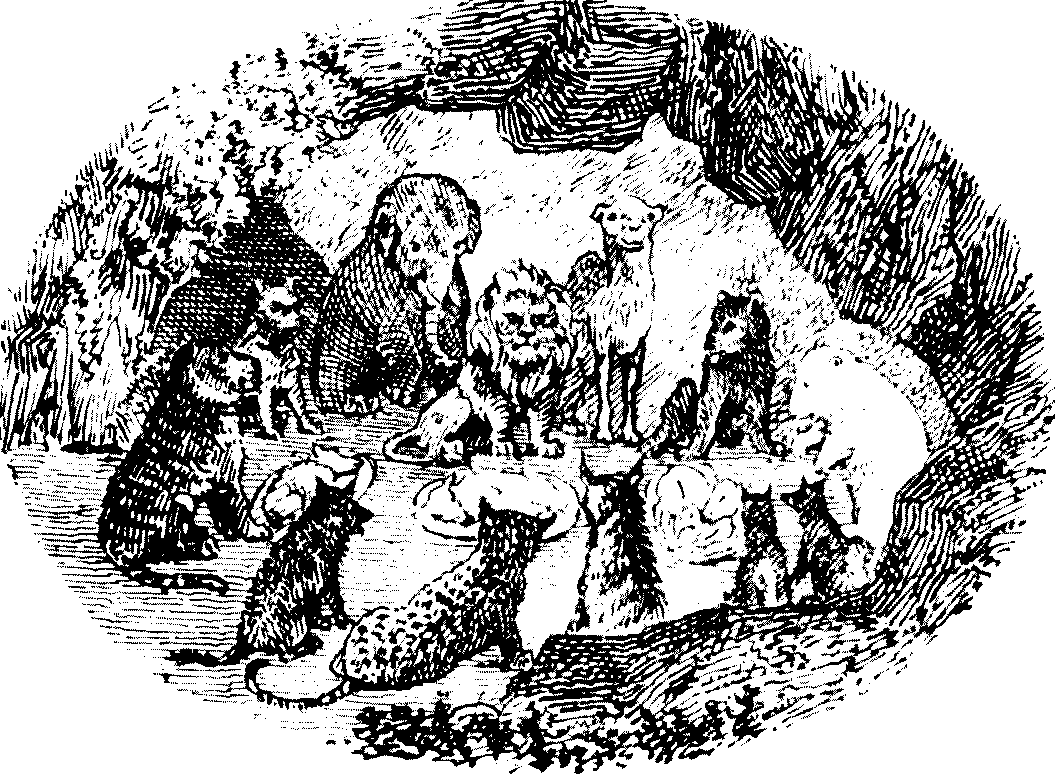
They are seated at last; and like smoke disappear
They are seated at last; and like smoke disappear The rich haunches of venison, and all the good cheer. Yea, as swift as a lion runs after his prey, The legs of the roebuck are cutting away Down the throat of the monarch; in spite of his teeth, They rush rapidly on just his large eyes beneath. Then dame Lion brought forward some wine like champagne, And—believe me—that no one was asked twice in vain: Like a torrent it flowed through their mouths, while their eyes Round are rolling with rapture, delight, and surprise. "How delicious! enchanting! what capital stuff! It has only one fault—that you can't drink enough At a draught, for the fumes seem to fizz up one's nose, And dispute with your breath for the passage like foes." Thus spake the Count Panther; but, too busy to speak, The rest nodded assent, and their glass again seek. They ne'er had fall'n in with that liquor before, And Fate had determined they never should more. For drinking they sat, till so drunk, they're not able To keep on their seats—so rolled under the table; Where some Indians out early next morning them found, Who with clubs dashed their brains out to manure the ground. And, thus, ever since (to these animals' shame) They made beasts of themselves,—Beast has been their name.

As 'tis likely all this You will skip o'er and miss, As remote from the subject before ye; I a few facts will lay Now before you, which may Form excuse for this turn of the story. First, I think it is rude to remark what folks eat, So I mended my pen while they cut up the meat; And this tale copied out, which I thought might apply To events that were passing close under my eye. But my strain I'll resume when they come to dessert, And will note down their jokes, which no feelings can hurt. For who'd like a reporter on paper with ink To note all that you eat, and write down what you drink? Of the number of slices it takes you to fill? Just as if he of parcels was making a bill! No, although—like all authors—I know each one's taste; What they thought, too; yea, dream't! still I will not now waste Your time or your patience by piece-meal retailing Who in this capacity showed greatest of feeling. Suffice it to say, like the beasts in the fable, They tucked in the victuals as long as they're able; Then applied to the bottle to fill up the chinks, While each mouth to the bridegroom and would-be bride drinks. "And now, pray, Mr. Murphy, we'll have your excuse; No excuse to get off, sir, you'll find of much use," Uncle Jonas exclaimed, as he shook his old head, Just to make it appear he knew more than he said. "Here's my niece has but eaten the third of a dinner,— Oh, this love it will make e'en the fattest one thinner! She seems vexed with us all, p'rhaps with you not the least, Though I rather believe it is most with the priest." "Well," said Murphy, "I meant through the forest to run To look out for old Peter, when dinner was done. But before I set out I will frankly declare What detained me so late, though 'tis quite an affair Of a delicate nature——wait—p'rhaps it's best not To go talking about it—'tis better forgot— She may think it unmanly, unjust, or unkind If I spread it abroad, so you please must not mind These few words I've just said; I'll be back here ere long, And will favour you then with a comical song." "Oh, oh!" said the farmer, and glanced a sly wink; "There's some gal in the gale then, you'd have us to think. We shall soon have a breeze, and a tempest will blow, If what's up in the wind you don't presently show. Pray be seated, there is no such great haste for the priest, Till we're satisfied all on this subject at least. What! oh, dear me! quick—water, she's fainting away!" He cried out, as the dame 'gainst his arm her head lay. While he knew, by the bye, just as much what to do, As a pig does of making an Irish stew. "No, no, brandy is better!" O'Flanagan said; "Raise her head!" whispered Clare. "Lay her down here!" said Ted. "Here's my salts," said Miss Riley, who twice had searched o'er Both her pockets, then strewed the contents on the floor. "Or some vinegar, p'rhaps, if applied to her brow Might her senses revive, which seem slumbering now," Exclaimed Mrs. Maguire; "poor, dear thing! she, indeed, Must have ate or drank something which has disagreed." "Warm her feet," said Miss Delhay; "and loosen her dress; If took out in the air she'd be better, I guess." Said her aunt, Mrs. Jonas, "Come, Murphy, lead her; And, Patrick, you run for a doctor to bleed her." "Oh, the wretch that I am! what a baste of a feller Thus to tease her to death, when I might as well tell her. It's no fault of my own if the girls will admire. Sure I cannot look ugly because I desire? Oh, pray come to, my dearest! my angel, revive! Do but squeeze out a smile, just to show you're alive. If you're not quite well soon, and my folly forgive, I shall ne'er more be happy as long as I live." Then she opened her eyes, cast them down to the ground, Rolled them slowly about, and in tones most profound Said, "There's not much the matter, I only was grieving For fear that dear Murphy had been a-deceiving. But I'm much better now, and quite able to hear What he wished to explain when I first was took queer." Oh, the wiles of the fair sex! What tricks they will try To beguile us poor men! With a tear in their eye They can crush Opposition without e'er a word, Though he wear a long tongue, and is armed with a sword. Yea, kingdoms have crumbled, washed away by a tear— A deep sigh sent an army to a premature bier. Twice a kiss has released condemned captives from death; While a frown often robs from a hero his breath. Many heads once were broke when Meg Dogharty cried, And fair Chloe won lovers whenever she sighed. And pray who has not felt the sweet force of a smile Your heart from you stealing, though on guard all the while, All your senses o'er-turning, and making your brain Like a teetotum spun by Miss Pleasure and Pain? But the brute of a man who can firmly persist 'Gainst the feminine tear and a sigh to resist, Leaves the fair one no weapons to urge her complaint But to go in hysterics, or have a good faint. But stop, pray where am I? I've been straying again! That I'm quite off my beat appears perfectly plain. Like the dog I take with me when walking about, Who will run down each turning, first in and then out. Thus, when but three miles past 'neath these two feet of mine, I am certain his four feet have traversed o'er nine; So this quill of wild goose, if the straight path it went, Might save more of your patience than thirty per cent. "Well," said Murphy, "you know," (and his fair bride he placed In a chair, while he bustled his arm round her waist; But perceiving a sore throat blow in at the door, He just twisted his arm round her neck like a boa.) "Well," he said; "you know"—but he could not get farther. Oh, truly, the subject seems delicate rather. "Stop, 'tis really too bad thus your time to be wasting, When I'm sure the sweet whisky you'd be after tasting. 'Tis a beautiful spirit, will cure melancholy; And can make even grief to look pleasant and jolly." Then continued he thus, in a still lower tone, "Dearest! Much-better-half, 'tis no fault of my own, But I'd rather explain to yourself quite alone." "No, no, no!" cried each voice; "we will have it, sir, now." And they clapped, stamped, and made such a terrible row, That poor Murphy soon saw he no rest there should find Till confessed, so thus spoke forth in accents resigned. "Well my friends, you must know, About eight years ago I first went as a lad to old Donolly's farm; Where I've been ever since, And, the truth not to mince, Am thought well-behaved, clever, and quite free from harm. Now of girls he has two, Pretty fair ones to view, With such figures I'm sure can surpassed be by none. But they both of them thought (Which their eyes soon me taught), That I'd make for their father an excellent son. Now what could a man do? He can't marry wives two, And in truth I myself wanted neither. So I hunted about, And a lover found out, Whom I gave a broad hint might have either. But the other poor girl would each offer refuse, Till the young man decided 'twas worse than no use To solicit her hand, and considered it mine, Though I two or three times did the honour decline; Then her father had made up his mind I should do, While poor Joan on that point seemed quite satisfied too; Though I never the slightest encouragement gave, But was only polite—as I always behave. I can but remember one time that I kissed her, And then sure the pleasure was shared by her sister. Just of late, since I fixed on this dame for my bride, I have fled from her presence, and ever have tried To show plain as might be—though I could not be rude— That her love was misplaced, and would prove of no good. Now I lived in the house, and you'll therefore suppose That she saw I was fed, and looked after my clothes; Sewing on truant buttons, and giving a darn To the rents—for that stitching I never could learn. Now it happened to-day, That I happened to say That p'rhaps it might happen I should be away; For some old friends of mine Had just asked me to dine To give my opinion on some foreign wine. To m' Sarah, m' deary, of course I alluded, And though speaking a figure of speech only true did. But the maiden appeared As if something she feared; And, somehow—I cannot tell why, I felt quite nervous too, And tried all I could do To shun the sad turn of her eye. Now I told you she took of my raiment the care, So I mentioned I wanted my best clothes to wear. When—can you believe it?—she would not give them out She declared, till I told her what I was about. There was something not right she could readily see, And she ne'er did expect such behaviour from me. One she much had respected and highly esteemed, Till my manner of late, which quite bearish she deemed Well, I tried all I knew (While I thought, love, of you), To escape from her questions by no means a few. But I found each plan vain, Till at length I spoke plain,— 'Then know, I am going a fair bride to obtain.' 'O the monster! the wretch!' she exclaimed with such fury, That I'm sure any justice and impartial jury, Had she killed me, would say 'twas manslaughter. As it was, from the fear she some rash act might do, To my heels out of sight like an arrow I flew, Truly grieved I was thus forced to thwart her. Still returning, I lingered some moments about, To catch hold of some maid, if perchance one came out, Who would fetch me my clothes, for I wished to appear To the greatest advantage, when coming up here; But just as I had made up my mind to depart, She stepp'd forth, and I scarcely had time back to start, Ere she drew near the spot where I stood; And, overwhelmed by despair, on the bank's mossy side She flung herself down, and most piteously cried. 'Oh, poor dear! 'twill,' I thought, 'do her good.' She had buried her face in her hands from my view, Yet I saw a tear trickle her long fingers through,— How I wished I her grief could assuage! But I feared all the means I the pow'r had to try, Which her sorrows could soothe, or her bitter tears dry, Might p'rhaps also rekindle her rage: So I kept snug concealed there as still as a mouse, Till she sobbed out the very last tear; Then just waited to see her safe into the house, And made double-quick haste to get here. So, my friends, you perceive that no blame I can own, I felt sure the excuse for the fault would atone; With your leave I will go now and fetch Mr. Peter, Cruel Fate has perplexed me, but still I'll defeat her." "Stop," said Flanagan John, "little Patrick will go,— Every turn in the wood he from instinct must know; And besides, I've been waiting I don't know how long, For the treat you just promised—a comical song." "Well," said Murphy, "I fear I'm not equal at present, And a molar he eased with the quill of a pheasant; "Not quite wound up, I mean, for a comical strain, Though not long in key doleful I mean to remain. But if Pat, my young namesake, my son that's to be, Will just trouble himself after Peter to see, And Maguire will oblige with the part instrumental, I will try what I can in a song sentimental." "With the greatest of pleasure," said Patrick, "I'm sure," As he bolted without hat or cap through the door; Though he tarried outside till the singing was done, And then swift as the deer on his errand he run. But quick, look, he returns,—he is after some spree; I can tell by his eyes, they are sparkling with glee: See, he enters the house by a window behind,— He will play them some trick, we shall presently find. Per-ling, pling—twang, twang, twang, went the fiddle strings soon, As Maguire screwed them up to the requisite tune; Though he scarce knows the song, he with grief must declare; So that Murphy politely first whistles the air; And then, after a prelude of Maguire's composing, To the following words his melodious voice flows in: "As rambling forth one morning, Whilst the birds were sweetly singing, I chanced to meet fair Kitty, Who her milk-pails home was bringing; She pretended not to see me, And was hastening away, When I hurried quickly after her, And said, "Sweet maiden, stay— For I love you fondly, dearly, Most tenderly, sincerely! And than a king more happy you can make me if you choose!" But the maid seemed scarce to hear me; Oh! she loves me not, I feared me; For she only shook her little head and said it was no use. "Oh thou fairest, brightest, flower, That e'er bloomed in beauty's bower! Than the nightingale's sweet melody I much prefer your voice; Then, dear maid, be not thus cruel, I can bear neglect from you, ill. As I've banished all your rivals to allow you the first choice." "Oh, you men do so deceive, sir, That your vows I'll not believe, sir, For you tell each girl she's pretty, that you roaming chance to meet; Then, besides, some other fellow P'rhaps may love me quite as well oh, Who has vowed to be my slave through life, and thrown him at my feet." "I will challenge ev'ry other, Who presumes to be your lover, Though I kill a man each morning, not a minikin care I; Sure, I'll perforate the river, Though the thought it makes me shiver, For without you as I cannot live, 'tis pleasant so to die. For my heart I know you'll break it, Though my love you ne'er can shake it, 'Tis more deeply rooted than yon oak that rears its head on high; Though the stem of hope is shivered, And each branch of pleasure withered, Yet it clings unto the earth still firm,—so, to my love, will I." "Will you promise ne'er to tease me, And do all you can to please me, If I take you for the better, though I know 'twill be for worse? Are you sure you love me truly? Well, I cannot think that you lie, But remember 'tis yourself I wed, and not your gilded purse." "Bravo! bravo! capital song, Very good length, and nothing too long; Lots of fine feeling and plenty of sense, Comical rather, and of int'rest immense." It was Flanagan John Sang this snatch of a song, Though the tune he was far from correct in; But he's one that don't care, And will do and can dare What he likes, without ever reflecting. "Let's encore it!—Encore!" "No," said Murphy, "no more, I must really the pleasure decline; 'Tis now some lady's turn, They such pretty songs learn, When their voices to singing incline. Ask the fairy-like May, Who with Samuel Delhay In a corner like two birds are caged. Here, my sweet pretty Miss, May I ask for a kiss, When those sweet lips are quite disengaged?" "Oh, for shame!" Said the dame, "Dearest Murphy, you really should never Say such things, For it brings A deep tint to the fairest cheek ever. But I'm sure Miss Maguire will oblige with a song, I have heard her fine voice, though some time ago, long; When a child she was, under my care." "Well," said Jerry Maguire, "She has at my desire Set her voice to an enchanting air; Which with pleasure she'll sing, 'Tis exactly the thing, Will amuse our old friend sitting there." "Oh, do sing, dearest May," Whispered Samuel Delhay; "Pray oblige us," said every guest; "Now then, May, don't be shy," Said her brother, "when I Can assist if you aid should request." "And," said Murphy, "I, too, Will be sure to clap you, If you will but oblige with your best." "I will try my best style," She replied with a smile; "If you'll promise you'll not be offended. Nor will go so far wrong, As to think that my song As a close to your tale is intended." "Dear, what can the girl mean? 'Twill be presently seen," Muttered he as the promise he gave. Then her voice mounted high, As a lark in the sky, As she warbled each beautiful stave. Ev'ry ear it arrests, ev'ry whisper soon dropt, Even breathing that moment appeared to be stopt. While each bosom seem'd touched by the soft, thrilling strain, And few eyes quite unwashed to the end could remain. The good dame as she hears Gently melts into tears As she thinks of disconsolate Joan. Who, heart-broken and sad, Or from grief nearly mad, Is bewailing her hard fate alone. The words simply are these, Which fair May sang to tease Mr. Murphy, though it she'll not own. "Oh, my beautiful flow'ret has faded, Is drooping its once joyous head; For the bee with its sweetness has laded His wings and away with it fled. And the fierce, cruel wind, it hath broken The stem which the bright blossom fed; While the leaves by their sad looks have spoken Their grief for the kind parent dead. So my heart's fondest hope has been slighted, Ev'ry joy has been stolen from me. I am drooping, am with'ring, am blighted; But the wreck of life shattered you see. Never more shall the sun by its brightness Illumine my dark gloomy fate; Nor can peace to my spirit bring lightness, For he comes to this bosom too late." Now to scatter the gloom Which pervaded the room, Murphy piles all the chairs into heaps. Flings his arm round the dame (Declares he's not to blame), And with her to the room's centre creeps. While Maguire struck up soon Such a capital tune, That like magic each youth forward leaps To the side of some fair, Who, with pleasure, steps where She in dancing can best show her feats. In and out, Round about, It appears quite a riddle. Hands across, Turn of course, And then rush down the middle. Back again, Pleasant pain! Sure he'll wear out his fiddle. "Quicker play!" "Scrape away!" Cries each pair as they pass by; As whirling And twirling They still swifter and fast fly; And in spite, Though fagged quite, Who can keep up the last try. Till whizzy And dizzy They sink into a seat; If they aint Fit to faint In a terrible heat. When to cool, As by rule, To some draught they retreat. Where the fair one imbibes such a delicate chill That her frame is refreshed; but ere morning she will Find the thoroughfare stopped in her organ of smell; With a rising blockade in the thorax as well. While her forehead of snow into pieces seems splitting, As the pain ev'ry moment is worse and worse getting. And her bright eyes are streaming regret for the folly Which has garnished her lungs with a feeling like holly; And has changed her sweet voice, as a matter of course, From the nightingale's tone to sound dreadfully hoarse. "Oh, how funny it seems to one not fond of dancing, To see women and men just like animals prancing! Roaming forwards and back like two bears in a cage, And then galloping round as if put in a rage. Working harder—I'll bet ten young pigs to a sow, Than they've been all day long at the tail of the plough." "Stop!" I fancy I hear some fair maiden exclaim, In a tone full of ire strongly mixed with disdain. "'Tis some horrid old man has been writing this tale, Who will make his remarks, though so stupid and stale." Now, kind reader, of this I must beg to assure you, That 'twas Flanagan muttered those words placed before you. Rat-a-tat! "Who is that?" Murphy cried; "pray come in." And a priest walked inside who had listening been. How the widow's heart beat as he stept up to greet her! He was very much like, still he was not old Peter. "Sure I'm in for it now," Murphy inwardly thought; "I would fly, but must own I've been quite fairly caught. No I aint!—'tis but Pat, though in clever disguise; He may cheat his old Mother's, but not these young eyes. But I'll not spoil the fun; I'm reprieved by his aid. Ah! his voice, as I feared, has the secret betrayed; And the good little dame appears quite in a pet. P'rhaps she'll wait longer still for a young bridegroom yet! For I rather repent having scouted poor Joan, She is prettier far, though I don't like her home. Still a second-hand wife, and four babes ready made, Must be popped in the scale and against that be weighed. "Now, Murphy," cried Flanagan, "your comical song! Why, you look black as if all on earth had gone wrong! Come, I'll bet what you like I can guess what you thought (If you did take the trouble to meditate aught), 'Tis a bother, I own, and you well may look blue (Still you're quite green enough if your friends all speak true). Oh, I fear you are out both of temper and tune, But I'll give you a song which shall banish care soon." Then he whetted his whistle, and clearing his voice, In a very gruff tone sang this ditty so choice:— "Oh, those that like, let them be sad, For my part I'll be merry. A life like theirs would drive me mad, So I'll be jolly, very. If Cupid should catch hold of me, And from my love me sever, And into woe would turn my glee, Shall he succeed?—no, never! If valued friends prove false, unkind, When any scrape I get in; I'll drive their memory from my mind, And thus no sorrow let in. If Miss Fortune should use me ill, And steal my only penny, Contentedly I'll jog on still, As happy without any. Though Landladies may bore for rent, And duns may loudly bellow; I'll tell them, though my money's spent, I'm still a jolly fellow. For love in sparkling wine I'll drown All care and melancholy; They are but fools who sigh and frown; For my part I'll be jolly."
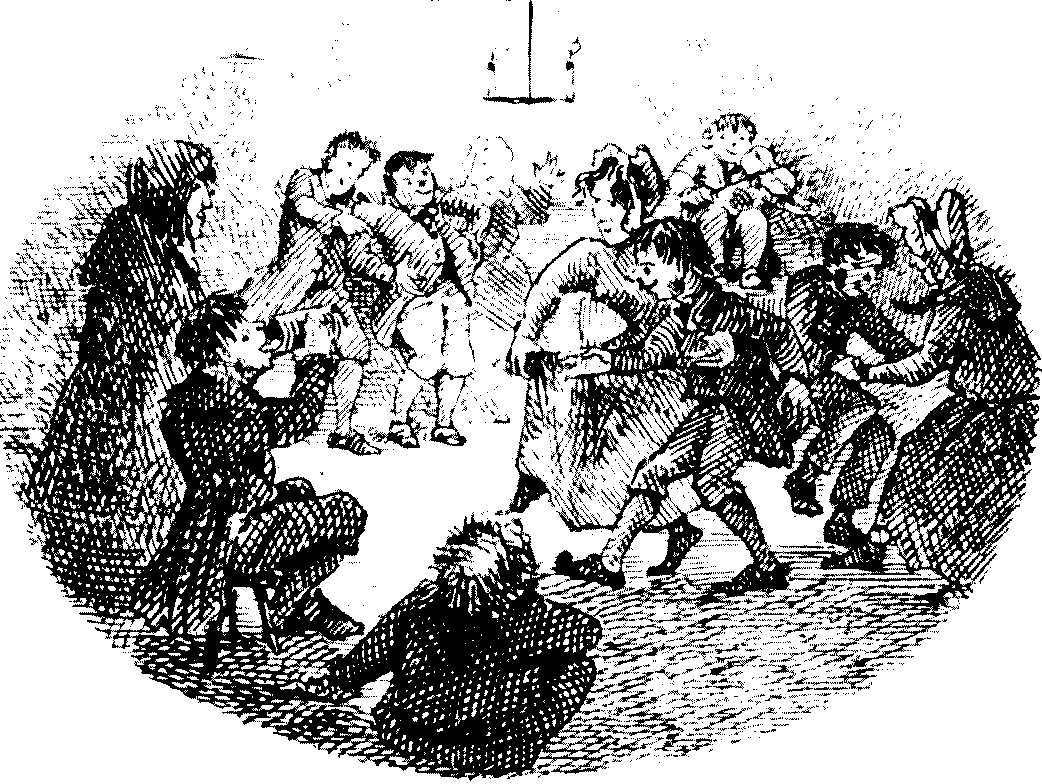
Then again the wild dance Does each young toe entrance.
Then again the wild dance Does each young toe entrance, And p'rhaps many an old one beside. There's antique Miss O'Riley Has coaxed Donoghue slily Just to waltz, which he ne'er before tried. For she chatted so pretty, And talked, oh, so witty, That he guessed at her age rather wide. But the maiden soon found She must drag him right round, For he could not his steps at all guide. While his arms stuck out still, Like the sails of a mill— How young Flanagan laughed till he cried! And called out, "Take care, Tom, what sweet words you are saying; For the breach of a promise you'll not like the paying." "What are breaches of promise?" said Donoghue laughing, Who was not so well versed as his friend was in chaffing. "Oh," said Flanagan Ted, who was comical rather, "They are breeches you'll get when worn out by your father." "Oh, look, Mother!" cried Pat; "all the wood seems on fire; It was first but a spark, but it now rises higher. We shall surely get burnt, for 'tis coming this way: What a flare-up to finish a grand bridal day!" But the dame felt depressed In her feelings, and guessed He was only a-joking again. So that no heed she took, No, not even a look, Although calling he still would remain. Like the boy that we read of in old Æsop's fable, He has jested till none to believe him are able. "Come, niece, give us some punch, And of cake a slight hunch, May it taste as it looks, so uncommonly nice, That I've wished for some long, But I feared 'twould be wrong, And might p'rhaps be thought greedy to ask for a slice. All the dancers, 'tis clear, Very hungry appear, And would much be refreshed by that snow-looking ice; While some hot whisky will Perhaps warm up the chill They imbibed at the draught by not taking advice." 'Twas old Jonas thus spoke, Half in earnest, half joke, The good dame from her rev'rie to rouse. But the lady felt sad, And thought just cause she had For the grief which her spirit allows. Still the punch she prepared, Though she sharply declared She had rather not cut up the cake; For the event it should grace Had not yet taken place, And much trouble it took her to make. "Hark! what voices are those?" Murphy cried, as he rose And went to look out at the door. But soon entered again, And admitted a train Of monks, about twenty or more. All in darkness arrayed, With their heads in a shade, Although each one a flaming torch bore. At the head of the band Marched the Abbot so grand, Whom the beaux lowly bend soon before. For him ev'ry one knows As his very best clothes, And his mitre so gorgeous he wore. Which seemed covered with gold, Then made sticky and rolled Among jewels to spangle it o'er; And which glittered so bright As they shot back the light, That most folks the real gems took them for. Now young Patrick had noticed this monkish array, As amid the dark forest it wended its way; But as no one would answer the first time he spoke, He considered that p'rhaps it might be a good joke If the crew on the party came unawares in As they're dancing, or drinking: things deemed a great sin By the Abbot, he knows—who had vexed been right sore When he stumbled on much the same party before. And truly it did cause a little confusion, For the liquors just mixed in the greatest profusion Filled the air with a grateful perfume. But as for the present they're too hot for drinking, The ladies were sniffing the odour, and thinking, When he first had stept into the room; Though some rather too bold were near choked, by the bye, And got burnt in their fright, till a tear leaves each eye, Which their temper does rather consume. But how sudden the spirits have vanished from sight! Far more rapid, I'm certain, than conjuring quite. For the Abbot, in spite of the scent, is believing That his nose plays him false, and has been him deceiving. Not the shade of a cork can he anywhere see, Though the kettle is boiling—it may be for tea. But I often have seen the same trick played before When I was but a young one, about half a score, As my ma has been mending some portion of dress, (What the garment might be I will leave you to guess). If a loud double-knock has been heard at the door, Quick as thought the said garment has rolled to the floor; And been under the sofa kicked out of the way, Till the visit has ended the guest came to pay. Now no one had spoken, Till silence was broken By the Abbot, who said,— "Friends, I'm come to unite By the conjugal rite The young pair who would wed. But, pray, which is the bridegroom, and which is the bride?— Are you firmly resolved, then, to have your fates tied In a very tight knot, which you neither can sever, Though you're sick of each other, as folks must get ever? As the poet so justly has said, (who so wise?) 'In the best-ordered families rows will arise.' So I'll wait a few moments, just out of humanity, Till you've thought o'er again what may prove quite insanity. Now, young bridegroom, just think—are you feeling quite sure That for life you the ways of this dame can endure; And with joy hear her chatter from morning till night (About nothing at all, mind,)—with unfeigned delight? For Plato remarks, 'That he ne'er in his life Heard an orator speak half so much as his wife. She would prate when she woke, and still chattering keep Until night, and would even then talk in her sleep.' Now, could you bear this to the end of your days, Supposing that always she spoke to your praise? Which by no means the case is, as sages declare, (For of course in such matters we priests have no share). Now I somewhere have read, but where, by mishap, Can't remember at present—the fair are a trap Made to catch the poor men, just like so many birds, With a few pretty looks and a lot of sweet words, Which persuade them to think they would not mind it much, And they yield as a prey to the feminine clutch. When, lo!—but I'll not track this sad history farther; Than e'er marry myself I would really die rather." "Sour grapes! sour grapes!" whispered Jonas, "'tis plain. But how lucky that single he still can remain! Sure I married have been thirty years, and ne'er found The discomforts with which the said state does abound." "Very likely," was Flanagan's smothered reply; "But I've found all he said more than true by the bye; So it is, after all, but a matter of taste, And it really seems foolish so much time to waste. But that Murphy is mad there is less than no doubt, Or he would the young wife, not the old one seek out. For I've seen the fair damsel of whom he was speaking, As pretty a girl as you'd find, though far seeking; With such beautiful eyes, such a sweet little nose; And such neat little ankles, and delicate toes: That, though t'other's your niece, sir, you fain must agree He must have some good reasons, or lunatic be. Sure I felt much surprised when I heard he was going To marry dame Neale, for I thought he was sowing All the seeds of affection in little Joan's heart. But most likely they've quarrelled, and settled to part." "Hush," said Jonas; "the Abbot is speaking again; That a screw has got loose appears perfectly plain. How I wish I could speak with the dame all alone! I should learn rather more, then, concerning poor Joan. But he seems in a hurry to marry them, now,— I've a good mind to stop him, but don't like a row." "Then you really intend Both your fortunes to blend Into one; And promise you'll never From each other sever Till life 's done? When as, sir, from your youth you will most like survive, To provide for these babes will you promise to strive? For, deprived of their ma, if I right understand, Most young ladies are likely to stick long on hand. Unless (and I here must the failings unfold Of the world), all their pockets are stuffed full of gold; When all other attractions—O thought most distressing! Are considered no more than the regular blessing Which the milkman bestows after measuring out The pale chalk-coloured fluid he carries about. Yes! sweet temper and truth are of little avail When proud Wealth takes his seat in the opposite scale. As the proverb declares, which we all so well know, That 'tis money alone that the mare makes to go. But of course, sir, 'twas nothing at all of this kind Which has thus to stern fate made you meekly resigned! It was love—purely love, caused your heart to prefer, From all others to flee, and reside here with her. But what's this I hear? Who dares interfere, With such racket and unseemly noise? Mr. Bridegroom go, see, (We will tarry for thee), Please to flog 'em if 'tis your two boys." Then not one of them spoke, Though all thought 'twas some joke Of that monkey, young Patrick O'Neale, Till the urchin they saw Fast asleep on the floor, Where he fled in the hopes to conceal The disguise he still wore, For he felt more and more That the wrath of the Abbot he'd feel. "Let me go! let me go!" cried a voice from without; And up many arose from their seats to rush out, When a female dashed through, cast her eyes swift around, And exhausted fell down, overwhelmed, to the ground, At the feet of the dame, who was too much affected To afford the assistance the fair one expected.
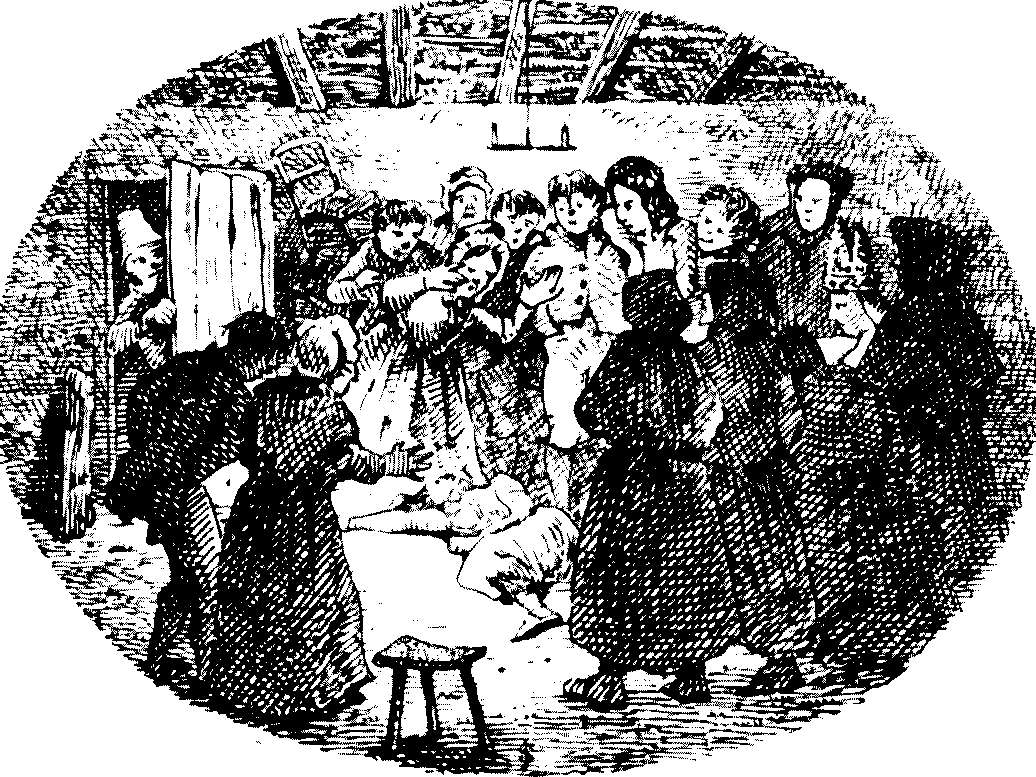
And exhausted fell down, overwhelmed, to the ground
"It is Joan! it is Joan!" ran in whispers about, And in truth on that subject there seemed little doubt; For poor Murphy kept popping his head in and out, Till the Abbot requested he'd walk in instead, When he took to his heels and ran off with his head, And as fast out of sight as a pickpocket fled. "Fetch him back!" cried the Abbot, in thundering tone, And far swifter than light'ning the monks out have flown; Oh, such speed you'd have thought that they never could own! It is true that old Peter kept quite in the rear, Still he bustled along though without an idea Of beholding the sport till his friends brought it near. Yet 'tis true (though you choose to believe it or not), He was one of the first to return to the spot When the captors their pris'ner in safe keeping had got. Now all through this commotion the beautiful maid Veiled her face in her hands, as if really afraid To encounter the gaze of the numbers of eyes Which she felt stared upon her with unfeigned surprise. So reclining she sat on the brick-covered floor, And so mournfully sobbed, 'twould have made your heart sore To behold one so tender, so young, and so fair Almost broken in heart, and nigh crushed by despair; Nearly out of her mind, and without an idea Of what she should do, now she's found them out here. Then again silence reigned, And each tongue still remained, Till the monks back returned With their captive, held tight, Who seemed breathless with fright, While his face fiercely burned, Like a red-hot coal blowed, Which to all plainly showed He had punishment earned. For the Abbot was one who but rarely had missed The least chance that he had of his toe getting kissed. Not exactly saluting his bunions, I mean, But of causing his sway to be visibly seen. By all other folks humbling he thought he should rise, So had made it a point all the world to despise; Ev'ry small fault exposing which hidden might pass, Was tracked out like a snake by the trail in the grass. "Sir, I'm sorry," he said, in a sarcastic tone, "If from other appointments I keep you: unknown To my sight till this hour you perhaps may have been, Still your character now I have readily seen; And would say a few words ere we part for the night, On a subject perhaps you can give us some light. Be so kind as to give that young lady a seat." But before he could move Joan had rose to her feet, And exclaimed, "Oh, base man! you might well flee with shame! 'Twas to warn these good people I hitherward came. Oh, how could you thus serve me, who lov'd you so dearly! Whom you promised to wed once or twice—very nearly. Is it thus all our kindness and trust you repay? Such ingratitude never I met till to-day. Still I'll wish you no worse, but your heart may relent, And for all the grief caused me may quickly repent." Then again into tears she was melting away, Having said all she had for the present to say. While her beautiful hair (dark and soft as black silk) Trickled down her fair neck (whiter far than new milk) In the greatest disorder, without comb or pin; For to be in good time, such a haste she was in; And unto the dame to support her she clung— With her head on her shoulder, her face downward hung; For the crimson tide rising rushed through ev'ry vein, With a pang piercing sharper than actual pain. "Come, Sir, Mr. Bridegroom, or whatever 's your name, Let me hear some excuse which shall ward off the blame Which you richly deserve, if appearance tells true. But they say—and their saying shall benefit you— That folks ought not to go by appearances ever, But should judge from plain facts, as more law-like and clever. So I'll hear all you have, sir, to say in defence Of what seems to these ladies a serious offence." Now, between you and I, the good Abbot enjoys This dispute quite as much as a child does his toys; And his eyes wander oft to the beautiful maid, To whose cause he inclines, I am sadly afraid. And so too you would feel if your heart be not stone, Though, like him, p'rhaps the feeling you'd not care to own. Still I'm sure your compassion would so far arise, That you'd lend her your kerchief to wipe up her eyes; And would feel much inclined, and with justice, I'm fearing, To condemn the poor culprit before his case hearing. But he speaks! and relates all he stated before, And declares he ne'er promised to marry her, nor Had said anything pointed, to give her to think That his fate unto hers he was wishing to link. "Stop—I did call her pretty, one time, by the bye, But she took not the trouble my words to deny; So 'tis plain she thought them not so out of the way, But a kind of a tribute that folks ought to pay. Then I lived in the house, and so might once have kissed her, For I treated her just as if she'd been my sister; Going out with her walks when she wanted fresh air, And by treating her always at every fair." Now I've heard a remark, which I know to be true, That a man is no judge of the kind of a view Which a sister presents to unprejudiced eyes. For I've seen brothers stare with a look of surprise When I talked of a sister, and thought I would flatter If I made a remark, or but cast a glance at her. I, by chance, once myself made this very mistake (Near as awkward a one as a man can well make), For I have a few sisters, but never once thought Them much out of the way, till more properly taught. They explained I was wrong, and I could not well doubt it, For they proved that I really knew nothing about it. Now in just this position was poor Murphy placed, He could scarcely perceive Joan was prettily faced; She was handy, he knew, in the kitchen and dairy, But for beauty—he thought that tastes widely must vary. It was living together so long, I suppose, Made him blind to the charms of this beautiful rose. For he's not what folks call a man really hard-hearted, And his conscience now pricked him, and terribly smarted, As he thought on the kindness she ever had shown him Since the days of his boyhood, when first she had known him. Then the dame was asked next, If she aught had to say; She look'd sad, much perplexed, And her head turned away As she said, "On my word, Till to-day I ne'er saw, No, nor even have heard Of this maiden before. Still it seems very plain She was first in the field; So her rights she shall gain, For all claims I now yield. She has loved him, it seems, all her life pretty nigh, So I'm sure she deserves him far better than I, Who all hope—yea, the wish—now for ever resign Of beholding young Murphy a bridegroom of mine. Unless (and she here had a slight tickling cough), Your rev'rence think right I should keep to my troth." "Please to stop," said the priest; "this is pretty, no doubt; Still when Justice begins she must have her say out. We have well scanned the subject on every side, But have not yet decreed which by law is the bride; Though, as some great philosopher wisely observed, 'They who come up the first ought to be the first served.' While the difference of ages compels me to fear, That a storm will arise ere the close of the year; For of course the old lady must have her own way, As 'age before honesty goes,' the folks say. It is true she may not get the like chance again; But she's had her turn once, so must patient remain. Unless that the jury, when packed, shall think best To remake her a wife, and deny her request." Then the jurors were chose, But so plainly he shows How the guests cannot impartial be, That such aid they refuse, And the number out choose From eyes that unprejudiced see. Who like peers soon pair out, To consider about In whose favour they ought to agree. Now what thrilling suspense! (To poor Joan how intense!) To the rest in a lesser degree.— All but Murphy, who ne'er Seemed to have the least care What Fate or what Justice decree. But the Jury return, and the maid droops her head, While her fair bosom heaves with a feeling of dread; As nigh breathless she listens the verdict to hear, Which shall fill her with transports of pleasure or fear. "And pray what's your decision?" the Abbot inquired; In the tones of a pig who has, murdered, expired. "Have you settled the point who the fair bride's to be? They seem terribly anxious to hear your decree." Then a very tall man with a very sharp nose, All their wisdom united and cleverness shows, "'Tis the young one, we think, is by justice the bride, So we deem it our duty on her to decide." Then again a loud shout Ran the chamber throughout, While the maiden had fainted with bliss Had not Murphy arose, Who both arms round her throws, And revives her at once with a kiss; And whispers that once he but loved as a brother, But now is most anxious to love as some other. But the Abbot, of course, must again interfere. Loud he calls, "Mr. Culprit, just step, sir, up here; And you, monks, keep your eyes on the door. For our sentence is this,—that the maiden you wed; Yes, and live with her too till you're dead, sir—quite dead. Oh, you ne'er shall escape from her more! And Miss Bride, you'll oblige by just letting me know If he does not behave himself properly, so I may think of some punishment sore. Now, before I unite In the conjugal rite This unhappy young pair, Is there any one here Has the slightest idea Of a like rash affair? If there is, I advise, Ere the chance from him flies, That he hither repair. For, as Romulus said, you should never delay Till to-morrow what can be as well done to-day. For delays dang'rous are, as the widow can prove, And time never returns, but is still on the move." Then he silent remained, as if buried in thought, While his eyelids dropt down as if slumber they sought; Till the beautiful Clare, by young Flanagan Ted (Her long-betrothed lover), was joyfully led. When "Ah!" he exclaimed; and again closed his eyes, Just to ponder, no doubt, on some subject more wise;— On the frailty, perhaps, of the masculine sex, Who allow pretty faces their thoughts to perplex, And their hearts twirl about like a conjurer's plate, While they kindly persuade them they can't avoid Fate. "O dear May! dearest May!" Whispered Samuel Delhay; "I scarce know what I say, But just listen, I pray. I've loved you so dearly, A twelvemonth or nearly, Most truly, sincerely,— Not for your looks merely, But the bewitching grace In each action I trace; With which no charm keeps pace But your beautiful face. Oh, if you would hear me! To be ever near me! What joy would then cheer me! Though trembling I fear me, Lest you now should say Nay; Your dear face turn away, Or should wish for delay, Which were death to obey." Then May blushed crimson deep, While her eyes downward keep, As she seems most intensely to think. Till her gaze slily peeps; Tow'rds her mother it creeps, Who she saw nearly audibly wink. Then, no more time to waste, In his hands hers she placed, Who appeared with such rapture possess'd That he screamed with delight, Put poor May in a fright, And exceedingly startled each guest. "Is there no one else then to be married, I pray? Mr. Hymen is not found at work every day," Said the Abbot; "can no other man boast a heart? Have you all really 'scaped from young What's-his-name's dart?" Just as if he was only essaying to fill Up the number required to form a quadrille; And had cried, Take your partners, and no more time waste, You young people might surely make rather more haste. "Oh, pray catch me! Oh, dear! I'm so dreadfully queer— I shall faint—I shall die— I must have a good cry"— Said Miss Riley, who could not her feelings command, As she seized and kept hold of young Donoghue's hand. "Shall you tell them? Oh, no; Though I'm very so-so. And my heart beats so fast, It will sure burst at last. No! 'tis useless cold water to throw on my grief, Far too deep are my sorrows for such a relief. Oh, could you but feel What my tongue must reveal— How much I love you, My dear Donoghue! Your heart surely would melt, though it very hard aint, And you'd try all you could to relieve my complaint." "Well," thinks he, "I don't care, Though in truth she's not fair; Still there's hundreds far worse, that I'm sure." So he said, "You're so kind, Miss, I'd fain ease your mind; But why did you not speak up before? For you really have taken me quite by surprise, Though great presence of mind at emergence will rise. Still, be quick; for should we by some chance be too late, I must leave you to struggle alone with your fate." But the course of true love it can never run smooth, As this tale will, as others, undoubtedly prove. There is always some guardian, or cruel old Pa, Who won't give his consent; or some tiresome Ma, Who don't think the young man is quite well enough off For her beautiful daughter to wed; and so forth. Now old Donoghue tries all he can to find out What so busies his son, till he leaps out of doubt, And jumps at the conclusion, which proves to be true, That he means to get married the old maid unto. "I won't give my consent!" he exclaims in a rage; "And you shall not yourselves to each other engage. I'll disinherit you sure if you dare to resist My commands, and shall still in this madness persist." "Oh, oh! what's the matter? What means all this clatter?" Said the Abbot, who seemed much amused; "It is really too bad! Sure the man must be mad: Such an offer, what maid could refuse? Sir, you'd better allow me for life to provide For your child, by converting her into a bride. As her poor little heart will undoubtedly break, If you cruelly make her her first love forsake." "But it is not a daughter," the other replied; "'Tis the man is my boy, who, if now he decide To be snared by yon penniless girl, for himself Must look out, for no finger he lays on my wealth." "Well, that alters the case; But I really must own That, were I in your place, I would leave them alone, For Love's arrows sink deep, and our heart's blood they quaff, While the little wretch dares at e'en locksmiths to laugh. So it really is wiser to give your consent, For you know you can't really the marriage prevent. For what's gold, may I ask, when its charms you compare With bright smiles, with such looks, and with features so fair? And, besides, the young people are quite old enough To decide for themselves; and advice would seem stuff And great nonsense, I fear, to their prejudiced ears; For their eyes are so blinded they won't see your fears." Then the old man sat down With a dark gloomy frown, As he muttered he never would give them a "brown." But the obstinate son Could be ruled o'er by none; When he made up his mind he would have a thing done. So he still stood his ground, And the fearful maid found That she now had a chance of her fate getting bound; Not just stitched, or bound half, But quite whole bound with calf. How she chuckles with joy, as she grins forth a laugh! As she says the few words which proclaim her the wife Of as stupid a man as e'er lived out a life! Now the eight are but four, for a pair forms but one; They have each one been halved, so they all are undone. Though the ladies of course (now pray don't make a jest of it), As the bettermost half, have for ever the best of it. Having two votes to one in nigh every dispute, And as much more to say if their words you compute. See, the bridegrooms are kissing their beautiful brides, Who a kiss too receive from the Abbot besides. All but Dame Donoghue, who by chance seems forgot; Or, perhaps, he had thought he had much rather not. Then the Abbot and train prepare to go; They fall into ranks in a double row; While the chief, at their head, walks on before, Without ere a word or a syllable more. But old Peter just tarries behind to state Why the Abbot had come there, and why so late. He had noticed the monk who was rambling out, And, inquiring, had learnt all the facts about. When to Peter's surprise he declared his mind, That to marry the couple he felt inclined. "I was very much vexed that he tarried so late, As I feared that for me you might probably wait. For I know very well, without being told twice, That when victuals are tepid they're not very nice. But I now must be gone; he will miss me, I fear; Though 'twould pleasure me much to await awhile here." Then young Patrick O'Neal out of pity, or jest, Took the half of a duck, which with onions was drest, And to old Peter gave it, unseen by the rest; Who declared he of boys was undoubted the best. Then he passed through the door and was soon with the throng Who by torchlight were marching the forest along. And 'twas lucky he did; for the Abbot inquired After him, who to walk by his side he desired. When a lecture he gave which the folly proved quite Of rich dainties employing to cure appetite. "They're the seed," he remarked, "of nigh ev'ry disease Which frail mortals invent, them to rob of their ease. What is gout, may I ask, but these victuals condensed And forced into the blood to create pain intense? Then, just look at your teeth; when compared with a brute, They're surpassed quite as much as a flower does its root. One is even, as smooth, and as white as a nut; While the other is jagged, and blacker than soot. Slow decaying away, from the poisonous food, Which, to pleasure the palate, the victims have chewed. Still, in spite the result, as of sense quite bereft, They persist, like the lunatics lately I've left. I can't drive the foul smell from my nose," he exclaimed; "The effluvia such hold on my sense has obtained." Then weeks and weeks rolled slowly by, And nothing strange had met the eye. The birds had ris'n every morn, And frightened been from off the corn. The bees had sipped the flow'ry juice, Preparing it for private use. The sheep had parted with their fleece; They held it on uncertain lease. The fruit had all been plucked, or fell, And made more ill than tongue can tell. The golden grain by reapers' care, Had strewn the rich fields everywhere; And filled the barns with Nature's store, For winter's use when summer's o'er. For Autumn's sunny days are past, And gloomy clouds are gathering fast. While northern gales assail the trees, Their treasures scattering to the breeze. Poor Peter, through unlucky fate, Has not been fishing out of late. He cannot fly that fearful dream, Which in the dusky night will seem To float before his slumb'ring gaze To fright his heart, and thoughts amaze. The Abbot fills him, too, with fear; He fancies he is always near, He cannot from his presence get, But feels like some one dunn'd for debt. And trembles when he meets those eyes That love to catch him by surprise. But dogs can't always watchful keep; Most wide-awake men sometimes sleep; And Peter gains a short respite From thoughts which needlessly affright. For really he was watched by none, Save what his conscience may have done. O day of bliss! O joyful day! The Abbot hastens far away, And comes not back till morrow's night! Old Peter seems delighted quite. "I will dine and will sup too off Jack," said he; "Nicely lined with veal stuffing. What joy! what glee! Let me see, where's my tackle? In yonder hole; I must catch a few gudgeon and have a troll. O I know a snug spot where the river runs deep, And there I will be ere they wake from their sleep. I will see that their breakfast is nicely made, And that, also, the reckoning's duly paid.

The morn was dull when Peter rose; And stormy, like the north wind blows; While the dark sky too plainly shows Ere long there will be rain. "But still," thinks he; "I'll go in spite; 'Twill sharpen up their appetite, And make them all the better bite; Such chance to lose gives pain. I tarry may a month or more, Till Christmas comes perchance, before I shall another day secure; If so, I'll go again. Then, with what food he could procure, He hurried through the Abbey door; But oft looked back to make quite sure; His fears were really vain. Pray, angling reader, was it ne'er your fate, When fish were biting to be short of bait? Have you ne'er roked about in terra-firma To find a grub, a chrysalis, a worm—or For e'en a grasshopper searched o'er a field Which would not e'en a caterpillar yield, While droves of perch, impatient to be hooked, Have vainly round for some temptation looked? Now, in such a position was poor Peter placed; He had flown to the river in very great haste. Still, although he had sought out a gravelly nook, But a pair of young gudgeons approached near his hook. In the space of an hour—so a trimmer he set; While he tried, though in vain, a few others to get. "There's a bite! there's a bite! see the reel how it turns!" He exclaimed, and his face with excitement fierce burns, "Ah, it now has stopt short! 'tis to pouch it," he thought; "Look! 'tis running again, and the fellow is caught!" But, alas! when he struck, to his grief and dismay He discovered, the jack had his bait torn away. "O how foolish," he said; "it was of me to throw That fine gudgeon away! I might guess 'twould be so. I detest using live bait, you're certain to lose them, For it seems the fish think they're put to amuse them, And away he will drag them, or into bits chews them— Just avoiding the hook, which might stick in their teeth. Oh, their cunning it really surpasses belief! One would think they were brought up from birth as a thief. But I'll try trolling now, as they seem on the feed, They must swallow the hook if the bait they then heed. But vain his hope, though time away Skips fast; the fish admire delay, And scarce to him attention pay. Perchance, his want of skill they saw, And from destruction quick withdraw To where they may their lives insure. 'Tis but midday, yet darkness shrouds the sky, For clouds of blackness furiously roll by. The watery sun has fled, but not to rest— Behind a cloud which overflows the West— The distant thunder strikes the list'ning ear, And streams of lightning pour down far and near. Yet still dame Nature grasps the slippery rains, Who, struggling, long to scour the dusty plains. But all these signs of tempest are forgot As soon as seen, or p'rhaps are heeded not, By our friend Peter, for behold his line Gently unrolls and cleaves a watery mine. With patient, anxious, fate-imploring look, He trembling hopes that now his laden hook May sink low down into the dark abyss, Midst fishes' entrails, where it cannot miss Its deadly hold; and where, till life shall fly, The barbèd hook immoveable may lie. But, oh! his chicks he counts before they're hatched, For by his foe, in skill, he's more than matched, (The scaly monster,) who at length of line, The close acquaintance sharply does decline. He tugged, it pulled, but all, alas! was vain, For one on t'other not an inch could gain. First Peter, winding, thought his foe waxed faint, But quickly Jack untwisting—cried, "I aint." Thus passed an hour, but still he keeps the water, Though Peter stormed, and vowed he'd give no quarter When land he reached; but Jack thought all this fun, And cried "No quarter! I'll 'scape whole or none." Then the friar, impatient, began to use force, When his line snapt in two, as a matter of course.