Chapter XIV
Reading edition
Of Colouring.
By the beauty of colouring, the painters mean that disposition of colours on objects, together with their proper shades, which appear at the same time both distinctly varied and artfully united, in compositions of any kind; but, by way of pre-eminence, it is generally understood of flesh-colour, when no other composition is named.
To avoid confusion, and having already said enough of retiring shades, I shall now only describe the nature and effect of the prime tint of flesh; for the composition of this, when rightly understood, comprehends every thing that can be said of the colouring of all other objects whatever.
And herein (as has been shewn in Chapter VIII, of the manner of composing pleasing forms) the whole process will depend upon the art of varying; i. e. upon an artful manner of varying every colour belonging to flesh, under the direction of the six fundamental principles there spoken of.
But before we proceed to shew in what manner these principles conduce to this design, we shall take a view of nature's curious ways of producing all sorts of complexions, which may help to further our conception of the principles of varying colours, so as to see why they cause the effect of beauty.
It is well known, the fair young girl, the brown old man, and the negro; nay, all mankind, have the same appearance, and are alike disagreeable to the eye, when the upper skin is taken away: now to conceal so disagreeable an object, and to produce that variety of complexions seen in the world, nature hath contrived a transparent skin, called the cuticula, with a lining to it of a very extraordinary kind, called the cutis; both which are so thin any little scald will make them blister and peel off. These adhering skins are more or less transparent in some parts of the body than in others, and likewise different in different persons. The cuticula alone is like gold-beaters-skin, a little wet, but somewhat thinner, especially in fair young people, which would shew the fat, lean, and all the blood-vessels, just as they lie under it, as through Isinglass, were it not for its lining the cutis, which is so curiously constructed, as to exhibit those things beneath it which are necessary to life and motion, in pleasing arrangements and dispositions of beauty.
The cutis is composed of tender threads like network, fill'd with different colour'd juices. The white juice serves to make the very fair complexion;—yellow, makes the brunnet;—brownish yellow, the ruddy brown;—green yellow, the olive;—dark brown, the mulatto;—black, the negro;—These different colour'd juices, together with the different meshes of the network, and the size of its threads in this or that part, causes the variety of complexions.
A description of this manner of its shewing the rosy colour of the cheek, and, in like manner, the bluish tints about the temple, &c. see in the profile [fig. 95 T p. II], where you are to suppose the black strokes of the print to be the white threads of the network, and where the strokes are thickest, and the part blackest, you are to suppose the flesh would be whitest; so that the lighter part of it stands for the vermilion-colour of the cheek, gradating every way.
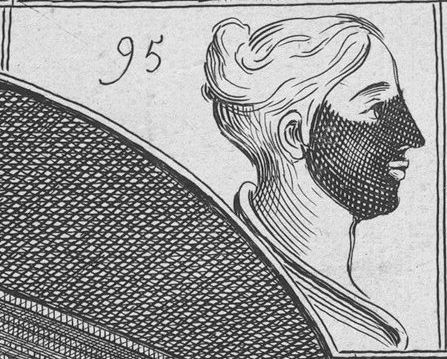
Some persons have the network so equally wove over the whole body, face and all, that the greatest heat or cold will hardly make them change their colour; and these are seldom seen to blush, tho' ever so bashful, whilst the texture is so fine in some young women, that they redden, or turn pale, on the least occasion.
I am apt to think the texture of this network is of a very tender kind, subject to damage many ways, but able to recover itself again, especially in youth. The fair fat healthy child of 3 or 4 years old hath it in great perfection; most visible when it is moderately warm, but till that age somewhat imperfect.
It is in this manner, then, that nature seems to do her work.—And now let us see how by art the like appearance may be made and penciled on the surface of a uniform coloured statue of wax or marble; by describing which operation we shall still more particularly point out what is to our present purpose: I mean the reason why the order nature hath thus made use of should strike us with the idea of beauty; which by the way, perhaps may be of more use to some painters than they will care to own.
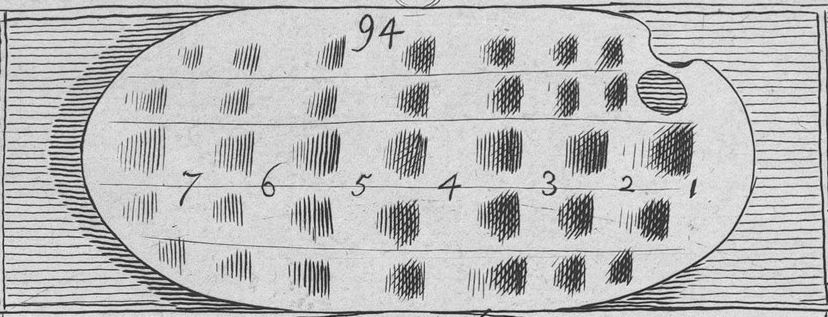
There are but three original colours in painting besides black and white, viz. red, yellow and blue. Green, and purple, are compounded; the first of blue and yellow, the latter of red and blue: however these compounds being so distinctly different from the original colours, we will rank them as such. Fig. [94 T p. II], represents mixt up, as on a painter's pallet, scales of these five original colours divided into seven classes—1, 2, 3, 4, 5, 6, 7.—4, is the medium, and most brillant class, being that which will appear a firm red, when those of 5, 6, 7, would deviate into white, and those of 1, 2, 3, would sink into black, either by twilight or at a moderate distance from the eye, which shews 4 to be brightest, and a more permanent colour than the rest. But as white is nearest to light it may be said to be equal if not superior in value as to beauty, with class 4. Therefore the classes 5, 6, 7, have also, almost equal beauty with it too, because what they lose of their brillancy and permanency of colour, they gain from the white or light; whereas 3, 2, 1, absolutely lose their beauty by degrees as they approach nearer to black, the representative of darkness.
Let us then, for distinction and pre-eminence sake, call class 4 of each colour, bloom tints, or if you please, virgin tints, as the painters call them; and once more recollect, that in the disposition of colours as well as of forms, variety, simplicity, distinctness, intricacy, uniformity and quantity, direct in giving beauty to the colouring of the human frame, especially if we include the face, where uniformity and strong opposition of tints are required, as in the eyes and mouth, which call most for our attention. But for the general hue of flesh now to be described, variety, intricacy and simplicity, are chiefly required.
The value of the degrees of colour being thus consider'd and ranged in order upon the pallet, figure 94, let us next apply them to a busto, fig. [96 R p. II], of white marble, which may be supposed to let every tint sink into it, like as a drop of ink sinks in and spreads itself upon course paper, whereby each tint will gradate all around.
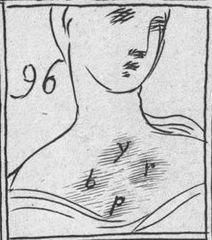
If you would have the neck of the busto tinged of a very florid and lively complexion, the pencil must be dipt in the bloom tints of each colour as they stand one above another at No. 4.—if for a less florid, in those of No. 5—if for a very fair, from No. 6—and so on till the marble would scarce be ting'd at all: let therefore No. 6, be our present choice, and begin with penciling on the red, as at r, the yellow tint at y, the blue tint at b, and the purple or lake tint at p.
These four tints thus laid on, proceed to covering the whole neck and breast, but still changing and varying the situations of the tints with one another, also causing their shapes and sizes to differ as much as possible; red must be oftenest repeated, yellow next often, purple red next, and blue but seldom, except in particular parts as the temples, backs of the hands, &c. where the larger veins shew their branching shapes (sometimes too distinctly) still varying those appearances. But there are no doubt infinite variations in nature, from what may be called the most beautiful order and disposition of the colours in flesh, not only in different persons, but in different parts of the same, all subject to the same principles in some degree or other.
Now if we imagine this whole process to be made with the tender tints of class 7, as they are supposed to stand, red, yellow, blue, green and purple, underneath each other; the general hue of the performance will be a seeming uniform prime tint, at any little distance, that is a very fair, transparent and pearl-like complexion; but never quite uniform as snow, ivory, marble or wax, like a poet's mistress, for either of these in living-flesh, would in truth be hideous.
As in nature, by the general yellowish hue of the cuticula, the gradating of one colour into another appears to be more delicately soften'd and united together; so will the colours we are supposed to have been laying upon the busto, appear to be more united and mellowed by the oils they are ground in, which takes a yellowish cast after a little time, but is apt to do more mischief hereby than good; for which reason care is taken to procure such oil as is clearest, and will best keep its colour[18] in oil painting.
Upon the whole of this account we find, that the utmost beauty of colouring depends on the great principle of varying by all the means of varying, and on the proper and artful union of that variety; which may be farther proved by supposing the rules here laid down, all or any part of them reversed.
I am apt to believe, that the not knowing nature's artful, and intricate method of uniting colours for the production of the variegated composition, or prime tint of flesh, hath made colouring, in the art of painting, a kind of mystery in all ages; insomuch, that it may fairly be said, out of the many thousands who have labour'd to attain it, not above ten or twelve painters have happily succeeded therein, Corregio (who lived in a country-village, and had nothing but the life to study after) is said almost to have stood alone for this particular excellence. Guido, who made beauty his chief aim, was always at a loss about it. Poussin scarce ever obtained a glimpse of it, as is manifest by his many different attempts: indeed France hath not produced one remarkably good colourist[19].
Rubens boldly, and in a masterly manner, kept his bloom tints bright, separate, and distinct, but sometimes too much so for easel or cabinet pictures; however, his manner was admirably well calculated for great works, to be seen at a considerable distance, such as his celebrated cieling at Whitehall-chapel[20]: which upon a nearer view, will illustrate what I have advanc'd with regard to the separate brightness of the tints; and shew, what indeed is known to every painter, that had the colours there seen so bright and separate, been all smooth'd and absolutely blended together, they would have produced a dirty grey instead of flesh-colour. The difficulty then lies in bringing blue the third original colour, into flesh, on account of the vast variety introduced thereby; and this omitted, all the difficulty ceases; and a common sign-painter that lays his colours smooth, instantly becomes, in point of colouring, a Rubens, a Titian, or a Corregio.