REPTILIA (continued 2)
Reading edition
Geophis maculiferus Taylor
Geophis maculiferus Taylor, Univ. Kansas Sci. Bull., 27:119, December 30, 1941.—Near Cicio [sic] = Tzitzio, Michoacán, México.
Tzitzio.
The type and only known specimen of Geophis maculiferus (UIMNH 25078) is a female having 140 ventrals and 30 caudals, dorsal scales in 15 rows, one postocular, and an anterior temporal. Only one other species in México has dorsal scales in 15 rows and has an anterior temporal; that species is G. incomptus, which differs from G. maculiferus in having six or seven lower labials, instead of five, and in having the edges of the ventrals dark, instead of a uniformly cream-colored belly.
The locality from which the specimen was obtained lies at an elevation of 1630 meters on the southern slope of the Cordillera Volcánica. At that elevation there is an interdigitation of arid tropical scrub forest and pine-oak forest; probably Geophis maculiferus inhabits the pine-oak forest.
Geophis nigrocinctus Duellman
Geophis nigrocinctus Duellman, Occ. Pap. Mus. Zool. Univ. Michigan, 605:1, May 29, 1959.—Dos Aguas, Michoacán, México.
Dos Aguas (3).
The three specimens comprising the type series of the species were found beneath logs and in a stump in pine-oak forest at an elevation of 2100 meters. A discussion of the variation in these specimens and of probable relationships of the species was given by Duellman (1959). Floyd Downs spent several days at Dos Aguas in July, 1960; although he found ten specimens of Geophis incomptus, no further specimens of G. nigrocinctus were obtained.
Geophis petersi Boulenger
Geophis petersii Boulenger, Catalogue Snakes... British Museum, 2:321, September 23, 1894.—Mexico City. Type locality restricted to Pátzcuaro, Michoacán, México, by Smith and Taylor (1950a:335).
Cherán; Coalcomán; Morelia; Pátzcuaro (6).
This seems to be the most widespread species of Geophis in Michoacán. It has been found at elevations between 950 and 2350 meters, chiefly in pine or pine-oak forest. Boulenger (1894:321) described Geophis petersi from a specimen stated to be from Mexico City, a locality which probably is in error. The only localities from which the species is definitely known are those listed in this account.
Three males and five females from the Mexican Plateau and the Cordillera Volcánica have respectively 140-144 (141.7) and 143-151 (146.0) ventrals and 39-41 (40.0) and 29-35 (33.2) caudals. All have dorsal scales in 15 rows, 1 postocular, no anterior temporal, and a relatively small triangular supraocular. The specimen from Coalcomán (UMMZ 104698) was referred to Geophis nasalis by Peters (1954:22). This specimen is abnormal in several characters; in five places there is a fusion and separation of the vertebral and paravertebral scale rows, producing a change from 17 to 15 rows of dorsal scales. Fusion of the three rows takes place at the level of the 8th, 41st, 47th, 54th, and 65th ventrals. Furthermore, there is a small secondary postocular on each side of the head. In other characters the specimen is like G. petersi; the resemblances to that species are greater than to G. nasalis, which has been recorded from Guatemala and southern Chiapas.
Geophis tarascae Hartweg
Geophis tarascae Hartweg, Occ. Pap. Mus. Zool. Univ. Michigan, 601:1, May 4, 1959.—Uruapan, Michoacán, México.
Uruapan (3).
A female of this species was collected in the Parque Nacional at the north edge of Uruapan in 1899, and a male was taken there in 1947; these specimens were used by Hartweg in his description of the species. Floyd L. Downs obtained another specimen in the Parque Nacional on July 19, 1960. It has 164 ventrals and 46 caudals; in life, the ground color of the neck was brown with a purplish tint; the dorsal markings were black; the chin was a cream-color, and the belly was white. This specimen is distinguished from those of all other species of Geophis in Michoacán in that it has dark irregular cross-bars on the dorsum and a row of dark spots on the venter.
Hypsiglena torquata ochrorhyncha Cope
Hypsiglena ochrorhyncha Cope, Proc. Acad. Nat. Sci. Philadelphia, 12:246, November 15, 1860.—Cape San Lucas, Baja California, México.
Hypsiglena torquata ochrorhyncha, Bogert and Oliver, Bull. Amer. Mus. Nat. Hist., 83:378, March 30, 1945.
Tupátaro.
The systematic status of the geographic variants of Hypsiglena in México and southwestern United States has been commented on by several authors. Tanner (1944) considered H. torquata and H. ochrorhyncha to be distinct species; Bogert and Oliver (1945:379) and Duellman (1957b:238) presented evidence indicating that H. torquata and H. ochrorhyncha intergrade in Sinaloa and southern Sonora. In Hypsiglena the scutellation, including the numbers of labials, dorsals, ventrals, and caudals, seem to vary in a clinal manner. Nevertheless, these snakes can be divided into two distinct populations on the basis of the nuchal color pattern, consisting of an ochrorhyncha-type (a broad dark nape-band, the lateral edges of which extend anteriorly and fuse with a postorbital stripe, and a narrow nape stripe extending from the posteromedian edges of the parietals to the dark nape band) and a torquata-type (a somewhat narrower dark nape-band bordered anteriorly by a pale nuchal area, and no dark nape stripe). Snakes having the ochrorhyncha-type of nuchal pattern are found on the Mexican Plateau from Michoacán northward into the desert regions of Sonora and the southwestern United States. Snakes having the torquata-type of pattern are found on the coastal lowlands and adjacent slopes of the Sierra Madre Occidental from southern Sinaloa to Colima and thence inland in the Balsas-Tepalcatepec Basin to Morelos and Guerrero. An exception is Hypsiglena torquata dunklei from Forlón and San Fernando, Tamaulipas; it has the torquata-type of nuchal pattern. The distributional picture is somewhat complicated because some individuals having the torquata-type of nuchal pattern also have a faint nape stripe. If these are taken as exceptions, the general picture of distribution in México is H. t. torquata on the Pacific lowlands from Sinaloa southward to the Balsas Basin and H. t. ochrorhyncha on the Mexican Plateau.
Smith (1943:433) resurrected Hypsiglena jani Dugès for the snakes of the ochrorhyncha-type on the southern part of the Mexican Plateau. He stated that the southern specimens differed from northern ones in having a nuchal spot 9 or 10 scales in length, as compared with a spot 2 to 6 scales in length in northern specimens. A cursory examination of specimens from the areas between Arizona and Michoacán showed that there is a gradual increase in the size of the spot from north to south. If no other characters can be found to distinguish the populations, they should be considered as a single subspecies.
Hypsiglena affinis differs from H. torquata in possessing 19 instead of 21 rows of dorsal scales. Additional material is needed from the western slopes of Jalisco and the Barrancas in Zacatecas and Durango, before definite allocation of affinis can be made.
Bogert and Oliver (1945:379) discussed the status of certain named populations in Baja California and concluded that only one species occurs there, and that the species probably is conspecific with H. torquata. A careful review of the genus Hypsiglena might show that there is only one species.
The one specimen from Michoacán (USNM 46513) is from an elevation of about 2300 meters near the southern edge of the Mexican Plateau.
Hypsiglena torquata torquata (Günther)
Leptodeira torquata Günther, Ann. Mag. Nat. Hist., ser. 3, 5:170.—Laguna Island, Nicaragua (in error).
Hypsiglena torquata torquata, Taylor, Univ. Kansas Sci. Bull., 25:371, July 10, 1939.
Apatzingán; Capirio; Cofradía.
Specimens from the three mentioned localities have the dark nuchal spot bordered anteriorly by a pale blotch. In life the specimen from Capirio (UMMZ 114424) had rich reddish brown dorsal spots; the dorsal ground color was grayish white above and somewhat more gray laterally. The pale nuchal area was a cream-color, and the iris was grayish red.
All of the specimens were found in the arid scrub forest in the Tepalcatepec Valley at elevations between 200 and 350 meters.
Imantodes gemmistratus gracillimus (Günther)
Dipsas gracillima Günther, Biol. Centrali-Americana, Rept., p. 177, July, 1895.—southern México. Type locality restricted to Acapulco, Guerrero, México, by Smith and Taylor (1950a:331).
Imantodes gemmistratus gracillimus, Zweifel, Amer. Mus. Novitates, 1961:12, September 16, 1959.
La Orilla.
The specimen from La Orilla was reported by Peters (1954:23) as Imantodes gemmistratus oliveri; Zweifel (1959c) showed that I. g. oliveri did not range west of Tehuantepec and that the snakes inhabiting the coastal lowlands of Guerrero, Michoacán, and Colima were assignable to the subspecies gracillimus. It may be assumed that this subspecies ranges throughout the coastal lowlands and foothills of the Sierra de Coalcomán.
Imantodes gemmistratus latistratus (Cope)
Dipsas gemmistrata latistrata Cope, Bull. U. S. Natl. Mus., 32:68, 1887.—Southern Jalisco. Type locality restricted to Guadalajara, Jalisco, México, by Smith and Taylor (1950a:334).
Imantodes gemmistratus latistratus, Zweifel, Amer. Mus. Novitates, 1961:3, September 16, 1959.
El Sabino.
The one specimen from Michoacán was collected near the upper limits of the scrub forest on the slopes of the Cordillera Volcánica. Zweifel (1959c:10) stated that in certain aspects of coloration this specimen was like I. gemmistratus gracillimus, but in scutellation and other features of coloration it was like I. g. latistratus. There are too few specimens of this species to define the ranges of the various subspecies with any degree of accuracy, but from the limited number of specimens available, it seems that I. gemmistratus gracillimus occurs on the Pacific lowlands from Guerrero northward to Colima. Northward on the Pacific lowlands from Colima to Sinaloa and in the Balsas-Tepalcatepec Basin is found I. gemmistratus latistratus.
Lampropeltis doliata (Linnaeus)
Coluber doliatus Linnaeus, Systema naturae, ed. 12, 1:379, 1766.—Charleston, South Carolina.
Lampropeltis doliata, Klauber, Copeia, No. 1:11, April 15, 1948.
Coalcomán (3); El Sabino; 24 km. W of Morelia; Río Nexpa; Uruapan.
The few specimens of this species from Michoacán show a wide range of variation; furthermore, the present systematic status of the subspecies of Lampropeltis doliata portrays an incongruous pattern of distribution. Specimens from the Sierra de Coalcomán have relatively narrow red bands that are not interrupted dorsally by extensions of the black rings; the scales in the red bands have black tips. The specimen from El Sabino (EHT-HMS 5253) and the one from the Río Nexpa on the coast (USNM 31491) have broader red bands; the scales in the red bands do not have black tips. A specimen from 24 kilometers west of Morelia (UIMNH 17782) and one from Uruapan (UMMZ 121508) have the red bands interrupted dorsally by extensions from the black rings.
Specimens from the Sierra de Coalcomán were referred to L. doliata blanchardi by Peters (1954:24), who noted that in some characters these snakes were like L. d. nelsoni and in others like L. d. polyzona. The individual from El Sabino was referred to L. d. nelsoni by Taylor (1940c:465); the one from 24 kilometers west of Morelia was referred to L. d. arcifera by Smith (1942c:198). If these assignments are correct, three subspecies of Lampropeltis doliata occur in Michoacán: blanchardi in the Sierra de Coalcomán, nelsoni on the coast and in the Tepalcatepec Valley, and arcifera on the Mexican Plateau and in the Cordillera Volcánica. Such a distribution is plausible, but the few specimens and our general lack of knowledge of the variation and relationships of the different populations do not permit a definite assignment at this time.
Lampropeltis ruthveni Blanchard
Lampropeltis ruthveni Blanchard, Occ. Pap. Mus. Zool. Univ. Michigan, 81:8, April 28, 1920.—Pátzcuaro, Michoacán, México.
Morelia; Pátzcuaro; Tacícuaro.
At the present time this species is known definitely from only three localities on the Mexican Plateau in Michoacán. An incomplete skin from El Sabino (EHT-HMS 5438) was referred to this species by Taylor (1940c:465); the specimen cannot be found, so verification of the identification cannot be made at this time.
Leptodeira latifasciata (Günther)
Hypsiglena latifasciata Günther, Biologia Centrali-Americana, Reptilia, p. 138, October, 1894.—Southern México. Type locality restricted to Huajintlán, Morelos, México, by Smith and Taylor (1950a:331).
Leptodeira latifasciata, Dunn, Proc. Natl. Acad. Sci., 22:696, December, 1936.
Apatzingán; El Sabino; La Playa; 32 km. E of Nueva Italia.
This nocturnal snake apparently ranges throughout the arid Balsas-Tepalcatepec Valley to elevations of about 1050 meters. It has been collected only in the arid scrub forest. Aside from the specimens listed by Duellman (1958a:93), there is one (UMMZ 120223) having eight body blotches, a body length of 510 mm. and a tail length of 103 mm.
Leptodeira maculata (Hallowell)
Megalops maculatus Hallowell, Proc. Acad. Nat. Sci. Philadelphia, 13:488, March 31, 1862.—"Tahiti." Type locality restricted to Manzanillo, Colima, México, by Duellman (1958a:54).
Leptodeira maculata, Duellman, Bull. Amer. Mus. Nat. Hist., 114:53, February 24, 1958.
Aguililla (2); Apatzingán (24); Arteaga (2); Capirio (3); Charapendo (2); Coahuayana (3); Cofradía; Cuatro Caminos; La Placita (3); Lombardia (69); Nueva Italia (29); Pómaro; Río Marquez, 10 km. S of Lombardia (2); Salitre de Estopila; Tafetan (2); Volcán Jorullo.
This snake is abundant in the arid Tepalcatepec Valley; most of the specimens have been collected in arid scrub forest at elevations of less than 500 meters. With the onset of the rains in late June and early July, large numbers of these snakes can be found around temporary pools, where they feed on small frogs and toads. In the dry season few individuals were found, and all of those were beneath cover. Specimens from the coast have more body-blotches than do those from the Tepalcatepec Valley (Duellman, 1958a:56); otherwise the snakes show little variation.
Leptodeira splendida bressoni Taylor
Leptodeira bressoni Taylor, Univ. Kansas Sci. Bull., 25:321, July 10, 1939.—Hacienda El Sabino, Michoacán, México.
Leptodeira splendida bressoni, Duellman, Bull. Amer. Mus. Nat. Hist., 114:84, February 24, 1958.
Coalcomán (3); El Sabino (3); Uruapan (5).
The range of Leptodeira splendida bressoni apparently does not overlap that of Leptodeira maculata; the latter is restricted to the lower reaches of the arid scrub forest, whereas L. s. bressoni inhabits the upper limits of the arid scrub forest and the lower part of the pine-oak forest. Specimens have been collected between 950 and 1630 meters on the slopes of the Cordillera Volcánica and at 950 meters in the Sierra de Coalcomán. At Uruapan individuals were found beneath rocks along a stream and in a stone fence. Leptodeira duellmani, which was described from Coalcomán by Peters (1954:25), is an aberrant individual of L. s. bressoni (Duellman, 1958a:56).
Leptophis diplotropis (Günther)
Ahaetulla diplotropis Günther, Ann. Mag. Nat. Hist., ser. 4, 9:25, 1872.—Tehuantepec, Oaxaca, México.
Leptophis diplotropis, Bocourt, Mission scientifique au Mexique et dans l'Amerique Centrale, Reptiles, livr. 15:835, 1897.
Between Aguililla and Dos Aguas; Arteaga; Coalcomán; El Diezmo; El Sabino (5); La Playa; Ocorla.
Most specimens of this species have been collected in tropical semi-deciduous forest at elevations of less than 1000 meters. In the Sierra de Coalcomán one was taken in pine-oak forest at an elevation of 1700 meters near Ocorla; another was found in broad-leafed forest between Aguililla and Dos Aguas at an elevation of 1600 meters. Most individuals have been seen in trees or bushes. The absence of broad-leafed forest in the Tepalcatepec Valley probably accounts for the absence of this snake in that area.
Manolepis putnami (Jan)
Dromicus putnami Jan, Elenco sistematico degli Ofidi, p. 67, 1863.—San Blas, Nayarit, México.
Manolepsis putnami, Smith and Taylor, Bull. U. S. Natl. Mus., 187:92, October 5, 1945.
La Placita (3); Maquili; Ostula.
In Michoacán the species has been found only in tropical semi-deciduous forest on the lower slopes of the Sierra de Coalcomán. From the observations made by Peters (1954:28), this snake is diurnal and feeds on teiid lizards.
Masticophis striolatus striolatus Mertens
Coluber striolatus Mertens, Zoologica (Stuttgart), 32:190, 1934.—Substitute name for Coluber lineatus Bocourt, a secondary homonym of Coluber lineatus Linnaeus = Lygophis lineatus. Type locality restricted to Presidio de Mazatlán, Sinaloa, México, by Smith and Taylor (1950a:343).
Masticophis striolatus striolatus, Zweifel and Norris, Amer. Midl. Nat., 54:242, July, 1955.
Apatzingán (4); Arteaga; Coalcomán (3); El Sabino; Jiquilpan; La Palma; La Playa (3); Lombardia; Nueva Italia; Río Cachán; Santa Ana; Uruapan (2); Volcán Jorullo; Ziracuaretiro.
This large diurnal species inhabits open scrub forest and cultivated terrain from sea level to about 1650 meters. On the Mexican Plateau it is known from the area around Lago de Chapala, to which it possibly gained access through the valleys in the headwaters of the Tepalcatepec drainage. Specimens from southern Michoacán have been reported previously by Peters (1954:28) and Duellman (1954b:16) as Masticophis flagellum lineatus.
Masticophis taeniatus australis Smith
Masticophis taeniatus australis Smith, Jour. Washington Acad. Sci., 31:390, September 11, 1941.—Guanajuato, Guanajuato, México.
Tacícuaro (2); Zamora.
This species reaches the southern limit of its distribution in the state of Michoacán. The limited ecological data available suggest that the species inhabits the open mesquite grassland of the Mexican Plateau.
Oxybelis aeneus auratus (Bell)
Dryinus auratus Bell, Zool. Jour., 2:324, 1825.—México. Type locality restricted to Tehuantepec, Oaxaca, México, by Smith and Taylor (1950a:340).
Oxybelis aeneus auratus, Bogert and Oliver, Bull. Amer. Mus. Nat. Hist., 83:381, March 30, 1945.
Coahuayana; El Sabino (4); between Las Tecatas and Las Higuertas; between Los Pozos and La Ciénega; Playa Azul; Pómaro (2); between Pómaro and Maruata (2); Punto San Telmo; Río Tizupan.
On the basis of the number of specimens seen and collected on the seaward slopes of the Sierra de Coalcomán, this is a common snake there. Most specimens were collected in tropical semi-deciduous forest; others were collected in oak forest to an elevation of 1700 meters. Apparently Oxybelis does not inhabit the lower parts of the Tepalcatepec Valley; the only specimens from the inland area are four from El Sabino, which is situated at about 900 meters on the slopes of the Cordillera Volcánica. One individual was seen in gallery forest near Limoncito at an elevation of 730 meters on the northern slopes of the Sierra de Coalcomán.
Pituophis deppei deppei (Duméril)
Elaphis deppei Duméril, Mem. Acad. Inst. France, 23:453, 1835.—México. Type locality restricted to San Juan Teotihuacán, México, México, by Smith and Taylor (1950a:334).
Pituophis deppei deppei, Stull, Occ. Pap. Mus. Zool. Univ. Michigan, 250:1, October 12, 1932.
Carapan (2); Morelia; Tacámbaro; Tacícuaro; Zacapu.
Duellman (1960b) showed that the widespread species Pituophis deppei was composite and that the "lined subspecies" actually represented another species, Pituophis lineaticollis. Pituophis deppei occurs only on the Mexican Plateau; in Michoacán it inhabits mesquite grassland and oak-bunch grass associations between 1900 and 2200 meters.
Pituophis lineaticollis lineaticollis (Cope)
Arizona lineaticollis Cope, Proc. Acad. Nat. Sci. Philadelphia, 13:300, December 28, 1861.—Southern Mexican Plateau. Type locality restricted to 24 kilometers northwest of Oaxaca, Oaxaca, México, by Duellman (1960b:607).
Pituophis lineaticollis lineaticollis, Duellman, Univ. Kansas Publ. Mus. Nat. Hist., 10:607, May 2, 1960.
Acuaro de las Lleguas; Dos Aguas (3); Morelia; Tancítaro (5).
This species reaches the northern limits of its range in the Sierra de Coalcomán and on the Mexican Plateau in Michoacán. On the plateau it has been collected in mesquite grassland at elevations between 1500 and 2000 meters. In the Sierra de Coalcomán individuals were found in open pine-oak forest at 2100 meters elevation and in a meadow surrounded by pine-oak forest at 2300 meters.
Pseudoficimia frontalis (Cope)
Toluca frontalis Cope, Proc. Acad. Nat. Sci. Philadelphia, 16:167, September 30, 1864.—Colima, Colima, México.
Pseudoficimia frontalis, Günther, Biologia Centrali-Americana, Reptilia, p. 96, May, 1893.
Apatzingán; Coalcomán (6); El Sabino (2).
Most specimens were found beneath rocks in grassy areas near the upper limits of the arid scrub forest, both in the Sierra de Coalcomán and on the southern slopes of the Cordillera Volcánica; all are from elevations of less than 1100 meters. One specimen was found on a road at night near Apatzingán. This species has been found in similar habitats near Huajintlán, Guerrero, and in arid scrub forest at lower elevations in Colima. It is unknown from the coast of Michoacán.
Pseudoficimia pulcherrima Taylor and Smith
Pseudoficimia pulcherrima Taylor and Smith, Univ. Kansas Sci. Bull., 28:246, May 15, 1942.—Huajintlán, Guerrero, México.
Apatzingán.
This specimen (CNHM 39208) was reported by Schmidt and Shannon (1947:81); they stated that it was a paratype of P. pulcherrima. However, Taylor and Smith (1942a:246) did not mention the specimen; aside from the type (EHT-HMS 5497), the only other specimen they designated as belonging to the type series was UMMZ 85711 from Chilpancingo, Guerrero.
The taxonomic validity of Pseudoficimia pulcherrima remains doubtful, for only minor characters distinguish it from P. frontalis. Furthermore, all known specimens of P. pulcherrima are from within the geographic range of P. frontalis.
Rhadinaea hesperia hesperia Bailey
Rhadinaea hesperia Bailey, Occ. Pap. Mus. Zool. Univ. Michigan, 412:8, May 6, 1940.—Omilteme and Sierra de Burro, Guerrero. Type locality restricted to Omilteme, Guerrero, México, by Smith and Taylor (1950a:332).
Rhadinaea hesperia hesperia, Smith, Proc. Biol. Soc. Washington, 55:185, December 31, 1942.
Arteaga (3); Coalcomán; El Sabino (2); Uruapan; Volcán Jorullo (2).
One specimen from Volcán Jorullo (UMMZ 104494), three from Arteaga (UMMZ 119281), and one from Uruapan (UMMZ 92342) are typical of the subspecies R. h. hesperia in possessing a lateral cream-colored line on the sixth and parts of the fifth and seventh dorsal scale rows and in lacking a dark line on the second scale row. The specimens from El Sabino (EHT-HMS 5441 and UIMNH 18933) and one from Coalcomán (UMMZ 104502) have the cream-colored line on the sixth and adjacent parts of the fifth and seventh scale rows and have a dark line on the second scale row. Another individual from Volcán Jorullo (UMMZ 104682) has cream-colored lines like the others, but it possesses two lateral dark lines, one on the second scale row, and one on the third.
Smith (1942d:186) diagnosed Rhadinaea hesperia hesperioides as differing from the nominal subspecies in having the cream-colored line on the fourth and fifth scale rows and in possessing a dark line on the second scale row. The specimens seen all have the lateral cream-colored line centered on the sixth scale row, as is characteristic of R. h. hesperia. Although many of the specimens also possess a dark line on the second scale row, these specimens are here assigned to R. h. hesperia. Additional specimens are necessary to define accurately the subspecies and their ranges. Peters (1954:29) assigned the specimens from Coalcomán to R. h. hesperioides.
In life the specimens from Arteaga had bright cream-colored temporal stripes and dorsolateral stripes on the anterior part of the body. The chin and anterior one-sixth of the belly was white; posteriorly the venter was bright orange-red.
In Michoacán this snake has been found in tropical semi-deciduous forest, arid scrub forest, and pine-oak forest at elevations from 850 to 1500 meters.
Rhadinaea laureata (Günther)
Dromicus laureatus Günther, Ann. Mag. Nat. Hist., ser. 4, 1:419, 1868.—Mexico City.
Rhadinaea laureata, Boulenger, Catalogue Snakes... British Museum, 2, p. 179, September 23, 1894.
Capácuaro; Carapan (8); Cherán (3); Paracho (2); Pátzcuaro; Tancítaro (10).
This snake is abundant in the Cordillera Volcánica, but it is unknown in the mountains to the northeast of Morelia or in the Sierra de Coalcomán. Most specimens were found beneath volcanic rocks imbedded in the ashy soil in pine forest between 1800 and 2300 meters.
Rhadinaea taeniata (Peters)
Dromicus taeniatus Peters, Monats. Akad. Wiss. Berlin, p. 275, 1863.—México.
Rhadinaea taeniata, Bailey, Occ. Pap. Mus. Zool. Univ. Michigan, 412:14, May 6, 1940.
Tancítaro (2).
This species, which is known only from a small region in the mountains of Jalisco and central Michoacán, is represented by two specimens (CNHM 37130 and 39030) collected at Tancítaro (see Schmidt and Shannon, 1947:80).
Salvadora bairdi Jan
Salvadora Bairdii Jan. Icon. gener. ophid., livr. 2, pl. 3, fig. 2, 1860.—México. Type locality restricted to Acámbaro, Guanajuato, México, by Smith and Taylor (1950a:330).
Barranca Seca; Carapan; Cerro San Andrés; Cojumatlán (2); Jiquilpan; Morelia; Pátzcuaro (4); Quiroga; Sahuayo (2); Tacícuaro (12); Tancítaro (56); Uruapan (2); Zacapu (2); between Zitácuaro and Tuxpan (3).
This species is abundant on the Mexican plateau, where it inhabits the more grassy areas in the mesquite grassland and cutover land in the pine forests from 1550 to 2500 meters. Davis and Dixon (1957:21) described a specimen from Zacapu as having two dark paravertebral stripes diverging on the temporals and extending through the eye onto the loreal, a characteristic of Salvadora lineata. On the basis of this specimen, Davis and Dixon suggested that Salvadora bairdi and S. lineata were subspecifically related. The examination of the large number of specimens from Michoacán has revealed this kind of coloration in only one other specimen, an individual from Tacícuaro, in which the stripes diverge, but do not extend through the eye onto the loreal. Data on scutellation for the large series from Tancítaro were given by Schmidt and Shannon (1947:78), and for the series from Tacícuaro by Smith (1943:466).
Salvadora mexicana (Duméril, Bibron, and Duméril)
Zamenis mexicanus Duméril, Bibron, and Duméril, Erpétologie genérale, 7 (pt. 1), p. 695, 1854.—Cape Corrientes, Jalisco, México.
Salvadora mexicana Günther, Ann. Mag. Nat. Hist., ser. 3, 12:349, 1863.
Apatzingán (12); Capirio (2); El Sabino (5); Huetamo; La Placita; La Playa (4); Lombardia; Nueva Italia; Ojos de Agua de San Telmo; Oropeo; Río Cancita, 14 km. E of Apatzingán; Santa Ana.
This is one of the most abundant snakes in the arid lowlands of the Tepalcatepec Valley; observations indicate that it probably is equally abundant on the coastal lowlands. Near Apatzingán as many as five of these snakes have been seen in one-half hour. The snakes seem to be equally abundant and active in the dry season and in the rainy season. Most individuals were seen on the ground, but two were found in low trees. On several occasions Salvadora mexicana was observed in pursuit of lizards on the ground. Captured individuals regurgitated Cnemidophorus costatus zweifeli, Cnemidophorus deppei infernalis, Sceloporus horridus oligoporus, Sceloporus pyrocephalus, and Urosaurus gadowi.
Salvadora mexicana inhabits only the arid scrub forest at elevations from sea level to about 1000 meters.
Sibon nebulatus (Linnaeus)
Coluber nebulatus Linnaeus, Systema naturae, ed. 10, 1, p. 222, 1758.—Africa (in error). Type locality restricted to Jicaltepec, Veracruz, México, by Smith and Taylor (1950a:349).
Sibon nebulatus, Taylor, Univ. Kansas Sci. Bull., 26:473, November 27, 1940.
Aquila.
The one specimen from Michoacán was collected by Peters (1954:30) in tropical semi-deciduous forest on the coastal foothills of the Sierra de Coalcomán. As presently known, the range of this species in western México extends from Chiapas to Nayarit. Throughout this region the species avoids scrub forest; this may explain its absence in the Balsas-Tepalcatepec Valley.
Sonora michoacanensis michoacanensis (Dugès)
Contia michoacanensis Dugès, in Cope, Proc. Amer. Philos. Soc., 22:178, 1885.—Michoacán. Type locality restricted to Apatzingán, Michoacán, México, by Smith and Taylor (1950a:335).
Sonora michoacanensis michoacanensis, Stickel, Proc. Biol. Soc. Washington, 56:116, October 19, 1943.
Apatzingán (3); Coalcomán (3); 12 km. S of Tzitzio.
These specimens, together with all known specimens from the Sierra del Sur in Guerrero (KU 23790-1, MVZ 45123) and the upper Balsas Basin in Puebla (UIMNH 41688), are referable to S. m. michoacanensis. The dorsal pattern consists of a highly variable number of cross-bands of red, white, and black. In the specimens from Michoacán there are as many as 17 red cross-bands on the body. One specimen from Apatzingán (CNHM 37141) has just behind the head a white band, bordered on either side by a narrow black band; posteriorly the body is uniform red. Two specimens from Coalcomán (UMMZ 109905-6) have respectively 11 and 13 red cross-bands and 20 and 17 white cross-bands, and the posterior part of the body is devoid of red color. Other specimens from these localities have red, black, and white cross-bands throughout the length of the body.
Sonora michoacanensis michoacanensis is distinguished from S. michoacanensis mutabilis by the presence of cross-bands on the tail in the latter (Stickel, 1943:116). One specimen from Coalcomán (UMMZ 109904) has one narrow band on the tail; all others from Michoacán have uniformly red tails.
Apparently Sonora michoacanensis michoacanensis ranges in semi-arid and arid habitats from the upper Balsas Basin in Puebla westward to the lower slopes of the Sierra de Coalcomán, whereas S. m. mutabilis lives in foothills of the Sierra Madre Occidental from southern Jalisco to Nayarit. Zweifel (1959b:6) presented evidence to show that specimens of S. m. mutabilis supposedly from "Distrito Federal" probably bear erroneous locality data.
Tantilla bocourti (Günther)
Homalocranium bocourti Günther, Biologia Centrali-Americana, Reptilia, p. 149, 1895.—Guanajuato, Guanajuato, México.
Tantilla bocourti, Cope, Amer. Nat., 30:1021, December, 1896.
Carapan; Pátzcuaro (2); between Zitácuaro and Río Tuxpan (11).
This small snake is an inhabitant of the coniferous forests and the pine-oak forests on the Cordillera Volcánica. Data on the series from between Zitácuaro and the Río Tuxpan were given by Taylor (1940c:481).
Tantilla calamarina Cope
Tantilla calamarina Cope, Proc. Acad. Nat. Sci. Philadelphia, 18:320, February 13, 1867.—Guadalajara, Jalisco, México.
Apatzingán; La Placita.
Although this snake has been collected at high elevations along the rim of the Mexican Plateau in Nayarit, Jalisco, México, and Puebla, the specimens from Michoacán are from arid scrub forest at elevations of less than 400 meters. The species has been found in similar habitats in Colima (Oliver, 1937:24) and in Sinaloa and the Tres Marías Islands (Zweifel, 1960:110).
Toluca lineata lineata Kennicott
Toluca lineata Kennicott, in Baird, Report on the United States and Mexican boundary survey, 2, Reptiles, p. 23, 1859.—Valley of México.
Toluca lineata lineata, Taylor and Smith, Univ. Kansas Sci. Bull., 28:343, May 15, 1942.
Capácuaro; Carapan (12); Cherán (23); Cojumatlán; Los Reyes; Morelia (2); Nahuatzen; Paracho (10); Pátzcuaro (17); Uruapan (2).
This small snake is an inhabitant of the coniferous forests between elevations of about 1550 and 2800 meters. Not infrequently, individuals have been found in pine-oak forest within these elevations.
The generic status of Toluca is unsettled. Taylor and Smith (1942b) separated Toluca from Conopsis by the presence of enlarged and grooved posterior maxillary teeth in Toluca and their absence in Conopsis. Bogert and Oliver (1945:378) suggested synonymizing Toluca with Conopsis. Smith and Laufe (1945:12) defined the generic position of Toluca. Actually, in deciding the generic position of these snakes, five genera (Ficimia, Gyalopion, Pseudoficimia, Conopsis, and Toluca) must be considered. Of these Ficimia and Gyalopion are closely related; they have been placed in one genus by some workers. Pseudoficimia is intermediate between Ficimia-Gyalopion and Toluca-Conopsis. A workable definition of the supraspecific classification of these snakes must await a thorough review of the species.
Trimorphodon biscutatus biscutatus (Duméril, Bibron, and Duméril)
Dipsas biscutata Duméril, Bibron, and Duméril, Erpétologie genérale, 7 (pt. 2):1153, 1854.—México. Type locality restricted to Tehuantepec, Oaxaca, México, by Smith and Taylor (1950a:340).
Trimorphodon biscutatus biscutatus, Smith, Proc. U. S. Natl. Mus., 91:159, November 10, 1941.
Apatzingán (11); Cofradía; Cuatro Caminos; El Sabino (2); La Placita; La Playa (2); Lombardia (2); Nueva Italia (2); Río Tepalcatepec, 27 km. S of Apatzingán; Tafetán.
In the arid lowlands of the Tepalcatepec Valley and presumably also in the scrub forest of the coastal lowlands, this is an abundant snake, which is active only at night. Usually snakes of this species are found on the ground, but one large individual was observed at night in a low tree. That individual defied capture by widely opening its mouth and striking repeatedly at the collector. The excreta of one specimen contained feathers of an unidentified species of bird.
Trimorphodon latifascia Peters
Trimorphodon biscutata latifascia Peters, Monats. Akad. Wiss. Berlin, p. 877, 1869.—Puebla, México. Type locality restricted to Izúcar de Matamoros, Puebla, México, by Smith and Taylor (1950a:341).
Trimorphodon latifascia. Taylor, Univ. Kansas Sci. Bull., 25:364, July 10, 1939.
Apatzingán (5); Casada Tzararacua; Coalcomán (2); Lombardia; 14 km. S of Lombardia; Nueva Italia; San Salvador.
In Michoacán this species has been collected in semi-arid habitats at elevations from 300 to 1430 meters in the Tepalcatepec Valley and lower slopes of the Cordillera Volcánica. In this area it occurs sympatrically with Trimorphodon biscutatus biscutatus.
In life, adults have a pale tan dorsal ground color and rich chocolate brown cross-bands; the eye is pale grayish tan. A juvenile from Coalcomán has black cross-bands on a pale grayish tan ground color. As stated by Schmidt and Shannon (1947:83) and Peters (1954:32), the type specimen of Trimorphodon fasciolata Smith from Cascada Tzararacua is indistinguishable from specimens of Trimorphodon latifascia.
Seven males have 209 to 223 (216.5) ventrals; one female has 227 ventrals. The number of dark cross-bands on the body varies from 12 to 16 (13.5). The relationships of this species are with Trimorphodon tau on the Mexican Plateau. In fact, additional specimens from the headwaters of the Tepalcatepec Valley and the lower slopes of the Mexican Plateau in eastern Michoacán and adjacent Jalisco may show that the two are conspecific. Trimorphodon latifascia differs from tau in having fewer dark cross-bands on the body and in lacking an interocular bar.
Trimorphodon tau Cope
Trimorphodon tau Cope, Proc. Amer. Philos. Soc., 11:151, 1869.—Quiotepec, Oaxaca, México.
Emiliano Zapata (2); between Morelia and Ciudad Hidalgo; Tacícuaro; Tangamandapio.
Two of the specimens from Michoacán (UMMZ 118948 from Tangamandapio and UIMNH 19138 from Tacícuaro) have cream-colored, Y-shaped marks on the head. These markings supposedly are characteristic of Trimorphodon upsilon. One specimen from Emiliano Zapata (UMMZ 118950) and one from between Morelia and Ciudad Hidalgo (EHT-HMS 21402) have a cream-colored line on the parietal suture; in another specimen from Emiliano Zapata (UMMZ 118949) the anterior end of this line is expanded, giving the appearance of an incipient "Y". Thus, the nature of the markings on the head in specimens from Michoacán is intermediate between the typical condition in Trimorphodon tau and the usual condition in T. upsilon. Smith and Taylor (1945:148) gave the range of Trimorphodon tau as: "Central Guerrero, in the Sierra Madre del Sur; central Oaxaca; and the edge of the plateau in central Michoacán." They gave the range of Trimorphodon upsilon as: "Southern Chihuahua south to central Michoacán, east to central Hidalgo." Specimens referable to T. tau have been found at La Joya de Salas, near Ciudad Victoria, and near Llera, Tamaulipas (see Smith and Darling, 1952:85, and Martin, 1958:74). Some of these specimens also show combinations of characteristics of T. tau and T. upsilon. Smith and Darling (loc. cit.) suggested that T. tau and T. upsilon be considered as subspecies. However, if T. tau and T. upsilon are subspecies, intergrades would be expected between the ranges of the two populations and not on the northeastern and southwestern periphery of their combined ranges. Instead, the limited evidence now available suggests that T. tau and T. upsilon are names based on a highly variable character of color pattern of the head, and that only one species is involved.
In Michoacán this species inhabits the mesquite grassland on the Mexican Plateau.
Tropidodipsas occidentala Oliver
Tropidodipsas occidentala Oliver, Occ. Pap. Mus. Zool. Univ. Michigan, 360:20, November 20, 1937.—Comala, Colima, México.
Coalcomán.
This specimen was reported by Peters (1954:34), who found it beneath a rock at the mouth of a heavily wooded ravine near Coalcomán at an elevation of 950 meters. The only other known specimen is from Comala, Colima, a village, like Coalcomán, that is located near the upper limits of the arid scrub forest.
Natrix valida isabelleae Conant
Natrix valida isabelleae Conant, Nat. Hist. Misc., 126:7, September 15, 1953.—Pie de la Cuesta, Laguna Coyuca, Guerrero, México.
Coahuayana; Playa Azul (2); Punto San Juan de Lima.
Three females and one male have, respectively, 133, 135, 135, and 131 ventrals, and 68, 68, 73, and 75 caudals. The grayish stippling on the posterior ventral surfaces mentioned by Conant (1953:9) is not visible on these specimens. In the small individuals from Punto San Juan de Lima and from Coahuayana there are four longitudinal rows of dark spots on the dorsum; in two large females from Playa Azul the spots are barely discernible.
All of the specimens from Michoacán were found in the coastal lowlands; those from Playa Azul were collected from a small brackish, mangrove-lined lagoon.
Storeria storerioides (Cope)
Tropidoclonium storerioides Cope, Proc. Acad. Nat. Sci. Philadelphia, 17:190, December 26, 1865.—Mexican Plateau. Type locality restricted to Tres Cumbres, Morelos, México, by Smith and Taylor (1950a:336).
Storeria storerioides, Garman, Mem. Mus. Comp. Zool., 8(3):29, June, 1883.
Dos Aguas (11); Puerto de Garnica; Tancítaro (11); Tzitzio; Uruapan; 16 km. NW of Zacapu.
Three males and six females from the Sierra de Coalcomán have, respectively, 122-128 (125.3) and 126-136 (130.0) ventrals, and 46-47 (46.7) and 38-42 (39.1) caudals. Four males and eleven females from the Cordillera Volcánica have, respectively, 124-132 (128.5) and 127-139 (136.4) ventrals, and 43-48 (44.7) and 38-44 (40.2) caudals. These data show that, although there is little difference in the number of caudals, specimens from the Sierra de Coalcomán have fewer ventrals than do specimens from the Cordillera Volcánica. Of eleven specimens from the Sierra de Coalcomán, two have black bellies. Five others from the Sierra de Coalcomán and one from Puerto de Garnica in the Cordillera Volcánica have the bellies heavily stippled with black, giving a gray appearance. Melanistic tendencies in this species have been discussed by Anderson (1960:64), who examined the specimen from Tzitzio. In life, one specimen from Dos Aguas (UMMZ 119451) had a cream-colored belly; the edges of the ventrals were dark brick-red.
In Michoacán this snake inhabits pine-oak, pine, and fir forests at elevations between 1550 and 2800 meters in the Cordillera Volcánica and the Sierra de Coalcomán. Most specimens were found beneath rocks; the one from Tzitzio was removed from the stomach of a Mexican Motmot (Anderson, 1960:66).
Thamnophis dorsalis cyclides Cope
Thamnophis cyrtopsis cyclides Cope, Proc. Acad. Nat. Sci. Philadelphia, 13:299, December 28, 1861.—Cape San Lucas, Baja California (in error). Type locality restricted to Guanajuato, Guanajuato, México, by Smith and Taylor (1950a:330). Smith, Copeia, no. 2:140, June 8, 1951. Milstead, Texas Jour. Sci., 5:368, September, 1953.
Thamnophis eques eques (nec. Reuss), Smith, Zoologica, 27:106, October 23, 1942. Bogert and Oliver, Bull. Amer. Mus. Nat. Hist., 83:356, March 30, 1945.
Thamnophis vicinus Smith, Zoologica, 27:104, October 23, 1942.—Temazcal, Michoacán, México.
Thamnophis dorsalis cyclides, Fitch and Milstead, Copeia, no. 1:112, March 17, 1961.
Barolosa; Coalcomán; Dos Aguas (3); Los Reyes; Morelia (16); Opopeo; Pino Gordo; Tacícuaro (16); Tancítaro (14); Tangamandapio (2); Temazcal (2); Tzintzuntzan; Uruapan.
The snakes comprising the former Thamnophis eques-group have undergone extensive taxonomic and nomenclatural shuffling by Smith (1942 and 1951), Bogert and Oliver (1945), Milstead (1953), and Fitch and Milstead (1961). Smith recognized in Michoacán three members of the T. eques (= dorsalis) complex: eques eques, eques postremus, and vicinus. Later, Smith (1951) showed that the specific name eques had been misapplied, so that T. eques eques became T. cyrtopsis cyclides, and T. eques postremus became T. cyrtopsis postremus; under this arrangement T. vicinus stood unchanged. In the meantime, Bogert and Oliver (1945:359) presented a reinterpretation of Smith's data and suggested that T. vicinus, which differs from T. dorsalis cyclides only in lacking a middorsal stripe, "... is not a species, but only a pattern phase, possibly a simple mutant of T. e. eques" (= T. dorsalis cyclides, by present arrangement). Milstead (1953) agreed with Bogert and Oliver on the status of T. vicinus; furthermore, on the basis of only a few specimens, Milstead concluded that T. cyrtopsis postremus was not subspecifically distinct from T. cyrtopsis cyclides. Recently, Fitch and Milstead (1961) showed that Thamnophis dorsalis Baird and Girard (1853) was the correct name for the snakes that had been recognized as Thamnophis cyrtopsis Kennicott (1860). Consequently, the snakes referred to T. eques eques by Smith (1942) and to T. cyrtopsis cyclides by Smith (1951) and Milstead (1953) are now T. dorsalis cyclides.
Aside from one specimen from Temazcal and nine from Morelia (paratypes of T. vicinus), only two other specimens completely lacking the middorsal stripe have been seen; one is a male (UMMZ 102510) having 161 ventrals and an incomplete tail from Pino Gordo, and the other is a male (CNHM 39060) from Tancítaro having 158 ventrals and an incomplete tail. A female from Tancítaro (CNHM 39061) having 153 ventrals and 77 caudals has no lateral stripes and only a narrow middorsal stripe on the anterior part of the body. Throughout the region where T. vicinus-like snakes have been found, typical T. dorsalis cyclides occurs in much greater numbers. I concur with Bogert and Oliver in placing T. vicinus as a synonym of T. dorsalis cyclides.
Fig. 10. Dorsal color pattern of Thamnophis dorsalis cyclides (A) and Thamnophis dorsalis postremus (B).
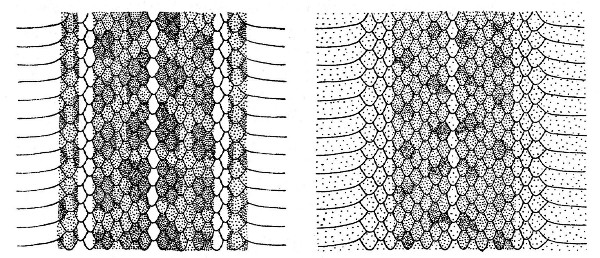
Milstead (1953) had available few specimens of Thamnophis dorsalis from the Tepalcatepec Valley. The large series now in existence shows that the population in the Tepalcatepec Valley differs distinctly from that inhabiting the Mexican Plateau, Cordillera Volcánica, and Sierra de Coalcomán. Therefore the name T. dorsalis postremus Smith (1942) is resurrected for the population in the Tepalcatepec Valley. T. dorsalis cyclides and T. dorsalis postremus differ in color pattern (Fig. 10) and in scutellation (Table 6). Specimens from the Mexican Plateau and mountain ranges have a distinct light stripe on the second and third scale rows, a dark brown dorsum having squarish black spots, and a row of dark spots on the first row of dorsal scales. Specimens from the Tepalcatepec Valley have a grayish brown dorsum having smaller and less distinct dark spots and no light stripe on the second and third scale rows; the first, second, and third rows of scales are colored like the venter. In some specimens there are small dark flecks on the first row of dorsal scales.
Table 6.—Variation in Scutellation in Thamnophis dorsalis.
CharacterMexican PlateauSierra de CoalcománTepalcatepec Valley
Ventrals♀ N 31 2 32
Mean 164.0 156.5 144.6
Range153-171 154-159 138-151
♂ N 19 2 32
Mean 153.5 154.7 138.3
Range149-159 149-159 131-141
Caudals♀ N 28 2 29
Mean 83.8 81.0 73.4
Range80-100 79-83 70-79
♂ N 14 2 28
Mean 78.0 72.0 68.5
Range 71-87 72 63-73
One specimen from Uruapan (1550 meters) and one from Coalcomán (950 meters) are intermediate in color pattern between T. dorsalis cyclides and T. dorsalis postremus. Both have indistinct lateral stripes and only small dark spots below the stripes. In scutellation these specimens are like T. dorsalis cyclides.
In Michoacán Thamnophis dorsalis cyclides has been collected in a variety of habitats on the Mexican Plateau: pine-oak forest, fir forest, marshes, and cleared land from 1550 to 2800 meters. In the Sierra de Coalcomán one was taken in broad-leafed forest at 950 meters, three in pine-oak forest at 2100 meters, and one in pine forest at 2300 meters.
Thamnophis dorsalis postremus Smith
Thamnophis eques postremus Smith, Zoologica, 27:109, October 23, 1942.—El Sabino, Michoacán, México.
Thamnophis cyrtopsis postremus Smith, Copeia, no. 2:140, June 8, 1951.
Thamnophis cyrtopsis cyclides (part), Milstead, Texas Jour. Sci., 5:368, September, 1953.
Thamnophis dorsalis postremus, Fitch and Milstead, Copeia, no. 1:112, March 17, 1961.
Apatzingán (31); Capirio (2); Charapendo; Cuatro Caminos (22); El Sabino; Lombardia (9); Nueva Italia (8); Uruapan (3).
The reasons for recognizing the population of Thamnophis dorsalis in the Tepalcatepec Valley as distinct from that on the surrounding highlands are presented in the discussion of Thamnophis dorsalis cyclides. In certain features of coloration and in the low numbers of ventrals and caudals, T. dorsalis postremus shows more resemblance to T. dorsalis sumichrasti than to T. dorsalis cyclides. According to Milstead (1953:367), T. dorsalis cyclides ranges southward from the Río Balsas in southwestern México. If specimens could be obtained from the upper Balsas Basin they might show that T. dorsalis postremus inhabits that extensive basin.
In the Tepalcatepec Valley T. dorsalis postremus is most frequently found at night in the rainy season, at which time the snakes are abundant near temporary pools where frogs are breeding. The absence of specimens from the coastal lowlands of Guerrero, Michoacán, and Colima indicate that, although the species inhabits the lowlands of the Tepalcatepec Valley, its range does not include the coastal lowlands.
A female (UMMZ 119402 from Cuatro Caminos) having 139 ventrals and a body length of 576 mm., on June 20, 1958, gave birth to 25 young, of which 18 (9 males and 9 females) were preserved. In body length the males varied from 132 to 141 (137.3) mm.; the females, 125 to 137 (133.1) mm. In tail length the males varied from 38 to 44 (42.4) mm.; females, 35 to 42 (39.7) mm. The males have 138 to 147 (142.2) ventrals and 70 to 75 (72.9) caudals; females have 131 to 140 (135.8) ventrals and 63 to 71 (67.0) caudals.
Thamnophis eques eques (Reuss)
Coluber eques Reuss, Zool. Misc., p. 152, 1834.—México. Type locality restricted to Guadalajara, Jalisco, México, by Smith and Taylor (1950a:334).
Thamnophis macrostemma macrostemma, Smith and Taylor, Bull. U. S. Natl. Mus., 187:163, October 5, 1945.
Thamnophis subcarinata subcarinata, Smith, Herpetologica, 5:63, May 31, 1949.
Thamnophis eques eques, Smith, Copeia, no. 2:139, June 8, 1951.
Jiquilpan; Lago de Cuitzeo; Lago de Pátzcuaro (17); Pátzcuaro (5); Tangancícuaro; Tupátaro (2); Undameo; Zacapu.
Although this snake has been collected in open pine-oak forest and in oak-bunch grass associations, it seems to reach its greatest abundance in marshes on the Mexican Plateau at elevations of 1550 to 2300 meters.
Thamnophis melanogaster canescens Smith
Thamnophis melanogaster canescens Smith, Zoologica, 27:117, October 23, 1942.—Chapala, Jalisco, México.
Lago de Cuitzeo (5); Lago de Pátzcuaro; Pátzcuaro; Tacícuaro; Tangamandapio (2).
This species of garter snake seems to be most abundant in the marshes adjacent to the lakes on the Mexican Plateau in Michoacán and Jalisco. At these elevations (1550 to 2200 meters) it often is found in association with Thamnophis eques eques and sometimes with Thamnophis dorsalis cyclides. On June 11, 1958, individuals of this species were found in a hyacinth-choked marsh at Tangamandapio at night.
One specimen from Tangamandapio (UMMZ 119414) had, in life, a dark chocolate brown dorsum, reddish brown sides, and cream-colored belly, chin, and labials. There were no longitudinal dorsal stripes.
Thamnophis scalaris scaliger (Jan)
Tropidonotus scaliger Jan, Elenco sistematico degli Ofidi, p. 70, 1863.—No type locality designated. Type locality restricted to Mexico City, Distrito Federal, by Smith and Taylor (1950a:329).
Thamnophis scalaris scaliger, Smith, Zoologica, 27:103, October 23, 1942.
Cerro Tancítaro (2); Nahuatzen; Opopeo; 26 km. S of Pátzcuaro.
The few specimens of this species from Michoacán have been collected at elevations from 1800 to 3400 meters in pine or fir forest in the Cordillera Volcánica.
Micrurus distans michoacanensis (Dugès)
Elaps diastema michoacanensis Dugès, La Naturaleza, ser. 2, 1:487, 1891.—Michoacán. Type locality restricted to Apatzingán, Michoacán, México, by Smith and Taylor (1950a:335).
Micrurus distans michoacanensis, Zweifel, Amer. Mus. Novitates, 1953:11, June 26, 1959.
Apatzingán (6).
All specimens were collected in the arid scrub forest of the Tepalcatepec Valley. The number of black rings on the body varies from six to eleven. In this respect they agree with the diagnosis of this subspecies presented by Zweifel (1959b:9).
Micrurus laticollaris (Peters)
Elaps marcgravii laticollaris Peters, Monats. Akad. Wiss. Berlin, p. 877, 1869.—Izúcar de Matamoros, Puebla, México.
Micrurus laticollaris, Schmidt, Publ. Field Mus. Nat. Hist., zool. ser., 20:39, December 11, 1933.
El Sabino (2); Lombardia.
This species ranges throughout the Balsas-Tepalcatepec Basin westward into Colima; specimens from Michoacán were collected in arid scrub forest at elevations from 500 to 1050 meters. The limited observations on Micrurus distans michoacanensis and M. laticollaris indicate that, at least in the Tepalcatepec Valley, M. laticollaris seems to inhabit slightly more mesic areas than does M. distans michoacanensis.
Pelamis platurus (Linnaeus)
Anguis platura Linnaeus, Systema naturae, ed. 12, 1:391, 1766.—Pine Island, Pacific Ocean.
Pelamis platurus, Gray, Ann. Philos., p. 15, 1825.
Boca de Apiza.
In November, 1955, Alfonzo Gonzales, a geographer from the University of Texas, observed sea snakes on the beaches of Michoacán. In May, 1956, Donald D. Brand of the University of Texas gave me one specimen of Pelamis platurus that he obtained on March 2, 1956, at Boca de Apiza. Furthermore, he supplied me with the following observations based on his field work along the coast of Michoacán from the Río Coahuayana to Maruata from March 1, to April 15, 1956. At that time many sea snakes were observed; in some places living and dead individuals were seen on the beaches; innumerable snakes were seen in the surf. When live individuals were taken from the beach and thrown into the ocean, they usually swam to shore. Many partially eaten individuals were seen protruding from crab holes. Inquiries among the natives resulted in the following information: Sea snakes are frequently seen between November and April, but most commonly in March and April, at which time the water is cold. The natives referred to the sea snakes as "culebra del mar." Most natives said that the snakes were not poisonous; others did not know of any venomous properties. In May, 1956, I worked the coastal region from the Río Coahuayana to La Placita and saw no sea snakes. In the summer of 1950 James A. Peters, and in the summer of 1951 I worked nearly the entire coastal region of Michoacán; during that time no Pelamis were seen. Insofar as I know, this is the first report of such seasonal activity in Pelamis platurus in the Americas.
Agkistrodon bilineatus bilineatus Günther
Ancisdrodon bilineatus Günther, Ann. Mag. Nat. Hist., ser. 3, 12:364, 1863.—Pacific coast of Guatemala.
Agkistrodon bilineatus bilineatus, Burger and Robertson, Univ. Kansas Sci. Bull., 34 (1):213, October 1, 1951.
Apatzingán; El Sabino; La Playa; Los Reyes.
All specimens from Michoacán are from inland localities between 300 and 1500 meters. The one from Los Reyes (USNM 46416) was collected by Nelson and Goldman on February 13, 1903. The elevation of Los Reyes (1500 meters) seems unusually high for this species, but otherwise there is no reason to doubt the authenticity of the record. Goldman (1951:192) in his description of Los Reyes stated: "Los Reyes is near the boundary between the Lower Austral and Arid Upper Tropical Zones but is preponderantly tropical in zonal character. The regular crops are mainly sugar cane, rice, and corn." Thus the biotic features of the area are not noticeably different from those at El Sabino and La Playa at lower elevations. The development of extensive agriculture through irrigation in the Tepalcatepec Valley and planting of rice and sugar-cane in that area may produce a more widespread habitat for this snake.
The absence of specimens from the coastal lowlands is due solely to inadequate collecting; the natives there know the snake and report that it is not uncommon in certain areas.
Crotalus basiliscus basiliscus (Cope)
Caudisonia basilisca Cope, Proc. Acad. Nat. Sci. Philadelphia, September 30, 1864.—Colima. Type locality restricted to Colima, Colima, México, by Smith and Taylor (1950a:328).
Crotalus basiliscus basiliscus, Gloyd, Nat. Hist. Misc., 17:1, April 23, 1948.
Apatzingán (4); Camachines; Coalcomán; El Ticuiz.
Specimens from southern Michoacán have fewer ventrals and caudals than do those from the northern part of the range; three males and three females have, respectively, 178, 182, 182, 185, 186, and 188 ventrals, and 27, 28, 29, 22, 29, and 29 caudals. Klauber (1952:81) gave the following data for Crotalus basiliscus (based on specimens from the entire range, except Oaxaca): ventrals in males, 179-201 (191.4), in females, 185-206 (197.6); caudals in males, 26-36 (30.7), in females, 21-29 (24.4). Klauber (1952:84) remarked that the one specimen that he had seen from Apatzingán had fewer ventrals and caudals than most other specimens. The low numbers of ventrals and caudals in specimens from Michoacán, as compared with more northern populations, may be indicative of a trend in the reduction of the numbers of these scutes from north to south. The southernmost examples of Crotalus basiliscus (Crotalus basiliscus oaxacus from Oaxaca) have 172-175 ventrals and 21 caudals (Gloyd, 1948).
In Michoacán Crotalus basiliscus basiliscus has been found in arid habitats on the coast, in the Tepalcatepec Valley, and in the lower parts of the Sierra de Coalcomán. All specimens are from localities below 1070 meters in elevation.
Crotalus durissus culminatus Klauber
Crotalus durissus culminatus Klauber, Bull. Zool. Soc. San Diego, 26:65, August 8, 1952.—El Sabino, Michoacán, México.
El Sabino (18).
These specimens are part of the type series and were collected by Hobart M. Smith near the upper limits of the arid scrub forest at an elevation of about 1050 meters on the lower slopes of the Cordillera Volcánica at the northern edge of the Tepalcatepec Valley. They were discussed in detail by Klauber (1952:66-70).
Crotalus intermedius intermedius Troschel
Crotalus intermedius Troschel, in von Müller, Reisen in Vereiningten Staaten, Canada und Mexico, vol. 3, p. 613, 1865.—Type locality unknown.
Crotalus intermedius intermedius, Klauber, Bull. Zool. Soc. San Diego, 26:9, August 8, 1952.
Cerro Tancítaro.
The one specimen is from the pine forests on the Cordillera Volcánica. At the present time this species is known from scattered localities in west-central Veracruz, Oaxaca, Michoacán, and as Crotalus intermedius omiltemanus in Central Guerrero. Apparently it is restricted to montane environments.
Crotalus molossus nigrescens Gloyd
Crotalus molossus nigrescens Gloyd, Occ. Pap. Mus. Zool. Univ. Michigan, 325:2, January 28, 1936.—Four miles west of La Colorada, Zacatecas, México.
Carapan; Los Conejos; Pátzcuaro; Tacícuaro (5).
In Michoacán this species has been found in pine forests between 1550 and 2300 meters in the Cordillera Volcánica. I expected to find it in the Sierra de Coalcomán, but inquiries among the natives living in the pine forests of that mountain range revealed that the people there have no knowledge of a large species of rattlesnake.
Crotalus polystictus (Cope)
Caudisonia polysticta Cope, Proc. Acad. Nat. Sci. Philadelphia, 17:191, December 26, 1865.—Tableland of México. Type locality restricted to Tupátaro, Guanajuata, México, by Smith and Taylor (1950a:330).
Crotalus polystictus Cope, in Yarrow, Wheeler's Rept. Geog. Geol. Expl. Surv. W. 100th. Mer., vol. 5, p. 533, 1875.
Tacícuaro (4); Tupátaro (2).
Formerly this species was abundant in the marshes around Lago de Chapala. The draining of these marshes probably resulted in reducing the numbers of these rattlesnakes. The species is known only from the Mexican Plateau at elevations of 1450 to 2400 meters.
Crotalus pusillus Klauber
Crotalus pusillus Klauber, Bull. Zool. Soc. San Diego, 26:34, August 8, 1952.—Tancítaro, Michoacán, México.
Acuaro de las Lleguas (2); Carapan; Cerro Tancítaro (16); Dos Aguas (12).
Aside from the type series of Crotalus pusillus from Cerro Tancítaro and one specimen from Carapan referred to the species by Klauber (1952:38), there are fourteen specimens from the Sierra de Coalcomán. These specimens (UMMZ 112566-7, 118591-9, 118601, 121512-3) are like Crotalus pusillus from Cerro Tancítaro in having the prefrontals paired, a black proximal rattle, and the underside of the tail black. The prefrontals are bordered posteriorly by one scale in two specimens, by two scales in three specimens, and by three scales in the other nine. The snakes from the Sierra de Coalcomán have 40 to 46 (42) dorsal body blotches. Ten males have 150-158 (154.4) ventrals and 29-33 (31.0) caudals; two females have 157 and 160 ventrals, and 25 and 27 caudals. The largest specimen is a male having a body length of 545 mm. and a tail length of 63 mm. The only noticeable difference between the specimens from the Sierra de Coalcomán and the topotypic series is that the latter have fewer dorsal blotches; the range of variation is 33 to 46 (39.8).
Most specimens of this species have a grayish brown dorsum and dark brown dorsal blotches. Two specimens from Dos Aguas (UMMZ 118596 and 118599) are pale brown above and have indistinct blotches.
One specimen from Dos Aguas regurgitated a large Gerrhonotus imbricatus imbricatus; of two others from the same locality, one regurgitated a Sceloporus bulleri and an Eptesicus fuscus. The latter specimen was collected at the entrance of a small cave, where it probably had captured the bat.
In the Cordillera Volcánica Crotalus pusillus has been obtained in pine-oak forest at elevations between 1550 and 1800 meters. In the Sierra de Coalcomán two specimens were taken in pine forest at an elevation of 2300 meters; ten other were found beneath rocks and logs in pine-oak forest at an elevation of 2100 meters.
Crotalus triseriatus aquilus Klauber
Crotalus triseriatus aquilus Klauber, Bull. Zool. Soc. San Diego, 26:24, August 8, 1952.—Alvarez, San Luis Potosí, México.
Morelia (10); Tacícuaro (2).
I am following Klauber (1952) in assigning some of the specimens of this species from Michoacán to the subspecies aquilus and others to C. t. triseriatus. The distinguishing characters of these subspecies are given by Klauber (1952:28). On the basis of the few localities from which the species is known in Michoacán it seems as though C. t. aquilus inhabits the open grassy areas on the Mexican Plateau and the associated open pine-oak or oak-bunch grass habitats to the north and east of the Cordillera Volcánica. Crotalus triseriatus aquilus has been collected at elevations from 1600 to 2000 meters in Michoacán.
Crotalus triseriatus triseriatus (Wagler)
Uropsophus triseriatus Wagler, Natürliches System der Amphibien, p. 176, 1830.—México. (Probably Mexico City.)
Crotalus triseriatus triseriatus, Klauber, Bull. Zool. Soc. San Diego, 26:19, August 8, 1952.
Cerro Tancítaro (36); Opopeo; Pátzcuaro.
This small rattlesnake inhabits rocky areas in pine and pine-oak forests above 1600 meters in the Cordillera Volcánica; it has been collected at 3270 meters on Cerro Tancítaro. The series reported by Schmidt and Shannon (1947:84) is a mixture of specimens of Crotalus triseriatus and Crotalus pusillus. The two species are found together on Cerro Tancítaro, but only Crotalus pusillus inhabits the coniferous forests of the Sierra de Coalcomán. Klauber (1952:30) stated that despite the proximity of Crotalus triseriatus triseriatus and Crotalus triseriatus aquilus in Michoacán, there is no evidence of intergradation. He went on to suggest that additional material might show that the two named populations actually are distinct species. The specimens that have been studied since Klauber's investigations also show no evidence of intergradation, but there still is no known sympatry of the populations.
The small montane rattlesnakes belonging to the species C. pricei, C. pusillus, and C. triseriatus present a problem in systematics and distribution worthy of intensive investigation. A knowledge of the distribution and relationships of the various populations of these snakes, together with other species also living in isolated populations on the higher mountains in México, probably will be of great significance in understanding dispersal and differentiation of animals during the Pleistocene.