VISIT TO ARGONNE (continued 2)
Reading edition

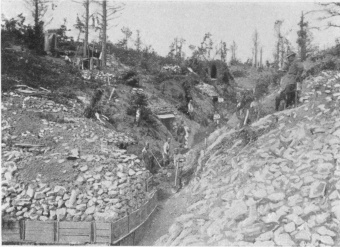
GRUERIE WOOD. ST. HUBERT SECTOR. MARIE THÉRÈSE RAVINE
After visiting Gruerie Wood, return to and proceed along G.C. 67. The road passes beside two large French cemeteries, then a row of dug-outs. The forest becomes more and more denuded of trees, which were smashed by the shells. The site of Four-de-Paris is soon reached, though not a trace of the village remains (photo, p. 104). Four-de-Paris is 2 km. from La Harazée.
Four-de-Paris
It was against the Four-de-Paris sector that the first efforts of the Germans, after their retreat of September, 1914, were directed. No sacrifice, however costly, was considered too great to recapture this essential position on the road to Les Islettes.
In two days (November 27-28) seven enemy attacks were launched to the north of Four. Three times on December 5 their troops, to the sound of fife and drum, returned to the charge, but without success. On the 18th, after blowing up a trench, they again attacked. On January 5, 1915, by way of a diversion, the French 2nd battalion of the 4th Foreign (or Garibaldian) Regiment carried out an operation in this sector, while, further to the east, the rest of the regiment delivered the main attack at Courte-Chausse. At 10 a.m., the Garibaldians, supported by some bomb-throwers belonging to the 9th Battalion of Chasseurs and French 91st Regiment of the Line, and by two sections of the engineers, attacked the enemy trenches on a front of 400 yards, but, decimated by machine-gun fire, they were unable to reach them. On February 16-17 and on March 9 there were renewed and violent struggles. From June 29 to July 15 the battle broke out again in this sector, interrupted from time to time by terrible bombardments with gas shells.
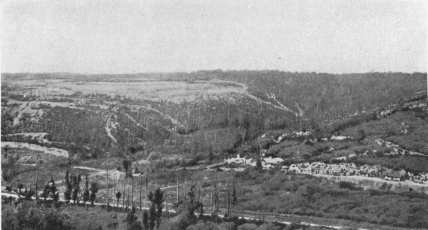
GENERAL VIEW OF THE “FOUR-DE-PARIS” (see page 103)
The road in the foreground leads from Four-de-Paris to Varennes.
In 1916 and 1917 this sector, like the rest of the Argonne, quieted down. Mining operations continued from time to time, but there were no battles properly so called. In the occasional surprise attacks which took place, the French generally got the better of the enemy.
From Four-de-Paris, instead of going to La Chalade by the direct road through the valley of the Biesme (2 km. 500), the Itinerary follows a number of roads (17 km. 500 in all) through the forest, in order to visit certain picturesque spots and at the same time to see places like Bolante, Les Meurissons, La Haute-Chevauchée, Fille-Morte, Pierre-Croisée and Courte-Chausse, made famous by the war. All these places were the scene of fierce conflicts in 1914 and 1915.
In December, 1914, many engagements, in which the French made slight progress, took place in this sector. It was to the east of Bolante Wood, in the wild ravine of La Fontaine-des-Meurissons, that the Garibaldian Regiment—raised by the Republicans of Italy to fight in France, and placed at the disposal of General Gérard (commanding the 2nd Active Corps)—received its baptism of fire. On December 26, 1914, the 2nd Garibaldian Battalion was detailed to carry a German trench. The attacking front was limited, about 150 yards, but the position was strongly held and protected by a deep entanglement of barbed wire. After an artillery preparation lasting from midnight until dawn, the Garibaldian companies rushed forward, one behind the other, to make a breach at all costs, but were held up by the uncut wire. At
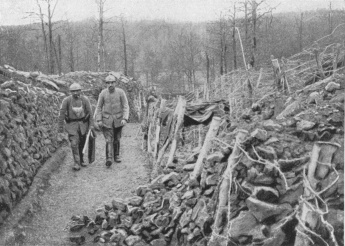
“FOUR-DE-PARIS.” FRONT-LINE DEFENCES (1916)
one point an opening was made and a few men got through to the edge of the German trench, only to be killed there. It was during this engagement, which cost the 2nd Battalion 30 dead, 17 missing, and 111 wounded, that Second-Lieutenant Bruno Garibaldi—a grandson of Giuseppe Garibaldi, “the old red bird” whom, in 1870, the Prussian General Werder confidently expected to “catch in his nest” in the Vosges, but failed in the attempt—was killed. Bruno Garibaldi, though in reserve, advanced to the assault with the 2nd Battalion, his sword drawn, his green tunic unfastened, showing the traditional and symbolic red shirt. Wounded in the hand, he went back to the trench to have it dressed, then returned immediately to the fight. Struck by a bullet he continued to urge his men forward, until another laid him low. Before dying, he embraced a wounded comrade near by, saying, “Kiss my brothers for me.” On January 5, 1915, further to the right, on the Courte-Chausse plateau, the 1st and 3rd Garibaldian Battalions had their revenge. Eight mines, the galleries of which, forty to fifty yards in length, ran under the German trench, were charged with about 6,000 lbs. of explosives during the night. At 7 a.m. the next morning the mines were fired, one after the other, after which, to the sound of bugles and drums, eight Garibaldian companies took the shattered enemy front line in a single charge, threw a German counter-attack into disorder, took and retook the second line, and penetrated into the third German line. This they were unable to hold, but they had nevertheless made an important advance, taken four machine-guns, two minenwerfer, and 200 prisoners of the 135th, 26th, and 24th German Regiments—most of them Pomeranians. By a strange coincidence it was the flag of a Pomeranian regiment—the LXIst—that had been taken in 1870 at the Battle of Dijon by Ricciotti Garibaldi, Bruno’s father. The Garibaldians’ losses that day were heavy. Among the dead was Adjutant-Chief Costante Garibaldi, Bruno’s brother. Some days later a violent battle took place in the Meurissons ravine. On January 7, after a half-hearted German attack, which was easily beaten off, rough trenches were dug on the plateau—in view of a possible retreat—by men belonging to the 46th French Regiment of the Line, who worked under heavy fire. General Gouraud, commanding the 10th Infantry Division, who came to examine the position, was wounded in the shoulder by a machine-gun bullet. On the following day a violent German artillery preparation began at dawn. At 7.30 a.m. three regiments of fresh enemy troops (Bavarian infantry) advanced to the attack. A trench held by men of the 89th Regiment of the Line was blown up, the French line was broken, and the Bavarians took on the flank the first and second lines held by troops of the 89th and 46th Regiments of the Line, who put up a fierce resistance. On the plateau the 11th Company of the 46th, which held the unfinished supporting trench, stopped the rush of the enemy. The Germans, unwilling to risk a frontal attack, turned the position on the right flank, and finally took the trench, but only after the gallant defenders had fired their last cartridges. The Germans penetrated into the ravine, capturing the regimental headquarters, and wounding the colonel and his staff. The 11th Company, however, still held on. On the crest, the cooks and the sick seized rifles and joined in the fight. At about 9.30 a.m. a blast of trumpets on the right announced the arrival of reinforcements. Units of the French 89th Regiment of the Line and 2nd Garibaldian Battalion charged through the undergrowth. A furious hand-to-hand struggle ensued in the copse-wood, no quarter being given. The French succeeded in saving their comrades of the 46th, and checked the enemy, who eventually evacuated the ravine. At dawn on the 9th, units of the 120th Regiment of the Line relieved the Garibaldians, who numbered among their dead the Regiment’s adopted child, Gaston Huet, a French boy of twelve, who had fought like a man. It was in vain that the Germans renewed their attacks; until nine o’clock in the evening they were repulsed and held. The remnant of the French 46th Regiment of the Line—some three hundred men—under the command of a captain clung for three days without supplies, to their positions. Their splendid resistance and sacrifice were not in vain, as reinforcements arrived in time to re-establish the position.
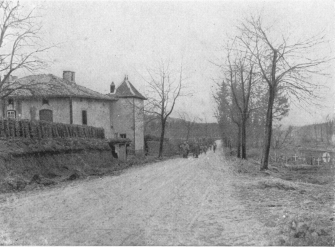
FOUR-DE-PARIS FARM IN 1915 (SUBSEQUENTLY RAZED TO THE GROUND), ON THE ROAD TO CHALADE
From March 9 to 19, several French attacks between Four-de-Paris and Bolante gave slight gains, in spite of enemy counter-attacks.
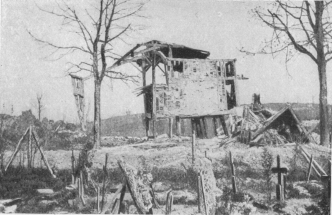
FOUR-DE-PARIS FARM IN 1918 (see p. 103)
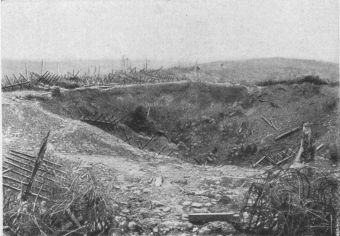
SHELL CRATERS ON HILL 285, IN THE “FILLE MORTE” SECTOR (as seen from the road)
On August 7, part of a trench was taken by the Germans in a night attack at Fille-Morte. During the whole of that month, at Courte-Chausse, Les Meurissons, La Haute-Chevauchée and Bolante, continual fighting took place with artillery, mines, trench-mortars, grenades and bombs. On September 27, during the French offensive in Champagne, the Germans attempted a diversion against Bolante and Fille-Morte. After a heavy bombardment with explosive and gas shells, a force of nearly two regiments attacked in four successive waves. At first they made some slight progress, but were soon almost everywhere repulsed with very heavy losses. From October, 1915, it was in this part of the Argonne that the activity was greatest, though here, as elsewhere, the fighting considerably diminished. In 1916, frequent mining operations gave rise to grenade fighting around the craters at Fille-Morte, Bolante, La Haute-Chevauchée and Courte-Chausse. In 1917, mine warfare was practically abandoned, but both sides frequently made raids into the opposing trenches, for the purpose of taking prisoners and destroying the works and shelters there.
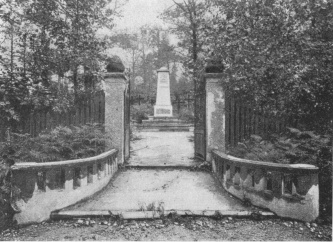
GERMAN CEMETERY ON THE ROAD FROM FOUR-DE-PARIS TO VARENNES (4 km. from the former)
On reaching Four-de-Paris from La Harazée, take G.C. 38, on the left, towards Varennes.
The road follows the valley of Les Meurissons (on the right is Bolante Wood), crosses Hill 265, and passes by the original front lines.
From here onwards, veritable villages built by the Germans may be seen on the sides of the hill, on the left bank of the Meurissons stream.
The forest on the crest of the hill was cut to pieces by the shells.
Almost at the top of the hill the road runs past a German cemetery containing a curious monument (4 km. from Four-de-Paris; photo above).
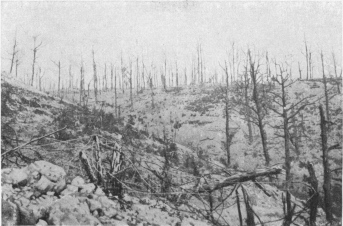
DESTRUCTION OF THE ARGONNE FOREST
One kilometre further on, at the Meurissons cross-roads, La Haute-Chevauchée, an old Roman road, is reached.
Follow La Haute-Chevauchée—a very interesting road, but in bad repair—driving slowly and carefully for the first 2 km.
The road passes through Jardinet Wood, which is full of dug-outs, shelters and gun-emplacements.
On leaving the wood the view is impressive. Hill 285, opposite, is literally ploughed up by the shell fire, while not a single tree is left (photo below).
This is the sector of the Fille-Morte, Pierre-Croisée and Courte-Chausse.
The road goes round the hill, passing a succession of shell-craters on the crest.
Shortly afterwards, after entering Chalade Wood, the road improves. On both sides are French structures of stonework.
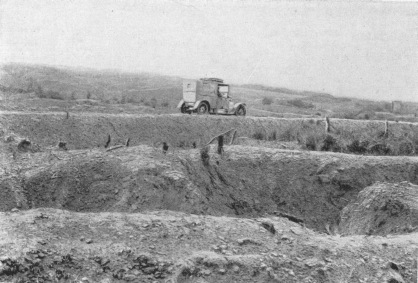
HILL 285, IN THE “FILLE MORTE” SECTOR
(The car is going towards the Croix-de-Pierre cross-roads.)
One kilometre beyond Hill 285 is the Sept-Fontaines cross-roads, where stood a French dressing-station, facing the road going towards the Mont-de-Villers.
Keep straight on: 1 km. 800 further on, at the cross-roads, near the site of the Forest Keeper’s Lodge, there is a large military cemetery. The Lodge was completely destroyed.
2 km. 300 further on, Croix-de-Pierre cross-roads is reached. Fifty yards this side of the cross-roads, on the left, is the shelter where Lieutenant de Courson met a glorious death in 1915 (photo, p. 110).
At Croix-de-Pierre cross-roads, where the Neuvilly road (on the left) and the Clermont road (in front) start, turn to the right into the road leading to Chalade (called Chemin des Romains).
Pass an old camp (Camp Monhoven), then 1 km. beyond Croix-de-Pierre leave the Claon road on the left.
Two kilometres further on there is a sharp descent leading to G.C. 22, which take on the right for 1 km. to Chalade.
The village of Chalade grew up around a monastery founded in 1120 by Robert and Riouin, monks of the Abbey of St. Vanne at Verdun.
The Abbey, occupied first by the Benedictines, and afterwards (from 1127) by the Cistercians, was placed under the care of the Bishops of Verdun, protected by the Lords of Vienne-le-Château.
The monks drained the marshes of the valley of the Biesme and cultivated the slopes.
The Abbey church, begun in 1275, was never finished.
There is a legend that the prior, who had given up all hope of finishing the church, received a visit from the Devil, who offered to finish the building for him, on condition that he should have the soul of the first Christian who crossed the threshold of the completed church.
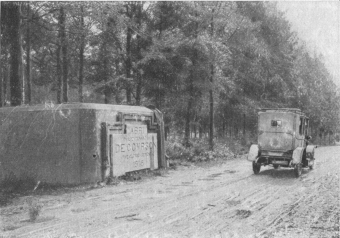
SHELTER, NAMED AFTER FRENCH OFFICER WHO FELL THERE IN 1915
The prior having refused this offer, the Devil scattered in all directions the houses which had until then been grouped around the monastery, and reduced to dust the blocks of “gaize” in the quarries.
Since that time the houses have remained scattered, and there are no more blocks of “gaize” to be found in the neighbourhood.
This legend is doubtless a naïve explanation of natural phenomena, “gaize” being a silicious clay peculiar to the district.
The Abbot’s house in the enclosure is in ruins. South of the church, monastic buildings, probably erected in the 17th century, are still standing, though in a dilapidated condition.
The Abbey church became the church of the parish. The windows and rose-window were restored in the 19th century. The nave has lost two of its bays, and the steeple has been pulled down.
The Gothic nave is large and high, the springing of the vaults resting on sculptured capitals. Fragments of old stained-glass, still to be found in some of the windows before the war, were destroyed by the bombardments.
At the end of the nave there is a fine rose-window, the mullions of which are said to have been taken from the old Abbey of St. Vanne at Verdun.
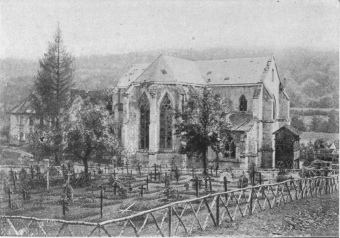
CHALADE. MILITARY GRAVES AND CHURCH
Return by G.C. 22, continuing along this road to Claon (3 km).
This little village served as a cantonment during the war, and was also a revictualling centre.
Take the road to the right in the village, returning to Sainte-Menehould, via Florent (9 km).
Before entering Sainte-Menehould, the road passes by a large French military cemetery containing 9,000 graves.
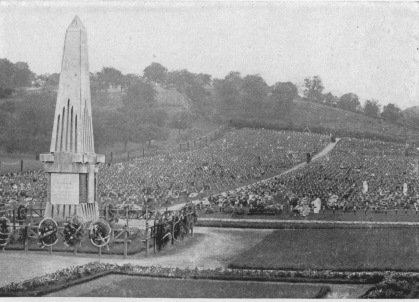
SAINTE-MENEHOULD. GREAT FRENCH MILITARY CEMETERY,
with monument to the defenders of the Argonne (10th and 18th C.)