THE RED CROSS AND PRESIDENT TAFT’S INAUGURATION
Reading edition
At the time of presidential inaugurations between two and three hundred thousand strangers, including large civil and National Guard organizations, come to Washington. The great crowds at the railroad station, in public conveyances, on the streets, the excitement and exposure involved—all tend to produce an unusual number of accidents and sudden illnesses. Under the Inaugural Committee a sub-committee on Public Comfort has heretofore taken entire charge of such emergency cases as have arisen, but a need was felt for a number of well-equipped relief stations with a competent personnel to act in co-operation with the physicians of the city. The American Red Cross offered its services, which, having been accepted, it immediately began its work of preparation. A relief column with thirty-six members, many of whom were medical students, devoted two months to weekly instructions in First Aid and hospital drill. The first course was given by Dr. Charles S. White, lately resident physician of the Emergency Hospital, and the second by Captain Reynolds, of the U. S. Army Medical Service. Each of these surgeons kindly donated their time and services for these instructions. The District Red Cross Branch, at an expense of over three hundred dollars, provided uniforms and equipment for the members as prescribed in Major Lynch’s Red Cross First Aid Book. Through the New York Branch the Brooklyn Relief Column was invited to take part and promptly accepted the invitation, meeting themselves the expense of their uniforms, equipment and transportation.
The question of the nursing personnel was next considered. The committee on nurses of the District Branch secured thirty-six of its enrolled Red Cross nurses, each nurse promising to secure a substitute in case she was prevented from serving. Besides those from the District the Pennsylvania Branch sent eleven, the New York and the Maryland Branches each five. These branches paid for the transportation of the nurses and the National Executive Committee defrayed their expenses here. The salary of the six nurses who were on duty for the week at the Railroad Relief Station, two nurses being on duty for each eight hours in the twenty-four, and those of the nurses who were on duty parts of several days at the Pension Office station were paid by the National Executive Committee, but the nurses who were on duty for the day of the inauguration all gave their services.
Thanks to the Army Medical Service and to the Quartermaster General’s Department twenty-two hospital tents, with a complete equipment of cots, tables, chairs, oil stoves and field hospital chests for all of these stations, was procured. It is always a great help as well as a pleasure to have the Army as an assistant in any Red Cross work, and too much praise cannot be given to the efficient and prompt assistance its officers are always ready to render the Red Cross. Major Merritte W. Ireland, of the Surgeon General’s Office, knew what was required and how and where to obtain everything not only for the relief stations along the line of march, but for the larger station at the Union Station and for a complete small hospital equipment, with operating room, installed at the Pension Office. Major William E. Horton, of the Quartermaster’s Department, under direction of the Quartermaster-General, procured the tents, made plans for wooden beam foundations, where they had to be raised on asphalt, and the Chief of Staff gave an order for a detail of soldiers to put them up. General Johnston, who was the marshal in charge of the inaugural parade, gave the Red Cross every assistance in his power, as did Major Sylvester, Chief of Police.
Dr. D. Percy Hickling was Chairman of the Sub-committee on the Hospital and Ambulance Service, Dr. Wm. P. Reeves and Dr. Emory W. Reisinger had charge of the Emergency Hospitals at the Union Station and the Inaugural Ball, respectively, and Dr. Frank E. Gibson of the relief stations along the line of march. All of these busy physicians, with a large number of others, gave up many hours of their time to this work and the Red Cross Personnel served gladly under their competent direction.
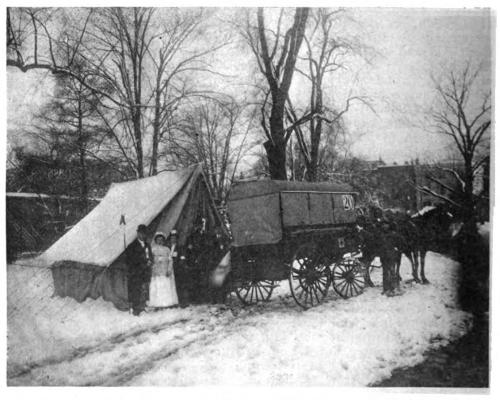
Red Cross Relief Station. There Were 22 of These Stations on Line of March.
Washington’s oldest inhabitant had to tax his memory to recall a worse morning than presented itself the fourth of last March. A driving wet snowstorm that had raged all night still filled the air with large flakes and covered the ground with several inches of melting snow. The picture of one of the relief stations gives some idea of conditions later in the day when the storm had ceased, but unfortunately no picture was taken of the tents that collapsed under the wind and weight of snow, no picture is given of the brave efforts to again erect these tents, nor of the nurses driven out of the tents taking refuge in the ambulances so as to remain on duty, or securing in two or three cases a room in a nearby building for their station. At every station in spite of the weather our nurses reported promptly for duty and the Red Cross is proud of their record and reliability. Our Relief Column men likewise did excellent service, as will be noted in the doctors’ reports. With equal devotion to duty the Brooklyn Column, twenty-two in number, left for Washington the night of the third, but with many others were detained by the storm-demoralized railroad service, and did not reach the city until late on the afternoon of the fourth, so that it was not possible for them to take active part, much to their and our regret.
Were these Red Cross relief stations of use? The fact that over two hundred cases of accidents and sudden illnesses were taken care of at these stations, not counting those which were removed to the hospitals, is a sufficient answer as to their value to the public. Some parts of the reports of the physicians in charge are appended to this article.
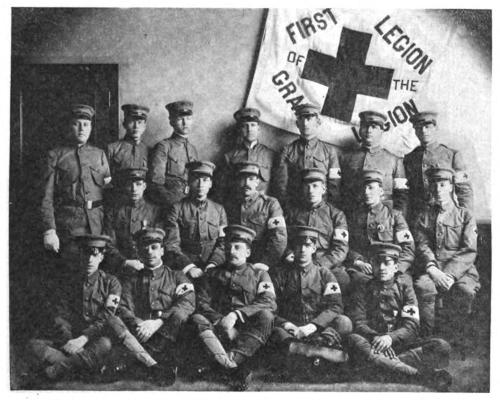
Detachment First Legion (New York) Ready to Proceed to Washington for Duty in Connection With Inauguration of President Taft.
The morning of the fifth the nurses from New York, Maryland and Pennsylvania were presented to President Taft at the White House and the following week some of the physicians, the nurses and the Washington Relief Column men were entertained by Miss Boardman at a tea.
The names of the nurses and Relief Column men who participated in the Red Cross work of inauguration day are as follows:
Relief Column Men—(Washington), Messrs. Dickens, Fitzhugh, Simon, Collins, Luckett, Sloat, Espinosa, Huske, Leonard, Watts, Carroll, Drew, Read, Hall, Eckhart, Hankins, Kelley, Webb, Newton, Townsend, Bruder, Sutton, Heally, Brick, Jobson, Rhees, Butler, Dougherty, Kennedy, French, Bricker, Robinowitz, Rollings, Colver, Rudolph, Posey.
Nurses—(New York), the Misses Phelan, Collins, Miller, Patterson and Hallahan; (Maryland), Kinhart, Murphy, Boyer, Lucas, Spielman and Bartlett; (Pennsylvania), Beitel, Rice, Simon, Uomer, Suddoth, McKnight, Calhoun, Zellfelder, Seiwell, Akeley and Bierstein; (Washington), Bauer, Hayes, Hart, Donnelly, Davis, Fitz, Backofen, Mahan, Bauer, Burhman, Grunwell, Stith, Lohr, Strong, Carbauld, Hewitt, Brown, Braun and Roach.
INAUGURAL COMMITTEE
The New Willard.
MAJOR RICHARD SYLVESTER, Chairman Committee on Public Order.
Dear Sir—In compliance with your request I have the honor to report the operations of the Hospital and Ambulance Service of the Committee on Public Order for the Inaugural period of 1909, of which, under your appointment, I acted as Chairman. In order to facilitate the work this sub-committee was organized by the appointment of Drs. George M. Kober and G. L. Magruder as Vice-Chairmen and Dr. P. C. Hunt as Secretary, the work being divided among four sub-committees, as follows: Sub-committee on Ambulance Stations, Sub-committee on Hospital at Pension Office, Sub-committee on Hospital at Union Station and Sub-committee on Inspection of Quarters. These Sub-committees were in charge of Drs. Gibson, Reisinger, Reeves and Gwynn, respectively.
SUB-COMMITTEE ON AMBULANCE STATIONS.
This Sub-committee cared for 81 cases, 10 surgical and 71 medical, 53 of whom were males and 28 females. This work was done under the most unfavorable circumstances on account of the weather, which not only interfered with the well-planned arrangements in many of their details, but made many of the physicians at some of the stations use Pennsylvania avenue as a thoroughfare to carry urgent cases to the Emergency Hospital instead of the longer runs to the other hospitals, as it was practically impossible to get the mules to pull the heavy ambulances over the snow-covered streets. While this was all done in violation of orders, yet suffering was materially lessened by so doing. Many of the tents were blown down, so that three of the emergency stations had to be established in three of the public buildings, namely, the District Building, State, War and Navy Building and the Marine Hospital Building.
Every station reported cases having been treated except No. 19. There were on duty during the day over 70 members of the Committee.
The work of the Red Cross is to be specially commended in connection with the Ambulance Stations, as they had not only furnished a complete relief equipment for each station, but two trained nurses in uniform at each station, all of whom, in spite of the weather, promptly reported for duty and rendered very efficient service. The stretcher men, trained and uniformed, at the expense of the American Red Cross Association, did excellent service and ought to be highly commended.
SUB-COMMITTEE ON HOSPITAL AT PENSION OFFICE.
The Hospital at the Pension Office was opened March 4th at 9 A. M. and closed March 7th at 11 A. M., having treated 24 cases.
The thanks of the Sub-committee are specially tendered to Lieut. Judge, of the Metropolitan Police Force, for the excellent assistance given and the order maintained, also to Mr. Graham, of the Inaugural Committee, through whose kindness supper was furnished to the Red Cross nurses on duty at the Hospital.
The work of the Red Cross Society in placing at the disposal of your Committee the equipment, trained nurses and stretcher men is highly appreciated.
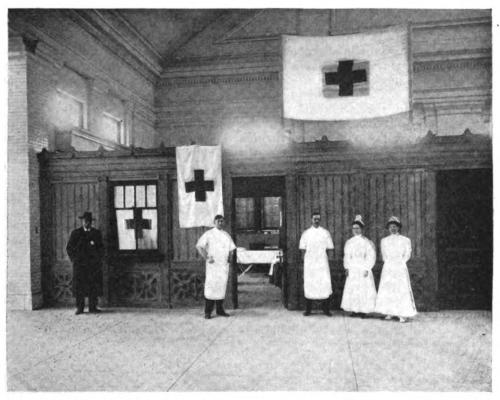
Physicians and Nurses on Duty at the Red Cross Emergency Hospital at Union Station, Washington.
SUB-COMMITTEE ON HOSPITAL AT UNION STATION.
Owing to the courtesy of the Terminal Station Officers and of the American Red Cross your Committee were enabled to establish and maintain a well-equipped emergency hospital at the Union Station. This emergency room was in operation from 8 A. M. March 1st until midnight of March 7th. During this time 105 cases were treated.
To the physicians, Red Cross nurses and Red Cross stretcher-bearers, who performed this work, covering the whole 24 hours, my thanks are specially due, as the work was done faithfully and well.
SUB-COMMITTEE ON INSPECTION OF QUARTERS.
In compliance with your desires, a number of the members of your Committee on Hospitals and Ambulances were designated to inspect the quarters of soldiers and organizations, who were quartered in large numbers in any one place during the inaugural period. This not only included those located in hotels, halls and tents, but also the numbers quartered in Pullman cars at Sixth street and Virginia avenue. The number of these places obtained from the Committee on Public Comfort was 25, all of which were inspected by the members of your Committee, who paid special attention to the ventilation and sanitation and also rendered efficient service to four men who were sick and in need of treatment.
In closing this report, I desire to call your attention to the fact that 214 cases have been reported as having been treated by your Committee without any expense to the Inaugural Committee, except the general printing and badge expenditures, and that the physicians willingly gave their services night and day in order to make the work of your Committee a success, and up to this time I have not heard of a single complaint.
I desire to specially call attention to the kindness of Miss Boardman, of the Red Cross Association, for her active co-operation. Through her efforts hospital tents were furnished along the line of march and at the fireworks. These tents were thoroughly equipped with appliances for the First Aid treatment of the sick and injured, and also two Red Cross nurses were on duty at each tent as long as the same was in commission, as well as two being constantly in attendance night and day at the Union Station and four at the Pension Office. The stretcher men, who had been drilled and uniformed, performed active and efficient service at the Pension Office, Union Station, along the line of march and at the fireworks, all of which was done without expense to the Inaugural Committee.
I also desire to express my high appreciation of your many acts of kindness and valuable assistance in carrying out the work of this Sub-committee.
(Signed) D. PERCY HICKLING, M. D.
REPORTS TO RED CROSS.
March 18th, 1909.
I have the honor to submit the following report:
The weather on the Fourth of March was unusually stormy, especially early in the morning, and six of the tents (Nos. 1, 4, 5, 11, 12 and 16) were blown down and the ice and snow made them so heavy that it was impossible for the men to place them again in position.
Cases at stations Nos. 1, 4, 5 and 11 were treated in the ambulances—that is, the slight ones, and the others were taken to the hospitals. Stations 12 and 16 were removed to a room in the District and War Department Buildings, respectively, and very comfortable quarters were provided indoors for these two stations.
On March the second I took Sergt. Frank G. Motz, of Company H, Engineer Corps, around to the different places where you wished the tents pitched, and early on the morning of March 4 he had his corps of eight good men at work pitching the tents. I was with them until they finished at six o’clock in the evening. These men deserve great credit, as they were compelled to work in the rain all the afternoon and they were wet to the skin, but did not give up until the last tent was pitched. The next morning when they knew it was snowing they came out without orders and pitched some of the tents that had blown down.
Too much praise cannot be given the good corps of nurses that so faithfully did splendid duty on that day. I visited several stations about nine o’clock in the morning and no one was there but the faithful nurses under your command. There was not a station at which the nurses did not report. In the reports from the different physicians much praise is given the nurses for their excellent work.
Every station had work to do, except No. 19, which was not on the route of parade.
Eighty-one cases were cared for—ten surgical and seventy-one medical—twenty-eight females and fifty-three males.
I most earnestly recommend that the next time the Red Cross is to do duty along the line of march and the weather is not good that rooms on the ground floor be utilized for Emergency Stations instead of tents.
FRANK E. GIBSON, M. D., In Charge of Ambulance Stations.
Washington, D. C., March 3-8, 1909.
D. PERCY HICKLING, M. D., Chairman Sub-committee on Hospitals and Ambulances.
Sir—I respectfully report that the Red Cross Hospital, at the Pension Office, organized by the Inaugural Committee, was opened March 4, 1909, at 9 A. M., and closed March 7, 1909, at 11 A. M. During the maintenance of said Hospital 24 cases were treated, which varied from incised wound of index, third phylanx, to la grippe; most of the cases were syncope and the majority of these were in males, this being due to the heavy snow. I wish through you to thank the Red Cross, the physicians, the nurses and the Red Cross stretcher-bearers for the hearty co-operation given, and especially Lieutenant Judge, of the Metropolitan Police Force, for the excellent assistance given and the order maintained.
Thanking you for the honor conferred, I am,
Respectfully,
(Signed) E. W. REISINGER, M. D., Physician in Charge
I have the honor to submit the following report:
The Relief Station situated in a room at the Union Station was in operation March 1 at 12 noon, the first case being treated at 5.30 of that day and the last one March 7 at 2 P. M. The total number of cases treated was 105.
The ambulances were used to transfer seven additional cases to hospitals.
The character of the cases treated was varied, practically an equal division of medical and surgical. Most of the cases were not serious, the patients being able to leave the hospital shortly after first aid was rendered. The serious cases were sent either to their homes or to permanent hospitals. There were one doctor and two nurses constantly on duty, the doctor being relieved every two hours and the nurses every eight.
The Washington Terminal employees were most kind and courteous and seemed to appreciate the work.
Very respectfully,
NELLIE REED, Head Nurse.
Mr. Barney Robinowitz, one of the Relief Column members, also made an excellent report of the work done at Station No. 8.