RED CROSS RELIEF SHIP “BAYERN”
Reading edition
BY LIEUTENANT-COMMANDER REGINALD R. BELKNAP United States Navy
Rome, January 19, 1909.
Directly after the news reached Rome of the magnitude of the disaster in Southern Italy our American Ambassador, Mr. Lloyd C. Griscom, organised a committee of prominent American men in that city for the purpose of assisting the Italian Government, Red Cross and National Committees in the immense work of relief that required all the aid human sympathy at home and abroad could provide. The fact that Messina was in Sicily; that the railroad service had been seriously disorganised, and that the necessity of moving troops to the scene of the disaster would largely employ what trains and what lines were still available, led to the prompt conclusion that aid must be sent mainly by sea. Acting under this conviction, the American Committee chartered and equipped the steamer Bayern—a few of the members guaranteeing the necessary amount so as to lose no time, while waiting to hear from Washington if the American Red Cross would provide the $100,000 necessary for this purpose. This our Red Cross, on receipt of Mr. Griscom’s cable, immediately consented to do. Just sixty hours after this ship was chartered it entered the harbor of Messina, under the command of the American Naval Attachè at Rome, Lieutenant-Commander R. R. Belknap, U. S. N.
Fifty-eight thousand dollars in a few hours’ time had been expended for the medical outfit, provisions and clothing, particular attention having been paid to the selection of food for little children.
Before leaving on the Bayern Mr. Griscom was received by King Victor Emmanuel, and notified His Majesty and the Minister of Foreign Affairs, Signor Tittoni, who was present, that the steamer would fly the Red Cross emblem. Both the King and the Minister remarked that his was an admirable example to the world of international fraternity for the Geneva Flag to fly over a ship carrying aid from one country to another in a period of disaster.
The following interesting report, somewhat abbreviated as to details, has been received from Lieutenant-Commander Belknap, to whose ability, conscientious work, deep interest and constant energy the American Red Cross is greatly indebted for the success of this expedition.—Editor.
I have the honor to submit the following report of the cruise of the North German Lloyd Steamship Bayern, which was chartered and fitted out at Genoa by the American Red Cross, through the American Relief Committee in Rome, and sailed from Civita Vecchia on January 7, with the Committee’s expedition on board, to render aid at Messina, Catania and other places in Sicily and Calabria to sufferers by the earthquake of December 28, 1908:
PURCHASE OF SUPPLIES
On Monday, January 4, about 6 P. M., the Bayern was engaged, to sail in 36 hours (afterwards changed to 4 P. M., Wednesday, without actual loss of time to the expedition), provisioned for 50 first-class passengers for 15 days and 1,000 steerage for 10 days; she was to carry a steam or motor launch, and every effort was to be made to expedite her loading and sailing on time. To the American Consul-General in Genoa, Mr. James A. Smith, the Committee sent the following telegram at midnight, Monday:
American Consul, Genoa:
American Committee for relief work, Calabrian Coast, has chartered German Lloyd steamer, Bayern, now in Genoa. You personally urge agent make every effort get steamer off Tuesday night, fifth instant, and arrive Civita Vecchia early Wednesday afternoon; also arrange with steamer agent to purchase at Committee’s expense and load on Bayern for relief distribution large quantity pasta flour, stockfish, tinned milk and also especially all available sterilized milk, biscuits, olive oil, hams, onions, sausages, beans, potatoes, salted pork, cheese, lard, chocolate, beef extract in jars or tins, macaroni, sugar, also 500 each blankets, trousers, coats. To cover these purchases draw on American Relief Committee Fund Banca Commerciale Italiana, Rome, up to 25,000 lire for food and 10,000 for clothing. Absolutely necessary that steamer have a motor or steam launch on board and other boats suitable for landing along the coast, as this is the main purpose of the expedition. Committee depends upon your active interest to forestall any delay of ship. Report progress Tuesday noon.
(Signed) GRISCOM, Chairman Committee.
Next day, Tuesday forenoon, the amount allotted to Consul-General Smith for purchases in Genoa was increased to 85,000 lire. A very satisfactory report came from him that afternoon, saying that the Bayern would surely be ready for us at Civita Vecchia by eight o’clock Thursday morning.
Definite arrangements were now made for the transportation of the expedition and the Rome purchases to Civita Vecchia. This matter was placed entirely in the hands of Mr. Stein, the well-known Spediteur. The Italian Government placed every facility at the service of the expedition, both on the railway and at the port of Civita Vecchia; and the Navigazione Generale Italiana also instructed its agents there and at all other ports to afford us every assistance, at the same time giving me a letter of the same purport to present to their agents, if necessary. With the way thus cleared, Mr. Stein was able to carry out his part with entire satisfaction and in good time, notwithstanding that Wednesday, the day when innumerable packages and cases had to be collected from shops scattered all over Rome, was a fiesta. Much credit is due Mr. Stein for his success in this.
During the final meeting of the Committee, before the departure of the expedition, about six o’clock Wednesday evening, word was received from Mr. Anniser that the Bayern had sailed from Genoa at 4 P. M. Thursday morning, at 9.30 the expedition left Rome by special train, reaching Civita Vecchia at 10.55. The Sub-Prefect, the Sindaco and the captain of the port met the party and conveyed them on board the Bayern. Mr. Anniser, the steamer agent, had come down by earlier train, and with the local agent of the Navigazione Generale Italiana was attending to all remaining to be done before departure of the steamer; the loading was progressing satisfactorily, and expected to be completed in time for sailing at 4 P. M.
Dr. Bastinelli was not to accompany the expedition, but he had come down to the ship to advise with Dr. Scelba, chief medical officer of the expedition, and the ship’s doctor as to the best disposition of the space available for hospital arrangements. It was decided by them to keep the medical departments of the expedition and of the ship entirely separate, with the exception of taking the two rooms allotted as ship’s hospital for use as isolation rooms for any infectious cases that might develop. The necessary work of arrangement recommended by the doctors was immediately undertaken.
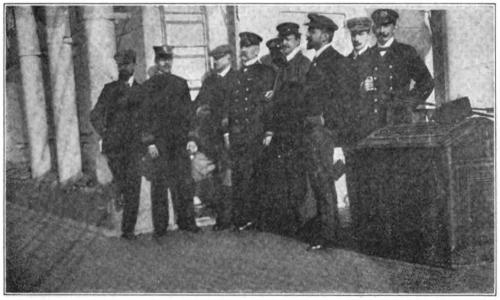
Officers and Passengers Aboard the “Bayern.”
Directly on coming on board I conferred with Mr. Anniser, the agent, and Captain Max Mitzlaff, commanding the Bayern, coming to the necessary understanding as to the control and management of the vessel and work of various kinds. Captain Mitzlaff promptly grasped the situation, and from the first moment did all in his power to forward the work of the expedition. He never made an objection; often suggested improvements that I was glad to adopt; and what was most important of all, he communicated his own zeal and interest throughout his entire ship’s company. Our relations throughout were most cordial, and I feel that we were most fortunate in having Captain Mitzlaff in command of the ship.
All guests were started ashore at 2.30 P. M., and loading was completed at 4. The captain of the port very kindly procured for us three small boats against the need of landing on an open beach, for which the ship’s boats were less suitable, and at 4.07 the Bayern sailed.
PERSONNEL OF THE EXPEDITION.
Representatives of the American Committee on board—Mr. Griscom, American Ambassador and chairman of the Committee; Lieutenant-Commander Belknap, U. S. Navy, Naval Attachè at Rome; Mr. William Hooper, of Boston; Mr. H. Nelson Gay, of Boston and Rome.
Executive Organization on board—Lieutenant-Commander Belknap, in charge of the expedition; Mr. Gay, in general charge of arrangement and distribution of supplies; Mr. Hooper, recorder, treasurer of the expedition and in charge of the afterholds.
Assistants—Mr. Weston R. Flint, cashier, and in charge of the forwardhold; Mr. Wilfred Thompson, supplies accounts and records of deliveries; Mr. John Elliott, interpreter, assistant in afterholds and elsewhere; Mr. Robert Hale, assistant in forwardhold; Avvocato Girodana, interpreter, clerical work and translation, assistant with handling supplies, aide to Lieutenant-Commander Belknap.
Medical Department—Dr. Cesare Scelba, Chief Medical Officer, in general charge; Dr. Guido Egidi, Dr. Paolo Alessandrini; Miss Mary H. Lawrence, head nurse; Miss Amy Claxton, second nurse; Miss Helen M. Moir, Miss Frances E. Nelson, Miss Emily A. Tory, Miss Mable W. Shingleton, duty nurses; Emma Niccolucci, head of Italian women nurses; women nurses, Schiarmi, Negri, Consolati, Manganelli, Antinori; Lanzi, head of Italian men nurses; men nurses, Neuci, Perfetti, Tondinelli, Guardabassi, Cascapera.
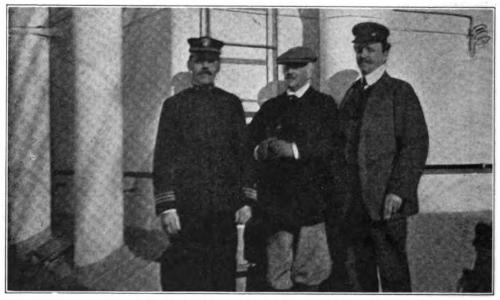
The Committee of the “Bayern.” Comdr. Belknap and Messrs. Hooper (of Boston) and Gay (of Boston and Rome).
Additional, not permanently with the expedition—Mr. Earle Dodge, Jr., embarked at Civita Vecchia and worked industriously in the forehold for the two days that he was on board. Mr. W. Bayard Cutting, Jr., American Vice-Consul at Milan, on special duty in Sicily, came on board at Messina, and continued from that time in close co-operation with the Committee to the great advantage of the prosecution of the work of the expedition. Mr. Winthrop Chanler came on board at Messina and remained until the second day at Catania, rendering very useful service for which his experience and knowledge of general and immediate conditions in the locality were valuable.
A few general orders were given, cautioning against the use of matches and smoking below decks; to report when orders had been compiled with; to apply for assistance from the ship only to the first officer or Lieutenant-Commander Belknap and the like. Simple arrangements were drawn up and posted also for stations for “Fire and Abandon Ship.”
Immediately on getting under way to Civita Vecchia, the work of arranging our supplies began, so that we might know what, how much, and where to lay our hands on everything. Fortunately, good weather favored us; the work continued in the forehold until 10 P. M. on Thursday, and went on all over the ship next day, so that by 4 P. M., when Messina was sighted, we were in all respects ready.
Only a few hours from Civita Vecchia we narrowly missed a serious handicap, Mr. Gay having a bad fall in the hold, breaking a rib. The loss of one who combined the best knowledge of what was included in our outfit, with tireless energy in getting it systematized, would have imposed a delay very unpleasant to contemplate, but, happily, Mr. Gay was the only sufferer by this accident, as he kept at work the same as before.
RELIEF FACILITIES.
Summarizing, the Bayern’s relief facilities were:
1. Immediately available for sick or wounded, 105 berths; additional berthing space available under proper shelter, 55 berths—total accommodations suitable for sick with comfort, 160 berths.
2. Supplies, in considerable quantity, of clothing of all kinds, shoes, blankets, sheeting, provisions, cooking and table utensils, picks, shovels, tools, oil stoves and fuel, lanterns, candles, matches, cordage, tenting canvas, chocolate, tobacco, and many other miscellaneous articles.
3. Money for relief distribution, amounting to 150,000 lire.
4. Accommodation for 1,000 steerage passengers.
MESSINA.
Sailing from Civita Vecchia at 4.07 P. M. Thursday, the Bayern arrived at Messina at 5 P. M. Friday, flying the American Ensign at the fore, the Red Cross on the triatic stay between foremast and funnel, and the German merchant flag aft. As we stood in, international signal was made “Have on board American Ambassador.”
The ship was boarded by an officer from the captain of the port’s office, to whom was given a detailed statement of supplies available.
About 9 P. M. General Mazza, in chief command of the military forces in the Straits, having returned to his headquarters on board the steamer Duca Di Genova, the American Ambassador, accompanied by Vice-Consul Lupton; Lieutenant-Commander Belknap, U. S. N.; Major Landis, U. S. N., and Mr. Elliott, as interpreter, visited the General, explaining the nature of the expedition, its approval by the King of Italy and the readiness of everything on board for disposal as General Mazza might direct. General Mazza expressed his warm appreciation of the offer and the spirit that had prompted it, and recommended that the ship proceed to Catania and Palermo, possibly also to Syracuse as these places had received many sick, wounded, and refugees, but so far no help in proportion to their needs. At Messina the situation was well in hand, and supplies were already available, sufficient for all requirements.
The next day, Saturday, the Ambassador and others of the expedition visited Messina, and during the course of the day landed several boatloads of supplies for the American Consulate’s distribution there. The sum of 1,000 lire was also given to the archbishop.
At nine o’clock the U. S. S. Connecticut, flagship of Rear-Admiral C. S. Sperry, U. S. Navy, Commander-in-Chief of the U. S. Atlantic Fleet, came in and anchored. After a conference between the Ambassador and Admiral Sperry, it was decided that the Bayern and the Culgoa should co-operate in relief work along the coast. The Ambassador, accompanied by Mr. Dodge, then quitted the Bayern, embarked in the Connecticut, and sailed in her at 5 P. M. for Naples.
Mr. Cutting and Mr. Chanler here joined the Bayern.
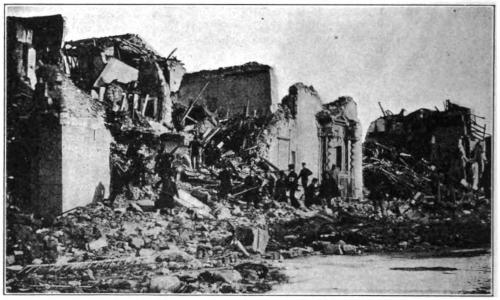
Digging in Ruins for Bodies at Messina.
(Photo by S. H. Chapman.)
About the time of the Connecticut’s sailing, staff officers from General Mazza and Rear-Admiral Viale, Senior Italian Naval Officer present, called on board the Yankton and Culgoa to state that supplies would be welcome at Reggio as well as at Catania. Lieutenant-Commander Patton and I, therefore, arranged to proceed to Reggio together next morning; and for easier communication between us, he lent the Bayern a signalman and two wireless operators from the Culgoa, who rigged up a small improvised wireless set over night.
REGGIO.
Sunday morning we left Messina about seven o’clock, reaching Reggio di Calabria about 8.30. We were unable to see General Mazzitelli, as he was ill, but Captain Cagni, commanding the Napoli, Senior Italian Naval Officer present, received us in his stead. He showed much satisfaction in having our supplies to draw upon, especially for women’s and children’s clothing, shoes, oil stoves, tent canvas, cooking and table utensils, tools and nails. About four-fifth of the Napoli’s crew had been sent away on relieving expeditions among the outlying small villages, and our supplies were in good time for use in a second expedition which was being prepared.
There were no sick or wounded needing to be cared for on board, nor any refugees to be sent; but we were cordially thanked for our offer of these facilities, as well as for our supplies. The latter made about 25 tons, in four boatloads, which we were able to transfer that afternoon. The Bayern then returned to anchor over night at Messina, there being no good berth at Reggio; the Culgoa remained off Reggio to deliver provisions next day.
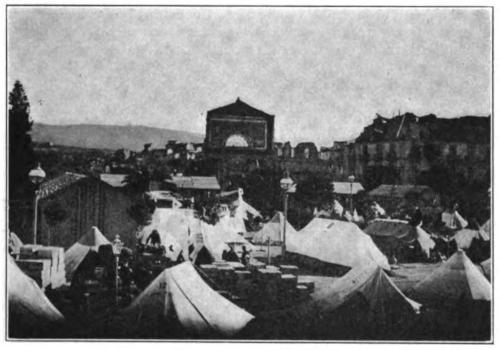
Red Cross Camp at Reggio.
(Photo by S. H. Chapman.)
CATANIA.
Monday at 6 P. M. we left Messina for Catania, arriving at 10.30 A. M. We were immediately boarded by an officer from the battleship Garibaldi, with the compliments of Rear-Admiral Gagliardi, commanding the second division of the Naval Force of the Mediterranean. The Admiral offered us any assistance we might need; and when I made an official visit to him that afternoon he inquired with much interest about all that could be learned of the situation at Messina and Reggio, and about the expedition. He very kindly made it well understood that we had only to ask to obtain any assistance at his disposal—an offer that I was glad to avail of, for men to assist with handling supplies, transmission of telegrams by wireless, and service of boats. The Admiral returned the visit next day, inspected the ship with evident interest, and expressed his approval of her organization and arrangements, especially in the medical department.
As soon as the Bayern was moored inside the mole of Catania harbor, Lieutenant-Commander Belknap, accompanied by Vice-Consul Cutting, Dr. Scelba and Avvocato Giordana, called upon the Prefect Commendatore P. Ferri and the Sindaco, Signor S. Consoli, placing the ship and her equipment entirely at their disposal. We were welcomed and thanked with the greatest cordiality, and in the afternoon, when the Sindaco, with Madame Ferri, Baronessa Zapalla, and a number of other ladies and gentlemen prominent in relief work came on board, he made a speech of thanks, and presented the following letter:
Catania, January 11, 1909.
Commune di Catania:
With pleasure I express to you, gentlemen, and to all the expedition of the American Red Cross, embarked on board the S. S. Bayern, the heartiest thanks of the population of Catania and of the refugees and wounded who have found here a shelter, for your generous offer of medicines, clothes, food, etc.
The relief brought by you will be effective to lessen the sufferings of so many wretched people, who have been deprived in a few moments of their relatives, of their beloved native town, and of every possession.
With esteemed consideration,
The Mayor, S. CONSOLI.
To Signor Reginald Rowan Belknap, Lieutenant-Commander, Naval Attachè to the Embassy of the United States of America in Rome.
To this the following reply was sent, both letters being published in the local papers:
Expedition of the American Red Cross, Steamship Bayern, Catania, January 12, 1909.
To the Mayor of Catania:
In response to your gracious letter conveying the thanks of the citizens of Catania for our offer of assistance, I have the honor, in the name of His Excellency the American Ambassador, and also of the American Red Cross, to express to you the sincere friendship and heartfelt sympathy which all our countrymen feel for this beautiful land and its people, especially in this time of sorrow.
To have relieved in some small measure the distressing needs of those we love is a cherished privilege, and the gratitude which you have sent to the United States will carry there widespread thankfulness.
With distinguished consideration,
R. R. BELKNAP.
Lieutenant-Commander, Naval Attachè to the American Embassy, Rome, in charge of the American Red Cross Expedition.
The party which came on board that afternoon inspected the ship and were much pleased with the comfortable, spacious arrangements for the sick, and our outfit and arrangement of supplies. Some light refreshments were served on deck, causing one of the ladies to remark that they were enjoying this visit very much, their first respite since the earthquake.
The Prefect was unable to come on board the day of our arrival, but he did come Tuesday morning. I took this occasion to inquire particularly about our taking refugees, to which he replied in the negative, saying that the refugees did not wish to leave Sicily, as a rule, and that the authorities and people at large did not wish to have them go. Accordingly it was definitely determined that we should take none; and the order was shortly given to knock down the steerage bunks, and add the lumber to that which we were going to land at Reggio.
We discharged at Catania the greater part of our cargo, finding that large quantities of our supplies would be put to immediate use. Medical supplies, moderate amounts of clothing, milk and provisions were given direct to the three hospitals, but the bulk of what was landed was turned over to the Ladies’ Committee, in charge of clothing distribution, and provisions, medical and miscellaneous supplies to the Municipal Committee, as requested by the authorities. Then, as it was believed that a small amount of ready money could be more conveniently applied by the authorities concerned than by anyone else, Mr. Hooper, the treasurer, delivered 1,000 lire to each of the hospitals; 5,000 to Madame Ferri for application to individual cases needing relief other than an immediate supply of clothing and food, and 25,000 to the Prefect for disposition at the discretion of the committees having the relief work in hand.
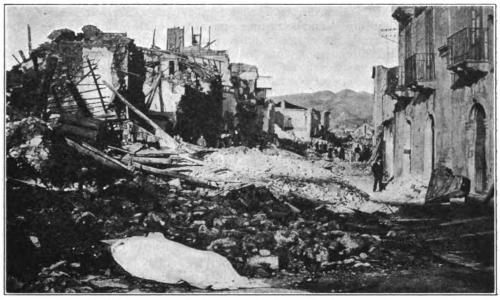
A Ruined Street in Reggio.
(Photo by S. H. Chapman.)
Tuesday morning a committee, consisting of Miss Mabel Hill, Fraulein Gasser, Mr. Charles King Wood and Mr. Harry Bowdoin, came on board from Giardini and Taormina with a letter from the Mayor of Giardini. Upon their representation of conditions in their district, work already done and still in hand, and cases of need still unrelieved, about twenty tons of clothing, shoes, blankets, provisions, medical dressings and miscellaneous articles were given into their care for shipment by rail, and 10,000 lire to be spent at the discretion of this committee in their work at these two places. We also sent, with this shipment, all clean bed linen remaining on board, since it was now evident that our reserve for patients would not be required.
The services of a nurse were also wanted at Taormina and Giardini, and Miss Claxton was sent with this party on their return there, with the understanding that the American Red Cross Committee would be responsible for Miss Claxton’s expenses and her return to Rome. A letter has since been received from Miss Claxton, saying that she is engaged as a district or visiting nurse, and that all the supplies sent have proved very useful.
A further sum of 10,000 lire was entrusted to Messrs. Kin and Bowdoin, both of them members of the American Red Cross, who undertook to arrange for the expenditure of this money for the relief of the small villages outside of Giardini and Taormina, between there and Messina, and to account for it to the American Red Cross through the American Ambassador.
In response to an appeal from Acireale, Mr. Gay made a personal visit among the relief workers there, after which some clothing and other supplies and 5,000 lire were delivered to them. To the Little Sisters of the Poor 1,000 lire were given for their immediate assistance. A few bundles of clothing were sent by rail to Messina, in care of Mr. Chanler, in response to a wireless message from the U. S. S. Yankton. There were several other cases acted on at Catania, as shown more in detail in the secretary’s report.
While lying at Catania, knowing that lumber was needed at Reggio, Mr. Flint was sent ashore on Wednesday morning to buy such quantity as we could get on board that day. Lighterage facilities were very scarce, as many steamers were in the harbor discharging; but by the persistent efforts of the German Vice-Consul, Mr. Jacob Peratoner, who very kindly devoted almost his entire day in our behalf, we succeeded in getting on board enough lumber to build 25 houses, 13 × 13 feet, complete with floors.
On Wednesday afternoon Madame Ferri, escorted by Marchese di San Juliano in his automobile, took Lieutenant-Commander Belknap, Dr. Scelba, Avvocato Giordana and Mr. Elliott on a tour of the hospitals and some of the refuges, in one of which alone 780 were then quartered. By this date, of course, sixteen days after the earthquake, all was in good order and organization as far as circumstances and available means would permit; to see so much suffering and misery, among people of all conditions of life formerly, was extremely affecting; but also it was impressive to note how much had been done for their needs and comfort, and particularly to mark the affectionate gratitude which these poor refugees demonstrated for their benefactress, who seemed to have become familiar with the details of nearly every case.
The Prefect and Admiral Gagliardi, after we had sailed the next morning, united in sending us a farewell message by wireless, as follows:
Signor Reginald Rowan Belknap, On board Bayern, Reggio, Calabria.
With our hearts still vibrating with gratitude and admiration for the work of fraternal solidarity and beneficience accomplished by you, Mr. Commandant, together with your representatives of the American Red Cross, we again repeat to you all, in the name of the Province and the King’s Government, our heartfelt thanks. To all the gentlemen on board the Bayern we send good wishes and greetings.
PREFECT FERRI GAGLIARDI.
To this the following reply was sent by telegraph to Prefect Ferri, and by letter to Admiral Gagliardi:
To Commendatore Ferri, Prefect of Catania, and Rear Admiral Gagliardi, Commanding the Second Division of the Naval Force of the Mediterranean:
Your message sent me at Reggio by wireless telegraph has been received, and I will have the honor to deliver it to His Excellency the American Ambassador at Rome, for communication to the United States Government and to the Red Cross of America.
The warmth of your appreciation of our efforts makes a deep impression in our hearts. To be so cordially associated with the noble work of the King’s Government and the devoted people of the Province of Catania is an honor that will always be remembered with pride and affection.
With distinguished consideration,
R. R. BELKNAP,
Lieutenant-Commander U. S. Navy, Naval Attachè at the American Embassy, Rome, in charge of the American Red Cross Expedition.
Although no refugees were to be sent by us, we were asked, and properly authorized by the Prefect, to take twenty-four orphan children, under charge of a carabinieri, to Genoa for delivery there to representatives of the Provincial Committee of the Province of Como, where we understood the children were to be placed in families. The Little Sisters of the Poor also were glad to avail themselves of the opportunity for transportation of six of their number, who had been hurt in the earthquake or were completely worn out with their subsequent efforts, and eleven old men and one old woman in their charge, all bound for Rome or Naples. There was, besides, an Italian woman with three children, wife of a naturalized American citizen in the United States, who was to be taken to Genoa. All these were on board by the time our dinner was over, so that we could have the pleasure of showing our departing guests the children, all bathed and put into fresh beds, still wide awake, bright-eyed and happy in the novelty of their surroundings. I am glad to say that the children continue happy, as also the old people, throughout the voyage. They were fitted out with additional clothing purchased at Palermo, and on arrival of the steamer at Genoa they were safely delivered to the proper authorities.
After spending the first day in Catania, Mr. Cutting went by rail to Syracuse, being requested by the Committee to look into conditions there, inform us as to needs, and offer our facilities to the authorities. During the succeeding day, however, the many demands made upon us at Catania and from the surrounding country compelled us to abandon the idea of going to Syracuse, as the amount of supplies remaining to be disposed of would be too small to warrant the extra day’s steamer charges for such a detour. Mr. Cutting was informed of this change of plan by telephone, and tactfully explained it to the authorities of Syracuse; and upon his return on board the Bayern Wednesday evening the Committee allotted 35,000 lire to Syracuse, distributed according to Mr. Cutting’s recommendation.
Leaving Catania at 4 A. M. we arrived at Reggio about 8.30, finding the U. S. S. Culgoa there, just returned from a coastwise trip, relieving small villages. Lieutenant-Commander Patton and I again called together upon General Mazzitelli and Captain Cagni, who said they had use for lumber, women’s and children’s clothing, shoes and some provisions.
We lost a few hours off Reggio trying to find a suitable anchorage from which we could discharge our lumber by rafting it down to leeward into the small artificial harbor, there being no lighter available; but the Bayern was too long and too light, so we remained underway while discharging on this day. This delay did not make any ultimate delay of our movements, however. We discharged a boatload of supplies for the Culgoa to deliver at Messina, and two boatloads for Reggio, then ran over to Messina ourselves for the night, arriving about eight o’clock.
The battleship Illinois had arrived at Messina during the afternoon, Captain J. M. Bowyer, U. S. Navy, commanding. He kindly sent a steam launch alongside, and I went on board, with Mr. Cutting and Dr. Scelba. There we found Major Landis, our military attachè, who had a telegram from Mr. Bishop, the American Consul at Palermo, desiring that the Bayern visit that port. Captain Bowyer undertook to send a reply for us, that we would arrive probably Saturday morning.
We obtained all the available shoes from the Illinois, 201 pairs of substantial quality. At the same time a package of tetanus antitoxin, which had been brought down from Rome by Mr. Robert Winthrop, was delivered, and on the advice of Dr. Scelba was divided between Messina and Catania.
We also on this day returned to the Culgoa the three men lent to us, as we expected to part company indefinitely. These men had behaved with credit to themselves and their service were generally helpful, and had won the good will of everyone.
Friday morning we got underway at six o’clock and by 8.30 were fast to a buoy off Reggio and discharging cargo. Our best day’s work was done here—not in amount delivered, but in the steady industry of all employed. Four boats were filled with supplies and towed over to the depot steamer, and later, as no men might be available to discharge them before dark, a working party of men nurses and stewards was sent to discharge them. Meantime the lumber was got out, each slingful lashed both ends before lowering over the side; then six or eight such slingfuls were made up into a raft and towed by our steam launch to a point about one-third of a mile distant, to windward of the place on the beach where the lumber was wanted; then the tow was cast off and it drifted ashore. This was a slow process, as our steamer was small and unsuited to open water, but by steady work and no mishaps we finished and left for Messina, the ship herself towing the last raft of lumber.
PALERMO.
Arriving at Messina about 8.30, we found another telegram from the Consul at Palermo. After visiting the Illinois again, we sailed for Palermo at 10.30 P. M.
We arrived at Palermo about 9.30 Saturday morning. The captain of the port sent an officer on board the Bayern with the following message:
The captain of the port thanks Captain Belknap for the sentiments of brotherhood and humanity which have brought him here, to give aid to those who have just escaped from the disastrous earthquake.
The American Consul, Mr. Bishop, then took the Committee, Lieutenant-Commander Belknap, Mr. Hooper, Mr. Gay, Vice-Consul Cutting, Avvocato Giordana and Mr. Flint to call upon the Prefect, with whom we found the Commissario Regio. Our remaining resources were placed at the disposal of the authorities, who accepted them with warm thanks and appreciation of our coming to Palermo with assistance. From the prefectura we were then escorted to the municipal palace by the Commissario Regio, Commandatore Avvocato Gennaro Bladier, who conducted us to his reception-room, where the necessary arrangements were made for the transfer of our remaining supplies. He took steps to have our discharging expedited so that our intended sailing that evening might not be delayed.
We delivered at Palermo 1,200 mattresses and about 7,000 rations, leaving nothing remaining on board that could be disposed of; also 20,000 lire to the Municipal Committee and 10,000 for distribution by the American Consul.
In the afternoon, the Commissario Regio came on board, to return our visit and inspect our ship, bringing the following letter, to which I replied orally, stating that I would have the honor to bring it to the attention of the American Ambassador:
Cabinet of the Commissario Regio, City of Palermo, January 15, 1909.
In the name of the city of the Committee I have the honor to represent, I accomplish the duty, heartfelt, of expressing to you a great many thanks for your generous offer of 20,000 lire and of food and mattresses, made through you by the American Ambassador for the benefit of the unfortunate refugees.
Messina, Sicily and Italy, in this tragic hour of disaster, feel an infinite sense of emotion before the universal spectacle of nobility and human kindness, before the common impulse that moves, in aid of so many sufferers from the reckless violence of nature, the generous, munificent souls of the world.
I beg, therefore, to ask you to be the bearer of our intense feeling to the illustrious American Ambassador, and to the American citizens, to whose magnanimous work will always be united the undying gratitude of this people.
Please accept, Illustrious Sir, on this solemn occasion, the highest expression of my consideration.
The Royal Commissioner, BLADIER.
To Captain Reginald Rowan Belknap, Naval Attachè to the Embassy of the United States of America.
RETURN OF THE “BAYERN.”
With regret that we might not prolong our stay, we sailed as soon as the last slingful was over the side, at 7 P. M., arriving at Civita Vecchia at 4 P. M. the next day, Sunday, January 17, after an absence of just ten days.
At Civita Vecchia we received a hearty welcome from the Sub-Prefect; Sindaco, captain of the port: Mr. Page and Mr. Pasigli, of the Committee; Mr. and Mrs. Billings, of Massachusetts, and Mr. Anniser, the Lloyd agent. There was time enough to transfer our aged charges ashore comfortably, with the expedition and baggage, to take the six o’clock train for Rome.
Drs. Egidi and Alessandrini, two Italian women and two men nurses remained on board to care for the twenty-four orphans until they were given over into other hands. Everything of our cargo, and more besides, taken from the ship, had been distributed, as originally intended.
Written instructions were given Dr. Egidi, who was left in charge of our party remaining on board, covering the delivering of children and return of the doctors and nurses to Rome. Written instructions were also given to the captain of the Bayern to proceed to Genoa, and releasing the vessel there upon the delivery of the children into proper hands. Telegrams were sent to the American Consul-General and to the Quæstor at Genoa, informing of the coming of the ship with persons for them to receive. The American Ensign and the Red Cross were then hauled down, at 5.15 P. M., and I came ashore with the captain of the port.
The party were greeted at the landing by Mr. and Mrs. Griscom, accompanied by Mr. Dodge, while a large crowd of the people of Civita Vecchia were gathered outside the gates. Carriages were provided by the municipality to convey the party to the station, with free passage by rail to Rome, the Italian officials and people favoring us with every kind wish. The trip to Rome was without incident.
Tuesday afternoon, the 19th inst., Drs. Egidi and Alessandrini reported their return in person and their duty completed, bringing a receipt from the Quæstor in Genoa for the twenty-four orphans. This receipt was turned over by me to the secretary. Dr. Egidi also reported that the American Consul-General at Genoa had taken charge of the woman with three children, bound for America to join her husband. A letter concerning her case had been written the Consul-General by Mr. Cutting. The active work of the relief ship may therefore be regarded as completed.
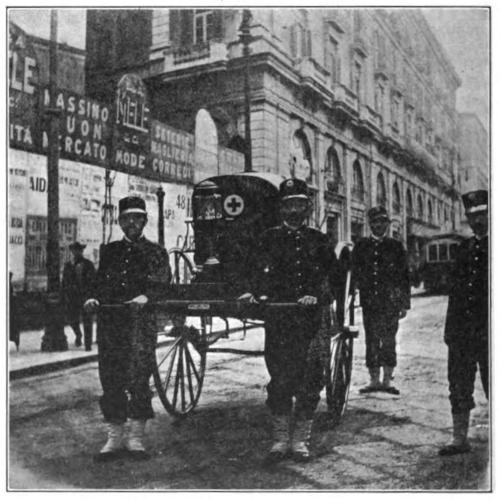
Ambulance of Italian Red Cross in Naples.
(Photo by S. H. Chapman.)
Before closing this report I take the opportunity as executive head of the expedition to express my appreciation of the admirable manner in which the members, individually and collectively, performed their duties. Perfect harmony prevailed throughout; there were no complaints, no questioning of orders, no difficulties of any kind. If fatigue was felt by anyone, it was not mentioned until after working hours.
DISTRIBUTION OF SUPPLIES AND MONEY BY “BAYERN.”
The American Red Cross Relief Ship Bayern, leaving Civita Vecchia on January 7 and returning to that port on the 17th, distributed 115,500 lire in cash, and supplies to the value of 230,000 lire.
DISTRIBUTION OF CASH.
30,000 lire to the Prefect of Catania (5,000 to be distributed at the discretion of Madame Ferri), 30,000 to the hospitals of Catania, 1,000 to the Little Sisters of the Poor of Catania, 35,000 to Syracuse, 5,000 to Acireale, 4,000 to Taormina, 6,000 to Giardini, 10,000 for distribution among small villages outside of Taormina du Giardini, towards Messina, 1,000 to Archbishop of Messina, 20,500 to Palermo.
KIND AND QUANTITY OF SUPPLIES.
2,000 metres tent canvas, 4,500 woolen blankets, 250 sheets, 1,400 metres of sheeting, 1,230 woolen shawls, 2,130 overcoats, ulsters and capes, 1,570 pairs of shoes, 2,100 suits of clothes for men and boys, 3,500 pairs of stockings, 350 skirts, 5,200 metres of dress goods and other cloth, 5,000 pieces of underwear, 700 shirts and blouses, 300 pairs pantaloons, 1,400 hats and caps, 5,000 kilograms flour, 20,000 galletti (hard biscuit), 8,000 kilograms potatoes, 6,800 kilograms macaroni, 3,180 tins of preserved meat, 60 cases of sterilized milk (50 quarts per case), 1,200 litres olive oil, 530 litres marsala, 210 litres cognac, etc., 1,350 kilograms cheese, 1,000 kilograms dried fish, 351 kilograms tobacco, 530 kilograms sausage, 1,225 kilograms of sardines, etc., 550 kilograms lard, 4,000 kilograms beans, 700 shovels, 700 picks, 300 galvanized iron buckets, 1,700 kilograms of rope, assorted size, 100 saws, 10 petroleum stoves, 50 cases petroleum, 1 ton candles, 2,000 cakes soap, cooking utensils, tableware, miscellaneous tools, matches in large quantities, 27 cases of medical supplies, 1,200 mattresses stripped from the bunks of the Bayern, 350 sheets and pillow cases, 230 coverlets.
At Catania lumber sufficient for the construction of 25 houses (13 × 13 feet, including flooring) was purchased, loaded on board the Bayern, and delivered to the Italian authorities at Reggio.
Lieutenant-Commander Belknap commends in the highest terms the work done by all the members of this Red Cross Relief Expedition, including Drs. Bastinelli, Scelba, Egidi and Alessandrini, the nurses, Avvocato Girodana, Messrs. Hooper, Gay, Cutting, Flint, Captain Mitzlaff, the other officers and the crew of the Bayern and Mr. Anniser, the North German Lloyd agent at Rome, for his personal assistance. The Navigazione Generale Italiana also rendered much assistance at Civita Vecchia. To all of these the American Red Cross extends its hearty thanks and appreciation of their valuable aid in this relief expedition.—Editor.