The South.
Reading edition
THE OPENING CHURCH MISSIONS.
BY SECRETARY F. P. WOODBURY.
The Eureka Church-Arbor, shown below, sheltered the opening service of the new plantation missions in Southern Georgia. The people came under the shadows of the piney woods from every quarter. The first mission church was organized under this rude booth. There the meetings continued until the cold and rainy months of winter. Now, by the help of a grant from the Church Building Society, a small church building will speedily become the home of a beneficent church and school work.
THE EUREKA CHURCH-ARBOR.
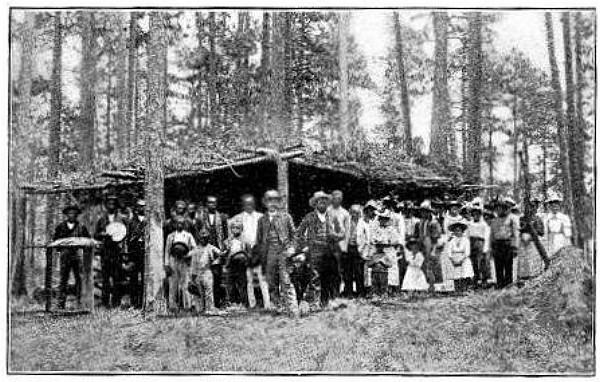
This church of the forest took its start from the earnest convictions of its pastor, Rev. J. B. Fletcher. After long study of the New Testament, with the help of few other books than his tattered Greek lexicon, he resigned his ecclesiastical connection because he had found, as he thought, the free church polity on Bible principles. His discovery was substantially the Congregational system. He called his first church "Eureka." It now has nine other churches associated in the same work. A mission preacher, a devoted man residing near, a man who is highly respected by all the people, has immediate charge of the Eureka work and holds the Sunday-school and other services.
A PASTOR'S HOME.
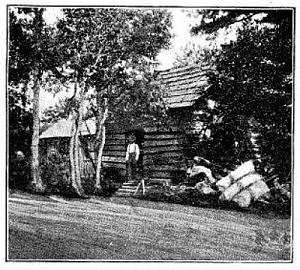
The abodes of many of the plantation preachers are as simple and humble as those of their people. We give an illustration of one of these homes. Usually there is a division into two or perhaps three rooms. Sometimes a small lean-to is built at the side or end, for use as kitchen. The chimney, erected on the outside, is often constructed of clay bound with sticks. It starts in a broad fireplace of stone, which warms the whole building. Some of these cabins have small glass windows; others of them have only openings for windows, with wooden shutters. In such dwellings there reside vast numbers of the plantation preachers, and some of our own mission preachers, at the early stages of mission work in the back country.
MARIETTA CHURCH AND PARSONAGE.
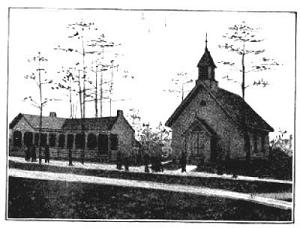
The picture given herewith of the church, parsonage, and school, in Marietta, Georgia, illustrates very many of the American Missionary Association church missions in the South. A neat church, a plain but comfortable house, with its adjoining school-room, are the type of the improving influences in both religious and educational service, which we seek to carry among these shadowed and suffering millions.
In both the Carolinas, as well as in Georgia, there is an awakening in the hearts of the colored people, both in the towns and in the country, for a better church life. This is inciting movements from the centralized forms of church government, with their arbitrary methods and hard taxation, into independency. Often the poverty of the people prevents their attaining anything beyond present and scanty shelter for their new free churches. The accompanying photograph is an illustration of such a chapel among the plantations of South Carolina.
A SOUTH CAROLINA CHURCH.
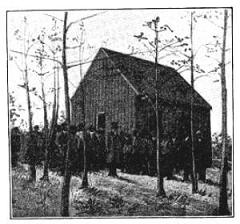
In very many parts of the plantation South, the very idea of a church free from outside control and allied to education and morality, is utterly unknown. Neither education nor morality form any constituent element of the common church life. Their introduction is looked upon with suspicion by the masses, and is met by hostility in every possible form of persecution by many of the old-time preachers and their personal adherents.
SCHOOL IN ANDERSONVILLE, GA
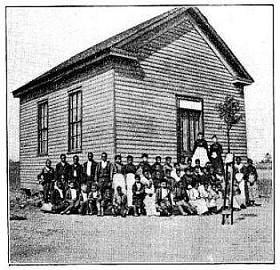
.
Nothing more contributes to the introduction of better forms of church life than do those mission schools which awaken the desire for something better in religion than the senseless and corrupt "old-time" ways. Such a school as that in Andersonville, Ga., is the initiative of a church mission. School education is of little advantage unless it is linked with moral training; and there is no moral training comparable with that of a pure and true Christian church. Our mission school teachers call for and need the re-enforcement of gospel preaching on the Lord's day, and the faithful work of a pastor during the week. A great deal of hard work in the school would be frittered away and lost without the distinctive church work which must supplement, and confirm it. To send the pupils back into the Egyptian darkness of most plantation and country churches is, for vast numbers, to throw away all that has been done for them. That they feel this is shown by the frequent and earnest appeals which come from them to have virtuous and educated ministers sent for the starting of better churches among their homes.
SCHOOL AT KING'S MOUNTAIN
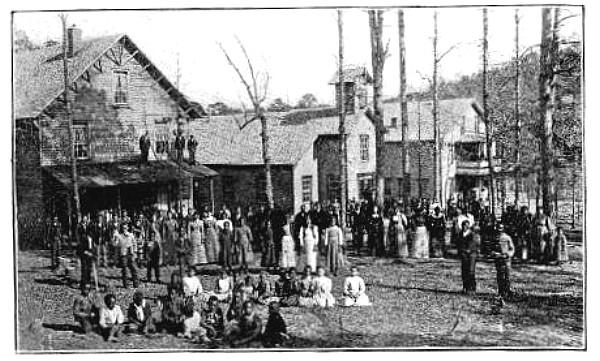
While this is the narrow and local influence of our smaller schools, it is also the broader and deeper influence of our larger schools, like that at All Healing, N. C. (King's Mountain P. O.) Here the religious life is intensified. A number of devoted teachers supplement each other's work. A unique Congregational church has been formed, its pastor being the principal of the school, who adds this work to all his other services. The influence of the constant religious work done in this church-school and school-church is felt a hundred miles around. Young men and young women go out with higher ideals, and they awaken a demand in their home neighborhoods for both religion and education of a higher character. It is not too much to say that such work as that of Miss Cathcart and her fellow teachers at King's Mountain tends toward a general advance of the communities from which her pupils come.
HAGAN COUNC'L.
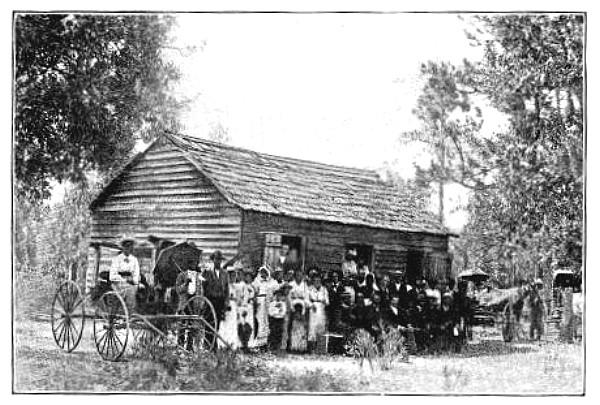
In Georgia, after the Eureka church movement was noised about, Mr. Fletcher received and now receives calls from every side, chiefly from the plantation people. At Piney Grove, a preaching station was begun in an old dwelling house, and a little church of twelve members is the result. At Shady Grove, ten miles away, a small church building is going up for the brotherhood there. The ground was given and the work of building is carried on by a respectable colored farmer of the neighborhood, who with many of his neighbors welcomes a church fellowship which stands for education and pure religion. At Alford, in the adjoining county, there is now a membership of thirty-two, for whose use a comfortable church building is furnished by the white people. This, with Nellwood as an out-station, will probably soon receive an excellent pastor, trained in our Congregational ways and principles. A beginning has been made at Portal, twelve miles beyond. In the next county westward, the church work began at Swainsboro with twenty-nine members, at Kemp with seventeen members, near Garfield with thirteen members, and at Pilgrim with twenty-three members.
Word comes to us that Mr. Fletcher, who is covering three counties in his work, has lost his faithful horse. This quite disables him from service. His fields lie at distances which make walking impossible, being from ten to fifty miles apart. The same day with this loss a member of the family, a young man, was brought home suffering from a broken leg. Are there not means which can reach us in the form of a special gift for the emergency of this faithful pioneer worker? Anything received beyond the immediate stress of need, will be placed to the support of his work.
The Hagan Council, called for the orderly recognition of these poor struggling pioneer churches, met in an old half-ruined school-house, as shown in the picture given herewith. It was a humble place, and they were humble bodies of poor people who thus asked recognition from the Congregational churches of the land. But it is not for us to despise the poor. Has not God chosen the poor of this world, rich in faith, and heirs of the kingdom? That little group in front of that poor old school-house may become historic as the precursor of a great movement of blessing to millions among the poorest of the poor in our nation.
GRACIOUS REVIVAL IN SELMA, ALA.
BY REV. A. T. BURNELL.
You will be interested to hear of the gracious revival we have had the past three weeks under the lead of the English Evangelist, Rev. James Wharton. Over 400 have professed Christ, and of these 140 were enrolled in Burrell School. To the very end of the meetings, "mourners" came forward, once in the church as many as fifty; but this was exceeded in immediate results at two schools where as many as fifty accepted Christ, after the briefest address. Following the Oberlin plan, I offered prayer with each class one day; the next, I suspended my recitations for a continuous prayer-meeting, permitting pupils to elect this instead of a class or study-period (certain grades, certain hours). At another time, instead of chapel the grade-teachers retained the Christians while the rest were addressed in the chapel,—the majority falling to their knees for prayer to rise in peace. Of course we have had regular prayer-meetings, with volunteer room gatherings at noon and like groups in the yards at intermission. When, on account of the late meetings each night, it seemed best to close at noon, most of the school gathered for a meeting in the chapel; and, with several after meetings, large numbers spent that half-holiday in the building, praying for and laboring with classmates. A member of Grade Eleven, for whom special effort had been made, came out at this time.
Some of the converts have made detailed confession of sins (stealing, e.g.); some who have been neglectful of school privileges have returned to get the religious impetus; and at least two that had been dismissed for meanness have experienced a change of heart. We shall look for permanent results, and work to that end with hope; yet this people are so emotional and so stolid! so ready to move along a certain line in a body, but indifferent to duty when it leads along an uninteresting path of individual effort. Indeed, the home life of many is unfavorable to genuine Christianity; some being persecuted, even, because they have not seen a vision, till they are made to believe they "have got nothing."
Mr. Wharton preaches the pure and simple gospel plainly and vividly; is attractive in person and of commanding presence. At his departure there were many expressions of regard and grateful remembrance, and he will always have a warm place in the affections of Selma people, who have been impressed in so short a time by the life and words of this man of God.
COTTON VALLEY, ALA.
BY A TEACHER.
I have been asked to tell something of the work and school in Cotton Valley. Hence I send a little description of it as it appears to a new teacher, just having entered the missionary field.
There are many features about the work here that make it a most interesting one. First, it is situated in a dense black belt, where the people are anxious to improve, and are appreciative of all that is done for them. Next, Cotton Valley is quiet and retired, being forty miles from Montgomery, nine from Union Springs, and thirteen from Tuskegee; so that, while we are enabled to teach without interruptions that break into school life in cities, we are yet not so far removed as to be incommoded when business necessitates our going to a city.
Doubtless Miss Lilla V. Davis, the pioneer, founder, and principal of our school is well known to most of the friends and helpers of the American Missionary Association, but, for the sake of those who are not so well informed, and because hers is a story worthy of being told anew, I will say a word of her whom all Cotton Valley delights to honor. She, ten years ago, left her home in Boston, Mass., and coming down here under the most adverse circumstances, and in the midst of the lowest humanity, established this school. Her teaching in those days was not so much from books, but she went into the homes of the people and made them feel that she was one of them. She talked and read to them, taught them the rules of decency and virtue, and that cleanliness is next to godliness. Thus, step by step has she been leading them on until now, instead of a valley of ignorance, it is "as a city set on a hill, whose light cannot be hid," for instead of a one-room-log-cabin we have a nice, comfortable school building, planned and furnished in modern style. I mean by this, that what we have is up-to-date and not that we have all we need, for our largest room, the one we call and use as our chapel, needs settees, blackboards, maps, and lights; and last but not least, we need a piano, as at present our only musical instrument is a baby organ, which is now so nearly worn out that many of the reeds instead of responding to the touch of the solicitous performer sit in silence, considering themselves too aged to jump up and down, and take part in such active service.
Our school this year is larger than ever, and our students, I think, would compare well with those of more favored schools in cities. The present enrollment is nearly two hundred, and when the weather is good, and all are in, we find the work rather heavy, as there are only three teachers, and we all believe in thorough work.
We have a large and interesting Sunday School to which the parents as well as the children come; also a Christian Endeavor Society, and a Circle of King's Daughters.
Perhaps it would be interesting to say, that the relation of the white people of the settlement to the school is most friendly. They respect Miss Davis to the highest degree, and are willing and glad to show any favors to her or her teachers.
Thus far, I have shown you only the favorable side of the picture, but I would beg my readers to remember that it has also a painful side. Those we are teaching are the children of ancestors who have lived for centuries in darkness and ignorance, with only eleven years of light; and there is still a great work to be done here. We find it necessary to instruct them, not only in books, but along the lines of all the virtues which go to make a man a man, and a woman a woman.
IMPARTIAL TESTIMONY.
BY REV. VINCENT MOSES, NEWBURY, MASS.
My wife and I recently spent about four weeks in New Orleans, La. While we were there, Straight University was constantly under our observation; and, without suggestion from any one, it comes to mind that testimony to the efficiency of American Missionary Association work in Straight would be welcome to you.
We not only attended more than once the general morning devotional exercises in the "Daniel Hand Preparatory School" and the "Central Building," but were also present during a recitation to nearly every teacher in the Preparatory, Grammar, Normal, College Preparatory, College and Theological Departments. The departments of music, woodworking, sewing and printing, and also the Boarding Department came under our observation.
The impression made upon us throughout was most favorable. The claims of the catalogue are fully sustained in every particular. We have been familiar with work in all these grades in the schools of several Northern States; but we have never seen more thorough work, never a school on the whole more satisfactory in deportment and scholarship. We cannot compare this with other American Missionary Association institutions. This is the only one we have visited. So we are glad to let this represent them all, and confess to a surprise in finding that we had never known better schools.
WHAT OUR GRADUATES ARE DOING.
FROM GRADUATES OF STRAIGHT UNIVERSITY, NEW ORLEANS.
I.
"I am principal of the public schools of Vicksburg, Miss. I have been teaching fourteen years, having had charge of my present work nine years. I have under my present charge eight hundred pupils, all the school can accommodate. Several hundred have been turned away."
II.
"Am editor of the Southwestern Christian Advocate, and practicing physician and minister. Have taught school in Alabama and Louisiana."
III.
"My present occupation is clerk in the War Department, Washington, D. C. I have taught three years in New Orleans. I graduated as doctor of medicine, April 13, from the medical department of Howard University."
IV.
"I am principal of the Harper Industrial Institute, Baton Rouge, La. Have taught almost continuously since graduating in 1879. For the American Missionary Association I entertain a feeling of the greatest possible gratitude. What little I am I owe to the training of dear old Straight."
V.
"I have been until last spring principal of the colored schools of Manhattan, Kansas, since 1885."
VI.
"The very name of the dear old institution is sweet to me, and while those who guarded the old mother in the memorable past have somewhat vanished, the purposes for which she was instituted are being vigorously pushed and great good accomplished. Many of her sons and daughters can be found throughout this Southland engaged in the various pursuits of life, doing a grand work for Christ and humanity. All honor to the American Missionary Association for this excellent school, and incessant praises to Him who guides and directs her efforts."
VII.
"I am instructor of ancient languages in Wiley University, Tex.; have been since 1887. I am a member of the Louisiana Conference."
VIII.
The following extract is of special importance as showing the breadth and completeness of the system of instruction of Straight University and the economy upon which it is based:
"I am always glad to do whatever lies in my power that will in any way be beneficial to Straight University, my alma mater. I am, as you know, a normal graduate of 1891. Though I had never before taken the first thought of learning anything about wood-working, I thought I would go into the shop the first day anyway; and I shall always be heartily thankful that I did so. From that day to the end of my course, without interruption to my studies, I worked in the carpenter shop, and acquired such a knowledge of carpentry that I am now able to support myself by following that trade. Still more, from the knowledge I gained of making pieces of furniture, such as center-tables, washstands, etc., I think I could be useful in the cabinet trade."
IX.
The following gives some idea of what the department in theology is doing:
"Having a desire to do something for Christ and humanity, I began the study of theology and other studies at Straight, that I might be thoroughly equipped, 'a workman that needeth not to be ashamed.' I was compelled to give up for two years, and it seemed to me that there was no use of my trying further, when just then through the dark cloud the sun shone again, and I hope now, if life lasts, to keep on till I finish the course. All that I am, or ever expect to be, is due to Straight University. May God bless her and the many friends who have made it possible for us to attend."
ALL HEALING, NORTH CAROLINA.
During the summer about forty of our pupils taught in the public schools; some had eighty or ninety scholars. In this way our school really influences many whom we cannot reach. It is so good to see the interest our young teachers take in their work and how, when they find a bright boy or girl, they always try the first thing to induce that one to come to school. Then, too, we see a growing desire among the scholars to come into school early in the fall, and we rejoice in a family of fifty-seven six weeks earlier than we had the same last year.
The richest blessing of the year has begun to fall upon us, the presence of the Holy Spirit leading souls to Christ. During this month five have felt that God had forgiven their sins. Is not that enough to compensate us for anything we may give up to engage in the work?
PLEASANT HILL, TENNESSEE.
A boy we could not receive, although we would have been glad to have done so, said he had worked all summer for his share of a crop which was about 100 bushels of corn. He would have about twenty bushels of the corn left after he had bought himself a few clothes, which he must have if he came to school, and he thought he ought to help his mother a little. It was his only chance to get what he so much desired. He realized that twenty bushels of corn, worth only about $5.00, was very little for him to do for himself. He would try to prove himself worthy of any help we could give him.
Still another boy writes: "It is not much I can do for myself, for I have not been able to find anything to do to get any money, although I have tried hard. But a friend has just given me a chance to assist him in his school for a couple of months. I don't know how much he will pay me, but you shall have every cent I do get. I do want to come into school, I need the education so much; I want to make a true man."