WHAT I FOUND IN THE CUMBERLAND MOUNTAINS.
Reading edition
BY REV. C.W. SHELTON.
First. There are living in this mountain country two millions of white people, until recently isolated from, and untouched by, the civilization of which we are so proud. No centennial anniversary commemorates their growth in wealth and intellect. As their fathers lived, so until recently, have they. One hundred years have witnessed but little progress, almost no change, in their condition. The open fire-place, the spinning-wheel and the home-spun jeans are familiar sights. Forgotten by the rest of the world, they, in turn, forget that beyond these mountain peaks, marking the limit of view and generally the limit of interest, a nation has pressed forward to take its place among the foremost of the earth. And yet no color line has excluded, no reservation boundary separated, this people from their fellow countrymen. Their lack of energy and the stagnation of their minds, is the explanation of this condition of things.
Secondly. I found this mountain people naturally American; in deepest sympathy with our free government; loyal to the old flag in the hour of its greatest danger; fighting, suffering, dying, that the Union might be preserved. To one who has spent any length of time on our western prairies settled so largely with an emigrant people, the great difference between the American born and educated people of the mountains, and the naturalized American of the prairie, constantly emphasizes itself. Here no new language has to be acquired, no new form of government understood. A common interest, a common sympathy, a mother country, binds one at once to this people as it never can to the American importation which is found at the West.
Thirdly. I found homes and a home life, or rather the want of it, which one would hardly believe possible among a white population in this country.
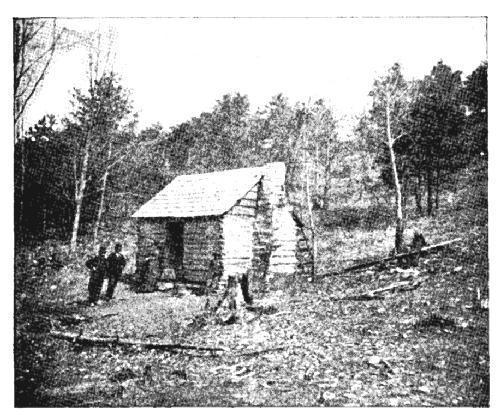
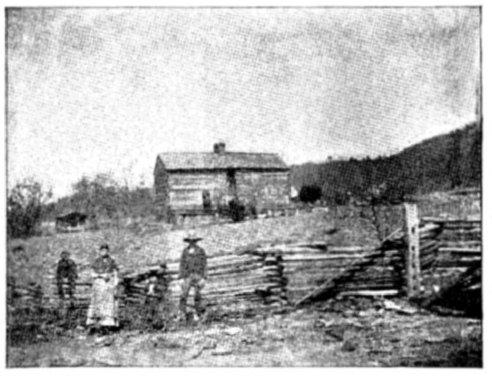
The following illustrations are correct representations of what I found to be average mountain cabins. Seldom do they contain more than two, often only one, room. A single window, an open fire-place, and a few home-made articles of furniture, comprise the whole. The home is begun when its founders are yet children. Ignorant and poor, the boy has "took up" with the girl, and it may be they are legally married. A building-bee is announced, a little cabin erected, a few pigs bought or given, a few trees girdled, some corn planted, in so crude and shiftless a way that even an Indian, in his first attempts at farming, would be ashamed to own it, and home life is begun. Into this home of poverty and ignorance come the children. The families are large—eight, ten, twelve, and sometimes more. The mother is too ignorant herself to instruct, and had she the ability, neither time nor strength to accomplish it are at her command. Life to her is a struggle. At twenty she looks thirty-five, at thirty-five she is old. Always she has a tired, hopeless expression, which simply to look at almost starts the tears. The children have something of the same expression; the babies even seem to realize that it is a sober, sad world they have come into. I do not remember seeing a laughing, cooing baby in all the cabins I visited.
MOUNTAIN CABIN.
MOUNTAIN CABIN.
Educationally, I found this people far below the emigrant on the prairie. Seventy per cent. of the whole two millions cannot read or write. The schools are the poorest. The school houses are built of logs; a hole is cut for the window; the ground serves for a floor, slabs for seats, and the teacher is strictly in keeping with all. Bare-footed, hair unkempt, snuff stick in her mouth, scarcely able to read herself, she is the example—the ideal toward which her pupils are to strive.
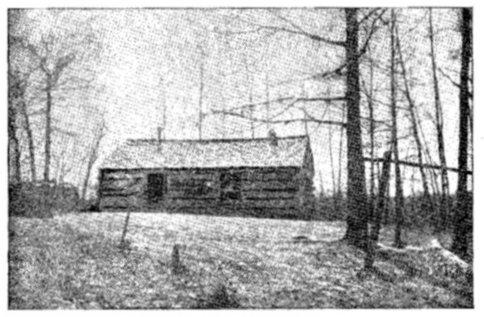
Religiously, I found that these people, almost without exception, were "professors," and "had jined" not a Christian church, but some one of these native mountain pastors. The accompanying illustration gives a good idea of the mountain church; it is built of logs, and is without windows; the pulpit is an unpainted board; the seats slabs from the nearest saw mill, turned flat side up, with pegs driven in for legs. The ministry is in strict keeping with the church, and intellectually little in advance of the people. They take pride in the fact that "These yer home-spun jeans have never brushed no dust from off no college walls," and exultantly declare that "The Lord taught me how to preach: and when the Lord teaches a man how to preach, you may just reckon he don't make no mistakes."
A NATIVE MOUNTAIN CHURCH.
On every hand, I found indications that the day of isolation for this people is rapidly passing away. Yankee inquisitiveness has discovered that these mountains are full of the best coal and iron—Northern capital has already begun to strip them of their rich forests of black walnut, oak and pine. The rivers are carrying these logs by the thousands to the immense mills, which in turn are making the large towns, toward which already the railroad is hastening.
Engineering skill is bridging streams, crossing valleys, climbing mountains or piercing them through. On every hand we see the change. From their long sleep of a century, these valleys, these homes, this whole people are awakening. A new life is beginning, a new future, opening.
And as a result of all this, I found a field of missionary work, which for opportunity and need has perhaps no equal in our country. Amidst all this change, a people, startled from their long separation, find themselves suddenly called to face, to compete with, to become a part of, our life, our intellectual advancement; to move with our energy, and work with our skill. Realizing their weakness, suddenly roused by their necessity, they are sending across their valleys and over their mountains the Macedonian cry, "Come over and help us!" Our duty to this people, whether we look at it from the standpoint of the Christian or the citizen, is beyond the measure of words.
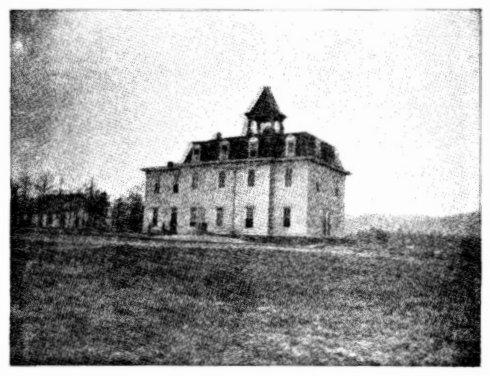
Here, as everywhere in the South, I found that the American Missionary Association, as representative of our Northern Christian sympathy, was at work. Its normal schools, fitting teachers to go out and displace the bare-footed, ignorant, snuff-stick-chewing school mistresses; its churches, fitting mothers and fathers to enter upon their duties conscious of their responsibility; and its missionaries, bringing in an intelligent Christian life, and driving the curse of the country— intemperance—out of the home, community and the county, are thus meeting the need, and answering the cry, and fulfilling the obligations. Below is a cut of one of the buildings of the Academy at Williamsburg, Ky., recently erected among these people.
WILLIAMSBURG ACADEMY, KY.
I found one worker where the field called for a dozen; one school where we should have twenty; one church where we should have a hundred; one scholar received into an over-crowded school house, when its doors should open to scores. I found one missionary with nine organized churches on his hands, and he the only pastor; the extremes of his parish being seventy-five miles apart.
And lastly, on returning to New York, I found an empty, a worse than empty, a debt-burdened treasury, forbidding all advancement in this field.