American Missionary Association.
Reading edition
The Annual Meeting of the American Missionary Association will convene in the Central Congregational Church, Brooklyn (Dr. Behrends’), Oct. 30. For further information, see 4th page cover.
We present to our readers in this number of the Missionary a résumé, or broadside, on the Color-line. The interest of the public on the question at issue is manifest from the constant series of articles on the subject in the religious papers.
As to caste prejudice itself, we hold and wish to propagate pronounced opinions. We believe it to be a sin and a curse; a hindrance to Christian missions abroad, and a root of bitterness that will trouble us in this country till it be eradicated. It is a stone of stumbling to whites and blacks in the South, and an element of discord in the nation. We, therefore, give these extracts with the hope that they may promote the discussion and aid in its final and right settlement. There are some good men and true who have written on this subject in a tone other than we would adopt, but we give extracts representing their views.
On the far less important question as to which missionary societies shall do the work among the whites and blacks in the South, we do not now express an opinion, and have no wish to influence the opinions of anybody, believing, as we do, that no difficulties on this score are likely to arise. On this point, therefore, our extracts are made with the utmost endeavor at impartiality, presenting them simply as showing fairly the drift of public sentiment on the subject.
Our receipts from collections and donations during the ten months closing July 31, 1882, were $188,677.02; the collections and donations for the same months this year have been $164,652.04, a decrease of $24,024.98. The legacies for these months last year were $74,152.29, while for this year they have been $64,594.65, a decrease of $9,557.64. The total receipts for these months last year in collections, donations and legacies were $262,829.31, while for this year they have amounted to only $229,246.69, a decrease of $33,582.62.
The John Brown Steamer, a drawing of which is given herewith, will be ready for use at the Mendi Mission during the next dry season, which commences about November 1.
THE NERVE OF MISSIONS.
The first effort on record, so far as we know, to cut the nerve of missions, was made by Satan himself in the Garden of Eden when he affirmed to our first parents, “Thou shalt not surely die.” The reason for missions comes out in the great truth of Scripture, that men are lost without the Gospel, and are saved only by the Gospel. The advocacy of any view that relieves the mind of a sense of the lost condition of unbelievers cuts at the nerve of missions. The purpose of God the Father in sending his Son was that “Whosoever believeth in him might not perish.” The fact that Christ came to seek and save the lost makes it clear that whatever serves to convince the world that men are not already, and will not continue eternally to be, lost without the obedience involved in the exercise of faith in Christ, runs counter to the whole drift of missionary endeavor. The gospel of repentance was foremost in the preaching of John the Baptist, of Christ and the Apostles—repentance because “He will thoroughly purge his floor and gather his wheat into the garner, but he will burn up the chaff with unquenchable fire.”
However much good may come from missions to civilization, howsoever much they may add to the comfort, the intelligence, the personal enjoyment of those who may receive the benefit of them, nevertheless the grand inspiring motive of missions is to save lost souls. Those in the closest sympathy with Christ, those who have consecrated themselves to work for him, feel this most deeply. There are many who appreciate the excellent example given us by our Saviour when on earth, many who are actuated by kindly impulses, who wish well for the happiness of their fellow men here and hereafter; but if these men fail to realize that Christ’s mission was to save the lost, and that the lost can be saved only through the preaching of His cross, they are not, as a rule, deeply interested in the work of promoting missionary efforts at home or abroad. They do not manifest in any good degree the actuating power of any nerve of missions. Help must come, progress must be made, indeed, the world must be brought to Christ, so far as we can see from history, or from observation in the present generation, by those who believe and are ready like Christ himself to do all in their power to bring a lost world into the fullness and blessedness of the Redeemer’s kingdom.
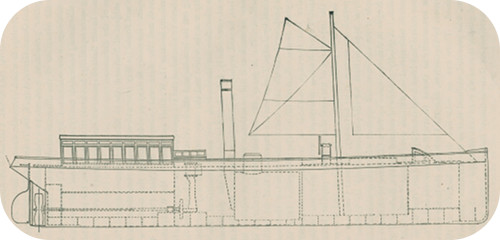
THE JOHN BROWN STEAMER.
SECOND NATIONAL EDUCATION ASSEMBLY.
This Assembly, to which reference was made in our July Missionary, was held at Ocean Grove, Aug. 9, 10, 11 and 12, for the purpose of bringing together prominent persons to awaken public sentiment in favor of aid for the education of the illiterate masses in our country.
The meetings were conducted by Rev. J. C. Hartzell, D.D., and the topics discussed embraced nearly every phase of educational work, relating more especially, however, to the negroes, the poor whites and the Indians. In our limited space, we can give simply two or three leading features of the discussion.
The subject of National Aid to Education deservedly received large attention and found its way into addresses other than those on that particular topic. Secretary Strieby presided during the session when it was considered, and the time was occupied by Prof. Painter, Hon. J. P. Wickersham, Senator H. W. Blair and others. Mr. Wickersham gave a comprehensive résumé of the aid provided by foreign nations for schools, pointing out its benefits and also its evils. He argued that, although it generally was the wisest and the only successful way for the people to provide education for themselves, yet under conditions like those in a portion of our country, help should be given by the government. True patriotism, he said, requires us to keep an army of schoolmasters in the South now as much as it did to maintain an army of soldiers to put down the rebellion. The urgency of national aid to education at once was emphasized by Judge Tourgee in the expression that ten million dollars for this purpose to-day would be worth more than ten thousand millions twenty years hence. Senator Blair, who recognizes fully the value of aggressive and thorough methods of reform, declared, and we think truly, that if every leading newspaper would give one strong editorial urging the importance of national aid, if every popular lecturer would devote one hour to public discussion of the subject, and if every minister would preach one sermon in its advocacy, the next Congress would pass a bill for an appropriation for the purpose among its earliest acts, and the people of the nation would applaud with hearty commendations.
The Negro in America came up for a full share of attention at a morning session. A goodly number of colored bishops, doctors of divinity and professors in educational institutions were present. Their zeal for bringing about reform had been heightened by the fact, that in so good and moral a community as Ocean Grove, they were requested to occupy a dining-room by themselves, near the kitchen, in the house where they were entertained. There was no color-line drawn, however, at the meeting. Dr. Rust, who presided, claimed that as the Africans came to this country as invited guests, that as we even sent our ships for them, they were entitled to more respect than ordinary foreigners. That respect was certainly accorded them on this occasion. Dr. Ward, of the Independent, led off with a clear-cut address on the Danger-Line in Negro Education, setting forth the folly of those who hold that education unfits men for useful labor. The gist of this topic he gave in a sentence: “We must educate or we perish.” Rev. J. C. Price (colored) of North Carolina, urged that the Negro must solve his problem by his own impressibility. So fitting and eloquent were his words, that when his limited time had expired, the audience, with prolonged applause, refused to allow the next speaker to be called, and it was only when the Chairman assured them that Mr. Price was but one colored orator among the many he had to bring forward and announced Bishop Campbell that the speakers were allowed to proceed. Dr. Tanner, also colored, read a paper on “The Color-Line,” taking the ground that in this country there must be no class distinction, but that we must be one people. A new code of ethics, he said, was proposed, a code not known in any other nation. It was that equals may associate with equals, if they are of the same color. The session, which had been participated in by two white speakers, was brought to a close by Bishop Campbell, whose good-natured appearance brought freshly to mind the anecdote that had just been told by Rev. J. W. Hamilton, of Boston, the pith of which was the reply of the black man, that if the negro had no soul, religion made his body feel mighty happy.
An evening was given for a public reception of missionaries, teachers and preachers who have labored in the South from the North since the war, about 150 of whom were present. Gen. John Eaton presided over the immense gathering assembled to welcome them. Pres. Braden, of Nashville, Tenn., Sup’t Salisbury, of the A. M. A., Gen. S. C. Armstrong, and others, made addresses.
All the meetings were full of interest, and the managers will publish a report of the proceedings in pamphlet form.
The little company which met in Albany Sept. 3, 1846, to found the American Missionary Association, is rapidly passing away. Another of those original founders, Hon. Freeman Walker, of North Brookfield, Mass., at the ripe age of seventy-nine entered into rest July 11, 1883. If less conspicuous than some others, he was not less clear in his convictions nor less staunch in his defense of the liberties and rights of his fellow men. He had large official trusts in town, and State and nation, extending over many years, and was always the incorruptible citizen, as he was the humble Christian.
He inherited all the mental keenness, as well as the moral toughness and tenacity of the Puritan ancestry, in the eighth generation of which he stood in regular descent. He had hardly reached his majority before he placed himself in the ranks of the few who then stood on the side of the slave. His heart and his hand, his purse and his home were at the service of the fugitive in the days of slavery, and since the emancipation as fully at the service of the freedmen.
The Association has had no firmer friend than Mr. Walker, and few, in the measure of their means, have more liberally contributed to its treasury. He belonged to a generation of heroes and martyrs—men of daring courage and of mighty faith. They were honored of God, and are now coming to receive the homage of mankind.
Sixty Years in the Harvest Field is the title of a biographical sketch of Havilah Mowry, Jr., published by A. S. Barnes & Co. The book contains 360 pages, and is valuable by way of suggestion as to how laymen may employ their leisure even in the humble walks of life in bringing sinners to Christ. Mr. Mowry, after working as a blacksmith for a series of years in Connecticut, entered upon service as city missionary at Brooklyn, N.Y., where he labored for many years with marked success. The book is worthy of a place in Sunday-school libraries, and fitted to promote evangelistic work.
A GIFT BY A BOHEMIAN BOY.
We publish below a letter from Dr. Alden, Secretary of the American Board, to District Secretary Woodworth, of Boston.
It is a touching fact that a boy in that far-off land should remember the black children of our own country. It shows how strangely the impulse of Christian sympathy strikes from land to land, and suggests the propriety of making this humble gift of the utmost value to him that gives and those who receive. We, therefore, propose, as a simple method of reaching that object, that any person or Sunday-school sending us $10 for the purpose shall receive one of these pieces of money. The donors to this object will receive the pieces in the order of application. If more gifts than the ten are forwarded, we will return them to the donors or appropriate them by permission to the colored children of the South.
“Rev. C. L. Woodworth, D.D.—My dear brother: I take great pleasure in committing to your trust the inclosed pieces of money, ten pieces in all, each of them the value of ten kreutzers, making 100 kreutzers in all, or probably about half a dollar of our currency. It is the gift of a boy in Prague, Austria, whose name is Bohumil Burda. The name ‘Bohumil’ is the same in signification as the ordinary name Theophilus, that is to say, ‘a friend of God.’ This boy placed the money in my hands when Dr. Clark and I were at Prague, saying that he wished it to be given to the ‘black children of America.’ I give you the exact coins which he had laid up after the self-sacrifices of several months, in his warm spirit of Christian benevolence, and I commit them to you as a sacred trust, assured that you will know how to multiply them, and how to use them in such a way as will be not only for the interest of the black children of America, but for the awakening of their interest in the needy and the promising children of Bohemia.
“With best wishes for the success of the Society which you now represent, I remain yours most fraternally,
“E. K. Alden, Sec. A. B. C. F. M.”
BENEFACTIONS.
Henry L. Kendall, of Providence, has bequeathed $1,500 to the Hampton Institute.
Dr. Eliphalet Clark has left a bequest of $50,000 to the Kent’s Hill Methodist Seminary in Maine.
An unknown contributor, of Massachusetts, has given $5,000 to Williams College to establish a physical gymnasium.
Charles L. Colby has given $1,000,000 to establish a new university in Wisconsin. It was his father, Gardner Colby, who endowed the college which bears his name in Waterville, Me.
The large liberality of Dr. Lucien C. Warner, of New York, will provide a building three stories high, and 150 feet by 120, for the Conservatory of Music at Oberlin. It is expected to cost from $30,000 to $50,000.
Mr. and Mrs. Mills have just added $20,000 to their gifts to Mills Seminary, Oakland, Cal., and fifteen acres of land. Another gift of $5,000 has also been received, and one of $2,000 from Mrs. Wm. E. Dodge.
The trustees of the estate of the late Frederick Marquand have given a subscription to the Elmira Female College of $25,000, on condition that an equal sum be raised by the friends of the college.
The Canadian government has appropriated $44,000 for the establishment of Indian schools in the Northwest. Two schools are to be built with this money—one Protestant and one Catholic.
Mr. Moody has recently received from a gentleman in Boston a gift of $50,000 for his school at Northfield, on condition that an additional $50,000 be raised. Several scholarships of $3,000 each have also been received lately.
The demand for a new building at the Tillotson Institute, Austin, Texas, of which mention was made in our December Missionary, is very urgent. Last year the number of students turned away for lack of room was greater than the number admitted. Twenty thousand dollars, in addition to the amount already pledged for the purpose, are needed at once.
GENERAL NOTES.
THE INDIANS.
—W. H. McKinney, a Choctaw from the Indian Territory, graduated this year from Roanoke College, receiving the degree of B.A.
—Thirty Nez Perces women, widows of the men who fled from Idaho in 1876, have been permitted to leave the Indian Territory and return to their old homes.
—The Department at Washington has entered into an agreement with the managers of the Lincoln Institute, Philadelphia, whereby that institution is to undertake the education of fifty Indian girls.
—Bishop Whipple, when on a recent visit to the Indian department of the missionary diocese, administered the communion to 247 Chippewa Indians. There are eight churches in the Chippewa mission. One just building will cost $10,000.
—Three hundred acres of land have been purchased, south of Lawrence, Kansas, for the site of an Indian Industrial School, located by the last session of Congress. Suitable buildings will be erected for the accommodation of 500 pupils. Ten thousand dollars have been raised for the object by private subscription, and it will probably be completed by November 1.
—Information is published in Nebraska to the effect that the tradition that Indians will not work is untrue. On the line of the Minneapolis & Omaha Railroad they hang around the section houses and insist on being hired whenever any extra work is to be done, and every regular gang has both Winnebagoes and Omahas in it. They make efficient laborers, often giving better satisfaction than foreigners in the employ of the company.
THE CHINESE.
—The revival power is being manifested to a greater extent in Japan than elsewhere.
—A union for Christian work among the Chinese of Brooklyn, N.Y., has been formed, with Andrew A. Smith, Secretary of the Park Commission, at its head. A reading-room and headquarters will be established at 991 and 993 Fulton street.
—There are now more than 300 Chinese Christians on the Hawaiian Islands, and stated religious services for them are maintained at four different points. One of these Celestials, a member and a deacon of the Church in Honolulu, has built a school-house in his native village in China, and now supports a Christian teacher there, thus showing the importance of evangelistic work among the Chinese of these Islands.
—European statisticians are gradually reducing their estimates of the population of China. It used to be put at over 400,000,000. Behm and Wagner reduce their estimate for China and Corea from 434,500,000 to 379,500,000. Peterson reduces his estimate by 75,000,000, making the present total 350,000,000. Dr. Happer, missionary, believes this can safely be reduced another 50,000,000. Mr. Hippisley, Acting Commissioner of Customs, thinks 250,000,000 more nearly correct than 350,000,000. The losses by the Taeping and Mohammedan rebellions, and by the famine and pestilence which swept the provinces of Chili, Shantung, Shansi, Shensi and Houan, are variously estimated at from 61,000,000 to 81,000,000.
AFRICA.
—King Mtesa, of Uganda, is dead. He welcomed and co-operated with Capt. Speke, the discoverer of Victoria Nyanza, and has played a prominent part in all the events that have occurred in his kingdom, whether they were in the interest of exploration or mission work.
—The German Reichstag is said to have voted 1,000,000 marks, about £50,000, for the expense of a German exploring expedition into Central Africa.
—Mr. H. M. Stanley is said to have used more than a million yards of Manchester goods in paying the workmen employed in constructing the road to Stanley Pool.
—Drs. Bachmann and Wilms, of Munster, set out in May for a journey of several years in Africa, especially in the Transvaal, which they contemplate exploring with reference to botany and zoölogy. They hope also to develop commercial relations between Southern Africa and Germany.
—Since the overthrow of Arabi Pasha, the missions of the United Presbyterians of America have been more prosperous than ever. Their work, which is largely among the Copts, is approved by the Coptic Bishop, and one of the young men recently licensed by the mission has been engaged to expound the Scriptures. So great was the interest in his first sermon that he was obliged to repeat it three times. Women disguised themselves in male attire in order to get into the streets to hear the preaching. An effort will be made to establish a regular national evangelical church in Egypt.
—From reliable statistics it appears that the progress of Islamism in Africa, during the last hundred years, has been appalling. At the Mohammedan Missionary University, at Cairo, in Egypt, there are at this day 10,000 students under training, ready to go to any part of the world to teach the doctrines of Islam. Missionaries meet these Moslem priests not in Turkey alone, which is the centre of their power, but also in Persia, India and China, and in the heart of Africa. Very few have been led to renounce their faith for Christianity. This is owing to the fear of persecution, for the Moslem holds that it is not only proper, but a duty to kill any one who abjures his faith in their prophet.
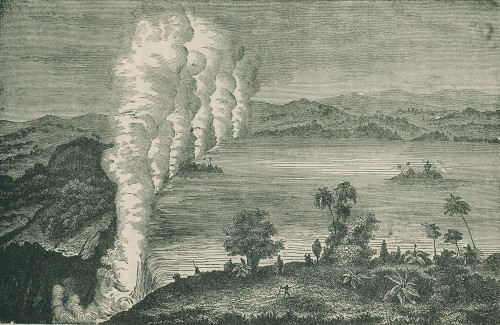
VICTORIA FALLS, ZAMBESE RIVER, AFRICA.