BUREAU OF WOMAN’S WORK.
Reading edition
TO THE LADIES OF THE CONGREGATIONAL CHURCHES.
Dear Friends: Permit me to call your attention to the urgent needs of the American Missionary Association in its department of Woman’s Work.
Many earnest Christian women are personally engaged as missionaries at the South, and among the Chinese and the Indians. They give instruction in home duties, improved housekeeping, family government, the best use of money; they gather children into Sunday-schools, teach in day and boarding-schools—bearing with them always the blessed Gospel truth, the foundation on which we build.
We need your aid in the support of these missionaries and missionary teachers, who will thus become your representatives in the field. Laboring with a lowly and despised people, they are cut off in many instances from social privileges, and your Christian love and remembrance will give strength and good cheer.
We need scholarships to aid worthy and needy students. Our boarding-schools are doing a great work for girls, and often a young girl is saved to a useful life by supplementing her meagre funds and retaining her in school. We need supplies of clothing for distribution by missionaries in getting the young into school and Sabbath-school; also furnishing of bed and table linen for mission homes and boarding halls. Already our matrons are asking supplies of this kind.
We are indebted to the ladies of many of the Congregational churches for valuable aid rendered, and now that the way is opened for more direct communication with you, may we not hope that all will become co-workers with our noble band of missionaries in seeking to instruct and benefit the women of races so ignorant and degraded as those with whom we labor?
We invite special correspondence in regard to the various fields and the aid that can be given. Surely so important a work, not limited to schools, but extending to the family and the church relations, cannot be accomplished until woman reaches forth her hand to sister woman in uplifting helpfulness.
Yours truly,
D. E. Emerson, Secretary.
MISSION HOMES.
MISS D. E. EMERSON.
“What is the Mission Home?” The question has often been asked by friends contributing to our work, as well as by those about to engage in it, and from the latter we have had some rather striking descriptions of what they supposed the home to be, and of their pleasant surprise upon reaching it. It is not a boarding hall for students, as many have thought. Such halls are in connection with boarding schools and accommodate both teachers and students.
The Mission Home, of which we give a specimen in the accompanying cut, is at stations where we have churches and day schools, and is the home of the pastor and teachers. In some of the larger cities, as Wilmington, N.C., Savannah, Ga., Mobile, Ala., we have graded schools requiring a teaching force of from six to ten persons. Then there are the pastor and family and the lady missionary, and the home accommodates all. As each has a special line of duty occupying the full time, a matron is appointed to take charge of household affairs and secure by her good management a pleasant and happy home for the family. Sometimes the wife of the pastor or principal acts as matron, sometimes the duties of matron and missionary are combined. It is no insignificant position to have charge of such a home, and our matrons are as truly missionaries as any in our field; besides the direct opportunities of usefulness among the people, they may add to the efficiency of every member of the family by the cheerful, genial, restful spirit of the home, which it is largely in their power to maintain.
This plan of Mission Homes has its advantages to the work. It gives opportunity to teach by example varied lessons in home life, of neatness, economy and thrift. The family altar is set up, and often some members of school or church join in the morning or evening song of praise. Social parlor-gatherings are had, when the people are cordially invited and are engaged in pleasant conversation and games, which, while interesting them, tend to their improvement. Here are often held the mothers meetings and the sewing class, and daily the people come singly or by twos or threes for special help and advice, knowing that they are welcome, and that they will find in some members of the family the wise counsellor and friend.
We can scarcely overestimate the educative influence of these Mission Homes upon the people. Even where there are but few workers employed, we cannot wisely dispense with them. Within a year we have built a small house in a country district where two ladies are employed as missionary teachers. It is plain, two stories, contains five rooms, is simply furnished, and cost about $900. There the ladies keep house, and they testify, as also do other missionaries from the city station near, that this little “Home” has already done more for the people as an “object lesson” in home life than all previous effort in that direction.
In other articles in this department, our friends will learn how they may share with us in this method of usefulness.
LETTER FROM MRS. CHASE, ATLANTA.
Mrs. Nelson has just called with her friend from the North, Mrs. Barker, who looked over school and domestic work very carefully, and then began plying me with questions, when Miss Stevenson, our missionary, dropped in. Mrs. Barker’s face lighted up as she exclaimed, “Now I have you both together, the teacher and the missionary, I want to know where you think a little money will do the most good?” Mrs. Nelson said: “Each one loves her own work too well to be a competent judge.” Miss Stevenson, you know, is one of our veterans, been in the field ever since the war. For years her mind and body were tied in the class-room six hours in the day, but her heart was in the cabins all the while; and as soon as she got relief from double duty, how she has put her whole soul into missionary work! With her pleading eyes upon me, how could I magnify my work above her’s?
A MISSION HOME.
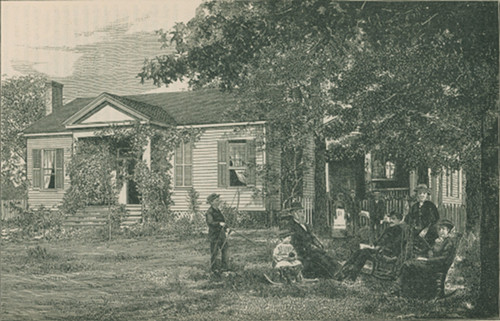
Since they left, I’ve been thinking that Mrs. Barker probably represents many women who wish their mites to go where they are most interested. Their hearts, like that of every true mother, yearn over these girls in their great peril, and these boys, driven from their wretched homes to the street for recreation. If missionary work, unlike the school, were without organization, systematic routine, or superintendence, it could not recommend itself to the cautious. But under the well-defined plan adopted of associating the missionary labor with the school and church, the best results are secured.
Much as I love the model school, I can but see that the model home is its only sure foundation. So the work is all one.
I only hope that the grandeur of “Work for Women in the Home” may be so felt that the noblest women will be drawn into the service, and develop such plans and mature such methods that the multitude of busy mothers and children, all over our land, can cast in their pennies and feel sure of a wise investment.
QUESTIONS AND ANSWERS.
H., N.Y.—What are the qualifications required of those who wish to become lady missionaries? Could one succeed with only a common-school education?
Sometimes a lady with only a common-school education does better than one more liberally educated. It depends upon the qualities of the woman, the executive ability, the tact, the practical good sense, and knowledge of human nature. Of course, all other things being equal, the more thorough the education the better the work.
B., N.Y.—What is the cost of supporting a lady missionary, and how many months during the year is it expedient for her to labor in the South?
It takes $450 to provide for a lady missionary for one year, including traveling expenses, board and a moderate salary. The time of service varies somewhat in different localities. At the extreme South she can wisely remain eight months of the year; further north, nine or ten. For other particulars we refer to the March number of the Missionary, which is devoted largely to woman’s work.
New York.—What assistance can sewing circles and ladies’ societies render during the summer months that would be most helpful and timely?
We shall need during the early autumn for replenishing our boarding departments and mission homes, quilts, sheets, pillow-cases, blankets, towels, table linen, table ware, and money for furnishing rooms in new buildings to be occupied by students. Help in either of these particulars will save so much for the support of the missionary work.
S., Ct.—What provision is made during vacation for young girls who have been taken from wretched homes into your institutions? Are they obliged to return to the temptations and want of their early associations? If not, what is the cost for their care during this time?
There is nothing more important for the well-being of many colored girls than suitable watch and care during their summer vacations. We have been unable to do much in this direction. A few have been kept in the different boarding institutions, where the buildings have been open. These have been given work whenever opportunity offered. Thirty or thirty-five dollars would provide for a girl in addition to what she could earn. We would be glad to correspond with any who are disposed to assist in this way.
R., Mass.—Our children have been accustomed to contribute to the Dakota schools through the Woman’s Board of Foreign Missions. Does the A. M. A. wish us to continue our interest in that particular work?
Certainly it does. We sincerely hope that all those who have been interested in the support of missions among the Indians will continue their efforts and forward their gifts to us. The April number of the American Missionary is devoted largely to the work the Association has accepted from the American Board, and is now carrying on. We shall need the cordial co-operation and support of all the friends of the Indians in order to conduct the enlarged work we have undertaken in their behalf.