THE SOUTH.
Reading edition
Rev. Joseph E. Roy, D.D., Field Superintendent.
Prof. Albert Salisbury, Superintendent of Education.
A REMARKABLE TRIBUTE.
HOW IT PAYS TO EDUCATE COLORED MINISTERS.
REV. W. W. PATTON, D.D., WASHINGTON.
Facts are worth more than abstract theories. Let the people have the facts. Howard University has for a number of years been carrying on a theological department, which has educated many colored ministers for all the evangelical denominations in this country, besides sending several missionaries to Africa. This department is mainly supported by the American Missionary Association, and its principal professorship has been partially endowed by Mrs. Stone. From this institution went forth a few years since, a young man (Rev. A. J. Henry) of unmixed African blood, who took as his field of labor a benighted county in Virginia. As the result of his patient, self-denying toil, several churches and schools have been established, and a new character has been given to the whole community. In proof of this, I am permitted to quote the following letter, voluntarily sent by the Prosecuting Attorney of the county to Mr. Henry:
“Amelia Court House, Va., Jan. 31, 1883.
Dear Sir: There has been such a marked improvement in the conduct, character, morals and intelligence of the colored population of this county, and crime has diminished to such an extent with the past several years, that it is natural that an observing man should at once consider the cause or reason for such a changed state of affairs. In doing so, I am at once constrained to believe and to attribute it to your untiring zeal in the laudable effort to do good to that race whose training has been so long neglected. Your boldness in condemning the wrong and asserting and approving the right, has not only impressed the colored people and influenced their conduct in the right direction, but it has at the same time won for you the confidence and esteem of all the thinking portion of the white race who are interested in good government, and a well-ordered and law-abiding community. It is not surprising to thinking men that an immense amount of crime should have been the result of liberating the vast number of colored people of the South, and throwing them suddenly upon their own resources, with their wants unprovided for and with no training, when it had not been their habit to think or provide for themselves. Consequently, the sad result was that crime was prevalent throughout this whole Southern country. It therefore became sensible men to undertake to provide a remedy; and the remedy is, to educate and Christianize the race; and I am glad—indeed, happy—to be able to say that you have contributed your full share toward bringing about that happy result, for which this community ought to be profoundly grateful.
“Now, for a moment, let us contrast the present state of things with the past, which is vivid in our recollection because of its sadness. I qualified as Prosecuting Attorney for this county at the April Term of the County Court 1870, and have held that office (with the exception of one term of four years) from that time to the present. It was no uncommon thing—indeed it was a common thing—to prosecute from two to four cases of felony at every term of the court, and I have prosecuted as many as seven felonies at one term of our Circuit Court, and the jail was full or crowded with those awaiting trial. But for the last four or five years crime has gradually diminished, until now it is a rare occurrence that we have a prisoner in jail awaiting trial or a felony to prosecute; and the jail is nearly all the time without an inmate. The present state of things is so different that it is a subject of remark. May He who directeth all things spare you long in the good work in which you have accomplished so much. Very respectfully and truly your friend,
T. K. Weisiger.”
This statement speaks loudly, not only as regards the particular case mentioned, but as regards the system which we are pursuing to elevate the colored people. Mr. Henry, during his studies in Howard University, was aided by funds contributed in Great Britain for the assistance of needy colored students, and it will be cheering to those benefactors to hear of the good which is being accomplished by this beneficiary. Will not other benefactors come to our help by furnishing other endowments and scholarships?
REVIVAL WORK AT FISK UNIVERSITY.
REV. H. S. BENNETT.
The religious history of Fisk University divides itself into two portions, that before New Year and after. Before the New Year, the week given to the Young Men’s Christian Association passed, and the work of holding nightly prayer meetings was taken in hand by the students. Several conversions resulted. After the new year had set in and I had returned from my Northern trip, I felt that the time had come for direct effort for the conversion of the students. I, therefore, directed my preaching to that end and held nightly meetings for inquirers. As a result two or three of the students were converted. At length, being convinced that I could do little more, I made no appointment for other meetings. At this point the young men in Livingstone Hall came forward and offered to carry on the meetings in their own way. I was glad to give them the opportunity to go forward. This they did, visiting from room to room and inviting the unconverted out. The result was that there was a large increase in the interest. The inquiry meetings were full, and from ten to fifteen were seeking Christ every night. This work went on for several weeks and resulted in the conversion of fifteen or more—twenty-two for the whole year. There is still some interest, although other things have interfered to divert the minds of the students from the direct effort for the salvation of souls.
EMERSON INSTITUTE.
BY MISS EMMA CAUGHEY, MOBILE, ALA.
The accompanying cut of Emerson Institute presents it in its new and enlarged proportions. Oct 3d, 1882, with much joy and thanksgiving, we dedicated its new walls, “Pro Christo et Humanitate.” It is a fine substantial building, well adapted to our school work. A basement play-room under the entire building furnishes protection to the children on rainy days. The first floor contains three pleasant school-rooms, four halls and a library. Four stair-ways lead to the play-room, and the same number lead up to the second floor, where are three more cheery, well ventilated school-rooms, separated from each other by uplifting sash doors, by which the entire upper story may be thrown into one large hall. Here we assemble for morning devotions, hold our public rhetoricals and evening socials. Contributions from friends at the North have enabled us to place a reading table in one corner of the normal room, furnished with the best weeklies and monthlies, a handsome clock and some tasteful mottoes on the wall, each of which we may hope is a little rill flowing into that stream of silent influences which serves not only to brighten the lives of the pupils but to help them to a nobler manhood and a purer womanhood. We have enrolled during the year three hundred and twenty-one different pupils under the care of six teachers. We have an industrial department connected with our school, in which sewing and fancy work are taught. We meet for two hours each Friday evening at the close of the regular session of school. This evening hour is a happy climax to the week for the girls, but is a great tension upon the nervous force of the teachers at the end of the week’s wear and tear. We close this department of our school with a fair, where the articles made by the girls are offered for sale, the proceeds of which are to be divided between foreign missions and our own worthy poor.
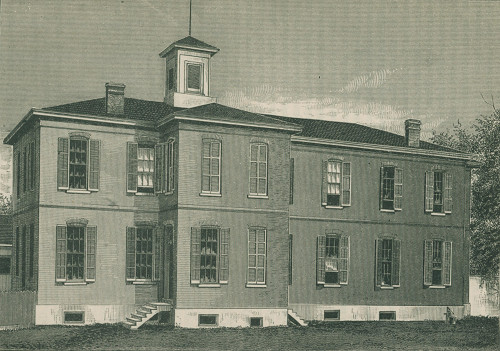
EMERSON INSTITUTE, MOBILE, ALA.
INDUSTRIAL WORK AT ATLANTA UNIVERSITY.
MR. H. M. SESSIONS.
Having been connected with this institution more than a year, we have learned from the boys in school from all parts of the South, as well as from our own observation in the State, of the limited scope of the agricultural products in this section. Most of the boys have been accustomed to farm work, and in answer to the question, “What kind of crops have you been used to raising?” they reply invariably, “corn and cotton.” It has been the custom of the planters here to use their means, men, teams and credit to raise cotton. While they are raising crops they run in debt for provisions, and at the end of the year frequently fail to realize enough from the crops to pay the bills. Some are learning the better way of raising a variety of crops for the family, and a few acres of cotton for a money crop. The great want of successful farming is fertilizers. The land is so impoverished that there is no use in trying to raise a crop without. With plenty of manure, we can secure as good crops as can be raised anywhere. Our tables were supplied last summer with a great variety of vegetables and our barns filled with fodder. Twelve acres only out of the sixty owned by the Institution have been under cultivation, our own table with 240 boarders making a market. The advantages of climate enable us to raise two or three crops a year on the same land. The soil is capable of producing any and every variety of crops that can be raised elsewhere in the United States.
Whatever possibilities may be attained in literary pursuits for generations to come, most of the manual labor at the South will be performed by the colored man. The great want at the present time is skilled laborers. The abundant resources are awaiting men as well as means for their development—men skilled in all the useful trades, educated in both muscle and brain, such as can plan as well as execute. There is a surplus of ignorant laborers South who cannot set themselves to work at anything but the most menial service. If the present generation can be instructed by skilled labor how to get a good living and earn money to educate their children, then the next generation can take a step higher. The opportunities offered the boys here to learn the useful arts will be enlarged. At the present time we are only developing the agricultural department in a small way for want of means. We are trying to utilize the labor of the boys for their advantage, as well as profit to the Institution. With a fair supply of mulberry trees, we propose to commence the culture of silk. This spring we have twenty-five boys competing for the premiums offered for the largest product of early garden vegetables grown on the square rod. The work is to be done during play hours and the crop harvested before the close of the term, the 15th of June. Monthly lectures on important farm topics are given to the students. We need an endowment of $30,000 for a school of agriculture, and the same amount for the mechanic arts.
AFRICA AT ATLANTA.
In a private letter Mrs. Chase writes about a young man from the west coast of Africa as follows: I must tell you about Philip. We had very interesting meetings last week. Thursday the topic was for the church. Philip who had not had courage to speak in meetings before this year, got up and said he was ashamed of having been so afraid of being laughed at by the boys; he expected in a few years to teach about Jesus in his own country—and it is your country, too. He then went on with his intense earnestness and broken English to tell of his home—how dear it was to him and how dear his people were—how sad it was that they did not know about Jesus, till I do not think there was a dry eye in the room. The meeting the next night was a larger one, as we have no study hours Friday night. We saw the effect of Philip’s thrilling words. More than one referred to them. A young woman who decided to be a missionary to Africa last year, said every word Philip spoke seemed meant for her. “To think that boy, who was a heathen such a little while ago, could justly say such things to us with our privileges, made me feel condemned. I want to preach the gospel to the heathen. I pray that I may be fitted for the blessed work. I don’t want money, I don’t want fame, but I do want such a spirit that it shall be my meat and drink to do my Father’s will.” Philip’s Bible, which he brought with him, is very fine print, and has no references. He wanted a new one, so as he had earned some money in summer, one of the teachers purchased him one. He is so pleased with it he takes it to bed with him. One day he asked his teacher if he could not buy some silk to cover it with. When she suggested covering it with paper, he did not like it at all. I am so glad he is with us, he is a great power.
ONE DAY.
BY MISS ADELE BREWER, RALEIGH, N.C.
Would you like to spend Sunday with us among the colored people at the South? The bell for Sunday School sounded at nine o’clock. At three, we answered the call for church. We saluted the sexton, a pretty girl, who was ringing the bell as we entered. The neat little church still had its Christmas trimmings. We were delighted with everything, the earnest minister, the good organ, the well-trained choir. Every word of the responsive reading was so clearly enunciated that it was a pleasure to listen. The pastor’s wife came in with her manly son and her wee baby. That smallest auditor behaved well. The missionary was there with the orphan she is training. Notices for the week were given out—Lyceum, Church prayer meeting, and the Women’s prayer meeting.
After the benediction, before we had hardly thought of turning in our places, we felt the pressure of a baby’s hand. Little Clara, aged five, had hastened to us. She had come to church alone. It was sweet to look at her and know what an angel of light she is. Her mother, though an invalid, takes in washing. She hires some one to carry the clothes. Clara wishes to grow. “Why?” “So I can tote de clothes.” In former days, long before she came to earth, her parents were prosperous. They bought land and built two houses, one for themselves and one to rent. Her father, still in the prime of life, is paralyzed and blind. Day after day he sits by the fire, unable to read, or work, or move. We have seen his blind, twitching face light tenderly at the touch of his only child. Clara led us along slowly, and we chatted with the missionary and her friends. One young lady has bought land, built a house for herself and furnished it well with carpet and organ. She is helping her sisters in their education. We met many whose friends were at school. We shook hands with the good deacons.
Some young girls were waiting at home for us. They wished to talk about “going North.” As soon as they had left, a friend sent by us an orange to Mrs. Knowles. In her one dark room, over a smoky fireplace, she was sitting, paralyzed, rheumatic and very “painy,” without kith or kin to help her, dependent on neighbors for food, wood and water; her lot did not seem an enviable one. “The children are mighty kind to me.” Boys come in and cut a stick of wood at a time. She cooks meal, her chief article of food, in three different ways, “so as to have a little variety, you know.” Often suffers for “suthing t’eat;” seldom knows whence the next dinner will come.
As we left the room we heard crying. Leaning by the fence, alone and screaming, was a little girl. “What is it?” “A boy threw a rock and hit me here,” showing her side. “Where is your home?” “Right over yonder.” “Shall I take you there?” “No; mother is not there.” It proved that her sister and friend were frolicking and helping (?) Mrs. Knowles. Her sister answered the appeal for help. “Hush, Queen; quit making such a fuss.” The friend explained: “She never did like to be hit by a rock, nohow.” We noticed the feet of the friend. A piece of leather tied around them, showing the bare toes. Many children can not go to Sunday-school because they have no shoes.
After tea we went to the S. S. Concert. In giving out the subject, the teacher said she did not want to call it a Lying Concert, though the verses were about lying, so she called it a Truth Concert. The room was full. Little Clara’s mother could not go, so the wee maiden invited a young lady to be her escort. The concert was excellent. The texts were well recited and the pastor’s remarks summed up the matter. At the close an appeal was made in behalf of a poor and sick scholar. A member of her class carried around the basket, and a dollar and seventy-nine cents was given in response. This little church takes up three collections a day, yet its members are very poor and the winter has been hard on all. One family stayed in bed till late in the afternoon to save wood to cook supper. A young man, sick with consumption, had nothing provided for him but bacon and cornmeal, which his delicate appetite loathed. It is hard to earn much, receiving thirty cents a week for a washing. We asked a widow if she was comfortable when her husband was alive. “Oh yes; I had plenty to eat, plenty to eat. He was cross sometimes, as men are, but I always had plenty to eat.” We lay down to rest that night with new feelings of gratitude and shame. “What shall we render unto the Lord for all His benefits?”
A JUBILATE.
(Composed for the Commencement Exercises of Tillotson Institute.)
BY MISS ANGIE FULLER.
A song, a song of joyous exultation, That where but late was darkness and despair, Harps upon the willows, hopeless lamentation, Sighing and moans, and foolish superstitions, The cringing fear and terror stricken wail, With all the miserable, the pitiful conditions Gross ignorance and bondage can entail, There now is light that promises to brighten, There now is thankful prayer and notes of praise, There now is hope, sweet hope, to cheer and lighten, A race oppressed and wronged in many ways; There now are minds aspiring and expanding And daily demonstrating they are strong, To answer to Progression’s stern demanding And take a place among the cultured throng. God-speed to those who lead this van of progress, Who work as pioneers in Wisdom’s fields; Proving to all the wondering, doubting people What grand results, fair mental culture yields. Still may they press undaunted onward, upward Greater achievements and successes win, While hopeful millions in their footsteps follow, And Heaven smiles approval most benign.
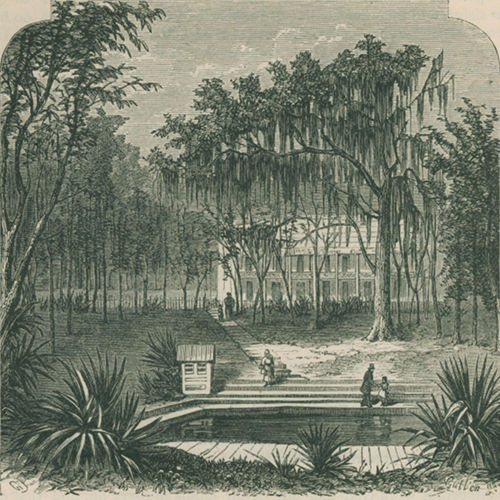
GREEN COVE SPRINGS, ST. JOHNS RIVER, FLA.
COLOR LINE IN FLORIDA.
BY REV. ALBERT P. MILLER.
While the “color-line” is being freely discussed in the leading Christian journals of the day, as to so-called “mixed churches,” the following incident may show to the Christian world the attitude taken by the African Methodist Episcopal Church—400,000 strong—with whose work I was very pleasantly connected last year. One of our preachers, a Rev. C. J. Croom, having charge of the Hamburg circuit in the East Florida Conference, was last year holding a series of revival meetings. The spirit waxed hot, and large numbers came rolling in from every quarter night after night. Conversions began to crown the efforts of the pastor, among the colored members of the congregation. As is very often the case several white friends were in attendance. One night after a soul-stirring sermon the preacher called on all who wanted to be prayed for to come and bow at the front seats. A great many came, and among these a white woman, who that night was deeply convicted. Her mother, brother and sister were terribly enraged, that she should be out so late at a “nigger meeting,” and came down on her very heavily. The next night, however, found her, more anxious than ever, at the “nigger revival.” The mother, who would not go herself, sent her son and daughter to bring their sister home. On arriving they became so much interested in what was going on that they decided to remain. They began to feel “funny.” Still they sat and looked on and saw their sister again press forward for prayer. They still felt “funny,” but couldn’t go. By and by the sister, who sat in the audience, went to get her anxious sister, and take her home. No sooner had she put her hands on her than she herself fell under conviction, and both that night were happily converted to God. Their brother at once became deeply concerned, and was soon rejoicing with his sisters and the Negroes in the “liberty wherewith Christ doth make his children free.”
“Big Sunday” came, day for communion and reception of members. Candidates received on profession were to be baptized, either by sprinkling or immersion. Our white brother and his two dear sisters having been received into full membership chose to go down under the water, which they did with several others, being baptized by Bro. Croom. Some of the white neighbors were a little offended at the conduct of both the colored preacher and his white brother and sisters in the Lord, and asked him to leave. But he told them frankly that he didn’t convert the candidates, and that if the same God who had changed their hearts, led them also to seek admission into his church, there was nothing, either in his Bible or his discipline, that would prohibit their becoming regular members of his church. Bro. Croom tells me that these three converts are among the most faithful of his members, and that he “would be glad to receive many more such members into the African Methodist Episcopal Church, for God is no respecter of persons,” and why should we be?
WOMAN’S MISSIONARY ASSOCIATION.
BY MISS M. K. LUNT, SELMA.
The Alabama Branch of the Woman’s Missionary Association held its annual meeting in the Normal room of Talladega College, March 27. The attendance was good, and the reports from the local societies very encouraging. The officers, with but two exceptions, were re-elected to serve for the coming year. After devotional exercises, Mrs. De Forest gave an address of welcome, in which she reminded us of the important work God had put in our hands to carry on, and that our part is to be doers, leaving results to Him. The local societies have given considerable time to industrial work, disposing of clothing, quilts, and fancy articles, aggregating the sum of $175, disbursing for Foreign Missions and home interests $116.85, leaving a balance for further distribution. Mothers’ meetings, children’s meetings, and sewing classes have received their share of attention. At the public meeting in March, in Selma, Mrs. McDougal, correspondent of the New York Weekly Witness, was present, and all enjoyed her fresh, practical and inspiring words.
Several papers were listened to with interest, the first read by Miss Jillson, on “Our Duty to Foreign Missions and the means by which an interest may be Promoted.” Miss Plimpton and Mrs. A. W. Curtis followed in discussion on the subject. Mrs. Curtis spoke of the joy her husband’s mother felt in giving three sons to the missionary fields; how this love had been awakened in her children by reading to them from the Missionary Herald. Mrs. Andrews read letters of greeting from the President and Secretary of the Boston Association. Miss Chafin sent a paper, on “Do we owe a Tenth to the Lord?”
A poem was read by Miss Partridge, “So Much to do at Home.” In this an African Chief is begging for some Christian teachers to go with him to lead his people to the Saviour, but is denied because there is so much at home to be done. Mrs. Fay gave a talk on “How to organize Missionary Societies,” urging the members of those churches who have no such organization to form one at once.
Miss Mickle presented another paper on “Hath She Done what She Could?” Mrs. Steele of Chattanooga, Tenn., was present and offered the closing prayer. Singing was interspersed, and we felt that the hours had brought to us an encouragement and strength which will make us more hopeful for the future.
NOTES FROM THE FIELD.
—A Welsh Cong. Church has been organized at Rock Creek, Tenn., with 22 members, by the Rev. Wm. H. Thomas.
—Rev. L. C. Joell, a recent graduate of the Theol. Dept. of Howard University, has been appointed for church work at Greenwood, S.C.
—More than two score souls are reported to have been converted at a series of meetings conducted by Revs. Imes and Fields at Memphis, Tenn.
—A revival is reported in connection with the labors of Rev. B. F. Foster at Fayetteville, Ark.
—Rev. Milus Harris, of Talladega, is conducting school and church services at Tecumseh, Ala., in the building erected by the Tecumseh Iron Co.
—A church of fourteen members has been recognized by Council at Jackson, Miss. The sermon was by Supt. Roy. Most of the members had been students at Tougaloo University.
—The Mississippi Association of Cong. Churches and ministers was organized at Tougaloo, Miss., March 31. Pres. Pope and Rev. C. L. Harris were elected as delegates to the National Council. A missionary committee was appointed to take charge of two missions already established.
—Supt. Roy has organized a church of ten members at Knoxville, Tenn., which was recognized by Council April 22. Rev. Simon Peter Smith, from Washington, has been assigned to this charge. A church edifice has been secured.
—The Central Church, New Orleans, under the ministration of Rev. Dr. Alexander, has received forty new members during the year. The church pays $50 a month towards the pastor’s salary.
—Miss Gerrish, who has been sustained by the ladies of Iowa, as missionary, in connection with the Central Church, New Orleans, has been greatly blessed in her work done in the mothers’ meeting and the sewing class. Twelve hundred calls were made by her during the first six months of her service.
—A church was organized at Fayetteville, Ark., with nine members, April 15. Supt. Roy and Rev. B. F. Foster, the pastor of the church, were in attendance. At the first communion season the church was made happy in the use of a new communion set and an outfit of chapel lamps from Rev. Geo. M. Boynton’s people, Jamaica Plain, Mass.
—The Spirit of God has been poured out upon both church and school at the Le Moyne Institute. In the normal department of the school there are but six or eight who do not profess Christ. Eighty per cent. of all the students are reported to be seeking to lead Christian lives. Over fifty souls have recently professed faith in Christ, about twenty of whom will soon be added to the church.
—Prof. Hitchcock, of Straight University, New Orleans, has interested parties on the ground to provide for orange and other fruit trees to be planted on the square in connection with the University buildings. He is anxious, however, to secure additional funds in order that the planting may be sufficient and immediate.
—A new church has been organized at Birmingham, Ala., under the guidance of Supt. Roy. Rev. Andrew J. Headen has been chosen pastor, and the work is now being carried on with good success.
—Rev. C. W. Francis, of Atlanta, reports the conversion of eighteen students in connection with the University. One is a member of the graduating class and another has been a Roman Catholic.