THE INDIANS.
Reading edition
WORK TRANSFERRED BY THE AMERICAN BOARD.
By vote of the Prudential Committee of the American Board, the entire Dakota Mission was transferred to the American Missionary Association, to take effect Jan. 1, 1883. We give the statistics of the Mission as published in the last Annual Report of the Board. But some of the churches in the list (especially those at the Sisseton Agency) are reported as having transferred themselves to the Presbyterian Board of Home Missions, prior to Jan. 1, 1883. When the Prudential Committee of the American Board and the officers of the Presbyterian Board of Home Missions have decided the questions on this subject, which seem to be at issue between them, we will correct the list accordingly, if any change shall be found necessary.
Fort Berthold (Dakota Territory).—Chas. L. Hall, Missionary; Miss Eda L. Ward, Miss Sophronia B. Pike, Assistant Missionaries. One church at Devil’s Lake, sixteen members.
Fort Sully (Dakota Territory). Peoria Bottom.—Thomas L. Riggs, Missionary; Miss Mary C. Collins, Miss Louisa M. Irvine, Assistant Missionaries. One church, twenty-four members.
Cheyenne River.—Isaac Renville, Stephen Yellow Hawk, David Lee, Native Pastors; Mrs. Renville, Samuel Hopkins, Mrs. Hopkins, Mrs. Elizabeth Winyan, Native Teachers.
Santee Agency (Nebraska).—Alfred L. Riggs, Missionary; James C. Robbins, Joseph H. Steer, Mrs. Mary B. Riggs, Mrs. Maria L. Steer, Miss Martha M. Paddock, Miss Susan Webb, Miss Sarah L. Voorhees, Miss Harriet B. Ilsley, Assistant Missionaries; Miss Harriet A. Brown, Miss Lizzie Glisan, Miss ——, Teachers; Artemas Ehnamini, Native Pastor; Eli Abraham. Native Teacher; John Cetanmani, Dennis Mazaadidi, James Brown, James Redwing, Catechists. One church, one hundred and seventy members.
Sisseton Agency (Dakota Territory).—Stephen R. Riggs, LL.D., Missionary; W. K. Morris, Mrs. Annie B. Riggs, Mrs. Martha Riggs Morris, Assistant Missionaries; Miss Thompson, Mrs. John B. Renville, Teachers; John B. Renville, Daniel Renville, Louis Mazawakinyanna, David Greycloud, Joseph Iron Door, Charles R. Crawford, Native Pastors. Six churches, four hundred and ten members.
4 stations; 9 out-stations; 9 churches; 4 missionaries; 3 American male assistant missionaries; 12 female assistant missionaries; 5 other teachers; 10 native pastors; 9 native teachers and catechists.
We add the statistics of the Indian work as sustained by the Association during the past year.
S’Kokomish Agency (Washington Territory).—Rev. Myron Eells, Missionary.
Spokan Falls (Washington Territory).—Rev. H. T. Cowley, Missionary.
Leech Lake Agency (Minnesota).—Rev. S. G. Wright, Teacher.
Hampton (Virginia).—Miss Isabel B. Eustis, Teacher; and appropriation in aid of Indian students.
SUGGESTIONS OF ENLARGEMENT.
We believe that those who read in this number of the Missionary the communications from Capt. Pratt, Gen. Armstrong and Prof. Riggs may ask with good reason, Why not develop at Santee an industrial school for the Indians, of like character to those at Hampton and Carlisle? Already fair beginnings have been made. As will be seen by a cut published herewith, we have good grounds, several attractive and suitable buildings, with other improvements. By an examination of a map with reference to the location of the different Indian tribes, it will be found that Santee is accessible to seven tribes, numbering over twenty thousand souls. The railroad systems of the vicinity are such that no great difficulty or expense would be experienced in bringing students together. The tribes speaking the Dakota language number more than those speaking any other Indian dialect on the continent. The churches already established among them, with a membership of 847, are in full sympathy with the Santee school. No difficulty is likely to come from a lack of students, as already the institution has during the present year been obliged to turn them away for want of room.
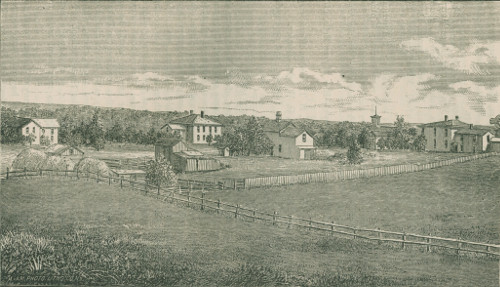
SANTEE NORMAL TRAINING SCHOOL.
Mr. Thomas L. Riggs, who collected a company of Indian youth for Gen. Armstrong’s school last autumn, reports that he could have secured several times as many, if he had been seeking students for Santee. The variety of industries that it would be desirable to promote would be limited only by the wants of the people in a new country. Carpentering, blacksmithing, shoemaking, broommaking and basketmaking, are trades that well might receive early attention. It would be no part of the plan to interfere with the religious or normal school work by the more general introduction of industrial training. We believe that Christian nurture is promoted rather than retarded by attention to industrial pursuits among students, when wise oversight is given for the sake of useful achievements. The plan of locating the students in cottages, so that each home may have a quiet and healthful influence upon the untutored youth from wigwam life, is already inaugurated, and can be extended to meet all emergencies. The land at the agency is controlled by the government, but no difficulty is anticipated in securing all that may be needed for the use of the school. Scholarships may also be had in numbers and amount sufficient to warrant preparations on a large scale for a first grade normal and industrial institute. It is the purpose of this Association to weigh carefully the above considerations, and if found practicable, to develop at an early day a training school in Nebraska that shall be equal in its facilities and enterprises to the demands of the new era in the progress of Indian civilization.
ASPECTS OF THE INDIAN PROBLEM.
BY HON. CARL SCHURZ.
The increased interest of public-spirited citizens in the education of Indian children is one of the best, if not the best result, of recent discussions of the Indian question. The success of the schools at Hampton, in Virginia, Carlisle, in Pennsylvania, and Forest Grove, in Oregon, have amply demonstrated what can be accomplished if such schools be organized on the right principle and conducted with ability and energy. That this is more and more generally appreciated is all the more fortunate, as the Indian question is no longer one the solution of which can be trusted to time.
As the progress of settlement and enterprise in the far western regions, or, as it is called in a general way, “the development of the country,” advances, the old methods of providing for the Indians become obsolete. Large reservations of wild land, on which the Indian can freely roam and support himself, partly by hunting, will soon be things of the past. Even now an “Indian frontier” does no longer exist. The abiding places of the Indians are almost everywhere surrounded by rapidly increasing populations of white men eagerly pressing upon the Indian lands. One reservation after another is broken up to make room for new lines of communication and for agricultural and mining enterprises. However conscientious the government may be in its intention and endeavor to protect the rights of the Indians at all points, it is evident that the Indians will soon, in every part of the country, be interspersed with an aggressive force, constantly growing in volume and power, which will threaten to overwhelm them like a rising flood. Their circumstances are essentially changed. The alternative of civilization or extermination is immediately before them—civilization enabling them to become in all important respects a part of the population among which they are to live; or extermination in a vain struggle to maintain the habits of savage life against the progress of superior forces, or rapid decay as miserable paupers and outcasts by the failure of self-sustaining ability. This alternative presents itself not as a question looming up in the distant future, to be solved by coming generations, but as a question involving the existence of the young generation of Indians now living. It is, in one word, a question of immediate urgency.
If the Indians are to live at all, they must learn to live like white men. They can no longer stand in the way of the development of the country, but they must be enabled to become part of that development, and thus to be benefited by it. The “white man’s way” of which they are in the habit of speaking, must not, as heretofore, remain to them a mere vague, shadowy idea, but they must acquire a practical conception of what the white man’s way really is, what its objects are, and by what means those objects are attained. They must acquire that conception soon, for they will need it soon. The education of the young generation of Indians is therefore an immediately pressing necessity. And it must be an education that takes them out of their traditional ways of thinking, out of their old ambitions and habits of life. They must not only learn some reading and writing, but they must learn what reading and writing is for in the practical competitions of human existence. They must learn how to work and how to make their work useful. They must learn to love work by seeing and appreciating the fruits of it. Industrial training of a thoroughly practical kind must therefore go hand-in-hand with the ordinary rudimentary school education. The two things must be carried on with constant regard to the unity of aim.
The schools at Hampton, Carlisle and Forest Grove are conducted upon this principle, and the results attained there prove that Indian youths can be taught the things required to provide for the necessities of life and to lift the Indian above the state of the pauper as well as of the savage. Of course we must not expect too much of them. We must not expect that they will issue from these schools as model men and model women in every respect. We must not expect that on the average they will be better than the average of white boys and girls, raised under the same circumstances and with the same advantages or disadvantages, would be. In point of fact, the reports about the young men and women who, after having gone through their three years’ term at Hampton or Carlisle, returned to their people in the western country, have been as different as reports would be about white boys and girls similarly situated. Some were bright, active and industrious, others dull and indolent. But a large majority of them have been doing well and showed a marked superiority in character, ambition and conduct over other young Indians who had not enjoyed the same kind of education. There is no doubt that their presence among their people as teachers and examples and as a moving force generally will exercise a most healthy and elevating influence, provided the number of Indians so educated be large enough to make them among the rising generation the rule, instead of their remaining exceptional cases, as they now are. It is, therefore, essential that such schools and the number of pupils in them be multiplied as much as possible.
The schools at Hampton and Carlisle are mentioned here in preference to the schools established at the different agencies, partly because the former are superior as to the force of teachers employed there, as well as to their equipment in other respects, and partly because they offer to their Indian pupils the peculiar advantage of withdrawing them entirely from the savage influences of the Indian camps and placing them under the immediate influence of civilized surroundings, where they can learn the “white man’s way,” by seeing civilization at work. But as this method of educating young Indians is expensive, and Congress rather parsimonious as to appropriations for such purposes, the number of Indians profiting from it is necessarily very small in proportion to the whole population, while it ought to be very large. The establishment of an Indian school on the same plan near the Santee agency in Nebraska, as contemplated by the American Missionary Association, is therefore all the more to be welcomed. Although the surroundings of that school will not be quite as civilized as those of Hampton and Carlisle, yet the Santee reservation is at least on all sides easily accessible to civilized influences. It is a small tract, encircled by settlements of white people. At the same time, a school established there will be able to draw its pupils from the great Sioux reserve in Dakota at small cost, the distance being inconsiderable and the means of communication cheap and convenient. The American Missionary Association could scarcely render a more valuable service to the Indian race or do more credit to its own good judgment and benevolent impulses than by making so valuable an addition to the educational forces among the red men.
—A difficulty in prosecuting the work among the Indians in British Columbia is found in the fact that the tribes speak distinct languages. Not less than seven different dialects are used in the range of country embraced by missionary effort.
ORIGIN AND HISTORY OF WORK AT CARLISLE.
BY CAPT. R. H. PRATT.
In compliance with your request I herewith furnish you with a brief history of the Carlisle School, and some account of its industrial features. It originated in the sending to Florida from the Indian Territory of 74 Indian prisoners in the spring of 1875. At the instance of General Sheridan I was selected by the War Department and placed in charge of those prisoners, they having been under my care at Fort Sill. They were from the Cheyenne, Arapahoe, Kiowa and Comanche tribes and were selected for this banishment because of well-known offenses against the peace of the frontier. Some of them were guilty of the most outrageous crimes. Years of army service among the Indians and observation of their treatment had led me to change my views for opinions in favor of giving to the Indian a broader chance and a desire that he might be brought more in contact with the peaceful and industrious side of civilized life, and so before the prisoners were started from Fort Sill I wrote to my superiors urging that they be educated and trained industrially during their imprisonment. Soon after reaching St. Augustine I wrote repeatedly to the War Department urging that some locality with more industrial surroundings be selected and the prisoners be transferred. This was denied, and I then set to work to make the best use of the elements to be found in the sleepy old Spanish town. With no means, I was forced to seek the co-operation of charitable and missionary folks. Miss S. A. Mather, Miss Perit, Mrs. King Gibbs, Mrs. Couper Gibbs, of St. Augustine, and Mrs. Dr. Caruthers of Tarrytown, N.Y., winter resident of St. Augustine, volunteered to teach and did teach the classes of those grown Indian men for two years and a half, giving them about one hour’s instruction daily. Industrially there was little practical opportunity, but numbers were placed for different periods to work on saw mills, at picking oranges, as hostlers, grubbing the land, boating and whatever could be found in connection with their own necessities and comfort in the old fort. Twice we boated pine logs from a distance and constructed log houses within the fort, riving the clap-boards, building stick chimneys, chinking and daubing that they might learn to construct their own homes. Some of them advanced rapidly in acquiring literary, English speaking and industrial knowledge. Others were very stupid. The greatest success in the labor line was in placing five men to grub five acres that had intimidated other laborers both white and black. The undergrowth and roots to be removed were of the most dense and appalling kind, and yet the Indians stuck to it until they had made a complete success of it.
Another of the best evidences of the success of our labor efforts was a petition signed by a very considerable number of laborers and others of the community asking that I be estopped in the putting of the Indians out to labor in competition with other classes, as I was taking bread from the mouths of those who were dependent upon such labor for their living, etc. In the spring of 1878 the authorities at Washington determined to release the prisoners and permit them to return to their homes. There were 22 of them who preferred to remain East and get a better knowledge of civilized life and more education before going home. The expenses of these 22 young men were undertaken by different charitable people. Gen. S. C. Armstrong, of the Hampton Normal Institute, received 17 into his institution, while four went to Paris Hill, near Utica, N.Y., under the immediate charge of Rev. J. B. Wickes, an Episcopal clergyman, encouraged by Bishop Huntington, all the expenses being undertaken by Mrs. Burnham. One was taken to Tarrytown, N.Y., in Dr. Caruther’s own family. Hampton Institute being an industrial school, furnished the most seasonable and practical education of any institution I was able to find. The remainder of the party were returned to their respective agencies, and such was the effect of their training in Florida during their three years’ absence, that they at once became the best element for progress in their tribes. At this time, while a few have gone back to the blanket condition, most likely from necessity, because no other way was open to them, there is abundant testimony in the reports of their respective agents during the past four years that they are still a useful and leading industrious element among their people.
A few weeks after the arrival of the party at Hampton Institute, General Armstrong was so favorably impressed by the conduct and progress of the 17 he had undertaken, that he was willing to increase the number by adding 50 more, and including girls. Mr. Schurz and Mr. McCrary, then Secretaries of the Interior and War Departments, accepted the proposition, and I was sent, in the fall of 1878, to Dakota, and brought away 49 children from six different agencies of the Sioux, Gros Ventre, Mandan and Arickeree tribes. These, together with the former Florida prisoners, were placed under training in all the varied systems of literary and industrial pursuits. Hampton Institute provides liberally for its colored students, and side by side with those colored pupils the Indian boys and girls, in perfect harmony with the new life, demonstrated their capacity to hold their own in improving the best of chances. It was very much desired by the friends of this new movement, and particularly General Armstrong, that I should remain with it, and a clause was introduced in the army appropriation bill, which passed Congress in the spring of 1879, for the detail of one officer, not above the rank of captain, for duty with reference to Indian education.
It was a plan which I had urged for several years that to get the best results in our educational work among Indian children as many as possible should be removed from reservation and tribal influences and placed in the atmosphere of civilized life, and to this end I had urged the use of vacant military posts and barracks as furnishing, without much cost in changing and improving buildings, places to make a beginning, and I proposed to the Interior and War Departments that I would undertake the education of 250 or 300 children at the old military buildings at Carlisle. This proposition was accepted, and after many preliminaries I was sent in September, 1879, to the Rosebud and Pine Ridge Agencies in Dakota and brought away 84 children, and immediately after went to the Indian Territory and from the Kiowa, Cheyenne, Pawnee and other tribes brought 52 more. To these were added 11 from the Hampton Institute of the young men who had been with me in Florida. The school was opened on the first of November with 147 students. To these were added from time to time children from various Western tribes, and at the end of July, 1880, we numbered 239 children, about one-third of whom were girls. At the end of the second year, October, 1881, we had increased to 295. At the present writing we number 379—132 girls and 247 boys. From the beginning our principle has been to place the most emphasis on industrial training, next English speaking and then literary training. To accomplish the first we very early in the work established shops for mechanical instruction in carpentry, blacksmithing, wagon-making, harness-making, tailoring, tinsmithing, shoemaking, printing, baking and on our farm of 115 acres gave some scope for agricultural training. We have avoided theory in our industries and adhered to practice, being governed to a great extent by the old apprentice system. We have at the head of each branch a skilled mechanic as practical instructor, and as nearly as possible we pursue the methods of trades people in their instructions to apprentices. We give half of each day to work and the other half to school, and have found that our progress is proportionately greater in each than it would be if the attention was directed to either the one or the other for the whole time. Under this system we have in training as carpenters 13 boys; as wagon-makers and blacksmiths, 15; as harness-makers, 15; as shoemakers, 19; as tailors, 12; as turners, 11; as printers, 5; as bakers, 3; and every boy not engaged at some trade is required to work during the season upon the farm. Such products of our labors as we are not able to make use of for the school are purchased by the Indian Department and shipped to agencies. We think our boys as forward in capacity for receiving instruction on each of the several branches as the average white boy. In the blacksmith shop our apprentice boys after two years’ instruction, are able to iron a wagon, repair a plow, shoe a horse, etc. In the wood-working department able to get out all the different wood parts of the wagon ready for the blacksmith. In the tin-smithing to construct coffee pots, buckets, pails, pans, cups, etc. In the harness-making to cut out and manufacture harness. In the tailoring to cut out and manufacture clothing. In shoemaking to repair and manufacture boots and shoes. In printing to set up and distribute type and make up forms. In baking we have no other help than Indians. We give to our girls instruction in the various industries of the sex and find no general lack. In cooking, sewing, house work, laundry work, etc., they are apt pupils.
One of the most useful features of our work has been the placing of our boys and girls in private families, principally among farmers, where they perform the same kind of labor and are subjected to the same home and labor influences that white children of their own ages receive. This has the most beneficial results. The children take on English speaking and the industries of civilized life very speedily. During vacation we place out all we can spare from our own work, and during the winter we allow a considerable number to remain and attend the public schools in the several neighborhoods, they being required to do such work mornings and evenings as they are capable of and so pay for their board and clothes. By this course we are enabled to carry a very considerable number more pupils than we are allowed appropriation for. It is plain that the real hindrance to Indian progress is found in their being kept entirely separated from the other masses of our population, and by every act of our government and every sentiment of its people, societies, missionary and others, made to feel that they are a separate people and must so remain forever. Through their education in separate schools, their home life upon prison reservations with their liberty of coming and going abridged to these reservations, with all their aspirations and ambitions so limited, there can be no healthy growth. To overcome these difficulties the Indian mind and the mind of the public as well as Congress must be educated to grant to them the enlarged privileges accorded to all other races. The boy will never learn to swim until he goes into the water, and the experiences of industrial life and civilized life through its associations and competitions will determine for the Indian and white the true status. We have had quite enough of the Sioux, Cheyenne, Comanche, etc., as Sioux, Cheyenne, Comanche, etc. We can end their existence among us as such separate people by a broad and generous system of English education and training, which will reach all the 50,000 children and in a very few years remove all our trouble from them as a separate people and as separate tribes among us, and instead of feeding clothing and caring for them from year to year, put them in condition to feed clothe and care for themselves. Our experiences in many individual cases in the last few years make it very evident that not only may we fit the Indian to take care of himself in his own home, but may fit him to go and come and abide in the land wherever he may choose, and so lose his identity.
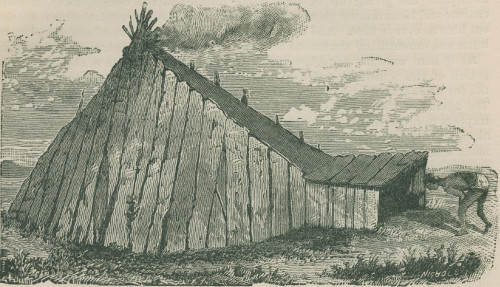
MANDAN HUT, DAKOTA.
THE HISTORY AND OUTLOOK OF THE INDIAN WORK TRANSFERRED TO THE A. M. A.
PROF. ALFRED L. RIGGS.
Just fifty years ago two Congregational young men from Connecticut, the Messrs. Samuel and Gideon Pond, pressed on into the heart of the then unknown continent to see what they could do for the Indian. They landed at Fort Snelling, in what is now Minnesota, and began their volunteer mission among an Eastern branch of the Dakota or Sioux nation.
One year later the American Board sent out the Rev. Dr. Williamson on a tour of exploration, and the next year after that a mission was regularly established. The organized work gathered in the volunteers, and, moreover, according to the fashion of the times, Congregational relations disappeared and work was started on the Presbyterian basis.
For years it was a slow, hard lift against the weight of heathenism and pride of race. Nowhere is race pride stronger than among the Indians. As is often the case, those who have least to be proud of vaunt themselves the most. So, while the Indian has to acknowledge that the white man is possessor of gifts that class him with the gods (the Dakota name for white man being the same as that he applies to his gods), and thus for the sake of his mysterious power he fears him, yet personally he despises him as different from himself and effeminate.
And heathenism! Some would have us believe that it did not exist; that the Indian naturally was as good a Christian as need be. The courtesy of the Indian perhaps leads to this deceptive view. He will assent to everything you say rather than be so impolite as to contradict you. Then, too, his pantheism easily makes room for another god. So the white man’s god soon had his banner set up at their sacred rites together with the Stone god, the Day god, the Night god, the Thunder god, and the god of the North.
But when Christ claims the whole of their worship, and belief in him is seen to require the giving up of their other faiths, and the casting away of their charms and incantations, then the antagonism of the unregenerate heart breaks out here as everywhere. And the magicians and “medicine men” are stirred up to bitter and unremitting warfare as soon as they discover that their craft is in danger.
As if here were not enough obstacles to meet, there comes in the opposition begotten of the selfishness and dissoluteness of unprincipled white men. For years the fur trade was almost as much the enemy of missions as was the slave trade. The agents of this great enterprise were bound to keep the Indians hunters and trappers in order that their warehouses might be filled with furs. The fur trade also controlled the government, and even to-day its power is felt through laws made then for its benefit and that yet remain on the statute book. Hence in its day the fur trade was a foe to be dreaded, for it could exert its power in a thousand secret ways. It could break up schools, scare people away from religious meetings, and put a ban on the Christian teacher, if content to leave him alive.
After thirty years of patient labor the reward seemed about to come. Christianity was proving its power to disintegrate heathenism, break down prejudice and survive the enmity of unprincipled white men.
Then the outbreak and massacres of 1862 occurred, seemingly sweeping everything away. It was the death-struggle of heathenism, alarmed at the steady advance of Christianity. Other political causes and conditions merely made this outbreak possible. And yet what seemed annihilation was only multiplication and dissemination. Again was fulfilled the Scripture: “They that were scattered abroad went preaching the word.” And the conversion in the military prisons of hundreds as it were in a day, is one of the notable instances of the power of God’s spirit.
Twenty years ago the field of Christian missions among the Dakotas was confined to a small section of the nation then dwelling in a corner of Minnesota. But now the field extends over the great Missouri valley and on northward toward the Saskatchawan in the British Possessions.
The work whose beginnings we have noted, originally one under the American Board, has since been divided. In 1871, at the time of the general division of the missions of the American Board, that part of the Dakota Mission immediately under the charge of the venerable Dr. Williamson and his son, Rev. John P. Williamson, was transferred to the care of the Presbyterian Board of Foreign Missions. But the larger portion remained with the other veteran of the mission, Rev. Stephen B. Riggs, under the care of the American Board. And now with the year 1883 another transfer is made to the American Missionary Association. But the five native churches, with a membership of 340, that had meanwhile grown up about Sisseton Agency are graduated from foreign missions into a home mission connection, and so naturally pass under the care of the Presbyterian Home Mission Board. It is not within the scope of this short article to speak of the work accomplished by the Episcopal Mission in the same field, which had its beginning about thirty years later than the original Dakota Mission, and in recent years has had very considerable success. Nor can we speak particularly of the portion of our great field lying across the British line, for though we have furnished the native laborers it is not organically connected with us. But as for the rest of the original mission, even though divided, it works as one. It has one General Conference, and in all its publications and matters of common concern acts as one mission still.
The statistics of the Dakota Mission, as thus defined, show 7 stations, 6 ordained missionaries, 26 assistant missionaries, 13 churches, 12 native pastors and preachers, 9 native teachers, and 847 church members, contributing during the past year $779.83 for their own missions among the heathen Indians, and $1,080.58 for pastoral support and church expenses.
Of this there now passes directly to the care of the American Missionary Association 5 stations, with also an interest in the Native Missionary field at Devil’s Lake, 4 ordained missionaries, 21 assistant missionaries, 2 churches, Pilgrim Church at Santee and Shiloh Church at the Sully Station, with 8 native preachers, 5 native teachers, and a church membership of 194.
As has been noticed, the organization of the work from the first has been on the Presbyterian model, and thus the fruits of the mission have mostly gone into the Presbyterian connection. The church at the Fort Sully Station was an exception. It was organized as a Congregational church. Nevertheless, this Presbyterian cast, this whole native force, is to be considered as one, and will be used by whichever denomination is ready to prosecute the work most vigorously, for the denominationalism of these churches is not of a radical type, as is instanced by the recent change of ecclesiastical relations on the part of the Pilgrim Church at Santee. This is the original mother church, but in order to come into closer and more sympathetic relations with the churches that support the Santee Training School, it voted cheerfully and almost unanimously to leave Presbytery and become Congregational. Indeed this is not hard for them to do, for Indians are naturally very democratic.
In the work that may now be done for this people, Santee Normal Training School must be an important factor. It has vital relation to all these native churches, and it has a name among the heathen communities. Its growth has been slow, for it has taken time and work to instil the idea of a higher education into the minds of the people. Henceforth its growth might be rapid. It now has one hundred and one pupils in attendance, with seventeen instructors, including those in charge of the industrial and boarding departments. This winter a number of pupils have been turned away for lack of room. If accommodations could be provided, the number of pupils might soon be doubled.
While giving great attention to industrial training, it affords unparalleled advantages for that training which is needed to make teachers suited to Indian schools.
The school is the basis of evangelizing the Indian. There will be no large audiences to preach to, except on exceptional occasions, until the school has gathered a company of disciples. Certain persons not understanding the nature of missionary work, or unable to take more than a superficial view, have recently represented our schools as of low grade, and unnecessary to real missionary work. But this is contradicted by the grand progress of the work.
We have spoken of five mission stations as now passing under the care of the A. M. A. But of these Standing Rock is hardly opened, and Berthold and Sully stations are sadly in need of reinforcements. And there are the large Indian Agencies of Spotted Tail’s and Red Cloud’s tribes, numbering about 7,000 each, which we ought to occupy. Then there is the Crow country in Montana, next door to our Berthold Mission. We should have at once six ordained missionaries and their wives, with as many more assistant missionaries, all picked men. This would enable us to manage a yet larger number of native missionary teachers working along with them.
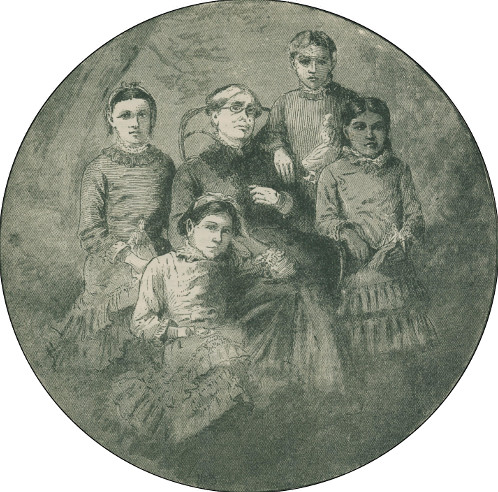
SISSETON GIRLS, WITH TEACHER.
The tribes speaking the Dakota language are the most numerous of any Indian people upon the continent. They are now universally open to Christianity and Christian civilization. They now look to Christian people for their future. Within the last ten or twelve years the whole temper of their mind has changed. The noted chief, Sitting Bull, is an illustration. Only a few years ago he hated the very wind that blew from the direction of the white man’s country. When the wind blew from the east he would send out the town crier to say, “Get you all into your teepees. This is bad air from the white man’s country.” But when it blew from the north his crier would proclaim, “Come out and breathe the healthy air.” And once when a woman of the tribe brought home a “rooster” from a distant trading post to enliven the tedium of her labor, Sitting Bull heard it crow and instantly dispatched his chief soldier to “soldier kill” the woman, that is, cut up her tent and kill her horses, for the crime of having that white man’s bird in the sacred precincts of a Dakota camp. But now the same Sitting Bull is petitioning for Christian teachers, and land, and domestic animals, and undoubtedly would also welcome “the-bird-that-crows-in-the-morning.”
INDIAN INDUSTRIES AT HAMPTON.
BY GEN. S. C. ARMSTRONG.
Every Indian boy who comes to Hampton is allowed his choice to learn farming or a trade, and to select the trade he prefers, to which he is expected to stick. They often wish to change after some months, for they are a fickle people. While this is by no means done as a matter of course, it has sometimes been found wise to do so. A boy who could do nothing at blacksmithing made remarkable progress in the wheelwright’s shop; one who is poor on the farm may be good in the shoe-shop, and vice versa; but it does not do to encourage shifting trades. The girls go through the same routine of housework, cooking, cutting and making and mending clothes.
The boys are assigned to work as follows: carpenters, 15; painters, 1; tinsmiths, 6; shoe-makers, 13; harness-makers, 3; farmers, 13; blacksmiths, 3; wheelwrights, 3; tailors, 1. A generous lady in New York City has recently given $5,000 for an Indian workshop, which will be completed and occupied by the first of April next, and be a most satisfactory change from the shed in which they have for four years uncomfortably worked at their trades.
Considering the past of the Indian, the disposition of our boys and girls to work is remarkable. The general rule is to work from seven to twelve o’clock, A.M., or from one to six o’clock, P.M., Saturday being holiday. Those who work mornings study afternoons, and vice versa. All are paid, girls as well as boys, usually at the rate of $2.50 per month, for to expect Indians to take a real interest in their work without some compensation is absurd. It is weak and foolish to reason that the skill they attain is enough compensation. Human nature requires something more. On the other hand they purchase all their underclothing and shoes with their earnings, and are thus taught the use of money and the true value of garments, and become quite skillful in buying. A school uniform is provided for each one, made in our tailoring department.
Their appreciation of work is a direct contradiction to the statement that an Indian hates to labor. Frequently boys who are working a half-day at some trade will ask to be allowed to work the entire day, including Saturday, so as to earn more and be better able to take care of themselves when they go home. Their wages are then increased and they go to night school. Every such application is encouraging.
Especially those who make extra time in the shops are inclined to save. They generally agree to draw but one-half of extra earnings, the other half being saved to buy them tools and other outfit when they shall finally leave school. We allow ten per cent. interest on all such savings; they are quick to see the advantage of laying up money. They seem to have no marked aptitude for special trades, unless it be for work in leather, shoe and harness-making. Their ancestors have dealt in this commodity more than in any other. They take to all handiwork remarkably; while quick to learn, they are slow to execute. They seldom bungle or “botch” a job. The first pair of shoes made by an apprentice is always serviceable. An Indian carpenter will make as good a mortise as a white one, but will take three times as long. Our expert harness-maker says he can do no better work than some of his boys, but they are very slow about it. We are constantly making and selling carts made by Sioux boys. They have made all our school benches, desks, wardrobes and wash-stands, besides window-frames, etc., for the outside market.
We would be only too glad to make buggy or plow harness, single or double, tin-ware of all kinds and brogan shoes for individuals or institutions in the North or South, solely on the ground of the merit and cheapness of the work done. A neat carriage harness was made last summer for a lady in Newport, R.I. Of the 500 dozen articles of tinware, 75 sets of double plow harness, and 2,000 pairs of men’s shoes made last year by our Indian boys for the use of the Western tribes (ordered by the Indian Department at the lowest contract prices of the previous year) the New York inspectors reported: “They are as well and as strongly made, and for actual service fully equal to any purchased by the Department.”
This year we are making an even larger amount of material for the Indian Department, but at prices which little more than cover cost of material. An outside private trade would be much more desirable. We were paid for men’s brogans “extra” good leather, $1.22½ per pair, boxed and delivered in New York City. Carlisle does even more than Hampton in supplying Indians, and with excellent success.
Owing to bodily ailments, Indian labor is more unsteady than that of Negroes. While in their own life they have endurance, a steady routine of industry is new to them, and they are for our purposes a rather feeble race: they find digging exhausting, but on the hunter’s trail or on the warpath they are tireless when we would soon be weary.
Unless every Indian child is educated to some occupation, teaching is of little account. Hard work rather than the higher studies gives them the best drill. As for all, so for Indians, home influence is a great thing. After the best practical education they are not fit for the loose, idle, dirty life of Indian camps any more than any other children. What is to be done? The best success with the thirty Sioux children who returned in October, 1881, to their agencies (five of them girls) has been with those to whom the agents gave separate rooms near the agencies, having their food cooked and their life led separately. An efficient agent will, by the care he takes, save four-fifths of our Indian graduates to decent lives; a careless, weak agent (and not a third of the sixty U.S. Indian Agents are first-class men) will lose four-fifths of them. We cannot make men of them in three years, but can give them a start in that time that a good agent can keep up, and lead them to true success.
Here, more and more, we find the real trouble; not with the Indian, but in our miserable system of paying so small salaries to Indian agents that a competent one is the exception. The boy or girl who goes home finds no strong, kind friend to advise and help; the current of influence is against a Christian life. Here the missionary is needed; never more than now.
Hampton, Carlisle and the many schools that are educating Indians need to be supplemented by good agents and wise missionaries who will help them to stand against the odds that would make the new life they have chosen nest to impossible. Here is the point of chief anxiety. Public sentiment must be felt at Washington before it shall remove the chief stumbling-block to Indian progress—poor agents. As Secretary Teller says in his last Report, the Indians are chiefly on reservations, and must for the present be treated there; to be gradually pushed upon lands of their own, individually, by the efforts of wise men and the influence of Christian education.
REVIVAL WORK AMONG INDIANS AT HAMPTON.
Miss Isabel B. Eustis, in giving an account of the revival meetings at Hampton, writes as follows of the Indians:
Meanwhile at one end of the chapel there sat a company of one hundred who took no part in the service. The Indian students watched with wondering and wistful eyes the scenes around them. “Pass me not, O Gentle Saviour,” they sang often in their own services during these days, and the Lord heard their cry and turned aside and called them too. Stago, our fiery little Apache boy, heard his voice, and set hard to work to conquer his temper and self-will. The quick-witted, ambitious, head-strong girl, whose influence over the other scholars we dreaded, listened, and her hard expression softened, and the stubborn will yielded, and with gentleness and humility she met the daily requirements which had often roused her rebellious spirit before. Shallow natures grew earnest and proud, and we knew that there was one walking with the Indian students too who could purify and inspire and help.
On Wednesday evening our senior Indian boy, of his own accord, left his class and took his seat with the other Indian scholars. Waiting his opportunity, he rose and called the attention of the school to those who sat behind him. He reminded me of the darkness out of which they had come, and of the dangers to which they must return. He told us that they longed for a share in the blessing God was giving the school, and asked our patience while they prayed to the Father, and spoke of Him in a language we could not understand.
Kamnach rose first. Kamnach came to the school four years ago, directly from his wild Indian life. His hair was uncut; he wore Indian clothes; he had been always familiar with scenes of bloodshed, and placed little value on human life. After three years he went back to his home, a changed man we thought in appearance and heart. But it was hard to stand among his savage comrades. He plead to come back to school. He was a happy boy, when, less than a year ago, he placed his foot again on Hampton soil. Poor boy! he had yet to learn that always his worst temptations would come from his own distorted heart. Some misunderstanding of his position as a returned student, some distrust of those who were over him, and he fell into passionate hatred, and was ready to commit a deliberate and deadly crime. We thought his repentance would be quick and deep, but not so. The first Sunday of the new year, the anniversary of the day on which he confessed Christ, he had no heart to meet the Lord, whose first command was to love and forgive. But the passing Saviour’s voice reached him now. He stood before the crowded school, and with the help of an interpreter acknowledged his sin, and renewed his allegiance to the Saviour, and begged the Indian students to follow the Lord Jesus, though they would find many things in His religion hard to understand and difficult to do.
After Kamnach’s confession a Sioux boy made a prayer. He spoke in another tongue, but more than one felt his heart was lifted to the Father’s heart by the earnestness and pathos of the stranger’s voice. Another tried to speak in broken English. Missing the words he wanted to say, waiting and struggling for confession, he acknowledged Jesus Christ as the Saviour of his soul. Our hearts were knit together in love. We knew that we belonged to one common family and nothing could separate from the love of Christ. Evidently the son of God who came to save the lost finds nothing in the Indian nature he cannot soften and subdue. Evidently the Indian is able to place his confidence in such a Saviour and yield himself in glad obedience to Him.