THE SOUTH.
Reading edition
Rev. Joseph E. Roy, D.D., Field Superintendent.
Prof. Albert Salisbury, Superintendent of Education.
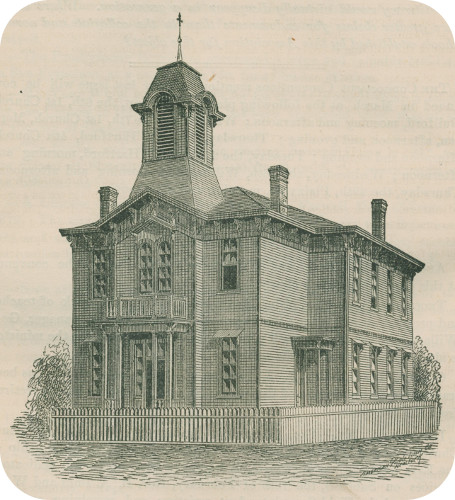
LEXINGTON HIGH SCHOOL.
BY PROF. GEO. F. JEWETT.
Nearly every one knows of the far-famed blue grass region of Kentucky. It is seventy miles south of Cincinnati, and fifty miles east of Louisville. Lexington is in the very heart of this fertile country, eighty miles south of Cincinnati, on the Cincinnati Southern R.R. The country excels in the production of corn, potatoes and thorough-bred stock, and it is said that the finest horses in the United States are raised in this region. Lexington is one of the oldest towns of Kentucky and has a population of 16,500, of which one half is colored. Although Kentucky did not take a very active part in the late war, yet at its close the provisions for the education of the colored people were as meagre as in other States.
Last June the Association decided to re-open the school, and accordingly the building was repaired. The cut given herewith represents the house in its present shape. On the first floor there are two large school-rooms capable of seating fifty pupils each, two large entries and two coat rooms. On the second floor there are two large school-rooms which may be thrown into one by means of folding-doors, thus forming our chapel. There are also two small recitation-rooms. In the front of the building there is a hall and stairway. The house is also provided with a large bell, which is a great help in securing punctuality. Our school numbers 133, 38 males and 95 females. There are 31 above 16 years of age. None are admitted below the fourth reader. The school is divided into three grades—high school, first and second grammar grades. Miss H. C. Minton is teacher of the first grammar grade, and Mr. C. H. Jewett of the second. Our scholars are not far advanced, because of the very poor advantages which they have had; yet they are a class of well-behaved and earnest pupils.
The discipline of the school is very easy. The scholars respect their teachers and seem to consider the school a means by which they are to rise. Our school-house is far superior to any building in the city for colored schools. This gives us a great advantage. We are obliged to turn away many from the lower grades. The State has just passed a law making the salary of white and colored public-school teachers equal. This makes it important that the colored teachers should fit themselves better for their work. Our school is intended to offer them opportunities for doing this work.
A WEEK’S WORK BY LADY MISSIONARIES.
FIRST CONGREGATIONAL CHURCH, SELMA, ALA.
By Miss Mary K. Lunt.
Sunday, Jan. 14.—A bright, crisp morning, and as we prepare for Sunday-school, we think that many of the little ones will be necessarily detained from their accustomed places, or at least, be obliged to see their cards with unclipped figures upon them. But no, one hundred and nineteen are present, a good average, and but few are tardy, notwithstanding that many have walked a long distance, and perhaps without having taken breakfast. At 9:30 A.M. the opening exercises commence—singing, prayer, chanting the Lord’s Prayer, and responsive reading—after which the weekly offerings are collected in envelopes, and the amount subsequently reported, also the number of pupils present, reported by the Secretary. The contributions are appropriated as follows: First Sunday of the month, for needy Sunday-schools; second and third, our own needs; fourth, our church; fifth, foreign missions. Several schools have been aided by this method, and the pupils bring their papers carefully folded, to be sent to other Sunday-schools. Collections last year amounted to $50, revealing the fact that scarcity of nickels does not keep them from helping others less favored. After the re-assembling of the classes, two of which, the infants, the girls named “Buds of Promise,” the boys, “Little Soldiers,” are taught in the rooms below, the main school comprising eight classes and one Bible class; their attention is directed to illustrations and lesson topics on the board by the superintendent, supplemented by remarks on the lesson from the pastor. Some of our teachers and pupils have read original papers on the subject of the lesson for the morning, this being an incentive to a more thorough study of the lesson. At 11 A.M. we are seated for the morning service, and after the usual opening exercises and responsive reading we listen to an earnest discourse, founded on the closing passages of that wonderful Sermon on the Mount, contrasting the builders, showing the foolishness of building religious characters on false pretenses, and the importance of building on the solid rock Christ Jesus.
At 3 P.M. is the children’s meeting known as the “Look Up Legion,” but called by some the “Look Up ’ligion,” composed of members of our own and other Sunday-schools of the city, ages ranging from two and a half to twelve years. Their regular and prompt attendance attests their interest and zeal. One of the members of the choir assists in leading the singing, which is a prominent feature of the hour. Our principal readings and talks are taken from the book, “Talks to Boys and Girls about Jesus.” Always when available we give them a short juvenile temperance story, and distribute books and papers when we have them. Our motto is “Lend a Helping Hand,” and the aim to teach to become children of the Great King, to help others to become such by inducing them to come to Sunday-school and to these meetings, where they can hear about Jesus. One little girl said to us to-day, “I am glad you have these meetings, for I get tired reading, and mamma won’t let me play.” One of the larger boys is anxious to know if we are to continue them during the year. At 7 P.M., with a good and attentive congregation, we listen to one of a series of illustrated sermons, which has been our privilege since Christmas, an earnest and solemn appeal to the unconverted from the passage in Rev. vi., 13-17, plainly proving that the fear and confusion of those who cried “Fall on us and hide us,” resulted from the sinner’s own carelessness and indifference, and it is hoped that the truth found lodgment in the hearts of the hearers, and will bring forth fruits meet for repentance. Our day closes full, and if in after years we see the young filling honorably responsible positions, we shall not regret that we were “sent.”
MISSIONARY WORK, SAVANNAH, GA.
By Miss Jane S. Hardy.
Monday, Jan, 15.—Early dawn found me wide awake, and planning the work of the day. Soon the accustomed “ding dong” caused a general stir in the Home, and the second call brought us all into the dining-room, where we soon satisfied our bodily wants, and on bended knee sought “supplies of grace” for our spiritual needs. Soon another bell announced the approach of school-time, and nearly two hundred pupils gathered, as was their wont, in the chapel of Beach Institute. There God’s blessing was again invoked, both in song and prayer, a few words of counsel were given by the Superintendent, and the scholars were dismissed to their respective school-rooms.
I would fain have lingered there; for it brought to my mind the many years of happy toil spent among my pupils in the school-room. Yet I am content—yea, happy, in doing the work that comes to my hand in visiting from house to house.
My first call this morning was upon the Deacon’s wife, who greeted me in her usual lady-like manner. Although often bending over wash-tub or ironing-board, she leaves all to be taught her reading and Bible lesson. She is not a Christian, but the truth brought before her in repeated Scripture readings is evidently making deep impressions.
My next call was at the house of a church member, but a wanderer—bitterness in her heart, “cares of this life and the lust of other things entering in have choked the word and made her life unfruitful.” She cannot read; but I have resolved to carry the word to her. May God lead her back to her Father’s house!
Mrs. K—— is a cripple. For her diseased feet I carried a pair of soft shoes, sent by some good friend in the North.
I found her with a company of children gathered about her whom she was teaching to read, thereby earning five or six dollars a month. She is an intelligent Christian woman, and has lately been reading “Prince of the House of David,” for which she expresses great admiration.
Hastening home, I met a class of young men—hotel-waiters—who are off duty in the middle of the day, and desire to improve their leisure time in studying the three R.’s and the Bible.
At two o’clock, I went into the school building to attend a prayer meeting held daily among the pupils since the opening of the Week of Prayer. There are indications of the Spirit’s presence among us, and we are anxiously hoping that some of these dear young people may be turned to the service of Christ.
After dinner I went to a distant part of the city to meet a regular appointment for a ladies’ prayer meeting. This week the meeting was held at the house of a good sister, who kindly opened her well-furnished parlor. A good number gathered to hear the word and to mingle their petitions at the throne of grace. Among those present was Mrs. S——, who, so lately, came into the kingdom. Her great desire is to work for the Master. Thus passed an hour, helpful, I trust, to us all. Returning home, I felt called upon, ere night should close in, to visit a family much afflicted by sickness. Both father and mother weak and feeble, no ready cash in hand, and seven small children to care for. No wonder the days look dark to them. We are glad to give them a helping hand. A few articles of clothing, a little money, and words of cheer are the things they most need just now. In the evening a Sunday school scholar came for instruction, giving me another opportunity to sow seeds of truth in a darkened mind. How precious are the opportunities that come to us day by day!
MISSION WORK AT ATLANTA, GA.
By Miss Lizzie Stevenson.
Tuesday, Jan. 16.—The heavy rains since my return from the North, Jan. 3, have kept me much at home. This morning, however, I started out, and soon found myself at Aunt Judy’s door, but she had gone to a neighbor’s to get warm. When she saw me, she said, “Missus I’s so glad you’se come back. I was just talkin’ about you. We folks don’t have nobody to come roun’ and see and talk to us since you’se gone.” She has been a cripple for years, but this winter is unable to work, on account of rheumatism. She has always been contented and happy, and “proud” that she could pay her rent, fifty cents a week. But to-day it made my heart ache when she said that it took all that “Wes,” a grandson ten years old, could make by picking up rags and papers to get something to eat and a little coal. The landlady had just been there for rent, but she did not know where she could get the money. After reading a few of the Saviour’s words, and commending her to the Father’s care, I gave her a little toward the rent and left her. I next found two children about two and four years old hovering around a handful of coals; talked with them a few minutes, gave them a picture paper and passed on. I then stopped at Aunt Gracie’s and knocked, but no answer; so I pushed open the door and went in, and spoke several times before I could rouse her. Then with great effort she told me that she had been in bed several days with rheumatism. Her miserable shanty is but poor protection from the rain. Every thing in the room was damp, and not a stick of wood or a mouthful of any thing to eat. I carried her a little food and sent to the wood-yard for wood. But the streets, which are not paved, were so muddy they would not deliver nor sell even an armful.
Next I find Mrs. Williams, who has been sick for two months. She is very old, and has for years supported herself and two orphan children by picking up rags. As soon as it was light she could be seen with her sack on her shoulder going to her work. She is quite sick, but fortunately she belongs to a society, which provides for her. From here I go to see an Auntie who is over one hundred years old. She is unable to lie down on account of asthma. As she sees who it is she exclaims “Bless the Lord, honey, I knowed the good Lord would send you back, kase we old folks haint got no one to come round and read to us when you’se gone! ’Pears like the rest are so busy. I prayed the Lord would send you back, and I felt it in my bones you’d come;” and she thanked the Lord again and again for sending me back. And at so many places their first exclamation was to thank the Lord for sending me back to read to them. Another poor woman, who has not walked for years, and whose husband has deserted her, is entirely dependent on the neighbors for her support; and no doubt she goes hungry many days. She said to me as I was leaving, “Miss Lizzie, I didn’t get no Christmas ’cause you’se gone.” After making several other calls and distributing quite a number of Sunday-school papers, I came home with a sad heart to think how little I could do to relieve these poor needy ones. Sometimes I feel that it is mockery to offer to read to them, when they are so cold and hungry. If I only had the means to make their bodies comfortable, they could enjoy so much more the food for the soul.
DAY’S WORK FOR JESUS—RALEIGH, N.C.
By Miss E. P. Hayes.
Wednesday, Jan. 17.—As this is the day for our woman’s prayer meeting, I had taken that day to call on the members of our church. After breakfast, I was preparing to start, when Georgia came in to inquire if I had heard from the ladies who were coming from the North. Then Mr. Smith, our pastor, called to decide upon articles to be read at the concert the next Sabbath evening on the work of the A. M. A. I wrote a postal to thank the lady who sent a nice silk hood to an old, sick auntie, and started.
It was raining a little, but I determined to proceed. I made the first call at Mr. Young’s, close by. Mr. Y. is blind and paralyzed. They were eating breakfast. It was then 10 o’clock. Mrs. Y. said they had nothing to eat till she went out and hunted up something. One day during the snow, as they had no wood, they were obliged to remain in bed till three in the afternoon, and the Saturday night before they had no wood, and nothing to eat. I furnished them with enough to last over the Sabbath. As Mrs. Young is a reader I gave her a paper, and went on to Mrs. Hills. Mrs. H. has two little children, and cannot get out to church, but is very fond of reading. I found her with a good coal fire, and looking very comfortable. I left a paper, and stepped into Mrs. Smith’s to see if her children were as destitute as she had represented and to request her to send her boy to the wood-yard to order some wood for me. I met her husband coming out half drunk, and talking in very loud tones. The boy was stretching a line around the room in which they lived for his mother to dry the washing she took in. Some wet wood in the fire-place was making a feeble effort to burn. I couldn’t see how clothes could dry in such a place as that, and said so to Mrs. S. She replied that she was compelled to dry them. When I came out, the rain was pouring down, but I was obliged to go to the Bank to get a check cashed, as I was out of money, and was expecting a barrel of clothing with a freight bill to be paid.
After going to the Bank, drug store and post-office, the rain and mud conquered and I turned my face homeward, feeling thankful when I entered my door that I had so good a shelter. I built a fire, or tried to, with wet wood, as all our wood is soaked with rain when we buy it, and spent an hour in selecting Bible verses for a Sunday-school class coming in the evening to study for a concert the last Sabbath in the month, partly wrote a letter to thank the ladies of Hopkinton for a barrel of clothing, and to interest them further in the work.
After lunch, Dea. Jones called to inquire about his part for concert. As the rain had slackened, I went to prayer meeting at three o’clock, at Dea. Dunston’s. We meet with the different members of the church. Dea. D. is our oldest member, seventy-three, in feeble health, and enjoys having us meet with them. But five were there, and three of those members of the family. All took part in the meeting, and after its close, I assisted the daughter, in selecting an article to read at the concert. She chose for her subject the Indians.
When I came home I looked over the mail, and went to inform Mrs. Bembry, with whom I had engaged board for the Northern ladies, that they would arrive Friday morning. On my way I stepped in to see an old lady who is paralyzed, and called to tell Georgia when the ladies would arrive. In the evening a Sunday-school class came to study verses, and get temperance cards. Then I finished my letter, wrote another and retired, feeling that I had accomplished but little.
ONE DAY’S WEAVING—MONTGOMERY, ALA.
By Miss Rebecca G. Jillson.
Thursday, Jan. 18.—The Swayne School for the colored children of Montgomery, with its four hundred scholars, is just opposite the “Teachers’ Home.” The day began with a call at the school; a bundle of Sunday-school papers was soon distributed among the boys. Near the school-house lives a good woman, from whose home two girls have just gone to Talladega to school. I stop and talk with her about their going and read a letter for her. A neighbor needs help, the mother and seven children are all sick. Although dependent on friends for care, these are the sick woman’s words: “We’re all down, but old Marsa knows what He’s doing.”
On the porch of the next house stands an old grandmother, children of all ages around her. A girl of eighteen promises to come to the Home twice a week for lessons. Across the way lives a kind-hearted woman; her neighbor, a sick woman, has only her little son and this friend to care for her. She needs much the comfort of God’s word and his assuring promises of help. Another is waiting for sympathy; she is alone though not widowed, and tells how, when the human help on which she leaned failed, she found support in God alone. A young woman whose husband’s health has failed is trying to help him by keeping a little store; she is brave though sometimes discouraged. The next call is on a woman just recovering from illness. Her friends have been kind to her in her sickness; this interest in one another is especially noticeable among the colored people. Stopping to speak to a group of children, “this one, they say, has no father or mother, so we have taken her in.” Two other calls in this neighborhood are made; an invitation given to a young man to attend the Singing School and to a young girl to renew her interest in music; and now the house of a faithful church member is reached. The Ladies’ Missionary Society and what work it may do is discussed, and questions from the article on Missions in Life and Light are left to be prepared for the next meeting. Two calls near by are made. One lady is interested in music and is glad to hear of the cantata we are to learn. The next is a scene of labor. This good woman washes for a large restaurant and has in this way earned enough money to build a substantial house. Every day piles of table-linen must be washed and ironed, and when it rains, every corner in-doors is made use of to dry the hundreds of napkins and towels.
The first call in the afternoon was on an old lady, a faithful Christian, who finds that her pilgrim journey has had in it many passages and experiences like that of the pilgrim of old, in whose story she is much interested. The Celestial City is for her almost in view, and her entrance there will be triumphant. “I’se only waiting,” she says, “for the Lord to say: ‘Elsie, come up to glory.’”
Several girls come to the Home in the afternoon, two to learn to make worsted hoods, two others to take lessons in music. There is also time to fold the Sunday-school papers for distribution next Sunday. Late in the afternoon I called on a mother whose little child God had taken home to himself. Our next neighbor is a man of intemperate habits. I had a talk with him. At nightfall a young woman came in and sang some of the old plantation melodies. In the evening a young girl came for lessons, and with her, two boys, who spent the hour with pencil and drawing cards. With God’s blessing may the day’s work not be in vain.
A DAY IN NEW ORLEANS.
By Miss A. D. Gerrish.
Friday, Jan. 19.—Having attended morning devotions at the University chapel, equipped with my satchel and a few gifts to be distributed here and there, I wend my way to Mrs. R.’s to hold a promised meeting. There are six of us altogether. At the close of the brief hour spent with Jesus I stop to speak with a young Catholic girl. The mother is evidently surprised. She “didn’t know as I’d talk to such as she.” I reply, “I came to speak to all.” My next call is at what I term the half-way house. A few late flowers still bloom in the pretty garden and the oranges seem turning a deeper gold, touched by the warm sunshine. Aunt Comfort is “only just about so so.” We talk of household affairs and the revival. An offered prayer for us both and I bid the dear old lady good morning. On the street a sad-hearted mother delays me for a moment to ask that I will please pray for her son, who is dying and without hope in Christ. With a few kindly words of sympathy and a promise to remember the young man, I pass on. The door of Mrs. A.’s pleasant room stands open and I pause long enough on the threshold to receive her cheery “Good morning” and the injunction to “be sure and stop next time.” As I reach the top of a winding flight of stairs a voice full of childish eagerness asks, “Did you bring my little Testament?” The Testament, a tiny book, and some picture papers are taken from my satchel and three little hearts for the time made happy. The mother is very grateful for the garments given her for the children. An urgent invitation is left with her to come to the evening meeting. Another call made and the city bells ring out the noontide hour. I stop for lunch and rest at Sister W.’s.
Mrs. M. lives at a distance, so I take the street cars. A rap at the outside gate, a careful climbing up the rickety stairway and I am warmly greeted by the little woman. Would that I had space to describe to you her one bit of a room. She says: “You must excuse it; ’tisn’t alus possible to keep things lookin jus so.” She has received no pay for her last three months’ washing, so for want of car fare her Sabbaths have been spent at home. I must tell her all about the meetings, the New Year’s tree, how many have joined the church, and affairs generally. With a prayer and a substantial proof that the “Lord will provide” her heart is comforted. I find Aunt Sally “jus tolable, thank’e, but powerful busy.” She tells me once again, “’Twill be a glorious time, shur nuff, chile, when I can leave this ere washtub for a manshun in de hebens.” I seek out a delinquent Sabbath-school scholar and call upon two interesting little girls, who promise to come to the sewing school. A picture paper given to each and I hasten homeward.
After dinner I find a little time for writing. Promptly at 7 o’clock the church prayer meeting begins. The passage selected for the evening lesson is Jer. 8:20. The large audience listen attentively to the pastor’s words. In the hush of this tender interest nine come forward for prayers. The voice of petition rises in their behalf. Two tell us that they have found Jesus. We sing “Praise God from whom all blessings flow.” Benediction is pronounced and the meeting closes. Another day, with its joys and sorrows, its failure and success, is ended. Its record is with Him who sees and understands. In the quiet of my room I kneel to humbly ask that it may be accepted as “one more day’s work for Jesus,” knowing that it is “one less of life” for us all.
LINCOLN MISSION, WASHINGTON, D.C.
By Mrs. C. B. Babcock.
Saturday, Jan. 20.—Be sure and find us when you take your pleasure trip to Washington, and we will show you better than we can write, the need of missionary work among its 60,000 colored people. This is one of our winter’s worst days. It rains fast, and the streets are full of snow and water. Breakfast over, I hastened to market for meat to make broth for the sick, and to the grocery for bread. While picking my way over the slippery pavements, a grandmother calls after me with a request that must be heeded. On entering my room in the Mission, a barrel from Brooklyn awaits unpacking. God bless the dear friends of the North who so nobly respond to my appeal for help. They never will know how much good the old clothes do. Before I’m half through, knock number one brings old Auntie Bennett, afflicted with a disease so offensive that she cannot attend our gatherings. When leaving with her bundle of warm garments, in steps Auntie Harris, always so trustful in the Lord, and yet she says, “I sat all yesterday without any fire”; her husband and crippled son unable to provide. Thankful for a little relief, she goes out to carry a big bundle to another poor creature, who, with her old man, have scarcely a crust, and nothing but a leaky shanty for shelter. Caller No. 3 is a young woman, bringing a note from the police station and a certificate from her doctor, that tells of serious sickness, one two-year-old child, and nothing wherewith to help herself. I send her to see our Day Nursery, and tell her to bring her baby on Monday, and I will see what more can be done. Her dull, wan face brightens as she leaves. Tom C. comes next—my boy, who draws our Temperance blackboard illustrations, paints our signs, puts up Christmas decorations, &c. I’ve just received his fit in a suit; so, with a patch to mend the sleeves, and more work under his arm, he goes. Pinkie T. has framed some mottoes, and I ask her to hang them in the school room, paying her with a pair of nice boots. Annie C., our missionary girl from Howard U., comes to assist, and, as a member of the Doing-Good Society of the school, this P.M. brings a report from sick Mr. Green. After preparations for the afternoon, and a peep into the nursery, where the floors are being scrubbed and the children are taking their bath (for, though the Associated Charities have adopted this, my pet project of last year, and have appointed a committee of ladies, I have the daily supervision). I leave for lunch at 12½. The girl’s industrial school opens at 1½; 61 out of 130 scholars are present. We are divided into 15 classes, each with a teacher, if enough ladies are present. I appoint a girl to attend to callers. We open with singing, and sew until 3 o’clock. Some are making bags for their work, some patch-work, some, fancy-work, while others are mending or making garments and learning to cut them. We intersperse sewing-songs. They help the pupils to remember instructions. From three to four we have various exercises, such as talks on health or manners; Bible lessons, repeating the Child’s Creed or the Commandments, with responsive chant or a Psalm and the Lord’s prayer. To-day, we have an object lesson in house-keeping. A table is placed on the platform and Annie C. is asked to prepare it for tea. She arranges the cloth, dishes and food, with criticisms from the scholars. Then, she invites four girls to sit and eat while she acts as waitress. After eating she removes the dishes for washing and folds the cloth. A few more callers and the busy week closes. Thank God for the sunlight it has brought to us during our revival meetings in the conversion of two of our dear girls.
VANTAGE GROUND NEEDED BY STUDENTS.
BY MISS JOSEPHINE KELLOGG, TOUGALOO, MISS.
We long for the time when these people shall obtain a little vantage-ground by industry and—still more essential—by economy and a prudent use of earnings, so that the children may begin the work of getting an education betimes and continue it until a respectable course of study is thoroughly mastered. We have some such, and we hope much from the earlier training and the favorable circumstance of their having parents interested in educating them and able to do it.
In the cases of a majority, they come to us already grown-up, something having given them an ambition for better things than they had known. They have their own way to make and can be in school only a part of each year, many of them working nights and mornings and one day of each week besides, to pay their board in whole or in part. As the time approaches when exhausted funds and worn-out clothing must compel them to go out and seek employment, thoughts will wander and there will be a relaxation in the matter of preparation and recitation of lessons in spite of themselves and the exertions of their teachers. No doubt there is a blessing connected with their struggles against adverse circumstances, and a manly and womanly self-dependence is fostered in this way, but it is not to be expected that a great number will complete the course in the face of such discouragements.
As year after year passes, and they get education enough to help them on somewhat in life and a knowledge that fits them to be useful in church, society and home, and they yet seem almost as far as ever from the goal of graduation which they once placed before themselves, they begin to be anxious to settle down to the real business of life, and they relinquish the hope of a completed normal course with, perhaps, a subsequent complete collegiate course.
While it is the few of those who enter that go on to the end of the course and the many drop out as I have described, yet we do not consider our labor in vain, but rather hope to claim the assurance “Blessed are ye who sow beside all waters.” If the teaching were only in the ordinary elementary branches we might think it of little avail unless carried on continuously to a more satisfactory issue, but much of it is more fundamental than even arithmetic. The entire mode of life is a lesson and a much needed one to most of those who come to us. The regularity of meals with the laws of the dining-room, the regularity of retiring and rising, the neatness and order of the rooms, the care of clothing, the personal habits, the sanitary regulations, the study and exercise, and the propriety of deportment required, not to speak of the regular work belonging to the industrial training, seem to new scholars to form a complete hedge, if not a bewildering labyrinth; but a very bright feature of our work is the spirit of subordination and respect for constituted authority, which greatly simplifies and lightens the enforcement of all necessary rules. This is an excellent and much-to-be commended trait in our students. I have asked some of those who go out to teach if the children in the public schools are easy to govern. Oh, yes, the answer has been, they expect to mind.
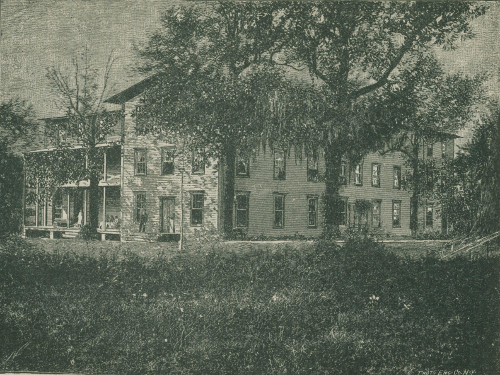
LADIES’ HALL, TOUGALOO, MISS.
It is very edifying to note how those who come without any taste or neatness in their personal appearance, with sorry attempts at finery and painfully-laced waists, improve under the tuition of the lady principal and the influence of those who have been here longer, the expression of the countenance often changing more rapidly and noticeably than even the manner of dress. But, O! the patience and the faculty required for this most important work of training the girls in womanly virtues and housewifely ways!
With all the patience and with all the faculty possible, it is a great and constant strain to have the care of such a household, and the matrons and lady principals need the uplifting prayers and sympathy of the warm Christian hearts interested in these schools, in a special degree.
And then the instruction in the Bible, as “the only and the sufficient rule both of faith and practice”—the value of this work cannot be over-estimated. The case of a young man who came into school for the first time this fall, comes to mind. Living far back from the railroad, in the country, he had had no advantages of any schooling but a few brief sessions of the public school. He was entered in the Third-reader grade and was to all appearance a most unpromising specimen, although a professed Christian, and apparently a sincere one, with a real experience of trust in God, but wofully untaught as to Christian character and duty. As the Scripture was from time to time plainly and searchingly expounded, and the vices which are sometimes permitted under the garb of religion were exposed, it was plain to see that he was listening as to a new revelation. In school-room work there was a marked improvement, especially in the expressiveness of his reading, but the great benefit that came in his term of school was in the way of moral enlightenment. A month ago he joined the temperance society. The last prayer-meeting was taken up largely with speaking of the temptations that would be met at Christmas-time to violate the pledge, and one young man said that, in view of these temptations he would rather spend Christmas at Tougaloo than anywhere else. This young man then “spoke in meeting” for the first time, I think, and said he did not feel that way. It seemed to him that the principal thing he wanted to go home for, was to tell his people he had become a temperance man. He had been a good deal of a drinker, a member of church, too, and his people were all in the same way, and didn’t know any better, but now he would tell them that he had found a better way, and that they, too, must forsake the old bad way, or they would surely go down. He said, “If I can’t keep my pledge, I may as well find it out first as last, but I do believe I can. I does feel as if temperance is grafted in here,” laying his hand upon his breast. He hopes to return and bring a sister with him, but if he cannot get the means and never comes, is there not here a little bread cast on the waters?
The evening before school closed there was a beautiful Christmas exercise, consisting of recitations, Scripture and music, lighted by a large star of evergreen filled with burning candles. No doubt many a new idea concerning the universal holiday was imbibed. This was followed by an exhibition by the temperance society.
Thanksgiving day was a blessed occasion with us. Rev. Mr. Stickel preached on Tests of Character, dwelling upon the test of faith and the test of gratitude, basing his sermon upon the story of the ten lepers. An opportunity has usually been given, in connection with the morning service, for personal testimonies, and so many had given themselves to the service of the Lord and so many had been led into a fuller Christian experience since last Thanksgiving that there was a real eagerness for this service, and a somewhat wistful look on a good many faces when the meeting was closed without it. At the end of dinner, however, President Pope rose and said such an opportunity would be given then and there; that we could not spend a portion of the afternoon more profitably nor have a pleasanter sort of after-dinner speeches than in recounting the good dealings of God with us. Notwithstanding the fact that a Thanksgiving dinner is about as well calculated to promote a spirit of thankfulness as anything that can be mentioned, it was a little harder to rise from the table and speak in the dining-room than in the chapel. Yet, after the first momentary hesitation, the testimonies came, briefly but freely, of gratitude for health, for success in work, for the privilege of being at school, for the pardon of sins, and many other things.
One young man said he had felt all the year, as never before, that all his blessings came right from the hand of God. He had felt it in his teaching, and had thanked God for all his success. He thanked God for this school, and for those friends in the North who had established it, and for all the benefits it is conferring upon the people of this State. One youth said he was thankful he had learned the true object of man’s life—what he was made for. He used to think a man could serve God or let it alone—that his time and faculties were his own, and he could do as he pleased. But now he had learned that a man’s true calling is to serve the Lord. He was glad to know that the great God has something for every one to do, and has His eye upon the way he does it, and that his reward is according to his faithfulness, and not according to the greatness of the work. It seemed to make life worth living.
Prof. Salisbury was with us three days of the last week, in the tour of the schools which he is making to get his work in hand. He gave us a helpful talk in chapel one morning, and again gave an account of the other schools he had visited, and we trust his subsequent visits will aid in promoting the symmetry and efficiency of the work of this school.