THE SOUTH.
Reading edition
Rev. Joseph E. Roy, D.D., Field Superintendent.
Prof. Albert Salisbury, Superintendent of Education.
THE HEMENWAY FARM.
BY GEN. S. C. ARMSTRONG.
In 1878, when the 150 acres of arable land of the Hampton Institute could offer no more farm work to the increasing number of negro and Indian students, a generous lady, of Boston, Mass., gave, principally for the benefit of the Indians, the sum of nine thousand dollars, to purchase a fine grass and grain farm of 350 acres, five miles from the school, to which was added, by purchase, 250 acres more, and to it has been given the name “Hemenway Farm,” as a memorial to the husband of the giver.
It was placed in charge of Mr. and Mrs. Chas. H. Vanison, both graduates of Hampton, but has been under the general control of Mr. Albert Howe, formerly of Dorchester, Mass., manager of the Normal School farm.
During the three and a half summer (vacation) months, the sixty Indian boys, excepting about one-third who go to Berkshire Co., Mass., to work with the farmers, spend by turns, in squads of twelve or fifteen, two weeks at a time at this farm, taking part in the stock and farming operations, which are carried on on a larger and simpler scale than at the school. They thus get a wholesome change from life in the workshops, besides useful, practical knowledge. A general knowledge of agriculture and stock is important for those who are learning trades.
The steady working force of the farm is composed of from eight to ten colored boys, who begin October 1st each year, working till the next October, ten hours a day, studying every night from seven till nine o’clock, under the direction of Mrs. Vanison. They receive, besides their board, from $8 to $10 a month, which, excepting $3 a month for clothing, they are expected to save to pay future school expenses. They are an ignorant, destitute class, but, as a rule, are most willing, earnest and deserving students. After working all day, they study harder at night than any others in the school. Ten hours of handling lumber at the saw-mill, or steady work on the farm, or in the machine shop, is no trifling duty, but they are eager for their night lessons.
The ten at the Hemenway Farm are a part of 130 “work students,” thirty of them girls, employed in the various industrial departments, constituting about one-third of the colored pupils at Hampton. They devote a preliminary year to day labor and night study, to fit themselves to enter the junior class of this year’s course, and to accumulate a small fund, averaging $75 for the year, to help meet cost of board, ten dollars a month, besides clothing and books. This is done in part by working two days each week of the regular course. With strict economy and working all vacations, they maintain themselves through the entire course graduating without receiving a dollar in charity, some, however, need help the last year and none are more worthy of it.
The effect on their characters is excellent. Good as it is, that they shall earn and learn in this way, it is even better for the habits, ideas and manliness it promotes. The entire class is mature, averaging 19 years of age. Mr. Vanison is as excellent a manager as we care to have; his wife keeps house, sees to the boys’ meals, rooms and washing, and teaches them nights, besides raising some 500 chickens, at which she has a wonderful “knack.”
The farm was cultivated last year as follows; 75 acres in wheat, 80 acres in oats, 112 in corn, 35 in clover and orchard grass, the rest in pasture, a few acres being devoted to vegetables and an orchard. Much was done in clearing old ditch banks. The stock consists of 50 hogs and pigs, 110 sheep and lambs, 6 colts, and from 10 to 20 beef cattle, which are bought in the neighborhood, fattened on the pasture and killed at the school, two or three a week being required there.
The Hemenway farm, of 600 acres, some 60 acres of it marshy, is situated in Elizabeth City County, on Bach River, which is an estuary half a mile in width. The house is a famous, but plain, old Southern mansion, in which Gen. Washington once dined. Until 1878 it had been for many generations in the hands of an old aristocratic family, whom the war impoverished, and their place was sold for debt. The location is a beautiful one; the region is quite Englishlike in appearance, with its rich, level fields and its hedge-rows. In summer, delicious breezes blow up the river from Chesapeake Bay, four miles distant.
Oysters and fish abound in its water front; a handsome lawn and fine old trees surround the house, all of which are a delight to the boys, especially to the Indians, who have long summer mornings.
The past season a plain but pretty cottage was added to the old house, which was too small, containing a dining-room, kitchen, laundry, and bedrooms for the boys upstairs. This leaves rooms, as was intended by the giver, for tired teachers to come and rest for a night from the cares and din of the institute, to whom the quiet and beauty of “Shellbanks,” its former name, is a great comfort. I must not forget to mention the ample barn, stable, cow-shed, tool-house, corn-crib, extensive stacks of straw, and wind-mill for pumping water for the stock.
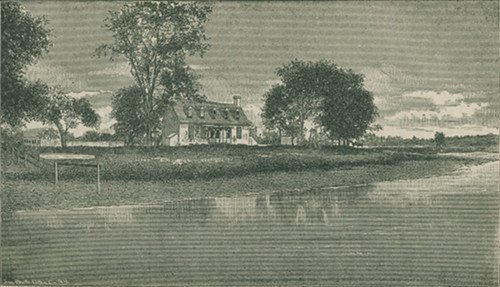
HEMENWAY FARM.
This is entirely a negro affair; no white person lives on the place. Its Christian character and influence are earnest and emphatic. Nothing in the Hampton system is more satisfactory than this farm. I hope others like it will be provided for other institutions, but to fit up an old Southern farm after buying it, costs about as much as the land costs.
An unexpected advantage of the farm is its being an excellent place for a badly-behaved Indian boy, when only one is sent there. He is punished by being separated from his old friends, but the ten colored fellows carry him along in their daily routine of work and study; he has no one to “cut up” with; he improves in spite of himself; the plan has never failed to work well; he finally likes it and returns changed for the better.
REVIVAL IN CENTRAL CHURCH, NEW ORLEANS.
W. S. ALEXANDER, D.D.
It has been our custom in previous years to begin our special religious meetings the first of January in connection with the “Week of Prayer.” But this year the Church seemed in readiness at an earlier date, and we felt that we were obeying the call of the Lord to “go forward” when we began our special effort to reach the impenitent, on the night of December 1st. The Friday preceding had been observed as a day of fasting and prayer. For many days the spirit of prayer and consecration had been evidently deepening upon the part of the great majority of the Lord’s people. People who, for some trivial reason, had been alienated, came together in the spirit of forgiveness. A great desire was expressed, and I have no doubt felt, to prepare the way for the coming of the Lord. Our lady missionary with unsurpassed devotion, visited all the families of the congregation, making in the short space of ten weeks some 600 visits. The effort was made to reach every one who sustained even a nominal relation to our church, as a member or casual attendant, and invite him to our revival services.
The result was all and more than we anticipated. The church was thronged every night. The very first night several presented themselves for prayer. The number of inquirers increased till we counted more than fifty. One by one, with a quietness and depth of feeling that impressed every heart, these earnest inquirers came into the light, and were made to “rejoice in hope of the glory of God.” The two manly and dearly beloved sons of the Dean of our Faculty, were among the first to share in the blessings of the revival. God only knows our joy when they came forward with the rest, and bowed before God as suppliants for His mercy and forgiveness. Never did the words of Holy Writ, which have fallen from the lips of so many believers, sound sweeter than when one of these young men recited as his verse at the breakfast table, the morning after his conversion, “I know that my Redeemer liveth.”
A pleasant and somewhat unusual feature of this revival has been its influence upon the men. On more than one occasion we counted twelve men on the “Mourners’ seats.” Thirty-four professed conversion. We hope and believe they have been “born again.” A class of 35 are waiting in joyful anticipation of taking the vows of God upon them in the Church, and of receiving their “first communion.”
I should do injustice to my own feelings did I not speak of the earnest sympathy and hearty co-operation of all the teachers in the University in this religious movement. We moved in this matter as a united body, with but one object in view: the glory of God, and the upbuilding of the Kingdom of His Son.
ADDITIONAL REPORT OF THE REVIVAL.
PROF. R. C. HITCHCOCK.
The revival which has been in progress for several weeks at Central Church has been to me a constant wonder. Even in sedate old Connecticut a revival season is usually a scene of much emotional excitement, and it is often impossible to tell how much is sincere and permanent; but this revival has been all through marked by a quiet, deep and reverential character. It was my first opportunity for observation of such meetings among the colored people. I had heard and read a great deal of the tumultuous excitement on such occasions, and each night I looked to see, when they should be fairly “warmed up,” such scenes as I had had pictured. What I actually did see was this. Each night the pastor preached a short, practical gospel sermon, packed full with reasons why religion should be chosen and chosen now, to an earnest, attentive audience. Then he stepped down in front, and in kind but strong words invited all who felt the truth of what had been said and wished to become Christians, to come forward for conversation and the prayers of the church. Most of those who accepted the invitation were men of middle age and young men; a few were young ladies.
Night after night this went on; while the pastor and others were talking with those who came forward, the audience engaged in singing. No general invitation was given to speak or pray, a few only being called on each night to take part. Each night some souls found peace and joy. It was my good fortune to talk with nearly every one of the converts, and I found all, so far as I could judge, thoroughly in earnest; no one scared or urged into confessions, but each, as the new hope was born in his soul, rising, generally with streaming eyes, to tell what God had done for him and ask for fellowship and prayerful help.
SCHOOL AND CHURCH WORK AT FAYETTEVILLE, ARK.
BY REV. B. F. FOSTER.
We began work here on the 5th of September, and opened school under very favorable auspices. We have had 92 pupils enrolled. Our school is the only one for colored children within a radius of 65 miles. We are giving some attention to church work, and are using our school-house as a place of worship. We have service every Sabbath morning at eleven o’clock—the audiences are large. We are gratified to say that the influence of the teachers takes fast hold upon both parent and pupil. We have Sunday-school every afternoon at three o’clock, and these services are largely attended. Thanksgiving day was appropriately commemorated. A sermon was preached in the morning by the missionary pastor. All who were present seemed deeply impressed with the word. The chapel was beautifully and tastefully festooned with autumn leaves and berries, and the walls were embellished with appropriate mottoes of the sacred Scriptures. At seven o’clock in the evening a very large number of patrons and friends of the school gathered, and partook of a repast prepared as a thanksgiving token for them by the teachers and pupils. Toasts were responded to by the several pastors of the town and teachers. I said we had service in our chapel at 11 A.M. every Sunday. We could induce as many to come in the evening if we had lamps to light up our chapel. Equally as good results would come from a weekly prayer-meeting, if we had sufficient lights. We heartily accept this opportunity of asking the friends of some of our Northern churches to give us of their old ones—chandelier lamps. The Lord’s Supper was celebrated the first time, since beginning our work here, last Sunday. Truly, the Lord was with his people on that solemn occasion. At this service the missionary pastor’s first and only little daughter was baptized, which increased the interest of the meeting. To carry this blessed Supper to Christ’s brethren and sisters, Mrs. Foster’s pie-pans were used for the emblems of his body, and two borrowed mugs for the emblem of his blood. From this the friends of God’s poor will see we would thank them very much to assist us in getting a communion set. The people among whom we are working are very poor. Few of them have homes.