THE FREEDMEN.
Reading edition
REV. JOSEPH E. ROY, D.D., Field Superintendent, Atlanta, Ga.
THE SOUTHWESTERN CONGREGATIONAL ASSOCIATION.
BY REV. W. S. ALEXANDER, D.D.
The time and place (June 1, New Orleans) proved propitious. They gave the ministers and delegates an opportunity, by anticipating the meeting, to be present at the anniversary exercises of the University. I think a fire has been kindled which will not be quenched when our brethren reach their homes, and we shall find, when the new school year opens, that new connecting lines have been established between Straight University and the interior towns.
The Association last met in this city, in the spring of 1877. In 1878 and 1879 we met in New Iberia, and in 1880 and 1881 in Terrebonne; so this is our sixth annual meeting without a break, and we are able to report not only continuity of life, but real progress. A little advance in the church work of this Association means more than a far greater advance in our older religious bodies. Here the fight has been, first upon the question, “Have we, as Congregationalists, a right to live in Lousiana?” The denominationalism among the colored people has been, and still is, intense. As the Baptist and Methodist Church once covered this entire Southern field, the Congregationalist is looked upon as a traitor to a holy cause, who has enlisted under a strange and piratical banner. “Who are you, anyhow?” “Where do you come from?” “What strange faith have you picked up now?” are questions which salute our brethren constantly, and which are designed to cover them with confusion and discomfiture. But this battle has been bravely and patiently fought, and the right to exist “established.”
There were 31 pastors and delegates present. The reports from the various fields were cheering and hopeful. It has not been a harvest year, though some churches have been refreshed by the gracious visitation of the Holy Spirit, and all have, we hope, felt the quickening of a new life. A revival of wonderful preciousness and power was reported from Central Church, New Orleans, beginning with the “Week of Prayer,” and continuing five weeks, during which time nearly 100 souls were awakened.
Brother Clay’s church in Terrebonne has been blessed and strengthened. There have been many hindrances in the year. The floods have caused great suffering among the poor. Cabins have been washed away, crops destroyed, and the plans of labor disarranged. When the laboring class of the colored people suffer, the churches suffer in their resources.
Let me summarize the result of our annual meeting.
I. From the reports of the churches we find that there have been numerical losses, which, though seemingly serious, are really gains, so far as the purity and vigorous life of the Association is concerned. The Association has not yet laid down the pruning knife, and it may be that more dead branches will be clipped off in the year, without which the tree will be more beautiful and fruitful.
II. A higher stand was taken for an educated ministry. One of the brethren, on his own volition, presented a resolution to this effect: “That from this day we, as an Association, will neither license nor ordain any man to preach in our churches who is not fitted by education to perform all the sacred duties of his office.” The brethren in the discussion preceding the vote said that while there was formerly an excuse for an ignorant ministry, we now have our colleges and theological seminaries, and with a little self-denial, all who wish may fit themselves to guide intelligently the minds and hearts of the people.
III. The necessity was deeply felt and freely expressed, of taking a clearer and stronger denominational position, with all charity and fellowship for all who love our Lord Jesus Christ in sincerity. We, as Congregationalists, should know the ground on which we stand, and be able to give a reason for the hope within us. It was voted that a Manual be prepared, answering more fully than any yet issued, the local needs of our Louisiana churches. This Manual will be prepared during the summer, and submitted in manuscript to the Association at its next meeting.
We were fortunate in having the presence and cordial aid of Rev. O. D. Crawford, of Mobile. He gave an address, Wednesday night, on the subject: “Why am I a Congregationalist?” It was scholarly, judicious and effective.
The Moderator, yielding to the kind and earnest desire of the brethren, occupied the evening session of Thursday in an account of his visit to Europe, with especial reference to the Jubilee Meeting of the Congregational Union of England and Wales, held at Manchester in October last.
After prayer and song, and with deep gratitude to God for His blessing upon our annual meeting, the Association adjourned, to meet in New Iberia the first Wednesday in April, 1883.
I desire, in concluding this statement, to say that if our Northern friends wish to see a vigorous Congregational Association in Louisiana, the helping hand must be extended, with the “God bless you” from the lips. Weak points along the lines need to be strengthened, the faint and weary to be encouraged and the streams of benevolence to be directed into the barren wastes, where men of God have only their lives to offer.
TEACHERS’ INSTITUTE AT MEMPHIS.
BY MISS ELLA A. HAMILTON.
I have thought that perhaps the readers of the Missionary would be interested to know something of the Institute held at LeMoyne for the colored teachers of Shelby and the adjoining counties. The Institute was continued for two weeks, beginning on the first Monday in June. Prof. Steele was appointed conductor by the State Superintendent. Teachers were present not only from western Tennessee, but also from Mississippi and Arkansas. On the first day our enrolment list reached eighty-nine, and increased during the succeeding days to one hundred and fifteen. Our daily session began at quarter before nine with short devotional exercises. These were followed by the recitations in the different branches. The lessons were given and studied by topics, and each teacher was provided with a blank book, in which he kept the topics for study and also any notes which he wished to remember. The Rev. Mr. Imes had charge of reading, Prof. Steele of arithmetic, grammar, penmanship and geology, while I took history and geography. A certain time each day was devoted to any matters of interest which we should wish to present. At this time several talks on school organization were given, an object lesson on coal was presented by Miss Lovell, principal of one of the public schools, the temperance charts showing the effects of alcohol upon the stomach were exhibited, and Miss Wadsworth, a worker under the W. C. T. U., addressed the teachers, answering many questions which they asked her. The teachers present were, without exception, earnest, enthusiastic and anxious to get good, that they might do good. One young man said to me at the close of the Institute: “This Institute has given me work to do for twelve months to come; it was just what I needed.” Many others told us of the good they had received during the Institute, and seemed to feel that they should do their work in their school-rooms better for the work they had done there. The county superintendent, who was with us for two days, told us that the colored teachers would average quite as high as the white teachers, who were then in attendance at a similar Institute at Bartlett, the county seat. This is about the first work of the kind that has ever been done in Tennessee, but if the results are as good as we have every reason to hope, we are sure it will not be the last.
SUNDAY-SCHOOL INSTITUTE AT TOUGALOO.
BY MISS J. KELLOGG.
It was thought that the last Sabbath of the school year could not be better spent than by calling in the Sunday-school workers among the colored people and holding a Sunday-school institute.
Providence smiled upon the exercises with a most beautiful day, and at an early hour the chapel was filled with an attentive though miscellaneous throng, whose intelligent looks and interested, orderly demeanor were a surprise to some of the newest workers and evidence of progress to all.
The regular exercises of the Sunday-school were first attended to. The lesson, “Following Christ,” with its golden text, “Whosoever will come after Me, let him deny himself, and take up his cross and follow Me,” seemed to furnish a peculiarly appropriate theme for the last conference of the teachers with their classes, and called forth thoughts and experiences, exhortations and warnings, calculated to be helpful alike to the Christian of years, the score or more of young converts, and the few who, with all their calls and opportunities, still refuse the yoke of Christian service.
In closing the review the superintendent gave a blackboard exercise suggested by the verses, “What shall it profit a man if he shall gain the whole world and lose his own soul? Or what shall a man give in exchange for his soul?” This formed an impressive introduction to the first subject brought forward—the use of the Blackboard. Other topics presented were, Opening and closing exercises, Duties of the superintendent, Use and abuse of lesson helps, How to get the children in, Conversion and training of pupils, Individual responsibility.
Two of these topics were well presented by former graduates of this institution. The only topic which evoked general discussion was that of success in gathering the children in and winning them to continued attendance. Of the many who volunteered a statement of methods to this end, all spoke briefly, pointedly, correctly and sensibly, and the question-box when opened revealed nothing but practical, intelligent queries.
The Institute closed with the repetition by Miss Koons of one of our regular Sabbath-afternoon course of lectures, a lecture on Temperance, illustrated by Sewall’s charts. A quantity of temperance literature was distributed, to be carried away for circulation. May the blessing of God render it very influential!
GO HOME TO THY FRIENDS.
Four years ago a little ten-year-old native on the west coast of Africa had a hungering for “big America,” and a captain beguiled him, by false promises of educating him, to come aboard his ship. The poor waif seemed providentially cared for in Brooklyn and Connecticut, till an A. M. A. friend picked him up and sent him to Atlanta University. During the winter our little Philip has often spoken of his purpose to live for God. Last night, in his broken English, he told us of the impression made on him by the Sunday-school lesson of the day—the demoniac made happy and sent home to tell what great things the Lord had done for him. Said Philip: “It is God who put me here, where I have learned of Christ, and now you must pray for me that I may be a good Christian and grow strong and wise, for I must sometime go home to my friends in Africa and tell them how the Lord had compassion on me.” His artless words touched all hearts and turned our prayer meeting into an impromptu missionary concert. One young man said: “Philip’s friends are our friends. Though there is much for us to do here our 250 years of trial in America may have been only a discipline to fit us for our greater work in Africa.”
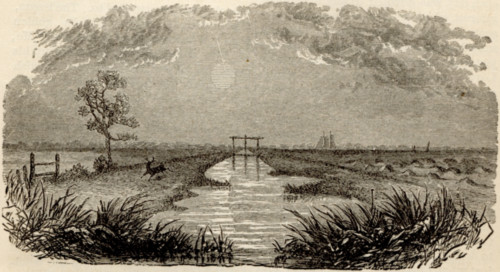
A RICE PLANTATION.
THE WORK AT FLORENCE, ALA.
BY REV. W. H. ASH.
The closing year has been peculiarly blessed. We commenced with dark clouds over our work in the beginning of the year, but ere the work was well started they proved to contain blessings. The good which the Association, under God, has accomplished here for the poor, is only seen vividly as we compare the results of the present year with those of four years ago. Then we had no church edifice; begun a day-school with three scholars in an old shell of a building for a school-house; the Sabbath-school had about ten scholars. Now we number nearly forty. Since that time a beautiful chapel has been built and a snug parsonage, and we now have an enrolment of seventy scholars in the day-school.
Some of our pupils have passed a very satisfactory examination before the Board of Examiners, and received certificates to teach in the public schools this summer. Our work has grown this year more than ever in the favor and confidence of both white and black. I believe that the good effect of the closing exercises will make the school very large next fall. One pleasing fact in connection with the exercises was the young organist we presented to the public. Ours is the only colored church here that has an organ, and my wife is the only colored woman, so far as I know, in the county, who plays the organ. Now that she has taken one of the girls and taught her how to play, one of the colored churches has ordered an organita for its Sabbath-school.
Another fact of interest is that the county Superintendent of Education has consented to give to our school a portion of the public money, so that we may teach it as a public school.
The interest of the church and school has been very much increased by a fine bell, given by Mr. F. W. Carpenter, of the Central Church, Providence, R.I., also a beautiful communion service, presented by the ladies of the same church.
We have received a barrel from the ladies of the church at Yarmouth, Mass. Many of the pieces will go to assist a poor girl who intends entering Fisk University next fall.
We have received a box from Rev. C. L. Woodworth, which enabled us to help worthy ones in the Sabbath-school.
My wife has planted a flower garden in front of the parsonage. I have planted a vegetable garden, which has given me an opportunity for physical exercise. We have every variety of vegetables, and as fine as I ever saw anywhere. My white potatoes are particularly fine.
VISIT TO TOPEKA.
BY GEN. O. O. HOWARD.
On last Sabbath, at 3 P.M., by the invitation of your missionary at Topeka, Rev. Mr. Markham, I visited the Tennessee Mission and participated in the exercises of the occasion. I found a large meeting room filled with young people, with a sprinkling of older heads.
I had seen some thirty girls, with perhaps half as many boys, over at the S. S. Convention Park. They had stood behind me on the platform Sunday morning and backed me up with their inimitable melodious songs of Zion. The large multitude of people—perhaps a thousand—were touched by their enthusiasm, where a little of art has not robbed nature of her best effects. So here again I find the same bright, happy faces and more of them.
Many of the regular school exercises were set aside for my address. They sang “Hold the Fort,” and others of Sankey’s collection, with spirit. The young lady who teaches them, Miss Gerrish, is remarkably faithful, full of tact and good sense. Your missionary himself interested me a good deal. I saw him first at the young men’s rooms at a prayer meeting. He gave a little personal experience, showing how a child comes to the Master’s arms. Professor Stearns, of Washburn College, spoke highly of his disinterested work at the mission. He has worked great changes for good. The people, for the most part, own their houses and lots. Some houses are very neat. One soldier’s wife said: “Yes, this little stone house is mine. My husband is a common working man. Yes, we have paid for the house. It is little, but, you know, there is nothing like home, if ’tis only so small!” Her husband had been through the war near me. On Sunday, every child was well dressed, and generally the blacks had as good clothing as the whites. I urged these good people, who are struggling up into respectable ways of living and moderate prosperity, to stand up for the Lord, that He may bless them more and more.
WHAT THE STRAWBERRY-BED DID.
Rev. A. Connet, of McLeansville, N.C., tells the story. Last year we canned 12 gallons, and the people stared. This year we have canned 20 gallons, sold $11.39 worth and have had all we wanted to use for the last 35 days. A white neighbor whom we feasted in the patch, and whose children were also fed on berries, said, “You have astonished the natives.” Ours are the only cultivated strawberries in this neighborhood. Now for the fruit. 1st, a new industry. Example is contagious. A number, some white and some colored, have spoken to us for plants. 2nd, the strawberry-bed is helping to bridge the social chasm. Some of our white neighbor ladies called on us in strawberry time. 3d, the children have just come in with a basket of cherries and a lot of dewberries given them by the man whom we feasted in the patch.