THE FREEDMEN.
Reading edition
REV. JOSEPH E. ROY, D.D., Field Superintendent, Atlanta, Ga.
ANNIVERSARY REPORTS.
ATLANTA UNIVERSITY, GEORGIA.
BY REV. C. W. FRANCIS.
Unless you could look through our eyes you would not know, from a formal record of the closing exercises of our school, how much interest and hope and pathos are crowded into these busy days.
On Sabbath morning, June 11th, President Ware preached to a crowded audience, the sermon to the graduating class from the text 1 Tim., 4th chap., 8th verse, giving a forcible presentation of the thought that right doing is profitable in all respects, for this life. The examinations were continued for three days, and were attended by a committee of the Board of Visitors, appointed by the Governor of the State, who, at the close, made to him a highly favorable report, which has been published with his approval. Two evenings were occupied by the exercises of the two literary societies of the school, which were favorably received by good audiences.
On Thursday, the commencement exercises were held at Friendship Baptist Church, one of the largest in the city, kindly placed at our disposal for this purpose, which was filled with a closely packed audience of about 2,000 people, well dressed, orderly, attentive, and evidently having a personal pride in the results exhibited. The appearance and conduct of this commencement audience in successive years affords a good indication of the steadily improving condition of the mass of the people, viewed with great satisfaction by friends who have opportunities for comparison.
A class of twelve was graduated, ten young women from the Normal course and two young men from the College course, all of whom presented pieces which received much commendation for their simplicity, directness and good sense.
The annual address was delivered by Rev. E. W. Bacon, of New London, Conn., and was a forcible and eloquent plea for self-education, which was singularly appropriate to the circumstances of the young people just leaving school, to whom it was primarily addressed.
Two members of the class which was graduated, had, during the year, been called away from earth, as well as five from other classes, being an unusual number of deaths in one year. A precious work of grace was enjoyed during the year, and more than thirty professed conversion, of whom fifteen united with the school church. All the members of the graduating class were professing Christians, which may also be said of nearly every class which has been graduated hitherto.
As an evidence of the increasing favor with which this school and its work is regarded in the community, there may be appropriately quoted some of the remarks of Rev. C. A. Evans, of the M. E. Church South, pastor of a large church in the city, formerly General in the Southern army, who spoke at the close of the class examinations: “I did not expect to say a word, but I comply with an American habit of making a speech whenever called upon. I am a Georgia man, and my children are all Georgia born, and I wish them all to stay here. It is a kindred wish that every one of you may remain a citizen of Georgia. I also wish that the friends who have come from afar to be your instructors shall not take to themselves wings and fly away, but shall settle in this grand old State, and their children after them. There is no enmity between the white and colored people in this State. There is a growing desire of the white people, as you will find, for your welfare. They are anxious that you should have the best in social life, the best in intellectual life, and in moral life, to which you can attain. The State is benefited by good citizens, and God is glorified by true manhood. I have looked upon these exercises with great interest as a fellow citizen, expecting to live with you and to come into contact with you in a thousand ways. I am glad for all I see and know.”
Remarks in a similar strain were made by several other prominent gentlemen in attendance.
Extracts From Report of the State Board of Examiners.
We do not believe that we have ever seen better teaching than we find done at the Atlanta University. Evidences of the same thoroughness appeared in all grades of the grammar school and throughout all the classes of the higher departments.
We were particularly struck with one feature in the method of instruction adopted in this institution, and that was the accuracy of the language in which every question was required to be answered. The answer is not only to be given correctly as to substance, but it must be expressed in words both grammatical and appropriate; if not, the pupil reciting is asked to correct it, and if unable to do so, it is passed to others of the class.
Your committee noticed another feature in the management of the university to which they desire to call your attention as worthy of high commendation, and that is the manual labor training that is here afforded in connection with the literary course. Every student, male and female, is required to work an hour each day at some useful labor, either on the farm connected with the institution, or in the household and kitchen department. The tendency of this regulation is not only to greatly reduce the expenses of board, etc., but to induce habits of industry, and impart valuable practical information for everyday use in after life. The farm, including the beautiful grounds immediately surrounding the college buildings, contains about sixty acres, and is under the direction of a thoroughly practical and energetic gentleman who keeps everything in admirable order and brings out the best possible results. Specimens of field and garden crops, embracing a great variety of grasses and forage plants, cereals and vegetables, were exhibited to your committee, evincing great efficiency in this department. Samples of the culinary art were also shown us, and if our eyes and our palates did not deceive us, they reflected great credit on those who prepared them for our inspection and entertainment.
Special contributions have been obtained for the establishment of an industrial department for instruction in the more useful trades.
“Stone Hall,” the gift of Mrs. Valeria G. Stone, of Malden, Mass., is in process of erection. Other new buildings are projected for the coming year.
At a recent meeting of the trustees of the university, a resolution was passed to institute forthwith a post-graduate course of two years for graduates of the normal department. Its privileges are to be open to those who have maintained a high standard in the regular course, and who give promise of efficiency in work for which this special training is designed to fit them, and the preference is to be given to graduates of one or more years standing. This course, while not neglecting intellectual culture, by providing for courses of reading and for attendance upon recitations and lectures, and for practice in teaching, is to provide special training in nursing the sick, sewing, cutting and making of garments, care of household affairs, the inauguration and management of mission work, and in general whatever training seems likely to prepare young women of culture for the responsible duties of actual life. At the same meeting the trustees directed the executive committee to select as soon as practicable a suitable person as principal of this course of study, who shall also be matron of the family of young women who may be gathered for this purpose; and they are further directed to prepare plans for the suitable accommodation of such a family.
The trustees also voted that an industrial department for boys be at once organized, which shall provide for training in carpentry and other mechanical work; and the executive committee were authorized to make the necessary arrangements.
TALLADEGA COLLEGE, TALLADEGA, ALA.
BY PROF. GEO. N. ELLIS.
The prelude of our twelfth anniversary exercises came Friday night, June 9, in the form of a school exhibition by the lower departments, consisting of declamations, recitations, concert exercises, etc. This was something new and drew a large and appreciative audience. The participants came attended by a throng of relatives and admiring friends, and the programme passed off in a manner creditable to all.
In lieu of the usual baccalaureate sermon Sunday morning, Rev. Edward W. Bacon, of New London, Conn., delivered a missionary discourse. To his mind, a missionary was not a religious drummer nor a mere itinerant preacher. He was a settler, locating in a community, growing up with it, molding its moral, social and religious life. To the young colored men of America, educated and consecrated, no field offers grander opportunities for distinguishment, in these respects, than does long-neglected Africa. Mr. Bacon said his object was to induce some one to become a missionary. His able and practical sermon will not be barren of results; and when the call for workers shall come, Talladega will respond with her quota.
At night President De Forest gave one of his practical talks to the students about to go out for the summer. It was crowded with good advice, plainly put, and will not be forgotten.
Monday, Tuesday and Wednesday forenoons public examinations were held in the various departments. They seem to have passed off satisfactorily to examiners, examined and visitors. One of the latter who spent his whole time in seeing and hearing as much as possible said: “I have not been into an examination which does not reflect credit on teacher and scholar alike. Everything shows that most excellent work has been done.” Theology is still the high water mark of scholarship, but the “small Latin and less Greek” of the institution are gradually rising and are not to stop short of the line of a full college course. There is a good deal of “back-water” waiting to be turned into these channels as soon as they are properly enlarged.
Wednesday afternoon occurred the prize declamations and essays.
The evening entertainments for the week were, on Monday night, a scholarly and uplifting address by Rev. Mr. Bacon upon self-education; on Tuesday night exercises by the young people’s literary societies, which showed commendable efforts in the way of self-improvement; on Wednesday night, the usual church prayer-meeting, one of the most enjoyable of all our Commencement gatherings; and on Thursday night, a concert by the Musical Union who rendered the Cantata of Esther, the Beautiful Queen, to the satisfaction of a densely packed house and with an income to the Union of nearly fifty dollars which they pledged for a new piano.
Talladega sends out no graduates this year. Though according to previous standards, students were ready to receive their diplomas both in theology and normal studies, they voluntarily chose to spend another year in further preparation for life’s work. The exercises of Thursday morning consisted of eight orations by representatives (four each) from the college preparatory and theological departments. In discussing standard and current themes, they showed a grasp of thought, a clearness and vigor in presentation certainly far from discreditable to any public rostrum. We were proud of them. A little further mental discipline in mathematics and the classics and they will be well prepared leaders of their people.
At these various exercises more than the usual number of visitors were present. During some of the examinations in the chapel the room was fairly filled with listeners. Upon the platform were leading white citizens of the town, and some from abroad. Among the latter were Rev. O. W. Fay and Judge Buckley, of Montgomery, who spoke most warmly of what they saw and heard.
Talladega College looks back upon the year just closed as the most prosperous one in her history. It has seen new buildings reared, others repaired, greatly needed improvements made, and a fair beginning in the way of endowments; to the many friends throughout the North whose gifts have caused these things to be, we are unspeakably grateful. It has seen most thorough work done in all departments of study, more than a score of its pupils confess a newly-found Saviour, and much activity in mission and Sunday-school work on the part of the more advanced. Already many applications for another year are coming in.
STRAIGHT UNIVERSITY, NEW ORLEANS.
BY W. S. ALEXANDER, D.D.
Our commencement began properly with the examination of the Law Department, and the graduation of eleven law students. The list of graduates from this department now numbers 50 names, of whom 43 have been awarded their diplomas within the last six years. It is an interesting fact that of our 50 law graduates 35 have been white and 15 colored. Side by side they have been gathered in the lecture rooms of the Professors, and have met in the crucial test of the final examination.
The Faculty is admirably constituted both on account of legal attainments, and real genuine interest in the young men. Four lectures are given each week. The prospects for the incoming class are excellent, both as to numbers and quality, the white element predominating as usual.
The great need of this department is a reference library. Many of the students are poor and law books are costly. Now the professors, though at great inconvenience, permit the students to consult their standard works. When we have a building devoted to the three professions, the law library should become at once an accomplished fact.
This year in the academic department we had no graduating class. Our anniversary exercises have been somewhat out of the usual order, but thoroughly interesting and successful. Perhaps never have we met the popular taste more fully than this year. The old graduates were invited to return and take part in the first public anniversary meeting of the Alumni. Seven accepted the invitation and entered heartily into the project, and others sent the cordial expression of their regrets.
The meeting was held in Central Church. A large and intelligent audience was present, and entered fully into the spirit of the occasion.
The orations were exceedingly well written and delivered. The oration of Rev. A. E. P. Albert, a graduate from our classical and theological department, on the subject, “Senator Jones’ speech, or is there to be a war of races?” was a surprise even to Mr. Albert’s friends, on account of its brilliancy, its vigorous thought and sustained eloquence. It is to be published in full in one of our city papers, and I wish all unbelievers in the mental capacity of the African would read it and pass upon its merits.
Wednesday noon occurred the Literary Exhibition in the University Chapel. What a storm raged without! It seemed as though the flood-gates were opened. We had it almost entirely to ourselves, only a few good friends venturing to face the tempest. The orations, compositions, dialogues, and select readings evinced decided talent in writing and speaking.
In the evening a concert was given at the church, with a few literary exercises. The musical programme was judiciously arranged, and was thoroughly appreciated by an audience of six hundred people.
The year has marked an advance in scholarship, and the University has acquired a firmer foothold in the city and state.
If we are quick to discern and seize upon opportunities of enlargement, the immediate future will furnish abundant room for the employment of busy hands and devoted hearts.
TILLOTSON INSTITUTE, AUSTIN, TEXAS.
BY JUDGE C. T. GARLAND.
The Tillotson Collegiate and Normal Institute has closed its first full year since the building of Allen Hall, and its Texas friends are full of congratulations on the progress made.
The Baccalaureate Sermon on June 4, by President W. E. Brooks, was listened to by a large and attentive audience, and was peculiarly happy in its adaptation to the occasion, and to the financial, intellectual and spiritual interests of the colored race.
On June 5 and 6, occurred the examination of the classes. Listening to these students, and considering the time they had spent at school, one could not see that they exhibited that mental inferiority so often attributed to their race in the past. Let one instance suffice. I was so much struck with the solid intellectual qualities of one young man, a coal black negro, that I sought him out and advised him to study law. Conversation with him elicited the fact that his only schooling of account had been during the last five months at the Institute, while his attainments would indicate a good common school education, such as is ordinarily the work of ten years.
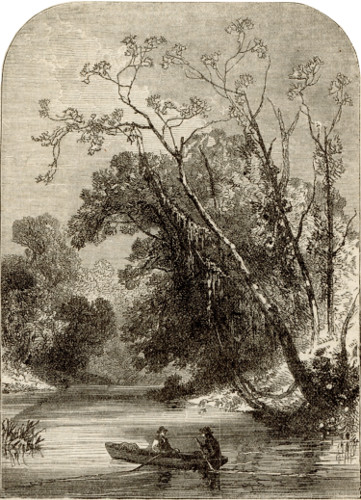
VIEW ON BAYOU AT HOUSTON.
On the evening of the 6th, a crowded audience being in attendance, there were declamations and readings, with vocal and instrumental music at suitable intervals. Then came addresses by Rev. Dr. E. B. Wright, a trustee of the Institute, and by other prominent clergymen and educators. The evening closed with a general reception in which visitors, students and faculty gave themselves up to a happy hour of congratulations and whole hearted social intercourse such as colored people so much delight in.
On the 7th inst., essays, declamations, readings and music were listened to with unwearied attention by another large audience, including many distinguished visitors, who stayed from the beginning to the end of the exercises.
The oration by A. S. Green, on “The Possibilities of Our People, and how they may be realized,” was received by the audience with special interest. At the conclusion of the exercises, addresses were delivered by Gov. O. M. Roberts, Ex-Gov. E. J. Davis, and other leading citizens. All the speeches were of deep interest, and whether from Democratic or Republican lips, they were alike full of appreciative good will toward the noble work done by such agencies as the American Missionary Association. In particular, I wish space and memory would permit me to write out for publication, every word uttered by Govs. Roberts and Davis, but their words on paper would convey but a feeble impression of the interest and emotion exhibited by them. As might have been expected from an audience largely colored, the addresses were listened to with breathless attention, except at intervals marked by hearty, though decorous, applause.
A noted feature of the exercises was the good elocution of the students, resulting mainly from the brief training received at the Institute. To one accustomed to the old time thick and indistinct plantation pronunciation, the change seemed indeed wonderful.
Those who had seen the students at the beginning and at the end of the term remarked a striking improvement in their personal appearance. Intellectual, moral and spiritual culture had impressed its stamp upon their countenances and was exhibited in their deportment.
Throughout the year much interest has been shown in the Tillotson literary and temperance societies. Their meetings have been numerously attended by the people of Austin and its vicinity, which has added to their zest and usefulness.
It need not be said that the moral and spiritual welfare of the students has all along been closely looked after. If any one of them of fair ability does not go out from the Institute a thoroughly trained Sunday School teacher, it will be his own fault and not that of President Brooks. Happily, both students and outsiders have shown great interest and appreciation in their attendance on the Sabbath services at the institution.
NORMAL SCHOOL, WILMINGTON, N.C.
BY MISS A. C. CHANDLER.
The examinations at Wilmington Normal School closed Thursday, June 1. Notwithstanding the inclemency of the weather, quite a number of interested parents and friends came in to inquire and see for themselves what their children had been doing for the year. After listening to various recitations and exercises, they expressed themselves highly gratified.
Friday evening the annual exhibition took place in Memorial Hall. About 400 were present.
No special attempt at decoration was made, yet the stage was not wanting in floral adornments, two large, tall baskets of handsome flowers standing one on each side. The wall back of the stage was prettily and tastefully decorated with green boughs, moss, and a little white drapery.
At a little past eight o’clock the school marched into the hall, and took seats as near the front as possible. The children made a good appearance, being neatly and some of them very prettily dressed.
The programme consisted of about twenty parts, interspersed with good music. The selections specially attractive were the cantata, “Grandpa’s Birthday,” three recitations upon the subject of temperance, a concert declamation entitled “A Leap for Life,” given by seven young men, and the recitation, “Auction Extraordinary.” Some of the pieces given by the little folks were very pleasing. The selections were all well rendered, and won many complimentary remarks from those present.
Rev. Mr. Dodge being called upon, responded with a few well-chosen words appropriate to the occasion, after which the benediction was pronounced.
LE MOYNE INSTITUTE, MEMPHIS, TENN.
BY PROF. A. J. STEELE.
The close of the year brings us also to the close of the first decade in the history of Le Moyne Institute. The founder of the school has gone to his reward and his works do follow him. The institution which he founded is but at the beginning of its usefulness and of its possibilities. This year we graduate a class of ten from the full course (four years), the largest class yet sent out, and the fourth. Thus far the graduates of the school, excepting one only, have taught almost continuously since completing the course. The ten members of the present class will teach; some of them expect to pursue their studies further at Fisk University, after working a year for the means.
The public exercises at the closing this year were unusually interesting, judging from the attendance, not only of colored people, friends of the graduates, but also of prominent white families of the city. Formerly gentlemen of this latter class only came, now quite as many ladies as gentlemen are seen in the audience that fills and overflows the church. I do not suppose that of the many who read this account, even those who look back to the joys and excitements of “graduation” can realize just what that word implies to our students here, with the memory of their past and with the difficulties of their present and future in mind.
To receive the diploma with its ribbon and “broad seal” and formal address, to listen as the principal parties interested to the “annual address” by the “Judge” or “General” or “Colonel” as the case may be, and it is sure to be the one or the other of these, to sit on the broad platform, to receive flowers and flowers, to be cheered and complimented and envied by admiring friends—we all know what these mean to a “graduate.” For my part, and for yours, too, dear readers, I know it is a matter of rejoicing that in all our land there is not a youth who may not hopefully look up and forward to the enjoyment of these things.
I should not have taken so much of my space for this part of my letter, for I have little now left in which to tell of the every day experiences and work of the year. How for want of room and accommodations we have, during the year, had to turn away over fifty pupils who applied in person for admission; how a more regular and steady attendance has told for good on the scholarship and work of the school; how the Spirit blessed us in the conversion of not less than thirty of our pupils.
In all our successes, as in all our discouragements, the good hand of our God has been upon us, and we rejoice in it all that we see His work going forward and yearly gaining new triumphs.
Our outlook for the coming year is most assuring, and our only serious difficulty would seem to be want of room for all who come to us. Our building must be enlarged.
LEWIS HIGH SCHOOL, MACON, GA.
BY REV. S. E. LATHROP.
The Primary Department closed on Friday, May 26. The little folks did well with their songs and speeches, and were neatly dressed. There are some funny things among them sometimes in regard to names. For example, Lily White was a coal-black Ethiopian. This department has been crowded into a low basement room in the Teachers’ Home this year, for lack of accommodation elsewhere. We all rejoice with teacher and scholars that there is hope of more roomy quarters next year.
On Saturday, the 27th, was the closing exhibition of the Sewing Class, under charge of Mrs. Lathrop. Seventy-six girls this year have been in the class, meeting on Saturday forenoons. Friends in the North have helped by contributing patchwork, basted garments, etc., and the girls have been taught plain sewing with the making of mottoes, bookmarks, etc. Only sixteen sessions were held, but the amount of work accomplished was surprising. There were displayed in the main school room eighteen patchwork quilts and one hundred and twenty-one finished garments, dresses, aprons, underclothing, etc., all neatly made, and showing decided improvement in sewing. There were some short readings, recitations and singing, and then a few brief talks from Prof. Hodge and others, and afterward the garments were distributed to those who made them, amid thankful hilarity.
On Monday and Tuesday, 29th and 30th, were held the closing examinations. These were more rigid and thorough than for a long time before, but the classes generally did well, and acquitted themselves with much credit. During the year there have been held monthly examinations, and the classes have been more thoroughly graded than ever, so that there will be less confusion than usual in opening the next school year. Quite a number of visitors were in attendance, both white and colored. Rev. B. F. Breedlove, pastor of the largest Southern Methodist Church in the city, was present a part of the time, and publicly expressed his gratification and commendation of the work done.
On Wednesday, the 31st, occurred the closing exercises, beginning at 9 A.M. The school went through with their essays, declamations, dialogues and songs in a way that reflected credit upon them and their teachers. The church was well filled with spectators of all colors. Three students received certificates of graduation from the High-School course, and these will probably go to Atlanta University or elsewhere in the fall. After the programme was finished, some of the visitors were called on for speeches. Hon. Felix Corput, Mayor of the city, responded in few but commendatory words. Hon. B. M. Zettler, County Superintendent of Schools, made quite an extended address, with somewhat of eulogium and considerable of good counsel. Rev. E. J. Adams, a colored Presbyterian clergyman from Baltimore, a man of fine education and ability, made an excellent address. He spoke very highly of the great educational work of the A. M. A., in whose service he has himself labored, as a missionary in Africa, and also in this country. Mr. J. J. Clay, a prominent white citizen, spoke with much apparent sympathy and earnestness, commending education and the work of our school. There were several other short speeches from former students or patrons of the school, all showing deep interest in its work.
On Wednesday night came the grand finale in the shape of a closing concert, conducted by our music teacher, Miss Jennie Woodworth. Although the night was very rainy and stormy, the church was full, with quite a number of white people, who expressed their great gratification. The singing was good, and the concert well carried out to the end, showing decided musical ability on the part of all in solo, duet and chorus singing. Mr. Derry, a friendly white citizen, made an impromptu and voluntary address, full of real sympathy and kind words. The daily paper printed a flattering report of the concert, and of the whole work of the school. Public sentiment in this respect is becoming more and more friendly.
We are glad to report that both school and church have prospered during the year. The total enrollment of students is 199, and we rejoice to know that additional school rooms, so greatly needed, are to be provided before another year begins. Fifteen or twenty of the scholars were converted during the precious revival in March last. Quite a number will engage in teaching during the summer, and several will go to higher institutions of learning in the fall.
“PINE GROVE COLLEGE,” KENTUCKY.
BY REV. B. H. FAIRCHILD, D.D.
In Jackson County, sixteen miles from Berea, there has long been a church called Walnut Chapel, similar in character to the church at Berea, and connected with the same association. A few families, slightly colored, have always lived among them, belonged to the same church and attended the same school. Indeed, their minister, the most prosperous man among them, and long a trustee of the public school, was said to be slightly colored. Another minister, who preached to them a few years, exhibited more signs of color. In this neighborhood lives Robert Jones, who, in 1856, was whipped by a mob, thirty-three lashes on his bare back, for being a colporteur of the American Missionary Association, and for sustaining Mr. Fee in one of his meetings. Four of the old man’s sons live about him; one is a preacher, as is the father himself.
When the colored school law was passed in this State, their harmony was disturbed. It is made unlawful “for any colored child to attend a common school provided for white children or for a white child to attend a common school provided for colored children.” This utterly deprived the colored children of school privileges, for there were not enough of them to organize a school district, and there was no prospect that there ever would be. In this emergency the church asked advice of the Association. After due deliberation they were advised to build a good school-house that should be open to all children of the neighborhood, and let the common school take care of itself. Aid was promised them, if it should be necessary.
The community accepted this advice. A plan of a school-house was furnished them, and a promise made that if they would build according to that plan, they should have a good teacher the first six months without expense to them. The school-house was to be 25×30, 12 ft. from floor to ceiling, with four large windows, two doors, and good seats and desks for 60 scholars.
This was a great undertaking, unheard of in that region. There was no house equal to it in the county, for schools or meetings. But enthusiasm was developed, as the work went on, and culminated at the dedication on the 26th of June. Three times as many were present as could be crowded into the house, and so great was the rush for the school it was necessary to publish that only sixty could be admitted. The children of those who aided in building the house were to be admitted first, but must make application within three days. At the end of the three days nearly a hundred applications had been received.
Before the dedication the people had, in some way, named the school “The Pine Grove College.” They were advised to drop the name college, as their most advanced students would never get within two years of college. But names are not easily dropped, and this seems destined to endure.
Miss Maria Muzzy, an experienced teacher, one of Berea’s corps, had been engaged to take the school. Very frequently she was warned by good friends who knew the mountain people and Kentucky habits that there would be no safety for her in that school, she would surely be mobbed, no lady should be asked so to expose herself, she should not think of staying a night without a pistol. She almost feared that it was a rash undertaking. But calmer counsels, with trust in God, sustained her. No indignity was ever offered her, and no one ever had more friends among such a people.
At the close of the first week she wrote to Berea that she hadn’t the heart to turn away so many, and asked for an assistant, who should exchange with her in teaching in the woods. This arrangement was made; and for two months a part of the school was in the house and a part in the grove. The assistant was Miss Kate Gilbert, another of Berea’s corps of teachers.
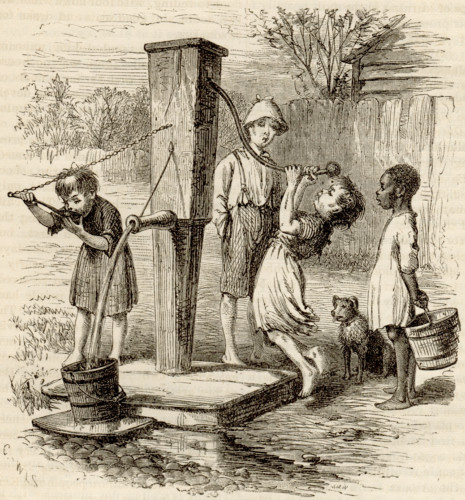
FAMILIAR SCENE IN LOUISVILLE, KY.
She offered to forego her summer vacation, and teach in the woods, with no promise of compensation.
Not the least difficulty was to find a boarding place for the teacher. A lady who was to teach eighteen months in succession without a vacation must be taken care of. Not a room could be found in the neighborhood, with a window in it, which she could have to herself.
A man was found who needed a new house, and for an advance of $100, for a part of two years’ board, built a log house near the school-house and furnished her a room fifteen feet square, with two windows, and a lock to her door. There is no other such room in all the region.
The school closed grandly and beautifully, with an examination and an exhibition.
But the common school was abandoned for not a pupil could be found to attend it.
The following are the friends who furnished the money for this important enterprise. I thank them most heartily for their promptness and liberality:
Asylum St. Church, Hartford, Ct., $50.00; Euclid Av. Church, East Cleveland, O., 50.00; First Cong. Church, Cleveland, O., 21.25; Mrs. Mary H. Penfield, Rockford, Ill., 50.00; H. Ford, E. Cleveland, O., 8.00; Mrs. A. A. Brakenridge, Cleveland, O., 6.00; Miss Lucy A. French, Cleveland, O., 6.00; Frank Fairchild, Mt. Vernon, O., 20.00; Mrs. S. E. Bosworth, for Ladies’ Benev. Soc., Elgin, Ill., 15.00; Mary I. James, Brooklyn, N.Y., 30.00; F. S. Sessions, Columbus, O., 25.00; Cong. Church, Muskegon, Mich., 25.00; Sunday-school class of girls, Brooklyn, N.Y., 10.85.
For special reasons of a local character, it became necessary to find a benevolent man who would purchase 150 acres surrounding the school-house. Rev. Wm. Kincaid, of Oberlin, is the good man who takes it at $1.50 per acre.
The house is situated on a lofty ridge, six or eight miles long, the route of the main road in that part of the county, but over which a team does not pass more than once a week, and there is no house in sight of the school-house.
The school is managed by trustees, one of whom is a professor of Berea College, and the present pastor of Walnut Chapel Church, to which he preaches once a month, in the school-house. There is no other school in the county fit to qualify young people for teachers.