THE FREEDMEN.
Reading edition
REV. JOSEPH E. ROY, D.D., Field Superintendent, Atlanta, Ga.
ANNIVERSARY REPORTS.
HAMPTON INSTITUTE.
BY REV. H. B. FRISSELL.
Anniversary day at Hampton was cool and comfortable. The steamers from New York and Boston for several days previous had been bringing the friends of the institution from the North, and the morning of Thursday, May 25, found a good number assembled to witness the anniversary exercises.
At 8.30 A.M. the battalion was drawn up in front of Academic Hall and the regular morning inspection was held by the U.S.A. officer who has charge of the military drill of the school.
The students and visitors then passed to the large assembly room of the New Academic, where morning prayers were held and the news of the day was read. The rest of the morning was spent in visiting the classes and looking at the various industries. The Indian classes claimed their full share of attention, and showed an improvement in the advancement and general character of the pupils over last year. The kitchen garden, the cooking class for girls and the class in the new “tonic sol fa” system were filled with visitors. The training class, where the seniors had a chance to show their skill in teaching a row of ten urchins brought up from the primary school, was one of the features of the day.
The new stone building erected for the industries of the school with the money given by Mrs. Stone showed this department to the best advantage. The shoe shops, the printing establishment, the tailoring and knitting department have gained a new impulse, now that they have gotten into their large new rooms. The saw mill, the harness-making shop, the tin, carpenter and wheelwright shops were all in full blast.
After a pleasant lunch in the “Stone building,” the procession, headed by the trustees and re-inforced by a large party from Norfolk, made its way toward Virginia Hall, where the graduating exercises were to be held. In a few moments the large hall was crowded. A few words from Gen. Armstrong explained the change in the graduating exercises inaugurated the previous year, by which the speakers of the day were for the most part members of classes that had graduated in previous years, and had come back to tell of work done and experience gained. Only two speakers, the valedictorian and salutatorian, were from the class of ’82. This change of plan has been found to work well, and has made the exercises of the last two years especially interesting.
The speeches of the afternoon were, for the most part, full of practical common sense, plain, straightforward accounts of work done and the difficulties and discouragements met and overcome. The salutatory, delivered by one of the girls of the graduating class, told of the missionary work which the students had done among the poor people of Hampton, of the Bible reading in the miserable cabins, and the help which they had been able to bring to those in distress.
“My Home” was the title of a very interesting piece by one of the girls, in which she described the condition of affairs among the colored people in one of the western towns of Virginia. “To the Girls” gave the graduating class and the audience the wisdom which had come from a year’s experience in the world. Thos. Wildcatt Alford, a young Indian chief, made a strong plea for the education of his people. He said that one educated Indian could do more for the benefit of his people in one year than a regiment of soldiers in ten years. He spoke hopefully and bravely of the future of his race, and of what he meant to do for it. He is one of the three Indians who graduated with the present class, the first who have finished the regular English course of the school.
“Our Race,” by one of the early graduates of the school, told of the discouraged feeling which he had when he arrived at Hampton and found that most of the students had to work hard with their hands every day. He showed of what advantage that same training had been to him, of how he had been able to build his own school-house. He spoke of lack of industry as being one great obstacle in the way of the success of the colored people.
Between the speeches, the great chorus, massed in the front part of the hall, swelled out in the national hymns of the different countries and the pathetic slave songs so full of power and feeling. After the valedictory, Rev. Dr. Strieby, the President of the Board of Trustees, presented the diplomas to the graduating class with appropriate remarks. Sixty students came forward to receive their diplomas. The present class is much the largest that has gone forth from the institution.
After the parting hymn had been sung by the class, Rev. Dr. Bartend paid a glowing tribute to the school and to Gen. Armstrong’s work. He said: “For many years after the beginning of this institution, we were accustomed in this part of the country to speak of the Hampton school as an experiment; to-day, by the help of Almighty God, we can say that Hampton school is a magnificent success.” He spoke of the work that was being done for the colored race, of the manly characters that were being developed by the school training. He referred to the Indians, and especially to the speech which one of them had made. He spoke of the intention of the early settlers of the country in regard to them. “Two hundred and fifty years ago there came floating into this beautiful harbor vessels from the old country. What was their object? What was their hope? The prayer that arose from their decks was this: God give us strength that we may educate and Christianize the Indian. William and Mary College, now almost ready to perish, is the monument of their endeavor. They did not see the answer to their prayer. God works in His own way, in His own time, with His own men. Could they see what we to-day behold, they would say as do we, speed on! God speed this glorious school. God bless its patrons that we may raise up good citizens here and glorify God forever and forever.”
The closing remarks were made by Rev. Dr. Burrows, of Norfolk, in the course of which he said that he had often heard of the institution, but the half had never been told him. When the crowd poured forth from the hall, the sun was far down in the west and the steamer was waiting to take away some that had brought much of brightness and cheer to our anniversary day.
FISK UNIVERSITY, NASHVILLE.
BY MRS. L. A. SHAW.
Commencement week, crowded with exercises representing the treasure accumulated by a year’s labor and overhung with the joys and sorrows usually attending such occasions, has just closed. Nearly two weeks ago “the last things” commenced, and the sadness of parting from friends began to settle down, tempering the joy of having completed a year’s work.
Friday, May 19, the first public exercises were held. A class of thirteen, having completed the Common School Normal Course, gave an exhibition and received certificates of fitness to teach the common English branches.
Sunday morning Prof. Bennett preached an appropriate sermon from Matt. 25:34. His delineation of the blessedness and glory of the saint’s inheritance in Heaven was especially attractive to tired teachers and pupils. The Baccalaureate sermon in the afternoon by President Cravath was from John 3:19. The darkness of the souls of those who engage in evil practices was so vividly depicted that deep and lasting impressions must have been made on many minds.
Dr. Haygood, President of Emory College, Georgia, delivered the annual sermon before the Missionary Society of the University. The speaker by his book, “Our Brother in Black,” has proven his interest in the colored people, and by his recent refusal of the office of Bishop in the M. E. church has demonstrated his loyalty to the choice made when he entered upon educational work. His sermon was listened to with close attention as he presented anew the setting apart and sending out of Paul and Barnabas on their first missionary tour.
On Monday, Tuesday and Wednesday, from 9 A.M. to 1 P.M., oral examinations of the various classes were conducted by their respective teachers. These were visited by quite a number of friends and strangers from different parts of the country, some of whom took part in the work by asking questions as opportunity was given.
Monday evening the two literary societies of the University held their anniversary exercises. In a debate between representatives of the two societies on the question “Should the State assume the payment of bonds issued in aid of railroads,” their ability to grapple and handle a living subject in a masterful and convincing manner was fully demonstrated.
Tuesday evening the Senior Preparatory exhibition, and Wednesday evening the graduating exercises of the higher normal department and the Alumni Address by John H. Burrus, were attended by large and enthusiastic audiences. Mr. Burrus is a member of the class of ’75. He described the “man for the times” in a way to inspire those preparing for usefulness. Four higher normal graduates received their diplomas, and ten from the Senior Preparatory class enter college.
Thursday, the “day of days,” to the two college graduates, dawned clear and beautiful. The audience assembled promptly at ten o’clock. The exercises opened with a number of distinguished guests on the platform. The music by the Mozart Society elicited much praise, as did the music given on other occasions by the same society. The two young men who were that day to take their degrees delivered their orations in a self-possessed and dignified manner that was a prophecy of future success. The subjects, “True greatness of republics” and “Atheism destructive of man’s nobility,” sufficiently indicate the line of thought.
The commencement address by Dr. Scott, President of the State University Columbus, Ohio, was worthy of the occasion, and crowned the whole with its beauty and grace of diction and the scholarly treatment of the hackneyed subject, Time. Music, sculpture and painting were beautifully shown not only to pay tribute to time, but to have their very existence in it. Words fail to describe the effect of the whole with the exquisite closing in the words of the poem, “I sat alone with my conscience.” It was remarked by one of the hearers, “That is the poetry of science.” After a few remarks by Gov. Hawkins and the Hallelujah Chorus by the Mozart Society, came the alumni dinner. At the table with the President and his wife were seated Gov. Hawkins, Judge Lawrence and wife of Nashville, Dr. Scott, orator of the day, Dr. and Mrs. Phillips of the Nashville Institute and the two new A. Bs. The other guests were seated at tables near the President. The after-dinner speeches by the Governor, Dr. Scott and Mr. Stewart, who is finishing the new custom-house, were evidences that “the world moves.” The Governor spoke of the solicitude he felt at the close of the war in regard to the future of the colored people and his questions as to what would really be the outcome of the struggle. He said, “The question has been answered. It is answered in the exercises of this occasion, in the intelligent faces before me. The tasteful decorations of these halls, these very walls themselves, have answered the question of doubters as to the elevation of the colored people.” His presence and remarks were well calculated to help on the good work of breaking down the walls of caste prejudice in which many minds are still inclosed.
Dr. Scott referred to the condition of things during and at the close of the war, in which he had a part. He expressed his delight in being permitted to see the growth and progress of the last seventeen years. His words of appreciation and sympathy were especially grateful to the workers. He reminded them that any institution which outlives the trying period of training and sending out its first graduates and of nourishing and giving strength to its first alumni was destined to live and grow. Alma Mater is a name dear to every good student, and Fisk University has a history and a future. The delightful exercises were brought to a fitting close by all rising and singing the doxology, “Praise God from Whom all blessings flow.”
TOUGALOO UNIVERSITY, MISS.
BY MISS J. KELLOGG.
The final examinations occupied three days, the 25th, 26th and 29th of May. The attendance of parents and friends increased from day to day. On Sunday a Sunday-school Institute was held and the attentive throng seemed about as great as the chapel would hold, but the absolute limit of its capacity was not reached until the exhibition, Tuesday evening, when the people were fairly wedged in. A beneficent down-pour of rain Wednesday morning prevented the crowd from being any greater on that day, and rendered the air so cool and pleasant that people did not suffer from being closely packed.
The Committee on Decorations had made the chapel very inviting with a fountain, motto and other devices. A class of six earnest, faithful Christian students, three young men and three young women, having completed the normal course, were to receive certificates. President Pope addressed his sermon to them Sabbath evening—his theme being Serving One’s Generation.
At 10 o’clock on Wednesday, the 31st, the commencement exercises began. As these young people have been, in accordance with the avowed aim of this institution, educated for usefulness in practical life, it was fitting that their essays and orations should be as they were, on subjects of every-day interest and treated in an intensely direct and practical manner.
The music was inspiring, especially the class song, composed for them by the Rev. B. A. Imes, of Memphis, a fine scholar and talented gentleman of their own race.
In presenting their certificates, the President gave them five “Remembers” from the Holy Scriptures, as his final charge to them.
In the afternoon the annual address was delivered by the Rev. Dr. Truman M. Post, of St. Louis. As I cannot reproduce it for you, I will only say that it seemed an address which must prove a strong lever to aid in the “Uplift of Character, Intelligence and Social Life,” which was his theme. Taking a sweeping glance at the providential dealings of God with races and nations, he came speedily to the problems which confront us in this our commonwealth; and, after pointing out that races or individuals can only be uplifted by their own exertions, cannot be raised but only assisted to rise by external aid, and that it is not merely duty, but godlike privilege for the stronger and more fortunate to render this aid to the weaker and less fortunate, he dwelt upon specific means of advancement and elevation, and pointed to a hopeful future.
There were but few white visitors present. Despite the rain, a carriage load of gentlemen came out from Jackson, and added materially to the interest of the exercises—Mr. Lemly, a trustee of this institution; Col. Power and Gen. Clifton, members of the State Board of Visitors.
The first-named gentleman is accounted a firm friend of the school, but can never be prevailed upon to evidence it by speech-making. The others spoke very kindly and entertainingly. In the close of his witty and eloquent speech, Col. Power, Editor of the Clarion, spoke of the progress he had witnessed in this school since its establishment, and expressed the hope that a few years hence the enrollment will have increased from a couple of hundred to a thousand, and that a spacious chapel will have been erected, capable of holding them all and their friends.
Gen. Clifton stated that in asking the Legislature for an increased appropriation for this school he had said that he believed it was doing more good than any other school in the State, and he could repeat that as still his conviction, because it is doing a work so vitally needed.
THEOLOGICAL DEP’T, HOWARD UNIVERSITY.
BY REV. W. W. PATTON, D.D.
Our theological anniversary exercises passed off very pleasantly May 5th. They were held in the Assembly Presbyterian Church, which is of convenient size and centrally situated. Though the weather was unpleasant, the attendance was good, both of the white and colored races, and included various persons of distinction. The number of theological students this year has been thirty, not including eight others, who study principally in the classical department. The graduates were five, connected with the Congregational, Presbyterian and Methodist denominations. Three go to the Southern field, and two look towards Africa. Their addresses were most creditable in matter and manner, and were warmly received by the audience. On behalf of the Washington Bible Society, Rev. Dr. Butler presented each of them with a neatly bound copy of the Holy Scriptures. Rev. Dr. Bullock, the chaplain of the United States Senate, made an excellent, practical address to them, on their coming life-work, and Rev. Dr. Craighead, Dean of the department, added some felicitous closing remarks. Owing to the endowment by Mrs. Stone, supplemented by the large aid of the American Missionary Association, and in a less degree by that of the Washington Presbytery, the Theological Department of Howard University is in vigorous operation; and we are prepared to receive and train young men, white or colored, for the Gospel Ministry of all Evangelical denominations.
AVERY INSTITUTE, CHARLESTON, S.C.
BY REV. E. T. HOOKER.
The public exercises incident to the closing of the school year at Avery Institute began Monday evening, May 29, with an exhibition by a portion of the intermediate department, under the charge of Miss Emma T. Miller. Though this was not a usual or most prominent feature of anniversary, it was enthusiastically received by one of the best audiences of the week, which have all been large and indefatigable. They were well repaid by the bright recitations, well-drilled singing and tasteful appearance of the pupils.
Tuesday morning, at 10 o’clock, began what is called “Children’s Day,” being a similar exhibition of accomplishments by the primary department, under Mrs. Brown and Miss McKinley, both natives of Charleston and of kindred blood with their pupils. The performances in dialogue, recital and music of these little ones did not differ from those in Northern schools of the same grade, which is enough to say both for the culture received and the faculty displayed. There were as many faces, too, of ideal childhood beauty, and obviously as much parental pride somewhere back of this their juvenile début, as if their race was not just making its début upon the stage of Saxon civilization.
Tuesday night saw a rendering of a lengthy and varied programme by the scholars of the upper grades not graduating. The News and Courier, in a report printed the next morning, says: “Of the essays it may truthfully be said that they were written with neat rhetoric and obvious originality; of the recitations, that they were given without a faltering of memory, and some with admirable distinctness of enunciation and winning hold upon the listeners.”
The regular Commencement exercises were held on Thursday, and attracted a large crowd of persons of both colors and was of more than passing interest. The stage was handsomely decorated, and above was the class motto, “Perseverance overcomes all obstacles.” After the essays, songs and choruses, the diplomas of the Institute were awarded to the three graduates by the Principal of the Institute, who took occasion to commend the graduates for their perseverance and to congratulate them upon their success. The Rev. E. J. Meynardie then delivered an eloquent address on “National Responsibility,” arguing that no civilization is perfect which is not founded upon the fundamental principles of revealed religion. He also claimed with justifiable pride to have been the first man in this city in antebellum days to advocate publishing the repeal of the prohibition upon schooling for the slaves. He spoke within A. M. A. walls evidently con amore. He is pastor of the Bethel M. E. Church South.
BEACH INSTITUTE, SAVANNAH, GA.
BY H. H. WRIGHT, PRINCIPAL.
The work at Beach Institute is taking on more definite shape. This year a class has graduated, and the course of study for the remaining grades has been brought into something like symmetry. The Savannah public schools graduate the colored pupils from the grammar grade, above which no provision is made for their education. For the white pupils, however, a High School is maintained. Hence the ambitious colored youth, many of whom are as fair as their white neighbors, turn hopefully to the “Beach” as a school which will give them what the city fathers have denied them.
The first of the public exercises which have just closed the academic year was a public examination, held Friday, May 26. The programme was the regular daily programme, so far as the order of classes was concerned, but the questions put were given at random and without previous preparation from the work of the entire year. By this plan, of course, a few failures occurred, but the visitors felt that they had seen the classes fairly tested, and their hearty commendation was duly appreciated.
The second public exercise was a sermon preached in the Congregational Church to the graduating class on Sunday evening, May 28, by the pastor, Rev. Dana Sherrill. His earnest words of advice to rise above county and State lines and become at least national in their views of life were fitly spoken and well received.
The third public exercise occurred Wednesday, May 31, beginning at 11 o’clock A.M. An extensive programme of declamations, dialogues and songs was rendered in a most satisfactory manner and listened to by a crowded house. The tables, the organ and the lamps were most tastefully trimmed with a profusion of flowers, the gifts of the pupils. Jessamines mingled their fragrance with that of the late-blooming rosebuds. Pond lilies and Spanish moss were enlivened by the æsthetic sunflower. Upon the platform, during a part of the exercises, were the Hon. J. O. Ferrill and Mr. Murray. The former is a member of the City Board of Education and a firm friend of the colored people. He has frequently advocated in the Board, but with only partial success, more extended facilities for their education in the public schools, and better salaries for the colored teachers. Mr. Murray is a representative of the Savannah Daily Recorder. In the audience were numerous colored men of influence, who happened to be in the city attending the Baptist Missionary Convention. The music was furnished entirely by the pupils, and included songs, quartets, duets, solos and two instrumental pieces. The exercises were closed by the graduation of a class of two girls. The diplomas were presented by the principal. Then the pupils rose at the touch of the organ, and striking up a march, “The Christian Soldier,” sang their way to their various school-rooms, and the year’s work was ended.
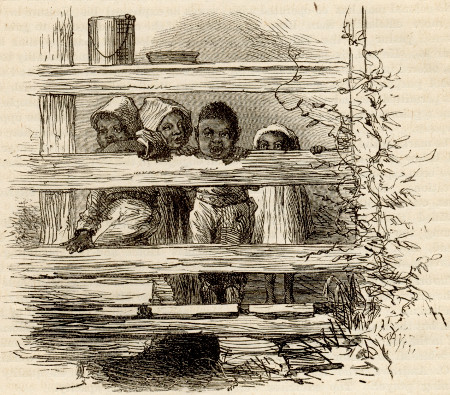
PEEPING THROUGH.
EMERSON INSTITUTE, MOBILE, ALA.
BY REV. O. D. CRAWFORD.
Emerson Institute has rounded out a year of peculiar disappointments and has crowned the last days with a brighter bow of promise than ever. The seven teachers have sought a well-earned rest in their cooler homes of the North. Their heroism at the burning of our church and school building last January, and their cheerful endurance for Christ’s sake of the hardships that have followed, have been beautiful object lessons to their pupils and any spectators. As the scattering of the early disciples from Jerusalem advanced the Kingdom, so our dispersion to two different sections of the city, it is believed, has accomplished the hope of our night.
No colored man has co-operated with us more efficiently than Rev. A. F. Owens, pastor of the Third Baptist Church. He and his people, after our fire, offered us the use of their house for school purposes. No mention of pay was permitted beyond that involved in some repairs necessary to adapt it to our purposes.
The marks at the written examinations fell below those of last year, as might have been expected in the midst of such privations. But at the oral examinations, on the 25th, the various classes gratified their teachers and visitors. Among the latter were our staunch friend, Rev. Dr. Burgett, and three colored pastors.
The brightest color in the bow appeared in the anniversary exercises. The preparation had not interfered with regular lessons, but their thoroughness was manifest in the hearty testimony of the leading white M. E. pastor in the city, Rev. J. O. Andrews, who had offered the opening prayer. The exercises were witnessed by over 800 people, some of them outside, at the window. Those within entered by tickets, an experiment which fully succeeded in the presence of those who have some real interest in the work, and in securing better attention. The new Music Department was justified by its fruits, especially in a short cantata in which the Queen of the Fairies crowned the virtues.
Like the latest wonder, the exhibition is universally declared the finest ever witnessed here. The deliverances warned against alcohol, tobacco, ignorance and laziness, and recommended labor and piety.
The advanced point made was the presence and remarks of the Recorder (Mayor) of the Port, R. B. Owen. He was accompanied by his wife. As his honor came upon the platform, before the closing song, the Superintendent grasped his hand, exclaiming, “The North and the South, one and inseparable!” to which he responded, “That is my sentiment.” In a few well-chosen words he expressed his pleasure in the efforts of the colored people to gain an education; declared that the time had come for intelligence and morality to be the recognized mark of a man, and said he was “infinitely gratified” with the performances of the young people at this time, and grateful for the opportunity of witnessing the results here obtained, and of giving a word of cheer to all engaged in the work of education.
THE NORTH CAROLINA CONFERENCE.
BY SUPERINTENDENT ROY.
The dedication of Christ’s Church of Wilmington, and the building of the Teachers’ Home and the rebuilding of the school-house were duly noted in the American Missionary, as the plant of that seedsman Mr. J. J. H. Gregory, of Marblehead, Mass. The picture of the same three buildings has also adorned our magazine. Now comes the Conference of the State to inspect the working of this machinery, to test the quality of its products and its capacity.
Arriving one day ahead of the opening, we take a leisurely visit through the several departments of the school, and find it reconstructed after the most approved style of the Grammar School. We find it presided over by six accomplished lady teachers, Misses Chandler, Warner, Fitts, Jewett and Bishop, and Mrs. Steere, who has charge of the musical department. We find it numbering 220 pupils; we find custom work done; we find the temperance text-books proposed by the A. M. A. introduced, as in all its schools of the South, and working wonders in laying the foundations for a temperance-loving generation. We test the capacity of the Home and find it elastic enough to take in sixteen guests beyond the fifteen of the regular family; we find it a marvel of convenience and taste and economy. We find the church edifice a gem of beauty, with its noble bell, which does double duty in serving the church and the school; and we find the saving of several thousand dollars of expense and the superior quality of workmanship due to the personal supervision of Rev. D. D. Dodge, the pastor, who selected the material and had the jobs done by the day. We hear of a Sister of Charity, who says that the only thing in Wilmington she covets is this group of buildings. We hear of citizens pronouncing it an ornament to the city. We hear of leading pastors in the city saying that it is doing the best work in Wilmington for the colored people. We find that the entire work on the three buildings was done by colored mechanics, except one master mason on the brick work and a dozen days of bricklaying.
And so the Conference finds itself in situ. The opening sermon is preached by Rev. A. Connet. The moderator of the last year is re-elected for this year, Rev. G. S. Smith, of Raleigh, a graduate of Atlanta, a member of the Executive Committee of the State Temperance organization. Rev. A. Connet is made registrar in the place of Rev. D. Peebles, who has left us to go and look after the other “twin relic” in Utah. When we were organizing this body at Raleigh, with five churches, I asked Dr. Tupper, the President of the Shaw (Baptist) University there, how many churches they had in the State. He answered, five hundred, “but never mind,” said he, “I can see that in twenty-five years you will have a great church work as the result of your school process.” So to the five we this year add two, those at Troy and Pekin, with two more coming on. While we are here, a Council, called in the regular way, ordains as the pastor of those two churches Mr. W. H. Ellis, a graduate of Williams. The sermon was preached by Supt. Roy; the prayer of ordination offered by Rev. J. P. Les Strade; the charge delivered by Rev. G. S. Smith and the right hand presented by Rev. Islay Walden. The two educated colored young ladies who teach school in those two churches are present to report their work, thus showing how by our plan the school and church work go hand in hand. Every church is represented, and so is every one of the seven schools of the State. As the churches must have their narrative of the state of religion, so the schools must have their report of operations, with discussion as to measures and principles.
An evening is given to the subject of temperance, especially to the business of reconstructing, reorganizing and resupplying the temperance army after its recent defeat in the State, and preparatory to the next intended assault upon the devil’s stronghold. The process of recruiting was beautifully illustrated when Miss Jewitt, with her class and a blackboard before the great assembly, brought up the enthusiasm as they represented the deadly poison of alcohol, how it is made, what its effects upon the physical system, upon the mental and moral nature. The topics of infant baptism, family training, Sunday-school management, were duly handled. In the local Sunday-school of two hundred scholars, the Conference appeared to pay its addresses, and offered the same courtesy to the day-school. Some of the city pulpits were supplied. The whole was an occasion of stimulus and of encouragement. Slowly but steadily our work is advancing in the old North State. Our two lady missionaries for the State, Miss Farrington, supported by the ladies of Maine, to labor in connection with this mission in Wilmington, and Miss E. P. Hayes, sustained by the W. H. M. A., of Boston, laboring at Raleigh, where she had taught many years, were present to report their work and to add to the inspiration of the occasion. It is said that there are not many models of patents in the Patent Office in Washington furnished by women; but these women show a wonderful ingenuity in devising ways and means for doing the people good, and reveal a vast amount of good accomplished.
WOMAN’S MISSIONARY ASSOCIATION.
At Marion, Ala.
BY MISS MARY K. LUNT, SELMA.
Mrs. H. S. De Forest, of Talladega, President, called the meeting to order, and after the opening exercises, welcomed representatives of sister societies and visitors who had come in to listen to the reports of the harvesters. Letters expressing interest and good cheer were read from the President and Corresponding Secretary of the Woman’s Missionary Association of Boston. Mrs. Fay sang “If I were a Voice.” Miss Partridge, of Talladega, read a letter from Miss Sawyer, of Boxford, Mass., a former laborer in the field, showing that her interest had not abated. Miss P. added a few remarks entreating the girls to make the most of their opportunities, showing that each one had a special duty to perform in imparting to others what she herself had received.
Mrs. Andrews, of Talladega, then made an address on Woman’s Home Missionary Work, giving an account of the organization of the State society, the motives which prompted and warranted it, with a summary of the organization of the parent society in Boston and the number of missionaries first commissioned to the South and Southwest, reviewing the home work in our own State.
After singing “Rescue the Perishing,” the reports from the local societies at Marion, Mobile, Montgomery, Selma and Talladega were given. The Marion society, with its thirty names enrolled, meets once a week. The Mothers’ meeting has been conducted by Mrs. A. W. Curtis, whose illness prevented her presence at this time. Miss Mickle told how greatly they esteemed Mrs. C., and by request led in prayer for her recovery.
The girls composing the Emersonian Mission Band of Mobile, are doing their part in the work of helpfulness and uplifting, by making articles for a fair, the proceeds of which are to be given to a missionary in South Africa. The mothers’ meeting, under the influence of Miss Clark, visiting missionary, gives promise of increasing interest. The Woman’s Missionary Association has received fifty names since its organization, thirty-two reporting themselves this year. Missionary subjects are presented once a month, and a collection is taken.
Montgomery reports forty members. Since late in the winter they have been engaged in making garments for the destitute. A special case of destitution, discovered by one of the members, was the means of rousing to greater activity. The meetings of the society aim to elevate in literary culture, as well as in other directions. Mrs. Fay offered suggestions in regard to the manner of increasing the interest of these meetings. Miss Fairbanks and Miss Curtis followed with remarks, sensible and practical, in regard to the training of the girls in our churches and schools. The contributions amounted to $39, $5 of which was donated to the Mendi Mission, the remainder to home work.
Selma has an enrollment of 32. Many of the members had been unable to attend regularly on account of business and family cares. Missionary tea parties were introduced, proving quite successful. Select reading, singing, conversation and simple refreshments occupied the hours of meeting. In response to a call from Tougaloo, two quilts were made and sent to help replace those lost by fire. In connection with the mission workers, they have contributed the sum of $50, $26.75 of which was sent to the A. M. A. as a special gift, the balance being expended for the church. A ladies’ prayer-meeting, three sewing classes and children’s meeting had been sustained during the week. A Young People’s Literary Society was held on alternate Monday nights.
Talladega showed a very prosperous year in the monthly gatherings of the Mission Band, mothers’ meetings and two sewing classes. With funds collected they had purchased a carpet for the platform of the chapel, secured a share in the John Brown steamer, defrayed the funeral expenses of a poor woman and aided many needy and destitute around them. The young people of both sexes are being educated in the direction of missionary labors through the different committees which have been formed for that purpose.
A paper prepared by Miss Wilcox, of Burrell School, “Helps or Hindrances, Which?” was read by the Secretary, being a practical and earnest appeal to all Christian workers in the field to be more self-denying and untiring in their efforts for the women and girls for whom they are laboring. Another by Mrs. Headen was read on “The Gain of Giving,” reviewing three points “How, When and What Shall We Give,” aptly quoting Scripture to sustain her arguments and making a practical application.
We cannot fail to be encouraged and strengthened by this mutual interchange of thoughts, and to have our hearts drawn out in closer sympathy, while listening to the prayers of those for whom we are laboring that they may become sons and daughters of the Great King.