THE FREEDMEN.
Reading edition
REV. JOSEPH E. ROY, D.D., Field Superintendent, Atlanta, Ga.
TWENTY YEARS AFTER FREEDOM.
It is worthy of note that near where the first slaves disembarked in our country, bondmen were first disenthralled by the events of our civil war. Gen. Butler, in May, 1861, issued his famous proclamation, declaring the negroes about his camp in Hampton contrabands.
At that time, and later on, thousands of them gathered in near proximity to his headquarters, living for the most part in an improvised city, christened Slabtown. Twenty years have wrought many changes in the condition of these people. Slabtown has disappeared, and in its place and for miles around, cottages with garden plots, and even considerable farms, are found. A large number of these are owned by the freed people, who constitute a majority in Elizabeth City county, and form a quasi-negro republic.
The blacks are courteous in their deportment toward the white citizens, who in return display much kindness and good will. One of the negroes, when asked recently by a Northern gentleman how his people were treated by the whites, is reported to have said. “Oh, we are largely in the majority, and the white man knows how to keep his place.” They seem willing that the white people should hold the important offices, and the most cordial relations apparently exist between all classes. Not long after the recent election in Virginia, the black people about Fortress Monroe were observed to be intently reading the newspapers. A ministerial-looking colored man, of fifty or upward, was asked by the writer if there was any law forbidding the white people to read. “Why do you wish to know that?” he inquired. On being told that the colored people were seen reading the papers while the white laborers were standing idly about, he replied pertinently, “These white folks don’t like the way the election went much, but it just suited us.”
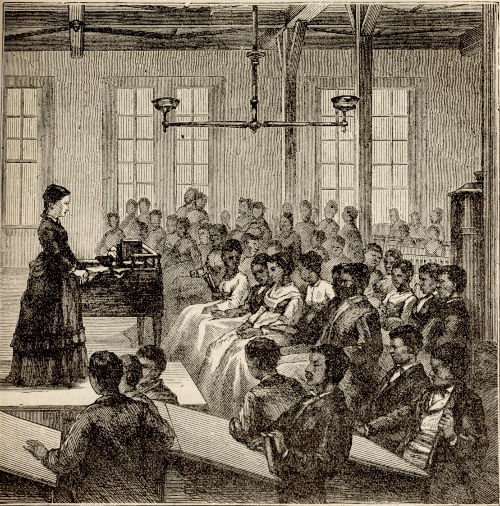
ASSEMBLY-ROOM AT HAMPTON.
The improvements about Fortress Monroe and Hampton during the past twenty years have been considerable. New buildings have been constructed inside of the fort, and Mr. Harrison Phoebus has built near the government wharf a mammoth, hotel, the Hygeia, capable of accommodating a thousand visitors. The Soldier’s Home at Hampton has extensive grounds, and accommodations for over 600 people. A large and tasteful building has just been completed, with an audience room seating from six to eight hundred. The grounds and buildings connected with the Soldier’s Home are kept up with much care and expense.
The Hampton Institute, which has done much to work all the changes mentioned, is a village by itself, and Gen. Armstrong, its principal, has 704 students under his supervision. The village of Hampton, which was burned early in the war, has been rebuilt, and recently Newport News has come to the front in consequence of the extension of the Chesapeake & Ohio Railroad to that point. Already the company has constructed a pier said to be the largest in the United States, and land is held at $16,000 an acre at a point where scarcely a dozen houses can be seen. The harbor facilities at Newport News are unrivaled.
These varied developments have created a demand for labor and given to the negro, especially as he is the recognized laborer, a grand opportunity for securing property. A canvasser for a sewing machine company, who has spent three years in Eastern Virginia, testifies that the negroes have most of the money to be found in that country. He says they are prompt in paying their instalments, whereas when he sells to the poorer white people he fails to collect his money, for the reason that they have none.
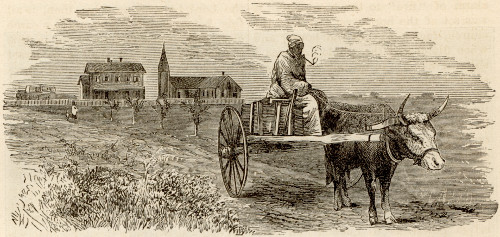
The manners and customs of the people are still unique. It is no uncommon thing to see a heifer or a steer harnessed to a cart and driven by one or two women who bring supplies to market. Possibly one-half of the conveyances seen by a visitor during a month’s stay are of this fashion; but the proprietors do not seem to be unhappy. Indeed, a Wall street broker, who had been spending a month at the Hygeia hotel, and who was fond of the recreation afforded by visiting Hampton on market days, affirmed that these negroes were the happiest people he ever saw.
If twenty years of freedom can work such changes all over the land as are manifested here, where emancipation first dawned, surely the future is full of hope.
EMERSON INSTITUTE, MOBILE, ALA., BURNED.
Emerson Institute is lying in ruins. For the second time in her history she is smoldering in ashes, and we are in mourning for the destruction of our little church, made dear by so many sacred and hallowed associations, and our beautiful school building, in which so many happy hours of toil have been spent and labors of love performed. November 21 a vain attempt was made to burn the little Congregational church at Mobile, but the fire, being set at an early hour in the evening, was discovered and soon extinguished. The insurance company repaired damages at an expense of $30. Now, when our minds were relaxing this tension, and lapse of time was giving us a degree of security against further molestation, the enemy approaches again and applies the torch—this time with marvelous success.
The fire was discovered about two o’clock on the morning of January 23 by one of the teachers, who was startled by the crackling sound of the flames. Arousing her room-mate and looking out to make sure of the evidence, they discovered the flames and gave the alarm of “fire” to the household. It was set at the northwest corner of the church, facing toward the house, and when discovered the whole end was a sheet of flame. In an incredibly short space of time Mr. Crawford was throwing an acid stream from our “Babcock Extinguisher” into the devouring flames, but they had gained so great an advantage before discovery that the “Babcock” alone could not avail. The alarm boxes being out of order the tower bell could not be struck. The Hook and Ladder Company were early on hand, but had no fire buckets. When we found ourselves powerless to quench the consuming flames on the church, we turned our attention to the school building standing near. Danger to that did not seem great as the building was of brick, the night was still and damp and the engines had arrived. But thinking it better to err on the safe side, most of the movable furniture was carried out. Before this was fully accomplished, however, the cornice had caught and the flames rapidly spread over the roof, leaping higher and higher in mock derision of the little shower bath from the hose. Not until the roof had fallen and the flames had spread to all parts and our hopes were buried in despair, did the engines succeed in getting water enough to throw a respectable stream. Help delayed was unavailing. It seems almost incredible that our school building should burn down before our very eyes, under such circumstances. Was it an enemy did this foul deed? Who can tell? God only, who reads the hearts of men, can answer. The expressed sentiments of the best people of the city are in severe condemnation of the act, and a reward of $300 has been offered for the arrest and conviction of the incendiary.
The question which presented itself to us, even before the smoke had died away, was, “What shall we do?” For a time we felt constrained to utter the language of Gideon: “O, my Lord! if the Lord be with us, why, then, is all this befallen us?” The answer came clear and unmistakable: “Go, in this thy might, and thou shalt save Israel from the hands of the Midianites; have not I sent thee?” The way was made plain to us at once, when Rev. Mr. Owen, pastor of the Third Baptist Church (colored) threw wide open its doors and said: “We gladly make room for you here.” The offer was as thankfully received as it was generously given. Scholars, patrons and friends seem as anxious that the work should be continued without delay as we ourselves. So that we re-open school again on Monday, Jan. 30, with three departments, at the Third Baptist Church, about one mile from the “Home,” and two departments in the basement of Little Zion Church, about three blocks distant from the Home. Of course, the accommodations now will be in sad contrast to those enjoyed in our well-arranged and convenient school-room, and our labors will be much more arduous and trying; but the Lord has said, “As thy days so shall thy strength be,” and we go forward relying on His strength. Our school seemed in a most prosperous condition, over two hundred pupils enrolled, and everything moving on to the satisfaction of all. The Sunday-school has not had a larger attendance for three years than now. There seemed to be a constantly growing interest manifested, and the outlook was very encouraging.
Nothing at all was saved from the church. The cabinet organ, the Sunday-school library of over two hundred volumes, a valuable chart used by the primary department of the school, together with Bibles, singing-books, etc., all perished in the flames.
In our now pressing needs we cannot close this article without an appeal to the earnest, hopeful and sympathetic friends at the North. “Come over and help us.”
Miss Emma Caughey.